Nine PBS Data Loss: What Happened to 50 TB of TV History?
Nine PBS, the St. Louis PBS station, lost access to 50+ TB of archival TV footage after its cloud vendor collapsed - not the national PBS archive.
Latest Story
A television archive can look like nothing more than a line item in a contract — until the day the company holding it stops answering the phone. That is roughly what happened to Nine PBS, the public television station serving St. Louis, Missouri, when the outside vendor storing more than 50 terabytes of its historical footage cut off access without warning in March 2026.
This is not a story about the Public Broadcasting Service losing its national archive. Nine PBS is a single local PBS member station — formally KETC, Channel 9 — and the material at risk is its own institutional collection: decades of local news, documentaries and community programming built up since the mid-1950s. National PBS programming, Sesame Street, NOVA and FRONTLINE are not part of what’s in dispute here.
What is verified: Nine PBS’s cloud-storage vendor, Open Source Storage (OSS), terminated the station’s access when their contract lapsed, and the physical servers holding the archive sat inside a Denver, Colorado, data center operated by Iron Mountain — which initially declined to release the material because its own contract was with OSS, not with Nine PBS. Courts in both Missouri and Colorado have since stepped in. As of mid-August 2026, the archive is described in reporting as inaccessible, not confirmed destroyed — a distinction this article treats as central, not incidental.
Latest Update — September 2026
Denver District Court Judge Eric Elliff’s 12 August 2026 order — which found Nine PBS owns the archived material and set a framework for retrieving it from Iron Mountain’s Denver facility — required Nine PBS and Iron Mountain to report progress to the court by 14 September 2026 on whether a qualified third party had been able to extract Nine PBS’s files from OSS’s former infrastructure without accessing other former OSS customers’ data still on the same hardware. As of 20 September 2026, no outcome of that progress report has been made public. The archive’s status is unchanged from what courts previously described: physically present at Iron Mountain’s Denver facility, still inaccessible to Nine PBS, with court-ordered recovery underway but not reported complete.
🧠 Quick Answer
Nine PBS — the local PBS station in St. Louis, Missouri, not the national PBS organization — lost access to more than 50 TB of archival footage spanning roughly 70 years after its contracted cloud-storage vendor, Open Source Storage, cut off its account in March 2026. The files physically sit in an Iron Mountain data center in Denver. Courts have since ordered preservation and cooperation; reporting describes the material as inaccessible, not confirmed deleted, as recovery efforts continue.
Nine PBS Archive: Key Questions
What Actually Happened, and What Didn’t
- This is Nine PBS, not national PBS: a single St. Louis member station’s archive, not the Public Broadcasting Service’s nationwide collection.
- The vendor cut off access on contract expiry: Open Source Storage stopped Nine PBS’s access on 6 March 2026 after the station’s renewal outreach went unanswered.
- Data appears intact, not deleted: reporting and court orders describe the archive as inaccessible, with no confirmation of destruction.
- A second vendor layer complicated recovery: OSS’s own servers sat inside Iron Mountain’s Denver facility, and Iron Mountain initially refused to deal directly with Nine PBS.
- Courts have intervened on Nine PBS’s behalf: a Missouri court reportedly confirmed Nine PBS’s ownership of the data against OSS; a Colorado court ordered Iron Mountain to preserve it and cooperate on retrieval.
- The archive spans roughly 70 years: reportedly from the mid-1950s through present-day local coverage — not just recent files.
- National PBS programs are not implicated: nothing in current reporting suggests Sesame Street, NOVA, FRONTLINE or any nationally distributed PBS content is part of the affected collection.
- Cloud storage is not automatically a backup: the incident illustrates the gap between “our files are in the cloud” and “we can independently retrieve our files.”
- The relationship predates the crisis by years: Nine PBS had worked with OSS and its predecessor since 2019, renewing annually.
- Recovery is active, not resolved: as of mid-August 2026, court-ordered cooperation is underway; a full return of the archive has not been reported as complete.
Nine PBS Is Not All of PBS
Three distinct organizations that are easy to conflate — and shouldn’t be
Nine PBS (KETC, Channel 9)
The public television station serving the greater St. Louis region. It produces and maintains its own local archive of news, documentaries and community programming — the collection actually affected by this incident.
PBS (Public Broadcasting Service)
The national nonprofit that distributes programming — Sesame Street, NOVA, FRONTLINE and similar — to member stations like Nine PBS. PBS’s own national archive is a separate collection, not part of this incident.
Corporation for Public Broadcasting (CPB)
The federally chartered entity that helps fund public broadcasting, including grants to stations like Nine PBS. CPB does not own or operate station archives and is not a party to this dispute.
Why a Local Archive Matters This Much
National television history is only part of the story here, and arguably the smaller part. A local public television archive built over 70 years contains things no national network ever recorded: neighborhood meetings, regional elections, local schools, community organizations, and the kind of on-the-ground coverage of events like the 1993 Great Flood or East St. Louis that never aired outside the region. People who never appeared on national television — local officials, teachers, activists, ordinary residents interviewed for a community-affairs program — exist on tape (and later, on file) largely because a station like Nine PBS chose to point a camera at them.
That is the real stake in this story. The strongest question isn’t “is cloud storage dangerous?” — it’s what happens when a community’s memory becomes dependent on a company that no longer controls the storage relationship. A television station entrusted decades of local history to a third-party storage arrangement, and when that vendor relationship broke down, access to a huge archive suddenly became uncertain. That’s a story about institutional memory, vendor dependency and data ownership — not a referendum on cloud computing as a technology.
The Incident Timeline
Reverse-chronological — most recent first. Dates as reported; treat single-source specifics as provisional pending official confirmation
Court-Ordered Progress Report Deadline Passes
The 14 September 2026 deadline set by Judge Eric Elliff’s order — for Nine PBS and Iron Mountain to report to the court on retrieval progress — passed. No outcome of that report has been made public as of 20 September 2026, and no further hearing date has been reported.
Colorado Court Grants Preliminary Relief
A Colorado court reportedly granted Nine PBS temporary relief, ordering Iron Mountain not to delete or overwrite the archived data and to cooperate in identifying a path to retrieve it — without compromising the data of Iron Mountain’s other OSS-linked clients on the same infrastructure.
Nine PBS Sues Iron Mountain
With Iron Mountain declining to release the archive directly to Nine PBS — citing its own contract with OSS, the now-defunct vendor, rather than with the station — Nine PBS reportedly filed a separate legal action against Iron Mountain seeking preservation and access to the data.
Nine PBS Wins Judgment Confirming Ownership
Nine PBS reportedly pursued legal action against OSS directly and obtained a judgment confirming its ownership of the archived material — a step that mattered because OSS itself had gone largely unresponsive, with its website inactive and the company listed as delinquent with the Colorado Secretary of State.
Nine PBS Contacts Iron Mountain Directly
After discovering that OSS’s infrastructure was physically hosted at an Iron Mountain data center, Nine PBS reportedly contacted Iron Mountain directly to try to retrieve its archive — only to learn Iron Mountain’s contractual relationship was with OSS, not with the station.
Access Cut Off
Nine PBS’s contract with OSS expired, and OSS cut off the station’s access to its archive without warning — reportedly without honoring a 30-day data-retrieval window the agreement was supposed to provide “upon termination of services.”
Renewal Outreach Goes Unanswered
Nine PBS attempted to schedule a routine meeting with OSS to discuss renewing the storage agreement for 2026. OSS did not respond and gave no indication it did not intend to renew — the first visible sign something was wrong.
Cloud Storage Relationship Begins
Nine PBS began working with OSS and a predecessor company to store a growing volume of digitized archival material in the cloud, renewing the arrangement annually for several years without incident.
Nine PBS’s Archive Begins
KETC/Nine PBS’s institutional archive traces back to the station’s early broadcasting years — the start of a collection that would eventually be digitized and, decades later, entrusted to third-party cloud storage.
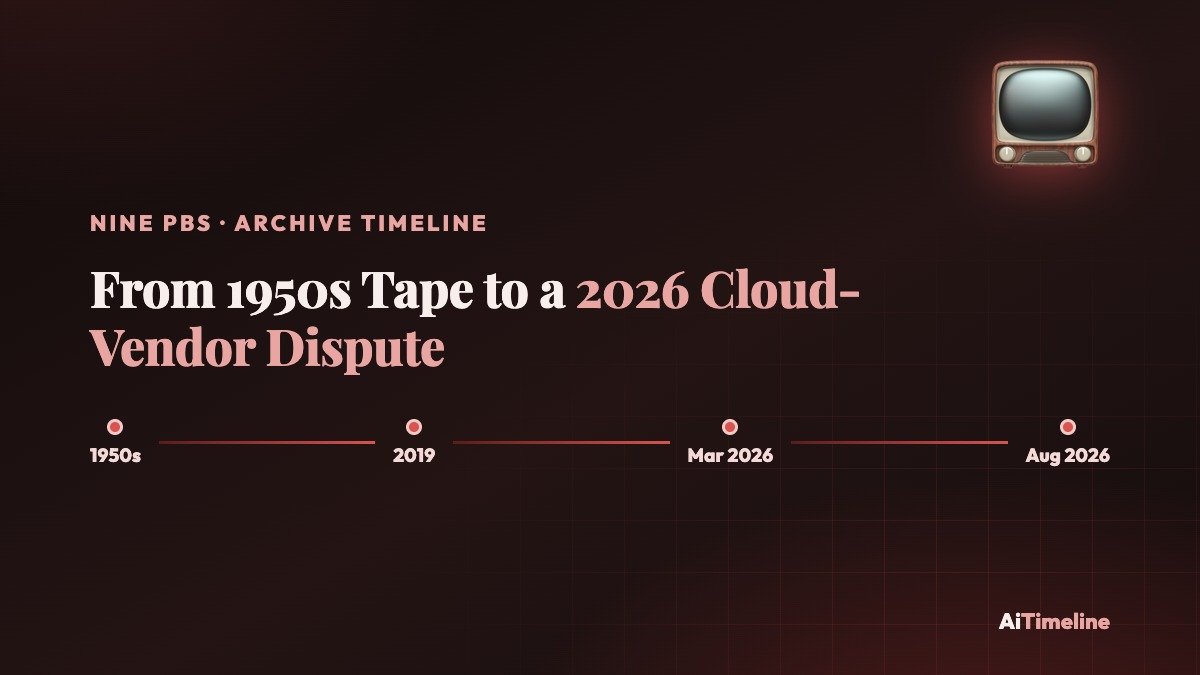
Nine PBS’s archive, from 1950s tape to a 2026 cloud-vendor access dispute — AiTimeline
The Vendor Investigation
Who actually held the data, and what happened to them
Two companies sit at the center of this story, and they are not the same thing. Open Source Storage (OSS) was Nine PBS’s contracted vendor — the company the station paid, since 2019, to store its digitized archive. Iron Mountain is a large, established data-management and storage company that, per reporting, physically hosted OSS’s own servers inside one of its Denver data centers. Nine PBS had no direct contract with Iron Mountain at all — its relationship was entirely with OSS.
The available reporting does not establish a single, confirmed reason for OSS’s collapse. What is reported: OSS stopped responding to Nine PBS in February 2026, its public website went dark, and Colorado state business records reportedly list the company as delinquent. Its president is identified in reporting as Charles Wells. Whether this reflects a bankruptcy, an orderly wind-down, an internal dispute, or something else has not been established by available reporting, and this article does not speculate beyond what has been reported.
Iron Mountain’s position, per its own public statement, is that it dealt appropriately with a difficult situation: its contract was with OSS, not Nine PBS, and OSS — not Iron Mountain — technically owned the physical servers housing the station’s data within Iron Mountain’s facility. That contractual structure is precisely why a station whose vendor goes dark can end up with no one to call: the party holding the hardware has no direct obligation to the party that actually owns the content on it.
Open Source Storage (OSS)
Colorado-based cloud storage provider Nine PBS worked with since 2019. Reportedly unresponsive since February 2026; website inactive; listed as delinquent with the Colorado Secretary of State as of reporting.
Iron Mountain
Established data-management company whose Denver facility physically housed OSS’s servers. Had no direct contract with Nine PBS; says it acted “appropriately and responsibly” to safeguard customer data throughout.
The Cloud Was Not Necessarily the Only Copy — But Access Was the Problem
“Our archive is in the cloud” is not the same statement as “we have a recoverable backup.” Primary storage is wherever the working copy of a file lives day to day. A backup is an independent copy, ideally on different infrastructure, that survives the loss of the primary copy. Replication mirrors data across locations for uptime, not necessarily for independent recovery. An archive is long-term storage of material not in active use — which is what Nine PBS’s collection was. Cold storage and offline archives add a further layer of separation, often intentionally hard to reach quickly, in exchange for durability and lower cost.
Vendor-controlled cloud storage can be any or none of these, depending entirely on the contract and the architecture behind it — and that’s the trap. When a single vendor holds the only accessible copy of an archive, that vendor relationship is the recovery plan, whether or not anyone framed it that way at signing. Nine PBS’s files were not, per current reporting, deleted or corrupted; the problem was access — the contractual and infrastructural relationship that made the files reachable stopped functioning. That is a distinct failure mode from data loss in the literal sense, and it is arguably a more common one for organizations that outsource archival storage.
What the Nine PBS Case Teaches About the 3-2-1 Backup Rule
- The 3-2-1 rule: keep 3 copies of important data, on 2 different types of storage media, with 1 copy geographically separate and, ideally, independently controlled.
- Its purpose is to ensure that no single failure — a hardware fault, a vendor collapse, a regional disaster — can take out every copy at once.
- Available reporting does not establish whether Nine PBS’s backup strategy did or didn’t follow this model — this article does not claim the station violated it.
- What the incident does illustrate: a vendor-controlled copy, however well the vendor performs day to day, is not automatically an independent recovery path if that same vendor relationship is the single point of failure.
- Organizations preserving irreplaceable archives — broadcasters, libraries, museums, public institutions — often consider independent copies and vendor-independent recovery essential precisely because of scenarios like this one.
How Can 50 TB of Data Become “Lost” Without Being Deleted?
A short technical explainer — the words matter
Data can remain fully, physically present on a disk somewhere and still be completely unreachable to the organization that owns it. That’s the situation reporting describes for Nine PBS: the archive appears to still exist inside Iron Mountain’s Denver facility, on servers that belonged to OSS. What Nine PBS lost first was not the bits — it was the login credentials, the account relationship, and the contractual path to the hardware. A vendor’s infrastructure can change, its authentication systems can be shut off, its billing and account systems can go dark, and a customer’s catalog or metadata system can become unreachable even while the underlying files sit untouched a few feet away in a rack.
| Term | What it means | Applies to Nine PBS? |
|---|---|---|
| Inaccessible | The data exists but the owner cannot currently reach or retrieve it — due to access, contractual, or infrastructural barriers. | Yes — per current reporting, this is the accurate description. |
| Lost | Colloquial term often used loosely to mean either “inaccessible” or “destroyed” — imprecise, and avoided in this article except when quoting others. | Ambiguous — avoided here in favor of “inaccessible.” |
| Corrupted | The data exists but has been damaged such that it can’t be read or used correctly. | Not reported as a factor in this case. |
| Deleted | The data has been affirmatively erased from storage media. | Not confirmed by any available reporting. |
| Unrecoverable | The data cannot be retrieved by any known means — the most severe outcome. | Not the case here; courts have ordered preservation and cooperation on retrieval. |
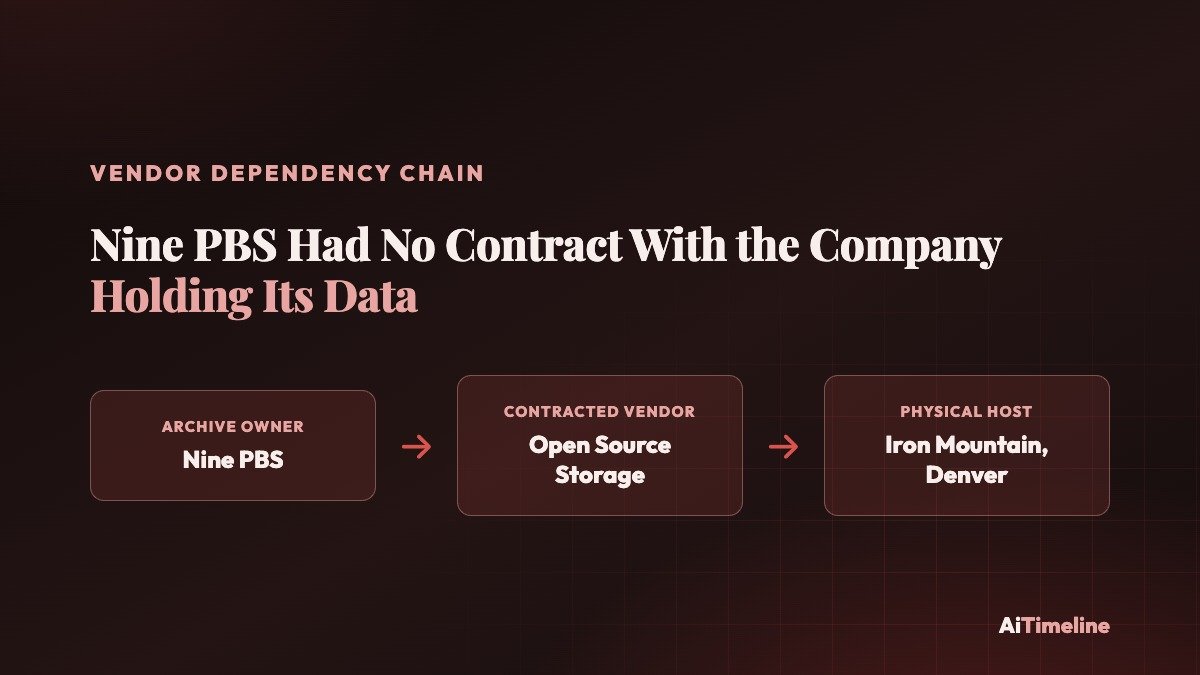
Vendor-on-vendor dependency: OSS’s infrastructure sat inside Iron Mountain’s data center — AiTimeline
From Tape to Cloud: How TV Archives Have Evolved
| Technology | Advantages | Risks | Recovery characteristics |
|---|---|---|---|
| Physical tape (U-matic, Betacam, DVCAM) | Self-contained, no vendor dependency, long shelf life if stored properly | Physical degradation, format obsolescence, playback hardware becoming rare | Recovery depends entirely on the institution’s own physical custody |
| Local server / on-premises storage | Full institutional control, fast access | Single-site disaster risk, hardware failure, limited scale | Fast if hardware survives; total loss if the site doesn’t |
| NAS (network-attached storage) | Shared access, moderate scale, still on-site | Same site-level risk as local servers | Fast, self-controlled |
| LTO tape archives | Low cost per terabyte, offline (air-gapped) durability | Slow to access, requires maintained hardware to read | Strong for disaster recovery if stored off-site |
| Cloud object storage (vendor-controlled) | Scalable, accessible from anywhere, low up-front cost | Vendor dependency, contract risk, account/credential risk | Only as good as the vendor relationship — the core lesson of this incident |
| Cloud archive / cold storage tiers | Lower cost, built for long-term retention | Slower retrieval, still vendor-dependent | Better durability guarantees, same contractual risk |
| Hybrid archive (multi-vendor, geographically separate) | No single point of failure, independent recovery paths | Higher cost and complexity to maintain | Best resilience against a single vendor’s collapse |
Why Digital Archives Are Harder to Preserve Than They Look
Digitizing an archive solves some preservation problems — tape degradation, obsolete playback hardware, physical damage — and creates new ones. File formats age; a video codec common a decade ago may need conversion to stay usable. Metadata — the catalog information that says what a file actually is, when it was recorded, and why it matters — is as important as the video itself, and is easy to lose or disconnect from the material it describes. Storage costs money indefinitely, not once; “bit rot” (silent data corruption over time) requires active checksum verification to catch; software dependencies for a rights-management or catalog system can break when that software is discontinued; and true resilience requires multiple copies in geographically separate locations, actively maintained, not just initially uploaded and forgotten.
None of this is unique to Nine PBS. It is the standard, well-documented challenge facing every institution — broadcaster, library, museum, government archive — that has moved from physical to digital preservation. What the Nine PBS case adds is a sharp, concrete illustration of one specific failure mode within that larger challenge: outsourcing the custody relationship, not just the storage medium.
The Legal Fight
Two separate actions, two different defendants
| Action | Against | Reported venue | Reported outcome so far |
|---|---|---|---|
| Suit over data ownership | Open Source Storage (OSS) | Missouri court | Judgment reportedly confirmed Nine PBS’s ownership of the archived material |
| Suit over data access | Iron Mountain | Colorado court | Preliminary relief reportedly granted mid-August 2026: preservation ordered, cooperation on retrieval required |
No court has been reported to have ruled on final resolution or set a timeline for the archive’s full return. Nine PBS Vice President and Chief Content Officer Leah Freeman has said the materials hold “significant historical importance for St. Louis” and that the station looks “forward to ensuring their preservation and protection through the Court-approved process.” Denver District Court Judge Eric Elliff’s order required a progress report from both parties by 14 September 2026; no outcome of that report has been reported publicly as of 20 September 2026.
Explore More Timelines
Original AiTimeline Analysis
Editorial observations, not reported facts
AiTimeline Analysis
- Digital does not automatically mean permanent — a file can be perfectly intact and still functionally lost to its owner.
- Cloud storage is infrastructure, not preservation by itself; preservation is a practice, not a product you buy once.
- An archive needs an exit strategy from day one — a plan for what happens if the vendor relationship ends badly, not just how the data goes in.
- Ownership of data and control of data are different things, and this case is largely a dispute about the gap between them.
- Local television archives can carry enormous historical value even when they carry little commercial value — a fact that makes them easy to under-protect.
- Vendor dependency becomes dangerous specifically when data is difficult or costly to migrate elsewhere.
- A backup controlled by the same vendor relationship you’re depending on may not function as an independent recovery path when that relationship itself fails.
- Metadata is as important as the video files themselves — a recovered archive without its catalog is far less useful.
- Public institutions preserving irreplaceable material need plans that survive a vendor going dark, not just plans for hardware failure.
- The real diagnostic question is not “was the data in the cloud?” — it’s “could the organization independently recover it without that one vendor’s cooperation?”
Frequently Asked Questions
30 questions people are asking about the Nine PBS archive incident
Sources & Further Reading
This article is based on independent reporting from technology and public-broadcasting trade press, cross-checked across multiple outlets. It does not rely on Reddit or other unverified discussion forums for factual claims — those are used, if at all, only to characterize public reaction, never as a source of fact.
Sources & further reading
Every dated entry above was checked against these references. Last reviewed 20 September 2026.
- Current: Nine PBS sues Iron Mountain over blocked access to archival data
- Tom's Hardware: Nine PBS loses access to 70 years of data after contracted cloud storage vendor goes defunct
- Engadget: Cloud storage is great until your vendor goes out of business
- Gizmodo: PBS station sues to regain access to 70 years of archival TV history
- The Desk: Missouri PBS station sues vendor after video archive becomes lost
- Nine PBS: Official Site