The Inquiry That Brought Down Punjab CM Partap Singh Kairon
Explore the Kairon Inquiry timeline, from the 1963 memorandum and Das Commission findings to Partap Singh Kairon's 1964 resignation and Punjab's fallout.
Latest Story
The Kairon Inquiry was the investigation that ended the eight-year rule of Partap Singh Kairon, the most powerful Chief Minister undivided Punjab had. In July 1963 opposition leaders gave the President a memorandum accusing him of using his office to benefit his family and associates. The Union government appointed a one-man commission under former Chief Justice of India S.R. Das. Its June 1964 report upheld some charges, rejected many others, and found that Kairon had connived at relatives and officials exploiting his position. Within days he resigned. This is what happened, in order, what the Das Commission report actually found, and what it did not.
💡 Short Answer
The Kairon Inquiry was the Das Commission, appointed on 1 November 1963 to examine charges against Punjab Chief Minister Partap Singh Kairon. Headed by former Chief Justice S.R. Das, it reported in June 1964. It found misuse of influence for his own benefit and to help relatives, and connivance at their conduct, while rejecting many other charges. Kairon resigned in mid-June 1964, usually dated 14 June. It was an inquiry, not a trial: he was never convicted.
Kairon Inquiry: Key Questions
The Kairon Inquiry in Nine Points
- Old charges: a Congress committee had already found “improprieties” but no corruption in 1958.
- The trigger: a memorandum to the President in July 1963, signed by Devi Lal and 26 others.
- Nehru’s choice: an independent inquiry, with Kairon left in office while it ran.
- The commission: former Chief Justice S.R. Das, appointed 1 November 1963.
- Mixed verdict: abuse of influence in specific cases; many charges rejected.
- Connivance: Kairon had reason to know of his family’s conduct and did not act.
- Timing: Nehru died on 27 May 1964; the report arrived in June; Kairon resigned.
- No trial: the findings led to chargesheets for officers, not a case against Kairon.
- Not the cause of reorganisation: Punjab’s 1966 split came from the Punjabi Suba movement.
What the Das Commission Actually Found
The report sorted the allegations into four groups.
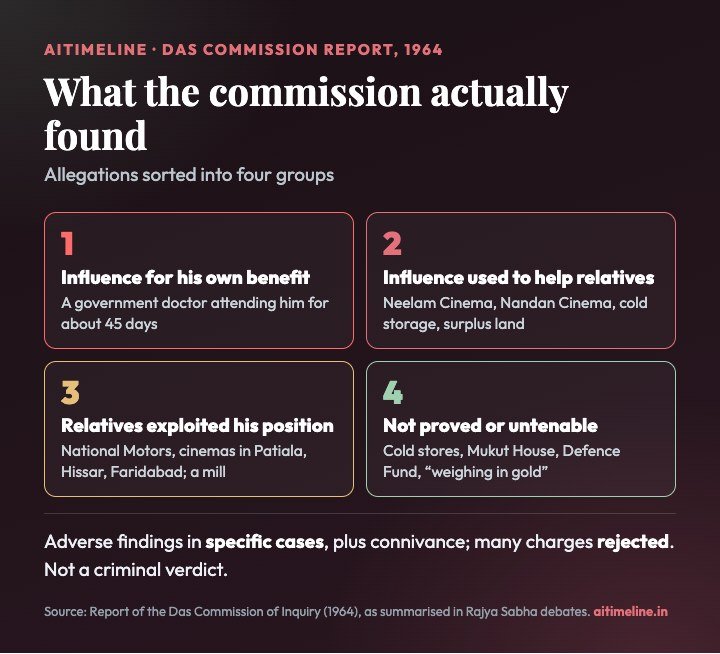
| Category | Commission’s finding | Cases highlighted |
|---|---|---|
| Influence for his own benefit | Abuse of influence by Kairon for himself | Government doctor Dr H.S. Dhillon’s services for about 45 days |
| Influence used to help relatives | Kairon used influence, personally or through colleagues and subordinates, to benefit family | Neelam Cinema (Chandigarh), Nandan Cinema, Punjab Cold Storage, surplus-land purchases |
| Relatives exploited his position | Relatives used his influence, or officials gave them undue advantages | National Motors, Capital Cinema, Elite Cinema, Neelam Cinema (Faridabad), New India Spinning and Weaving Mills |
| Not proved or untenable | Allegations rejected | Amritsar Cooperative Cold Store, Mukut House, Teg Cold Storage, National Defence Fund, others |
The doctor case was the only one in the first group. A government medical officer, Dr Harcharan Singh Dhillon, had attended Kairon during travel in 1956–57, and the commission looked at how his leave and service records were handled afterwards. It treated the arrangement as using official influence for personal benefit. By today’s standards it looks small, which is partly why the Hindustan Times later used it as a measure of how high the bar for public life once was.
The land deals were the most serious. The commission found that purchases at Ramgarh Dhani and Madhar Kalan went against the spirit and purpose of the land-tenure laws, and were made with Kairon’s full knowledge and consent, if not at his direction. The involvement of close relatives, and the benefit to his son Surinder Singh Kairon, weighed heavily.
Above the individual cases sat the finding that mattered politically: that Kairon had connived at what his family and officials were doing. He knew, or had ample reason to suspect, and did not stop it. The commission called this conduct unbecoming of a Chief Minister, then left the consequences to the government.
✔️ Charges upheld (in part)
- A government doctor used as a personal physician.
- Influence used to help relatives in cinema, cold-storage and land deals.
- Relatives and officials exploiting his position, with his connivance.
✖️ Charges rejected
- Several cold-storage and property allegations.
- The National Defence Fund allegations.
- The claim that Nehru was weighed in gold.
- A number of administrative complaints.
From Memorandum to Resignation
Eleven months, and one death that changed everything.
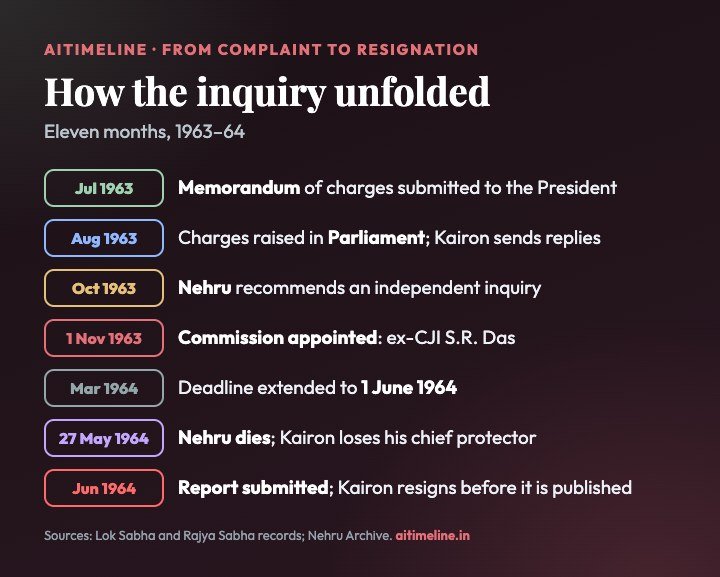
Kairon had survived complaints before. The Hindustan Times counts three earlier probes under Nehru, all of which cleared him. The difference in 1963 was the form of the complaint and the response to it. Nehru did not ask Kairon to step aside; in his note of 25 October 1963 he argued that would destabilise Punjab. But he did recommend a statutory inquiry, and on 1 November the Centre appointed one.
The timing then turned against Kairon. The commission’s deadline was pushed from 1 February to 1 June 1964. Nehru died on 27 May. Lal Bahadur Shastri was sworn in as Prime Minister on 9 June, and the report arrived days later. Kairon resigned before the government had even released it.
Timeline: The Kairon Inquiry, 1956–1966
Newest first. Colour shows the type of event.
Punjab is reorganised into Punjab and Haryana Aftermath
What happened: The Punjab Reorganisation Act took effect, creating the present state of Punjab and the new state of Haryana. Some hill areas went to Himachal Pradesh, and Chandigarh became a Union Territory serving as the capital of both states.
The cause: Reorganisation came out of the long-running Punjabi Suba movement, linguistic demands and decisions taken in New Delhi. It was not a result of the Kairon inquiry.
The link: The leadership crisis and factional fighting that followed Kairon’s fall were part of the political setting in which reorganisation was decided, but nothing more than that.
Kairon’s network outlives him Aftermath
What happened: Kairon’s resignation did not end the influence of the group he had built in the Congress legislature party and organisation. Ram Kishan had to balance Kairon loyalists against the leaders who had pushed for his removal.
How it ended: Ram Kishan’s government lasted until 5 July 1966, when President’s rule was imposed for 119 days in the run-up to reorganisation.
The research: A 1973 McGill University study of party factionalism in Haryana by Robert George Schwab traced how the Kairon group kept shaping Congress politics after his exit.
Kairon is shot dead near Rasoi Aftermath
What happened: Travelling by car from Delhi, Kairon was stopped and shot dead on the Grand Trunk Road near Rasoi. A Lok Sabha statement in March 1965 recorded that three other people were killed with him, including former Joint Director of Intelligence Baldev Kapur and his personal assistant Ajit Singh.
The killers: Sucha Singh, Baldev Singh and Nahar Singh were convicted and hanged; a fourth accused, Daya Singh, was sentenced to life imprisonment. Sucha Singh was traced to Nepal after the killing.
No proven link: The murder was a separate crime. The motive usually given is revenge over an earlier murder case. Kairon’s family has long alleged a wider political conspiracy; no court has found one, and nothing connects the killing to the Das Commission.
The Rajya Sabha debates the Das report Parliament & follow-up
What happened: Members held a long debate on the report. Supporters of Kairon pointed to the many charges the commission had rejected and to his record on Punjab’s development. Critics said the adverse findings called for firmer action.
The procedure question: Several speakers questioned the commission’s choice to rely on affidavits and documents rather than oral evidence and cross-examination.
Why it matters: The debate made the Kairon affair a national test of how far an elected state government could be held to account from the Centre.
Officers face chargesheets Parliament & follow-up
What happened: Answering in the Rajya Sabha, the Home Ministry said Punjab had appointed a special officer to examine the records and decide whether disciplinary or criminal proceedings were justified.
Progress: Several government officers were being served with chargesheets over transactions discussed in the report.
Why it matters: Accountability had moved beyond the Chief Minister to the officials who had made the decisions.
Punjab sets up a follow-up review Parliament & follow-up
What happened: Ram Kishan told the Assembly that former ICS officer R.S. Krishnaswamy had been appointed Officer on Special Duty to examine the records and recommend action.
Scope: Possible departmental proceedings against officials, criminal prosecution where evidence justified it, the role of non-officials and former ministers, and the disputed transactions themselves.
Why it matters: It was the state’s formal answer to a report that had left action entirely to the government.
Report laid before the Lok Sabha Parliament & follow-up
What happened: The Report of the Das Commission of Inquiry into allegations against Partap Singh Kairon was laid on the table of the Lok Sabha.
What followed: It became the subject of questions in both Houses about the findings and the government’s response.
The distinction: Ministers drew a line between the commission’s findings and the government’s own responsibility to decide what to do about them.
Ram Kishan becomes Chief Minister Power & succession
What happened: After a 15-day interim, Congress leader Ram Kishan took office as Chief Minister of Punjab. Some accounts give the swearing-in as 6 July.
The challenge: He had to manage both the leaders who had campaigned against Kairon and the Kairon network that still held power in the legislature and party.
Why it matters: His two years in office were dominated by factional disputes the inquiry had sharpened.
Kairon’s tenure ends; Bhargava steps in Power & succession
What happened: Kairon’s term formally ended on 21 June 1964. Gopi Chand Bhargava, Punjab’s first Chief Minister after Independence, returned as acting Chief Minister.
How long: Bhargava held office for 15 days while the Congress chose a successor.
Why it matters: Kairon had led Punjab for more than eight years, the longest uninterrupted tenure of the state’s first two decades.
Kairon resigns Power & succession
What happened: Kairon submitted his resignation, along with that of his Council of Ministers. It is usually dated 14 June 1964; foreign wire reports carried it a few days later and said the report had not yet been published.
Before publication: He resigned once the report’s adverse findings were known but before the government released it. He said he accepted the commission’s verdict.
Why it matters: A long political controversy had become findings by a statutory commission headed by a former Chief Justice. With Nehru gone, that was enough.
Justice Das submits his report Commission
What happened: Justice S.R. Das submitted his report to the Union government. The copy cited by researchers is dated 11 June 1964; we could not open it to confirm that date.
The core finding: It found cases in which official influence was misused for Kairon’s own benefit and to help relatives, and concluded that he had connived at the conduct of family members and officials by failing to act when he had reason to know.
What it did not do: It rejected many charges and left consequences and further action to the government.
Nehru dies Power & succession
What happened: Jawaharlal Nehru died in New Delhi. He had backed Kairon through earlier complaints and had argued against making him step down merely because an inquiry was under way.
The effect: When the report arrived two weeks later, Kairon no longer had his most powerful defender. Lal Bahadur Shastri had been Prime Minister for days.
Why it matters: Many accounts treat Nehru’s death as decisive: the findings were damaging, but the political cover had gone.
Deadline extended to 1 June 1964 Commission
What happened: The original deadline of 1 February 1964 had passed. The government told the Lok Sabha that “the time for making the report has been extended, in consultation with the Commission, till 1st June, 1964.”
Why: The volume of affidavits, files and legal argument made the original three months unrealistic.
Why it matters: The new deadline put the report’s arrival just after Nehru’s death.
Charge by charge: the commission works Commission
How it worked: The commission took evidence through affidavits and documents. After hearing lawyers for both sides, it decided oral evidence and cross-examination were not needed.
What it examined: Cinemas in Chandigarh, Amritsar, Patiala, Hissar and Faridabad; a cold-storage business; National Motors; New India Spinning and Weaving Mills; land at Ramgarh Dhani and Madhar Kalan; and the use of a government doctor.
Not everything stuck: Each allegation got its own finding, and a number were rejected as unproved or untenable.
First sitting in New Delhi Commission
What happened: The commission held its first sitting and invited statements and affidavits from the complainants, Kairon and anyone else with relevant information.
The scope: Government files, property deals, business interests and the conduct of officials.
Why it matters: For the first time the charges were tested by a statutory body, not a party committee.
Das Commission appointed Commission
What happened: On the Prime Minister’s recommendation, accepted by the President, the Union government notified a Commission of Inquiry consisting of S.R. Das, formerly Chief Justice of India.
Mandate: To inquire into the allegations against Kairon in the memorandum submitted to the President, and report before 1 February 1964.
Why it matters: It was an unusual use of the Centre’s power against a sitting Chief Minister who still had a majority in his legislature.
Nehru recommends an inquiry, not a resignation Allegations
What happened: Nehru examined the memorandum and Kairon’s replies. His final note recalled the 1958 Congress finding of no corruption but some improprieties.
His position: Removing Kairon during an inquiry could destabilise Punjab, so he thought it undesirable to ask him to resign merely because an inquiry was being set up. He recommended an independent examination.
Why it matters: Kairon stayed in office throughout the inquiry.
The charges reach the Rajya Sabha Parliament & follow-up
What happened: The government confirmed that a memorandum of charges had been given to the President in July 1963.
The route: The President forwarded it to Nehru, who sent it to the Punjab government for comments. Kairon sent detailed replies, which were being examined.
Why it matters: The complaint was now on the national record.
Opposition memorandum to the President Allegations
What happened: A deputation of opposition leaders, with Master Tara Singh among them, met President Sarvepalli Radhakrishnan. The memorandum was signed by Devi Lal and 26 others, according to the commission’s record.
The charges: Property and businesses acquired by family members, favours to cinema and industrial ventures, manipulated permissions, land deals by relatives and misuse of officials.
A caution: The memorandum was a political complaint. It proved nothing by itself.
Kairon begins a second full term Power & succession
What happened: After Congress won the 1962 election, Kairon was again sworn in as Chief Minister.
The backdrop: He was at the height of his power but faced growing opposition from Congress dissidents, the Akali Dal and leaders in the Haryana region.
Why it matters: The charges that led to the Das Commission focused heavily on this period.
Dissidents keep up the pressure Allegations
What happened: Despite the 1958 review, allegations about Kairon’s family and influence stayed in Punjab’s politics.
Who: Congress dissidents and opposition groups questioned administrative decisions and favours to people around the Chief Minister.
Why it matters: The charges became part of a wider struggle between Kairon’s supporters and rival factions.
A Congress committee looks at the charges Allegations
What happened: A committee of senior Congress leaders examined allegations against Kairon and his explanations.
Finding: No basis for the corruption charges, but certain improprieties involving family members or associates, and procedural irregularities in administration.
Constructive responsibility: Kairon could be held “constructively responsible” for some of these because of his position, even where personal knowledge was not shown.
Kairon becomes Chief Minister Power & succession
What happened: Partap Singh Kairon took over as Chief Minister of Punjab from Bhim Sen Sachar.
His record: He is credited with resettling refugees after Partition, preparing the ground for the Green Revolution and bringing industry to Punjab.
The other side: Critics accused him of concentrating power and favouring relatives and associates.
The Businesses and the Land
Main matters named in the report, by the report’s own grouping.
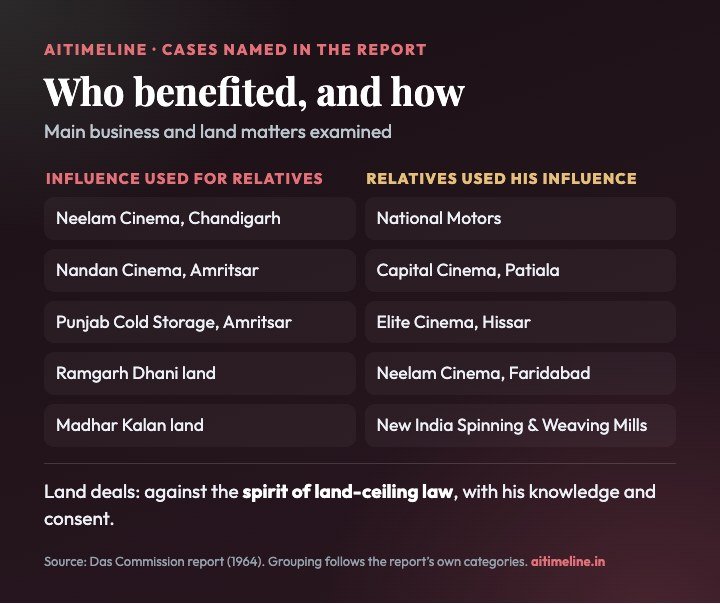
Most of the cases involved the ordinary machinery of a state government in the 1950s: licences for cinemas, permits and supplies for cold stores and a mill, decisions on transport businesses, and the application of land-ceiling rules. The commission’s question in each was the same: did Kairon’s position bend those decisions in favour of his sons or relatives, and did he know?
An Inquiry, Not a Trial
Why “guilty” is the wrong word.
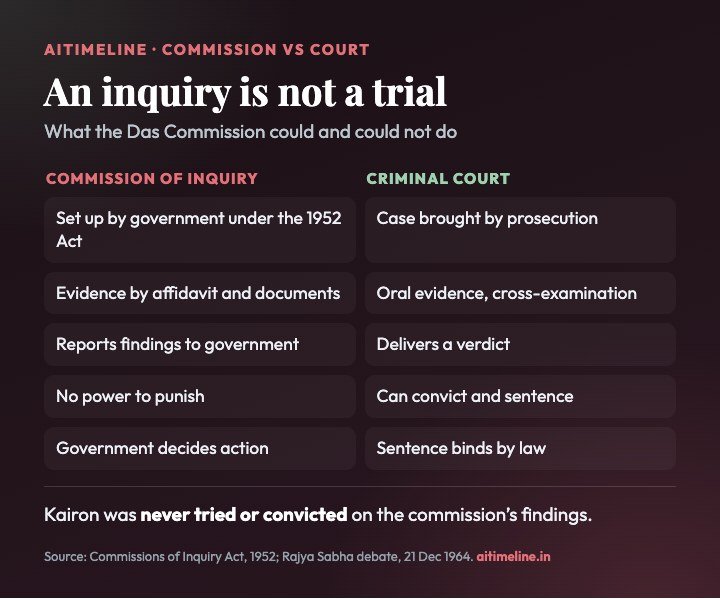
The Das Commission was created to find facts and report them. It could not convict, fine or disqualify anyone. Its conclusions about abuse of influence and connivance were grave findings of public accountability, made by a former Chief Justice, but they were not a criminal verdict reached after a prosecution.
Its procedure drew criticism. It decided the case on affidavits and documents, and after hearing both sides’ lawyers ruled that oral evidence and cross-examination were unnecessary. In the Rajya Sabha debate of 21 December 1964, Kairon’s defenders argued that this left the evidence untested. The commission acknowledged that political rivalry formed the background to the complaint, but it did not dismiss the memorandum as motivated; it ruled on each charge separately.
What Happened to the Findings
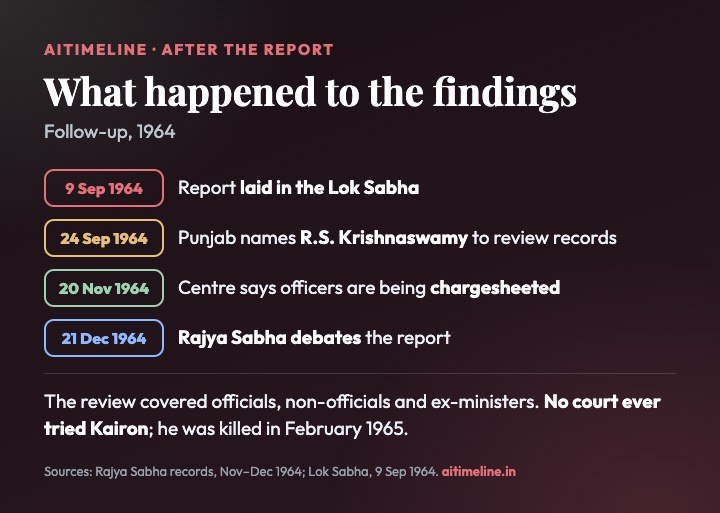
The state’s response came through a review rather than a prosecution. R.S. Krishnaswamy, a former ICS officer, was asked to recommend departmental or criminal action against officials, and to look at non-officials, former ministers and the disputed transactions. By November 1964 officers were being chargesheeted. Kairon himself was never charged; he was killed in February 1965.
How the Inquiry Reshaped Punjab Politics
Who ran Punjab after Kairon.
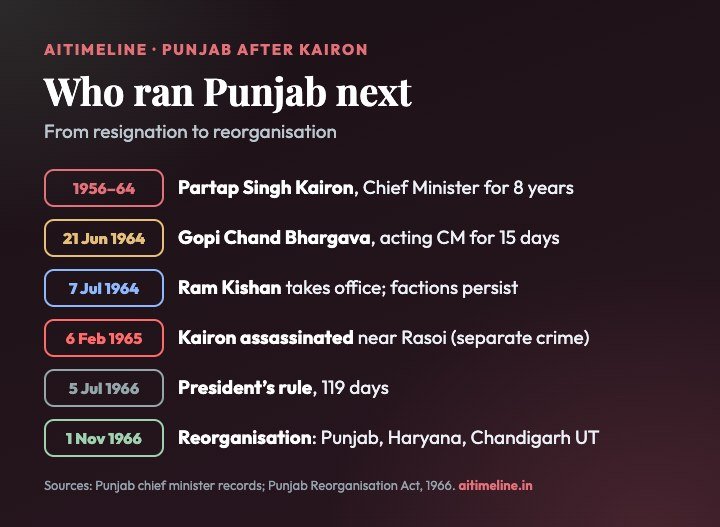
- It ended a long reign. Kairon had dominated Punjab for more than eight years. His exit opened a leadership vacuum in the Congress.
- It exposed the factions. The inquiry was fought between Kairon’s supporters and his opponents, and his resignation did not settle that fight.
- It showed a powerful CM could be investigated. A commission headed by a former Chief Justice, appointed by the Centre, examined a sitting Chief Minister with a majority.
- It complicated the High Command’s job. Ram Kishan had to balance the Kairon network, still strong in the legislature, against those who had pushed him out.
- It became a reference point. The report’s findings on family interests and responsibility for relatives’ conduct are still cited in debates on nepotism.
The inquiry did not single-handedly transform Punjab. The 1966 reorganisation came from the Punjabi Suba movement and decisions in New Delhi, and Kairon’s murder was a separate crime. Its significance is narrower and clearer: it removed the state’s strongest leader and left a divided party behind.
Key People and Institutions
| Person / institution | Role |
|---|---|
| Partap Singh Kairon | Chief Minister of Punjab, 1956–1964, facing the allegations |
| Justice Sudhi Ranjan Das | Former Chief Justice of India (1956–59) who conducted the inquiry |
| Jawaharlal Nehru | Prime Minister who referred the charges and recommended a formal inquiry |
| Devi Lal | Signatory of the July 1963 memorandum; later Haryana CM and Deputy PM |
| Master Tara Singh | Sikh leader in the deputation to the President |
| Surinder Singh Kairon | Kairon’s son, named in the land-deal findings |
| Gopi Chand Bhargava | Acting Chief Minister, 21 June – 6 July 1964 |
| Ram Kishan | Chief Minister from 7 July 1964 to 5 July 1966 |
| R.S. Krishnaswamy | Former ICS officer who reviewed follow-up action |
| Government of India | Appointed the commission under the Commissions of Inquiry Act, 1952 |
Terms Explained
- Commission of Inquiry: a fact-finding body appointed by government under the 1952 Act; it reports, it does not judge.
- Memorandum: the written charge-sheet of allegations submitted to the President in July 1963.
- Connivance: knowing, or having reason to know, of wrongdoing and choosing not to stop it.
- Constructive responsibility: responsibility that follows from a person’s position, even without proof of personal knowledge.
- Officer on Special Duty: an official appointed for a specific task, here to review the report’s follow-up.
- Surplus land: land above the ceiling a holder may keep under land-reform law.
Explore More Timelines
People Also Ask
Frequently Asked Questions
Based on Lok Sabha and Rajya Sabha records, the Das Commission report and contemporary accounts.
⚠️ Editorial Note
We checked dates against Lok Sabha and Rajya Sabha records and standard references. Several primary documents (the Das report itself, the Nehru Archive notes and some parliamentary PDFs) were not reachable when we prepared this page; facts drawn only from them are attributed in the text. Sources differ on the exact resignation date (14 June is the usual date; Kairon left office on 21 June) and on Ram Kishan’s swearing-in (7 July in the state list, 6 July in some accounts). The commission’s findings are findings of an inquiry, not a criminal conviction.
Related Reading on AiTimeline
Sources & further reading
Every dated entry above was checked against these references. Last reviewed 11 November 2026.
- Report of the Das Commission of Inquiry into allegations against Sardar Partap Singh Kairon (1964), digitised copy
- Lok Sabha: appointment of the Commission of Inquiry, Gazette notification of 1 November 1963 (26 February 1964)
- Lok Sabha: deadline extended to 1 June 1964 (25 March 1964)
- Lok Sabha: Das Commission report laid on the table (9 September 1964)
- Lok Sabha: murder of Sardar Partap Singh Kairon (8 March 1965)
- Rajya Sabha: Kairon inquiry, question (19 November 1963)
- Rajya Sabha: follow-up action on the Das Commission report (20 November 1964)
- Rajya Sabha: motion on the Commission of Inquiry report (21 December 1964)
- Charges against Partap Singh Kairon, 18 May 1958
- Kairon Affair: draft and final notes, October 1963
- Builder of Punjab: the lost legacy of Sardar Partap Singh Kairon
- Why Partap Singh Kairon, man behind Punjab's industrial and agricultural growth, was killed
- Book to chronicle rise and rise of father of modern Punjabi politics (19 February 2012)
- Partap Singh Kairon
- List of chief ministers of Punjab (India)