The WestJet Flight Attendants Strike: A Complete Timeline
At 5:40 AM at Calgary International Airport, the departure board is still mostly amber — “On Time” beside flight after flight. A man in a rumpled blazer stands underneath it, phone in one hand, boarding pass in the other, refreshing an app that hasn’t changed in the last ninety seconds. He is flying to Toronto for a meeting he cannot reschedule. Around him, families with young children, a hockey team in matching jackets, and a woman meeting her mother’s ashes at the other end are all doing the same small, anxious ritual: looking up, looking down, looking up again. None of them chose to think about crew scheduling, collective bargaining, or the Canada Labour Code this morning. All of them are about to learn how directly those things determine whether a plane leaves the ground.
A modern flight is not simply an aircraft and a runway. It depends on a precisely sequenced handoff between pilots, dispatchers, ground crews, air traffic control — and cabin crew, whose presence is not a service add-on but a regulatory requirement without which the aircraft cannot legally push back from the gate. When the people who fill that role are in an active, unresolved labour dispute with their employer, the effects are not abstract. They show up on a departure board, in a rebooking queue, and in the quiet calculus every traveller now has to do before a trip they already paid for. This guide explains, as neutrally and completely as the public record allows, what the WestJet flight attendants’ dispute actually is, how it reached this point, what Canadian labour law says happens next, and what it means, concretely, for anyone holding a ticket.
CUPE 8125 and WestJet: the full strike timeline, ground-pay dispute, Canadian labour law, passenger rights and all official updates as of 3 August 2026.
Latest Story
WestJet is Canada’s second-largest airline, headquartered in Calgary and owned by Onex Corporation since 2019. Its cabin crew — roughly 4,400 flight attendants on WestJet’s Mainline operation — are represented by CUPE 8125, a local of the Canadian Union of Public Employees. After nearly a year of negotiations that began with a formal Notice to Bargain in September 2025, talks over a new collective agreement broke down, and on 2 August 2026, WestJet flight attendants began a legal strike after a 99.4% strike-authorization vote and a 72-hour notice period. WestJet responded with a matching lockout notice. Hundreds of flights have been cancelled and federal mediators are engaged in Calgary. This guide explains the dispute’s full history, the Canadian labour law that governs it, and — separately and clearly — exactly what travellers’ rights are under federal passenger-protection rules while it continues.
🧠 AI Overview Summary
WestJet flight attendants, represented by CUPE 8125, began a legal strike on 2 August 2026 after collective bargaining over a new contract, centred on pay for ground duties, failed to produce an agreement. WestJet issued a matching lockout notice. Hundreds of flights have been cancelled and federal mediators are involved. Passengers affected by the disruption are entitled to rebooking or a refund under Canadian passenger-protection rules, though standard delay compensation does not apply to labour disruptions. The dispute’s resolution and current operational status should be confirmed through official WestJet, CUPE 8125 and government channels.
Who, What, Why, When, Where and How
What to Understand Before Reading Further
- This is a labour dispute between WestJet and CUPE 8125, not a safety issue or an operational failure — flights are cancelled because of a work stoppage, not a mechanical or weather problem.
- The core issue is ground-pay compensation: whether flight attendants are paid for time spent on duty before an aircraft’s doors close and after they reopen, not only for time in the air.
- The strike followed a legally required process under the Canada Labour Code — notice to bargain, negotiation, conciliation, a strike vote, and a 72-hour notice period — not a sudden or unilateral walkout.
- This dispute closely echoes the 2025 Air Canada flight attendants’ strike, which was also led by CUPE and centred on unpaid ground work, and which ended in a settlement after significant federal government involvement.
- Under the Air Passenger Protection Regulations, a labour disruption is classified as outside the airline’s control, which changes — but does not eliminate — passengers’ rights to rebooking, refunds and care.
- Since June 2025, federal law has banned the use of replacement workers in most federally regulated strikes and lockouts, meaning WestJet cannot simply staff flights with non-union replacement cabin crew.
- The federal government holds tools, including Section 107 of the Canada Labour Code, that could affect how the dispute unfolds; whether and how these are used is something to follow through official government sources, not speculation.
- This guide takes no position on whether either side’s proposals are reasonable. It explains the process and the facts as officially reported.
- Passenger guidance in this guide reflects general federal rules; always confirm your specific situation through WestJet’s official channels or the Canadian Transportation Agency.
- Because this is a live, developing situation, treat any specific operational detail in this guide as time-stamped to its “Last Updated” date, and check official sources for anything more recent.
Executive Summary
The whole situation in about 150 words
WestJet’s approximately 4,400 Mainline flight attendants, represented by CUPE 8125, began a legal strike at 12:01 AM Mountain Time on 2 August 2026, after nearly a year of collective bargaining failed to resolve a dispute centred on pay for ground duties — time spent boarding, managing delays and deplaning that the union says is largely unpaid under WestJet’s current compensation structure. A strike-authorization vote passed with 99.4% support on 97.3% turnout in July 2026, and both sides issued legally required 72-hour notices on 30 July before the strike and a matching WestJet lockout took effect. Hundreds of flights have been cancelled, affecting an estimated 250,000 passengers over the August long weekend, and federal mediators are engaged in Calgary. The dispute closely parallels the 2025 Air Canada flight attendants’ strike over the same ground-pay issue. This guide tracks developments through official sources and explains the labour process, airline operations and passenger rights involved.
⏱️ One-Minute Summary
- CUPE 8125 served formal Notice to Bargain with WestJet in September 2025.
- After conciliation, members voted 99.4% in favour of strike action on 16 July 2026.
- Both sides issued 72-hour notices on 30 July 2026.
- The strike began 12:01 AM MT on 2 August 2026; WestJet issued a matching lockout.
- Hundreds of flights cancelled; federal mediators engaged in Calgary.
- The core dispute is pay for ground duties, echoing the 2025 Air Canada strike.
Who WestJet Is, and Why This Dispute Matters
The airline, the crew, and the mechanics of a labour dispute
WestJet was founded in Calgary in 1996 as a low-cost carrier and grew into Canada’s second-largest airline, operating a large domestic, transborder and international network from its main hub at Calgary International Airport. In May 2019, WestJet agreed to be acquired by Onex Corporation, a Toronto-based private equity firm, in a deal valued at roughly C$5 billion; the acquisition closed that December, making WestJet a privately held subsidiary rather than a publicly traded company. Unlike some global carriers, WestJet is not a member of one of the three major airline alliances (Star Alliance, Oneworld or SkyTeam), instead relying on a network of codeshare and interline agreements with partner airlines.
What Flight Attendants Actually Do
Flight attendants are not, first and foremost, a hospitality function. Their presence on every commercial flight is a regulatory requirement, set by aviation safety authorities, tied directly to aircraft capacity and emergency evacuation procedures. Their responsibilities include pre-flight safety checks, verifying emergency equipment, managing boarding, briefing passengers on safety procedures, monitoring the cabin throughout the flight, responding to medical or security incidents, and leading evacuations if required. Because an aircraft cannot legally operate without its required minimum cabin crew complement, a work stoppage among flight attendants has an immediate, direct effect on whether a flight can depart at all — not a secondary or cosmetic one.
What a Strike Actually Is
A strike is a temporary, organised work stoppage by unionised employees, undertaken to pressure an employer during a collective bargaining dispute. It is not spontaneous: in Canada’s federally regulated sector, which includes airlines, a strike only becomes legal after a defined sequence of steps under the Canada Labour Code — formal notice to bargain, negotiation, often conciliation, a secret-ballot strike vote, and a minimum notice period before any job action begins. A lockout is the employer’s equivalent tool: temporarily barring employees from work to apply the same kind of pressure. Both are legal, regulated actions within Canada’s collective bargaining framework, not equivalent to each other in initiation but similar in their operational effect on a workplace.
Why Airline Negotiations Happen at All
Collective bargaining is the process by which a union and an employer negotiate the terms of employment — wages, hours, benefits, scheduling rules and working conditions — for everyone the union represents, replacing individual negotiation with a single collectively negotiated contract. Airline labour agreements are renegotiated periodically, typically every three to five years, and disputes are a normal, recurring feature of that cycle industry-wide, not unique to WestJet or to Canada. What determines whether a renegotiation concludes quietly or becomes a public strike is usually the size of the gap between what employees are asking for and what an employer is offering, and how each side reads its leverage at the bargaining table.
✈️ Aviation Insight
Modern airlines rely on highly coordinated crews, making labour agreements an important part of operational stability. A single flight involves scheduled handoffs between pilots, cabin crew, ground handling staff, air traffic control and maintenance teams, often across multiple time zones in a single day. Collective agreements are, in effect, the operating manual for how that coordination is staffed and paid — which is why a dispute over one contract can visibly disrupt a schedule built for an entire network.
The Complete Timeline: From Notice to Bargain to the Current Strike
Each entry is grouped by record type — official announcement, union statement, government action, or independent reporting
WestJet Is Founded in Calgary
Background. WestJet launched in 1996 as a low-cost carrier, built on a model of point-to-point domestic routes and a famously informal corporate culture, and grew over the following decades into Canada’s second-largest airline by traffic.
Current relevance. WestJet’s home base, Calgary International Airport, remains the operational centre of both the airline’s network and the current labour dispute.
WestJet Is Acquired by Onex Corporation
Background. In May 2019, WestJet agreed to be acquired by Onex Corporation, a Toronto-based private equity firm, in a deal valued at approximately C$5 billion; the transaction closed in December 2019.
Current relevance. The acquisition took WestJet private, meaning its owner today is a private equity firm rather than public shareholders — a structural detail sometimes raised in public commentary on the current dispute, though this guide does not take a position on its relevance to the negotiations.
Canada Bans Replacement Workers in Federal Strikes and Lockouts
Official development. Bill C-58, amending the Canada Labour Code to prohibit the use of replacement workers during a strike or lockout in federally regulated workplaces, received Royal Assent on 20 June 2024 and came into force a year later, on 20 June 2025.
Legal development. The law requires employers and unions to agree on a “maintenance of activities” arrangement for any essential functions, and sets penalties of up to $100,000 per day for employers who illegally use replacement workers.
Current relevance. Because WestJet is a federally regulated employer, this law directly restricts how it can staff flights during the current strike, and is one reason cancellations — rather than continued operations with substitute crew — have been the airline’s primary response.
Air Canada Flight Attendants Strike Over the Same Core Issue
Background. CUPE, representing more than 10,000 Air Canada flight attendants, struck from 16 to 19 August 2025 over largely the same core issue now at the centre of the WestJet dispute: compensation for unpaid ground-duty work, which the union estimated at roughly 35 hours per month per member.
Government action. The federal Minister responsible for labour invoked Section 107 of the Canada Labour Code hours after the strike began, and the Canada Industrial Relations Board issued back-to-work orders on 17 and 18 August. CUPE’s national leadership publicly stated its members would defy the orders, which they did — a step labour researchers described as the most significant Canadian union defiance of a back-to-work order in decades.
Resolution. A tentative agreement was reached on 19 August 2025 after overnight, government-mediated talks, though a subsequent ratification vote on the wage portion was rejected by 99.1% of voting members, requiring further negotiation.
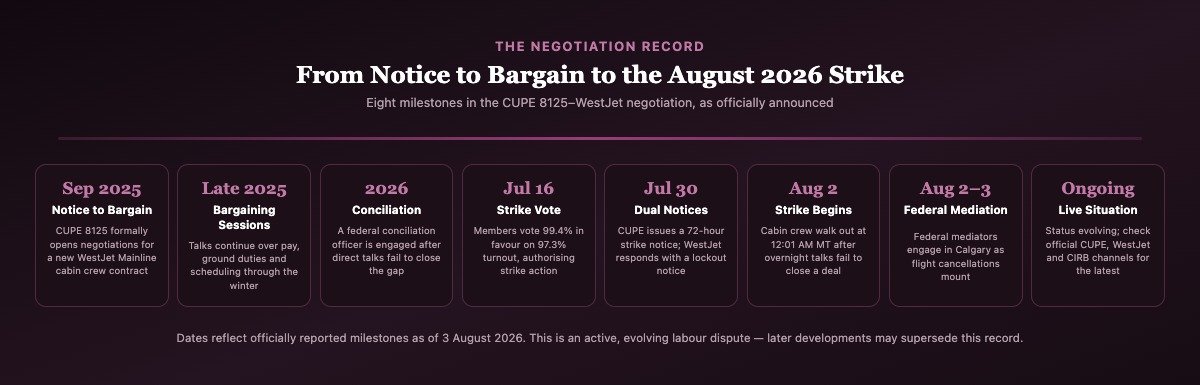
CUPE 8125 Serves Notice to Bargain
Union communication. CUPE 8125, the local representing WestJet’s Mainline flight attendants, formally served Notice to Bargain on 16 September 2025, opening negotiations for a new collective agreement and publicly framing the union’s core demand as “fair pay” and “an end to unpaid work.”
Current relevance. This date marks the formal start of the negotiation process that led, roughly eleven months later, to the August 2026 strike.
Bargaining Continues, Then Moves to Conciliation
Negotiation stage. Direct bargaining between CUPE 8125 and WestJet continued through the autumn and winter, covering wages, scheduling and, centrally, compensation for ground duties. When direct talks did not close the gap, the dispute moved into conciliation — a formal Canada Labour Code process in which a federally appointed officer works with both sides to try to reach agreement before any strike or lockout can become legal.
Current relevance. Conciliation is a mandatory step, not an optional one, for federally regulated employers like WestJet; its conclusion, without an agreement, starts the clock toward a legal strike or lockout position for both parties.
Members Vote Overwhelmingly to Authorise a Strike
Union communication. CUPE 8125 announced that its members had voted 99.4% in favour of strike action, on a turnout of 97.3% — an unusually high participation rate for a union vote of any kind.
What a strike vote does, and doesn’t, mean. A strike-authorization vote grants the union’s bargaining team the legal ability to call a strike; it does not, by itself, start one, and does not obligate the union to strike if a deal is reached first. High-margin votes like this one are common in Canadian labour relations and are generally read as a mandate strengthening the bargaining team’s position, not a guarantee of a walkout.
Both Sides Issue 72-Hour Notices
Union communication. CUPE 8125 issued a formal 72-hour strike notice, the legally required advance warning before job action can begin under the Canada Labour Code.
Official airline statement. WestJet responded with its own 72-hour lockout notice, a step airlines commonly take alongside a strike notice to control the timing and orderliness of any work stoppage rather than face one unannounced.
Current relevance. This set the earliest possible strike date at 12:01 AM Mountain Time on 2 August 2026 — the moment the notice period expired.
WestJet Begins Pre-Emptive Flight Cancellations
Official airline statement. With no agreement reached and the strike deadline approaching, WestJet began an organised wind-down of its schedule, cancelling dozens of flights on Saturday, 1 August, ahead of the notice period’s expiry.
Passenger advisory. WestJet stated it would allow passengers travelling between 30 July and 4 August to make a one-time change or cancellation without fees, and began proactively rebooking or notifying affected travellers.
The Strike Begins
Official development. After overnight talks failed to produce an agreement, WestJet Mainline flight attendants began a legal strike at 12:01 AM Mountain Time on 2 August 2026, with WestJet’s matching lockout taking effect simultaneously.
Operational impact, as reported. WestJet cancelled several hundred flights as the strike began, with reporting on the exact figure varying — from roughly 300 on the strike’s opening day to nearly 500 by the Sunday of the long weekend — and an estimated 250,000 passengers affected over the holiday period.
Statements from both sides. WestJet’s CEO, Alexis von Hoensbroech, said the airline had “presented a proposal that would have set a new standard for cabin crew in Canada” that “wasn’t accepted.” CUPE 8125 president Alia Hussain said the union “tried until the very last minute to get a fair deal that recognizes the value of the work cabin crews do,” and that WestJet’s offer “did not go far enough.”
Federal Mediation Engages as the Dispute Continues
Government action. Canada’s Federal Mediation and Conciliation Service engaged with both parties in Calgary as the strike continued. Canada’s Minister of Jobs and Families, whose portfolio includes federal labour matters, publicly described the breakdown in talks as “disappointing” while emphasising a preference for a negotiated settlement at the bargaining table. Canada’s Transport Minister also commented publicly on the dispute’s impact on travellers.
An evolving, disputed point. Some reports have suggested the government was weighing, or had already taken, action under Section 107 of the Canada Labour Code — the same provision used during the 2025 Air Canada strike — while other reporting, including wire coverage as of 2 August, indicated no such order had been issued. CUPE 8125 has publicly urged the federal government to “respect collective bargaining rights” and not intervene. This guide does not treat either possibility as confirmed; readers should consult official CIRB and Government of Canada sources for the current status.
📈 Labour Insight
Most labour negotiations conclude through agreements rather than prolonged strikes. The overwhelming majority of unionised contracts in Canada, including in the airline sector, are renegotiated and ratified without any work stoppage at all; strikes are the visible exception that captures public attention, not the norm. Even after a strike begins, most disputes are resolved within days to a few weeks through continued negotiation, frequently with mediation assistance — as the 2025 Air Canada dispute, resolved within four days, illustrates.
A Labour Relations Glossary
The terms this dispute cannot be explained without
- Collective Bargaining
- The process by which a union and an employer negotiate a single contract covering wages, hours and working conditions for everyone the union represents.
- Strike Authorization Vote
- A secret-ballot vote giving a union’s bargaining team legal authority to call a strike; it does not itself start a strike.
- Conciliation
- A mandatory Canada Labour Code process in which a federally appointed officer helps an employer and union try to reach agreement before a legal strike or lockout can occur.
- Mediation
- A voluntary process in which a neutral third party helps both sides negotiate; unlike arbitration, a mediator cannot impose a binding outcome.
- Lockout
- An employer’s decision to bar unionised employees from work during a labour dispute, the employer-side counterpart to a strike.
- Essential Services / Maintenance of Activities
- An agreement or CIRB ruling identifying which functions must continue during a strike or lockout to protect public health or safety.
- Canada Labour Code
- The federal law governing labour relations, including collective bargaining, strikes and lockouts, for federally regulated industries such as airlines.
- Canada Industrial Relations Board (CIRB)
- The independent federal tribunal that administers the Canada Labour Code, including certification, essential-services and back-to-work matters.
- Section 107
- A Canada Labour Code provision letting the responsible federal minister direct measures, including referring a dispute to the CIRB, to maintain or secure industrial peace.
- Replacement Worker Ban
- A 2025 legal change prohibiting most federally regulated employers from using replacement workers to perform struck or locked-out employees’ duties.
- Ground Duties / Ground Pay
- Work performed by flight attendants while an aircraft is on the ground — boarding, safety checks, delays, deplaning — at the centre of this dispute over compensation.
- Crew Scheduling
- The airline function that assigns flight attendants and pilots to specific flights, balancing regulatory rest requirements, contract rules and operational needs.
How a Federally Regulated Strike Actually Happens
The legal process, stage by stage, and where WestJet and CUPE 8125 are in it
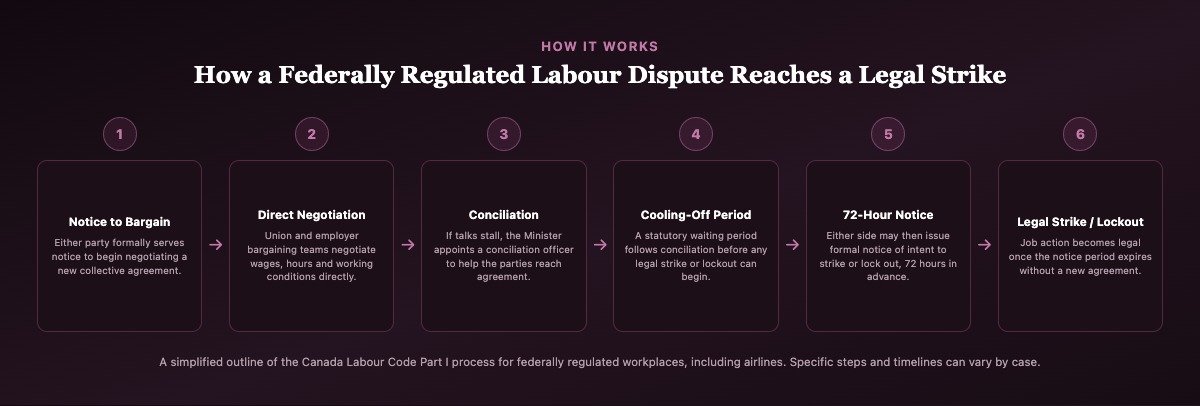
Airlines operating across provincial borders, like WestJet, fall under federal rather than provincial labour law, which means their strikes and lockouts follow the process set out in Part I of the Canada Labour Code. That process is deliberately slow and structured, designed to make a strike the last step in a defined sequence rather than a sudden event.
Notice to Bargain
Either the union or the employer can formally trigger negotiations by serving a Notice to Bargain, which obliges both sides to begin meeting within a set period. CUPE 8125 served this notice on WestJet on 16 September 2025.
Direct Negotiation
Bargaining teams from both sides negotiate directly, typically over multiple sessions across weeks or months, covering the full range of contract terms — wages, benefits, scheduling rules and, in this case, the central question of ground-duty compensation.
Conciliation
If direct talks stall, either party can request — or the Minister can direct — the appointment of a conciliation officer, whose role is to help the parties find common ground. Conciliation is not optional for federally regulated employers: a legal strike or lockout cannot occur until this stage has concluded (or a fixed period has passed) without a settlement.
The Cooling-Off Period
After conciliation ends without an agreement, a further waiting period follows before either side can take job action, giving both parties one last window to reach a deal under less time pressure than a live strike deadline creates.
Strike Vote and 72-Hour Notice
A union must hold a secret-ballot strike vote before striking; CUPE 8125’s vote returned 99.4% support on 97.3% turnout. Once authorised, either side must still give 72 hours’ written notice before beginning a strike or lockout — the step both parties took on 30 July 2026.
Legal Strike or Lockout
Once the notice period expires without a new agreement, the strike or lockout becomes legal. That is what began at 12:01 AM Mountain Time on 2 August 2026.
💡 Did You Know?
Canadian labour relations include formal mediation and conciliation processes before many strikes or lockouts occur. In the federally regulated sector, a strike cannot legally happen the moment talks break down — it requires conciliation (or the passage of a legally defined period), a cooling-off window, a successful strike vote, and a further 72-hour notice. From the first sign of serious disagreement to a legal strike routinely takes months, which is exactly what unfolded between CUPE 8125’s September 2025 notice and the August 2026 walkout.
The Passenger Guide: What Your Rights Actually Are
Based on official Canadian Transportation Agency rules — not general assumptions
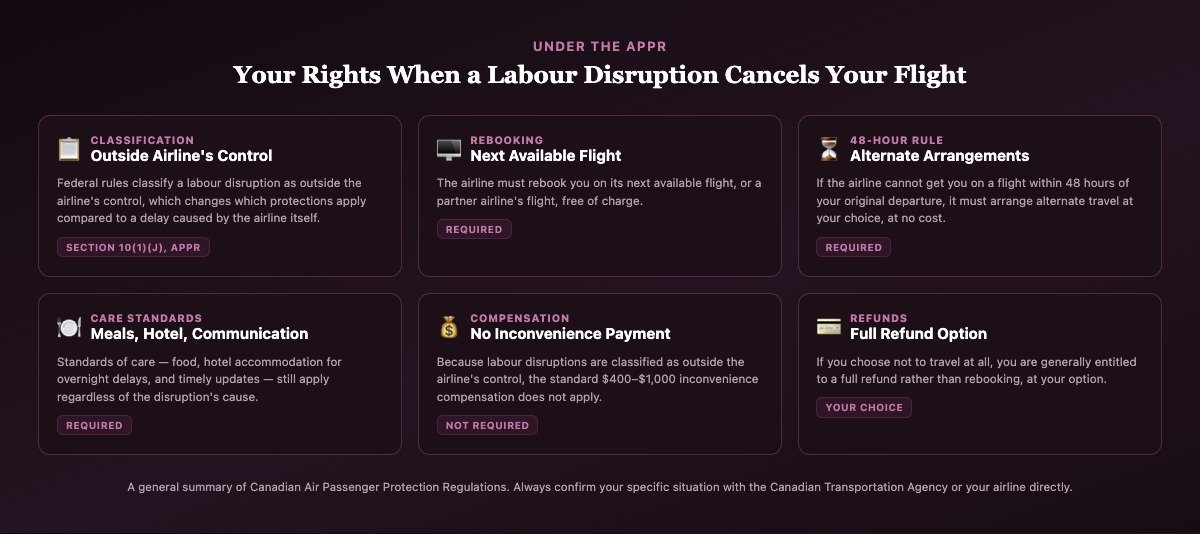
If your WestJet flight is cancelled or significantly delayed because of this strike, your rights are set out in the federal Air Passenger Protection Regulations (APPR), administered by the Canadian Transportation Agency (CTA). The single most important classification to understand is this: under section 10(1)(j) of the APPR, a labour disruption — whether at the airline itself or at an essential service provider like an airport — is treated as a situation outside the airline’s control. That classification does not remove your rights, but it does change which ones apply compared with, say, a delay caused by an airline’s own scheduling error.
What Happens If Your Flight Is Cancelled
WestJet is required to rebook you on its next available flight, or on a flight operated by another airline it has an agreement with, at no additional cost. If it cannot get you to your destination within 48 hours of your original scheduled departure, it must, at your choice, make alternate travel arrangements — which can include a different airline or another mode of transport — also free of charge.
Refunds
If you would rather not travel at all once your flight is disrupted, you are generally entitled to choose a full refund instead of rebooking. This applies to the unused portion of your itinerary and is your choice to make, not the airline’s.
Compensation for Inconvenience
This is the detail most likely to surprise travellers: because a labour disruption is classified as outside the airline’s control, the standard APPR compensation for inconvenience — amounts that can range roughly from $400 to $1,000 depending on the length of delay — does not apply. This is a significant difference from a delay the airline itself caused, and it is worth understanding before assuming a payout is automatic.
Standards of Care
Regardless of the cause of a disruption, airlines must still meet baseline standards of care for stranded passengers: timely communication about the situation, and for longer delays, food, drink and hotel accommodation where an overnight stay is required. These obligations are taken seriously by the regulator — the CTA fined Air Canada $426,000 in March 2026 for passenger-rights violations connected to its August 2025 flight attendants’ strike, one of the largest enforcement actions under the APPR to date.
Travel Insurance
Whether travel insurance covers costs related to a labour disruption depends entirely on your specific policy’s wording — some policies explicitly exclude strikes or labour disputes, others cover certain related expenses. This guide cannot tell you what your policy covers; check your policy documents directly or contact your insurer.
Where to Get Official Information
For your specific flight, always use WestJet’s own official channels — its website, app, or customer service — rather than third-party trackers or social media, which can lag or misreport individual flight status. For general questions about your rights, the Canadian Transportation Agency publishes plain-language guidance directly.
✉️ Passenger Insight
Official airline notifications provide the most accurate information about individual flight status. In a fast-moving disruption affecting hundreds of flights, aggregated news reports and social media can be hours out of date by the time you read them, while your airline’s own booking record and app reflect your specific itinerary in close to real time. When in doubt about your own flight, go to the source.
Five Things Worth Understanding in More Depth
Evergreen explainers that answer the questions behind the headlines
How Airline Labour Negotiations Work
Airline contracts are renegotiated on a cycle, typically every three to five years, through collective bargaining between the airline and each union representing a distinct group of employees — flight attendants, pilots and ground staff usually bargain separately, under separate contracts. Negotiations cover wages, benefits, scheduling rules and working conditions, and in federally regulated Canadian aviation, the entire process operates within the structure set by the Canada Labour Code: notice to bargain, negotiation, conciliation, a cooling-off period, and only then the possibility of legal job action.
Strike vs Lockout
A strike is initiated by unionised employees withholding labour to pressure an employer; a lockout is initiated by an employer barring employees from work to pressure a union. Both are legal tools within Canada’s collective bargaining framework, both require the same underlying legal conditions to be met (conciliation, notice periods), and both produce a similar operational effect — work stops. In the WestJet dispute, both occurred simultaneously: CUPE 8125’s strike notice and WestJet’s lockout notice were issued on the same day, and both took effect at the same moment.
Canadian Passenger Rights, Explained
The Air Passenger Protection Regulations set minimum obligations airlines must meet when a flight is delayed or cancelled, scaled to the disruption’s cause. Situations “within the airline’s control” (like a scheduling error) carry the strongest passenger protections, including compensation. Situations “outside the airline’s control” (like a labour disruption or severe weather) still require rebooking, refund options and standards of care, but not the standard compensation for inconvenience. Knowing which category applies is the single most useful piece of information for understanding what you are, and are not, owed.
How Airlines Manage Operational Disruptions
When a major disruption like a strike is anticipated, airlines typically wind down their schedule in a controlled, staged way rather than cancelling flights at random as the deadline hits. This usually means cancelling a portion of flights in the days beforehand, prioritising getting aircraft and remaining crews to the right airports, and proactively rebooking or notifying affected passengers ahead of time — the pattern WestJet followed from 1 August onward, ahead of the strike’s actual start.
What Travellers Should Do During Flight Disruptions
Check your specific flight’s status directly through the airline’s official app or website rather than general news coverage. If your flight is cancelled, decide promptly whether you want rebooking or a refund, since airlines typically process whichever you request rather than assuming one by default. Keep records of any additional costs you incur, in case they become relevant to a travel insurance claim or a future CTA complaint. And avoid making irreversible downstream plans (like non-refundable hotel bookings) until your air travel is confirmed.
Comparison Tables: The Dispute Side by Side
Seven reference tables covering labour process, operations and passenger rights
Strike vs Lockout
| Aspect | Strike | Lockout |
|---|---|---|
| Initiated by | Union | Employer |
| Purpose | Pressure employer to improve an offer | Pressure union to accept an offer, or match a strike’s timing |
| Legal requirements | Conciliation, cooling-off, vote, 72-hr notice | Conciliation, cooling-off, 72-hr notice |
| Effect on work | Employees withhold labour | Employer bars employees from work |
| In this dispute | CUPE 8125 strike, 2 Aug 2026 | WestJet lockout, same date and time |
Mediation vs Arbitration
| Aspect | Mediation | Arbitration |
|---|---|---|
| Third party’s role | Facilitates negotiation | Makes a binding decision |
| Outcome | Parties must still agree | Imposed contract terms |
| Voluntary? | Typically voluntary or ministerially encouraged | Can be voluntary or imposed (e.g. via Section 107) |
| Used in this dispute | Federal Mediation and Conciliation Service engaged, Aug 2026 | Not confirmed as of this guide’s last update |
Flight Delay vs Cancellation
| Aspect | Delay | Cancellation |
|---|---|---|
| What happens | Flight departs later than scheduled | Flight does not operate as booked |
| Rebooking | Not applicable unless very extended | Airline must rebook or refund |
| Care standards | Apply after a set delay threshold | Apply immediately |
| Compensation (labour disruption) | Not owed under APPR’s outside-control rule | Not owed under APPR’s outside-control rule |
Passenger Rights by Scenario
| Scenario | Rebooking | Refund Option | Inconvenience Compensation |
|---|---|---|---|
| Cancelled, airline’s fault | Yes | Yes | Yes |
| Cancelled, labour disruption | Yes | Yes | No |
| Cancelled, safety requirement | Yes | Yes | No |
| Cancelled, severe weather | Yes | Yes | No |
Labour Process Comparison: 2025 Air Canada vs 2026 WestJet
| Aspect | Air Canada, Aug 2025 | WestJet, Aug 2026 |
|---|---|---|
| Union | CUPE (Air Canada component) | CUPE 8125 |
| Members | ~10,517 flight attendants | ~4,400 flight attendants |
| Core issue | Unpaid ground work (~35 hrs/month claimed) | Unpaid ground duties (credit-hour system) |
| Section 107 invoked? | Yes, hours after strike began | Not confirmed as of this guide’s last update |
| CIRB back-to-work order? | Yes, defied by the union | Not confirmed as of this guide’s last update |
| Duration | 4 days (16–19 Aug 2025) | Ongoing as of 3 Aug 2026 |
Operational Impacts
| Metric | Reported Figure | Source Type |
|---|---|---|
| Flight attendants affected | ~4,400 | Union / airline reporting |
| Strike vote result | 99.4% in favour, 97.3% turnout | Union communication |
| Flights cancelled (opening days) | Approx. 300–500 | Independent reporting, varies by day |
| Passengers affected (long weekend) | ~250,000 | Independent reporting |
| Pre-emptive cancellations (1 Aug) | 81 flights | Independent reporting |
Timeline Summary
| Date | Event | Importance |
|---|---|---|
| 1996 | WestJet founded | Establishes the airline now at the centre of the dispute |
| 2019 | Onex acquisition completed | WestJet becomes a private, not publicly traded, company |
| Jun 2025 | Replacement-worker ban in force | Restricts how WestJet can staff flights during the strike |
| Aug 2025 | Air Canada flight attendants strike | Direct precedent for the ground-pay issue and government response |
| Sep 2025 | CUPE 8125 serves Notice to Bargain | Formal start of the WestJet negotiation |
| Jul 16 2026 | Strike vote: 99.4% in favour | Authorises union bargaining team to call a strike |
| Jul 30 2026 | Dual 72-hour notices issued | Sets the legal strike/lockout start time |
| Aug 2 2026 | Strike and lockout begin | Work stoppage takes effect; flights cancelled |
| Aug 2–3 2026 | Federal mediation engages | Government-supported negotiation continues |
Who’s Who: The Institutions Behind This Dispute
The organisations named throughout this guide, in one place
WestJet
Canada’s second-largest airline, headquartered in Calgary, privately owned by Onex Corporation since 2019, and the employer party to this dispute.
CUPE 8125
The local of the Canadian Union of Public Employees representing approximately 4,400 WestJet Mainline flight attendants.
Canada Industrial Relations Board (CIRB)
The independent federal tribunal that administers the Canada Labour Code, including essential-services and back-to-work matters.
Canadian Transportation Agency (CTA)
The federal body that administers the Air Passenger Protection Regulations and enforces airline passenger-rights obligations.
Government of Canada (Minister of Jobs and Families)
The federal ministry whose portfolio includes labour matters, and which holds tools such as Section 107 of the Canada Labour Code.
Federal Mediation and Conciliation Service
The federal service providing conciliation and mediation officers to help resolve disputes like this one, engaged in Calgary as talks continue.
Calgary International Airport
WestJet’s home hub and the operational centre of both the airline’s network and much of the disruption caused by the strike.
Onex Corporation
The Toronto-based private equity firm that has owned WestJet since completing its acquisition in December 2019.
Air Canada
Canada’s largest airline, whose own CUPE-represented flight attendants struck over the same ground-pay issue in August 2025.
Canada Labour Code
The federal statute governing collective bargaining, strikes and lockouts for federally regulated employers including airlines.
Myth vs Fact
Common misconceptions, checked against the official record
✓ Verified Facts
- The strike began after a legally required process: notice to bargain, conciliation, a strike vote, and a 72-hour notice period.
- WestJet and CUPE 8125 issued matching 72-hour notices on the same day, 30 July 2026.
- Under the APPR, a labour disruption is classified as outside the airline’s control, which removes standard inconvenience compensation but not rebooking, refund and care obligations.
- Federal law has banned most use of replacement workers in federally regulated strikes and lockouts since June 2025.
- This dispute closely parallels the August 2025 Air Canada flight attendants’ strike over the same core ground-pay issue.
✗ Common Myths
- Myth: “Passengers are automatically entitled to cash compensation for a cancelled flight.” Fact: For a labour disruption specifically, standard APPR inconvenience compensation does not apply, though rebooking and refund rights still do.
- Myth: “WestJet can just use replacement crew to keep flying.” Fact: Federal law has banned most use of replacement workers in a legal strike or lockout since June 2025.
- Myth: “A strike vote means a strike is certain.” Fact: A strike vote authorises a union’s bargaining team to call a strike; it does not obligate one, and deals are frequently reached after a strong vote.
- Myth: “This is the same event as the 2025 Air Canada strike.” Fact: They are separate disputes, involving different airlines and different (though related) union locals, sharing a similar core issue.
- Myth: “The government has already forced flight attendants back to work.” Fact: As of this guide’s last update, no Section 107 order for this specific dispute had been consistently confirmed by official sources.
💡 Interesting Facts
- WestJet’s 1996 founding model — low-cost, point-to-point domestic flying — was itself partly a response to the market Air Canada dominated, making the two airlines’ parallel 2025-26 labour disputes a notable symmetry.
- CUPE 8125’s 97.3% strike-vote turnout is unusually high for a union ballot of any kind, reflecting how central the ground-pay issue was to the membership.
- The replacement-worker ban that shapes WestJet’s options during this strike is barely a year old, having come into force in June 2025 — meaning this is one of the first major Canadian airline strikes to unfold entirely under the new rules.
- The Canadian Transportation Agency’s $426,000 fine against Air Canada in March 2026 remains one of the largest passenger-rights enforcement actions in the APPR’s history, a data point relevant to how seriously care-standard obligations are taken even during “outside control” disruptions.
- 3 August 2026, when this guide was last updated, is itself a civic holiday Monday in several Canadian provinces — part of why the strike’s timing over the long weekend has amplified its passenger impact.
🌐 Industry Insight
Labour negotiations are a recurring feature of the aviation industry worldwide. Airlines everywhere periodically renegotiate contracts with multiple, separately organised employee groups, and high-profile strikes or near-strikes have affected carriers across North America and Europe in recent years. The WestJet dispute is best understood as part of that ongoing, industry-wide pattern — and specifically, in Canada, as part of a live conversation about ground-duty pay that the 2025 Air Canada strike opened and this dispute continues.
👀 Future Watch
What to monitor going forward, from official sources only: further negotiation updates from WestJet and CUPE 8125’s official channels; any government announcement regarding Section 107 or other Canada Labour Code tools; CIRB filings or orders, if any are issued; and updated operational notices from WestJet regarding flight schedules and passenger rebooking. This section deliberately excludes speculation about which side will prevail or when the dispute will end; it tracks only documented institutional developments.
Explore More Timelines
People Also Ask
Frequently Asked Questions
80 questions on the negotiation, labour law, and passenger impact of the WestJet flight attendants’ dispute
Why Labour Relations Matter to Modern Aviation
Return to the departure board at Calgary International Airport, and to the man in the rumpled blazer still refreshing his phone. Nothing in the process described in this guide will resolve his morning any faster. But understanding that process changes what his wait actually means. A cancelled flight during a labour dispute is not a system failure; it is a system working exactly as Canadian law designed it to — slowly, procedurally, and with every stage, from notice to bargain through conciliation to a strike vote to a 72-hour notice, built to make a work stoppage the outcome of a long, formal attempt at agreement, not a shortcut around one.
Airline labour negotiations are an important part of balancing employee interests, operational reliability and passenger service, and they are not unique to WestJet, to Canada, or to this moment. Every major airline periodically renegotiates contracts with the people whose coordinated, regulated work makes flight possible at all, and the ground-pay question now at the centre of this dispute — whether compensation should reflect every hour on duty, not only hours in the air — is a live, industry-wide conversation that the 2025 Air Canada strike opened and this one continues. Neither dispute is fully separable from the other, and neither is likely to be the last word on the issue.
What travellers can reasonably do is exactly what this guide has tried to lay out clearly: understand what rights actually apply under the Air Passenger Protection Regulations, use WestJet’s own official channels for flight-specific information, and follow the negotiation itself through WestJet, CUPE 8125 and Government of Canada sources rather than speculation. Understanding the negotiation process does not make a disrupted trip less inconvenient. It does make it easier to interpret — to see a cancelled flight not as an isolated failure, but as one visible consequence of a structured, still-unfolding negotiation between people whose work you rely on every time you fly, and the airline that employs them.
Related Reading on AiTimeline
Sources & further reading
Every dated entry above was checked against these references. Last reviewed 15 September 2026.