WordPress Student Plan 2026: How Students Get a Website They Actually Own
WordPress student plan 2026: free hosting, a free domain, and full plugin access for a year - verified against WordPress.com's official Aug 17 launch.
Latest Story
A college student finishing a design portfolio, a journalism major who needs somewhere to publish class work, a computer science student trying to ship a side project before internship season — all of them run into the same wall. A real website means a real domain, real hosting, and usually a monthly bill a student budget can’t absorb. Free site builders exist, but most trade that cost for limits: no custom domain, a builder-branded URL, or a project that vanishes when the semester ends and the free trial does too. WordPress.com is trying to close that gap directly. On August 17, 2026, at WordCamp US, it publicly launched WordPress.com Education, built around a WordPress student plan: a professional-tier WordPress.com site, a free domain, and a year with no bill at all — activated not by the student signing up, but by a teacher applying for the whole class. This article verifies exactly what that means against WordPress.com’s own official pages: eligibility, the application path, what’s included, and what changes once the first year ends.
🔔 WordPress Student Plan — August 2026 Update
Launched: August 17, 2026, at WordCamp US 2026, after roughly a year of private piloting that reached more than 5,000 active students across 27 countries. Eligibility: students in a class whose teacher applies and is approved — there is no individual student application. Free period: the first 12 months, no credit card required. Domain: a free .blog or .art domain for year one. Included: a full WordPress.com plan — plugin support, 6 GB storage, backups, staging sites, SFTP/SSH, phpMyAdmin, and Studio Sync. Renewal: $2/month ($24/year) after year one. If a student doesn’t renew: nothing is deleted — the site moves to WordPress.com’s free plan on a subdomain, with all content intact. Source: WordPress.com’s Education page and its August 17, 2026 launch announcement — both checked directly for this article.
🧠 AI Overview Summary
The WordPress student plan is a free-for-one-year WordPress.com plan for students whose teacher applies on their behalf. Approved students get real hosting, a free .blog or .art domain, and full plugin access, launched publicly by WordPress.com on August 17, 2026 after a year-long pilot. After year one, renewal is $24/year; not renewing doesn’t delete the site — it simply drops to WordPress.com’s free plan.
WordPress Student Plan: Key Questions
What to Know About the WordPress Student Plan
- This is a genuinely new offering, publicly launched August 17, 2026 — not a decades-old discount program, and not the same thing as WordPress.org’s separate education initiatives.
- Only teachers, department heads or program coordinators can apply, at wp.com/edu, on behalf of a class. There is no individual-student application path in current official documentation.
- It’s free for 12 months with no credit card, and includes a real WordPress.com plan — full plugin support, not a limited classroom tier.
- A free domain is included, but only two extensions qualify: .blog or .art, described by WordPress.com as “our two education-eligible TLDs for this initial phase.”
- Renewal after year one costs $24/year ($2/month) — separate from WordPress.com’s general Free and Personal plans, which have different terms.
- Not renewing does not delete the site. It moves to WordPress.com’s free plan on a subdomain; posts, pages, comments and media stay intact. The custom domain and any third-party plugins/themes are removed.
- Students own and control their sites and can migrate content, or the entire site, to another host at any time.
- The public launch followed a year-long private pilot that reached more than 5,000 active students across 27 countries.
- “WordPress student discount” is not an official term for this program — that phrase mostly surfaces unrelated third-party coupon pages for other hosts.
WordPress.org vs WordPress.com vs the Student Plan
Three distinct things that get blurred together in casual coverage
WordPress.org is the free, open-source software project itself — the code you can download and install on your own server. It was first released on May 27, 2003, by Matt Mullenweg and Mike Little, as a fork of an earlier tool called b2/cafelog. WordPress.com is a completely different, commercial thing: a hosted service, run by the company Automattic (founded by Mullenweg in 2005), built on top of that same open-source software. WordPress.com opened to the public on November 21, 2005. The WordPress student plan is neither of those — it’s a specific plan that lives inside WordPress.com, activated only through an educator application, first opened to the public in 2026. Mixing these up is the single biggest source of confusion in this space: “WordPress is free” is technically true of the .org software, but a student can’t just “get the free WordPress plan” without going through WordPress.com’s Education program if they want the professional-tier features described in this article.
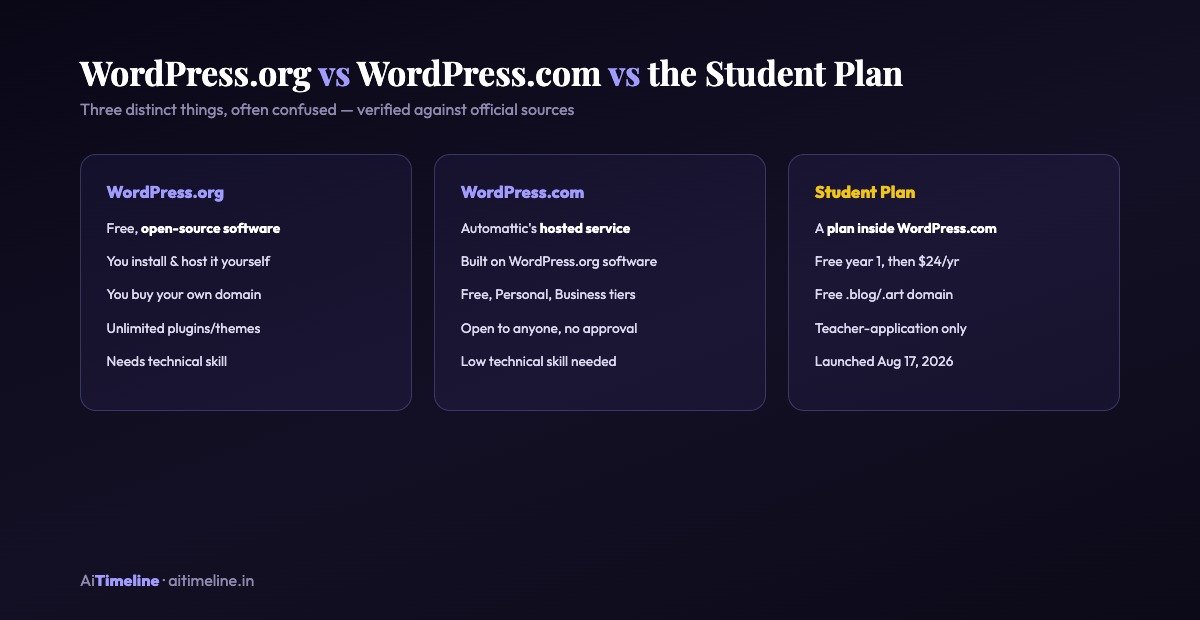
WordPress.org, WordPress.com and the Student Plan are three distinct things — AiTimeline
| Feature | WordPress.org | WordPress.com Student Plan |
|---|---|---|
| What it is | Free, open-source software you install | A hosted plan you’re approved into |
| Hosting | You buy and manage your own | Included, managed by WordPress.com |
| Domain | You buy separately | Free .blog/.art for year one |
| Cost | Software free; hosting/domain aren’t | Free year one; $24/year after |
| Plugins/themes | Any, from anywhere | Officially supported catalog |
| Maintenance | You handle updates, security, backups | WordPress.com handles it |
| Access route | Download anytime, no approval | Teacher application required |
How the WordPress Student Plan Works
Ten steps, verified against the official application FAQ
- The teacher applies. A teacher, department head or program coordinator submits an application for their class at wp.com/edu — not the student.
- WordPress.com reviews it. Both official pages describe an approval process, not automatic enrollment.
- Each student gets an individual site once the class is approved — not one shared class blog.
- The student registers a free domain — a .blog or .art address, at no cost for the first year.
- The student builds using the full plugin and theme catalog, the same one available on WordPress.com’s paid tiers.
- The plan is free for 12 months, with no credit card required at signup.
- The student owns and controls the site throughout, per WordPress.com’s own language.
- At the 12-month mark, the student decides whether to renew — not the school.
- Doing nothing doesn’t delete anything. The site drops to WordPress.com’s free plan, keeping every post, page, comment and media file.
- The student can migrate at any point — content only, or the entire site — to a different host.
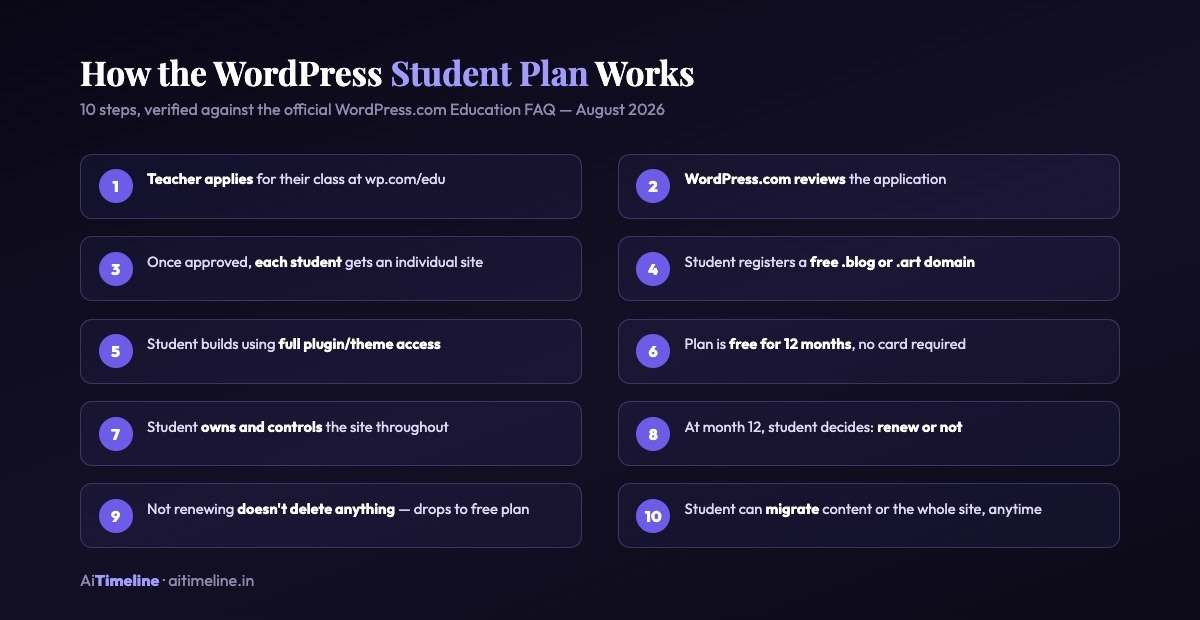
The WordPress student plan application process, step by step — AiTimeline
Who Qualifies for the WordPress Student Plan
Built around classes, not individuals
The program is built for students — school, college and university — whose class is enrolled by an educator. Neither WordPress.com’s Education page nor its launch announcement describes an individual-student application route; both frame enrollment as class-based and teacher-initiated. That means a motivated student who wants in can’t sign themselves up directly — the practical first step is asking a teacher, professor, department head or program coordinator to apply on the class’s behalf. The pilot behind this launch already spanned 27 countries, so geography alone doesn’t appear to be a blanket restriction, though official material doesn’t publish a full country allowlist; eligibility for a specific school or country should be confirmed directly on the application page.
What Students Actually Get
A real plan, not a limited “student tier” — verified line by line
Full Managed WordPress.com Hosting
6 GB storage, backups, and staging sites — the same infrastructure tier used on WordPress.com’s commercial plans, not a cut-down version.
Free .blog or .art Domain
Free for the first year; the only two “education-eligible TLDs for this initial phase,” per the official FAQ. Other extensions must be purchased separately.
Full Plugin Support
WordPress.com’s own language: “No watered-down ‘student tier,’ no restricted plugin access.” Students can install plugins and extend their sites as coursework.
SFTP/SSH, phpMyAdmin, Studio Sync
Direct file and database access plus WordPress.com’s local-development sync tool — tools students will encounter working with WordPress professionally.
Free Year vs. What Changes After
Every price, separated cleanly by era
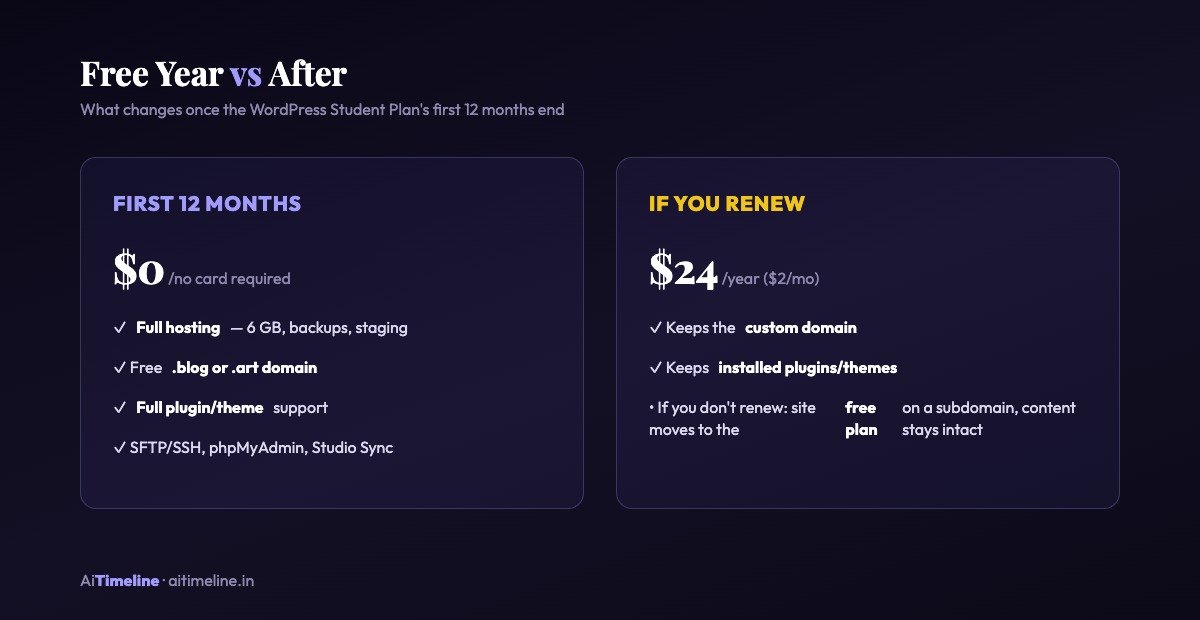
What’s free in year one, and what renewal costs after — AiTimeline
| Period | Cost | What’s included |
|---|---|---|
| First 12 months | $0, no card required | Full hosting, free .blog/.art domain, full plugin support |
| After year one, renewing | $24/year ($2/month) | Keeps the custom domain and installed plugins/themes |
| After year one, not renewing | $0, ongoing | Free WordPress.com plan on a subdomain; content preserved; domain and plugins removed |
This is genuinely different from WordPress.com’s other plans. The general Free plan has no custom domain and no plugin support, available to anyone with no application. The general Personal plan is priced comparably to the Student Plan’s post-year-one renewal, open to anyone, but doesn’t bundle a free education-eligible domain the same way. The Student Plan sits between them: application-gated, free longer, and aimed specifically at a 12-month academic use case.
What Happens When the Free WordPress Student Year Ends?
The most misunderstood part of the program, stated plainly
❌ It Does NOT Mean
- The website is deleted
- Posts, pages or media are lost
- The student is billed automatically without choosing to renew
- The free domain continues without payment
✅ What Actually Happens
- Content (posts, pages, comments, media) stays fully intact
- The site continues on a free WordPress.com subdomain (example.wordpress.com)
- The .blog/.art domain and any third-party plugins/themes are removed
- The student can upgrade again later, at any time
One nuance worth stating plainly: losing “third-party plugins and themes” also means losing functionality tied to them — WordPress.com’s own FAQ gives the example of WooCommerce order history becoming unavailable once a plugin is removed on downgrade. A student running anything plugin-dependent should treat the $24/year renewal as the real cost of keeping that functionality, not just the domain.
A Short History: Why an Education-Specific Plan Now
Kept to verified, directly relevant milestones — this is a genuinely recent initiative, not a decades-old program
WordPress.com Education Publicly Launches
WordPress.com opens the Student Plan to any teacher, after a year of private piloting. Announced by WordPress.com staff writer Alvaro Gómez.
WordPress.org Consolidates Its Separate Education Hub
WordPress.org relaunches a single hub for its own community programs — Campus Connect, Credits, and Student Clubs — distinct from WordPress.com’s commercial Student Plan.
WordPress.com Quietly Begins Piloting Education
The direct precursor to the 2026 launch: roughly a year of unannounced testing that reached 5,000+ active students across 27 countries before WordPress.com opened applications publicly.
WordPress.com Launches
Matt Mullenweg founds Automattic and launches WordPress.com as a hosted service built on the WordPress software — the “.com” side the Student Plan lives inside two decades later.
WordPress 1.0 Is Released
Matt Mullenweg and Mike Little release WordPress, forked from b2/cafelog — the origin of the free, open-source software that both WordPress.com and the Student Plan are ultimately built on.
Plan Comparison
Student Plan vs. WordPress.com’s other tiers vs. self-hosted WordPress.org
| Feature | Student Plan | Free WordPress.com | Personal Plan | WordPress.org |
|---|---|---|---|---|
| Cost, year one | Free | Free forever | Paid from day one | Free software; hosting extra |
| Cost after year one | $24/year | Free | Ongoing subscription | Your own hosting bill |
| Custom domain | Free .blog/.art, year one | Not included | Included | You buy it |
| Plugin support | Full | None | Limited/none | Unlimited |
| Storage | 6 GB | 1 GB | 6 GB | Depends on host |
| Access route | Teacher application | Open sign-up | Open sign-up | Open download |
Student Use Cases
Illustrative examples of how the plan fits real coursework — not testimonials
Portfolio & Final-Year Project
Hosting coursework and a capstone demo, with SFTP access to deploy build artifacts directly.
Byline Archive
Publishing class assignments and a personal writing portfolio under a real .blog domain.
Visual Portfolio
Using the plugin catalog to build a genuine portfolio site instead of a generic template gallery.
.art Domain Portfolio
A domain extension that actually matches the subject of a visual-arts portfolio.
Capstone Documentation
Staging environments let a student iterate on a project site before it’s graded or demoed.
Personal Brand Site
Standing up a consulting-pitch or personal-brand site ahead of internship recruiting season.
Educator Use Cases
Why teachers are the ones applying
Real Production Environments
Students get a real WordPress.com environment instead of a local-only sandbox that disappears after the course.
Individual Bylined Sites
Replacing one shared class blog with individually owned student publications.
Ownership Concepts, Hands-On
Teaching domain, hosting and ownership concepts hands-on, with a real free-tier fallback students can study.
Standardized Final-Project Hosting
One application covers a whole class, replacing ad hoc free tools that vanish at semester’s end.
Claim vs. Fact
What is actually free, verified against the official FAQ
| Claim | Fact |
|---|---|
| Students get WordPress free | The Student Plan is free for 12 months, only for classes whose teacher was approved — not a blanket “WordPress is free for any student” claim. |
| Students get a free domain forever | Free only while the plan stays active (free year, or paid renewal after); non-renewal removes the domain. |
| Students can apply independently | False. Applications route through educators only, per current official documentation. |
| The website disappears after one year | False. Non-renewal moves the site to a free plan with content intact — nothing is deleted. |
| It’s a stripped-down “student edition” | False. WordPress.com’s own language: “a real WordPress.com plan… no watered-down ‘student tier.'” |
| It’s the same as WordPress.org’s education programs | False. WordPress.org’s Campus Connect/Credits/Student Clubs are a separate, community/open-source-contribution effort, though WordPress.com sponsors some with donated hosting. |
📊 The Pilot, By the Numbers
- 5,000+ active students across 27 countries during the private pilot
- 88.9% of surveyed educators said the program improved student employability
- 81.5% said it improved students’ entrepreneurial capacity
- 20+ of 30 students at one pilot school, IES Luís Seoane in Spain, went on to internships
- 150+ students have received free WordPress.com hosting through the related WordPress Credits program
Why This Matters
Beyond “it’s free” — the ownership argument
Most tools schools hand students are borrowed, not owned: a classroom license that expires with the course, a school Google account that closes at graduation, a free-tier site builder that holds the URL hostage behind a paywall. The Student Plan’s actual pitch isn’t the free year — it’s that the non-renewal path doesn’t punish a student for finishing school. A portfolio built during a semester stays reachable, migratable, and genuinely the student’s, whether or not they ever pay WordPress.com another dollar. That’s a real, verifiable design choice (see §”What Happens When the Free Year Ends” above), and it’s the part of this launch most worth a student’s attention — more than the headline “free” does.
Explore More Timelines
People Also Ask
Frequently Asked Questions
⚠️ Editorial Note
This article covers a program WordPress.com launched the same day it was written. Every price, eligibility rule, and policy above is sourced directly to WordPress.com’s official Education page and its August 17, 2026 launch post, checked against the raw page text the same day — not to third-party summaries. Terms can change; verify current details at wordpress.com/education before applying. This is editorial, AI-assisted content, not an official WordPress.com resource, and does not guarantee any application outcome.
Sources & further reading
Every dated entry above was checked against these references. Last reviewed 20 September 2026.