Saradha Scam: How a Financial Empire Collapsed and Left Investors Waiting
Follow the Saradha chit fund scam timeline, from its rise and 2013 collapse to CBI and ED investigations, investor losses and the 2026 court developments.
Latest Story
In April 2013 a Kolkata business group that had been taking deposits from lakhs of small savers across eastern India stopped paying. Its founder fled, its agents were mobbed, and its newspapers and TV channels went dark. The Saradha chit fund scam became West Bengal’s biggest financial fraud and one of its most political: ministers and MPs were arrested, a Police Commissioner was confronted by the CBI, and accusations reached across party lines. Thirteen years later, the founder, Sudipta Sen, is out on bail, hundreds of cases are still open, and the question investors care about most, how much of their money will come back, has no answer.
Saradha is not one case but hundreds, handled by different agencies and courts. We keep apart what was alleged (in letters, complaints or charge sheets), what was found (by the SFIO or SEBI) and what courts have decided. Bail is not acquittal; provisional attachment of assets is not repayment. Where the brief we worked from got a date wrong, we say so in the entry.
💡 Short Answer
The Saradha scam was the collapse in April 2013 of a West Bengal group of more than 200 companies, founded by Sudipta Sen in 2006, that took deposits from lakhs of small investors with promises of high returns. Investigators found its schemes were Ponzi schemes. The Supreme Court gave the case to the CBI in May 2014. Sen was bailed in 2026 after almost 13 years in custody; most cases remain undecided.
Saradha Scam: Key Questions
The Saradha Story in Ten Points
- The model: deposits disguised as land, holiday and property products, sold door to door by commission agents.
- Warning ignored: the state referred the group to SEBI in April 2010; SEBI’s wind-up order came on 23 April 2013.
- The collapse: payments stopped in April 2013; Sen fled and was caught in Sonamarg on 23 April.
- The letter: an 18-page letter dated 6 April 2013 named politicians and others; it is an allegation, not evidence of guilt.
- Relief: a state commission paid about Rs 251 crore to roughly 4.98 lakh small investors from a taxpayer-funded fund.
- The CBI: the Supreme Court transferred the case on 9 May 2014 because it crossed state borders.
- Ponzi finding: the SFIO reported on 15 September 2014 that 14 group companies ran Ponzi schemes.
- Arrests: two Trinamool MPs and a serving minister were held in 2013-14; all were later bailed.
- The backlog: 389 cases in West Bengal alone; Sen has been acquitted in three and convicted in none.
- 2026: Sen bailed after nearly 13 years in custody; the ED has attached assets worth over Rs 380 crore, none yet returned to investors.
How the Saradha Scheme Worked
A deposit business dressed up as land and holiday sales.
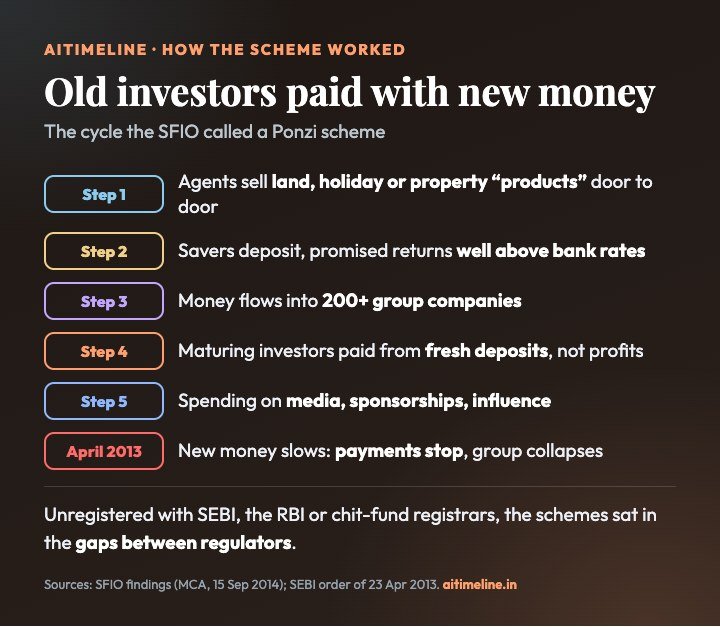
- Recruit agents: local agents, often investors themselves, earned commissions for bringing in deposits from neighbours and relatives.
- Sell a “product”: savers bought plans described as land, holiday packages or property, with a promise of returns or a payout at maturity.
- Spread the money: deposits went to many group companies, which helped keep each one below regulatory radar.
- Pay old investors with new money: maturing plans were paid out of fresh collections, not business income.
- Build visibility: money went into newspapers, TV channels, sponsorships and connections that made the group look solid.
- Run out: once new collections slowed, payments stopped and the structure collapsed.
The schemes fell between regulators. Registered chit funds are a state subject, deposit-taking finance companies are supervised by the RBI, and collective investment schemes by SEBI. Saradha’s plans were none of these on paper, which is partly why it took SEBI three years to act on a 2010 referral. Parliament later closed the gap with the Banning of Unregulated Deposit Schemes Act, 2019.
How Much Money Was Involved?
The figures differ because they measure different things.
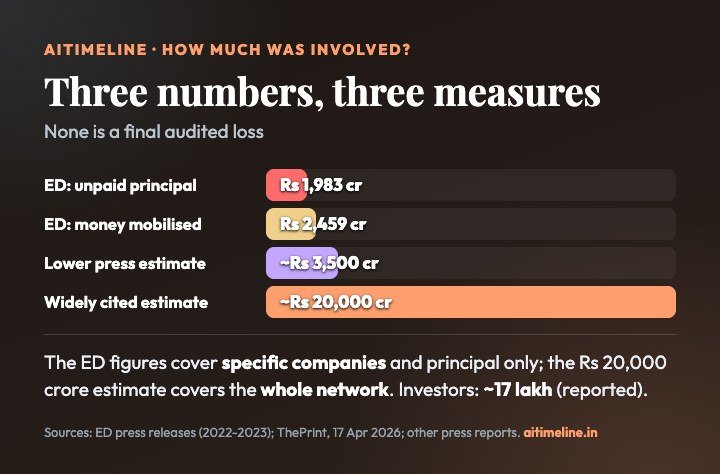
| Figure | Source | What it measures |
|---|---|---|
| About Rs 1,983 crore | Enforcement Directorate | Principal still unpaid to depositors, excluding interest, for the companies examined |
| About Rs 2,459 crore | Enforcement Directorate | Total money mobilised by those companies |
| About Rs 3,500 crore | Some press reports | Lower estimate of collections; we could not trace it to a primary record |
| About Rs 20,000 crore | Widely reported, e.g. ThePrint | Broad estimate of collections across the 200-plus company network |
| About 17 lakh investors | Widely reported | Estimated number of depositors; not an audited count |
The gap between Rs 2,459 crore and Rs 20,000 crore is not a contradiction so much as a difference in scope. The ED’s figure is tied to particular companies and to principal only. The larger figure tries to capture the whole group over its life, and some versions include promised returns. The Supreme Court itself noted in 2014 that the money trail had not been traced, and it still has not been fully.
April 2013: The Month Saradha Fell
A letter, a flight, a regulator’s order and an arrest in Kashmir.
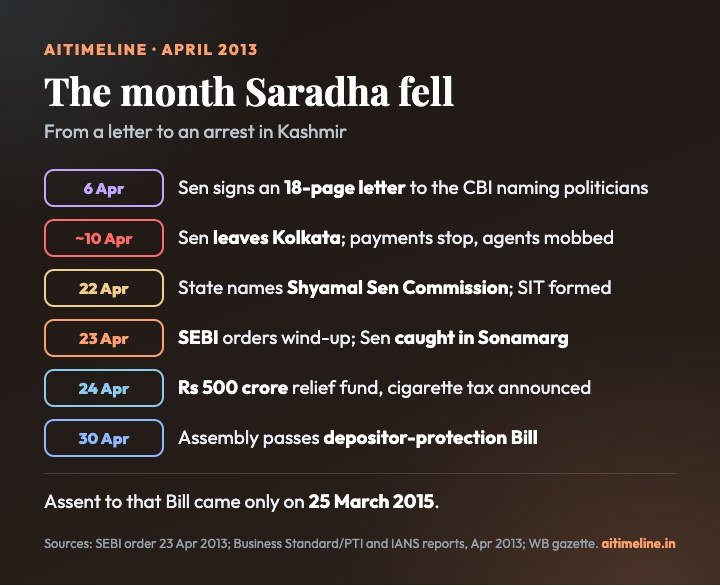
The speed of the state’s response in the last week of April was matched by how slowly it paid off. The relief fund was financed by taxpayers and smokers, not by Saradha’s assets. The depositor-protection Bill passed on 30 April did not receive the President’s assent until 25 March 2015. The brief we worked from dated Sen’s arrest to 24 April; he was detained and arrested on 23 April and flown to Kolkata on 24 April.
Timeline: The Saradha Scam, 2006 to 2026
Newest first. Colour shows which track each event belongs to.
Where the Saradha cases stand Courts & bail
Settled: Sudipta Sen has bail in the West Bengal cases (Calcutta High Court, 8 April 2026) and in a CBI case from Assam (Supreme Court, 18 August 2026). He and Debjani Mukherjee were acquitted in three small cases in August 2025.
Not settled: ThePrint counted 389 Saradha cases in West Bengal alone in April 2026. The CBI has merged its 77 cases into four and is still filing supplementary charge sheets, and the ED money-laundering case is pending. We found no report confirming the date Sen physically left custody, and no figure for how much investors have recovered in total.
Supreme Court grants Sen bail in the Assam CBI case Courts & bail
What happened: The Supreme Court set aside a Gauhati High Court order of 20 January 2025 that had refused Sen bail in a CBI case arising from a 2013 complaint at Dispur police station in Guwahati. It directed his release on terms to be fixed by the trial court and asked for the trial to be expedited.
Why it matters: The Calcutta High Court’s April order had covered only the West Bengal cases. Cases outside the state, including in Assam, had to be dealt with separately.
A count of the backlog: 389 cases Courts & bail
What it found: There were 389 Saradha cases in West Bengal alone: 77 probed by the CBI and 312 by the state police. Sen had been arrested in 305 police cases and had bail in 282 by 2025, and 17 cases outside Bengal had production warrants pending.
Why it matters: The report described missing papers, absent witnesses and accused persons not produced in court. The ED case had seen 146 hearings by 2025 without reaching a verdict.
Calcutta High Court bails Sen in the last two Bengal cases Courts & bail
What happened: The court granted bail in the two remaining West Bengal cases that kept Sen in custody, almost 13 years after his arrest. ThePrint reported the state had admitted the prospect of an early trial was “remote and bleak”.
What the court said: The bench found “a systemic collapse of the trial machinery” in Barasat, noting that “a decade is consumed merely in the supply of papers”. It also took note of his health; he had recently suffered a stroke.
Conditions: Reports said the bond was set at Rs 5,000 with two sureties, one of them local. He must attend trial.
Acquitted in three Hare Street cases Courts & bail
What happened: A magistrate acquitted Sen and Debjani Mukherjee in three cases registered at Hare Street police station in 2013, which together involved about Rs 15 lakh. The defence argued the prosecution had failed to prove its case.
Why it matters: These were the first Saradha trials against Sen to end. Both stayed in custody because of the other pending cases.
ED names eight more accused Investigations & arrests
What happened: The Enforcement Directorate filed a second supplementary prosecution complaint against eight more people, including former armed police DGP Rajat Kumar Majumder, former CPI(M) MLA Debendranath Biswas and East Bengal club official Debabrata Sarkar. The court took cognisance the same day. The ED announced it on 28 August.
Numbers: The ED said it had already prosecuted 26 accused and had issued nine provisional attachment orders covering assets worth more than Rs 380 crore.
Assets of “beneficiaries” attached Investigations & arrests
What happened: The ED provisionally attached movable assets worth Rs 3.30 crore and immovable property worth over Rs 3 crore belonging to people it called beneficiaries of Saradha money, among them Nalini Chidambaram, Debendranath Biswas and Debabrata Sarkar.
The ED’s figures: Its releases put the money mobilised by the group companies it examined at about Rs 2,459 crore, of which nearly Rs 1,983 crore remained unpaid to depositors, excluding interest.
Sen’s letter from jail Political fallout
What it alleged: Sen wrote that politicians from several parties had taken money from him, naming among others Suvendu Adhikari, Mukul Roy, Adhir Ranjan Chowdhury, Sujan Chakraborty and Biman Bose. Adhikari, then breaking with the Trinamool Congress, wrote to the CBI asking it to examine the letter.
How to read it: The letter is an accused person’s allegation, made months before the 2021 Assembly election. None of those named has been charged on the strength of it.
Rajeev Kumar gets anticipatory bail Courts & bail
What happened: The Calcutta High Court granted anticipatory bail to Rajeev Kumar, the former Kolkata Police Commissioner who had led the state’s Saradha SIT, after its earlier protection from arrest was withdrawn in September 2019.
Why it matters: The CBI accused him of withholding evidence collected by the SIT; Kumar denied it. Reports in 2026 said the CBI’s challenge to his bail was still before the Supreme Court.
Questioning in Shillong Investigations & arrests
What happened: Rajeev Kumar appeared before CBI officers at the neutral venue the Supreme Court had chosen, over the handling of evidence by the SIT.
Why it matters: It defused, for the moment, a confrontation between a state government and a central agency without precedent.
Supreme Court: cooperate, but no arrest Courts & bail
What happened: The court directed Rajeev Kumar to appear before the CBI in Shillong and cooperate, while barring coercive steps against him at that stage.
Why it matters: Both sides claimed victory: the CBI got its questioning, the state got protection for its officer.
CBI at the Police Commissioner’s door Political fallout
What happened: A CBI team that went to question Rajeev Kumar at his residence was stopped and taken to a police station by Kolkata Police. Chief Minister Mamata Banerjee began a sit-in in central Kolkata, calling the move an attack on federalism.
Why it matters: It turned Saradha from a fraud investigation into a Centre-versus-state showdown three months before the 2019 general election.
Charge sheet names Nalini Chidambaram Investigations & arrests
What it alleged: The CBI alleged that Nalini Chidambaram, a senior advocate and wife of former Union Finance Minister P. Chidambaram, received Rs 1.4 crore from Saradha companies between 2010 and 2012 and conspired with Sen. She has denied wrongdoing.
Why it matters: It showed the money trail reaching beyond Bengal’s politicians to professional advisers.
Madan Mitra released on bail Courts & bail
What happened: Former Transport Minister Madan Mitra got bail and walked out of jail, with conditions to report weekly to the CBI and stay within his police-station area. The CBI moved the High Court against the order.
Why it matters: He remained the highest-ranking serving minister arrested in the case.
Depositor-protection law finally gets assent Regulators & law
What happened: The West Bengal Protection of Interest of Depositors in Financial Establishments Act, passed by the Assembly on 30 April 2013, received the President’s assent, according to the state gazette notice published in May 2015.
Why it matters: The law lets the state attach assets of establishments that fail to repay deposits. It came almost two years after the collapse it was written for.
Mukul Roy questioned Political fallout
What happened: The CBI questioned Mukul Roy, then the Trinamool Congress’s general secretary and a former Union Railway Minister, in the Saradha probe.
How to read it: Questioning is not a charge. Roy later joined the BJP in 2017 and returned to the Trinamool Congress in 2021; no charge against him in the case has been reported.
A serving minister arrested Investigations & arrests
What happened: The CBI arrested Madan Mitra, then a Cabinet minister in Mamata Banerjee’s government, after questioning him in the case.
Why it matters: It brought the investigation into the state Cabinet.
Himanta Biswa Sarma questioned Political fallout
What happened: The CBI questioned Himanta Biswa Sarma, then a minister in Assam’s Congress government, for several hours over his alleged ties to Saradha in Assam. Agents had searched his premises in August 2014.
How to read it: He denied wrongdoing and was never charged. He joined the BJP in 2015 and became Assam’s Chief Minister in 2021.
Srinjoy Bose, MP, arrested Investigations & arrests
What happened: The CBI arrested Srinjoy Bose, a Trinamool Congress Rajya Sabha member and owner of a Bengali newspaper, after questioning him about his media dealings with Saradha.
Why it matters: He was the first serving MP arrested by the CBI in the case and resigned from the Rajya Sabha after getting bail.
CBI’s first charge sheet Investigations & arrests
What happened: The CBI filed its first charge sheet, naming Sudipta Sen, Debjani Mukherjee and Kunal Ghosh among the accused.
Why it matters: It began a long series of supplementary charge sheets as the agency merged 77 cases into four main ones.
Shyamal Sen Commission wound up Regulators & law
What happened: The commission’s term ended after it had issued cheques worth about Rs 251 crore to roughly 4.98 lakh investors with small deposits, out of about Rs 287 crore received from the state, according to commission officials.
The catch: Many cheques bounced over wrong addresses, and about Rs 138 crore was to go back to the government. The Calcutta High Court later asked why the commission was dissolved before it finished.
SFIO: “Ponzi schemes” Regulators & law
What it found: The Serious Fraud Investigation Office, ordered in by the ministry in April 2013, concluded that 14 Saradha companies ran Ponzi schemes, paying earlier investors with new investors’ money, and violated the Companies Act. Firms SEBI had found running unregistered collective investment schemes were to be prosecuted under the SEBI Act.
Why it matters: It was the first official finding that the business model itself, not just some bad loans, was a fraud.
First arrest with a direct Trinamool link Investigations & arrests
What happened: The CBI arrested Rajat Majumdar, a 1971-batch IPS officer and former head of the state’s armed police who had joined the Trinamool Congress, on charges of conspiracy, cheating and misappropriation. He had worked as a security adviser to Saradha after retiring.
Why it matters: It was the CBI’s first Saradha arrest of someone with a party post. Majumdar called it politically motivated.
Supreme Court hands the case to the CBI Courts & bail
What happened: Ruling on public interest petitions, the court ordered West Bengal to hand all Saradha cases to the CBI and extended the probe to other Ponzi schemes, including 44 companies in Odisha. It asked the ED to speed up its own investigation.
Why: The bench said it would be “virtually impossible” for a state police force to investigate a scam with inter-state ramifications, and asked the CBI to look at the role of regulators and of anyone who helped the schemes.
Kunal Ghosh arrested Investigations & arrests
What happened: The state SIT arrested Kunal Ghosh, a journalist and Trinamool Rajya Sabha MP who had been chief executive of Saradha’s media group. The party had suspended him weeks earlier after he criticised its leadership.
Why it matters: He was the first lawmaker arrested in the case, and later accused senior party figures of benefiting. He was released on bail in 2016 and later returned to the party as a spokesperson.
Assembly passes a depositor-protection Bill Regulators & law
What happened: The Assembly passed the West Bengal Protection of Interest of Depositors in Financial Establishments Bill, 2013, giving the state power to attach the assets of firms that take deposits and fail to repay.
Why it matters: It was the state’s legal answer to Saradha but it took almost two years to get assent.
A Rs 500 crore relief fund, paid for by smokers Regulators & law
What happened: The government announced a Rs 500 crore fund to repay small depositors, partly financed by a new tax on cigarettes.
Why it matters: It was the only route by which most victims got any money back. Trade sources doubted the tax would raise even Rs 150 crore.
Sudipta Sen caught in Sonamarg Investigations & arrests
What happened: Jammu and Kashmir Police detained Sen, director Debjani Mukherjee and Jharkhand operations head Arvind Singh Chauhan at a Sonamarg hotel on a tip-off from Bengal police. They were flown to Kolkata on 24 April and remanded to police custody on 25 April.
Why it matters: Sen had been on the run for about two weeks, driving through several states. The brief we worked from dated the arrest to 24 April; detention and arrest were reported on 23 April, and the transfer on 24 April.
SEBI orders Saradha Realty to wind up Regulators & law
What happened: SEBI found that Saradha Realty India Ltd ran collective investment schemes without registration, ordered it and Sen to wind them up, refund investors with returns within three months, and barred them from the securities market.
Why it matters: The order came three years after the state referred the group to SEBI, and on the same day Sen was caught. By then there was little left to refund.
State sets up a commission and an SIT Regulators & law
What happened: West Bengal appointed a commission under retired Calcutta High Court Chief Justice Shyamal Kumar Sen to examine the collapse and repay small investors, and formed a police Special Investigation Team, later headed by Rajeev Kumar.
Why it matters: These state bodies ran the case for its first year, until the Supreme Court moved it to the CBI.
Collapse, flight and protests Group & collapse
What happened: Saradha stopped paying in early April. Sen left Kolkata around 10 April. Agents who had collected deposits from neighbours faced angry crowds, and some killed themselves; Saradha’s TV channels and newspapers stopped paying staff and shut.
Why it matters: The collapse showed how much of the risk had been carried by the commission agents, who were often investors themselves.
The 18-page letter Group & collapse
What it said: In a letter signed on each of its 18 pages, Sen described payments and pressure from politicians, journalists and others, naming among them Kunal Ghosh, Srinjoy Bose, Himanta Biswa Sarma, Matang Sinh and Nalini Chidambaram.
How to read it: The letter was the account of a man about to abscond. Some of those named were later charged; others were questioned and never charged; some were not pursued at all.
Media empire and high-profile sponsorships Group & collapse
What happened: Saradha bought or launched Bengali, English, Hindi and Urdu newspapers and TV channels, with Kunal Ghosh running the media arm, and sponsored football clubs and cultural events.
Why it matters: Visibility built trust among depositors and access among politicians. Association with the group, by itself, was not proof of wrongdoing.
The first warning goes to SEBI Regulators & law
What happened: The state’s Economic Offences Investigation Cell referred Saradha Realty to SEBI over its fund-raising. ThePrint reported that SEBI warned the state about a possible Ponzi scheme as early as 2010.
Why it matters: Three years passed between the warning and SEBI’s order. Regulators argued over whether the schemes were chit funds, deposits or collective investment schemes, each under a different authority.
Saradha Group starts collecting Group & collapse
What happened: Sen founded the group, which grew into a network of more than 200 companies selling land, holiday and real-estate “products” that worked as deposits promising high returns, sold door to door by agents.
Why it matters: Most investors were small savers in rural and semi-urban eastern India with little access to banks.
The Investigations Explained
Six bodies, each answering a different question.
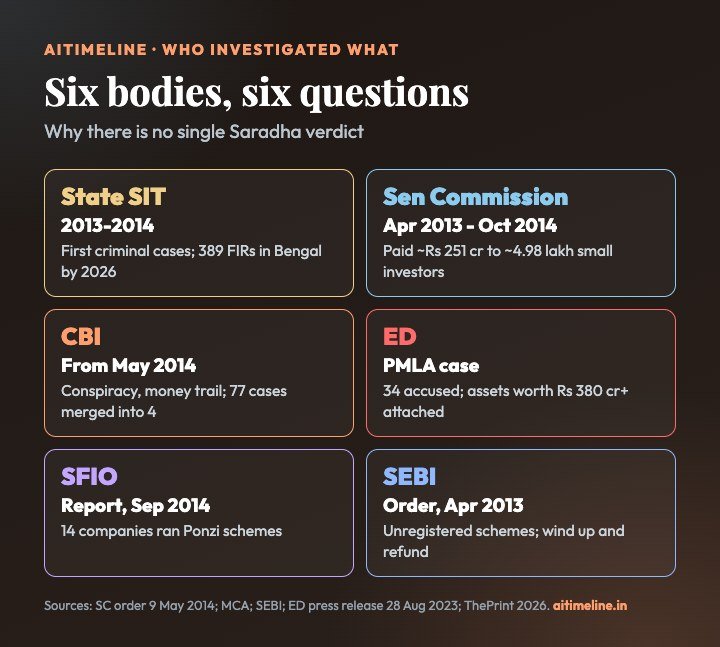
| Body | Role | Key output |
|---|---|---|
| West Bengal Police SIT | First criminal investigation, 2013-14 | Hundreds of local cases; arrested Sen and Kunal Ghosh |
| Shyamal Sen Commission | State inquiry and refunds, April 2013 to October 2014 | About Rs 251 crore paid to about 4.98 lakh small investors |
| CBI | Supreme Court-ordered probe into conspiracy and the inter-state money trail | 77 cases merged into four; first charge sheet October 2014 |
| Enforcement Directorate | Money laundering under the PMLA | 34 accused prosecuted; assets worth over Rs 380 crore provisionally attached |
| SFIO | Company-law investigation | 14 companies ran Ponzi schemes (15 September 2014) |
| SEBI | Securities regulator | Wind-up and refund order against Saradha Realty, 23 April 2013 |
The Political Controversy
Allegations, questioning, arrests and convictions are four different things.
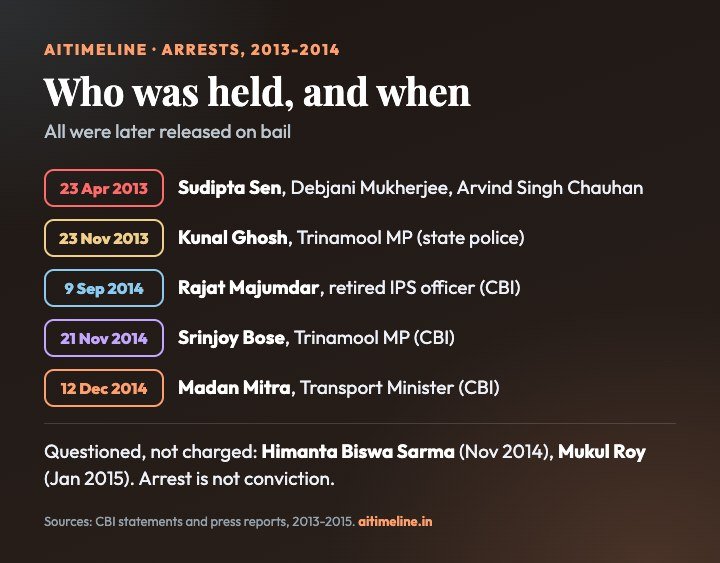
Saradha became political because the people around it were political. Two Trinamool Congress Rajya Sabha members and a serving state minister were arrested. The CBI also questioned Himanta Biswa Sarma, then a Congress minister in Assam, and Mukul Roy, then the Trinamool’s second-in-command. Both later joined the BJP, and critics of the CBI pointed out that no action followed against either; Roy later returned to the Trinamool. Sen’s letters of 2013 and 2020 named politicians from the Trinamool, the Congress, the CPI(M) and, by 2020, people who had moved to the BJP.
The fight peaked on 3 February 2019, when Kolkata Police detained a CBI team sent to question Police Commissioner Rajeev Kumar and Chief Minister Mamata Banerjee began a sit-in, calling it an attack on federalism. The Supreme Court ordered Kumar to cooperate in Shillong, without arrest. No court or agency has charged Mamata Banerjee in the case. The pattern resembles West Bengal’s other great political battles, from Singur and Nandigram to the RG Kar hospital case: investigations that matter as much for the politics as for the outcome.
What was alleged vs what was established
- Payments to politicians: claimed in Sen’s letters of 2013 and 2020.
- Fees and benefits: charge sheets against Nalini Chidambaram and others.
- Evidence withheld: the CBI’s claim against Rajeev Kumar, which he denied.
- Ponzi schemes: SFIO finding on 14 companies, 2014.
- Unregistered schemes: SEBI order, April 2013.
- Court outcomes: three acquittals for Sen, many bail orders, no convictions of him so far.
Why the Cases Never End
389 cases in West Bengal alone, and counting outside it.
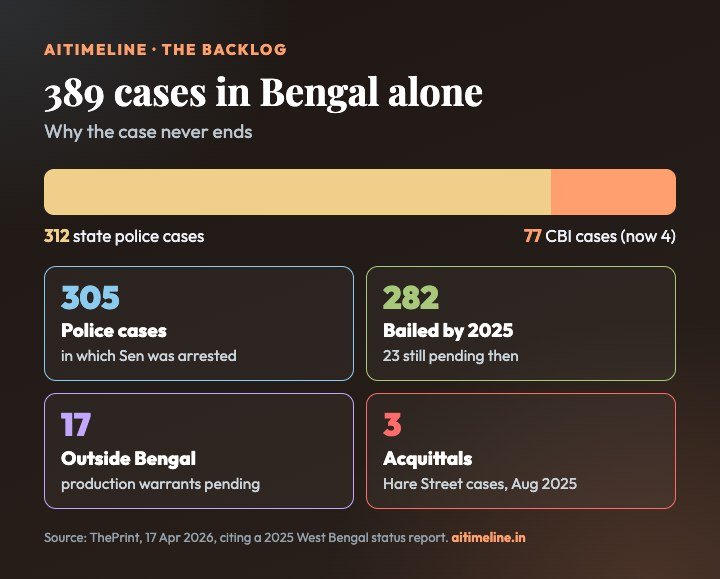
Each depositor’s complaint could become its own FIR, so the case multiplied into hundreds of trials in different courts, each with its own witnesses, papers and production orders. When the Calcutta High Court bailed Sen on 8 April 2026, it described “a systemic collapse of the trial machinery” in Barasat, where a decade had gone on supplying documents. The first trials to finish, in August 2025, ended in acquittals for want of proof. Compare the faster, if equally contested, endings of other large frauds such as the Telgi stamp paper scam.
What Happened to the Investors
- Immediate losses: savings meant for weddings, school fees and medical bills disappeared when payments stopped in April 2013.
- Agents in the firing line: collection agents faced neighbours demanding their money; suicides linked to the collapse were reported, though no official count exists.
- State relief: the Shyamal Sen Commission paid about Rs 251 crore to roughly 4.98 lakh small depositors, from a fund paid for by taxpayers.
- Unfinished refunds: many cheques bounced, and the commission was wound up in October 2014 before finishing; the Calcutta High Court later questioned why.
- Attached, not returned: the ED’s attachments of over Rs 380 crore are provisional and must survive court challenges before assets can be sold.
Where Things Stand
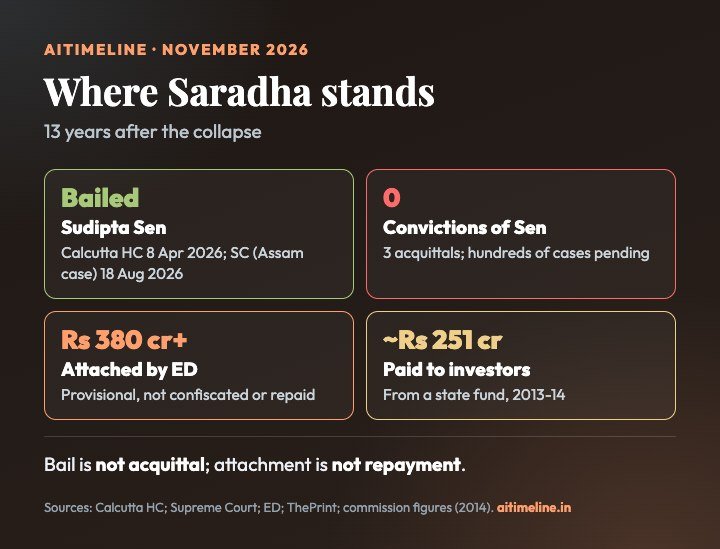
Thirteen years on, the accused have mostly been released, the investigators are still filing papers, and the investors are still waiting. The lessons have been partly learned: Parliament banned unregulated deposit schemes in 2019, and West Bengal has its depositor-protection law. What Saradha never produced is the thing a fraud trial is for: a judgment on who was responsible, and a plan to return what was taken. For other cases of banks and lenders failing their depositors, see our timelines of the PNB-Nirav Modi fraud and the IL&FS default.
Key People
| Person | Role |
|---|---|
| Sudipta Sen | Founder and chairman of the Saradha Group; arrested 2013, bailed 2026; not convicted |
| Debjani Mukherjee | Group director; arrested with Sen; acquitted with him in three cases in 2025 |
| Kunal Ghosh | Former Trinamool Rajya Sabha MP and head of Saradha’s media arm; arrested 2013, bailed 2016 |
| Srinjoy Bose | Former Trinamool Rajya Sabha MP; arrested by CBI 2014, bailed 2015 |
| Madan Mitra | Former West Bengal Transport Minister; arrested 2014, bailed 2016 |
| Rajeev Kumar | Headed the state SIT; Kolkata Police Commissioner during the 2019 standoff |
| Justice Shyamal Kumar Sen | Retired Calcutta High Court Chief Justice; headed the state commission |
| Justices T.S. Thakur and C. Nagappan | Supreme Court bench that ordered the CBI probe in May 2014 |
Facts at a Glance
| Question | Answer |
|---|---|
| Founder | Sudipta Sen |
| Group established | 2006 |
| Main states | West Bengal, Assam, Odisha, Jharkhand, Tripura |
| Collapse | April 2013 |
| Founder arrested | 23 April 2013, Sonamarg |
| SEBI wind-up order | 23 April 2013 |
| Supreme Court CBI order | 9 May 2014 |
| SFIO finding | 14 companies ran Ponzi schemes (15 Sep 2014) |
| ED attachments | Over Rs 380 crore, provisional (Aug 2023) |
| Cases in West Bengal | 389 (ThePrint, April 2026) |
| Sen bailed | 8 April 2026 (Calcutta HC); 18 Aug 2026 (SC, Assam case) |
Explore More Timelines
People Also Ask
Frequently Asked Questions
Based on court orders, agency releases and reporting to 14 November 2026.
⚠️ Editorial Note
This page separates the SFIO’s company-law findings, SEBI’s regulatory order, the CBI’s criminal investigation, the ED’s money-laundering case and individual court outcomes. Collection and investor figures are estimates and vary by source; none is a final audited loss. Allegations in Sudipta Sen’s letters and in charge sheets are not findings of guilt, and people named, questioned or arrested are presumed innocent unless convicted. Checking the record, we corrected the brief we worked from: Sen was detained and arrested on 23 April 2013, not 24 April; Rajat Majumdar was arrested on 9 September 2014; Himanta Biswa Sarma was questioned on 26 November 2014, not in 2015; and the depositor-protection law received assent on 25 March 2015 rather than gaining attention in 2016. We added the Supreme Court’s 18 August 2026 bail order in the Assam CBI case. We could not open The Indian Express report on the April 2026 bail order, so we describe its conditions from other reports; we could not trace the Rs 3,500 crore estimate to a primary record. This page is not legal or financial advice.
Related Reading on AiTimeline
Sources & further reading
Every dated entry above was checked against these references. Last reviewed 14 November 2026.
- SFIO completes investigation of 14 companies (Saradha Group), 15 September 2014
- Order in the matter of Saradha Realty India Ltd, 23 April 2013
- CBI probe into Saradha chit fund scam: Supreme Court judgment, 9 May 2014
- SC orders CBI probe into chit fund scams, 10 May 2014
- Saradha scam: ED files fresh chargesheet, names ex-West Bengal DGP, ex-CPM MLA, others, August 2023
- Saradha: ED attaches assets of beneficiaries including P Chidambaram's wife, ex-CPM MLA, February 2023
- West Bengal Protection of Interest of Depositors in Financial Establishments Act, 2013 (Act XXIX of 2013)
- After 13 years, Saradha chit fund scam accused Sudipta Sen to be out on bail, 8 April 2026
- Saradha scam trials: 13 yrs on, Bengal's biggest financial fraud stuck in a 'stalemate' in courts, 17 April 2026
- Supreme Court grants bail to Sudipta Sen in CBI case after nearly 10 years' custody, August 2026
- Kolkata court acquits Saradha Ponzi scam accused Sudipto Sen, Debjani Mukherjee, August 2025
- How police caught Sudipta Sen, 23 April 2013
- Saradha scam: CBI files chargesheet against Nalini Chidambaram, January 2019