Iran War and Filipino Households: How Fuel, Food, OFWs and Inflation Are Affected
How the 2026 Iran war affects Filipino households through fuel prices, food costs, OFW remittances, the peso and inflation, with dated PSA and BSP data.
Latest Story
A missile fired near the Strait of Hormuz does not show up on a Filipino household’s monthly budget as a headline. It shows up as a jeepney driver adding two pesos to the fare, a Meralco bill with an unfamiliar line item, or a remittance from an aunt in Riyadh that arrives a few days later than usual. The 2026 Iran war has already reached the Philippines this way, not through any direct military connection but through the pipes that move oil, cargo and labor between the Gulf and Southeast Asia. Brent crude has swung from under $60 a barrel in December 2025 to above $120 in April 2026 and back to the high $80s by mid-August, tracking a conflict that has opened, closed, and reopened the Strait of Hormuz more than once this year. This article traces that chain link by link — from the strait to the pump, from the pump to the jeepney fare, from the fare to the household budget — and separates what Philippine government data actually confirms from what remains a risk, a scenario, or simply unclear. It also puts real numbers on Iran war impact on Filipino households: fuel prices, food costs, OFW remittances, inflation and the peso, each dated and sourced.
🔔 Latest Update — August 2026
Conflict status: The US-Iran ceasefire declared April 8, 2026 collapsed in early July 2026; Washington told Tehran the ceasefire was “no longer in effect,” and fresh US sanctions followed. The Strait of Hormuz — briefly reopened toll-free from mid-June under a US-Iran memorandum of understanding — has been effectively closed again since early July after attacks on commercial vessels. As of August 17, 2026, only about 1 ship transited the strait on August 9 versus roughly 73 per day under normal conditions (source: Hormuz Strait Monitor tracking, cross-referenced with Al Jazeera live coverage). Jared Kushner was in Egypt and Israel the week of August 16 for renewed mediation talks; no new ceasefire had been confirmed at the time of writing.
Oil: Brent crude was $88.31/barrel on August 17, 2026, down slightly from $89.81 on August 4 (Trading Economics, Fortune). PH fuel: national average diesel was ₱87.38/liter and gasoline ₱77.16/liter on August 17; DOE-tracked pump prices were set to rise again from August 18 (+₱3.84/L diesel, +₱2.49/L gasoline) after a late-July spike of over ₱7/liter (TopGear PH, citing DOE data). Inflation: PSA reported headline inflation eased to 6.2% in July 2026 from 6.4% in June, though it remains above the government’s 2–4% target band (PSA, reported August 5, 2026). OFWs: Iran, Iraq and Syria remain under DMW/OWWA Alert Level 4 (mandatory repatriation); no new mass-evacuation order for Gulf Cooperation Council states was issued as of mid-August. Remittances: BSP’s most recent published monthly total (May 2026) showed $2.713 billion in cash remittances, up 2% year-on-year; a June or July 2026 figure was not yet published at the time of writing. Government response: the DOE’s nationwide ₱10/liter Fuel Subsidy Program for public utility vehicle drivers remains active, and BSP’s policy rate stands at 4.75% after back-to-back hikes in April and June 2026.
🧠 AI Overview Summary
The 2026 Iran war affects Filipino households mainly through global oil prices, not direct oil imports from Iran. Strait of Hormuz disruptions push Brent crude higher, which raises Philippine pump prices, transport fares, electricity generation costs and food logistics costs — feeding into inflation that peaked at 7.2% in April 2026 and eased to 6.2% by July. A separate channel runs through the roughly 40% of Overseas Filipino Workers based in the Middle East, where war risk affects employment and remittance flows, though total remittances from the region have so far stayed resilient.
Iran War and Filipino Households: Key Questions
What to Know About the Iran War’s Impact on Filipino Households
- The Philippines does not import meaningful oil volumes from Iran directly — the exposure runs through global crude benchmarks (Brent, Dubai), which move on Strait of Hormuz risk regardless of who ships through it.
- The Strait of Hormuz has closed and reopened multiple times in 2026: effectively shut from March 2, briefly reopened mid-June under a US-Iran deal, closed again in early July, and still effectively closed as of August 17.
- Philippine inflation peaked at 7.2% in April 2026 and has since eased to 6.2% in July — still above the 2–4% target band, with the Middle East oil shock as one driver among several, not the sole cause.
- BSP raised its policy rate twice in 2026 (to 4.5% in April, 4.75% in June), its first tightening cycle in two years, explicitly citing Middle East-driven inflation risk.
- OFW risk is not uniform. Iran, Iraq and Syria sit at DMW/OWWA Alert Level 4 (mandatory repatriation); the Gulf states hosting most Middle East-based Filipino workers do not.
- Middle East remittances have so far proven resilient, rising 19.94% month-on-month in March 2026, even as the region contributes less than a fifth of total OFW remittance value.
- The government response has been active, not passive: a nationwide ₱10/liter fuel subsidy for public transport drivers, DA food-logistics measures, and two BSP rate hikes are all already in place.
- Electricity costs have risen partly, not wholly, because of the conflict — Meralco has cited Middle East-linked Power Supply Agreement costs alongside domestic transmission and generation charges.
- “Iran war” is the commonly used shorthand, including in Wikipedia’s and Britannica’s own 2026 event naming — but the ceasefire history is genuinely tangled, and this article treats every date and figure as dated evidence, not settled history.
What Happened in Iran? A Concise Explainer
Just enough background to explain the economics — not a military chronology
What English-language sources, including Wikipedia and Britannica, are now referring to as the 2026 Iran war escalated from strikes by the United States and Israel on Iranian targets in early 2026. A ceasefire was declared on April 8, 2026, and President Trump extended it indefinitely on April 21 — but the truce proved tenuous, with violations reported from both sides in the months that followed. By July 2026, talks had deteriorated: the US informed Tehran the ceasefire was “no longer in effect,” fresh US sanctions were imposed on Iran, and on July 12 Iran’s Revolutionary Guard Corps (IRGC) announced it had closed the Strait of Hormuz after firing on a vessel attempting an unauthorized route.
This is why “Iran war” terminology needs a caveat rather than a clean definition: there was a formal ceasefire, it was extended, it broke down, and as of mid-August 2026 mediators including Jared Kushner were still shuttling between regional capitals without a confirmed new deal. This article uses “the 2026 Iran war” as the commonly adopted shorthand for the conflict and its ceasefire-and-collapse cycle, while treating any specific claim about troop movements, casualties or military strategy as outside its scope. The relevant fact for Filipino households is narrower and more stable than the military situation itself: the Strait of Hormuz, the world’s most important oil chokepoint, has been repeatedly disrupted in 2026, and that disruption is what reaches Philippine kitchens and jeepneys — not the war’s tactics.
Why the Philippines Could Be Affected
Two transmission chains: one through oil, one through overseas workers
Chain 1 — Oil and Prices
- Iran conflict / Strait of Hormuz disruption
- ↓ Global oil-supply risk premium
- ↓ Brent / Dubai crude prices rise
- ↓ Philippine pump (fuel) prices rise, set weekly by DOE-tracked refiners
- ↓ Transportation costs rise (jeepneys, buses, delivery, shipping)
- ↓ Food and logistics costs rise (transport is embedded in farm-to-market pricing)
- ↓ Headline and core inflation rise
- ↓ Household budgets absorb the difference
Chain 2 — OFWs and Remittances
- Middle East conflict / regional instability
- ↓ OFW employment and travel-safety risk (varies sharply by host country)
- ↓ Possible remittance disruption or, alternatively, precautionary remittance increases
- ↓ Household income uncertainty for the roughly 40% of OFWs based in the Middle East
- ↓ Consumption and savings decisions inside the household
- ↓ Aggregate effect on national remittance inflows and the peso
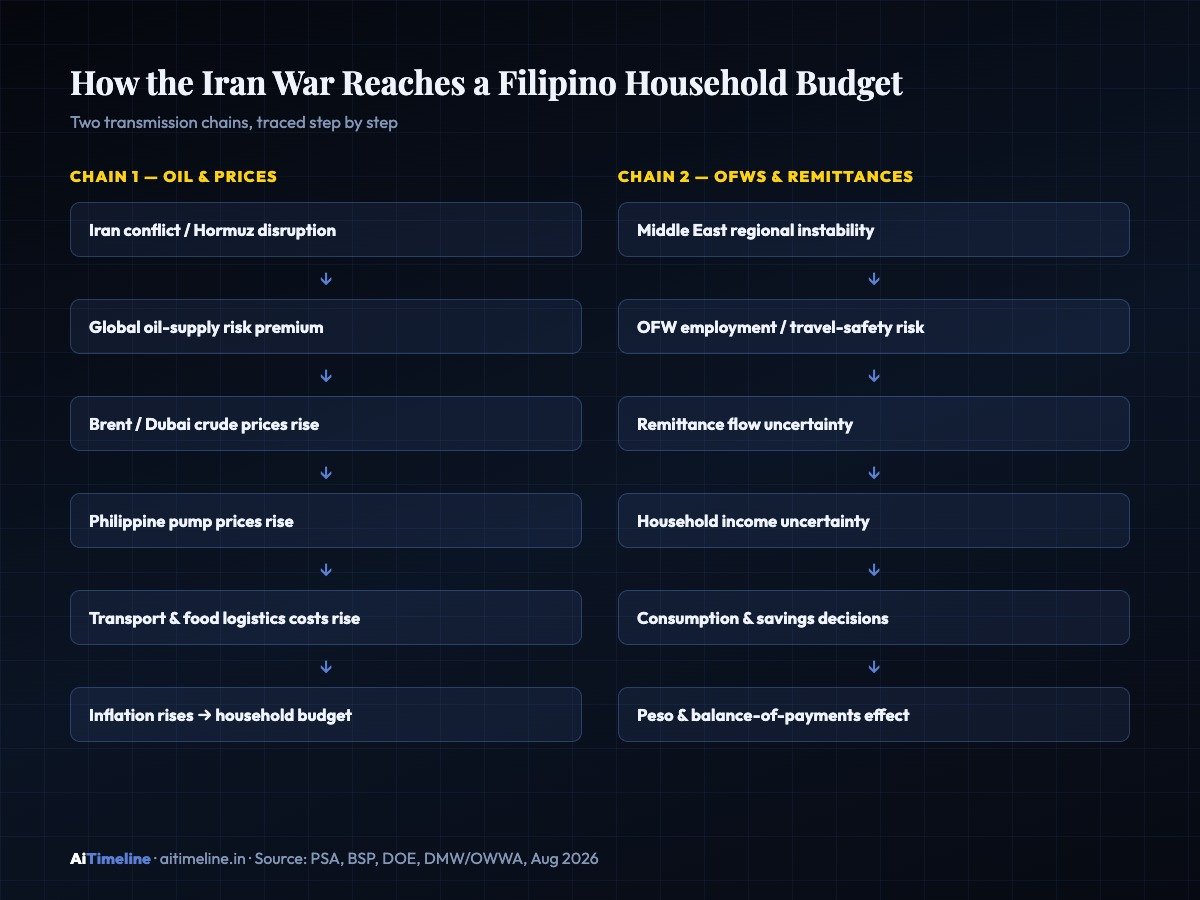
GRAPHIC: The two transmission chains, traced step by step — AiTimeline
These two chains are related but distinct, and conflating them is a common error in casual coverage. A household with no OFW member can still feel Chain 1 in full through fuel and food prices alone. A household with a relative working in Dubai or Riyadh feels both chains, but Chain 2’s actual effect on that household depends heavily on which country the relative is in and what sector they work in — a construction worker in Qatar and a nurse in Israel face very different exposure.
The Oil Channel: Why a War Involving Iran Moves Philippine Fuel Prices
Global crude benchmarks, not direct imports, are the real transmission mechanism
It is a common misconception that Philippine fuel prices move because the Philippines buys oil from Iran. It does not, in any meaningful volume — Philippine crude imports are sourced mainly from Gulf and Southeast Asian suppliers via long-term contracts, not from Iran, which has been under varying degrees of Western sanction for years. The actual mechanism is global, not bilateral: Iran is a major OPEC producer, and the Strait of Hormuz — the narrow waterway between Iran and Oman through which roughly a fifth of global oil and a substantial share of global LNG normally transits — is the chokepoint that matters. When Iran restricts or is perceived to threaten shipping through the strait, Brent and Dubai crude prices rise on supply-risk expectations alone, even before any actual shortage materializes. Because the Philippines imports nearly all its petroleum products and prices them off these same global benchmarks, the effect reaches Manila within days, not months.
Do not claim, and this article does not claim, that “all Philippine oil passes through the Strait of Hormuz.” Asian oil demand broadly is highly dependent on Gulf supply that transits Hormuz, but the Philippines’ own crude sourcing mix specifically was not confirmed in DOE data reviewed for this article; the accurate claim is the price-benchmark linkage above, not a direct physical-supply claim.
Fuel Prices in the Philippines: The 2026 Rollercoaster
DOE-tracked weekly price movements, national average, per liter
| Week / Date | Gasoline movement | Diesel movement | Context |
|---|---|---|---|
| Jul 28 – Aug 3, 2026 | +₱6.80/L | +₱7.32/L | Sharp spike as ceasefire collapse and Hormuz closure fed through |
| Early-mid Aug 2026 | Partial rollback | Partial rollback | Brief relief; national average settled near ₱77.16/L gasoline, ₱87.38/L diesel by Aug 17 |
| Aug 18–24, 2026 | +₱2.49/L | +₱3.84/L | Renewed increase confirmed for the week; kerosene +₱5.01/L |
A note on precision: different Philippine outlets reported slightly different per-liter figures for adjustments in the same mid-August window, likely reflecting different reporting cycles or rounding across DOE-tracked oil companies. The direction — a net increase for the week of August 18 after a brief rollback — is consistent across sources; this article does not present a single decimal figure as more authoritative than DOE’s own weekly bulletin, which readers can check directly (see Sources).
Food Prices: An Indirect, Not Automatic, Effect
Energy shocks reach the grocery counter through logistics and inputs, not instantly or uniformly
Higher fuel costs raise food prices indirectly — through farm-to-market transport, cold-chain and delivery costs, imported fertilizer and animal feed, and fishing-fleet fuel costs — rather than through any direct link between Iran and Philippine agriculture. Agriculture Secretary Francisco Tiu Laurel Jr. attributed rising fuel and production costs in 2026 mainly to Middle East geopolitical tensions, and one analysis put food inflation at 6.1% at a point when the oil shock was most acute. Rice, the Philippines’ most politically sensitive staple, saw regular milled rice average ₱51.11/kilo in April 2026, up from ₱48.69/kilo in mid-March; the Department of Agriculture studied a ₱50/kilo price cap on imported rice around the same period. By May 2026, rice prices had eased somewhat even as fish and vegetable costs climbed — a reminder that food inflation in 2026 has multiple drivers (weather, local supply, import policy) beyond the oil shock alone. One Rappler report flagged a projected rise to ₱62/kilo by September 2026 — explicitly a forecast, not a confirmed price.
The DA’s response has focused on logistics rather than price controls alone: reactivating food lanes to speed agricultural transport, removing toll fees for agri-trucks, cutting port charges, and extending fuel subsidies to transport stakeholders in the food supply chain.
Electricity: A Partial, Documented Link
The Philippine grid is not oil-dependent, but imported gas and coal costs still transmit the shock
Oil-based power generation is a small share of the Philippine energy mix, which leans on coal, natural gas, and a growing renewables share. That means Meralco bills do not move purely on Brent crude the way pump prices do — but they are not immune either, because the Philippines also imports the coal and LNG that fuel a large share of its generation, and those commodities are priced in globally linked markets that also react to Middle East supply risk. Meralco’s own public rate notices document this: a March 2026 increase of ₱0.6427/kWh cited transmission and generation charges; an April increase of ₱0.5335/kWh noted that rates had “yet to reflect” expected Middle East-driven fuel increases; and by July 2026, Meralco explicitly attributed part of a rate hike to Power Supply Agreement costs rising “due to the impact of the continuing Middle East conflict on the global energy market.” The honest summary: electricity costs have risen for multiple reasons in 2026, and the Iran war is one documented contributor, not the sole cause.
Transportation: Where Households Feel It First
Jeepneys, buses, delivery riders and shipping all price fuel directly into fares
Transportation is usually the fastest-moving link in the chain because Philippine public transport fares and delivery pricing are directly indexed, formally or informally, to diesel and gasoline costs. PSA data shows this in the inflation basket itself: the transport index rose 12.8% year-on-year in June 2026 before slowing to 11.9% in July as fuel prices partially rolled back — still a heavy load on commuter households, and consistent with the diesel and gasoline price swings tracked above. Jeepney and bus operators, along with public utility vehicle drivers more broadly, are also the specific group targeted by the government’s fuel subsidy program (see Government Response below), a signal of where policymakers see the most immediate pressure.
Inflation: How an Oil Shock Reaches the CPI Basket
The Iran war is one driver among several — not the sole explanation for 2026 price levels
| Month (2026) | Headline inflation | Note |
|---|---|---|
| March | 4.1% | Pre-peak level, PSA |
| April | 7.2% | Cycle peak, PSA |
| May | 6.8% | Eased on domestic fuel rollbacks, PSA |
| June | 6.4% | Core inflation hit 4.4%, a 31-month high, PSA |
| July | 6.2% | Jan–Jul average: 5.0%, still above 2–4% target, PSA (reported Aug 5, 2026) |
The rise in core inflation to a 31-month high in June 2026, even as headline inflation eased, is a meaningful technical signal: it suggests the oil shock had, by mid-2026, moved beyond a temporary supply blip and begun feeding into services, rents and wage expectations — a slower-moving, stickier form of inflation than a simple fuel-price pass-through. This article does not attribute the full 5.0% year-to-date average inflation rate to the Iran war; domestic demand, prior-year base effects and non-energy factors all contribute, and PSA’s own release cites transport, education and restaurant/accommodation costs as easing components in July specifically.
OFWs: Who Is Actually at Risk, and How Much
Alert levels vary by country — this is not a uniform risk across the Middle East
Lead Agency for OFW Protection
Coordinates whole-of-government response for Filipinos abroad; has “intensified aid” to OFWs in the Middle East in 2026 while stating no mass repatriation was underway as of the most recent DMW statements reviewed.
Overseas Workers Welfare Administration
Activated emergency protocols for over 33,000 OFWs in the Middle East through its regional office network (OWWA-7 alone covers over 33,000); confirmed 1,189 OFWs sought repatriation assistance amid the tensions.
Department of Foreign Affairs
Manages country-specific travel advisories and alert levels; President Marcos directed DFA and DMW jointly to locate and assist Filipinos in affected areas as the conflict escalated in early 2026.
Iran, Iraq, Syria
Mandatory repatriation status under the DMW/OWWA alert system. The February 28, 2026 advisory separately covers Filipinos in Israel, Jordan, Oman, Qatar, Lebanon, UAE, Bahrain, Kuwait and Saudi Arabia at lower alert levels.
It is not accurate to say “Filipino OFWs in the Middle East will lose their jobs.” The Middle East hosts roughly 40% of all OFWs, spread across construction, healthcare, engineering, domestic work and other sectors in countries with very different exposure to the conflict. A worker in Saudi Arabia’s Eastern Province and a worker in a mandatory-repatriation country like Iraq are not facing comparable risk, and government data reviewed for this article does not show broad Gulf-wide job losses tied to the war as of August 2026.
Remittances: The Data So Far Shows Resilience, Not Collapse
Middle East inflows have risen in 2026, even as they remain a minority of total remittances
| Period (2026) | Figure | Source |
|---|---|---|
| January | $3.02B total cash remittances (+3.5% YoY) | BSP, via PNA |
| February | 9-month low (specific figure not independently confirmed in sourcing reviewed) | BSP, via Tribune |
| March | Middle East remittances: $565.91M (+19.94% MoM); Saudi Arabia alone: $194.79M (+28.37% MoM) | BSP |
| May | $2.713B total (+2% YoY); Jan–May cumulative $14.11B (+2.5% YoY) | BSP |
| Jun–Jul | Not yet published at time of writing | — |
The Middle East hosts an estimated 40% of all OFWs but historically supplies under 20% of total remittance value — the United States, not any Gulf state, remains the single largest source, followed by Singapore and Saudi Arabia. This matters for how much a Middle East disruption could plausibly move the national remittance total even in a worse scenario: significant for individual households with a Gulf-based relative, but a smaller share of the aggregate national number than intuition might suggest.
The Philippine Peso: Pressured, Not Collapsing
A higher oil import bill adds dollar demand — BSP is actively managing the response
Higher global oil prices raise the Philippines’ import bill, which can add to dollar demand and put downward pressure on the peso — this is a plausible, partially observed mechanism, not a guaranteed one-to-one relationship, since remittances, BPO export earnings and portfolio flows move the peso too. The BSP’s reference rate stood at ₱61.35 per US dollar on August 14, 2026. This article does not claim direct, isolated causality between the Iran war and this specific level; BSP’s own public statements have framed 2026 rate decisions around inflation control broadly, with Middle East-linked oil costs as one named factor among several, alongside global monetary conditions and domestic demand.
BSP’s Response: Two Rate Hikes in 2026
First tightening cycle in two years, explicitly tied to Middle East-driven inflation risk
| Date | Action | Stated reason |
|---|---|---|
| Apr 23, 2026 | Policy rate raised to 4.5% | Middle East conflict “deteriorating” inflation outlook — first hike in two years |
| Jun 18, 2026 | Policy rate raised to 4.75% | Elevated global oil and fertilizer prices; second consecutive hike |
BSP’s own forecast, as of mid-2026, put average inflation at around 6.4% for the full year 2026, easing to 4.5% in 2027 and finally within the 2–4% target band at 3.1% in 2028 — a projection, not a guarantee, and one that assumes no further major oil-price shock.
Government Response: What Manila Has Actually Done
Real, confirmed measures — not a hypothetical policy wishlist
| Agency | Measure | Status / date |
|---|---|---|
| DOE / DBM | ₱10/liter nationwide Fuel Subsidy Program for PUV drivers (jeepney, bus, taxi, TNVS); up to ₱1,500/vehicle/week for 3 months | Expanded nationwide, 2026; ₱2.49B fast-tracked, 139,000+ Metro Manila drivers benefited initially |
| DOE | Nationwide fuel price ceilings during acute shortage window | In effect through March 9, 2026 |
| DBM | ₱3.0 billion released for fuel subsidy and fare-discount programs | 2026 |
| DA | Reactivated food lanes, removed agri-truck toll fees, cut port charges, fuel subsidies for food-supply transport | 2026, ongoing |
| BSP | Two policy rate hikes (4.5% then 4.75%) | Apr and Jun 2026 |
| DMW / OWWA | Alert-level system, emergency protocols, repatriation assistance for 1,189+ OFWs | Active since Feb 2026 advisory |
| DFA | Country-specific travel advisories, coordination with DMW on affected-area Filipinos | Ongoing since early 2026 |
Household Budget Scenarios
ILLUSTRATIVE SCENARIO — NOT A FORECAST. Ranges only, based on transparent assumptions.
| Scenario | Oil / Hormuz condition | Fuel | Transport & food | Illustrative household effect |
|---|---|---|---|---|
| 1. Limited disruption | Brief Hormuz friction, no sustained closure | Small, temporary pump-price bumps | Modest fare/food pass-through, weeks not months | A few hundred pesos/month in extra transport and food costs for a typical commuting household |
| 2. Prolonged disruption | Recurring closures, similar to actual 2026 pattern | Repeated multi-peso weekly swings, as tracked above | Sustained fare and food pressure, inflation stays above target | Low-hundreds to low-thousands of pesos/month depending on transport dependence and household size |
| 3. Severe, extended closure | Strait effectively shut for months, as seen Mar–Jun and Jul–Aug 2026 | Sharp, sustained pump-price increases | Broad-based food, transport and electricity pressure; BSP forced into further tightening | Materially higher monthly costs across fuel, food, transport and electricity; disproportionately affects transport-heavy and low-income households |
Illustrative Household Examples
Hypothetical, clearly labeled — not real households or national averages
Transport-heavy commuter family
A jeepney- and tricycle-dependent household spending a large share of income on daily fares is proportionally hardest hit by transport-index inflation (11.9%–12.8% YoY through mid-2026) and is the intended beneficiary of the PUV fuel subsidy program.
OFW household, Gulf-based relative
Income partly depends on a remittance from a lower-alert-level Gulf country; March 2026 BSP data showed Middle East remittances rising, not falling, but this household’s exposure depends entirely on which country and sector the relative works in.
Urban, Meralco-billed household
Feels the electricity-rate line item directly (Meralco’s documented 2026 increases), plus food and fuel, but has more budget flexibility to absorb short-term swings than lower-income households.
Provincial small-business household
A household running a small transport, retail or agri-supply business faces both a personal cost-of-living increase and a business-input cost increase (fuel, logistics), a double exposure not captured by consumer inflation figures alone.
What Filipino Families Can Watch
A practical monitoring checklist — useful beyond today’s headlines
- DOE weekly fuel-price bulletins (doe.gov.ph, Oil Monitor)
- PSA monthly Consumer Price Index and inflation releases (psa.gov.ph)
- BSP policy rate announcements and peso reference rate (bsp.gov.ph)
- DFA and DMW travel advisories and alert-level updates for Middle East countries
- BSP monthly OFW cash remittance data
- Brent and Dubai crude oil price movements
- USD/PHP exchange rate
- Local transport fare and delivery-fee announcements
- Meralco (or local utility) rate adjustment notices
- DA and local market food-price bulletins
What This Does Not Mean
Myth-busting the most common overstatements
❌ The Iran War Does NOT Automatically Mean
- All Philippine fuel prices double — actual 2026 moves have been multi-peso weekly swings, not a doubling
- All OFWs in the Middle East lose their jobs — risk is country- and sector-specific
- The peso collapses — it has weakened, not crashed, and BSP is actively managing policy
- Food prices immediately explode — the transmission is indirect, through logistics and inputs, over weeks
- Electricity prices rise purely because of Iran — oil is a small share of PH generation; multiple factors are in play
✅ What Is Actually Documented
- Real, tracked weekly fuel-price swings tied to global crude benchmarks
- A measurable inflation cycle (peak 7.2% in April, easing to 6.2% by July)
- Two BSP rate hikes explicitly citing Middle East-linked inflation risk
- Country-specific OFW alert levels, not a blanket Middle East evacuation
- Active, funded government subsidy and logistics programs already running
Claim vs. Fact
What we know versus what remains uncertain, projected, or overstated
| Claim | Status |
|---|---|
| Iran conflict will make Philippine fuel prices rise | CONFIRMED (documented, dated DOE-tracked weekly moves) — but future moves remain dependent on global crude markets |
| Filipino OFWs will lose their jobs | NOT UNIVERSALLY TRUE — risk varies by country/alert level and sector |
| The peso will collapse | UNSUPPORTED by evidence reviewed; weakening documented, “collapse” is not |
| Food prices will rise | POSSIBLE / PARTIALLY CONFIRMED indirect effect, via energy, logistics and input costs — not automatic or uniform |
| Rice could reach ₱62/kilo by September 2026 | PROJECTED (Rappler/DA-sourced forecast), not a confirmed price |
| Middle East OFW remittances are falling | CONTRADICTED by available BSP data through March 2026, which shows a rise |
| Electricity prices are rising solely because of Iran | PARTIALLY CONFIRMED — Meralco cites it as one contributing factor, not the only one |
| All Philippine oil comes from the Middle East via the Strait of Hormuz | UNVERIFIED / imprecise — the real link is global benchmark pricing, not confirmed direct-import volumes |
Complete Timeline: Conflict, Oil Markets and the Philippine Economy
Newest first — every entry dated, sourced and labeled by type
Strait of Hormuz Effectively Closed; Brent at $88.31
What happened: Only around 1 ship transited the strait on August 9 versus roughly 73/day normally; major container carriers remain on Cape of Good Hope routing for the rest of 2026. Brent crude traded at $88.31/barrel, PH national average diesel at ₱87.38/liter.
Kushner Mediates as Multiple Middle East Conflicts Continue
What happened: Jared Kushner met regional leaders in Egypt and Israel as mediation efforts continued; no new US-Iran ceasefire had been confirmed at the time of writing.
PSA: Inflation Eases to 6.2% in July
What happened: PSA reported headline inflation slowed to 6.2% from June’s 6.4%; transport index growth slowed from 12.8% to 11.9% year-on-year as fuel prices partially rolled back.
Ceasefire Collapses; Hormuz Closes Again
What happened: The US informed Iran the ceasefire was “no longer in effect” and imposed fresh sanctions; on July 12 the IRGC announced closure of the Strait of Hormuz after firing on a vessel using an unauthorized route, following attacks on commercial vessels in the strait.
Strait of Hormuz Briefly Reopens; BSP Hikes Rate to 4.75%
What happened: A mid-June US-Iran memorandum of understanding reopened the strait toll-free (traffic stayed well below normal); the same month, BSP raised its policy rate to 4.75%, citing elevated global oil and fertilizer prices.
Inflation Eases to 6.8% on Domestic Fuel Rollbacks
What happened: Headline inflation eased from April’s peak as fuel prices rolled back domestically; rice prices eased even as fish and vegetable costs climbed.
BSP’s First Rate Hike in Two Years
What happened: BSP raised its policy rate to 4.5%, citing the Middle East conflict “deteriorating” the inflation outlook — its first tightening in two years.
Inflation Peaks at 7.2%; Brent Hits 52-Week High of $120.88
What happened: Philippine headline inflation hit its 2026 cycle peak; Brent crude reached its 52-week intraday high on April 30. Meralco’s April rate notice separately flagged that charges had not yet fully reflected expected Middle East-driven fuel increases.
Strait of Hormuz Effectively Closes After US-Israeli Strikes
What happened: Following US and Israeli strikes on Iran, the Strait of Hormuz became effectively closed to routine commercial shipping — the disruption that would recur through the rest of 2026.
OWWA Issues Middle East Safety Advisory
What happened: OWWA advised OFWs in Israel, Jordan, Oman, Qatar, Lebanon, UAE, Bahrain, Kuwait, Saudi Arabia and Iran to monitor official advisories, identify shelters, and prepare for emergency alerts; Iraq, Syria and Iran were placed under Alert Level 4 (mandatory repatriation).
US-Iran Ceasefire Declared
What happened: A ceasefire between the United States and Iran was agreed upon, later extended indefinitely by President Trump on April 21 — though violations from both sides were reported in the following months.
Philippine Response Timeline
Government, DOE, BSP, DA, DMW/OWWA and Meralco actions only — newest first
DOE Fuel Price Update Confirms Renewed Increase
What happened: Gasoline +₱2.49/L, diesel +₱3.84/L, kerosene +₱5.01/L, effective August 18, following a brief early-August rollback.
Meralco Cites Middle East Conflict in Rate Hike
What happened: Meralco attributed part of a residential rate increase directly to Power Supply Agreement charges rising “due to the impact of the continuing Middle East conflict on the global energy market.”
BSP Second Rate Hike: 4.75%
What happened: Second consecutive policy-rate hike, citing elevated global oil and fertilizer prices tied to the ongoing Middle East crisis.
Fuel Subsidy Program Expands Nationwide
What happened: The ₱10/liter Fuel Subsidy Program expanded to all fuel retailers nationwide with tighter compliance oversight, widening access for PUV drivers beyond the initial Metro Manila rollout.
Marcos Rolls Out PUV Service Contracting Program
What happened: Alongside the fuel subsidy rollout, the government launched a public utility vehicle service-contracting program as part of a “whole-of-government” fuel-aid and fare-discount effort ordered by the Palace.
BSP First Rate Hike: 4.5%
What happened: First policy tightening in two years, explicitly linked to the Middle East conflict’s effect on the inflation outlook.
DOE Nationwide Fuel Price Ceilings End
What happened: Temporary nationwide price ceilings on petroleum products, imposed during the acute March supply-shock window, ran through this date.
OWWA Middle East Advisory Issued
What happened: Formal safety advisory issued for OFWs across ten Middle East countries; Iraq, Syria and Iran placed under mandatory-repatriation Alert Level 4.
Explore More on AiTimeline
Related geopolitics, oil markets and cost-of-living coverage
Explore More Timelines
People Also Ask
Frequently Asked Questions
⚠️ Editorial Note
This article separates confirmed government/official data (PSA, BSP, DOE, DMW/OWWA, Meralco) from press-reported figures, projections and illustrative scenarios, which are explicitly labeled throughout. Economic effects are attributed to the 2026 Iran war only where credible reporting or official statements draw that connection; where multiple factors are documented (e.g., electricity and food prices), this article says so rather than assigning a single cause. Figures were current as of August 17, 2026, and will change as the conflict and markets evolve — check the Sources section below for primary data you can verify directly. This is editorial, AI-assisted analysis, not financial or safety advice; OFW families should always follow official DFA/DMW/OWWA advisories for their specific country.
Sources & further reading
Every dated entry above was checked against these references. Last reviewed 15 September 2026.
- Philippine Statistics Authority — Consumer Price Index and Inflation Rate
- Bangko Sentral ng Pilipinas — Exchange Rate Statistics
- Department of Energy Philippines — Oil Monitor
- Rappler — Inflation eases to 6.2% in July 2026, but still elevated
- TopGear Philippines — PH fuel price update, August 18-24, 2026
- Meralco — Higher Residential Rates This June 2026
- GMA News — OFWs in Middle East urged to follow safety advisories after attacks on Iran
- Wikipedia — 2026 Iran war ceasefire