Most Wickets in ODI Cricket: Muralitharan’s 534 and Every Record That Follows
Muttiah Muralitharan's 534 ODI wickets is cricket's all-time ODI record. Verified rankings, fastest milestones and active challengers, updated Aug 2026.
Latest Story
Muttiah Muralitharan holds the all-time record for most wickets in men’s One Day International cricket, with 534 wickets from 350 matches for Sri Lanka between 1993 and 2011, a mark confirmed by the ICC and cross-checked against ESPNcricinfo’s ball-by-ball records for this page. It is one of the most durable records in the sport: Muralitharan retired 15 years ago, and the next bowler on the list, Wasim Akram, is more than 30 wickets behind him despite also playing over 350 matches. What made the record possible was not a single devastating spell but 18 uninterrupted years of an off-spinner who was nearly impossible to score off in the middle overs, took wickets in bursts rather than trickles, and stayed fit and first-choice through five World Cups. Modern ODI schedules make that kind of longevity structurally harder to repeat – nations now play fewer bilateral ODIs, rotate fast bowlers for workload management, and prioritise T20 cricket for white-ball spinners – which is one reason no currently active bowler is within 280 wickets of Muralitharan’s total. This page tracks the verified all-time leaderboard, the fastest-to-milestone records, India’s, the women’s, the World Cup’s and the Champions Trophy’s separate leaderboards, and an honest, math-based look at who – if anyone – is positioned to chase 534.
Latest Update — September 2026
On September 18, 2026, Australia’s Adam Zampa took his 200th ODI wicket during the second ODI against Zimbabwe in Harare, becoming only the second Australian spinner after Shane Warne to reach the mark – and the seventh Australian bowler overall – doing so in 123 matches, two fewer than Warne needed. It does not change this page’s all-time top 25, since Zampa remains well outside that list, but it is the most recent entry on the sport’s fastest-to-200-wickets list for spinners. In the same window, Afghanistan’s Rashid Khan – this page’s most statistically plausible long-term challenger to Muralitharan’s record – moved to 226 ODI wickets from 123 matches, verified as of August 15, 2026, up from 214 at this page’s previous check.
🧠 AI Overview Summary
Muttiah Muralitharan (Sri Lanka) has the most wickets in ODI cricket history: 534, from 350 matches between 1993 and 2011, at an average of 23.08. Wasim Akram (502) and Waqar Younis (416) rank second and third. India’s leading ODI wicket-taker is Anil Kumble with 337. No active bowler as of August 2026 is within 280 wickets of Muralitharan’s record, making it one of the least-threatened records in international cricket.
Most ODI Wickets: The Key Questions
What the Record Book Actually Shows
- 534 has stood since 2011 and the gap to second place (Wasim Akram, 502) is itself bigger than most bowlers’ entire careers – 32 wickets, more than Allan Donald’s total for South Africa’s entire 1990s new-ball attack in some seasons.
- Only two bowlers have ever reached 500 ODI wickets: Muralitharan (534) and Wasim Akram (502). Both retired between 2003 and 2011; no one has come within 90 wickets of 500 since.
- 9 of the current top 25 all-time wicket-takers (36%) are frontline spinners; the other 16 (64%) are pace or fast-medium bowlers – a genuine pace tilt, though less lopsided than ODI cricket’s reputation as a fast-bowler’s format suggests.
- No bowler has ever taken 9 or 10 wickets in a men’s ODI innings. The record remains Chaminda Vaas’s 8 for 19 against Zimbabwe in 2001, and it has stood for 25 years.
- Anil Kumble’s 337 wickets have led India’s list since 2007 – almost 20 years – with Javagal Srinath’s 315 still the closest challenger among retired Indian bowlers.
- Sandeep Lamichhane of Nepal broke Mitchell Starc’s “fastest to 150 ODI wickets” record in May 2026 – one of the very few entries in this page’s records tables to change in the last year, and the only associate-nation bowler on the fastest-to-milestone list at all.
- Glenn McGrath’s 381 wickets make him Australia’s all-time ODI leader by a single wicket over Brett Lee’s 380 – one of the tightest national records in world cricket.
- No currently active bowler is within 280 wickets of 534. Mitchell Starc (247, as of January 2026) is the closest of the frontline actives verified for this page; closing that gap at any realistic career pace would require playing on for another decade or more.
- The ICC’s two-new-ball rule, introduced in 2011, was partially reversed from July 2025 – one new ball is now used for the last 16 overs, specifically to restore some old-ball conditions that had suppressed reverse swing for 14 years.
- Jhulan Goswami’s 255 wickets lead the entirely separate Women’s ODI record book. Men’s and women’s ODI wicket totals are different statistical pools tracked independently by the ICC and should never be merged into one leaderboard.
Top 10 All-Time ODI Wicket-Takers, at a Glance
Full top-25 table with average, economy and career span further down. Figures cross-checked against ESPNcricinfo-derived aggregators; strike rate is shown only where independently confirmed.
Sri Lanka
Pakistan
Pakistan
Sri Lanka
Pakistan
South Africa
Australia
Australia
Sri Lanka
India
📋 How We Count ODI Wickets – Methodology
“ODI” on this page means official men’s One Day Internationals only, as classified by the ICC. World Cup and Champions Trophy matches ARE ODIs and count toward the career totals above – but this page also reports World Cup and Champions Trophy wickets as their own separate tournament leaderboards further down, because that is how ICC and ESPNcricinfo track them, and merging tournament records into career totals (or vice versa) is one of the most common errors in cricket-statistics content. Test wickets, T20I wickets and List A (domestic one-day) wickets are entirely different pools and are never mixed into the ODI figures here.
Source hierarchy: career totals and milestone dates are drawn primarily from ESPNcricinfo’s Statsguru-derived records (via Wikipedia’s actively-maintained ODI records tables, which cite ESPNcricinfo directly) and cross-checked against at least two independent statistics aggregators per figure. Where sources disagreed by a small margin – which happens occasionally with older matches and rounding of averages – we used the figure confirmed by the majority of sources and independently sourced Wikipedia player pages for active players’ current totals. Where a field could not be independently verified to our standard, it is shown as “—” rather than estimated.
Update frequency: retired players’ totals are effectively fixed and re-checked periodically. Active players’ totals (marked “Active” in every table) are the figures most likely to be outdated within weeks, since India, Australia, England, Pakistan, Afghanistan and others continue to play ODIs through 2026 – each active player’s row states its own last-verified date. Next full update: after the next major ODI series involving a top-10 active wicket-taker.
All-Time Top 25 ODI Wicket-Takers
Data last verified: August 10, 2026. Economy/average shown to two decimal places; cells marked “—” indicate a figure not independently confirmed for this page rather than a zero or missing stat.
| Rank | Player | Country | Matches | Wickets | Average | Economy | Best | Span | Status |
|---|---|---|---|---|---|---|---|---|---|
| 1 | Muttiah Muralitharan | Sri Lanka | 350 | 534 | 23.08 | 3.93 | 7/30 | 1993–2011 | Retired |
| 2 | Wasim Akram | Pakistan | 356 | 502 | 23.52 | 3.89 | 5/15 | 1984–2003 | Retired |
| 3 | Waqar Younis | Pakistan | 262 | 416 | 23.84 | 4.68 | 7/36 | 1989–2003 | Retired |
| 4 | Chaminda Vaas | Sri Lanka | 322 | 400 | 27.53 | 4.18 | 8/19 | 1994–2008 | Retired |
| 5 | Shahid Afridi | Pakistan | 398 | 395 | 34.51 | 4.62 | 7/12 | 1996–2015 | Retired |
| 6 | Shaun Pollock | South Africa | 303 | 393 | 24.50 | 3.67 | 6/35 | 1996–2008 | Retired |
| 7 | Glenn McGrath | Australia | 250 | 381 | 22.02 | 3.88 | 7/15 | 1993–2007 | Retired |
| 8 | Brett Lee | Australia | 221 | 380 | 23.36 | 4.76 | 5/22 | 2000–2012 | Retired |
| 9 | Lasith Malinga | Sri Lanka | 226 | 338 | 28.87 | 5.35 | 6/38 | 2004–2019 | Retired |
| 10 | Anil Kumble | India | 271 | 337 | 30.89 | 4.30 | 6/12 | 1990–2007 | Retired |
| 11 | Sanath Jayasuriya | Sri Lanka | 445 | 323 | 36.75 | 4.78 | 6/29 | 1989–2011 | Retired |
| 12 | Shakib Al Hasan | Bangladesh | 247 | 317 | 29.52 | 4.46 | 5/29 | 2006–2025 | Inactive |
| 13 | Javagal Srinath | India | 229 | 315 | 28.08 | 4.44 | 5/23 | 1991–2003 | Retired |
| 14 | Daniel Vettori | New Zealand | 295 | 305 | 31.71 | 4.12 | 5/7 | 1997–2015 | Retired |
| 15 | Shane Warne | Australia | 194 | 293 | 25.73 | 4.25 | 5/33 | 1993–2005 | Retired |
| 16 | Saqlain Mushtaq | Pakistan | 169 | 288 | 21.78 | 4.29 | 5/20 | 1995–2003 | Retired |
| 16 | Ajit Agarkar | India | 191 | 288 | 27.85 | 5.07 | 6/42 | 1998–2007 | Retired |
| 18 | Zaheer Khan | India | 200 | 282 | 29.43 | 4.93 | 5/42 | 2000–2015 | Retired |
| 19 | Jacques Kallis | South Africa | 328 | 273 | 31.79 | 4.84 | 5/30 | 1996–2014 | Retired |
| 20 | Allan Donald | South Africa | 164 | 272 | 21.78 | 4.15 | 6/23 | 1991–2003 | Retired |
| 21 | James Anderson | England | 194 | 269 | 29.22 | 5.13 | 5/23 | 2002–2015 | Retired |
| 21 | Abdul Razzaq | Pakistan | 265 | 269 | 31.83 | 4.85 | 6/35 | 1996–2011 | Retired |
| 21 | Harbhajan Singh | India | 236 | 269 | 33.35 | 4.30 | 5/31 | 1998–2015 | Retired |
| 24 | Makhaya Ntini | South Africa | 173 | 266 | 24.65 | — | 6/22 | 1998–2009 | Retired |
| 25 | Kapil Dev | India | 225 | 253 | 27.45 | 3.71 | 5/43 | 1978–1994 | Retired |
Ranks 16 and 21 are genuine ties on wickets (288 and 269 respectively); the order within a tie follows the source aggregate and carries no additional ranking significance.
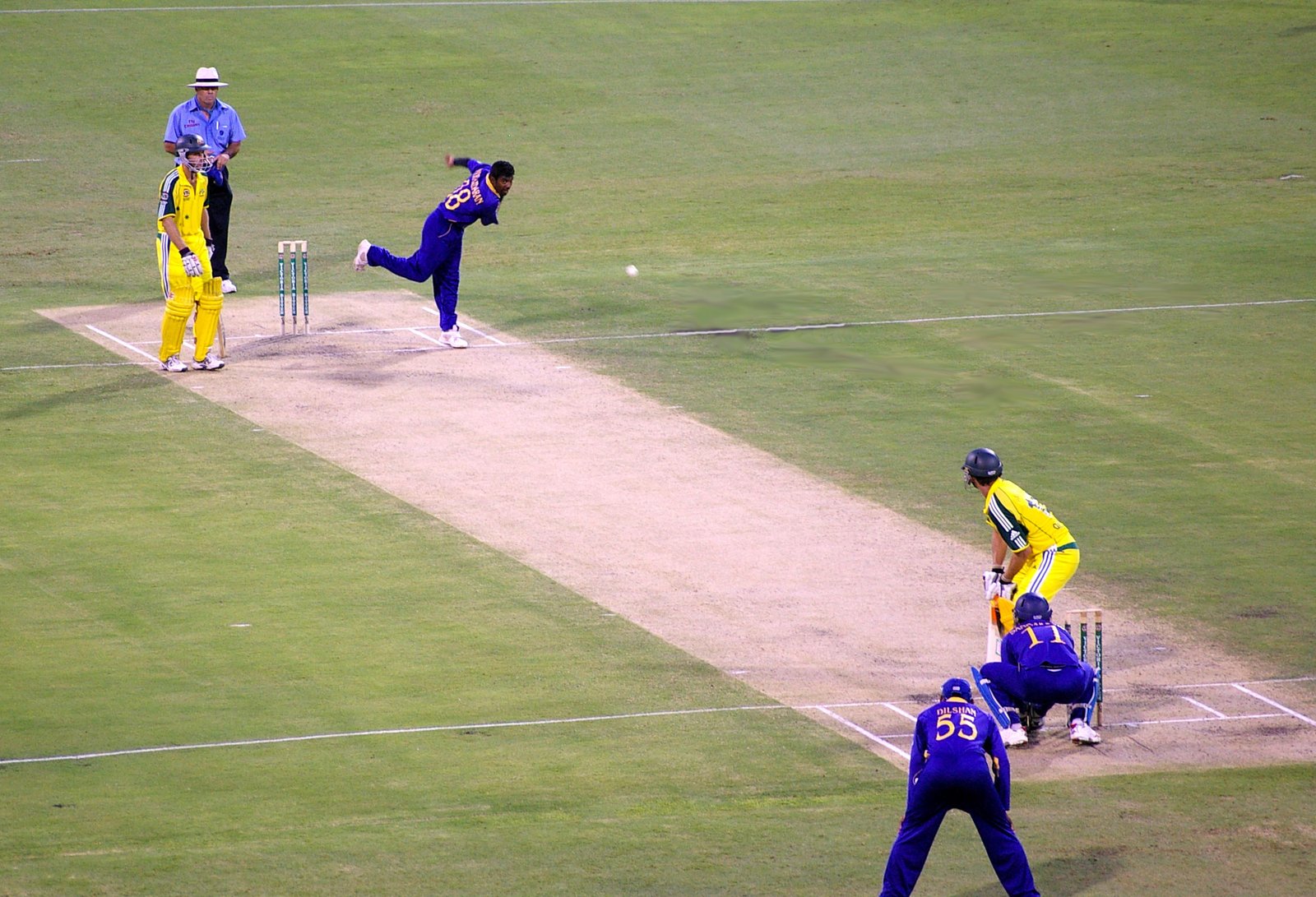
Muralitharan’s action, mid-delivery against Australia. Photo: Rae Allen / Wikimedia Commons, CC BY 2.0.
Why 534 Is Still Untouchable
A record built on longevity and precision, not one spell of magic.
Most career bowling records are explained by longevity alone – play long enough, at a reasonable standard, and the wickets accumulate. Muralitharan’s is different because the rate never really dropped. He debuted on 12 August 1993 against India at Colombo’s R. Premadasa Stadium (still commonly called by its old name, Khettarama), finishing with 1 for 38 off 10 overs and a first ODI wicket – Pravin Amre – that gave no hint of what was coming. Eighteen years later, on 2 April 2011, he bowled his final ODI overs in the World Cup final against the same opponent at the Wankhede Stadium in Mumbai, in front of a global television audience, with 534 wickets already banked and Sri Lanka’s chase of the title falling short. In between, he was rarely dropped, rarely rested, and almost never collared: his career economy rate of 3.93 runs per over is lower than several out-and-out fast bowlers on this list, in an era when captains increasingly used spinners as containment options in the middle overs precisely because Muralitharan had shown how effective that containment could be.
The mechanics mattered as much as the volume. Muralitharan’s action – a hyper-flexible wrist and a bent-arm release later cleared by biomechanical testing after prolonged scrutiny – generated turn and bounce that traditional off-spinners could not replicate, and his “doosra” (a delivery that turned the opposite way to a stock off-break) gave batters two genuinely different threats from a single, hard-to-read action. In the middle overs of an innings – the 15 to 40-over window where field restrictions ease but batters are typically still building rather than attacking – that unpredictability was worth more than raw pace. Fielding captains trusted him to bowl at both ends of an innings, including at the death when few frontline spinners get the ball, which is a large part of why his 350 matches produced more overs, and more wicket-taking opportunities, than most seam-bowling careers of similar length ever get.
He was also durable in a way that is increasingly rare in fast bowling, where stress fractures and workload management now regularly interrupt careers. Muralitharan missed relatively little cricket to injury across nearly two decades, played all or part of five World Cups (1996, 1999, 2003, 2007 and 2011), and finished as the tournament’s second-highest wicket-taker of all time with 68 – trailing only Glenn McGrath’s 71. That combination – an unhittable stock delivery, a genuine variation, a captain’s trust to bowl in all four phases of an innings, and two decades without a long injury layoff – is what actually separates 534 from every other total on this page, and why it has now outlasted the career of every bowler who has debuted since.
Muralitharan’s ODI Career: Verified Milestones
Newest first. Only milestones with an independently confirmed date are included – we do not estimate or interpolate dates for wicket totals we could not verify.
2011
Final ODI: the 2011 World Cup final
What happened: Muralitharan played his 350th and final ODI in the World Cup final against India, closing his career with 534 wickets. Sri Lanka set 274 but lost the match and the title.
Why it mattered: It closed an 18-year, five-World-Cup career on the sport’s biggest stage, with the all-time ODI wicket record already unassailable at the time.
2009
Becomes ODI cricket’s all-time leading wicket-taker
What happened: Muralitharan dismissed Gautam Gambhir to move past Wasim Akram’s previous career record of 502 ODI wickets.
Why it mattered: It made him the outright all-time leader for the first time – a position he has now held for over 17 years without serious challenge.
2009
Fastest to 500 ODI wickets – still the record
What happened: Muralitharan reached 500 career ODI wickets in his 324th match, the fastest any bowler has ever done so.
Why it mattered: Seventeen years on, no other bowler has even reached 500 wickets, let alone challenged the speed of the milestone.
2007
Fastest to 450 ODI wickets – still the record
What happened: Muralitharan reached 450 ODI wickets in his 295th match, another milestone he still holds outright.
Why it mattered: It came in the same year he was named in the ICC’s World ODI XI, reflecting a peak period of consistency in his late thirties, an age at which most bowlers of his era had already retired or slowed down.
2000
Career-best bowling figures: 7 for 30
What happened: Muralitharan recorded his best-ever ODI figures, 7 for 30, against India in Sharjah.
Why it mattered: It remains his career-best return and one of the finest spin-bowling spells in the format’s history, though it ranks outside the all-time top-5 best figures, which are dominated by later performances.
1993
ODI debut, and the first of 534 wickets
What happened: A 21-year-old Muralitharan made his ODI debut against India, taking figures of 1 for 38 from 10 overs. His first wicket was Pravin Amre.
Why it mattered: It was the unremarkable start of an 18-year career that would end with more than triple any other off-spinner’s ODI wicket tally.
Fastest to Wicket Milestones (by Matches Played)
“Fastest” here means fewest matches played to reach the milestone – the standard ESPNcricinfo/ICC convention for this record, and the one used throughout this table. Data last updated 18 May 2026.
| Milestone | Player | Country | Matches | Date reached |
|---|---|---|---|---|
| 50 wickets | Ajantha Mendis | Sri Lanka | 19 | Jan 12, 2009 |
| 100 wickets | Sandeep Lamichhane | Nepal | 42 | Apr 21, 2023 |
| 150 wickets | Sandeep Lamichhane | Nepal | 73 | May 18, 2026 |
| 200 wickets | Mitchell Starc | Australia | 102 | Sep 3, 2022 |
| 250 wickets | Saqlain Mushtaq | Pakistan | 138 | Apr 20, 2001 |
| 300 wickets | Brett Lee | Australia | 171 | Jun 29, 2008 |
| 350 wickets | Brett Lee | Australia | 202 | Aug 10, 2011 |
| 400 wickets | Waqar Younis | Pakistan | 252 | Dec 8, 2002 |
| 450 wickets | Muttiah Muralitharan | Sri Lanka | 295 | Apr 18, 2007 |
| 500 wickets | Muttiah Muralitharan | Sri Lanka | 324 | Jan 24, 2009 |
The 150-wicket record changed most recently: Sandeep Lamichhane broke Mitchell Starc’s 77-match mark in May 2026, becoming the only associate-nation bowler to hold an entry on this table.
India’s Top ODI Wicket-Takers
Anil Kumble has led this list since 2007. Active players’ rows carry their own verification date.
| Rank | Player | Matches | Wickets | Average | Best | Span | Status |
|---|---|---|---|---|---|---|---|
| 1 | Anil Kumble | 271 | 337 | 30.89 | 6/12 | 1990–2007 | Retired |
| 2 | Javagal Srinath | 229 | 315 | 28.08 | 5/23 | 1991–2003 | Retired |
| 3 | Ajit Agarkar | 191 | 288 | 27.85 | 6/42 | 1998–2007 | Retired |
| 4 | Zaheer Khan | 200 | 282 | 29.43 | 5/42 | 2000–2015 | Retired |
| 5 | Harbhajan Singh | 236 | 269 | 33.35 | 5/31 | 1998–2015 | Retired |
| 6 | Kapil Dev | 225 | 253 | 27.45 | 5/43 | 1978–1994 | Retired |
| 7 | Ravindra Jadeja | 210 | 232 | — | 5/33 | 2009–present | Active |
| 8 | Mohammed Shami | 108 | 206 | — | 7/57 | 2013–present | Active |
| 9 | Venkatesh Prasad | 161 | 196 | — | 5/27 | 1994–2001 | Retired |
| 10 | Kuldeep Yadav | 120 | 194 | — | 6/25 | 2017–present | Active |
| 11 | Jasprit Bumrah | 91 | 151 | 23.74 | 6/19 | 2016–present | Active (verified Aug 4, 2026) |
Bumrah’s 151 wickets have come at a rate of 1.66 per match – higher than any other bowler in India’s top 11 at the same stage of their careers – but ICC workload management and fewer bilateral ODI series mean he is playing far fewer matches per year than Kumble or Srinath did in the 1990s and 2000s.
Country-Wise ODI Wicket Leaders
Leading wicket-taker for each major Test-playing nation. “—” marks a closest-challenger figure we could not independently verify to this page’s standard.
| Country | Leader | Wickets | Matches | Span | Closest challenger |
|---|---|---|---|---|---|
| Sri Lanka | Muttiah Muralitharan | 534 | 350 | 1993–2011 | Chaminda Vaas, 400 |
| Pakistan | Wasim Akram | 502 | 356 | 1984–2003 | Waqar Younis, 416 |
| South Africa | Shaun Pollock | 393 | 303 | 1996–2008 | Allan Donald, 272 |
| Australia | Glenn McGrath | 381 | 250 | 1993–2007 | Brett Lee, 380 |
| India | Anil Kumble | 337 | 271 | 1990–2007 | Javagal Srinath, 315 |
| Bangladesh | Shakib Al Hasan | 317 | 247 | 2006–2025 | — |
| New Zealand | Daniel Vettori | 305 | 295 | 1997–2015 | Trent Boult, 211 (retired 2023) |
| England | James Anderson | 269 | 194 | 2002–2015 | Adil Rashid, 242 (active, closing gap) |
| Zimbabwe | Heath Streak | 239 | 189 | 1993–2005 | — |
| Afghanistan | Rashid Khan | 226 | 123 | 2015–present (Active) | — |
| West Indies | Courtney Walsh | 227 | 205 | 1985–2000 | — |
Two entries stand out: Australia’s record is separated by a single wicket (McGrath’s 381 to Lee’s 380), and Afghanistan’s leader, Rashid Khan, is still an active player with a genuinely young career – the only nation on this table whose all-time record is not yet closed.
Spinners vs Fast Bowlers: Who Actually Dominates the ODI Wicket List
Computed directly from the verified top-25 table above – not a separate estimate.
Counting bowling style across the top 25 all-time ODI wicket-takers verified for this page: 9 of the 25 (36%) are frontline spinners – Muralitharan (off-spin), Shane Warne, Anil Kumble and Shahid Afridi (leg-spin/leg-break), Daniel Vettori, Sanath Jayasuriya and Shakib Al Hasan (left-arm orthodox), and Saqlain Mushtaq and Harbhajan Singh (off-spin). The other 16 (64%) are pace or fast-medium bowlers, led by Wasim Akram, Waqar Younis, Chaminda Vaas, Shaun Pollock and Glenn McGrath. That is a genuine pace tilt at the very top of the list, but a less lopsided one than ODI cricket’s reputation as a fast bowler’s format might suggest – more than a third of the game’s greatest wicket-takers built their careers on spin.
ODI rules explain a large part of why spin survives at the top. Field restrictions during the middle overs (roughly overs 11 to 40, depending on the exact playing-conditions era) historically gave containment-minded spinners room to operate with a mix of close catchers and a sweeper, a balance fast bowlers at the same stage of an innings often lack. Powerplay rules, revised repeatedly since their introduction in the mid-2000s, initially concentrated fielding restrictions and boundary hitting into shorter bursts, which pushed captains toward spin in the overs outside the powerplay specifically to slow scoring down. Floodlit day-night cricket, near-universal since the 1990s, is generally considered more helpful to seam and swing bowlers under lights and dew than to spinners, which is one reason the very top of the wicket list still skews toward fast bowling despite spin’s middle-overs utility.
Muttiah Muralitharan
534 wickets, the off-spin standard the format has never seen matched. Saqlain Mushtaq (288) and Harbhajan Singh (269) are the format’s other major off-spin wicket-takers.
Wasim Akram
502 wickets built on reverse swing and yorkers. Chaminda Vaas (400) and Zaheer Khan (282) are the format’s other leading left-arm quicks.
Waqar Younis
416 wickets, mostly through toe-crushing yorkers. Glenn McGrath (381), Brett Lee (380) and Allan Donald (272) sit in the same bracket.
Shahid Afridi
395 wickets in a career built on aggressive leg-breaks and googlies. Shane Warne (293) and Anil Kumble (337) are the format’s other leg-spin giants.
Daniel Vettori
305 wickets from consistent, low-pace control. Sanath Jayasuriya (323, largely a part-time bowler) and Shakib Al Hasan (317) share this style.
Shaun Pollock
393 wickets at an economy rate (3.67) among the best of any bowler on the all-time list, spinner or seamer.
Several players on this list – Jacques Kallis, Sanath Jayasuriya, Abdul Razzaq – were primarily batting all-rounders whose bowling style overlaps more than one category above; the classification here follows their dominant stock delivery, not a rigid single label.
The Two-Ball Era: How a 2011 Rule Reshaped ODI Bowling
Fact and analysis kept deliberately separate below.
Fact: The ICC introduced the use of two new balls in ODI innings – one from each end – in late 2011, shortly after Muralitharan’s retirement. Under that rule, each ball was used for a maximum of 25 overs instead of the full 50, and remained newer and harder for longer. From July 2, 2025, the ICC revised the rule again: two new balls are still used from the first ball of the innings through the 34th over, after which the fielding side must choose one of the two balls to use at both ends for overs 35 through 50.
Analysis: The original 2011 rule is widely credited by bowlers, commentators and cricket boards with suppressing reverse swing, since neither ball was ever old or rough enough by the death overs to move sharply in the air – a skill fast bowlers like Wasim Akram and Waqar Younis had used to devastating effect in the 1990s. It is also broadly considered to have made life harder for wrist-spinners, who typically get more purchase from a ball that has lost some of its shine and seam definition. The 2025 revision – reintroducing a single, comparatively older ball for the last 16 overs – was explicitly designed to restore some of those old-ball conditions at the death, where boundary-hitting had increasingly dominated under the two-new-ball era. It is too recent, as of this page’s last verification in August 2026, to show up as a measurable trend in the wicket-taking data above; whether it meaningfully revives reverse swing or death-overs wicket-taking is a genuine open question, not yet a settled fact.
Records Within a Single Match or Innings
| Rank | Figures | Player | Country | Opponent | Venue | Date |
|---|---|---|---|---|---|---|
| 1 | 8/19 | Chaminda Vaas | Sri Lanka | Zimbabwe | R. Premadasa Stadium, Colombo | Dec 8, 2001 |
| 2 | 7/12 | Shahid Afridi | Pakistan | West Indies | Bourda, Georgetown | Jul 14, 2013 |
| 3 | 7/15 | Glenn McGrath | Australia | Namibia | JB Marks Oval, Potchefstroom | Feb 27, 2003 (World Cup) |
| 4 | 7/18 | Rashid Khan | Afghanistan | West Indies | Darren Sammy Stadium, Gros Islet | Jun 9, 2017 |
| 5 | 7/19 | Wanindu Hasaranga | Sri Lanka | Zimbabwe | R. Premadasa Stadium, Colombo | Jan 11, 2024 |
No bowler has ever taken 9 or 10 wickets in a men’s ODI innings. The ceiling, 25 years on, remains Chaminda Vaas’s 8 for 19 against Zimbabwe in 2001 – the only 8-wicket haul in ODI history.
Most Five-Wicket Hauls in an ODI Career
| Rank | 5-Wicket Hauls | Player | Country | Matches | Span |
|---|---|---|---|---|---|
| 1 | 13 | Waqar Younis | Pakistan | 262 | 1989–2003 |
| 2 | 10 | Muttiah Muralitharan | Sri Lanka | 350 | 1993–2011 |
| 3 | 9 | Mitchell Starc | Australia | 127 (as of last update) | 2010–present (Active) |
| 3 | 9 | Brett Lee | Australia | 221 | 2000–2012 |
| 3 | 9 | Shahid Afridi | Pakistan | 398 | 1996–2015 |
This table was last confirmed against source data dated March 20, 2023. Mitchell Starc is still active, so his tally of 9 five-wicket hauls may already be higher than shown here – treat his row as the one most likely to be stale on this page.
Best Career Bowling Average, Economy and Strike Rate
All three tables use a minimum-1,000-balls-bowled qualification, the standard ESPNcricinfo threshold. Most names here are not among the top career wicket-takers – a low qualifying threshold favours shorter, cleaner careers over longevity, which is the opposite trade-off from the wickets tables above. Read as a “peak efficiency” leaderboard, not a “greatest bowler” ranking.
Best Career Average (min. 1,000 balls)
| Rank | Average | Player | Country | Wickets | Span |
|---|---|---|---|---|---|
| 1 | 18.84 | Joel Garner | West Indies | 146 | 1977–1987 |
| 2 | 18.89 | Bernard Scholtz | Namibia | 100 | 2019–2025 |
| 3 | 18.90 | Ryan Harris | Australia | 44 | 2009–2012 |
| 4 | 18.97 | Tony Gray | West Indies | 44 | 1985–1991 |
| 5 | 19.45 | Mike Hendrick | England | 35 | 1973–1981 |
Last updated (source): December 16, 2025.
Best Career Economy Rate (min. 1,000 balls)
| Rank | Economy | Player | Country | Balls / Runs | Span |
|---|---|---|---|---|---|
| 1 | 3.09 | Joel Garner | West Indies | 5,330 / 2,752 | 1977–1987 |
| 2 | 3.25 | Max Walker | Australia | 1,006 / 546 | 1977–1981 |
| 3 | 3.27 | Mike Hendrick | England | 1,248 / 681 | 1973–1981 |
| 4 | 3.28 | Bob Willis | England | 3,595 / 1,968 | 1973–1984 |
| 5 | 3.30 | Richard Hadlee | New Zealand | 6,182 / 3,407 | 1973–1990 |
Last updated (source): March 6, 2023. All five careers here predate or barely overlap the 2011 two-new-ball rule discussed above – a genuinely different scoring environment from today’s game.
Best Career Bowling Strike Rate (min. 1,000 balls)
| Rank | Strike Rate | Player | Country | Balls / Wickets | Span |
|---|---|---|---|---|---|
| 1 | 23.43 | Ryan Harris | Australia | 1,031 / 44 | 2009–2012 |
| 2 | 24.48 | Dilshan Madushanka | Sri Lanka | 1,224 / 50 | 2023–2025 |
| 3 | 24.75 | Corey Anderson | New Zealand | 1,485 / 60 | 2013–2017 |
| 4 | 24.85 | Bilal Khan | Oman | 2,510 / 101 | 2019–2024 |
| 5 | 25.85 | Mohammed Shami | India | 5,326 / 206 | 2018–2025 |
Last updated (source): December 4, 2025. Strike rate measures balls per wicket, not runs – a bowler can have an excellent strike rate and a mediocre economy rate, or vice versa, which is why all three tables are shown separately rather than merged into one “best bowler” ranking.
World Cup Wicket Records (A Separate Leaderboard From Career ODI Wickets)
Cricket World Cup matches are ODIs and their wickets count toward the career totals above – but the ICC and ESPNcricinfo also track a standalone tournament-history leaderboard, shown here.
| Rank | Player | Country | Matches | Wickets | Average | Best | World Cups |
|---|---|---|---|---|---|---|---|
| 1 | Glenn McGrath | Australia | 39 | 71 | 18.19 | 7/15 | 1996–2007 |
| 2 | Muttiah Muralitharan | Sri Lanka | 40 | 68 | 19.63 | 4/19 | 1996–2011 |
| 3 | Mitchell Starc | Australia | 28 | 65 | 19.42 | 6/28 | 2015–2023 |
| 4 | Lasith Malinga | Sri Lanka | 29 | 56 | 22.87 | 6/38 | 2007–2019 |
| 5 | Wasim Akram | Pakistan | 38 | 55 | 23.83 | 5/28 | 1987–2003 |
| 6 | Mitchell Johnson | Australia | 22 | 52 | 20.46 | 4/33 | 2007–2015 |
| 7 | Chaminda Vaas | Sri Lanka | 31 | 49 | 21.32 | 6/25 | 1999–2011 |
| 8 | Javagal Srinath | India | 34 | 44 | 27.81 | 4/30 | 1992–2003 |
| 8 | Zaheer Khan | India | 23 | 44 | 20.22 | 4/42 | 2003–2011 |
| 10 | Trent Boult | New Zealand | 22 | 43 | 22.97 | 4/30 | 2015–2023 |
Glenn McGrath also holds the record for most wickets in a single World Cup tournament: 26, at the 2007 event in the Caribbean – a separate, tournament-specific record from his career total.
ICC Champions Trophy Wicket Records
A separate ICC tournament with its own standalone leaderboard – do not merge these totals with career ODI or World Cup figures above.
| Rank | Player | Country | Matches | Wickets | Notes |
|---|---|---|---|---|---|
| 1 | Kyle Mills | New Zealand | 15 | 28 | 2002–2013, all-time leader |
| 2 | Lasith Malinga | Sri Lanka | 16 | 25 | |
| 3 | Muttiah Muralitharan | Sri Lanka | 17 | 24 | Most successful spinner in CT history |
| 4 | Brett Lee | Australia | 16 | 22 | |
| 5 | Glenn McGrath | Australia | 12 | 21 | Best: 5/37, his only CT 5-wicket haul |
Women’s ODI Wicket Records (A Separate Dataset From Men’s ODIs)
Men’s and women’s ODI cricket are tracked as entirely distinct statistical pools by the ICC. These totals should never be compared directly to, or combined with, the men’s figures above.
| Rank | Player | Country | Matches | Wickets | Average | Economy |
|---|---|---|---|---|---|---|
| 1 | Jhulan Goswami | India | 204 | 255 | 22.04 | 3.37 |
| 2 | Shabnim Ismail | South Africa | 127 | 191 | 18.41 | 3.60 |
| 3 | Cathryn Fitzpatrick | Australia | 109 | 180 | 16.79 | 3.01 |
| 3 | Anisa Mohammed | West Indies | 141 | 180 | 20.91 | 4.19 |
| 5 | Ellyse Perry | Australia | 140 | 176 | 25.21 | 4.36 |
| 6 | Katherine Sciver-Brunt | England | 141 | 170 | 24.02 | 4.04 |
| 7 | Sana Mir | Pakistan | 120 | 151 | 24.27 | 3.75 |
Jhulan Goswami retired in 2022 as the only woman to reach 200 ODI wickets – a 64-wicket cushion over the next name on the list. She also took 43 wickets across Women’s Cricket World Cups, the most in that tournament’s history, and her career-best figures of 6/31 came against New Zealand in 2011.
Active ODI Wicket-Takers to Watch
A player counts as “active” here only if independently confirmed to have played or been selected in ODIs within the last 12 months – not merely because he has not formally announced retirement.
| Player | Country | Matches | Wickets | Average | Best | Last verified | Gap to 534 |
|---|---|---|---|---|---|---|---|
| Mitchell Starc | Australia | 130 | 247 | 23.58 | 6/28 | Jan 8, 2026 | 287 |
| Adil Rashid | England | 161 | 242 | — | — | Mid-2026 | 292 |
| Rashid Khan | Afghanistan | 123 | 226 | 19.43 | 7/18 | Aug 15, 2026 | 308 |
| Ravindra Jadeja | India | 210 | 232 | — | 5/33 | 2026 | 302 |
| Shaheen Afridi | Pakistan | 71 | 135 | 25.04 | 6/35 | Mar 8, 2026 | 399 |
| Jasprit Bumrah | India | 91 | 151 | 23.74 | 6/19 | Aug 4, 2026 | 383 |
Trent Boult (211 wickets) and Tim Southee are both omitted from this table despite strong career numbers – both have retired from international cricket (Boult’s last ODI was November 2023; Southee retired from all internationals in December 2024) and no longer qualify as active.
Muttiah Muralitharan vs Rashid Khan
Rashid Khan’s wickets-per-match rate and bowling average are both better than Muralitharan’s were at the same career stage – the single most statistically plausible case for anyone challenging 534, though it would still require roughly a decade more of comparable output, discussed below.
Can Anyone Break Muralitharan’s 534?
Verdict labels used below: possible, plausible, unlikely, long shot – never a prediction of certainty.
Realistically: no bowler currently playing ODI cricket is on a path that gets them to 534 without an extraordinary, multi-decade change in workload, selection and fitness fortune – and even then, it would take most of a full career to do it. Mitchell Starc (247 wickets, verified January 2026) is the most experienced active bowler on this page’s list, but he is in his mid-thirties, and closing a 287-wicket gap at his own career rate (roughly 25 wickets per Australian ODI year when fully fit) would require playing into his mid-forties – not a realistic scenario for a fast bowler. Verdict: long shot, effectively closed by age.
Rashid Khan (226 wickets, verified August 2026) presents the most statistically interesting case: he is still in his late twenties, has a better bowling average and a better wickets-per-match rate than Muralitharan had reached at the same stage, and captains an Afghanistan side playing more international cricket as its schedule matures. Even so, he would need roughly 308 more wickets, which – sustained at an excellent pace of 25-30 wickets a year – is a 10-to-12-year proposition requiring him to match or exceed Muralitharan’s own rare longevity. Verdict: plausible in principle, but a long shot in practice – it depends on a level of durability only a handful of bowlers in ODI history have ever managed.
Jasprit Bumrah (151 wickets, verified August 2026) has the best strike-rate profile of any bowler on the active list, but is 32 years old with a documented history of managing workload around back and body issues, and India’s fast-bowling rotation policy means he plays a smaller share of India’s ODIs than a bowler of his rank might have in the 1990s. Verdict: unlikely – the ceiling is a very good career total, not a genuine assault on the record.
Shaheen Afridi (135 wickets, verified March 2026) is the youngest bowler on this page’s active list and already the fastest Pakistani to 100 ODI wickets, but a 399-wicket gap from a 26-year-old with a recent history of knee issues is a two-decade proposition even in the best case. Verdict: long shot – too far out to assess meaningfully today, and dependent on an entire career’s worth of good health that hasn’t happened yet.
The honest, unifying conclusion: 534 is not just a big number, it is a number that required an unusually injury-free, selection-secure, 18-year career layered on top of elite skill – and modern ODI scheduling, which prioritises T20 leagues and rests bowlers more aggressively, makes that specific combination harder to assemble today than it was for Muralitharan’s generation.
📊 Record Gap Analysis – Illustrative Mathematical Scenario
The figures below are illustrative arithmetic, not predictions. They divide each player’s current gap to 534 by a plausible sustained wickets-per-year rate to show how long closing the gap would theoretically take – nothing more.
Rashid Khan: 308 wickets needed ÷ ~25-30 wickets/year (his approximate recent pace) ≈ 10-12 more years of comparable output.
Jasprit Bumrah: 383 wickets needed ÷ ~15 wickets/year (his career-average pace across 91 matches in roughly 10 years) ≈ 25 more years – beyond any realistic playing career.
Mitchell Starc: 287 wickets needed ÷ ~20 wickets/year (his approximate recent pace) ≈ 14 more years, taking him into his late forties.
None of these scenarios should be read as a forecast. They illustrate why cricket commentators routinely describe Muralitharan’s record as effectively permanent: even the best-positioned active challenger needs a decade-plus of uninterrupted, near-peak output just to draw level.
Records That Have Survived
- Most career ODI wickets (534): set April 2, 2011 – 15 years standing, with no active bowler within 280 wickets.
- Best ODI innings figures (8/19, Vaas): set December 8, 2001 – 25 years standing, and no bowler has even taken 9 wickets since.
- Fastest to 500 wickets (Muralitharan, 324 matches): set January 24, 2009 – 17 years standing, and only one other bowler in history (Wasim Akram) has even reached 500.
- Most 5-wicket hauls in a career (13, Waqar Younis): set across 1989-2003 – over two decades standing, with Mitchell Starc (9, active) the closest chaser.
ODI Bowling, Era by Era
A narrative guide to how the wicket-taking landscape shifted decade by decade – not a precise decade-bounded wicket count, which would need Statsguru date-range data beyond what this page independently verified.
1970s-1980s: ODI cricket was young and rules were sparser. West Indies’ pace battery (Joel Garner, Malcolm Marshall and others) and India’s Kapil Dev defined the format’s early bowling identity, often operating with fewer fielding restrictions than the modern game and correspondingly tighter economy rates – Garner’s career economy of 3.09 and Kapil Dev’s 3.71 remain among the best ever recorded, part of why both appear on this page’s efficiency tables.
1990s: The decade of Wasim Akram and Waqar Younis’s reverse-swing partnership for Pakistan, Anil Kumble’s rise for India, and Muralitharan’s emergence as a genuine wicket-taking spinner rather than a containment option. Fielding restrictions and powerplay-style rules were formalised and tightened through the decade, rewarding attacking new-ball bowling.
2000s: Muralitharan’s peak years (450 and 500-wicket milestones both fell in this decade) coincided with Glenn McGrath’s late-career dominance, including his record-setting 2007 World Cup. Chaminda Vaas’s 8/19 – still the only 8-wicket haul in ODI history – was set in 2001.
2010s: The two-new-ball rule (introduced 2011) reshaped death-overs bowling, and Lasith Malinga’s slower-ball variations became the template for T20-influenced ODI death bowling. Mitchell Starc’s rapid rise, including the fastest-ever run to 200 wickets, began in this decade.
2020s: Rashid Khan’s emergence as a genuinely elite modern wrist-spinner, Sandeep Lamichhane’s record-breaking pace to 100 and 150 wickets for Nepal, and the July 2025 partial reversal of the two-new-ball rule mark the current era – one in which fewer bilateral ODIs are played overall, concentrating wicket-taking opportunities into World Cups, the Champions Trophy and a shrinking bilateral calendar.
Explore More Timelines
People Also Ask
Frequently Asked Questions
40 direct-answer questions covering ODI bowling’s most-searched records. Data last verified August 10, 2026.
Myth vs Fact
| Myth | Fact |
|---|---|
| Muralitharan has the most wickets in all forms of cricket combined. | He holds the ODI record (534) and the Test record (800) separately – formats are never combined into one “all-time” wicket total. |
| World Cup wickets count as a separate career record from ODI wickets. | World Cup matches are ODIs, so World Cup wickets are already included in career ODI totals – but the ICC also tracks a standalone World Cup leaderboard (led by Glenn McGrath, 71) alongside, not instead of, the career list. |
| The most career wickets automatically means the best bowler. | Wicket totals reward longevity as much as skill. This page separately tracks average, economy and strike rate, each with a minimum-balls qualification, specifically because the “most wickets” list and the “best bowler” question are not the same thing. |
| A high economy rate always means a bowler was ineffective. | Economy rate depends heavily on era and role – a death-overs specialist in the 2020s will typically have a higher economy than a 1980s bowler in a lower-scoring game, even if both were excellent at their jobs. |
| Someone has taken 10 wickets in a men’s ODI innings. | No one has. The record is 8 for 19 (Chaminda Vaas, 2001) – no 9 or 10-wicket haul has ever been recorded. |
| Jasprit Bumrah is close to challenging Muralitharan’s record. | Bumrah has 151 ODI wickets as of August 2026 – a gap of 383, which even at his excellent career rate would take an unrealistic number of years to close. |
| The two-new-ball rule has always been in place in ODI cricket. | It was introduced only in 2011 and partially reversed in July 2025. Every bowler on this page’s all-time top-10 list except Muralitharan’s final two seasons played under a single-ball system for most or all of their careers. |
| Women’s and men’s ODI wicket records are the same leaderboard. | They are entirely separate datasets. Jhulan Goswami’s 255 leads the women’s list; Muralitharan’s 534 leads the men’s. Neither ranks on the other’s table. |
| Anil Kumble’s ODI wickets and Test wickets are the same total. | His 337 ODI wickets are separate from his 619 Test wickets – two different formats, two different records. |
| Champions Trophy wickets count toward the World Cup wicket leaderboard. | They are two entirely separate ICC tournaments with independent leaderboards – Kyle Mills leads the Champions Trophy list; Glenn McGrath leads the World Cup list. |
| Mitchell Starc’s fastest-to-150-wickets record still stands. | Sandeep Lamichhane of Nepal broke it in May 2026, reaching 150 wickets in 73 matches versus Starc’s 77. |
| All bowlers on the “best average” and “best economy” tables are among history’s greatest. | Most qualify only because a 1,000-ball minimum favours short, clean careers – several, like Bernard Scholtz and Ryan Harris, played far fewer matches than the career-wicket leaders. |
Sources & further reading
Every dated entry above was checked against these references. Last reviewed 20 September 2026.
- ICC Hall of Fame - Muttiah Muralitharan
- ESPNcricinfo - Most Wickets in a Career (ODI)
- Wikipedia - List of One Day International Cricket Records
- Wikipedia - Muttiah Muralitharan
- ICC - Several Changes Made to ICC Playing Conditions (2025 two-ball rule revision)
- Cricbites - Highest Wicket-Takers in ODI World Cup History
- Wikipedia - Jhulan Goswami