Dedicated Freight Corridor Timeline 2005–2026: How India Built a Railway Just for Cargo
India’s Dedicated Freight Corridor timeline 2005–2026: DFCCIL, Eastern DFC, Western DFC, land acquisition, JNPA connectivity and logistics-cost impact.
Latest Story
For decades, India’s freight trains had to share space with passenger trains. A coal rake, a container train, an express service and a local passenger train could all be competing for the same stretch of track — and on India’s busiest routes that competition was severe: the Golden Quadrilateral corridors linking Delhi, Mumbai, Chennai and Kolkata make up only 16% of the rail network but carried more than 58% of its freight, running at 115–150% of line capacity. The Dedicated Freight Corridor timeline is India’s twenty-year answer to that bottleneck: build a high-capacity railway backbone where cargo does not have to keep stepping aside for the next passenger service. On 8 September 2026, the government dedicated the final Western DFC sections linking the network to Jawaharlal Nehru Port — completing the current Eastern and Western DFC network and raising the real question this article is built around: can freight trains actually transform India’s logistics economy?
Can Freight Trains Transform India?
🧠 Quick Answer
The Dedicated Freight Corridor is a high-capacity rail network built mainly for freight trains. India’s current DFC network has two arms: the Eastern DFC, running roughly 1,337 km from Ludhiana to Sonnagar in Bihar, and the Western DFC, running about 1,506 km from Dadri to Jawaharlal Nehru Port. By separating cargo trains from busy passenger routes, the DFC can improve freight speed, reliability, wagon turnaround and port connectivity. The next test is whether this actually translates into lower logistics costs and more freight shifting from road to rail.
Dedicated Freight Corridor: Key Questions
What this Dedicated Freight Corridor timeline really shows
- The DFC’s core purpose is capacity, not comfort. It separates freight traffic from passenger-heavy routes so that neither has to wait on the other.
- Two arms exist today: the Eastern DFC carries bulk freight like coal and food grain across the north and east; the Western DFC links Delhi-region industry to Jawaharlal Nehru Port.
- DFCCIL was incorporated in October 2006 as a government special-purpose company, built to execute a mega-project outside routine railway bureaucracy.
- Two different lenders financed the two corridors: the World Bank backed the Eastern DFC in three loan tranches; Japan’s JICA funded about 77% of the Western DFC through a roughly $5.2 billion soft loan.
- Land acquisition alone took about four years, covering roughly 11,000 hectares across 77 districts and affecting close to 300,000 project-impacted people.
- Total project cost rose from about ₹28,000 crore in 2006 to roughly ₹1.24 lakh crore, as engineering, utility-shifting and pandemic delays stacked up.
- The 8 September 2026 milestone completes the Western DFC’s port connection to JNPA, alongside the already-operational Eastern DFC core between Ludhiana and Sonnagar.
- This is not the end of India’s freight-corridor building. The Sonnagar–Dankuni stretch, the East–West DFC, and a newly announced Dankuni–Surat corridor are all still in planning or construction.
- Freight speed has real room to close: about 20–25 km/h on shared tracks today versus a DFC design target above 60 km/h.
- The real test ahead is economic, not engineering: whether faster, more reliable rail freight actually pulls cargo off India’s roads and lowers the country’s logistics cost from around 14% of GDP toward the roughly 8% global benchmark.
Why Build an Entire Railway Just for Cargo?
Everyday logic: if every train wants the same track, someone has to wait. The DFC gives cargo its own track instead.
Two Freight Backbones: Eastern & Western DFC
Different routes, different cargo — one built for bulk freight across the north and east, the other built to feed India’s busiest container port
Same Tracks, or a Dedicated Railway?
Toggle between the two models to see what actually changes
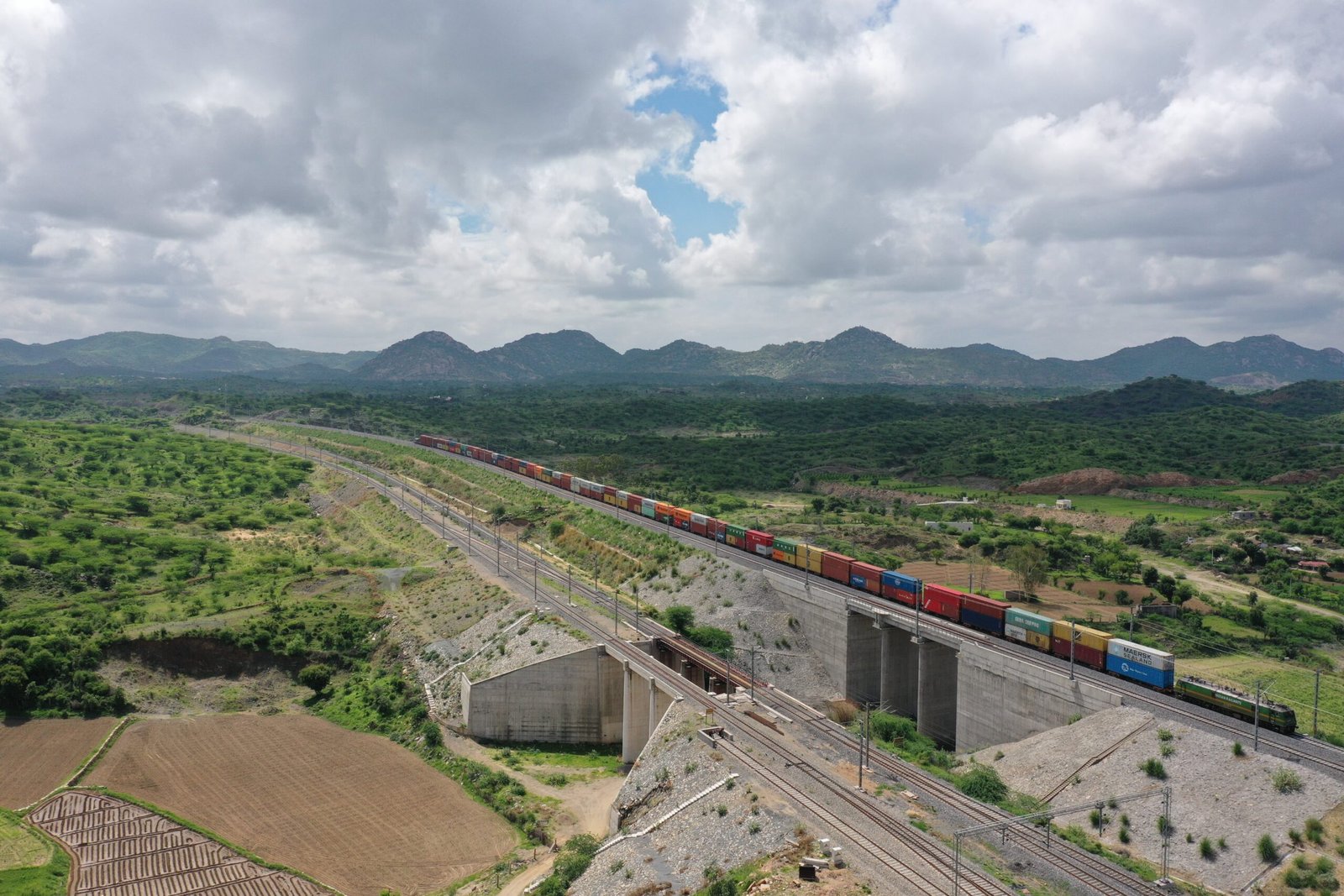
A double-stack container train on the Western Dedicated Freight Corridor. Credit: DFCCIL / Government Open Data License – India.
A Container’s Journey via the DFC
How the corridor actually fits into a shipment, from factory floor to ship’s deck
- Factory: Goods are packed into a standard container at the manufacturing site or a nearby logistics park.
- Inland container depot / multi-modal logistics park: The container is trucked to an ICD or MMLC, where it is loaded onto a DFC-bound rake.
- DFC train: A double-stack container train runs the corridor — Eastern or Western — at higher priority and higher speed than on a shared conventional line.
- Port handover at JNPA: On the Western DFC, the train runs directly into the port complex, handing containers to terminal operators without a road transfer in between.
- Ship departure: The container is loaded onto a vessel for export, or the reverse sequence runs for an import container heading inland.
Timeline: From a 2005 Feasibility Study to a Fully Linked Port Corridor
Newest developments first. Land acquisition, financing and construction ran in parallel for much of the 2010s.
Before 2005, India’s railway capacity problem was already visible in the numbers. Passenger and freight trains shared most of the network, and on the Golden Quadrilateral routes linking Delhi, Mumbai, Chennai and Kolkata — just 16% of Indian Railways’ total route length — congestion was severe enough that these lines carried more than 58% of the network’s freight at 115–150% of rated line capacity. A heavy, slow-moving coal or steel rake had no good way to avoid delaying, or being delayed by, a scheduled passenger express on the same line. That mismatch is the problem the Dedicated Freight Corridor was built to solve.
2026
Government Dedicates Final Western DFC Sections, Completing the JNPA Link
What happened: The government dedicated three Western DFC sections to the nation — Sanand (North)–Makarpura, New Umbergaon–New Saphale, and New Saphale–JNPA — together covering 326 route km and developed at a cost of more than ₹20,700 crore, as part of a wider infrastructure package worth over ₹35,000 crore inaugurated from Vadodara.
Why it matters: This completes the direct rail link between the Western DFC and Jawaharlal Nehru Port. Combined with the already-operational Eastern DFC core between Ludhiana and Sonnagar, the current Eastern and Western DFC network becomes fully operational — though, as later sections of this article explain, that is not the same as saying India’s freight-corridor building is finished.
2026
Final WDFC Stretch Commissioned Between JNPT and Vaitarna
What happened: DFCCIL commissioned the last section of track between JNPT and Vaitarna, completing physical construction and safety clearance for train operations across the full roughly 1,506 km Dadri–JNPT Western DFC route.
Why it matters: This is the engineering finish line — freight trains could technically run end to end from that point. The 8 September dedication above is the separate, formal ceremony for the specific port-linking sections.
Eastern DFC Construction Completed, Corridor Turns Fully Operational
What happened: Construction on the Eastern DFC’s operational core was completed in February 2024, and the corridor turned fully operational in April 2024, covering roughly 1,337 km from Ludhiana in Punjab to Sonnagar in Bihar.
Why it matters: Reliable, dedicated freight capacity on this stretch showed up in a real, if narrow, number: a Punjab power plant was able to cut its coal stockpile from about 30 days to 15 days of cover, saving an estimated ₹300–400 crore in inventory costs — a data point, not proof of an economy-wide saving yet.
Ludhiana–Khurja Section Closes the Last Eastern DFC Gap
What happened: The roughly 400 km Ludhiana–Khurja section — financed under a 2016 World Bank loan (EDFC-3) and built as a single line rather than double track — was commissioned, closing the last major gap before the Eastern DFC’s full completion.
Why it matters: This was the final large construction milestone standing between an “almost complete” corridor and a fully operational one.
Palanpur–Mehsana and Dadri–Khurja Sections Extend Both Corridors
What happened: The Western DFC’s Palanpur–Mehsana section opened in June 2022, taking the corridor’s operational length to about 720 km. The Eastern DFC’s 46 km Dadri–Khurja branch line opened in October 2022, linking the National Capital Region into the network.
Why it matters: Sections did not open all at once. Each addition brought more of the network into commercial use while construction continued elsewhere.
Rewari–Madar Section Proves Double-Stack Electrified Freight at Scale
What happened: Prime Minister Narendra Modi inaugurated the 306 km Rewari–Madar section of the Western DFC, engineered to run electrified double-stack container trains, with a design speed up to 100 km/h.
Why it matters: Running two stacked containers under live overhead electric wires required extra vertical clearance across the entire corridor — a civil-engineering choice made early that shaped the DFC’s capacity advantage over conventional lines.
New Khurja–New Bhaupur Opens with a New Operations Control Centre
What happened: PM Modi inaugurated the 351 km New Khurja–New Bhaupur section of the Eastern DFC, built at a cost of over ₹5,750 crore, alongside a new Operations Control Centre in Prayagraj to manage freight traffic on the corridor.
Why it matters: This was the first large operational stretch of the Eastern DFC, giving northern industrial and agricultural freight a dedicated route that bypassed some of the most congested legacy junctions.
First Freight Train Trial Run Completes on a 190 km Stretch
What happened: The first trial run of a freight train took place on a completed 190 km segment of the Western DFC.
Why it matters: Ten years after Cabinet approval, this was the moment the project stopped being only drawings, land records and construction contracts, and became a railway a real train could actually run on.
Financing Locks In: World Bank Backs the East, Japan Backs the West
What happened: In September 2009 the Union Cabinet approved a Japan International Cooperation Agency (JICA) loan — ultimately around $5.2 billion, funding roughly 77% of the Western DFC’s cost, with conditions tying the financing to Japanese-company participation. The World Bank financed the Eastern DFC in three separate tranches: $975 million in 2011 for the Khurja–Kanpur section, $1.1 billion in 2014 for Kanpur–Mughalsarai, and a further loan in 2016 (EDFC-3) for Ludhiana–Khurja.
Why it matters: Splitting financing this way meant the two corridors were, in effect, built by two different international financing and technical-standards regimes running in parallel — part of why they progressed on different schedules.
Land Acquisition, Utility Shifting and a Decade of Delay
What happened: Acquiring roughly 11,000 hectares of land across 77 districts took close to four years and about ₹21,000 crore, and affected close to 300,000 project-impacted people. Relocating power lines, telecom networks, gas pipelines and water and sewer infrastructure added a further ₹10,000–15,000 crore. No-objection certificates from various departments took a year or more each, a 2013 change to India’s land acquisition law paused parts of the process, and the COVID-19 pandemic later cost roughly two working seasons and disrupted supplies of cement, steel and welding oxygen.
Why it matters: This is the single biggest reason a project approved in 2008 did not see its first trial train until 2018. Engineering was rarely the bottleneck; land, utilities and administrative clearances were.
Cabinet Approves Two Corridors: One for the North and East, One for the Ports
What happened: The Cabinet Committee on Economic Affairs approved both the Eastern DFC (Ludhiana toward the east) and the Western DFC (Dadri to Jawaharlal Nehru Port).
Why it matters: India split the plan into two purpose-built arms rather than one single corridor, because the freight problem itself had two different shapes: bulk cargo such as coal and food grain moving through the north and east, and container traffic moving to and from the country’s largest container port.
2006
DFCCIL Is Incorporated to Build and Run the Network
What happened: The Dedicated Freight Corridor Corporation of India Limited was incorporated as a special-purpose company under the Ministry of Railways.
Why it matters: DFCCIL was given the mandate to plan, finance, construct, and eventually operate and maintain the corridors as a dedicated entity, rather than routing a project of this scale through the day-to-day railway administrative structure.
The Idea Takes Shape: Give Cargo Its Own Track
What happened: Facing routes running at 115–150% of rated line capacity, railway planners began drawing up freight-only corridors along India’s busiest economic axes, instead of continuing to fit freight movement around an increasingly crowded passenger timetable.
Why it matters: This is the starting point of the entire Dedicated Freight Corridor timeline — the moment the solution shifted from “manage the congestion” to “build a separate railway.”
Can the DFC Actually Cut India’s Logistics Costs?
The engineering is largely done. The economic test is only just starting.
India’s logistics cost is commonly put at around 14% of GDP, against an international benchmark closer to 8%. The DFC is one of the biggest single bets India has made on closing that gap, but the corridor itself does not automatically lower a shipper’s bill. On paper, the potential is real: freight speeds on India’s shared conventional network average around 20–25 km/h, while the DFC’s design target is above 60 km/h. Officials have cited a Mumbai–Delhi transit time falling from about three days to a targeted 48 hours, and NCR-to-Gujarat freight movement falling from four to five days down to about two. The coal-inventory example in the 2024 timeline entry above — a Punjab power plant cutting stockpile days in half — is a real, if narrow, early data point in that direction.
None of that is the same as a guaranteed, economy-wide fall in logistics cost. That depends on how much freight volume actually shifts from road to rail, how quickly ports and inland terminals scale to match the corridor’s capacity, and how first-mile and last-mile road connectivity holds up around each new DFC-linked hub. The Maritime Gateway report on the 8 September 2026 dedication points to exactly this: the metric worth watching next is how fast rail’s share of container evacuation from JNPA actually rises, not the ribbon-cutting itself.
✅ The DFC Can
- Move freight faster and more reliably on the corridor itself, versus a shared, congested conventional line
- Run longer, heavier, double-stack container trains under dedicated electrification
- Connect major industrial belts directly to Jawaharlal Nehru Port without a shared-track bottleneck
- Free up capacity on conventional lines by moving freight traffic off them
❌ The DFC Cannot (Yet)
- Guarantee lower shipping prices for exporters and importers by itself
- Fix first-mile and last-mile road connectivity to factories and warehouses
- Replace the need for more inland container depots and multi-modal logistics parks
- Claim to be India’s last freight corridor — several more are still being planned or built
Eastern DFC vs Western DFC, Side by Side
| Detail | Eastern DFC | Western DFC |
|---|---|---|
| Route | Ludhiana (Punjab) to Sonnagar (Bihar) | Dadri (Uttar Pradesh) to JNPA/JNPT (Maharashtra) |
| Approx. length | ~1,337 km operational core | ~1,506 km |
| States crossed | Punjab, Haryana, Uttar Pradesh, Bihar | Uttar Pradesh, Haryana, Rajasthan, Gujarat, Maharashtra |
| Primary financier | World Bank (three loan tranches, 2011–2016) | Japan International Cooperation Agency (JICA) |
| Primary cargo | Coal, food grain, cement, general bulk freight | Containers, double-stack export-import cargo |
| Fully operational since | April 2024 | 8 September 2026 (final port-linking sections) |
| Unfinished extension | Sonnagar–Dankuni (~540 km, PPP, in progress) | — |
What It Cost, Year by Year
| Year | Development | Figure |
|---|---|---|
| 2006 | Original project cost estimate | ~₹28,000 crore |
| 2011 | World Bank loan, Khurja–Kanpur (EDFC) | $975 million |
| 2014 | World Bank loan, Kanpur–Mughalsarai (EDFC) | $1.1 billion |
| 2020 | New Khurja–New Bhaupur section (EDFC) | ~₹5,750 crore |
| 2026 | Three WDFC sections dedicated, 8 September | >₹20,700 crore |
| 2026 | Total infrastructure package inaugurated alongside it | >₹35,000 crore |
| Current | Total DFC network cost (Eastern + Western) | ~₹1.24 lakh crore |
Who This Actually Affects
JNPA
Gains a direct dedicated rail link, reducing reliance on road transport for container evacuation from India’s busiest container port.
CONCOR & private train operators
Can run longer, double-stack container rakes at higher priority, potentially lowering their per-container haulage cost over time.
ICDs & multi-modal logistics parks
Become the connection points between road-fed factories and DFC-fed rail movement; their capacity is now part of the bottleneck question.
Exporters & the Bhiwandi logistics cluster
Stand to gain from faster, more predictable transit times to port — if pricing and terminal capacity keep pace with the new rail capacity.
Facts Worth Knowing
- JNPA (Jawaharlal Nehru Port Authority) and JNPT (Jawaharlal Nehru Port Trust) refer to the same port — JNPA is the current statutory name, JNPT the older name still used informally.
- DFCCIL was incorporated on 30 October 2006, nearly two years before the Eastern and Western DFC themselves were formally approved by the Cabinet in February 2008.
- Most of the network is double-tracked and electrified at 25 kV AC, except the Ludhiana–Khurja section of the Eastern DFC, which was built as a single line.
- Running double-stack containers under live overhead electric wires required extra vertical clearance across the entire Western DFC — an engineering decision baked into the corridor from the start.
- India is not done building freight corridors: the Sonnagar–Dankuni stretch, the ~2,000 km East–West DFC (Dankuni to Palghar, land acquisition underway), and a newly announced Dankuni–Surat corridor from the Union Budget 2026–27 are all still in planning or construction.
- The Golden Quadrilateral routes — just 16% of Indian Railways’ route length — carried more than 58% of its freight before the DFC, at up to 150% of rated line capacity.
Explore More Timelines
People Also Ask
Frequently Asked Questions
Related AiTimeline Coverage
⚠️ Editorial & Sources Note
Author: The AI Timeline Editorial Team · Last updated: 8 September 2026. This article treats the “current DFC network” as the operational Eastern DFC (Ludhiana–Sonnagar) plus Western DFC (Dadri–JNPA/JNPT), and does not claim India has completed all possible or future freight corridors — the Sonnagar–Dankuni, East–West and Dankuni–Surat corridors remain in progress or planning. Route lengths, dates and financing figures are drawn from DFCCIL, PIB, Ministry of Railways statements and Reuters/wire reporting on the 8 September 2026 dedication, cross-checked against publicly available project documentation. Cost and inventory-saving figures are approximate and cited as such; this is editorial infrastructure coverage, not investment or engineering advice.
Sources & further reading
Every dated entry above was checked against these references. Last reviewed 15 September 2026.
- DFCCIL — Official Site
- Western Dedicated Freight Corridor — Wikipedia
- Eastern Dedicated Freight Corridor — Wikipedia
- PM Modi dedicates final Western DFC sections — Maritime Gateway
- PM Modi to dedicate key WDFC sections on Sept 8 — ANI News
- Dedicated Freight Corridor: What a Decade of Rail Investment Achieved — IMPRI
- Railways' massive DFC nears completion — ThePrint
- World Bank approves Eastern Dedicated Freight Corridor loan — Railway Gazette