ENIAC Unveiling: How Computing Power Went From 5,000 Additions a Second to Exascale
ENIAC did 5,000 additions a second in 1946. In June 2026 China's LineShine hit 2.198 exaflops. Every step from vacuum tubes to exascale, dated and sourced.
Latest Story
On 14 February 1946 the University of Pennsylvania showed reporters a machine of about 17,468 vacuum tubes that filled a room, weighed about 27 tonnes and could do 5,000 additions a second. That was ENIAC, and its unveiling is the usual starting point for the story of modern computing power. Eighty years later, the fastest supercomputer on the June 2026 TOP500 list, China’s LineShine, runs at 2.198 exaflops: more than two quintillion calculations a second. This is how that happened, one bottleneck at a time: transistors, integrated circuits, the microprocessor, the PC, parallel supercomputers, GPUs, the cloud and AI accelerators, with the dates, the numbers and the places where the usual telling gets them wrong.
💡 Short Answer
ENIAC, unveiled on 14 February 1946, did about 5,000 additions a second using some 17,500 vacuum tubes. Transistors (1947), integrated circuits (1958–60) and the microprocessor (Intel 4004, 1971) shrank computers and multiplied their power; parallel processors and GPUs then pushed supercomputers through the teraflop (1997), petaflop (2008) and exaflop (Frontier, 2022) barriers. In June 2026 the fastest is China’s LineShine at 2.198 exaflops, with El Capitan second at 1.809.
ENIAC and Computing Power: Key Questions
Eighty Years of Computing Power, in Ten Points
- The start: ENIAC, unveiled on 14 February 1946, did about 5,000 additions a second with some 17,468 vacuum tubes.
- Its first job was secret: hydrogen-bomb calculations for Los Alamos in December 1945, not artillery tables.
- Programming was physical: six women set up problems with cables and switches; stored programs arrived in 1948.
- The transistor (1947) and the integrated circuit (1958–60) made computers smaller, cooler and more reliable.
- The microprocessor: the Intel 4004 of 1971 put roughly ENIAC-class power on one chip, at up to 740 kHz.
- Two branches: personal computers made computing common; supercomputers like the Cray-1 made it as fast as possible.
- Parallelism won: teraflop in 1997, petaflop in 2008 and exaflop in 2022, each by connecting more processors.
- GPUs and AI: graphics chips became the engines of deep learning after 2012; NVIDIA’s Blackwell has 208 billion transistors.
- The 2026 leader: China’s LineShine, 2.198 exaflops, ahead of El Capitan’s 1.809.
- The next limit is energy: LineShine draws about 42 megawatts; work done per watt has risen roughly a trillion-fold since ENIAC.
80 Years of Computing Power, in Two Charts
Both on log scales: every gridline is a thousand times the one before.
A straight-line chart of this history would be useless: ENIAC would be invisible next to Frontier. On a logarithmic scale the pattern is clearer. Speed at the top of the list has risen about 15 orders of magnitude in 80 years, and transistors per chip about 8 in 53 years. The two are linked but not the same: from the 1990s most of the gain at the top came from connecting more chips, not from any single chip becoming faster, and since the mid-2000s clock speeds have barely risen at all.
The units matter too. ENIAC’s figure is ten-digit decimal additions; the Cray-1’s is a theoretical peak; TOP500 figures are measured 64-bit floating-point results on the HPL benchmark. AI chips are often quoted in 8-bit or 4-bit operations, which can make them look far faster than they are on scientific work.
Step through eight machines from ENIAC to LineShine and watch the size shrink while the speed explodes.
Figures are approximate and use each era’s own measure, so speeds are not exactly comparable. Updated 6 October 2026.
Choose a machine above
The Computing Power Timeline, 1943–2026
Newest first. Tags mark hardware, architecture, records, market changes and context.
China’s LineShine takes No. 1 at 2.198 exaflops Record
LineShine, at the National Supercomputing Centre in Shenzhen, debuted at the top of the 67th TOP500 list with 2.198 exaflops on the HPL benchmark, more than 20% ahead of El Capitan. It is the first China-based No. 1 since Sunway TaihuLight in 2017. Unusually for a modern leader, it uses no GPUs: its performance comes from Arm-based LX2 processors with 304 cores each and on-package high-bandwidth memory. Five ranked systems now pass one exaflop, and the 500 machines on the list add up to 18.73 exaflops.
Why it matters: the top of the list is again a contest between countries, and the leader burns 42 megawatts, about 280 times ENIAC’s power draw.
ENIAC turns 80 Context
Historians and enthusiasts marked 80 years since the unveiling with talks and a new exhibition, ‘ENIAC at 80’, at the American Helicopter Museum in West Chester, Pennsylvania. Much of the attention went to the six women who first programmed it, whose role was barely recognised for half a century.
Europe joins the exascale club Record
JUPITER Booster at Germany’s Jülich Supercomputing Centre reached exactly 1.000 exaflops, making it Europe’s first exascale system. It is built on NVIDIA Grace Hopper superchips with direct liquid cooling. El Capitan, still No. 1 at the time, improved its result to 1.809 exaflops against a theoretical peak of 2.821.
El Capitan becomes the fastest computer Record
El Capitan, built by HPE for the US National Nuclear Security Administration, debuted at No. 1 with 1.742 exaflops. Its AMD MI300A chips combine CPU and GPU cores with shared high-bandwidth memory in one package. It has more than 11.3 million cores and draws about 29.7 megawatts, and its main job is simulating the US nuclear stockpile without explosive testing.
NVIDIA Blackwell: 208 billion transistors Hardware
NVIDIA unveiled the Blackwell GPU, two reticle-sized dies joined by a 10 TB/s link to act as one chip with 208 billion transistors. AI data centres now buy these by the hundred thousand, and the biggest are planned in gigawatts. The question shifted from how fast one chip is to how many can be connected, cooled and powered.
Frontier breaks the exascale barrier Record
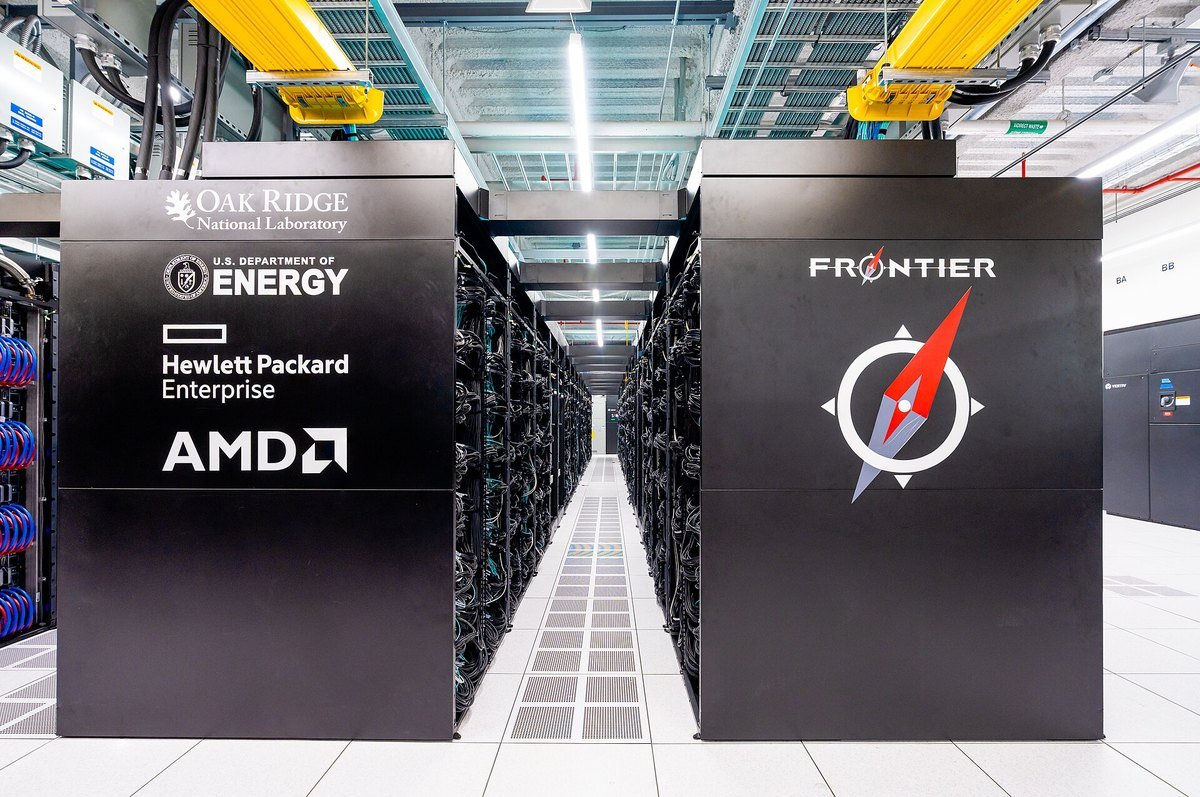
Frontier, an HPE Cray EX system with AMD EPYC CPUs and Instinct MI250X GPUs, became the first supercomputer publicly confirmed to pass one quintillion floating-point operations a second, scoring 1.102 exaflops. It later reached 1.353 exaflops. It needed about 21 megawatts, far less than early estimates of what an exascale machine would draw.
Why it matters: exascale was a target set more than a decade earlier; meeting it relied on GPUs doing most of the arithmetic.
Apple M1 puts 16 billion transistors in a laptop Hardware
Apple’s M1 combined eight CPU cores, up to eight GPU cores, a 16-core Neural Engine rated at 11 trillion operations a second and unified memory in one system-on-chip of 16 billion transistors, about seven million times the 4004’s count. The same year Japan’s Fugaku, built on Arm-based Fujitsu A64FX chips, took the supercomputer crown with 415.5 petaflops in June and 442 in November.
Summit: GPUs take over supercomputing Architecture
IBM’s Summit put the US back at No. 1 with 122.3 petaflops, rising to 143.5 in November 2018 and 148.6 in June 2019. Most of its power came from more than 27,000 NVIDIA V100 GPUs, a pattern most leading systems have followed since.
AlexNet shows GPUs can train deep networks Architecture
A neural network trained by Alex Krizhevsky, Ilya Sutskever and Geoffrey Hinton on two consumer graphics cards cut the error rate in the ImageNet image-recognition contest by about 10 percentage points. Deep learning took off, and the GPU went from graphics engine to the default hardware for AI.
Roadrunner passes one petaflop Record
IBM’s Roadrunner became the first system to sustain more than one petaflop (1015 operations a second) on the HPL benchmark, by pairing ordinary processors with Cell chips derived from the PlayStation 3. It was an early version of the accelerator-heavy design used today.
CUDA and the cloud Architecture
Amazon launched EC2, letting anyone rent computing by the hour instead of buying servers. NVIDIA released CUDA, which let programmers use graphics chips for general calculation in a C-like language. Together they set up the two pillars of the AI era: rented compute and programmable parallel hardware.
ASCI Red passes one teraflop Record
Built by Intel, ASCI Red became the first computer to beat one trillion floating-point operations a second on the HPL benchmark. It used thousands of ordinary PC processors working in parallel, the approach that replaced the custom vector machines of the Cray era.
The first TOP500 list Context
Researchers began ranking the world’s 500 fastest computers twice a year using the Linpack benchmark. The first leader, a massively parallel CM-5, managed 59.7 gigaflops. Today’s No. 1 is about 37 million times faster on the same test.
The IBM PC Market
IBM’s Personal Computer used an Intel 8088 processor with about 29,000 transistors and Microsoft’s MS-DOS. Its open design was widely copied, and ‘IBM-compatible’ PCs took computing into offices around the world.
The personal computer ‘trinity’ Market
Three ready-made computers went on sale to ordinary buyers. The Apple II ran at about 1 MHz with 4 KB of memory as standard. For the first time, a computer could belong to one person rather than an institution.
Cray-1: the supercomputer as a product Hardware
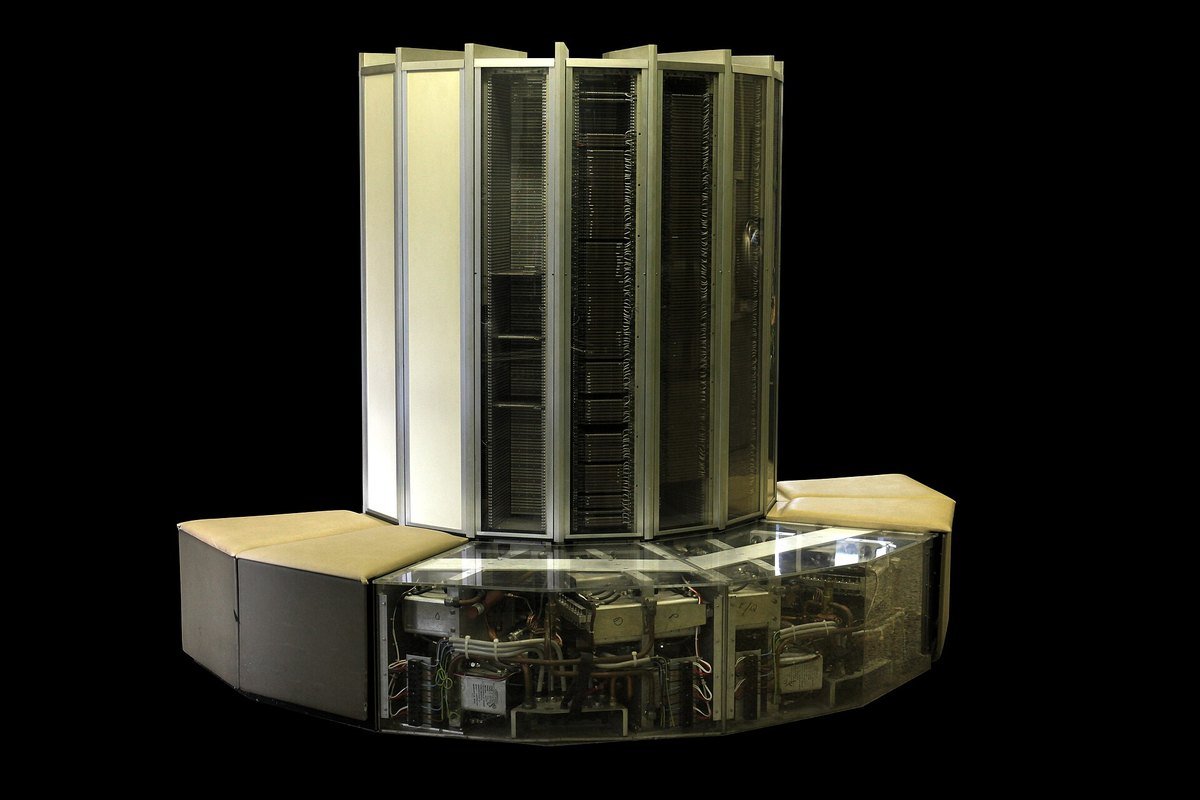
Seymour Cray’s Cray-1 used vector processing, dense integrated circuits and a C-shaped cabinet that kept wires short. Its peak of about 160 megaflops made it the fastest machine in the world; around 80 were sold at about $8 million each.
Intel 4004: a CPU on one chip Hardware
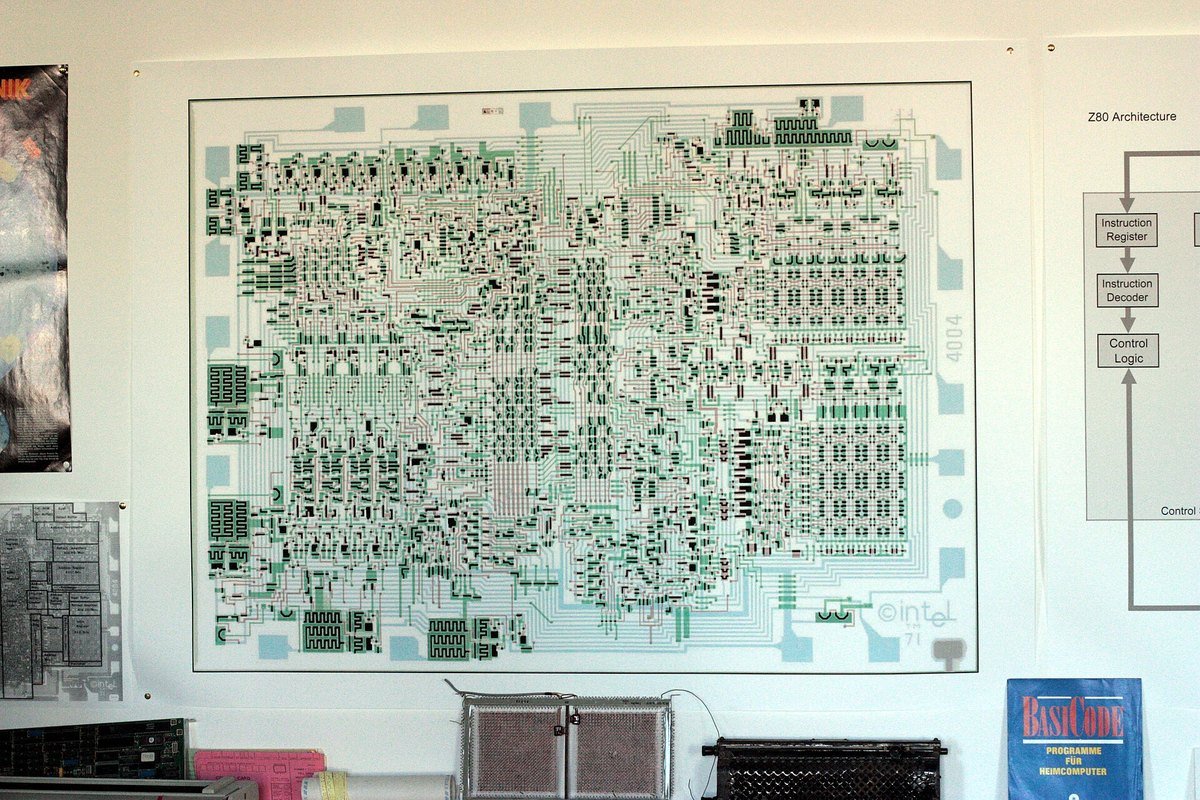
Designed by Federico Faggin, Ted Hoff, Stanley Mazor and Busicom’s Masatoshi Shima, the 4004 put a complete 4-bit processor on a chip about 12 mm² in area. It could run about 92,000 instructions a second. Intel bought back the rights from Busicom and sold it to anyone, starting the microprocessor industry.
Moore’s law is written down Context
Gordon Moore, then at Fairchild, predicted that the number of components on a chip would keep doubling every year. In 1975 he revised the pace to about every two years. Chipmakers treated it as a target for half a century.
IBM System/360 Architecture
IBM announced a family of computers that could all run the same software, so a customer could move to a bigger machine without rewriting programs. The gamble, reportedly about $5 billion, made the mainframe the backbone of banks, airlines and governments.
The integrated circuit Hardware
Jack Kilby built a working circuit on one piece of germanium; Robert Noyce patented a practical silicon version that could be mass-produced. Putting many transistors on one chip is the step every later gain in computing depends on.
ENIAC is switched off Context
After almost ten years of service, ENIAC was shut down. By then transistorised and stored-program machines were overtaking it, and IBM was selling computers to businesses.
UNIVAC I: the first US commercial computer Market
Eckert and Mauchly’s company delivered UNIVAC I, the first computer built for sale in the US. It became famous in 1952 when CBS used it to predict Dwight Eisenhower’s landslide from early returns. Britain’s Ferranti Mark 1 had been delivered weeks earlier, in February 1951.
The Manchester Baby runs a stored program Architecture
The Small-Scale Experimental Machine ran the first program held in a computer’s own electronic memory, so changing the task meant loading new instructions rather than rewiring. The same year ENIAC was converted to a basic stored-program mode.
The transistor Hardware
John Bardeen and Walter Brattain demonstrated the point-contact transistor; William Shockley soon designed the junction transistor. It could do a vacuum tube’s switching job in a fraction of the space and power, without burning out.
ENIAC is unveiled Hardware
At the Moore School in Philadelphia, ENIAC computed a shell trajectory faster than the shell itself would fly. It had about 17,468 vacuum tubes, weighed about 27 tonnes and drew about 150 kW. Its first big job, in December 1945, had been hydrogen-bomb calculations for Los Alamos.
Why it matters: ENIAC showed that electronic machines could be set up to solve many kinds of problems, at speeds no mechanical calculator could approach.
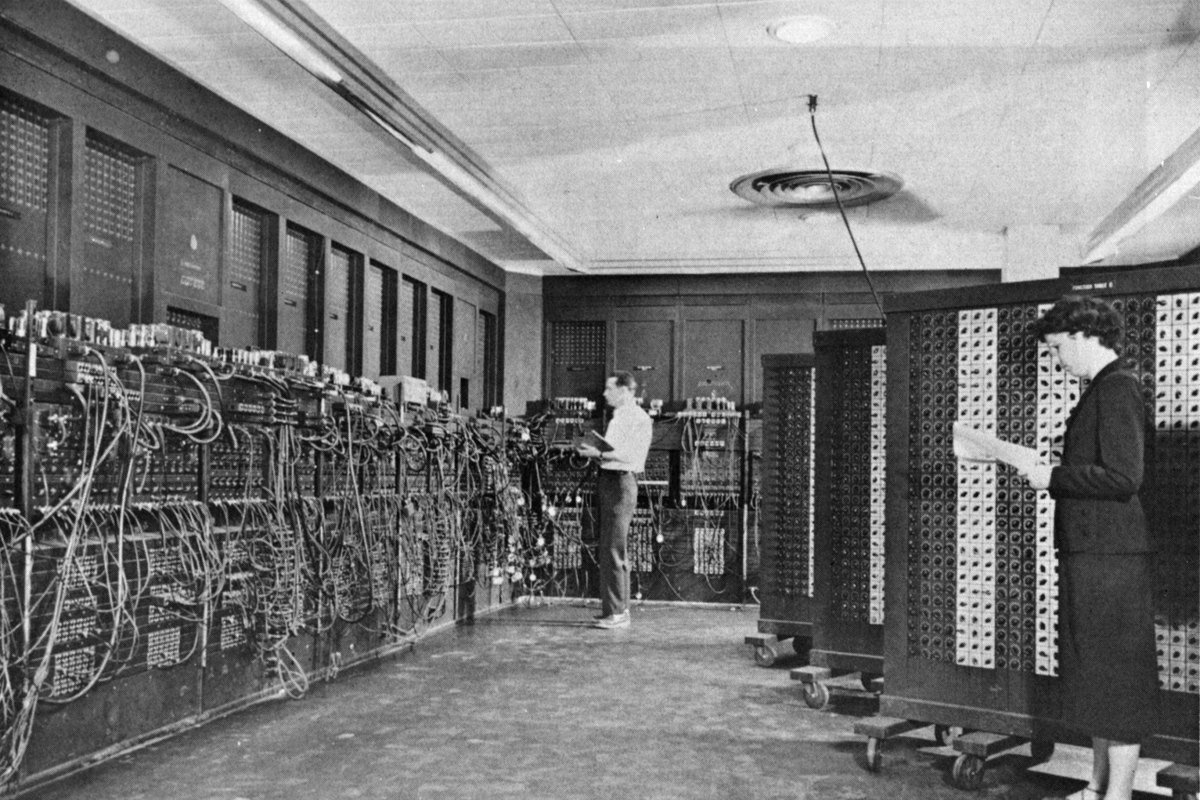
Project PX begins Context
The Army funded Mauchly and Eckert’s proposal for an electronic calculator to speed up firing tables for new artillery. The war ended before ENIAC was finished; the final cost was about $487,000.
The Fastest Supercomputers in 2026
TOP500 list, June 2026 (HPL Rmax). Swipe sideways on mobile.
| Rank | System | Country | HPL (exaflops) | Cores | Power |
|---|---|---|---|---|---|
| 1 | LineShine (NSCS Shenzhen) | China | 2.198 | 13,789,440 | 42.2 MW |
| 2 | El Capitan (LLNL) | USA | 1.809 | 11,340,000 | 29.7 MW |
| 3 | Frontier (ORNL) | USA | 1.353 | 9,066,176 | 24.6 MW |
| 4 | Aurora (Argonne) | USA | 1.012 | 9,264,128 | 38.7 MW |
| 5 | JUPITER Booster (Jülich) | Germany | 1.000 | 4,801,344 | 15.8 MW |
| 9 | Fugaku (RIKEN) | Japan | 0.442 | 7,630,848 | 29.9 MW |
LineShine’s win is notable for two reasons. It is the first time since 2017 that a Chinese system has topped a list China had largely stopped submitting to, and it reached the top without GPUs, using a very large number of Arm CPU cores with high-bandwidth memory on the package. It is also less efficient than El Capitan, at about 52 gigaflops per watt against roughly 61, which is why it needs 42 megawatts. The most efficient systems on the June 2026 Green500, built on NVIDIA Grace Hopper chips, exceed 73 gigaflops per watt.
ENIAC vs Today’s Fastest Computer
Approximate, and in different units: a sense of scale, not a benchmark.
| Measure | ENIAC, 1946 | LineShine, 2026 | Change |
|---|---|---|---|
| Speed | ~5,000 additions/s | 2.198 quintillion flops (HPL) | ~440 trillion times (rough) |
| Switching parts | 17,468 vacuum tubes | Billions of transistors per chip | Tubes to nanometre transistors |
| Processing units | 20 accumulators | 13.8 million CPU cores | Parallel at massive scale |
| Power | ~150 kW | ~42.2 MW | ~280 times more |
| Programming | Cables and switches | Software, compilers, schedulers | Hardware to software |
| Speed per watt | ~0.03 additions/s per watt | ~52 billion flops per watt | Roughly a trillion-fold |
Every Generation Removed a Bottleneck
Calculate electronically
ENIAC replaced moving parts with electronic switching, gaining a thousandfold. The new limit: thousands of hot, failure-prone vacuum tubes.
Shrink the switch
Transistors, then integrated circuits, then the microprocessor packed ever more switches into ever less space and power.
Make it usable
Compatible mainframes, then PCs, made computing a platform for software and for ordinary people.
Go parallel
When single processors stopped getting much faster, supercomputers connected thousands, then hundreds of thousands, of them.
Specialise and rent
GPUs and AI accelerators did the heavy maths; the cloud let anyone rent them by the hour.
Power and data movement
The new limits are electricity, cooling and moving data between memory and processors, not raw arithmetic.
Corrections and Clarifications
Claims in the material this page was built from, and in common retellings.
“El Capitan is the world’s fastest”
True from November 2024 to November 2025. On the June 2026 TOP500 list China’s LineShine is No. 1 with 2.198 exaflops; El Capitan is second at 1.809.
“The Intel 4004 ran at 108 kHz”
Its maximum clock was 740 kHz. The 108 kHz figure appears to come from a confusion with its 10.8-microsecond instruction cycle.
“1950: UNIVAC I begins commercial computing”
UNIVAC I was accepted by the US Census Bureau on 31 March 1951. Britain’s Ferranti Mark 1 was delivered in February 1951.
“2018: Summit reaches 148.6 petaflops”
Summit debuted in June 2018 at 122.3 petaflops. It reached 143.5 in November 2018 and 148.6 only in June 2019.
“ENIAC was the first computer”
It was the first programmable, general-purpose electronic digital computer. The Atanasoff–Berry Computer and Colossus came earlier with narrower designs, and a 1973 US court ruling invalidated the ENIAC patent.
“Unveiled on 14 February 1946”
Correct for the press demonstration. The formal dedication was the next day, 15 February, and ENIAC had already done secret work for Los Alamos since December 1945.
What to Watch Next
The next TOP500 list
Whether LineShine holds No. 1, and whether more European and Asian systems pass an exaflop.
Private machines beyond the list
The largest AI training clusters are not ranked on TOP500 and are measured in GPUs and gigawatts rather than HPL scores.
Flops per watt
Green500 leaders exceed 73 gigaflops per watt; energy, not chips, increasingly sets the size of the next machine.
Quantum and beyond
Quantum, neuromorphic and optical computing promise gains on particular problems, but none yet rivals exascale systems on general work.
Quick Quiz
1. Roughly how many additions a second could ENIAC do?
2. What was ENIAC’s first major calculation?
3. What was the Intel 4004’s maximum clock speed?
4. Which machine first passed one exaflop?
5. Which system tops the June 2026 TOP500 list?
Explore More Timelines
People Also Ask
Frequently Asked Questions
The Bottom Line
ENIAC’s 5,000 additions a second look tiny now, but its real legacy was the idea that one electronic machine could be set up to solve many different problems. Every generation since attacked a different limit: vacuum tubes gave way to transistors, transistors to integrated circuits, single processors to millions of cores, and general-purpose chips to accelerators built for AI.
In 1946 a computer filled a room and one country had it. In 2026 the fastest machine is in Shenzhen, eight of the top ten are in the US and Europe, and anyone with a credit card can rent a slice of a data centre. The next chapter is less about doing more calculations than about doing them on less power, since the biggest machines are now limited by the electricity grid as much as by silicon.
Related AiTimeline Stories
⚠️ Editorial Note
Last updated 6 October 2026. ENIAC details are from the University of Pennsylvania and standard histories; specifications vary slightly between sources depending on what is counted. Supercomputer figures are TOP500 HPL results (Rmax) from the list named; peak figures are labelled. Speed comparisons across eras use different units and are approximate. Chip specifications are from the manufacturers.
Sources & further reading
Every dated entry above was checked against these references. Last reviewed 6 October 2026.
- ENIAC: history and heritage (Penn Engineering, University of Pennsylvania)
- TOP500 June 2026 list highlights: LineShine debuts at No. 1
- TOP500 November 2025 list
- The Story of the Intel 4004 (Intel)
- The Nobel Prize in Physics 1956: Shockley, Bardeen and Brattain, for the transistor
- IBM System/360 (IBM History)
- Frontier supercomputer debuts as world's fastest, breaking exascale barrier (ORNL, May 2022)
- Apple unleashes M1 (Apple Newsroom, November 2020)