Pi Day: The History of Computing Pi as a Benchmark
From Archimedes and Aryabhata to ENIAC, y-cruncher and the 314 trillion digit record: how computing pi became a test of computers, era by era.
Latest Story
Pi never changed. The machines chasing it did. Every 14 March, written 3/14, people celebrate Pi Day. Behind the pies is a 3,600-year story: scribes approximating circles, Archimedes trapping π between polygons, Indian mathematicians finding infinite series, and finally computers spending months on a single number. In November 2025 one server finished 314 trillion digits. This is how computing pi became a benchmark for the computers themselves.
💡 Short Answer
Pi has been approximated for about 3,600 years. Archimedes bounded it with polygons around 250 BC, Aryabhata gave 3.1416 in 499, and Madhava found infinite series around 1400. ENIAC computed 2,037 digits in 1949. Since then records have become computer benchmarks: in November 2025 a single server running y-cruncher computed 314 trillion digits in 110 days.
Computing Pi: Key Questions
What to Know About Pi and Computing
- Method beat measurement: Archimedes replaced measuring circles with provable polygon bounds around 250 BC.
- India shaped the story: Aryabhata’s 3.1416 (499), Madhava’s infinite series (c. 1400) and Ramanujan’s 1914 series.
- Formulas matter more than hardware: Madhava’s basic series gains under one digit per term; Chudnovsky’s gains about 14.
- ENIAC started the computer race in 1949 with 2,037 digits in about 70 hours.
- Growth was exponential: a million digits in 1973, a billion in 1989, a trillion in 2002.
- 2009 was the turning point: Fabrice Bellard beat a supercomputer record on one desktop PC, and y-cruncher launched.
- Every record since 2010 used y-cruncher, Alexander Yee’s multithreaded program.
- Records are now storage tests: the 2024-25 runs used hundreds of terabytes to petabytes of SSDs.
- The record is 314 trillion digits (November 2025), run on one server for 110 days without a restart.
- Practical need is tiny: NASA uses 15 decimals; about 37 would cover the visible universe.
Tap a year. Watch the digits explode.
From 2,037 digits on a room-sized computer to 314 trillion on one rack server.
Six Eras of Chasing Pi
Each era asked a different question about the same number
For most of history the problem was mathematical: find a better way to squeeze pi. From 1949 it became computational: turn a formula into a program and run it. Since 2009 it has become an engineering problem: keep a machine, its memory and dozens of drives working correctly for months. Pi is just the workload.
The Timeline, 2026 Back to c. 1650 BC
Newest first. Digit records from the AMS Feature Column, MacTutor and y-cruncher’s record list
Still 314 trillion; Pi Day turns hopeful
As of September 2026 no larger computation has been listed, so 314 trillion digits stays the record. The seventh International Day of Mathematics on 14 March runs under UNESCO and the International Mathematical Union with the theme “Mathematics and Hope”. y-cruncher itself reached version 0.8.7 in November 2025.
2025
314 trillion digits on one server
Kevin O’Brien, Divyansh Jain and Brian Beeler run y-cruncher on a single Dell PowerEdge R7725 with 2 × AMD EPYC 9965 (384 cores), 1.5 TB of DDR5 and 40 Micron 6550 Ion SSDs. The run starts on 31 July and ends 110 days later, never resumed from a checkpoint. It uses about 4,305 kWh, or 13.7 kWh per trillion digits. Verification takes 4.37 hours.
2025
300 trillion digits
Jake Tivy of Linus Media Group computes 300 trillion digits on 2 × AMD EPYC 9684X with 3 TB of memory and about 2 PB of networked storage. The run takes about 225 days, including weeks lost to interruptions, and resumes from checkpoints more than once.
105 trillion, then 202 trillion
StorageReview’s first record, 105 trillion digits on 2 × AMD EPYC 9754, is announced on Pi Day 2024 after 75 days. Weeks later the team finishes 202.1 trillion on 2 × Intel Xeon Platinum 8592+ and about 1.6 PB of Solidigm SSDs, completing on 20 May after 104 days. Pi records have become storage showcases.
The cloud era
Emma Haruka Iwao of Google computes 31.4 trillion digits on Google Cloud, announced on 14 March 2019, then 100 trillion, announced on 8 June 2022 after 158 days. In between, Timothy Mullican reaches 50 trillion on used server hardware in his home (303 days), and the University of Applied Sciences of the Grisons in Switzerland reaches 62.8 trillion.
UNESCO makes 14 March official
UNESCO proclaims 14 March the International Day of Mathematics, first celebrated in 2020. Pi Day stops being only an American museum joke and becomes a global day for mathematics.
Home servers take the record
Using the new y-cruncher, Shigeru Kondo, an engineer in Japan, and Alexander Yee reach 5 trillion digits in August 2010 on a two-socket workstation with 96 GB of memory and a wall of hard drives. Kondo pushes to 10 trillion (2011) and 12.1 trillion (2013). Sandon Van Ness reaches 13.3 trillion, and physicist Peter Trueb 22.4 trillion in November 2016.
Supercomputer vs desktop PC
In August Daisuke Takahashi at the University of Tsukuba computes about 2.58 trillion digits on the T2K supercomputer in about 29 hours. On 31 December Fabrice Bellard announces about 2.7 trillion digits on a single desktop PC with a Core i7, over 131 days. The same year, Alexander J. Yee releases y-cruncher. The US House of Representatives passes a resolution recognising National Pi Day in March.
1.24 trillion digits
Yasumasa Kanada’s team uses a Hitachi SR8000/MPP supercomputer for about 600 hours to pass one trillion digits. Kanada holds the record for much of the 1980s to 2000s. This run uses two different Machin-type arctangent formulas, each checking the other.
Chudnovsky formula; one billion digits
Brothers David and Gregory Chudnovsky publish a Ramanujan-style series that adds about 14 digits per term, and in 1989 pass one billion digits with it. In 1988, Larry Shaw holds the first Pi Day at San Francisco’s Exploratorium.
Algorithms overtake hardware
Eugene Salamin and Richard Brent independently publish the AGM (Gauss-Legendre) method, which doubles the correct digits each step. Kanada reaches 16.7 million digits in 1983. In 1985 Bill Gosper uses a Ramanujan series for 17 million. Jonathan and Peter Borwein publish faster AGM-type algorithms and, in 1987, the book Pi and the AGM.
One million digits
Jean Guilloud and Martine Bouyer in France compute just over 1,000,000 digits on a CDC 7600 in about 23 hours, still with Machin-type arctangent formulas.
100,000 digits
Daniel Shanks and John Wrench compute about 100,265 digits on an IBM 7090 in about 8.7 hours. Twelve years after ENIAC, the record has grown about fifty-fold.
ENIAC computes pi
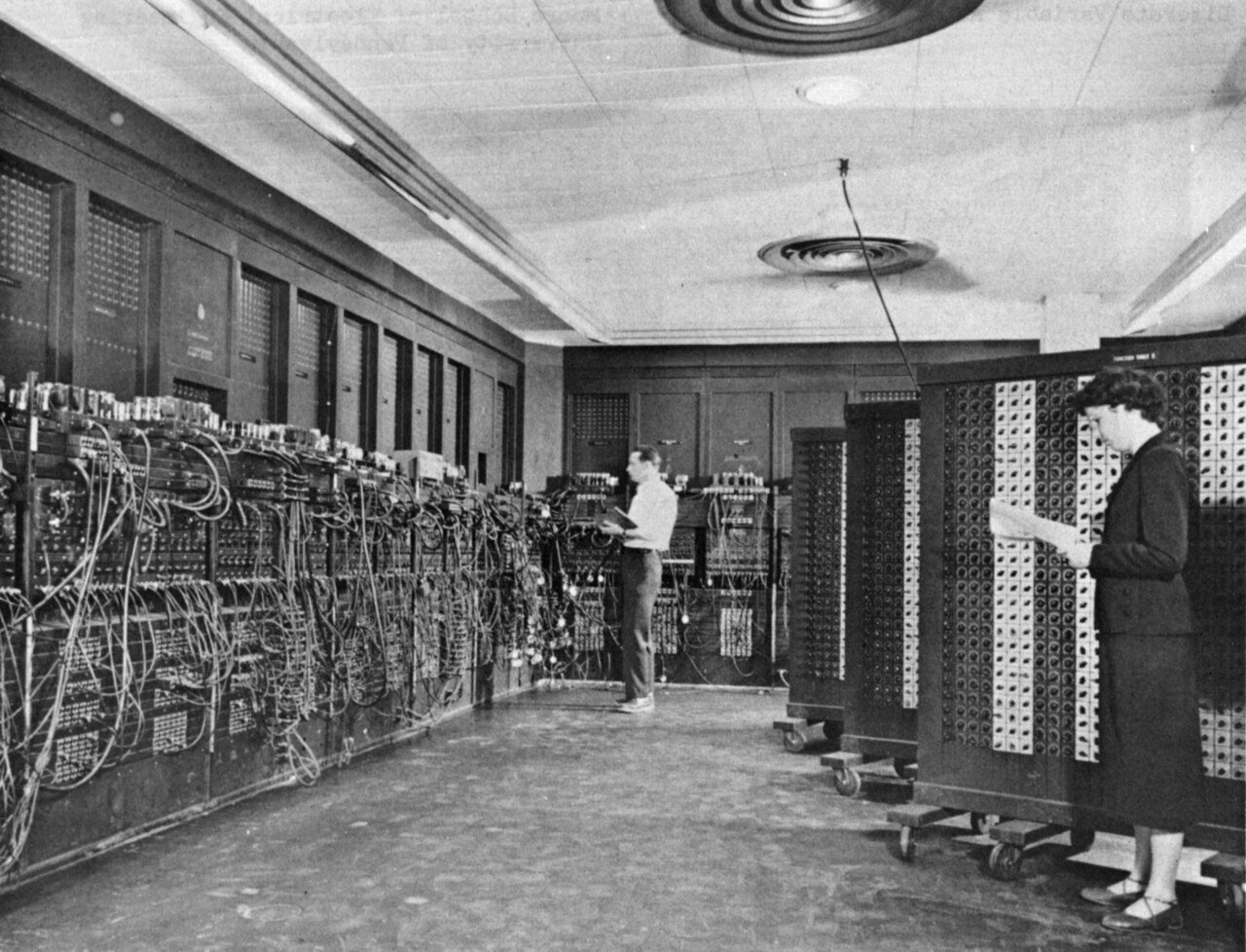
Over a holiday weekend, ENIAC computes pi to 2,037 decimal places in about 70 hours, including the time to feed punched cards. The run is organised by George Reitwiesner, with John von Neumann interested in whether the digits look random. It uses Machin’s 1706 formula.
The last hand record
D. F. Ferguson finds that William Shanks’s famous 1873 hand calculation of 707 digits went wrong at the 528th decimal. Using a desk calculator he reaches 808 digits by 1947, the last record made without an electronic computer.
Ramanujan’s series
Srinivasa Ramanujan, then at Cambridge, publishes 17 series for 1/pi. One adds about eight correct digits per term. They are curiosities for 70 years, until computers make them the fastest way to reach record digit counts.
The symbol and the proofs
William Jones uses the symbol π in 1706, the year John Machin finds a fast arctangent formula and computes 100 digits. Euler adopts π in 1737. Lambert proves π irrational in 1761 (published 1768), and Lindemann proves it transcendental in 1882. That ends the ancient hope of squaring the circle with ruler and compass.
Ludolph’s number
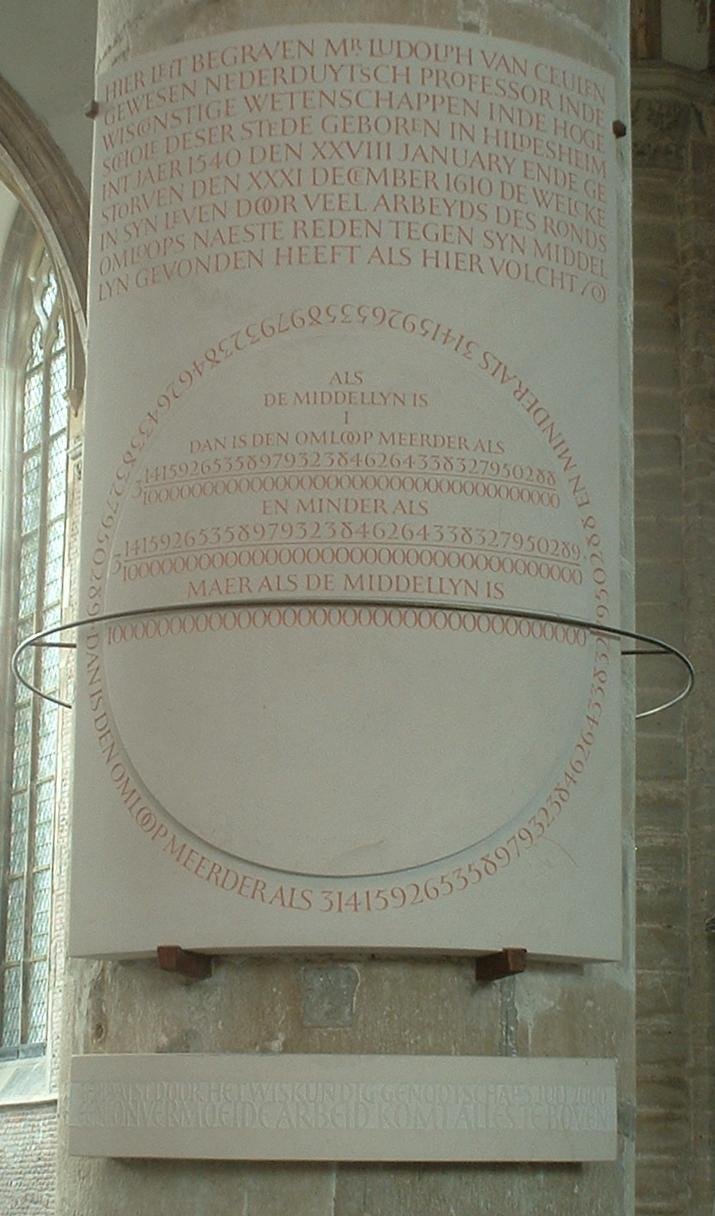
Ludolph van Ceulen uses Archimedes’ polygons with up to 262 sides, reaching 20 digits in 1596 and 35 by his death in 1610. The digits are cut into his tombstone. It is the peak, and the limit, of the polygon method.
Infinite series and al-Kashi
Madhava of Sangamagrama finds infinite series for pi, including π/4 = 1 − 1/3 + 1/5 − 1/7 + …, adds correction terms and reaches 11 decimal places. In 1424 Jamshid al-Kashi in Samarkand uses a polygon with 3 × 228 sides to get 16 decimal places, the record for about 170 years.
Aryabhata’s 3.1416
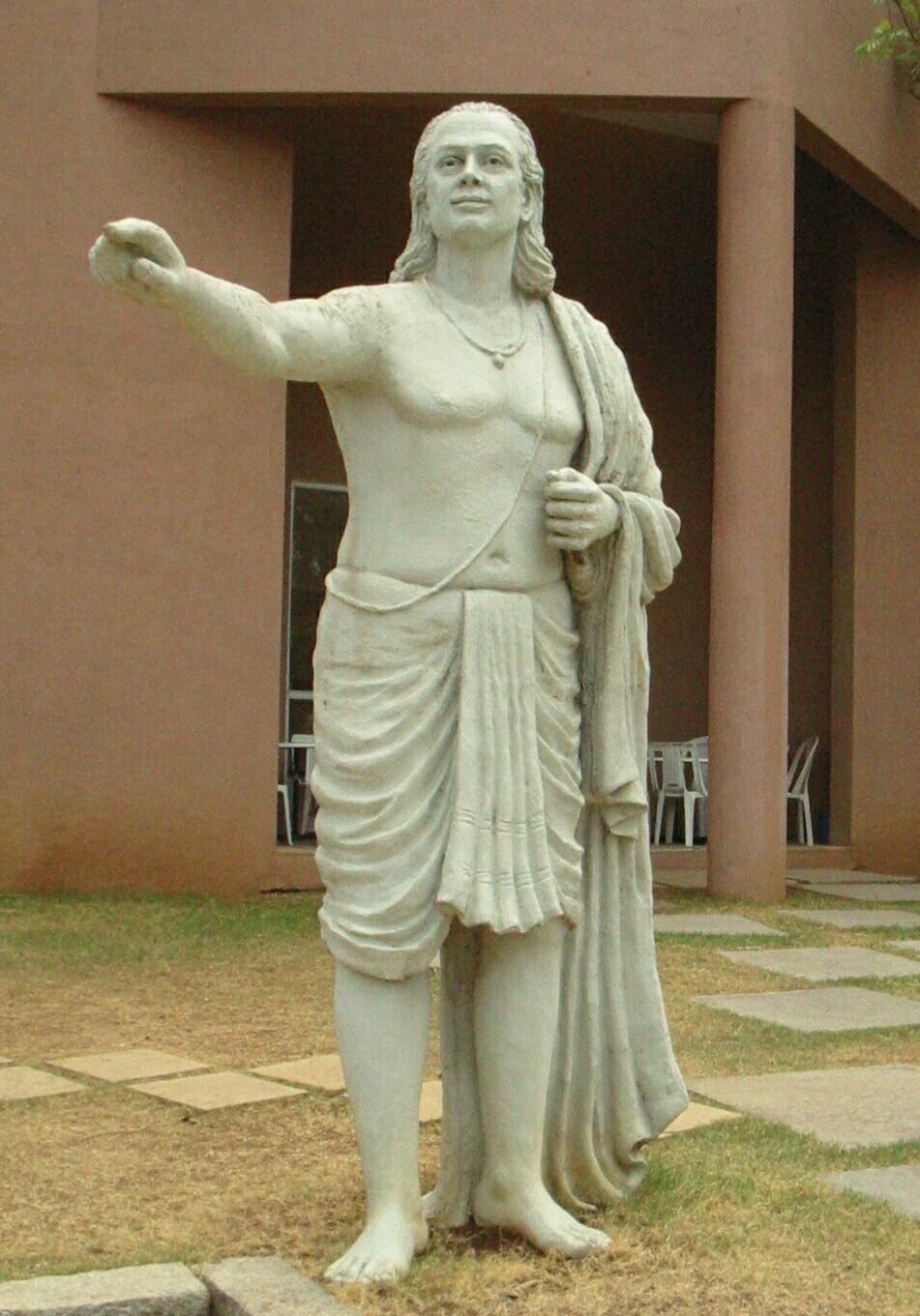
Aryabhata gives the circumference of a circle of diameter 20,000 as about 62,832, which is 3.1416. He calls it asanna, approximate, which some historians read as an early hint that pi cannot be written exactly.
Zu Chongzhi’s 355/113
Zu Chongzhi shows 3.1415926 < π < 3.1415927 and gives 355/113, correct to six decimals. No one improves on it for about 900 years. His method was in a book, Zhui Shu, that is now lost.
Archimedes traps pi
Archimedes doubles polygons from 6 to 96 sides inside and outside a circle and proves 223/71 < π < 22/7, or 3.1408 to 3.1429. It is the first method that can, in principle, be pushed to any accuracy.
The first approximations
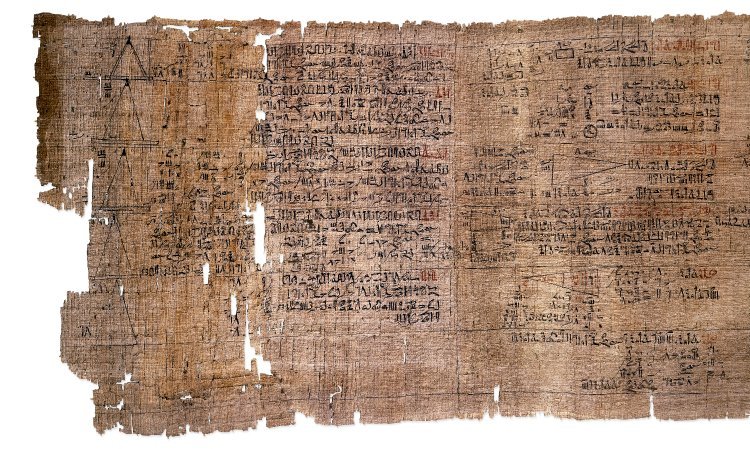
The scribe Ahmes copies a rule that finds a circle’s area by squaring 8/9 of its diameter, equivalent to π ≈ 3.1605. A Babylonian tablet from about the same era implies 3.125.
The Real Revolution: Better Formulas
Why 1988 mattered more than any single computer
Madhava’s series, π/4 = 1 − 1/3 + 1/5 − …, is beautiful and nearly useless for records: every extra correct digit needs about ten times as many terms. Machin’s 1706 arctangent formula gains about 1.4 digits a term and carried every record, ENIAC’s included, until the 1970s.
Two changes then broke the curve. The AGM method of Salamin and Brent (1976) doubles the correct digits with each iteration, so about 40 iterations reach a trillion digits. Ramanujan-type series, and above all the Chudnovsky formula of 1988, add about 14 digits a term. Combined with FFT-based multiplication and binary splitting, which turn the sum into a few enormous multiplications, they let a program’s speed depend on how fast it can multiply numbers with trillions of digits. That problem is what y-cruncher is built for.
What a Pi Benchmark Actually Tests
It isn’t just CPU speed
CPU and vector units
Huge multiplications run on every core and on wide vector instructions such as AVX-512. The 2025 record used 384 cores.
Capacity and bandwidth
About 4.7 bytes per digit in RAM. Moving data between memory and cores is often the real limit.
The swap array
Past a few trillion digits the work spills to disk. The 314 trillion run peaked at about 1.43 PiB on its SSDs.
Algorithms and tuning
Same hardware, different software, very different results: formula, FFT method, threading and memory layout all matter.
Months without an error
One flipped bit in months ruins the answer. That is why y-cruncher is also a popular overclocking stress test.
Verification
The last digits are checked with a separate Bailey-Borwein-Plouffe-type formula. For 314 trillion this took about 4.37 hours.
Pick a digit target and a machine.
A rough, order-of-magnitude guide based on how y-cruncher scales. Real results vary a lot.
Estimated values only. Actual performance depends heavily on the algorithm, software version, processor, memory speed, storage and configuration. Assumptions: about 4.7 bytes of RAM per digit; laptop 16 GB, desktop 64 GB, workstation 256 GB, server 1.5 TB.
Every y-cruncher Pi Record, 2010–2025
From one engineer’s workstation to one rack server with 2 PB of flash
| Completed | Digits | Who | Hardware | Run time |
|---|---|---|---|---|
| Aug 2010 | 5 trillion | Shigeru Kondo, Alexander Yee | 2 × Xeon X5680, 96 GB | 90 days |
| Oct 2011 | 10 trillion | Shigeru Kondo | 2 × Xeon X5680, 96 GB | 371 days |
| Dec 2013 | 12.1 trillion | Shigeru Kondo | 2 × Xeon E5-2690, 128 GB | 94 days |
| Oct 2014 | 13.3 trillion | Sandon Van Ness | 2 × Xeon E5-4650L, 192 GB | 208 days |
| Nov 2016 | 22.4 trillion | Peter Trueb | 4 × Xeon E7-8890 v3, 1.25 TB | 105 days |
| Jan 2019 | 31.4 trillion | Emma Haruka Iwao | Google Cloud, >1.4 TB | 121 days |
| Jan 2020 | 50 trillion | Timothy Mullican | 4 × Xeon E7-4880 v2, 315 GB | 303 days |
| Aug 2021 | 62.8 trillion | UAS Grisons | AMD EPYC 7542, 1 TB | 108 days |
| Mar 2022 | 100 trillion | Emma Haruka Iwao | Google Cloud 128 vCPU, 864 GB | 158 days |
| Feb 2024 | 105 trillion | StorageReview | 2 × AMD EPYC 9754, 1.5 TB | 75 days |
| May 2024 | 202.1 trillion | StorageReview | 2 × Xeon Platinum 8592+, 1 TB | 104 days |
| Apr 2025 | 300 trillion | Jake Tivy (LMG) | 2 × AMD EPYC 9684X, 3 TB | 225 days |
| Nov 2025 | 314 trillion | StorageReview | 2 × AMD EPYC 9965, 1.5 TB | 110 days |
Two patterns stand out. First, run times have barely changed: records still take roughly three to ten months, because each team pushes the digit count up to whatever its hardware can finish in that time. Second, the record-holders changed from hobbyists and academics to cloud providers and storage vendors, for whom a pi record is a public demonstration of reliability.
Inside the 314 Trillion Digit Run
300 trillion (2025) vs 314 trillion (2025)
The newer run finished more digits in half the time with half the memory. StorageReview credits the storage bandwidth of its directly attached SSD array. That is the benchmark lesson of 2025: at this scale, pi measures how fast a system can move data, not only how fast it can calculate.
How Much Pi Do You Actually Need?
| Value used | Decimals | Good enough for |
|---|---|---|
| 3.14 | 2 | School geometry, everyday estimates |
| 3.14159 | 5 | Most engineering drawings |
| 3.141592653589793 | 15 | NASA JPL interplanetary navigation |
| 37 decimals | 37 | Circle the size of the visible universe, to about one hydrogen atom |
| 314 trillion digits | 314,000,000,000,000 | No measurement at all: a test of computers |
NASA’s Jet Propulsion Laboratory uses 3.141592653589793 for its most precise navigation. Beyond about 37 decimals there is nothing physical left to measure. The extra trillions are used to study whether pi’s digits behave randomly, which they appear to, though no one has proved it, and to test computers.
Pi Day: From a Museum to UNESCO
Pi Day began with Larry Shaw at San Francisco’s Exploratorium in 1988, with a parade around a circular room and fruit pies. The US House of Representatives recognised National Pi Day in March 2009. In November 2019 UNESCO proclaimed 14 March the International Day of Mathematics, first held in 2020. The 2026 theme was “Mathematics and Hope”. The date has two more coincidences: Albert Einstein was born on 14 March 1879, and Stephen Hawking died on 14 March 2018.
Records have leaned into the date too. Google announced 31.4 trillion digits on Pi Day 2019, and StorageReview announced 105 trillion on Pi Day 2024.
Did You Know?
- Shanks’ error: William Shanks spent years computing 707 digits by hand in 1873. Digits from the 528th on were wrong, and nobody noticed for 72 years.
- 900-year record: Zu Chongzhi’s bounds were not improved until al-Kashi in 1424.
- Madhava first: the series usually credited to Leibniz (1670s) was known in Kerala about 250 years earlier.
- Home-built: in the early 1990s the Chudnovsky brothers built their own supercomputer from mail-order parts in a Manhattan apartment.
- Memory feats: Guinness lists India’s Rajveer Meena reciting 70,000 digits in 2015.
- The 100 trillionth digit of pi is 0, according to Google’s 2022 run.
Test Yourself: Pi Computing Quiz
1. What does π represent?
2. Who bounded π between 223/71 and 22/7?
3. Who gave the fraction 355/113?
4. What value did Aryabhata give in 499 AD?
5. What happened in September 1949?
6. Which formula powers modern pi records?
7. What is y-cruncher?
8. What is the record as of September 2026?
Explore More Timelines
People Also Ask
Frequently Asked Questions
Related AiTimeline Stories
⚠️ Editorial Note
Ancient and medieval values follow the MacTutor History of Mathematics chronology. Computer-era records to 2002 follow the American Mathematical Society Feature Column. Records from 2010 onward are from y-cruncher’s official record list at numberworld.org, and the 314 trillion run details are from StorageReview’s own report. Additions and corrections to circulating summaries: records between 2002 and 2024 (Takahashi, Bellard, Kondo and Yee, Trueb, Iwao, Mullican, UAS Grisons) and the 105 trillion run of 2024 are often skipped; Machin’s 1706 formula, Ramanujan’s 1914 series and the 1988 Chudnovsky formula are central to the story; and the 300 trillion record was announced in May 2025, not April. The interactive estimator is illustrative, not a benchmark result.
Sources & further reading
Every dated entry above was checked against these references. Last reviewed 29 September 2026.
- y-cruncher: records set by y-cruncher (Alexander J. Yee)
- StorageReview: 314 trillion digits on a Dell PowerEdge R7725
- MacTutor: A chronology of pi
- MacTutor: Pi through the ages
- Google Cloud: Calculating 100 trillion digits of pi
- Fabrice Bellard: Pi computation record (2.7 trillion digits, 2009)
- NASA JPL: How many decimals of pi do we really need?
- UNESCO: International Day of Mathematics 2026