Wall Street Crash 1929: Causes, Impact, and Legacy
Wall Street Crash 1929 timeline: the margin-fuelled boom, Black Thursday and Black Tuesday, the bank panics behind the Great Depression, and the reforms.
Latest Story
In the autumn of 1929, the American stock market suffered the most famous collapse in its history. Over four trading days in late October, investors who had borrowed heavily to buy shares rushed to sell, and the Dow Jones Industrial Average lost about a quarter of its value. The Wall Street Crash of 1929 became the symbol of the Great Depression. But the disaster that followed was not caused by one week of panic: speculation, borrowed money, a slowing economy, failing banks and policy mistakes combined to turn a market crash into a decade-long international crisis. This timeline follows it from the 1920s boom to the reforms that still shape markets, and to 2026, when borrowing to buy shares hit a new record.
💡 Short Answer
The Wall Street Crash of 1929 was a collapse in US share prices that peaked between Black Thursday, 24 October, and Black Tuesday, 29 October 1929. The Dow fell from 381.17 on 3 September to 198.60 by 13 November, and to 41.22 by July 1932, 89% below its peak. A boom built on borrowed money met a slowing economy. The crash did not cause the Great Depression alone: bank failures, a collapsing money supply and policy errors made it far worse.
Wall Street Crash 1929: Key Questions
The 1929 Crash in Ten Points
- The boom: the Dow rose about six-fold from 63 in August 1921 to 381.17 on 3 September 1929.
- The leverage: brokers’ loans topped $8.5 billion, more than all US currency in circulation.
- The turn: the economy peaked in August 1929, two months before the crash.
- Black Thursday: a record 12.9 million shares traded on 24 October; a bankers’ pool steadied prices.
- Black Monday and Tuesday: falls of 12.82% and 11.73% on 28 and 29 October.
- The first low: 198.60 on 13 November 1929, almost half gone in ten weeks.
- The real damage: about 9,000 banks suspended operations between 1930 and 1933.
- The bottom: 41.22 on 8 July 1932, 89% below the peak; unemployment about 25% in 1933.
- The reforms: deposit insurance, the Securities Acts and the SEC, Fed margin rules.
- The echo: US margin debt hit a record $1.5 trillion in June 2026.
Wall Street Crash 1929 at a Glance
The Dow is a price-weighted index of 30 large companies. Its percentage fall is not the same as the share of all American wealth lost.
| Key fact | Details |
|---|---|
| Market | New York Stock Exchange and the wider US share market |
| Dow Jones peak | 381.17 on 3 September 1929 |
| Black Thursday | 24 October 1929: record 12.9 million shares; Dow closed −2.09% |
| Black Monday | 28 October 1929: Dow −12.82% to 260.64 |
| Black Tuesday | 29 October 1929: 16.4 million shares; Dow −11.73% to 230.07 |
| First low | 198.60 on 13 November 1929 (about −48%) |
| Final low | 41.22 on 8 July 1932 (−89.2%) |
| Peak regained | 23 November 1954 |
| Brokers’ loans | Over $8.5 billion by mid-1929 |
| Broader crisis | Great Depression, 1929–1941; unemployment about 25% in 1933 |
| Main reforms | FDIC (1933–34), Securities Acts (1933, 1934), SEC |
Wall Street Crash Timeline: From Boom to Great Depression
Newest first, from 2026 back to the boom of the 1920s. Tags mark the boom, warnings, the crash, the Depression, policy, reform and the legacy.
2026
Borrowing to buy shares hits a record again Legacy
Nearly a century after brokers’ loans fuelled the 1929 boom, leverage is again a talking point. Debit balances in US customers’ margin accounts, the closest modern equivalent, reached a record $1.502 trillion in June 2026, according to FINRA, and stood at $1.454 trillion in August, about 37% higher than a year earlier.
The comparison has limits. Margin debt today is small relative to the size of the market and the economy, minimum margin rules have applied since the 1930s, and bank deposits are insured. But the mechanism that turned falling prices into forced selling in 1929 has not disappeared.
2025
Sorkin’s ‘1929’ revives the story Legacy
Exactly a year before this update, the journalist Andrew Ross Sorkin published 1929: Inside the Greatest Crash in Wall Street History and How It Shattered a Nation, the product of eight years’ research. It follows the bankers, politicians and investors from February 1929 to June 1933, and its success reflected a renewed interest in the crash as markets debated whether artificial-intelligence stocks were in a bubble.
1999
Glass–Steagall’s wall comes down Reform
The 1933 rule keeping deposit-taking banks out of securities underwriting was largely repealed, allowing combined financial groups such as Citigroup. Whether that contributed to the 2008 crisis is still argued. Deposit insurance, the other pillar of the 1933 Act, survived and was expanded.
1954
The Dow finally regains its 1929 peak Boom
It took a quarter of a century for the Dow Jones Industrial Average to close above its September 1929 high. An investor who bought at the peak waited through the Depression, a world war and the start of the post-war boom to break even on price, although dividends shortened the wait in total-return terms.
1938
Recovery stalls in a second downturn Depression
After four years of growth, the economy contracted sharply again. Unemployment, which had fallen to about 14% in 1937, rose to about 19% in 1938. Economists still debate how much the cause was tighter fiscal policy, higher bank reserve requirements or the sterilisation of gold inflows. The lesson most drew was that withdrawing support too early can stall a recovery.
Deposit insurance begins and the SEC is born Reform
From 1 January 1934, the new Federal Deposit Insurance Corporation insured deposits up to $2,500 per depositor, and bank failures dropped sharply. On 6 June, Roosevelt signed the Securities Exchange Act, creating the Securities and Exchange Commission to oversee exchanges, brokers and trading, and giving the Federal Reserve power to set margin requirements.
The first SEC chairman was Joseph P. Kennedy, himself a successful 1920s market operator, on the theory that it took one to catch one.
1933
Securities Act and the Banking Act (Glass–Steagall) Reform
The Securities Act required companies selling shares to the public to register them and disclose accurate information. The Banking Act of 1933, known as Glass–Steagall, separated commercial from investment banking and created the FDIC.
Both followed Senate Banking Committee hearings led by counsel Ferdinand Pecora, which revealed insider share pools, preferential deals and tax avoidance by leading bankers, including National City Bank’s Charles Mitchell, one of the men in the 1929 bankers’ pool.
1933
Roosevelt shuts every bank in America Policy
By inauguration day, states across the country had closed or restricted their banks. Roosevelt declared a nationwide bank holiday on 6 March; Congress passed the Emergency Banking Act in a single day on 9 March; and on 12 March Roosevelt explained on the radio that money would be safer in a reopened bank than under the mattress. When banks began reopening the next day, deposits flowed back in.
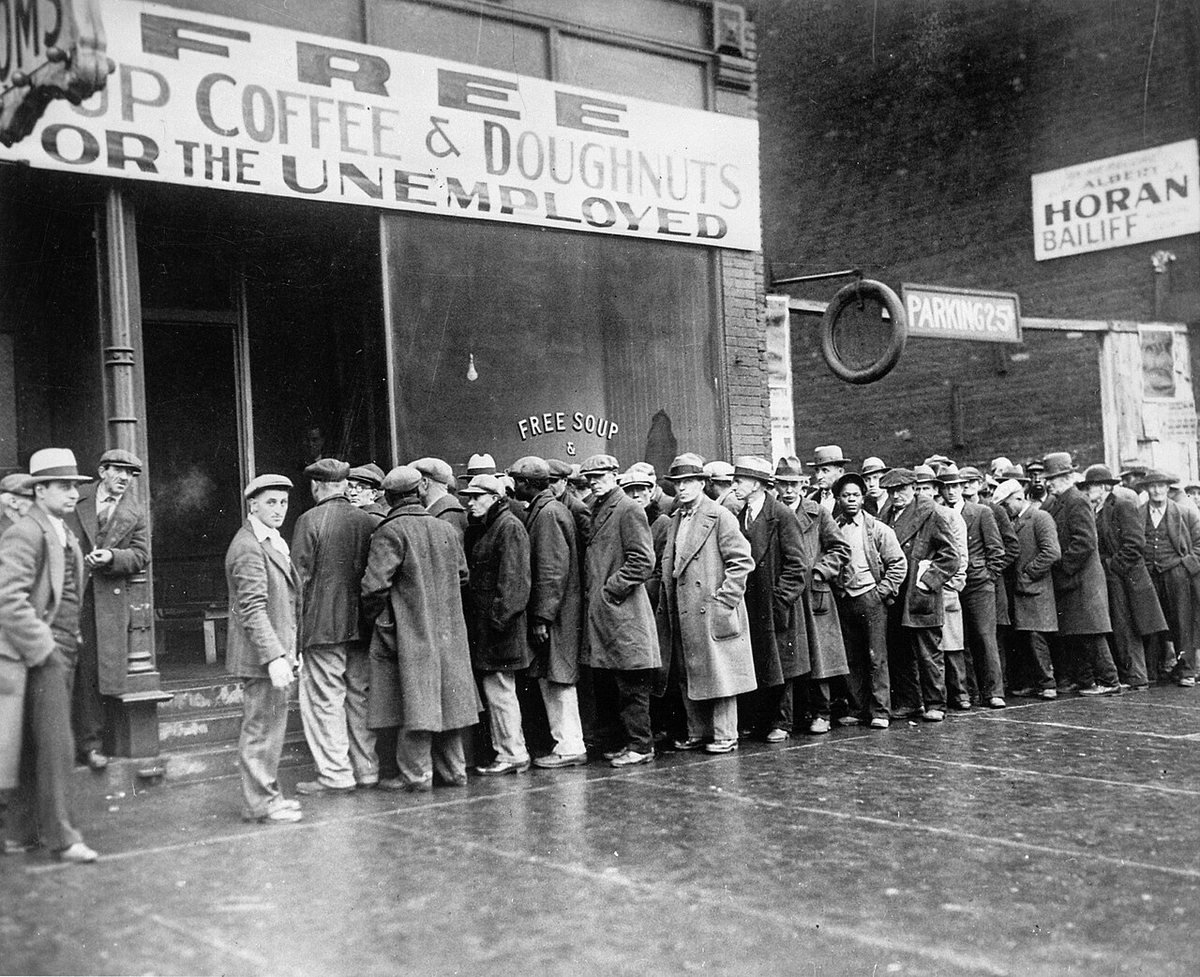
March 1933 is also the trough of the Depression in the official US business-cycle dates. Unemployment that year averaged about 25%.
1932
Roosevelt defeats Hoover Policy
Franklin D. Roosevelt won the presidency on a promise of a ‘new deal’. The long gap between election and inauguration, then four months, allowed a final banking panic to build over the winter of 1932–33. The Twentieth Amendment, ratified in January 1933, later moved inauguration day to January.
1932
The Dow hits bottom at 41.22 Depression
The Dow closed at 41.22, barely above the level at which the index had started in 1896. The fall from the 1929 peak was 89.2%, far greater than the October crash itself. Much of the decline came after the economy, the banks and the international monetary system had broken down.
The crisis goes global Depression
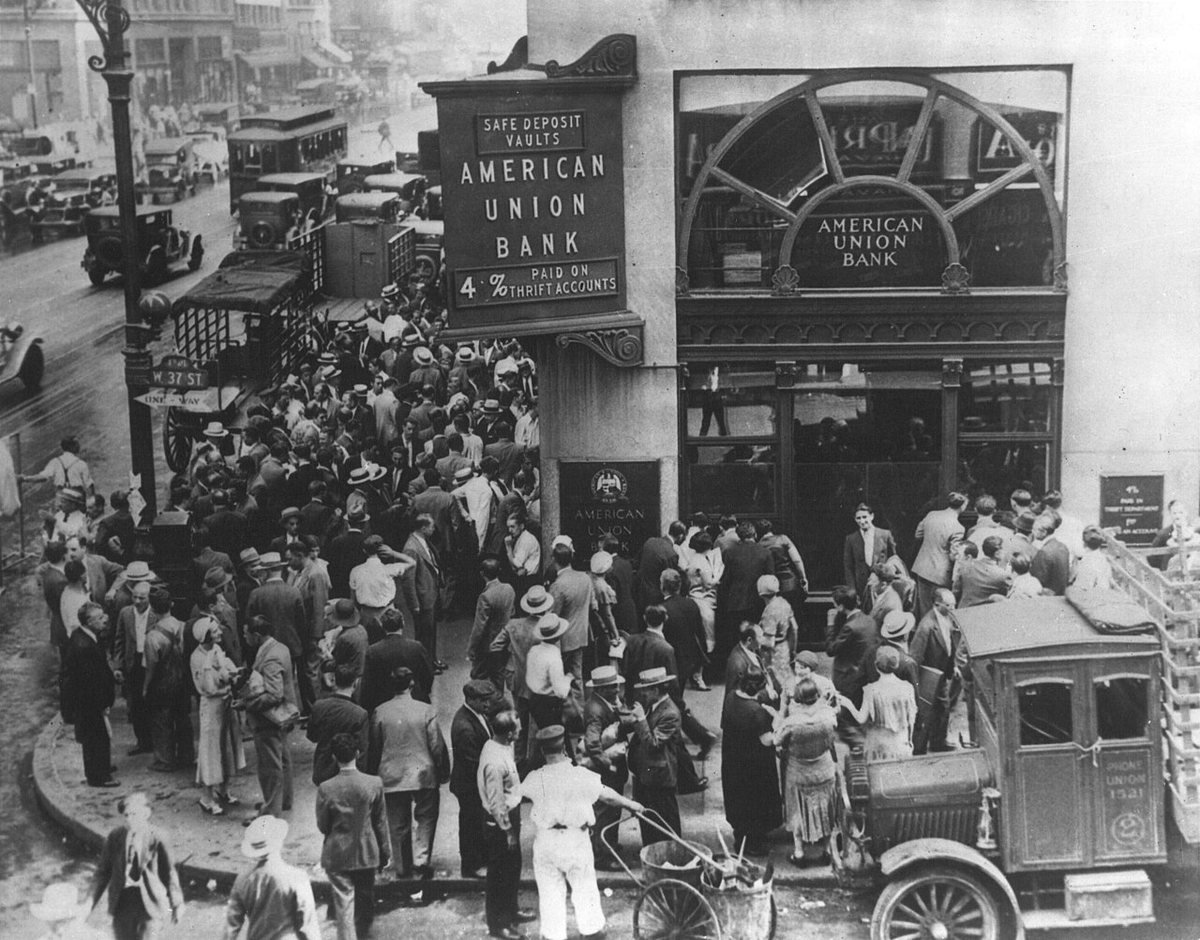
The failure of Austria’s largest bank, the Creditanstalt, in May set off a run through central Europe and Germany. On 21 September, Britain left the gold standard. To stop gold flowing out of the US, the Federal Reserve raised interest rates in October, in the middle of a depression, a decision later blamed for deepening the US banking crisis.
Countries that left gold earlier generally recovered earlier, one of the clearest findings of later research on the Depression.
1930
The first banking panic Depression
In November 1930, the collapse of banks linked to the Nashville investment firm Caldwell and Company triggered runs across the South. On 11 December, the Bank of United States, with some 400,000 depositors in New York, closed. The Federal Reserve History essay on the panics calls this the moment a ‘typical recession’ began turning into the Great Depression.
Responses differed by Federal Reserve district: Atlanta lent freely to struggling banks; St Louis did not, and hundreds of banks in its district failed.
1930
Hoover signs the Smoot–Hawley Tariff Policy
Begun as a measure to protect farmers, the bill grew into a broad increase in tariffs. More than a thousand economists petitioned Hoover to veto it. Canada, European countries and others retaliated, and world trade shrank sharply over the following years.
Most economists now see the tariff as an aggravating factor rather than a main cause of the Depression, but it remains the classic example of trade protection backfiring during a downturn.
1930
A false dawn: the Dow rebounds to 294 Warning
By spring 1930 the market had recovered much of its autumn loss, and many believed the worst was over. It was the last high for years. From April 1930 prices fell almost without interruption for more than two years, as the real economy deteriorated.
1929
The first low: almost half the value gone Crash
Selling continued after Black Tuesday until the Dow closed at 198.60 on 13 November. In ten weeks the index had lost almost half its value. The New York Fed had cut its discount rate and bought government securities to supply banks with cash, which helped prevent a banking panic in New York that autumn.
1929
Black Tuesday Crash
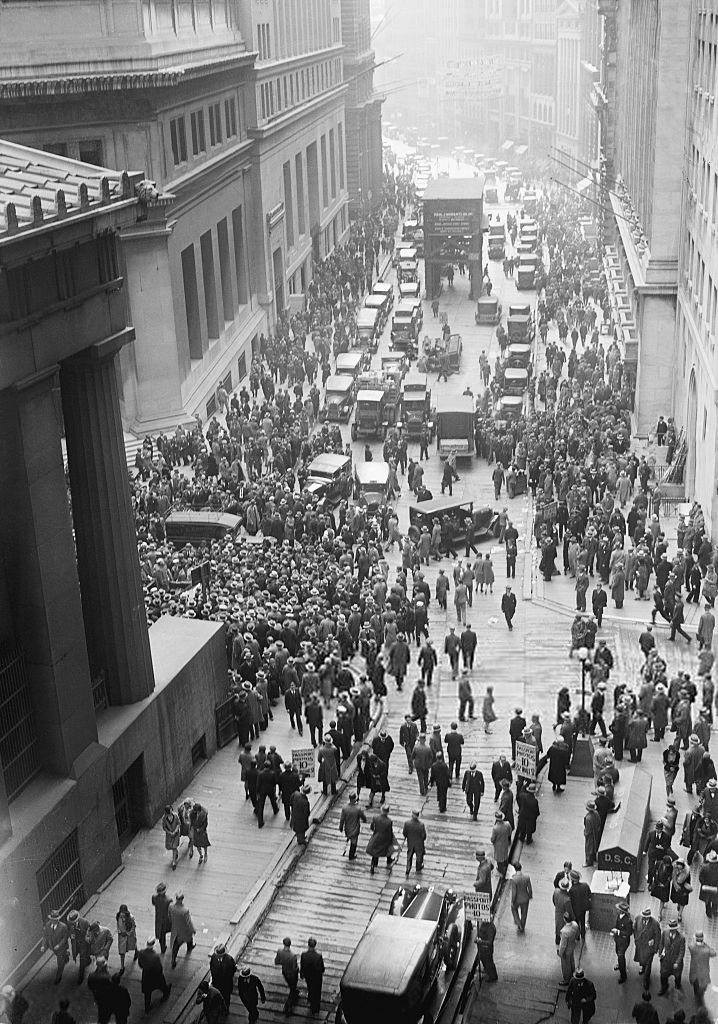
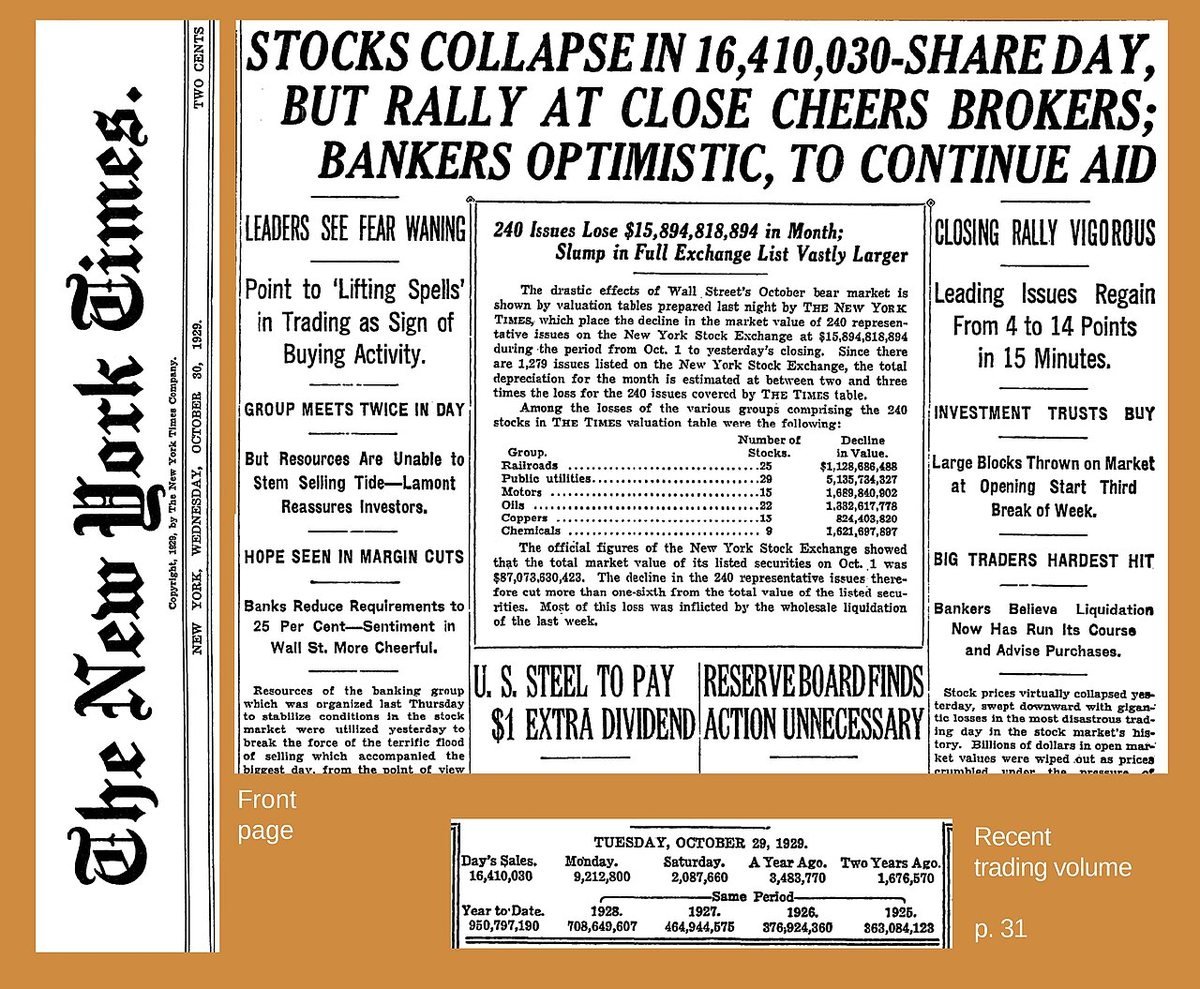
The most famous day of the crash. Sell orders flooded the exchange from the opening bell and the ticker ran hours behind, so many investors did not know what price they had sold at. The Dow fell 30.57 points to 230.07.
The next morning’s New York Times reported ‘Stocks collapse in 16,410,030-share day, but rally at close cheers brokers’. In two sessions the Dow had lost about 23%.
1929
Black Monday Crash
After a quiet weekend session, selling resumed on Monday on a scale the bankers could not absorb. The Dow fell 12.82% in a day, one of the largest one-day percentage falls in its history. Margin calls went out across the country, forcing more sales the next morning.
1929
Hoover: business is ‘sound and prosperous’ Warning
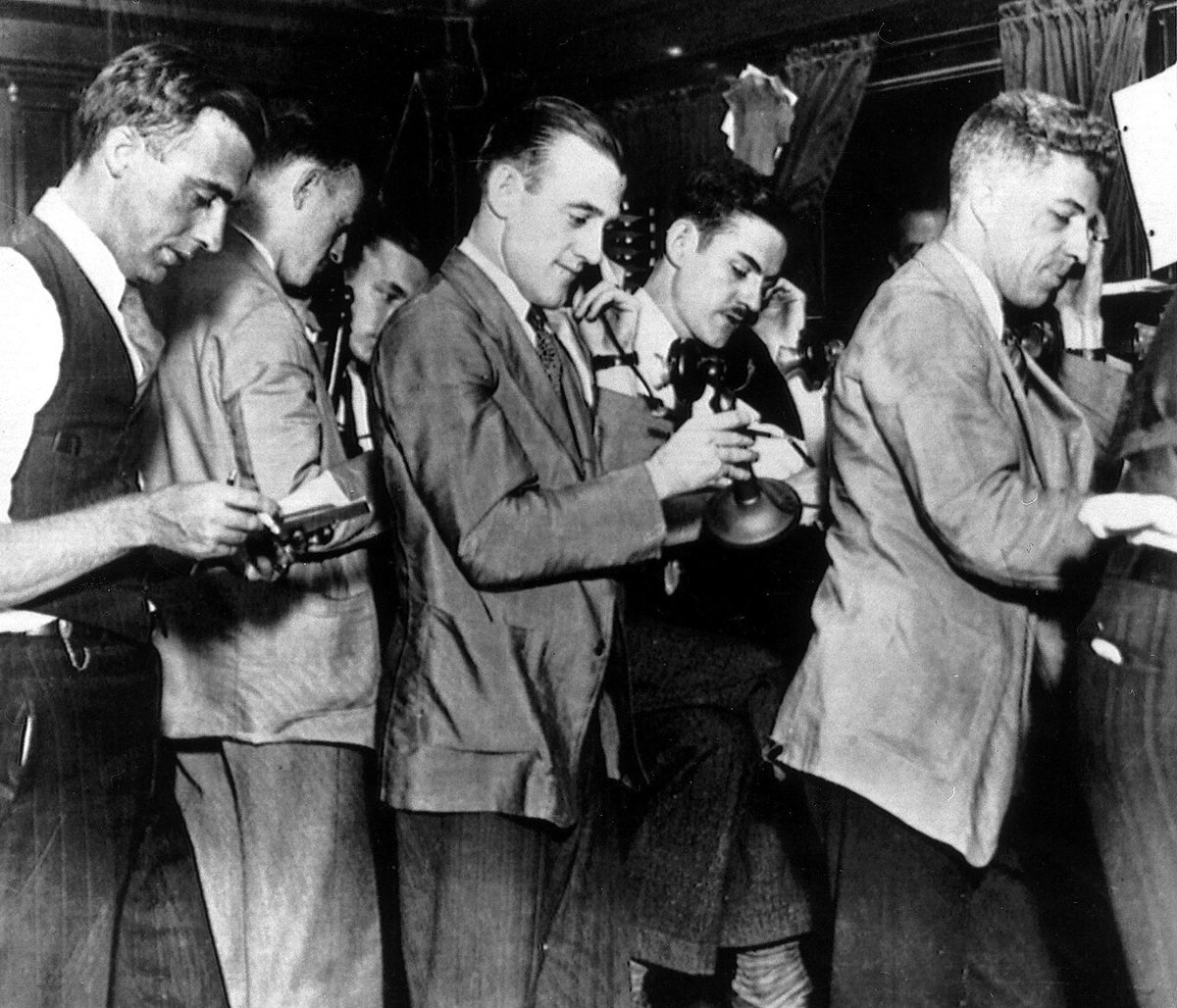
Markets steadied after Thursday’s rescue, and President Herbert Hoover said that the fundamental business of the country was ‘on a sound and prosperous basis’. Bankers and brokers told newspapers that the worst was over. The calm lasted barely two trading sessions.
1929
Black Thursday Crash
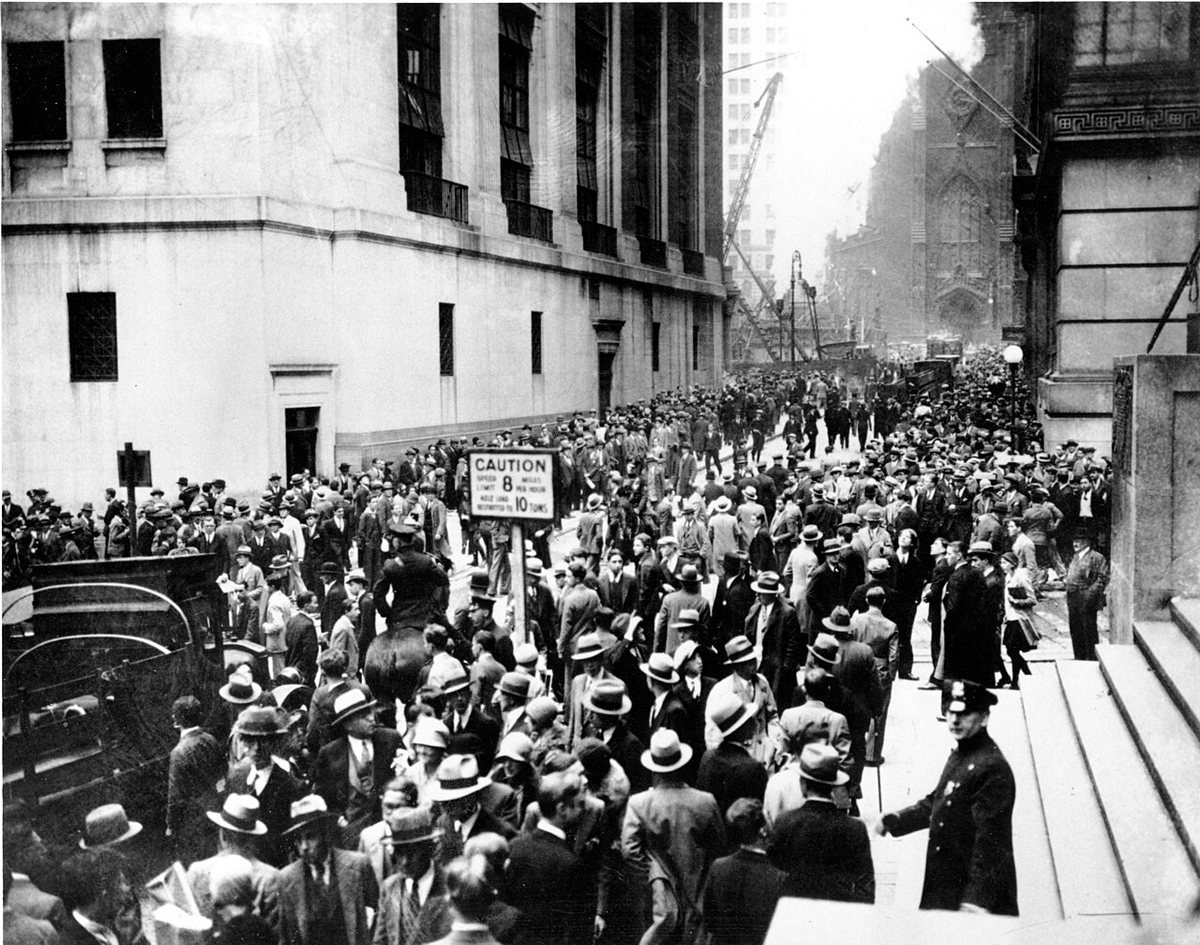
Panic selling hit the market at the opening and prices fell about 11% within hours. Crowds gathered outside the New York Stock Exchange. At midday, leading bankers including Thomas Lamont of J.P. Morgan, Albert Wiggin of Chase National Bank and Charles Mitchell of National City Bank met and agreed to support the market.
Their agent, NYSE vice-president Richard Whitney, walked onto the floor and bid $205 a share for 25,000 shares of US Steel, well above the market. Prices recovered, and the Dow closed only 6.38 points lower. Whitney was later jailed for embezzlement in 1938.
1929
Warnings ignored Warning
On 5 September, the investment adviser Roger Babson said that ‘a crash is coming, and it may be terrific’, and prices dipped. On 20 September, the London financier Clarence Hatry and associates were arrested for fraud, shaking confidence in British markets. On 16 October, Yale economist Irving Fisher said stock prices had reached ‘what looks like a permanently high plateau’. Eight days later came Black Thursday.
1929
The Dow peaks at 381.17 Boom
The Dow Jones Industrial Average closed at 381.17, the top of the 1920s bull market. Brokers’ loans to investors buying on margin had passed $8.5 billion, more than all the currency in circulation in the United States. Many investors had put down only a small share of the price of their stocks.
The economy turns and the Fed tightens Warning
The official US business-cycle peak is August 1929, two months before the crash: production and activity were already turning down. The same month, the Federal Reserve Bank of New York raised its discount rate to 6%, the last step in a series of increases since 1928 aimed at curbing speculative lending.
Speculation and the Fed’s dilemma Warning
The Federal Reserve worried that bank credit was being drawn into stock speculation and began raising interest rates in 1928. Higher rates did little to cool the market, where borrowers expected gains far larger than the cost of a loan, but they tightened credit for the rest of the economy. New investment trusts, often themselves highly leveraged, sold shares to the public on a large scale.
1928
The Roaring Twenties boom Boom
From a low of about 63 in August 1921, the Dow rose about six-fold to its 1929 peak. Mass production of cars, the spread of electricity and radio, and new instalment credit transformed American life, and shares in companies such as RCA became household talking points.
The boom was uneven. Farmers struggled with low prices through most of the decade, and income gains were concentrated at the top. The headline prosperity concealed weaknesses that mattered once the economy turned.
The Crash on One Chart
October 1929 was the start of the fall, not the end.
Pick a date. How far below the 1929 peak was the market?
The meter shows the Dow Jones Industrial Average’s fall from its closing peak of 381.17 on 3 September 1929. Closing prices from Federal Reserve History and the daily Dow record.
The Four Days That Shook the Global Economy
24–29 October 1929, session by session. Scroll sideways on a phone.
| Day | Date | Dow close | Change | Shares traded |
|---|---|---|---|---|
| Black Thursday | Thu 24 Oct | 299.47 | −6.38 (−2.09%); about −11% intraday | 12.9 million (record) |
| Rally | Fri 25 Oct | Small gain | Hoover: business ‘sound’ | Heavy |
| Black Monday | Mon 28 Oct | 260.64 | −38.33 (−12.82%) | Heavy |
| Black Tuesday | Tue 29 Oct | 230.07 | −30.57 (−11.73%) | 16,410,030 (a record for almost 40 years) |
The volumes overwhelmed the exchange’s machinery. On Black Thursday and Black Tuesday the stock ticker ran hours late, so investors and brokers across the country were trading blind, often learning only that evening how much they had lost. The bankers’ intervention on Thursday worked for one day; by Monday it had become clear that no private group could buy enough to stop a market-wide rush to sell.
What Caused the Wall Street Crash?
Seven forces, and how they fed each other.
1. Excessive speculation
Many investors believed share prices would keep rising, and the expectation of easy profits drew in more buyers. Prices rose well beyond what company earnings could justify. When confidence cracked, the same optimism amplified the reversal.
2. Buying on margin
Borrowing let investors take positions much larger than their own money, often with only a small down payment. Gains were magnified on the way up, losses on the way down. When prices fell, brokers demanded more collateral or sold the shares, which pushed prices down further: a self-reinforcing cycle. Try the margin calculator below.
3. Uneven prosperity
The Roaring Twenties did not reach everyone. Farmers faced low prices for most of the decade, and income gains were concentrated among the better-off. The economy was less resilient than the stock-market boom suggested.
4. A slowing economy
The official business-cycle peak was August 1929, before the October crash. A weakening economy threatened profits and made high valuations harder to sustain. The crash then deepened the downturn.
5. Monetary policy and credit
The Federal Reserve raised interest rates from 1928 to curb speculative lending, reaching 6% at the New York Fed in August 1929. Historians disagree on how much this caused the crash. There is much wider agreement that the Fed later failed to stop the banking panics and the collapse in money and credit.
6. A fragile banking system
Thousands of small, undiversified banks with no deposit insurance were vulnerable to runs. When banks closed, depositors lost savings and businesses lost credit, turning financial losses into a collapse in spending.
7. International debt, trade and gold
War debts, reparations and the gold standard tied economies together and forced central banks to defend their currencies rather than their economies. Tariffs and retaliation shrank trade. The crisis crossed borders because policy in one country hit others.
You buy $1,000 of shares in September 1929. How much of your own money survives?
Choose how much you put down (the rest is a broker’s loan) and how far the market falls. A simple illustration that ignores interest, dividends and the timing of margin calls; real 1929 terms varied by broker.
Wall Street Crash vs Great Depression: What Was the Difference?
Scroll sideways on a phone.
| Wall Street Crash | Great Depression | |
|---|---|---|
| What | A stock-market collapse | A decade-long economic collapse |
| When | Sep–Nov 1929, worst 24–29 Oct | 1929–1941; trough March 1933 |
| Who was hit first | Investors, especially those on margin | Workers, farmers, depositors, borrowers |
| Key numbers | Dow −48% to Nov 1929 | Unemployment ~25%; ~9,000 bank failures; money supply −30% |
| Role | Trigger and symbol | Driven by bank panics, deflation, gold and policy errors |
The distinction matters. The crash was a dramatic trigger and a symbol. The Great Depression became so severe because banking failures, contracting credit, falling prices and policy responses reinforced one another for more than three years.
The Bank Failures That Made It a Depression
US bank suspensions, rounded. Scroll sideways on a phone.
| Year | Bank suspensions (approx.) | What happened |
|---|---|---|
| 1921–28 | Under 1,000 a year | Farm-belt failures during the boom |
| 1930 | About 1,350 | Caldwell collapse; Bank of United States |
| 1931 | About 2,290 | Chicago panic; European crisis; Fed raises rates |
| 1932 | About 1,450 | Reconstruction Finance Corporation lends to banks |
| 1933 | About 4,000 | Winter panic; national bank holiday |
| 1934 | Under 100 | Federal deposit insurance begins |
The Impact of the Crash and the Depression
Unemployment peaked four years after Black Tuesday.
Millions lost jobs
As businesses lost credit and customers cut spending, companies cut production, laid off workers or closed. Unemployment rose from about 3% in 1929 to about 25% in 1933.
Families lost savings and homes
Before deposit insurance, a bank failure could wipe out a family’s savings. Falling incomes left households unable to pay mortgages and rents, and foreclosures spread through cities and farm country.
Businesses stopped investing
Uncertain sales and scarce finance made firms reluctant to expand. Falling investment cut demand for machinery, construction and labour, deepening the slump.
World trade collapsed
Tariffs, retaliation, currency crises and falling demand shrank international commerce. Export-dependent countries were hit hard, and economic hardship fed political instability in Europe and beyond.
Politics changed
The Depression shattered faith in the existing order and increased demand for government action. In the United States it reshaped federal responsibility through the New Deal; elsewhere the consequences ranged from reform to dictatorship.
What Changed After 1929?
The rules written in 1933–34 still frame US markets. Scroll sideways on a phone.
| Reform | When | What it does | Today |
|---|---|---|---|
| Emergency Banking Act | 9 Mar 1933 | Reopens sound banks after the holiday | Historic |
| Securities Act | 27 May 1933 | Registration and disclosure for new share issues | In force |
| Banking Act (Glass–Steagall) | 16 Jun 1933 | Separates commercial and investment banking; creates FDIC | Separation repealed 1999 |
| Deposit insurance | 1 Jan 1934 | Insures deposits, initially $2,500 | $250,000 per depositor, per bank |
| Securities Exchange Act | 6 Jun 1934 | Creates the SEC; Fed sets margin requirements | In force; Regulation T 50% initial margin |
These reforms did not make crashes impossible: 1987, 2000, 2008 and 2020 all brought severe falls. What changed is the plumbing underneath. Insured deposits make bank runs rarer, disclosure rules make fraud harder, margin requirements limit leverage, and central banks now act as lenders of last resort. The 2023 failure of Silicon Valley Bank showed the limits of that safety net when most deposits are uninsured.
Who Was Who in 1929
Herbert Hoover
Called business ‘sound and prosperous’ after Black Thursday; signed Smoot–Hawley in 1930.
Franklin D. Roosevelt
Declared the 1933 bank holiday and signed the banking and securities reforms.
Richard Whitney
Bid $205 for US Steel on Black Thursday; jailed for embezzlement in 1938.
Charles E. Mitchell
Leading bull and member of the bankers’ pool; exposed by the Pecora hearings.
Irving Fisher
Said on 16 October 1929 that stocks had reached a ‘permanently high plateau’.
Ferdinand Pecora
His 1933 hearings on Wall Street practices helped drive the securities laws.
Explore More Timelines
People Also Ask
Frequently Asked Questions
Conclusion: The Crash Was the Beginning, Not the Whole Story
The Wall Street Crash of 1929 ended the illusion that a boom could continue without regard to the economy underneath it. Black Thursday, Black Monday and Black Tuesday destroyed confidence and enormous amounts of paper wealth. But the most devastating consequences came afterwards: bank failures, collapsing credit, mass unemployment and falling prices turned a market crash into the Great Depression, and the response reshaped financial regulation for the rest of the century.
The enduring lesson is that markets do not exist in isolation. When speculation and leverage meet weak institutions and a failing policy response, losses on a trading floor can become a crisis in homes, businesses and whole economies.
Related AiTimeline Stories
⚠️ Editorial Note
This article draws on Federal Reserve History essays, the National Bureau of Economic Research, the FDIC, the SEC, FINRA margin statistics, the Library of Congress and contemporary newspaper records. Dow Jones closing levels are those published by Federal Reserve History and S&P Dow Jones Indices; unemployment and bank-suspension figures are standard historical estimates and are rounded. Interpretations of the causes of the Depression remain debated among economists, and this article notes where. The margin calculator is a simplified illustration. This is history, not investment advice. Current to 14 October 2026.
Sources & further reading
Every dated entry above was checked against these references. Last reviewed 14 October 2026.