Hydrogen Trains in India Timeline: From Steam to the First Fuel-Cell Train on the Jind–Sonipat Route
From steam to the 2026 Jind Sonipat launch: a sourced hydrogen trains in India timeline covering how fuel cell trains work, key specs and net zero rail.
Latest Story
At Jind junction on a bright July morning, a ten-coach train eased away from the platform, and the few people who had come to watch noticed what was missing. There was no cloud of diesel exhaust, no deep mechanical growl—just a low electric hum and a faint wisp of water vapour trailing from the roof. Inside, the air conditioning, the lights and the traction motors were all being fed by a chemical reaction quietly taking place in stacks of hydrogen fuel cells, turning hydrogen and oxygen into electricity and leaving behind nothing but warm water. This was India’s first indigenously built hydrogen-powered train, and its short run between Jind and Sonipat in Haryana marked the newest chapter in a railway story that began more than two centuries ago with fire, steam and coal. This timeline traces that whole arc—how the technology works, why Indian Railways backed it, how it compares with diesel and electric trains, and what the 2026 launch really means.
⚡ In One Minute
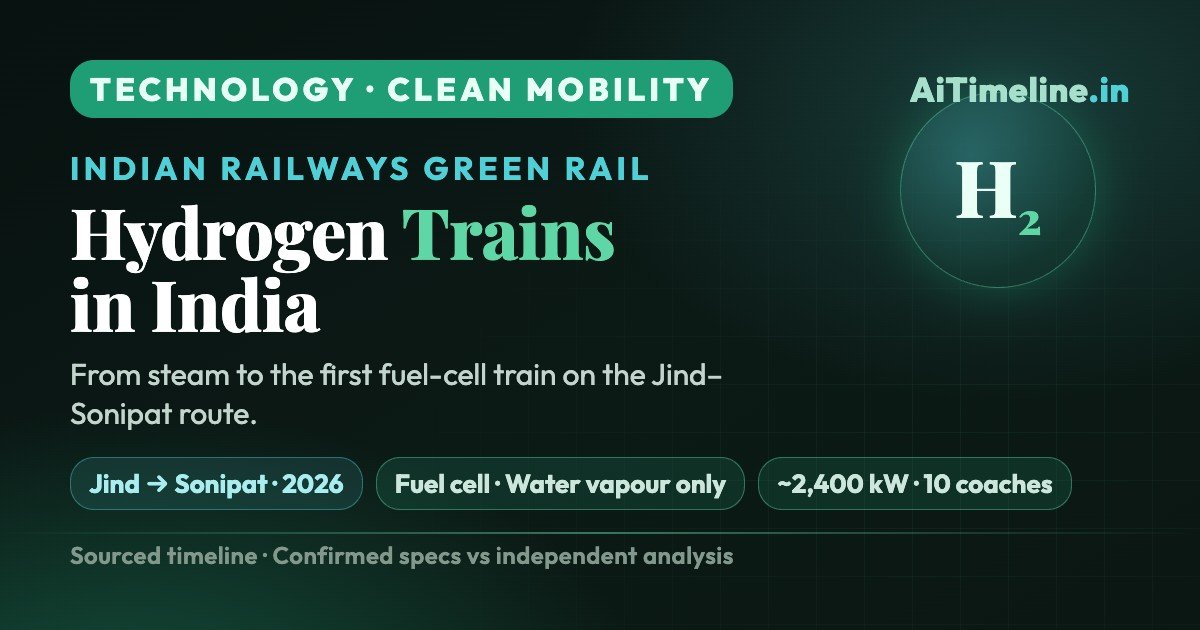
A hydrogen train is a fuel cell-electric train: instead of burning diesel or drawing power from overhead wires, it carries hydrogen on board and converts it into electricity using fuel cells, which drive the same kind of electric traction motors used on modern electric trains. The only tailpipe output is water vapour. India’s first such train, developed by the Integral Coach Factory in Chennai for Indian Railways, entered service on the roughly 90-kilometre Jind–Sonipat route in Haryana in July 2026.
The project is part of Indian Railways’ Hydrogen for Heritage programme and aligns with the National Green Hydrogen Mission. It matters because hydrogen offers a way to cut emissions on routes that are difficult or uneconomical to electrify—not as a replacement for the wires that already power most of the network, but as one more tool in a decarbonisation strategy that leans first on electrification and renewable energy.
The Essentials
What to Remember
- India’s first indigenously built hydrogen train launched on the Jind–Sonipat route in July 2026, one of the longest hydrogen trainsets in the world.
- A hydrogen train is really an electric train that makes its own electricity onboard from hydrogen, emitting only water vapour.
- It is aimed at routes that are hard to electrify, not at replacing the overhead wires that power most of Indian Railways.
- The train was designed and built in India, though the fuel-cell stacks were imported—a point worth stating honestly.
- Hydrogen is one option within a broader strategy that still relies mainly on electrification and renewable energy.
How a Hydrogen Fuel-Cell Train Works
The technology, step by step, in plain English.
The clever part of a hydrogen train is that it is not really a new kind of train at all. Under the floor, the traction system is the same electric setup found on a modern electric multiple unit. What changes is where the electricity comes from. Rather than collecting it from overhead wires, the train generates it onboard, on demand, from hydrogen. Here is how that happens.
Hydrogen is stored on board
Compressed hydrogen gas is held in reinforced high-pressure tanks, usually mounted on the roof or in a dedicated coach, well away from the passenger cabin.
Fuel cells combine hydrogen and oxygen
In the fuel-cell stack, hydrogen meets oxygen drawn from the air across a membrane. The reaction produces electricity, heat and water—no combustion, no flame.
Electricity drives the motors
That electricity powers the same traction motors an electric train uses, turning the wheels. Because there is no engine burning fuel, the ride is quiet and smoke-free.
Batteries smooth the load
Onboard batteries store energy recovered during braking and help meet sudden power demands, letting the fuel cells run steadily and efficiently.
Only water comes out
The single byproduct at the point of use is water vapour and warm air. There are no particulates, no nitrogen oxides and no carbon dioxide from the train itself.
💡 Technology Insight — Fuel Cells vs Batteries
Both a fuel-cell train and a battery train are electric, but they store energy differently. A battery train stores electricity directly and must stop to recharge, which limits its range. A fuel-cell train stores energy as hydrogen and generates electricity as it goes, so it can be refuelled quickly and cover longer distances between stops. The trade-off is complexity and the need for hydrogen supply. In practice the two are complementary: batteries suit short, predictable routes, while hydrogen suits longer runs where recharging pauses would be impractical.
Why India Backed Hydrogen Rail
The reasoning behind the pilot.
Indian Railways is already one of the world’s most electrified major networks, and electrification remains its first choice for cutting emissions. But a huge system still has branch lines, hill routes and heritage sections where stringing overhead wires is expensive, slow or visually intrusive. Diesel has long filled that gap—and diesel means soot, noise and carbon. Hydrogen offers a way to run those services cleanly without rebuilding the whole corridor.
There is an industrial logic too. India has launched a National Green Hydrogen Mission to build a domestic hydrogen economy, and a flagship railway project helps create demand, expertise and supply chains. Indian Railways has set itself the ambitious goal of becoming a net-zero carbon emitter, and while most of that will come from electrification powered by renewables, hydrogen is the piece that addresses the awkward routes. It is worth being precise here: India’s national net-zero target is 2070, while Indian Railways aims for net-zero carbon emissions much sooner. Hydrogen trains are a means to the second, not a silver bullet for the first.
🚃 Railway Insight — Why Hydrogen for the Pilot
Indian Railways chose hydrogen for a pilot precisely because it fills a gap that electrification cannot easily reach. The Jind–Sonipat corridor is a manageable length for a first deployment, close to industry and infrastructure, and it lets engineers test onboard storage, refuelling and safety in real service before scaling up. The Hydrogen for Heritage framing is deliberate: the technology is being aimed first at heritage and hill routes, where its clean, quiet operation is most valuable and where full electrification is least attractive.
Timeline Summary
Two centuries of rail, from steam to hydrogen, at a glance.
| Year | Event | Importance |
|---|---|---|
| 1804 | First steam locomotive | Rail traction is born |
| 1825 | First public passenger railway | Railways open to the public |
| 1925 | Rail electrification begins in India | The move beyond steam starts |
| 1950–1990 | Diesel and electric expansion | India’s network modernises |
| 2018 | Germany’s first commercial hydrogen train | Hydrogen rail proves viable |
| 2021 | India explores hydrogen; National Hydrogen Mission | Policy foundation laid |
| 2022 | Feasibility, RDSO and ICF work; Green Hydrogen Policy | Engineering begins in earnest |
| 2023–25 | Design, prototyping and testing | The train takes shape |
| 2026 | First hydrogen train on Jind–Sonipat | India joins the hydrogen-rail club |
The Full Hydrogen Rail Timeline
Newest first. Tags mark confirmed milestones, global context and independent caveats.
India’s First Hydrogen Train Enters Service
Technology development: India flagged off its first indigenously developed hydrogen train, a 10-coach fuel cell-electric set with a combined output of about 2,400 kW, on the roughly 90-kilometre Jind–Sonipat route, supported by a dedicated hydrogen plant and refuelling facility at Jind.
Engineering significance: Built by the Integral Coach Factory in Chennai, it is among the longest hydrogen trainsets in the world, and it demonstrated onboard storage, refuelling and safety systems in real passenger service.
Environmental impact: On the route, the train replaces diesel operation with a service that emits only water vapour, cutting local pollution and carbon.
Manufacturing, Integration and Trials
Technology development: The trainset was assembled and its fuel-cell stacks, hydrogen storage and battery systems integrated, with Indian firms handling systems integration. Trial runs pushed the set to speeds of up to 120 km/h on a test corridor.
Engineering significance: Testing at speed validated the traction, storage and control systems together—the hardest part of turning a prototype into a service-ready train.
Current relevance: These trials were the final technical gate before the train could carry paying passengers.
Infrastructure, Refuelling and Safety
Technology development: Work advanced on the ground infrastructure a hydrogen train needs—hydrogen production, high-pressure storage and a refuelling system—alongside the safety certification that governs handling a light, flammable gas.
Engineering significance: A hydrogen service lives or dies on its refuelling and safety systems as much as on the train itself, so this groundwork was essential.
Economic importance: Building this infrastructure from scratch is a large part of why hydrogen routes cost more upfront than simply running diesel.
Design, Prototyping and a National Mission
Technology development: Design approvals, prototype engineering and hydrogen-storage work progressed. In parallel, the government approved the National Green Hydrogen Mission, with a large outlay to build a domestic hydrogen economy.
Engineering significance: Storing enough hydrogen safely on a moving train, at high pressure, was among the toughest design problems to solve.
Economic importance: The national mission gave the railway project a policy and funding backdrop, linking clean rail to a wider industrial push.
Feasibility, RDSO and ICF
Technology development: Feasibility studies matured into a concrete plan, with the Research Designs and Standards Organisation setting standards and the Integral Coach Factory tasked with building the train. India also notified its Green Hydrogen Policy that year.
Engineering significance: Assigning the work to established railway institutions signalled that hydrogen had moved from idea to funded engineering programme.
Historical background: The plan built on Indian Railways’ long experience retrofitting and manufacturing rolling stock at home.
India Turns to Hydrogen
Historical background: India announced a National Hydrogen Mission to develop hydrogen as a clean fuel across sectors, and Indian Railways began seriously exploring hydrogen for traction on non-electrified routes.
Economic importance: Framing hydrogen as a national priority created the political and financial momentum that railway projects would later draw on.
Current relevance: This is the policy starting gun for India’s hydrogen-rail journey.
Germany Proves It in Service
Historical background: Germany put the world’s first commercial hydrogen passenger trains, Alstom’s Coradia iLint, into regular service, replacing diesel units on a regional line.
Engineering significance: It showed that fuel-cell trains could meet the reliability and range demands of daily passenger operation, not just run as demonstrators.
Current relevance: Germany’s success became the reference point for every hydrogen-rail programme that followed, including India’s.
European Prototypes Emerge
Technology development: Through the 2000s, engineers in Europe and elsewhere built and demonstrated hydrogen fuel-cell rail prototypes and shunting locomotives, proving the basic concept on rails.
Engineering significance: These prototypes worked out early questions of onboard storage, fuel-cell durability and integration that later commercial trains would refine.
Historical background: They rode a broader wave of fuel-cell research spurred by concerns over oil and emissions.
Global Hydrogen Research Accelerates
Historical background: As climate concern grew and fuel-cell technology matured from the space programme and the auto industry, hydrogen attracted serious research funding worldwide as a clean energy carrier.
Technology development: Advances in proton-exchange-membrane fuel cells made compact, responsive units suitable for vehicles—and, eventually, trains.
Current relevance: This research base is what later national missions and railway projects would build upon.
Diesel and Electric Expansion in India
Historical background: Over these decades, Indian Railways steadily replaced steam with diesel and electric traction, expanding capacity and speed across a vast network.
Engineering significance: Domestic factories such as the Integral Coach Factory and diesel and electric locomotive works built deep manufacturing expertise—the same base later used for hydrogen.
Environmental impact: Electrification, in particular, laid the groundwork for cutting emissions long before hydrogen entered the picture.
Electrification Begins in India
Historical background: India’s first electric train ran in the Bombay area in 1925, beginning the long shift away from coal-fired steam toward cleaner, more efficient electric traction.
Engineering significance: Electrification set the template that hydrogen now extends—electric motors driving the wheels, just with a different power source.
Environmental impact: It was the first major step in reducing the smoke and soot of steam-era railways.
The First Passenger Railways
Historical background: The Stockton and Darlington Railway opened in England in 1825 as the first public railway to carry passengers behind steam locomotives. India’s first passenger train followed in 1853, between Bombay and Thane.
Engineering significance: These lines established the basic form of the railway—flanged wheels on rails, hauled by a powered locomotive—that every later technology has inherited.
Current relevance: Two centuries later, the wheels and rails are unchanged; only the power source keeps evolving.
The First Steam Locomotive
Historical background: Richard Trevithick built and ran the first full-scale steam railway locomotive in 1804, proving that a steam engine could haul a load along rails.
Engineering significance: It began the age of mechanical traction—the first time a machine, not a horse, pulled a train.
Current relevance: The line from Trevithick’s smoky engine to a silent hydrogen train is the story of two centuries of cleaner, quieter power.
Steam, Diesel, Electric, Battery, Hydrogen
How the five traction types really compare.
| Type | Power source | Emissions at use | Infrastructure | Best use case |
|---|---|---|---|---|
| Steam | Burning coal or wood | High (smoke, CO2) | Water and coal stops | Historic and heritage only |
| Diesel | Burning diesel fuel | High (CO2, particulates) | Fuel depots | Non-electrified routes today |
| Electric | Overhead wires or third rail | Zero at train (depends on grid) | Full electrification | Busy main lines |
| Battery | Onboard rechargeable battery | Zero at train | Charging points | Short, predictable routes |
| Hydrogen | Onboard fuel cells | Water vapour only | Hydrogen supply and refuelling | Longer hard-to-electrify routes |
Hydrogen Train vs Other Indian Rolling Stock
Where the hydrogen train sits among familiar Indian trains.
| Train | Power source | Emissions | Typical role |
|---|---|---|---|
| Hydrogen train | Hydrogen fuel cells | Water vapour only | Clean service on non-electrified routes |
| Vande Bharat | Electric (overhead wires) | Zero at train | Fast intercity on electrified lines |
| DEMU | Diesel-electric | Diesel emissions | Local services on non-electrified lines |
| MEMU | Electric (overhead wires) | Zero at train | Suburban and short-haul on electrified lines |
| Diesel locomotive | Diesel engine | Diesel emissions | Hauling on non-electrified routes and freight |
Green, Grey and Blue Hydrogen
Not all hydrogen is equally clean.
A hydrogen train only delivers its full climate benefit if the hydrogen itself is made cleanly—and that depends on how it is produced. Green hydrogen is made by splitting water with electricity from renewable sources, so it is close to carbon-free. Grey hydrogen, the cheapest and most common today, is made from natural gas and releases carbon dioxide in the process. Blue hydrogen is grey hydrogen whose carbon emissions are captured and stored, sitting somewhere in between.
This is why India’s National Green Hydrogen Mission matters to the railway story: a hydrogen train running on grey hydrogen simply moves the emissions from the tracks to the factory. The environmental case for hydrogen rail rests on scaling up genuinely green hydrogen, which is still more expensive to produce. Stating this plainly is part of an honest account—the train is only as clean as its fuel.
Global Context
Where India sits among hydrogen-rail nations.
| Country | Status | Notable point |
|---|---|---|
| Germany | In commercial service | Ran the world’s first hydrogen passenger trains from 2018 |
| France | Testing and orders | Regional hydrogen trains developed for several regions |
| China | Testing and demonstration | Domestic hydrogen and hybrid trainsets developed |
| Austria and others | Trials completed | Passenger trials of hydrogen units on regional lines |
| India | First train in service 2026 | Among the longest hydrogen trainsets, built domestically |
India arrives at hydrogen rail later than Germany, but at a notably large scale: a ten-coach, high-capacity trainset rather than the shorter two- or three-car units common elsewhere. That reflects the sheer size of Indian passenger demand. It also raises the stakes—a bigger train needs more hydrogen, more storage and more robust refuelling, which is exactly what the pilot is designed to prove.
One Tool, Not the Whole Toolbox
- Hydrogen is one option within a broader clean-mobility strategy that still leads with electrification.
- Its natural home is hard-to-electrify routes, where it replaces diesel rather than the wires.
- The climate benefit depends on producing genuinely green hydrogen at lower cost.
- The 2026 launch proves the concept in India; scaling it is the next, harder question.
Current Limitations
An honest ledger of the challenges.
What Still Needs Work
- Hydrogen must be stored at very high pressure, which is technically demanding and space-consuming onboard.
- Green hydrogen is still costlier than diesel or grid electricity, so running costs remain a question.
- Refuelling and production infrastructure has to be built from scratch on each route, raising upfront cost.
- The fuel-cell stacks in the first train were imported, so full domestic self-reliance is still developing.
- On already-electrified lines, drawing power from the wires stays cheaper and more efficient than hydrogen.
- Long-term reliability and maintenance costs in Indian conditions are yet to be proven at scale.
Key Entities and Terms
The organisations, places and concepts in this story.
Indian Railways
India’s national rail operator, which developed and launched the country’s first hydrogen train.
Hydrogen Fuel Cell
A device that converts hydrogen and oxygen into electricity, emitting only water and heat.
Green Hydrogen
Hydrogen made by splitting water using renewable electricity, so it is nearly carbon-free.
National Green Hydrogen Mission
India’s programme to build a domestic green-hydrogen economy across sectors.
RDSO
The Research Designs and Standards Organisation, which sets technical standards for Indian Railways.
Integral Coach Factory
The Chennai rolling-stock manufacturer that built India’s first hydrogen train.
Jind and Sonipat
The two Haryana towns linked by the roughly 90-kilometre pilot hydrogen corridor.
Northern Railway
The Indian Railways zone operating the Jind–Sonipat hydrogen service.
Fuel Cell Electric Train
An electric train that generates its own electricity onboard from hydrogen rather than from wires.
Hydrogen for Heritage
Indian Railways’ plan to deploy hydrogen trains on heritage and hill routes.
Net Zero
Indian Railways’ target of net-zero carbon emissions, within India’s wider 2070 net-zero goal.
Ballard
The Canadian company that supplied the fuel-cell stacks for India’s first hydrogen train.
Confirmed Facts vs Independent Analysis
Confirmed by Indian Railways and official sources: the July 2026 launch, the Jind–Sonipat route, ICF as builder, the Hydrogen for Heritage programme, and the alignment with the National Green Hydrogen Mission.
Reported engineering specifications: the roughly 2,400 kW output, the 10-coach configuration, capacity around 2,600 seats and test speeds up to 120 km/h are drawn from reporting and may be refined as official data is published.
Independent analysis: that the fuel-cell stacks were imported, that green hydrogen remains costly, and that hydrogen suits only certain routes are analytical points, not official claims, and are flagged as such.
Lesser-Known Facts
- A hydrogen train is really an electric train that carries its own power station in the form of fuel cells.
- India’s first hydrogen trainset is among the longest in the world, reflecting the scale of Indian passenger demand.
- The only tailpipe output of a hydrogen train is water, clean enough that the concept is often demonstrated with a glass of it.
- Indian Railways aims for net-zero carbon emissions well ahead of India’s national 2070 target.
- The programme is branded Hydrogen for Heritage because it targets scenic heritage and hill routes first.
Explore More Timelines
Related clean-energy and India reading from AiTimeline.
Explore More Timelines
Frequently Asked Questions
Thirty clear answers on hydrogen trains in India.
Why Hydrogen Trains Could Shape the Next Chapter of Indian Railways
Stand on the platform at Jind and it is easy to see the 2026 launch as an ending—the moment India finally joined the small club of nations running hydrogen trains. It is better understood as a beginning. A single pilot on a 90-kilometre corridor proves that the engineering works in Indian conditions; it does not yet prove that hydrogen rail can be affordable, reliable and green at national scale. Those are the questions the coming years will answer.
What the launch does establish is that hydrogen has a real place in India’s clean-mobility toolkit. Not as a rival to the overhead wires that already power most of the network—electrification, run on renewable energy, will remain the backbone of a decarbonised railway—but as the answer for the routes those wires cannot easily reach. Hill lines, heritage sections and lightly used branches have long been stuck with diesel. Hydrogen offers them a way out.
The honest conclusion is a measured one. Hydrogen-powered trains are one part of a broader strategy, and their wider adoption will hinge on the cost of green hydrogen, the build-out of production and refuelling infrastructure, and hard-nosed economics rather than enthusiasm. The 2026 launch is an important milestone in cutting emissions on suitable rail routes. It is not the moment hydrogen replaced the electric train—and it was never meant to be. That distinction is exactly what makes the story worth telling accurately.
Sources & further reading
Every dated entry above was checked against these references. Last reviewed 19 September 2026.