Dantewada Maoist Attack: Aftermath and Legal Decisions Timeline
The 2010 Dantewada Maoist attack killed 76 security personnel. See the inquiries, the 2013 acquittal of 10 accused and the May 2026 High Court verdict.
Latest Story
The Dantewada Maoist attack of 6 April 2010 killed 76 security personnel, 75 from the CRPF and one from the Chhattisgarh Police, in the Tadmetla forest, near Chintalnar. It led to an independent inquiry under former BSF chief E. N. Rammohan, a CRPF internal inquiry and a criminal trial of 10 accused. The trial court acquitted all 10 on 7 January 2013, and on 5 May 2026 the Chhattisgarh High Court upheld that acquittal and called the investigation flawed. This record separates the attack from the question of who was proved guilty, and marks what sources confirm and what they do not.
💡 Short Answer
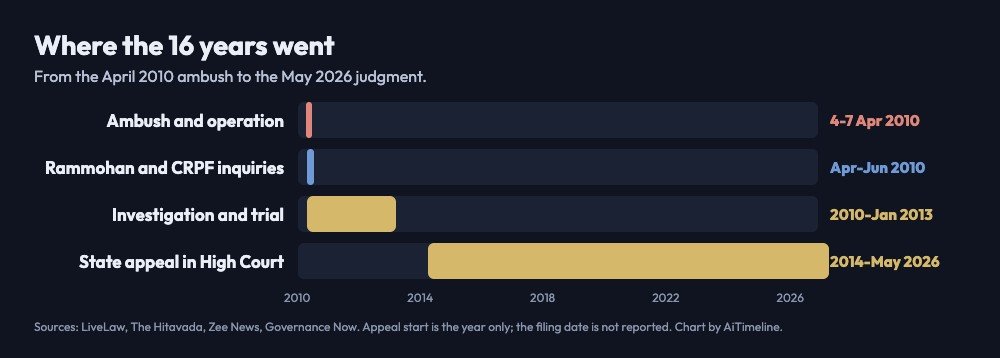
On 6 April 2010 Maoists ambushed a CRPF party at Tadmetla, killing 75 CRPF personnel and one state police member. The government ordered an inquiry on 8 April and Rammohan reported about 27 April. A CRPF inquiry reported on 30 June. Ten accused were tried and acquitted on 7 January 2013. The State appealed in 2014, and on 5 May 2026 the High Court dismissed the appeal because no reliable evidence linked the accused to the attack. The court did not say the attack never happened.
Dantewada Maoist Attack: Key Questions
The Dantewada Case in Eight Points
- The attack: 76 personnel died on 6 April 2010 at Tadmetla, in what was then Dantewada district.
- Two inquiries: an independent one under E. N. Rammohan and a CRPF Court of Inquiry, reported in April and June 2010.
- Command failure: the Home Minister told Parliament on 19 April 2010 that control and command had failed.
- Trial: 10 accused, 43 witnesses, most hostile; all acquitted on 7 January 2013.
- Appeal: the State appealed in 2014 and lost on 5 May 2026.
- Why it failed: no eyewitness, uncorroborated confession, no forensic report, no identification parade, no Arms Act sanction.
- What it does not mean: the court did not deny the massacre or clear any group of responsibility.
- What follows: police training and compliance reporting; a Supreme Court appeal has not been reported.
Dantewada Maoist Attack Timeline: From the Tadmetla Ambush to the 2026 Judgment, Latest First
Entries are colour-coded by stage. Dates follow court, government and press records, and we say where they differ.
High Court upholds the acquittals and flags a ‘flawed’ probe Trial and appeal
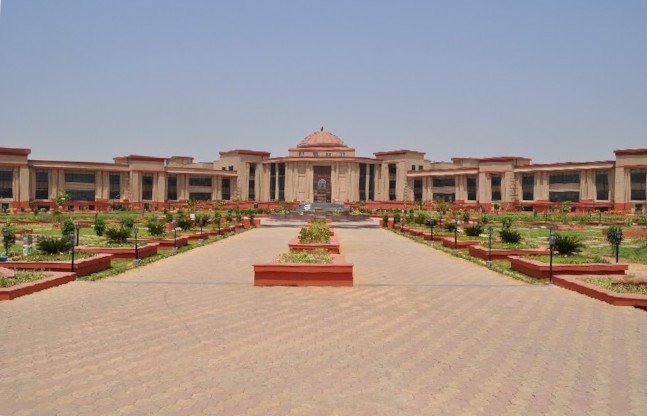
What happened: A Division Bench dismissed the State’s appeal in State of Chhattisgarh v. Oyami Ganga & Ors and upheld the acquittal of all 10 accused. The judgment is dated 5 May 2026; LiveLaw and most outlets reported it on 8 May.
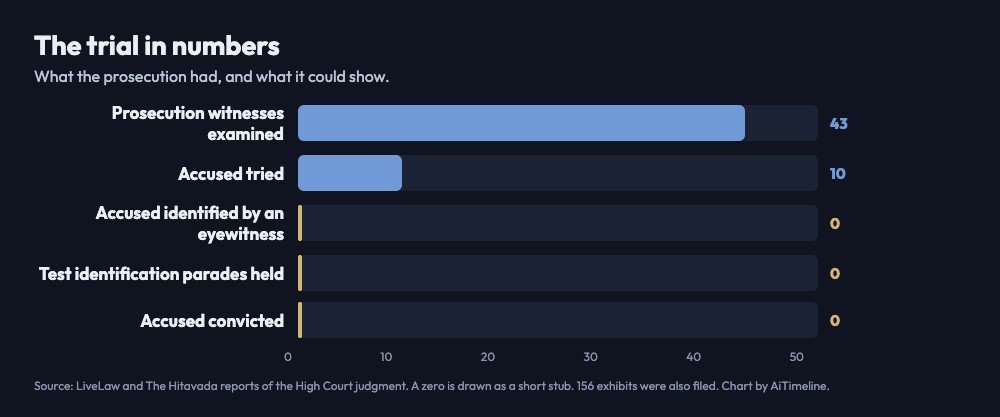
What the court found: There was no eyewitness evidence and the case rested on circumstantial evidence. One accused had given a confession under Section 164 of the Code of Criminal Procedure, but nothing independent supported it. Pipe bombs, grenades and rifles had been recovered from the place of the attack, not from the accused, and the forensic report certifying the material as explosive was never produced. No test identification parade was held, and the record showed no prosecution sanction under the Arms Act. The court said suspicion, however strong, cannot replace proof beyond reasonable doubt, and called the collapse of the case ‘deeply painful’.
Directions to the State: The Chief Secretary and the Director General of Police were told to arrange training for police officers in collecting and preserving evidence, to strengthen investigative standards in mass-casualty and national-security cases, and to report on compliance periodically. Reports give no deadline.
The State appeals under Section 378 Trial and appeal
What happened: Chhattisgarh challenged the acquittal before the High Court under Section 378 of the Code of Criminal Procedure, which lets the State appeal against an acquittal. The appeal was registered as Acquittal Appeal No. 85 of 2014. The CRPF was reported to have decided to contest the verdict.
Date note: Reports we could read give the year of the appeal, not the filing date, so we do not give one. The appeal took about 12 years to be decided.
Trial court acquits all 10 accused Trial and appeal
What happened: A court in Dantewada acquitted all 10 arrested accused for lack of evidence. The Zee News report was published on the evening of Monday 7 January 2013, and the High Court judgment, as reported by The Hitavada, refers to the ‘January 7, 2013’ acquittal.
Why the case failed at trial: The prosecution examined 43 witnesses and filed 156 exhibits. Most turned hostile, meaning they did not support the prosecution’s version in court, and none identified the accused as the attackers. The defence called no witnesses.
Charges: Rioting with a deadly weapon (IPC 148), criminal conspiracy (IPC 120-B), dacoity with murder with 76 counts (IPC 396), Arms Act sections 25 and 27, and Explosive Substances Act sections 3 and 5.
Date note: Wikipedia’s biography of one accused gives 9 January 2013; the 7 January date is supported by contemporaneous and High Court reporting, and we use it.
CRPF Court of Inquiry reports Inquiries
What happened: A CRPF Court of Inquiry set up to examine ‘specific acts of omission and commission’ by an inspector general and three other officers is reported to have submitted its report to CRPF headquarters on 30 June 2010.
What followed: A Rajya Sabha reply of 27 July 2016 confirms that the CRPF set up a Court of Inquiry into the circumstances that led to the loss of lives. Secondary summaries of Home Ministry replies say its findings led to new CRPF camps in Dantewada, Sukma and Bijapur, specialised training and more troops; we could not open the reply text to confirm that list. The report itself is not public.
What we could not verify: Our brief named the head of the inquiry and described its findings as ‘hurried planning’. We could not confirm either from a source we could open, so we do not repeat them.
Rammohan submits his report Inquiries
What happened: The Hindu’s headline of 27 April 2010 said Rammohan had submitted his report. The report had been expected by about 25 April. The committee was asked to reconstruct events from early morning until the first rescue party arrived, review the training of the CRPF companies and the standard operating procedures, and look at the response of the CRPF and the state police.
What was reported: Unnamed sources said the report blamed the CRPF battalion’s leadership and the state police for not following command procedure and drills, and pointed to poor coordination between the two forces. The full report was not made public, so these are press accounts, not the document.
Chidambaram admits a command failure Inquiries
What happened: In the Rajya Sabha on 19 April the Home Minister acknowledged a failure of command and control and said responsibility would be fixed ‘right up to his level’. He ruled out using the Army or the Air Force against Maoists, and said aircraft could be used for surveillance, logistics and evacuation.
Context: Chidambaram had offered to resign on 9 April; Prime Minister Manmohan Singh declined the offer.
Government orders an independent inquiry Inquiries
What happened: Two days after the ambush the Home Minister said the government had decided to institute an inquiry into what went wrong. The Home Ministry later told Parliament it had constituted a single-member committee under E. N. Rammohan, a former Director General of the Border Security Force, to establish the circumstances of the ambush. The inquiry was to cover the chain of command, from an assistant commandant up to the Home Minister’s level.
Date note: The 8 April date comes from the PTI report of the announcement. The government order itself is not public.
Maoists ambush a CRPF patrol at Tadmetla; 76 killed The ambush
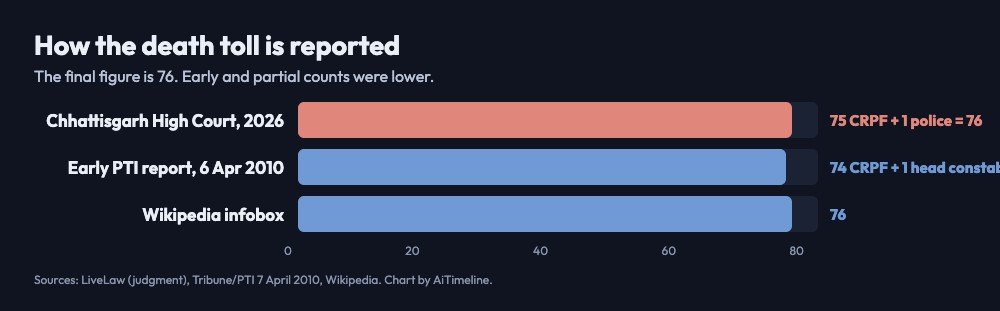
What happened: Between about 6 and 7 am, a CRPF party returning after the area-domination operation was hit by land mines and then heavy fire. The Chhattisgarh High Court judgment records 75 CRPF personnel and one state police member killed, 76 in all. The FIR was registered at Chintagufa police station.
How it happened: Early press reports said Maoists blew up a mine-protected vehicle with an IED and fired from the hills. The Tribune reported Home Ministry sources saying the men were lured by false information from an informer, and that pressure mines had been laid where the men might take cover. Those are reports, not judicial findings.
Numbers that differ: Home Ministry officials spoke of about 1,000 Maoists. Wikipedia gives a range of 300 to 1,000. The early PTI report counted 75 dead, 74 CRPF plus one head constable, before the figure settled at 76. We treat the attacker count as an estimate.
Weapons: Reports in 2026 say the attackers looted the weapons of the dead personnel.
The area-domination operation begins The ambush
What happened: A 62nd Battalion CRPF team and state police personnel set out on an area-domination operation planned for 4 to 7 April 2010, according to the judgment as reported by The Hitavada. The Tribune reported that the party had been camping in the forest for three days on a combing operation.
Why it matters: The ambush came on the third day, as the party was returning along a route it had used. Chidambaram said the force appeared to have ‘walked into a trap’ by returning the same way, a remark Wikipedia records.
Who Investigated What
Four bodies looked at the attack, each asking a different question.
| Body | Set up | Asked to examine | Reported outcome |
|---|---|---|---|
| Rammohan inquiry | 8 Apr 2010 (announced) | Chain of command, training, standard procedures, response of CRPF and state police | Submitted about 27 Apr 2010; report not public; press accounts blame command lapses and poor coordination |
| CRPF Court of Inquiry | Spring 2010 | Acts of omission and commission by an inspector general and three other officers | Reported to headquarters 30 Jun 2010; led to camps, training and posting actions |
| Trial court, Dantewada | After arrests and chargesheet | Guilt of 10 accused | All acquitted 7 Jan 2013 |
| Chhattisgarh High Court | Appeal registered 2014 | Whether the acquittal was wrong | Appeal dismissed 5 May 2026 |
Legal Analysis: Why the Prosecution Failed
The attack and the guilt of these 10 accused are two separate questions.
Why the prosecution could not prove guilt
In a criminal case the State must prove each accused person’s guilt beyond reasonable doubt. That standard is high on purpose, because a conviction takes away liberty. Here the prosecution had no eyewitness who identified any of the 10, and it had to build its case from circumstances: a confession by one accused, items found at the scene and a conspiracy charge. Each link failed. The confession was uncorroborated, the recovered weapons were not linked to the accused, the forensic certification of the explosives was missing, no test identification parade had been held, and a mandatory sanction under the Arms Act was not on record.
The Bench put the principle plainly: mere suspicion, however strong, cannot replace proof beyond reasonable doubt. It also described the collapse of the case as deeply painful, and it called the investigation flawed.
| Gap in the case | What the court found | Why it mattered |
|---|---|---|
| Eyewitnesses | None identified the accused. Most of the 43 witnesses turned hostile. A request to call seven injured CRPF personnel under Section 311 was refused. | Nobody linked the 10 men to the attack |
| Confession | One accused gave a confession under Section 164 CrPC. Nothing independent supported it. | A confession against one man cannot carry a conspiracy case without corroboration |
| Recovered weapons | Pipe bombs, grenades and rifles were found at the place of the attack, not on the accused. | Nothing tied those items to the 10 men |
| Forensic report | The report certifying the material as explosive was never produced. | The seizure had little value as evidence |
| Test identification parade | None was held. | No fair, early test of any identification |
| Arms Act sanction | The record showed no prosecution sanction. | A procedural defect in the Arms Act charges |
An acquittal is not a finding of innocence
The High Court did not declare that the attack was staged or that the Maoists were not responsible. It decided a narrow question: did the evidence against these 10 men meet the legal standard? It did not. An acquittal protects the accused from punishment on this evidence, but it does not say who carried out the ambush. In this case the individual criminal liability of the accused and the fact of the massacre are two separate questions, and the court answered only the first.
Why procedure and forensics decide cases
A forensic certificate turns a recovered object into evidence. Without it, a pipe bomb found in a forest is only a claim. A test identification parade protects against a witness pointing at a stranger in a courtroom. Prosecution sanction ensures that a statutory safeguard has been followed before certain offences are tried. These steps look technical, but each exists to stop innocent people being convicted, and when they are skipped a court cannot repair the gap years later.
What it means for future Maoist-related cases
The judgment does not change the law. It is a warning about practice. The court told the State to train police in collecting and preserving evidence and to report on compliance, and it asked for stricter standards in mass-casualty and national-security cases. Investigators in remote areas will have to document recoveries, secure forensic reports and plan identification procedures at the start, not at the end.
Aftermath and Wider Impact
Impact on the CRPF and anti-Maoist operations
A Rajya Sabha reply of 27 July 2016 confirms the CRPF Court of Inquiry. Secondary summaries of Home Ministry replies say its findings led to new CRPF camps in Dantewada, Sukma and Bijapur, specialised training and more troops; we could not open the reply text to confirm that list. The Home Minister told the Rajya Sabha that aircraft could be used for surveillance, logistics and evacuation, but not as combat weapons against Maoists.
Command responsibility
The Home Minister acknowledged a failure of command and control. The inquiries were designed to look at decisions from the assistant commandant upwards. News reports at the time said the CRPF also examined the conduct of an inspector general and three other officers. Because the reports are not public, outsiders cannot check how far responsibility was fixed.
Why remote forest cases are hard
The scene was a remote forest, and the reports we read do not say why most witnesses turned hostile. What they do show is how fragile such trials are: when witnesses do not support the prosecution and nothing else ties the accused to the crime, the case has little left.
Lessons
- Intelligence: the Tribune reported that Home Ministry sources believed the party was lured by false information. Whether that is true was not tested in court.
- Forensics: certify every recovered item early and produce the report at trial.
- Witness protection: witnesses in conflict areas may need protection before trial, not after they turn hostile.
- Prosecution: check every sanction and identification step before the chargesheet is filed.
For other stories about investigations and accountability, see our Bhima Koregaon Elgar Parishad timeline, the Ishrat Jahan encounter case, the Vikas Dubey encounter timeline and the Pulwama attack and India’s security doctrine.
Record Check: Common Errors
Where common summaries of this case go wrong
- “The court said Maoists did not carry out the attack.” It did not. The judgment accepts that 76 personnel died. It held that the prosecution did not prove the guilt of these 10 accused.
- “The judgment was on 8 May 2026.” The order is dated 5 May 2026. LiveLaw and other outlets reported it on 8 May.
- “The attack was in Sukma.” In 2010 the area was part of Dantewada district. It now falls in Sukma, and the FIR was registered at Chintagufa police station.
- “A CRPF inquiry headed by an Additional DG named Dey found hurried planning.” We could not confirm the name, the rank or that finding from a source we could open, so we leave them out.
- “The trial court verdict was 9 January 2013.” One encyclopaedia entry says so. Zee News published the verdict on 7 January 2013 and the High Court judgment refers to 7 January.
- “Rammohan submitted on 26 April.” The Hindu’s headline is dated 27 April and the report had been expected by about 25 April, so we say ‘about 27 April’.
- “76 were all CRPF.” The judgment records 75 CRPF personnel and one state police member.
Other Dantewada cases are separate
- The alleged 2009 killings of villagers in Dantewada, which reached the Supreme Court, are a separate matter and are not part of this story.
- A separate 2010 Dantewada-area bus bombing led to its own trial. It is a different attack and is not covered here.
Explore More Timelines
People Also Ask
Dantewada Maoist Attack: Frequently Asked Questions
Conclusion: Proof Is Not the Same as Outrage
The Tadmetla ambush killed 76 security personnel and is among the deadliest Maoist attacks on Indian forces. Sixteen years later no one has been convicted of it. The High Court did not doubt that the attack happened. It held that a case built on hostile witnesses, an uncorroborated confession and missing forensic and procedural steps could not send these 10 men to prison.
The lesson is practical. In a place where witnesses are afraid and scenes are remote, the quality of the first investigation decides the last verdict. The court’s order for training and compliance reports is a start, but its effect will show only in how future cases are built. Where accounts differ, such as the date of the trial verdict, the CRPF inquiry’s head and the attackers’ number, we say so.
Related AiTimeline Stories
⚠️ Editorial Note
Last updated 2 November 2026. Court findings follow LiveLaw’s report of the 5 May 2026 judgment (State of Chhattisgarh v. Oyami Ganga & Ors, ACQA No. 85 of 2014, 2026 LiveLaw (Chh) 39) and The Hitavada and Deccan Chronicle reports of it; we did not read the judgment itself. Inquiry details follow PTI via Governance Now, Tribune, Deccan Herald, Wikipedia and Home Ministry replies in Parliament as summarised by others; the Rammohan and CRPF reports are not public, so press accounts of them are unverified. Items flagged for review: the exact date of the State’s appeal, the number of attackers, the head of the CRPF inquiry, and whether a Supreme Court appeal has been filed. This article is informational, not legal advice. The accused were acquitted and should not be described as guilty of the attack.
Sources & further reading
Every dated entry above was checked against these references. Last reviewed 2 November 2026.
- LiveLaw: Chhattisgarh High Court upholds acquittal in 2010 Dantewada Naxal attack (5 May 2026 judgment)
- The Hitavada: HC upholds acquittal in Tadmetla CRPF massacre case, flags probe failures
- Deccan Chronicle: No one guilty in 2010 killing of 76 security personnel in Tadmetla
- Zee News: All 10 accused in 2010 Dantewada massacre case acquitted (7 January 2013)
- Governance Now (PTI): Responsibility for Dantewada will be fixed, says Home Minister (19 April 2010)
- The Tribune: Dantewada ambush report (7 April 2010)
- Wikipedia: April 2010 Maoist attack in Dantewada
- Newswav (ANI): Chidambaram questions prosecution agencies after Tadmetla acquittal (9 May 2026)