Ishrat Jahan Encounter Case: The Timeline of a Controversial Police Operation
Ishrat Jahan encounter case timeline: the 2004 police claim, SIT and CBI findings, charge sheets and the discharge orders that ended the main case.
Latest Story
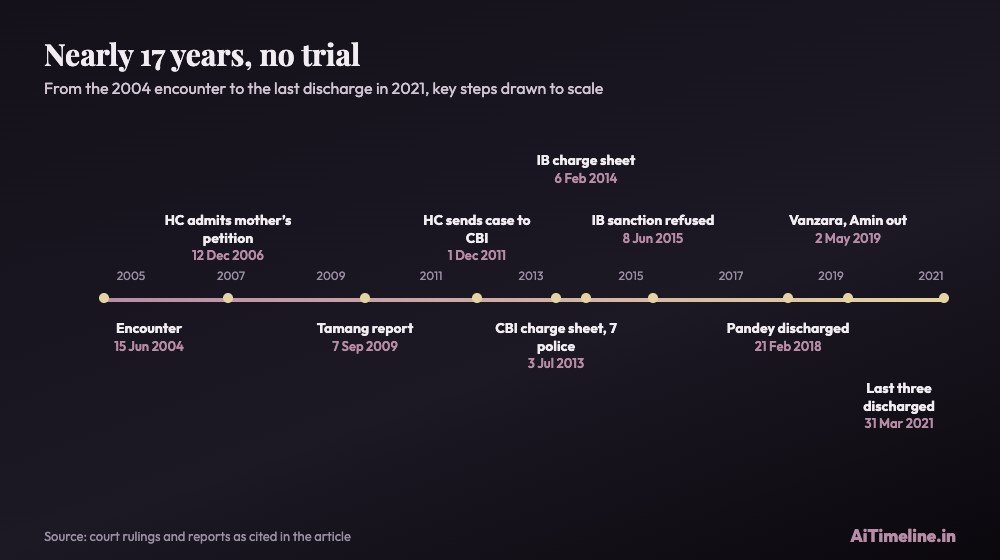
The Ishrat Jahan encounter case began on 15 June 2004, when Ahmedabad Crime Branch police shot dead 19-year-old Ishrat Jahan and three men near Kotarpur and said they were Lashkar-e-Taiba militants plotting to kill Gujarat Chief Minister Narendra Modi. Her family said the killing was staged. A magistrate, a High Court-appointed investigation team and the Central Bureau of Investigation (CBI) later questioned the police account, and the CBI charged seven police officers and four Intelligence Bureau officials. No trial took place: the police accused were discharged or died by 2021, mostly because the Gujarat government refused sanction to prosecute them. This page separates the police claim, the family’s allegation, the investigators’ findings and what courts actually ordered. For related cases, see AiTimeline’s timelines of the Radia tapes, the 2G spectrum case, the 2018 Supreme Court judges’ press conference and the 2020 Delhi riots.
Tap a stage. The key point: no trial ever took place.
Choose a stage above.
💡 Short Answer
On 15 June 2004, Gujarat Police killed Ishrat Jahan and three men near Ahmedabad, calling them Lashkar terrorists. A magistrate, a court-appointed SIT and the Gujarat High Court (1 December 2011) doubted that account, and the CBI charged seven police officers (2013) and four IB officials (2014). All seven police accused left the case without a trial between 2018 and 2021, chiefly because Gujarat refused sanction. The IB officials’ case has not been verified beyond 2018.
Legal Status, as of 23 October 2026
Last updated: 23 October 2026. Kept separate from the historical timeline because each proceeding had its own outcome. “Not verified” means AiTimeline could not confirm the latest position from published reports and the court record should be checked.
| Question or proceeding | Court or agency | Latest position AiTimeline verified | Status |
|---|---|---|---|
| Main prosecution of seven Gujarat Police officers (CBI charge sheet, 3 Jul 2013) | Special CBI court, Ahmedabad | Pandey discharged 21 Feb 2018; Vanzara and Amin 2 May 2019; Parmar’s case abated on his death, Sep 2020; Singhal, Barot and Chaudhary discharged 31 Mar 2021 | Ended without a trial verdict |
| Any appeal against the discharges | CBI; Ishrat’s family | The CBI said in Jul 2019 it would not appeal the Vanzara and Amin discharge; AiTimeline found no report of an appeal against any discharge order | No appeal found |
| Four Intelligence Bureau officials (supplementary charge sheet, 6 Feb 2014) | Special CBI court and magistrate, Ahmedabad | Union Home Ministry refused sanction Jun 2015; magistrate issued summonses Dec 2017; two officers challenged them Jan 2018; no later order found | Not verified; check the court record |
| Magistrate S. P. Tamang’s inquiry report (7 Sep 2009) | Gujarat High Court | Stayed on 9 Sep 2009 on the state’s petition; later status of the stay not found | Stayed when last reported |
| SIT findings that the encounter was fake (2011) | Gujarat High Court | Led to the 1 Dec 2011 judgment sending the case to the CBI | Superseded by the CBI probe |
| High Court judgment of 1 Dec 2011 | Gujarat High Court | Held the encounter not shown to be genuine; fresh FIR and CBI investigation ordered | Led to the CBI case; no trial followed |
| Dismissal of SIT investigator Satish Chandra Verma | Union Home Ministry; Delhi High Court | Dismissed 30 Aug 2022; High Court dismissed his challenge 24 May 2023; no later appeal found | Service matter, not a ruling on the encounter |
| Headley’s 2016 testimony naming Ishrat Jahan | Mumbai sessions court (26/11 trial) | Recorded in a separate trial; the Home Minister relayed it to Parliament; no ruling on it in this case | No ruling |
Ishrat Jahan Encounter Case: Key Questions
The Ishrat Jahan Case in Ten Points
- The event: four people killed near Kotarpur, Ahmedabad, at dawn on 15 June 2004.
- The police claim: they were Lashkar militants plotting to assassinate the chief minister, intercepted on IB intelligence.
- The family’s challenge: Ishrat’s mother went to the High Court in August 2004 alleging a fake encounter.
- Inquiries: Magistrate Tamang (7 Sep 2009, stayed) and an SIT (2011) said the encounter was fake.
- The High Court: on 1 December 2011 held it not shown to be genuine and sent the case to the CBI.
- The CBI: charged seven police officers on 3 July 2013 and four IB officials on 6 February 2014.
- Government affidavits: the Centre cited intelligence inputs on 6 August 2009, then called them “not conclusive proof” on 29 September 2009.
- Sanction: Gujarat refused it for the police and the Union government for the IB officials.
- Outcome: all seven police accused discharged or dead by 31 March 2021; no trial. Ishrat’s mother withdrew from active participation in October 2019.
- The caution: a charge sheet is an allegation, a discharge is not an acquittal, and neither tested the evidence at a trial.
Ishrat Jahan Encounter Case: The Timeline, Latest First
Each entry is tagged as a court ruling, CBI investigation, inquiry, government or politics, or the encounter itself, and ends with why it matters.
Filter the timeline: court rulings, CBI investigation, inquiries, government and politics, or the encounter itself.
–
2023
The Delhi High Court upholds the dismissal of SIT investigator Satish Verma Government and politics
Satish Chandra Verma, the Gujarat-cadre IPS officer who investigated the encounter for the SIT between April 2010 and October 2011 and later assisted the CBI, was dismissed by the Union Home Ministry on 30 August 2022, a month before he was due to retire. The order followed a departmental inquiry; one ground was “interacting with public media”. LiveLaw reported that the proceedings began in 2016 after he spoke to the media denying allegations of torture during the probe (LiveLaw).
The Supreme Court kept the dismissal in abeyance for a week on 19 September 2022, the Delhi High Court refused to stay it on 26 September, and the Supreme Court declined to interfere on 28 September (The Tribune). On 24 May 2023 a bench of Chief Justice Satish Chandra Sharma and Justice Sanjeev Sachdeva dismissed his writ petition: “We find no merit” (The Tribune). AiTimeline did not find a report of any further appeal.
The dismissal concerned Verma’s service record. It was not a ruling on the encounter or on the SIT’s findings.
2021
A Special CBI court discharges the last three police officers in the main case Court ruling or discharge
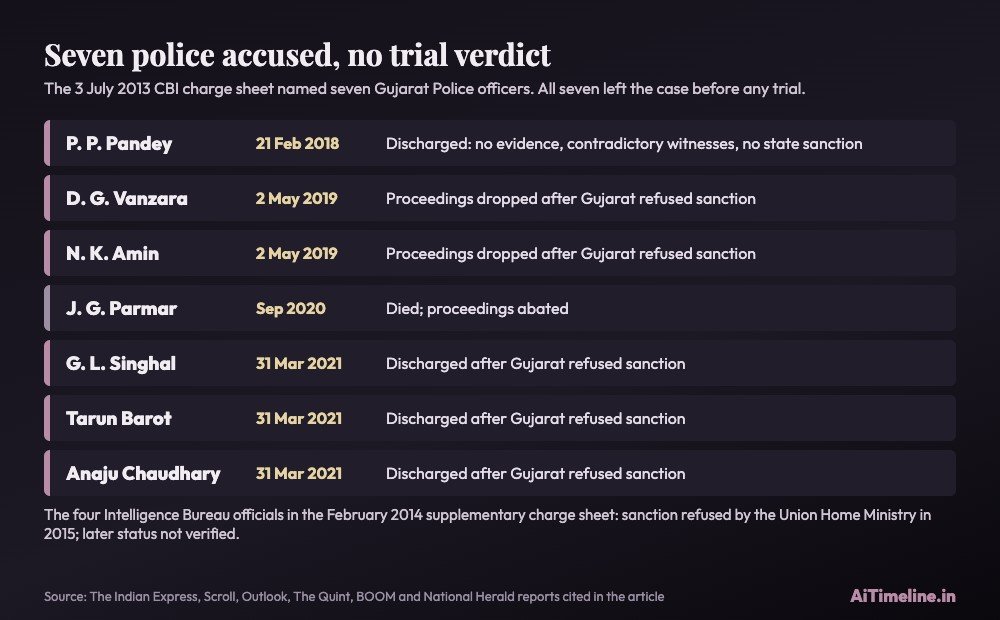
The court allowed the discharge applications of IPS officer G. L. Singhal, retired DySP Tarun Barot and assistant sub-inspector Anaju Chaudhary. They were discharged from the offences charged, including murder and conspiracy (IPC 302, 341-343, 365, 368 and 201) and Arms Act sections 25(1)(e) and 27, and were released on personal bonds of Rs 15,000 each (The Quint).
The ground was procedural. The Gujarat government had refused sanction to prosecute the three, saying they acted in the course of their official duties, and under section 197 of the Code of Criminal Procedure such sanction is needed to prosecute a public servant. The CBI argued the refusal was made “without application of mind”; the judge disagreed. The Indian Express noted that the discharge applications “did not get into the merits of the case” (The Indian Express).
In the order the court also recorded that, on the material before it, the Gujarat Police had acted on a “sound, solid and correct” intelligence input and that nothing on record showed, even prima facie, that the four dead were not terrorists (Sabrang). Those remarks were made at the discharge stage, with no trial and no witnesses examined, and they sit against the CBI’s investigative findings and the High Court’s 2011 judgment. With the three discharged, no police officer remained as an accused in the main case.
2020
The court rejects discharge pleas of three officers, saying sanction is needed Court ruling or discharge
The Special CBI court rejected the discharge applications of the three remaining accused on the ground that prosecution sanction under section 197 of the CrPC was required, and directed the CBI to seek it from the Gujarat government (Deccan Herald; The Quint). The court had raised the same question with the CBI about D. G. Vanzara and N. K. Amin in 2018.
The seventh police accused, Inspector J. G. Parmar, had died in September 2020, and the proceedings against him abated (BOOM). By March 2021 the state had refused sanction, setting up the final discharge.
2019
Ishrat’s mother tells the court she has lost the will to fight The encounter and the family
In a four-page letter filed in the Special CBI court, Shamima Kauser said she had instructed her counsel, Vrinda Grover, that she had “lost my will to fight” and could no longer take part in the proceedings, leaving it to the CBI to prosecute the accused. She wrote that she felt “hopeless and helpless” that the trial had “barely started” 15 years after her daughter’s death, and repeated her belief that Ishrat was innocent (Deccan Herald).
Those are the family’s statements and beliefs, reported as such. The letter came five months after Vanzara and Amin were discharged.
2019
The CBI says it will not appeal the Vanzara and Amin discharge Court ruling or discharge
The CBI told the court in a written submission that it would not appeal against the discharge of former DIG D. G. Vanzara and former SP N. K. Amin. The submission did not give grounds, and Ishrat’s mother Shamima Kauser, who had opposed the discharge, had not gone to a higher court (Scroll).
The Indian Express later wrote that the CBI had not appealed the discharge of Pandey, Vanzara or Amin (The Indian Express).
2019
Vanzara and Amin are discharged after Gujarat refuses sanction Court ruling or discharge
A special CBI court dropped proceedings against Vanzara and Amin after the agency failed to get the Gujarat government’s sanction to prosecute them. The state had refused, saying the officers did their official duty (Scroll).
Earlier, on 7 August 2018, Judge J. K. Pandya had rejected their discharge applications, holding that Vanzara played a “greater” role than P. P. Pandey and could not claim parity with him, and had asked the CBI whether it would seek state sanction (National Herald, PTI; The Wire). The CBI had taken the position that sanction was not needed for the Gujarat officers, while it had sought it from the Union government for the Intelligence Bureau accused; the court noted the two stands (The Indian Express).
2019
Gujarat refuses sanction to prosecute Vanzara and Amin Government and politics
The CBI produced a letter in which the Gujarat government refused sanction to prosecute D. G. Vanzara and N. K. Amin in the “larger public interest”, saying Vanzara should be protected against “malicious and vexatious prosecution”. According to Deccan Herald, as cited by Sabrang, the letter also said that records placed by the CBI indicated Ishrat Jahan was a Lashkar member, citing a claim in a Lashkar-linked publication (Sabrang).
Shamima Kauser filed an application challenging the refusal, pointing to the SIT’s conclusion that the four had been abducted, held and killed. The two officers applied on 26 March to have proceedings dropped. The state’s letter is a government’s reason for refusing sanction, not a court finding about Ishrat Jahan.
2018
P. P. Pandey, a former in-charge DGP, is discharged Court ruling or discharge
The court allowed the discharge application of former Gujarat in-charge DGP P. P. Pandey, the most senior serving IPS officer arrested in the case. It said there was no evidence against him linked to the kidnapping and murder, that witnesses had given contradictory statements to different agencies, and that permission to prosecute him as a government servant had not been obtained (Outlook).
Ishrat’s mother’s lawyer, Vrinda Grover, said at the time that the discharge showed the case was going “the Sohrabuddin case route” (The Wire). That is a lawyer’s comment, not a finding.
2018
Two IB officers challenge a magistrate’s summons Court ruling or discharge
A magistrate’s court for CBI cases had summoned Special Director Rajinder Kumar and officers M. K. Sinha, Rajeev Wankhede and Mittal in December 2017 (initials vary in reports), on the supplementary charge sheet filed almost four years earlier. Wankhede and Mittal challenged the summons because the Union government had not given sanction to prosecute them (Business Standard, PTI).
AiTimeline could not find a report of how the challenge was decided or what happened to the IB accused afterwards. See the status table above.
2016
The Supreme Court refuses to quash the case on the strength of Headley’s testimony Court ruling or discharge
A day after the Home Minister’s statement, the Supreme Court dismissed a petition seeking to quash the criminal cases against the Gujarat policemen on the basis of Headley’s deposition. The bench said “so many issues” were involved and that a person with standing could approach the High Court under Article 226 (LiveLaw).
2016
The Home Minister tells Parliament about the 2009 affidavits Government and politics
Home Minister Rajnath Singh made a statement in the Lok Sabha about an alleged alteration of the Centre’s affidavit in the case. He said the first affidavit (6 Aug 2009) had cited intelligence inputs on Lashkar-e-Taiba and the four dead, that the further affidavit (29 Sep 2009) said such inputs “do not constitute conclusive proof”, and that the file notings gave no reason for filing it (Press Information Bureau).
He also told the House that David Headley, testifying in the 26/11 trial in Mumbai, said he had learnt from accomplices of a botched operation in which a woman was killed, and picked Ishrat Jahan from three names the prosecutor offered. That is testimony in a different trial, relayed secondhand; it has not been tested in this case. Former Home Secretary G. K. Pillai had alleged on 28 February 2016 that P. Chidambaram rewrote the 2009 affidavit; Chidambaram denied it (The Caravan).
2015
The Home Ministry refuses sanction to prosecute four IB officials Government and politics
The Union Home Ministry declined the CBI’s request for sanction to prosecute the four Intelligence Bureau officials named in the supplementary charge sheet. The Hindu, quoted by LiveLaw, reported that the ministry did not give its grounds (LiveLaw). The Indian Express later reported that the ministry held they had acted in discharge of official duty (The Indian Express).
The Union Home Minister confirmed the decision in Parliament in March 2016, saying the ministry “did not find it a fit case for grant of prosecution sanction”.
2015
D. G. Vanzara gets bail after seven and a half years in jail Court ruling or discharge
The Special CBI court granted bail to D. G. Vanzara on a personal bond of Rs 2 lakh, barring him from entering Gujarat and from leaving the country and requiring him to appear every working Saturday (Business Standard, PTI). He had been in custody since 2007, first in the separate Sohrabuddin Sheikh case.
Bail is not an acquittal; it governs custody while a case is pending.
2014
The CBI files a supplementary charge sheet against four IB officials CBI investigation
The CBI charged IB Special Director Rajinder Kumar and three officers, P. Mittal, M. K. Sinha and Rajiv Wankhede, with conspiracy in the killings (Press Information Bureau). The CBI called the encounter a joint operation of Gujarat Police and the IB (The Indian Express).
According to Deccan Chronicle, the CBI charged Rajinder Kumar alone with murder and alleged that he had interrogated Ishrat Jahan and Javed Sheikh at a farmhouse where they were held, and supplied arms used in the killing; the other three were charged with conspiracy, kidnapping and wrongful confinement. The agency also asked for an added charge of giving false evidence against J. G. Parmar. The charge sheet did not name Amit Shah, then Gujarat’s minister of state for home; he was never an accused in this case (Deccan Chronicle).
These are the CBI’s allegations, never tested at a trial, and the officers are presumed innocent. The charge sheet was filed without prosecution sanction. Reports differ on cognisance: Deccan Chronicle said a magistrate took cognisance in February 2014, while The Indian Express wrote in June 2016 that the court had not yet done so (The Indian Express). A magistrate issued summonses in December 2017.
2013
The CBI files its first charge sheet against seven Gujarat Police officers CBI investigation
The CBI named seven officers: P. P. Pandey, D. G. Vanzara, G. L. Singhal, N. K. Amin, J. G. Parmar, Tarun Barot and Anaju Chaudhary, under IPC sections 302, 364, 368, 346, 120-B, 201, 203, 204, 217 and 218 and Arms Act sections 25 and 27 (Press Information Bureau; The Indian Express).
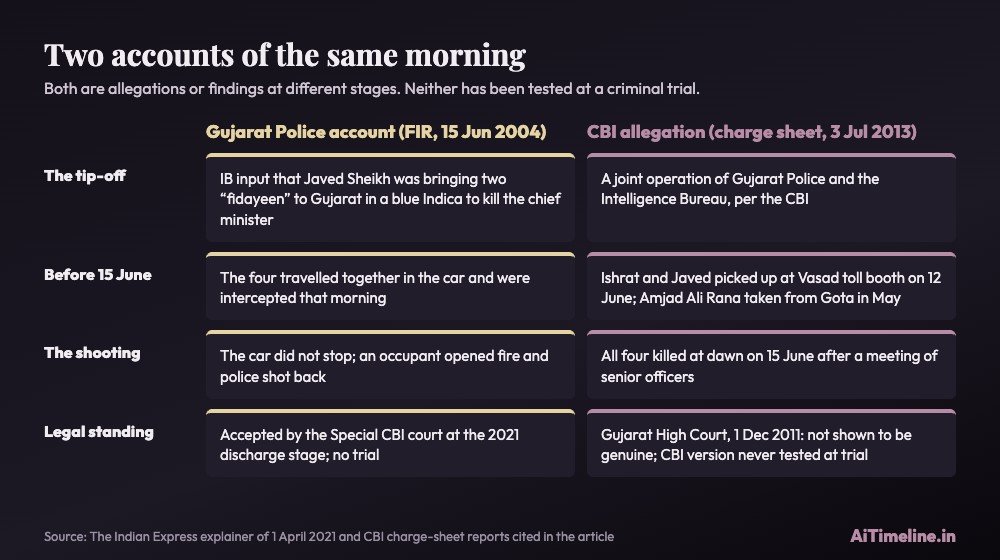
Its case was that Ishrat Jahan and Javed Sheikh were picked up at the Vasad toll booth on 12 June 2004 and held at a farmhouse, that Amjad Ali Rana had been taken from Gota circle in May, and that all four were killed in the early hours of 15 June after a meeting of senior officers. The CBI leaned on statements recorded under section 164 CrPC from people first named as accused, who became witnesses (The Indian Express). The Gujarat government later noted that the FIR named 20 officers but the charge sheet only seven.
2013
The CBI makes its first arrests, starting with G. L. Singhal CBI investigation
About a year into the probe the CBI arrested IPS officer G. L. Singhal, followed by Tarun Barot, who was already serving a term in the Sadiq Jamal case, and two others. The agency missed its deadline to file a charge sheet on 27 May 2013, and Singhal and the others got bail (The Indian Express). P. P. Pandey was arrested later in 2013 (Outlook).
2011
The CBI registers a fresh FIR against 21 policemen CBI investigation
Following the High Court’s order, the CBI registered a fresh FIR on the complaint of SIT chief R. R. Verma against 21 policemen, among them former DGP K. R. Kaushik (The Indian Express; The Indian Express). Gujarat’s later sanction order counted 20 named officers, so reports differ by one.
2011
The Gujarat High Court says the encounter was not genuine and hands the case to the CBI Inquiry or SIT
The Gujarat High Court, in the petition filed by Ishrat’s mother in 2004, held that the encounter was not shown to be genuine, ordered a fresh case against those accused, and transferred the investigation to the CBI (Press Information Bureau; The Caravan). Justice Jayant Patel is quoted as saying, “The encounter is not found to be genuine.”
This was a judicial finding that justified an investigation. It was not a trial or a conviction of anyone, and later discharge orders were made by a different court on different grounds.
The SIT turns against the police version Inquiry or SIT
SIT member Satish Verma filed an affidavit on 28 January 2011 saying the encounter was fake (The Indian Express). The High Court appointed Bihar-cadre officer Rajiv Ranjan Verma to head the SIT on 19 July 2011, after three earlier nominees had left or refused the job, and on 24 November he filed an affidavit saying the encounter was fake and that witnesses had been threatened (The Indian Express; The Indian Express).
These were findings of a court-appointed investigation team. The Gujarat government disputed them. They are not the same as a trial court’s verdict.
2010
The Supreme Court rejects Gujarat’s challenge to the High Court’s SIT Court ruling or discharge
The Gujarat government argued that its own SIT should continue and that the High Court had no power to set up another. The Supreme Court dismissed the plea: “Court is not deprived of its power. In exceptional cases, it can do (constitute a team). In the facts of the case, we find no reason to interfere” (The Daily Star, PTI).
2009
A second Centre affidavit says intelligence inputs are “not conclusive proof” Government and politics
The Centre filed a further affidavit saying all intelligence inputs do not constitute conclusive proof, that it was for the state government and police to act on them, that the Centre was “in no way concerned” with such action and did not “condone or endorse any unjustified or excessive action”, and that it had no objection if the court ordered an independent inquiry by the CBI or otherwise (Press Information Bureau). It said the first affidavit had not been meant to support the Gujarat Police action.
2009
The High Court orders an SIT; its chairmen keep leaving Inquiry or SIT
On 13 August 2009 the High Court ordered a three-member SIT to probe whether the encounter was genuine (The Indian Express). A new SIT under IPS officer Karnail Singh was formed on 24 September; Singh quit, Satyapal Singh left after him, and J. V. Ramudu declined the chair (The Indian Express). Gujarat cadre officers Mohan Jha and Satish Verma were members (The Indian Express).
2009
Magistrate S. P. Tamang calls the encounter fake; the High Court stays his report Inquiry or SIT
Tamang’s inquiry concluded on 7 September 2009 that the encounter was staged and accused Ahmedabad Crime Branch officers of taking part. The Gujarat government attacked the report as overstepping his jurisdiction, and on 9 September the High Court stayed it on the state’s petition (The Indian Express).
The stay meant the report could not be acted on while it lasted; AiTimeline did not find a later report on the stay. The SIT and the High Court later reached a similar conclusion by another route.
2009
The Centre files an affidavit citing Lashkar links Government and politics
An under-secretary of the Home Ministry filed an affidavit, approved by the then Home Minister, saying the Centre held specific inputs that Lashkar-e-Taiba was planning attacks, including assassinations of leaders, in Gujarat, and giving the background of the four dead. It opposed a CBI probe (Press Information Bureau; The Indian Express).
The Home Minister said in 2016 that the affidavit was meant to point out contradictions between the mother’s petition and Javed Sheikh’s father’s petition, and that the Centre had not known a judicial inquiry under section 176 was under way.
Vanzara is arrested in the separate Sohrabuddin Sheikh case The encounter and the family
IPS officers D. G. Vanzara, Rajkumar Pandian and Dinesh M. N. were arrested in the Sohrabuddin Sheikh alleged fake-encounter case after a Supreme Court-directed investigation. By then questions were also being raised about other Gujarat encounters (The Indian Express). The Sohrabuddin case is separate; a CBI court there acquitted all 22 accused in 2018.
2006
The Gujarat High Court admits Shamima Kauser’s petition The encounter and the family
The High Court admitted the 2004 petition by Ishrat’s mother seeking a CBI investigation and compensation (The Indian Express). Javed Sheikh’s father, M. R. Gopinath Pillai, had separately gone to the Supreme Court in 2007; it did not entertain his petition and told him to approach the High Court (Press Information Bureau).
2006
A police report calls the encounter genuine, and a magistrate inquiry is ordered Inquiry or SIT
The investigating officer, ACP Parikshita Gurjar of the Ahmedabad Crime Branch, filed a report before the POTA special judge concluding that the encounter was genuine and the dead were terrorists. The court ordered a judicial inquiry by Metropolitan Magistrate S. P. Tamang (The Indian Express).
Ishrat’s mother goes to the High Court The encounter and the family
Shamima Kauser, Ishrat Jahan’s mother, approached the Gujarat High Court alleging that her daughter had been killed in a fake encounter, seeking a CBI probe and compensation (The Indian Express).
2004
Ishrat Jahan and three men are killed near Kotarpur, Ahmedabad The encounter and the family
At dawn the Crime Branch, led by Deputy Commissioner D. G. Vanzara, shot dead Ishrat Jahan Raza, 19, a Khalsa College student from Mumbra, Javed Sheikh (born Pranesh Pillai), and two men described as Pakistanis, Zeeshan Johar and Amjad Ali Rana (The Indian Express).
The FIR, lodged by Inspector J. G. Parmar, said the police acted on intelligence that Javed was coming from Mumbai in a blue Indica with two “fidayeen” to kill Chief Minister Narendra Modi, and called Ishrat “one woman terrorist” seated beside the driver. Ishrat’s mother claimed her body, Javed’s wife claimed his, and the two men were buried unclaimed in Ahmedabad.
What Did Gujarat Police Claim?
The version in the FIR of 15 June 2004, and the version the Special CBI court accepted in 2021.
The FIR, lodged on a complaint by Inspector J. G. Parmar, said the Crime Branch received intelligence that Javed Sheikh was travelling from Mumbai with two “fidayeen” in a blue Indica to kill the chief minister, and described Ishrat Jahan as “one woman terrorist” seated beside the driver (The Indian Express). In the version the Special CBI court relied on in 2021, the IB warned that four terrorists had entered Gujarat; the car did not stop at a checkpoint, an occupant opened fire, and the police fired back (The Indian Express).
The Centre’s first affidavit, of 6 August 2009, cited inputs that Lashkar-e-Taiba planned attacks in Gujarat and gave background on the four (Press Information Bureau). The second, of 29 September 2009, said intelligence inputs are not conclusive proof and that the government did not endorse unjustified police action.
The police account has been disputed by Ishrat’s family since 2004 and, in turn, by the Tamang inquiry, the SIT, the High Court’s 2011 judgment and the CBI. The 2021 discharge order reached the opposite view without a trial.
What Did the CBI Allege?
The investigators’ case, as set out in charge sheets that no court ever tried.
The CBI said the encounter was staged. Its charge sheet alleged that Ishrat Jahan and Javed Sheikh were picked up at the Vasad toll booth on 12 June 2004 and held at a farmhouse, that Amjad Ali Rana was taken from Gota circle in May, and that all four were killed early on 15 June after a meeting of senior officers (The Indian Express). It described a joint operation of Gujarat Police and the Intelligence Bureau (The Indian Express).
The first charge sheet (3 July 2013) named seven police officers; the supplementary one (6 February 2014) named four IB officials, including Special Director Rajinder Kumar. The CBI relied on statements recorded under section 164 CrPC from people first named as accused who became witnesses. The Gujarat government said those statements contradicted earlier ones and that the charge sheet named only seven of the 20 officers in the FIR (The Indian Express).
A charge sheet records what investigators believe they can prove. It is not a finding of guilt, and the accused are entitled to the presumption of innocence.
Why Did the Case Stay Controversial?
Four reasons, each tied to the record.
1. Conflicting accounts. The police, the family, a magistrate, an SIT, the High Court, the CBI and the Special CBI court gave different pictures of the same morning at different stages. Without a trial, none was tested by cross-examined witnesses.
2. Intelligence is not proof. The Centre’s two 2009 affidavits showed the gap. An input can justify watching or intercepting someone, but the Centre itself said inputs are not conclusive proof and that it did not endorse unjustified or excessive action. Whether lethal force was justified is a separate question from whether the dead had militant links.
3. Prosecution sanction. Section 197 of the CrPC lets a government refuse permission to prosecute a public servant for acts in official duty. Gujarat refused for the police, and the Union government for the IB officials. The Special CBI court noted that the CBI had taken different positions on whether sanction was needed for the two groups (The Indian Express). Gujarat’s order called public servants a “special class of persons” protected by section 197, while the CBI argued that sanction was not needed for an alleged staged killing; the Special CBI court held that the officers had acted in their official duties.
4. Political polarisation. The police claim involved an alleged plot against Narendra Modi, then Gujarat’s chief minister and later India’s prime minister. In 2016 a former Home Secretary alleged the Centre’s affidavit had been rewritten, which a former Home Minister denied, and the matter reached Parliament (Press Information Bureau). Political rivals presented the case through competing narratives, so this page names who said what.
What Was the Outcome of the Ishrat Jahan Case?
What the orders actually decided, as of 23 October 2026.
There was no conventional trial and no verdict on whether the encounter was genuine. The seven police accused left the case as follows: Pandey (21 Feb 2018, no evidence and no sanction), Vanzara and Amin (2 May 2019, sanction refused), Parmar (died, Sep 2020) and Singhal, Barot and Chaudhary (31 Mar 2021, sanction refused). The CBI chose not to appeal at least the Pandey, Vanzara and Amin discharges.
The IB officials’ case had a separate history: sanction was refused in 2015, and the latest position AiTimeline found was the January 2018 challenge to summonses. It would be wrong to say either that every allegation was proved or that the discharges established the police account; they established only that, on the material before the court, the officers could not be prosecuted without sanction that the state had refused.
Whether any court record from after 2021 changes this, for example an appeal or an order in the IB branch, should be checked at the Ahmedabad CBI court before relying on this page for legal purposes.
Allegation, Finding or Ruling?
The same story, sorted by how strong each statement is.
| Statement | Where it came from | Type | What the record shows |
|---|---|---|---|
| The four were Lashkar-e-Taiba terrorists planning to kill the chief minister | Gujarat Police FIR; the Centre’s first 2009 affidavit | Police claim and intelligence input | The Centre’s second affidavit said inputs are “not conclusive proof”; the family disputes it; no trial has tested it |
| The encounter was staged | Magistrate Tamang, the SIT, the CBI | Investigative finding and allegation | The High Court held on 1 Dec 2011 it was not shown to be genuine; the Tamang report was stayed; no trial tested the CBI’s version |
| The officers acted in their official duty | Gujarat government; Special CBI court, 2018-2021 | Basis for refusing sanction | Accepted at the discharge stage; the CBI had argued sanction was not required |
| Nothing shows the four were not terrorists | Special CBI court, 31 Mar 2021 | Court observation at discharge stage | Made without a trial; contrasts with the High Court’s 2011 judgment and the CBI’s findings |
| Intelligence Bureau officials joined the conspiracy | CBI supplementary charge sheet, 2014 | Prosecution allegation | The Home Ministry refused sanction in 2015; never tried; the officers are presumed innocent |
| The Centre rewrote its 2009 affidavit for political reasons | G. K. Pillai and BJP leaders, 2016 | Political allegation | P. Chidambaram denied it; the Home Minister said file notings gave no reason; no court has ruled |
| Headley said Ishrat Jahan was a Lashkar member | Home Minister’s statement relaying his 26/11 trial testimony | Secondhand testimony in a separate trial | Headley said he learnt it from accomplices and picked the name from three offered; not tested in this case |
The Story at a Glance
Oldest first, with the type of each entry.
| Date | Event | Type |
|---|---|---|
| 15 Jun 2004 | Ishrat Jahan and three men are killed near Kotarpur, Ahmedabad | The encounter and the family |
| Aug 2004 | Ishrat’s mother goes to the High Court | The encounter and the family |
| 8 Jun 2006 | A police report calls the encounter genuine, and a magistrate inquiry is ordered | Inquiry or SIT |
| 12 Dec 2006 | The Gujarat High Court admits Shamima Kauser’s petition | The encounter and the family |
| 2007 | Vanzara is arrested in the separate Sohrabuddin Sheikh case | The encounter and the family |
| 6 Aug 2009 | The Centre files an affidavit citing Lashkar links | Government and politics |
| 7 Sep 2009 | Magistrate S. P. Tamang calls the encounter fake; the High Court stays his report | Inquiry or SIT |
| 13 Aug 2009 | The High Court orders an SIT; its chairmen keep leaving | Inquiry or SIT |
| 29 Sep 2009 | A second Centre affidavit says intelligence inputs are “not conclusive proof” | Government and politics |
| 11 Nov 2010 | The Supreme Court rejects Gujarat’s challenge to the High Court’s SIT | Court ruling or discharge |
| 2011 | The SIT turns against the police version | Inquiry or SIT |
| 1 Dec 2011 | The Gujarat High Court says the encounter was not genuine and hands the case to the CBI | Inquiry or SIT |
| 17 Dec 2011 | The CBI registers a fresh FIR against 21 policemen | CBI investigation |
| 21 Feb 2013 | The CBI makes its first arrests, starting with G. L. Singhal | CBI investigation |
| 3 Jul 2013 | The CBI files its first charge sheet against seven Gujarat Police officers | CBI investigation |
| 6 Feb 2014 | The CBI files a supplementary charge sheet against four IB officials | CBI investigation |
| 5 Feb 2015 | D. G. Vanzara gets bail after seven and a half years in jail | Court ruling or discharge |
| 8 Jun 2015 | The Home Ministry refuses sanction to prosecute four IB officials | Government and politics |
| 10 Mar 2016 | The Home Minister tells Parliament about the 2009 affidavits | Government and politics |
| 11 Mar 2016 | The Supreme Court refuses to quash the case on the strength of Headley’s testimony | Court ruling or discharge |
| 3 Jan 2018 | Two IB officers challenge a magistrate’s summons | Court ruling or discharge |
| 21 Feb 2018 | P. P. Pandey, a former in-charge DGP, is discharged | Court ruling or discharge |
| 19 Mar 2019 | Gujarat refuses sanction to prosecute Vanzara and Amin | Government and politics |
| 2 May 2019 | Vanzara and Amin are discharged after Gujarat refuses sanction | Court ruling or discharge |
| 25 Jul 2019 | The CBI says it will not appeal the Vanzara and Amin discharge | Court ruling or discharge |
| 1 Oct 2019 | Ishrat’s mother tells the court she has lost the will to fight | The encounter and the family |
| 23 Oct 2020 | The court rejects discharge pleas of three officers, saying sanction is needed | Court ruling or discharge |
| 31 Mar 2021 | A Special CBI court discharges the last three police officers in the main case | Court ruling or discharge |
| 24 May 2023 | The Delhi High Court upholds the dismissal of SIT investigator Satish Verma | Government and politics |
| Term | Meaning | Why it matters here |
|---|---|---|
| Encounter | Police shooting described as an exchange of fire | Whether this one was genuine is the central dispute |
| FIR | First Information Report, which starts a police case | The police FIR of 15 Jun 2004 and the CBI FIR of 17 Dec 2011 tell opposite stories |
| Charge sheet | The investigators’ report setting out the prosecution case | An allegation, not a finding of guilt |
| Section 197 CrPC sanction | Permission from the government to prosecute a public servant for acts done in official duty | Its refusal ended the police prosecution |
| Discharge | The accused is released at the charge stage because the court finds no ground to proceed | Not an acquittal after a trial |
| Abatement | Proceedings against an accused end on death | Applied to J. G. Parmar in Sep 2020 |
| SIT | Special Investigation Team | The High Court appointed one in 2009; its findings sent the case to the CBI |
| Magistrate inquiry | A judicial inquiry into a death caused by police under section 176 CrPC | S. P. Tamang’s 2009 report was one |
| Affidavit | A sworn statement filed in court | The Centre filed two with different emphasis in 2009 |
Who Is Who in the Case
Ishrat Jahan, Javed Sheikh, Zeeshan Johar and Amjad Ali Rana
Ishrat Jahan, 19, a student from Mumbra; Javed Sheikh, born Pranesh Pillai; and two men the police described as Pakistanis.
Shamima Kauser
Ishrat’s mother, who went to the Gujarat High Court in 2004 and kept pressing for a CBI probe.
Seven Gujarat Police officers
P. P. Pandey, D. G. Vanzara, G. L. Singhal, N. K. Amin, J. G. Parmar, Tarun Barot and Anaju Chaudhary; none was tried, and all are presumed innocent. Six were discharged and one died.
Four IB officials
Rajinder Kumar, P. Mittal, M. K. Sinha and Rajeev Wankhede, named in the 2014 supplementary charge sheet; never tried and presumed innocent; the Centre refused sanction.
Magistrate S. P. Tamang and the High Court-appointed SIT
Tamang’s 2009 report and the SIT’s 2011 affidavits both said the encounter was fake.
Central Bureau of Investigation
Took over after the 1 Dec 2011 judgment and filed charge sheets in 2013 and 2014.
Gujarat High Court and the Special CBI court, Ahmedabad
The High Court sent the case to the CBI; the Special CBI court heard the discharge applications.
Gujarat government and the Union Home Ministry
Each refused sanction to prosecute a different group of officials.
The Popular Story vs the Record
| Popular version | What the record shows |
|---|---|
| A court convicted the police of murder | No. All seven police accused were discharged or died before any trial |
| A court cleared the police after a trial | No. The 2021 order was a discharge at the charge stage, mostly because the state refused sanction |
| The CBI proved the encounter was fake | The CBI alleged it in charge sheets; the High Court found it not shown to be genuine in 2011; no trial tested the evidence |
| The 2021 order proved Ishrat Jahan was a terrorist | It recorded the court’s view of the material at the discharge stage. There was no trial, and her family disputes it |
| The whole matter is closed | The police prosecution is over. The proceedings against four IB officials have not been verified |
| There is one Ishrat Jahan case | A different Ishrat Jahan, a former Delhi councillor, was charged in the 2020 Delhi riots |
Explore More Timelines
People Also Ask
Frequently Asked Questions
Related AiTimeline Stories
⚠️ Editorial Note
Last updated 23 October 2026. This is a historical overview, not a determination of criminal responsibility, and not legal advice. The police version, the family’s allegations, investigators’ conclusions and court orders are kept apart; allegations in charge sheets and public statements are reported as allegations, a discharge is not described as an acquittal or a conviction, and no officer named here has been convicted. The status of the proceedings against the four IB officials after January 2018 could not be verified; check the Ahmedabad CBI court record. Spelling of some names and initials varies across reports. Source dates are given in the notes above.
Sources & further reading
Every dated entry above was checked against these references. Last reviewed 23 October 2026.
- Press Information Bureau, Ministry of Home Affairs: Union Home Minister's statement in Lok Sabha on the Ishrat Jahan case affidavit (10 March 2016)
- The Indian Express: Ishrat Jahan encounter case, why a CBI court discharged the last of the accused (1 April 2021)
- The Indian Express: Ishrat Jahan encounter case, here's what has happened since 2004 (16 June 2016)
- The Indian Express: Timeline of the Ishrat Jahan fake encounter case (3 July 2013)
- The Wire: Ishrat Jahan encounter case, a timeline of events (2 May 2019)
- The Wire: Court rejects discharge pleas of two former policemen (7 August 2018)
- National Herald (PTI): Court rejects discharge pleas of Vanzara, Amin (7 August 2018)
- Outlook: CBI court discharges retired Gujarat DGP P. P. Pandey (21 February 2018)
- Scroll: CBI will not challenge discharge of D. G. Vanzara and N. K. Amin (26 July 2019)
- Deccan Herald: Court rejects discharge plea of four cops, directs CBI to seek sanction (23 October 2020)
- The Quint: CBI court discharges three accused police officers (31 March 2021)
- BOOM: Ishrat Jahan encounter not fake, Gujarat court closes case (1 April 2021)
- Sabrang India: CBI court discharges 3 police officers in Ishrat Jahan case (1 April 2021)
- Business Standard (PTI): IB officials challenge summons by court in Ishrat Jahan case (3 January 2018)
- LiveLaw: Home Ministry refuses sanction to CBI to prosecute IB officials (8 June 2015)
- The Caravan: What the Gujarat High Court said on the Ishrat Jahan case (2 March 2016)
- The Daily Star (PTI): Supreme Court rejects Gujarat plea against special probe (12 November 2010)
- LiveLaw: Supreme Court dismisses plea to quash charges against Gujarat police after Headley's deposition (11 March 2016)
- Business Standard (PTI): Vanzara gets bail in Ishrat case (5 February 2015)
- Deccan Chronicle: Ex-Special IB Director and 3 others made accused in Ishrat Jahan case (7 February 2014)
- Sabrang India: Application challenging Gujarat government's denial of sanction filed on behalf of Ishrat Jahan's mother (29 March 2019)
- Deccan Herald: Ishrat Jahan's mother gives up hope for justice (1 October 2019)
- LiveLaw: Supreme Court stays dismissal of IPS officer Satish Chandra Verma (19 September 2022)
- The Tribune: SC declines to stay dismissal order of IPS officer who probed Ishrat Jahan case (28 September 2022)
- The Tribune: Delhi HC upholds dismissal of IPS officer Satish Chandra Verma (24 May 2023)
- Wikipedia: Ishrat Jahan encounter killing