Oslo Accords: What Was Promised, Why It Collapsed and What Remains (1991-2026)
Oslo Accords timeline, 1991-2026: what Israel and the PLO agreed in 1993, why the five-year plan collapsed and how Areas A, B and C still shape the region.
Latest Story
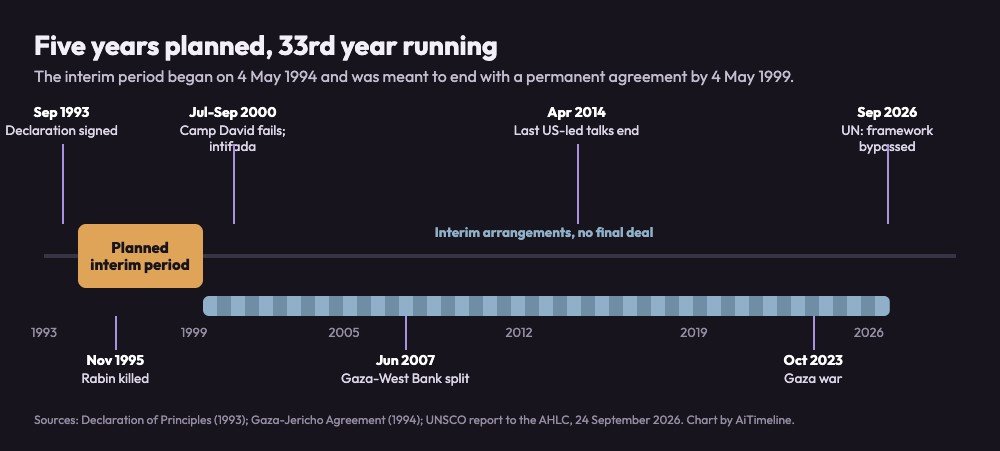
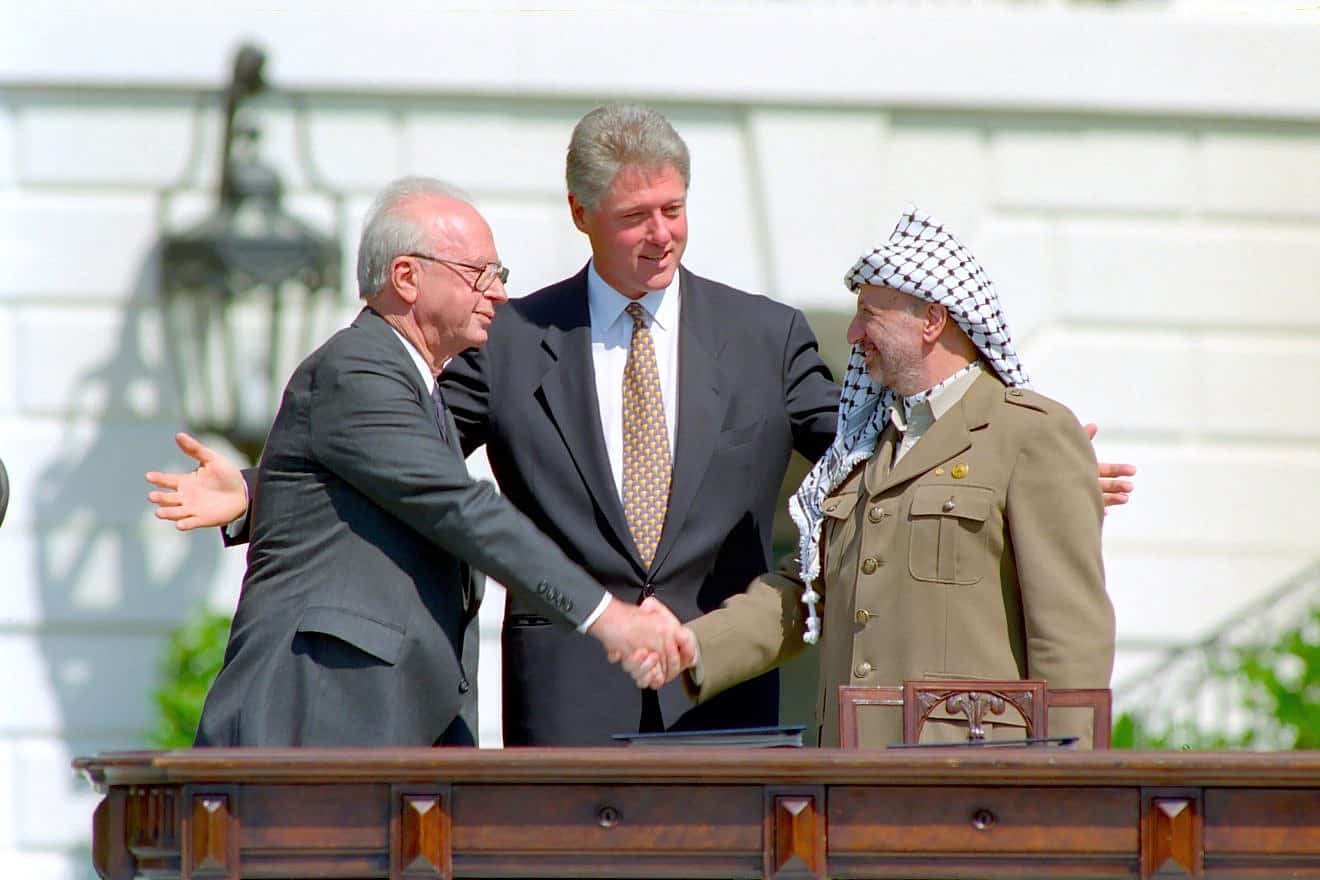
On 13 September 1993, Yitzhak Rabin and Yasser Arafat shook hands on the White House lawn after their foreign-policy chiefs signed the first of the Oslo Accords. Israel recognised the PLO as the representative of the Palestinian people; the PLO recognised Israel’s right to exist in peace and security. But the accords were an interim framework, not a peace treaty. They postponed borders, Jerusalem, settlements, refugees and security to talks that were meant to finish by 1999 and never did. This timeline sets out what was agreed, what was delivered, why it unravelled, and how its temporary arrangements still shape the West Bank in 2026.
💡 Short Answer
The Oslo Accords (1993-1995) were interim agreements between Israel and the PLO that created mutual recognition, the Palestinian Authority and the West Bank’s Areas A, B and C, with a permanent deal due by May 1999. That deal never came: talks failed at Camp David in 2000 and violence followed. In September 2026 the UN said Oslo’s framework is being bypassed with no replacement.
Oslo Accords: Key Questions
The Oslo Accords in Nine Points
- Interim, not final: Oslo was a transitional framework; it was never a peace treaty.
- Signatories: Peres and Abbas signed in 1993; Rabin and Arafat made the handshake.
- Recognition: the PLO recognised Israel’s right to exist; Israel recognised the PLO as the Palestinians’ representative.
- Deadline: a permanent deal was due by 4 May 1999; statehood was not guaranteed.
- Areas A, B and C: civil and security responsibilities, not sovereignty; Area C is still about 60%.
- Turning points: Rabin’s assassination (1995), Camp David (2000) and the Second Intifada (2000).
- Disputed history: why Camp David failed is still contested, and Sharon’s visit was a trigger, not the sole cause.
- Unilateral, not Oslo: the 2005 Gaza withdrawal was Israel’s own decision.
- Today: the UN says Oslo’s economic machinery is being bypassed, with about US$6 billion of PA revenue withheld.
Oslo Accords Timeline: 1991 to 2026, Latest First
Each entry is colour-coded by period and ends with why it matters.
The UN says Oslo’s economic framework is being bypassed without a replacement After Oslo, 2006-2026
What the report said: The UN Special Coordinator’s office told donors meeting in New York on 24 September 2026 that the framework set up by the Declaration of Principles, the Interim Agreement and the Paris Protocol “was designed for a five-year interim period” and is now being bypassed “without a formal replacement”.
The numbers: Israel continues to withhold some US$6 billion in clearance revenues, the taxes it collects on the Palestinian Authority’s behalf and the PA’s largest source of income. The World Bank put the PA’s deficit above 10% of GDP. The UN recorded more than 1,430 settler-related incidents in 2026 and about 3,800 Palestinians displaced in the West Bank this year. Correspondent-banking links between Israeli and Palestinian banks remain uncertain.
Gaza: Almost a year after the 10 October 2025 ceasefire, the report called it “fragile”: strikes continue, Hamas and other armed groups have not disarmed, and the transitional arrangements under Security Council resolution 2803 are not yet operating inside Gaza.
Since then: On 20 October 2026 a senior Palestinian official warned that the West Bank was on the verge of an “explosion”, AFP reported.
Western states recognise Palestine; a Gaza ceasefire and UN resolution 2803 follow After Oslo, 2006-2026
Recognition: The United Kingdom, Canada and Australia recognised the State of Palestine on 21 September 2025, and France and several other states followed at the UN the next day. By September 2026 the UN counted 161 recognising states.
Ceasefire: A ceasefire in Gaza took effect on 10 October 2025 under the US-brokered plan. It ended large-scale hostilities and saw the return of all remaining Israeli hostages and remains, but not all violence.
Resolution 2803: On 17 November 2025 the Security Council endorsed the plan’s transitional arrangements for Gaza in resolution 2803. Like Oslo, it anticipates a later “pathway” to Palestinian statehood rather than creating one.
The International Court of Justice gives its advisory opinion on the occupation After Oslo, 2006-2026
What happened: Asked by the General Assembly, the ICJ said Israel’s continued presence in the Occupied Palestinian Territory was unlawful and should end “as rapidly as possible”, and that settlement activity should stop. Advisory opinions are not binding.
The Oslo link: The court said the Oslo Accords could not be read as detracting from Israel’s obligations under international law. Israel rejected the opinion.
The Hamas-led attack on Israel and the Gaza war that followed After Oslo, 2006-2026
What happened: Hamas-led fighters attacked southern Israel, killing about 1,200 people, most of them civilians, and taking 251 hostages into Gaza. Israel launched a military campaign in Gaza that lasted two years.
The toll in Gaza: By the October 2025 ceasefire, Gaza’s Health Ministry reported more than 67,000 Palestinians killed. Much of Gaza’s housing, health and water infrastructure was destroyed, and most of its 2.1 million people were displaced, many repeatedly.
Why it belongs here: The war ended any remaining pretence that the Oslo-era arrangements were managing the conflict. The PA had not governed Gaza since 2007.
Thirty years on, the UN finds Oslo’s mechanisms have “atrophied or disappeared” After Oslo, 2006-2026
What happened: Marking 30 years since the signing, the UN Special Coordinator’s September 2023 report found that the Oslo-era mechanisms for handling economic and administrative questions between the two sides had atrophied or disappeared, contributing to instability and the risk of escalation.
The contradiction: Arrangements built to last five years were still shaping trade, taxation, movement and security three decades later.
UN Security Council adopts resolution 2334 on settlements After Oslo, 2006-2026
What it said: The resolution reaffirmed that Israeli settlements in territory occupied since 1967, including East Jerusalem, have “no legal validity” and are a major obstacle to the two-state solution, and called for an end to settlement activity and to violence.
The vote: It passed 14-0. The Obama administration abstained instead of using its veto. Israel rejected it.
Not part of Oslo: Resolution 2334 is not an Oslo document. It reflected international concern that facts on the ground were eroding the territory a negotiated settlement would need. The UN Secretary-General still reports on it every quarter.
The last sustained US-led talks collapse After Oslo, 2006-2026
What happened: Talks led by US Secretary of State John Kerry began in July 2013 with a nine-month target. They broke down in April 2014 amid disputes over a final prisoner release, new settlement tenders and Palestinian moves to join international treaties. Israel suspended the talks after Fatah and Hamas announced a reconciliation deal on 23 April.
Since then: There have been no comprehensive, direct permanent-status negotiations of the kind Oslo envisaged.
Palestine becomes a UN non-member observer state After Oslo, 2006-2026
What happened: The General Assembly upgraded Palestine’s status to non-member observer state by 138 votes to 9, with 41 abstentions.
What it did and did not do: The upgrade let Palestine join international bodies and treaties, including later the International Criminal Court. It did not create a sovereign state on the ground, end the occupation or replace the negotiations envisaged under Oslo.
Hamas takes control of Gaza; Palestinian rule splits in two After Oslo, 2006-2026
What happened: After months of clashes, Hamas fighters took control of the Gaza Strip in mid-June 2007. President Mahmoud Abbas dismissed the unity government and appointed a new cabinet in Ramallah. The Fatah-led PA kept governing parts of the West Bank.
Why it matters: Oslo assumed one Palestinian authority able to negotiate and deliver. From 2007 there were two rival administrations, and Israel and Egypt tightened restrictions on Gaza.
Hamas wins the Palestinian legislative election After Oslo, 2006-2026
What happened: Hamas, which had boycotted the 1996 election and rejected Oslo, won 74 of the 132 seats in the Legislative Council. Fatah won 45.
The reaction: Israel and the Quartet said they would deal with a Hamas-led government only if it recognised Israel, renounced violence and accepted previous agreements. Hamas refused, and aid and revenue transfers were cut.
The irony: The election itself was held under the institutions Oslo created.
Israel withdraws settlers and troops from Gaza, unilaterally Unravelling, 1995-2005
What happened: Under Prime Minister Ariel Sharon’s disengagement plan, Israel evacuated all 21 settlements in Gaza and four in the northern West Bank in August 2005, and its last troops left Gaza on 12 September.
What it was not: This was a unilateral Israeli decision, not a negotiated step under Oslo and not a final-status settlement. Israel kept control of Gaza’s airspace, territorial waters and most crossings; Egypt controlled its side of Rafah.
What followed: The status of Gaza and its link to the West Bank remained unresolved.
The Quartet publishes the Roadmap for Peace Unravelling, 1995-2005
What it proposed: A three-phase, performance-based plan: an end to violence and Palestinian institutional reform, then an interim state with provisional borders, then a permanent agreement. Israel was asked to freeze settlement activity and dismantle outposts built since March 2001.
What happened: Both sides accepted it formally, with Israel attaching 14 reservations. Implementation stalled almost immediately amid attacks, military operations and arguments over who had to act first.
Israel launches Operation Defensive Shield in the West Bank Unravelling, 1995-2005
What happened: After a wave of suicide bombings, including the 27 March attack on a Passover meal in Netanya that killed 30 people, Israel launched its largest West Bank operation since 1967. Forces re-entered Area A cities including Ramallah, Nablus, Jenin and Bethlehem, and besieged Arafat’s compound.
Effect on Oslo: The operation badly damaged PA security and civil institutions. In practice, the line between Area A and the rest of the West Bank stopped limiting Israeli military operations.
The Second Intifada begins Unravelling, 1995-2005
The trigger: Opposition leader Ariel Sharon’s visit to the Temple Mount/Haram al-Sharif compound on 28 September became the immediate flashpoint. Protests and clashes the next day escalated into a prolonged uprising.
Not a single cause: The visit was a trigger, not the sole cause. Anger over the failure of Camp David, continued occupation and settlement growth, movement restrictions and political rivalries had built up for years.
The cost: The violence included Palestinian suicide bombings in Israeli cities and extensive Israeli military operations. By 2005 roughly 3,000 Palestinians and about 1,000 Israelis had been killed.
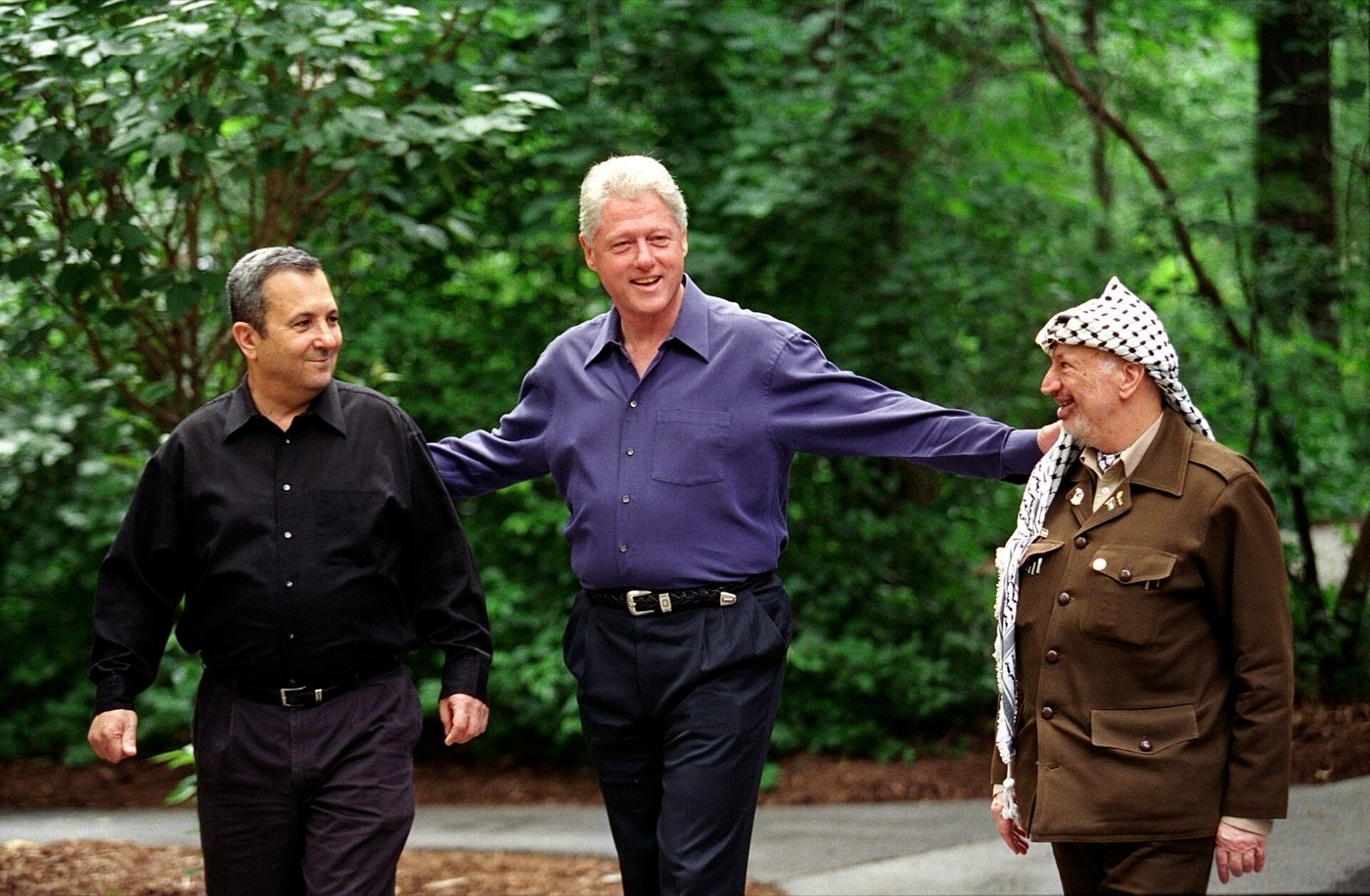
The Camp David summit ends without a final agreement Unravelling, 1995-2005
What happened: President Clinton hosted Israeli Prime Minister Ehud Barak and Chairman Arafat to try to settle the permanent-status questions Oslo had postponed: borders, Jerusalem, settlements, security and refugees. The summit ended without agreement.
Why it failed: disputed: Accounts differ sharply. Some US and Israeli participants blamed Arafat for rejecting proposals without a counter-offer; Palestinian negotiators and some US officials argued the offer was unclear, unwritten and fell short on territory, Jerusalem and refugees. Talks continued afterwards, including the Clinton Parameters of December 2000 and the Taba talks of January 2001.
What it showed: Seven years of interim arrangements had not built enough trust or common ground to resolve the core issues.
The five-year interim period expires without a permanent deal Unravelling, 1995-2005
What happened: The interim period, which began with the Gaza-Jericho Agreement on 4 May 1994, was due to end within five years. Permanent-status talks had opened formally in May 1996 but barely progressed, and the deadline passed with no settlement.
A deadline, not a promise: The 1999 date was a target for completing negotiations. Oslo did not guarantee that a Palestinian state would be created when it arrived. Arafat was persuaded not to declare statehood unilaterally on that date.
Next: The Sharm el-Sheikh Memorandum of 4 September 1999 set a new timetable, aiming for a framework agreement by February 2000 and a permanent deal by September 2000. Neither was met.
The Wye River Memorandum tries to restart implementation Unravelling, 1995-2005
What it said: Israel would carry out a further redeployment from 13% of the West Bank, and the Palestinian side made security commitments, including action against militant groups and a review of the PLO Charter. There were also prisoner releases and plans for Gaza’s airport.
What happened: Israel carried out the first phase in November 1998, including around Jenin, then froze the rest in December, citing Palestinian non-compliance. The Netanyahu government fell and early elections followed in May 1999.
The Hebron Protocol divides one city into two zones Unravelling, 1995-2005
What happened: After months of US mediation, Israel and the PLO agreed the protocol on 14-15 January and signed it on 17 January 1997. Israeli forces began redeploying on 16 January.
The division: H1, about 80% of the city, came under Palestinian civil and security responsibility. H2, including the Old City and the area around the settler enclaves, stayed under Israeli security control.
Date check: Some timelines give 15 January as the signing date. That was when the agreement was approved; the protocol itself was signed on 17 January.
Palestinians vote in their first general election Unravelling, 1995-2005
What happened: Palestinians in the West Bank, Gaza and East Jerusalem elected a president and an 88-member Legislative Council under the Oslo II rules. Arafat won about 88% of the presidential vote, and Fatah won a clear majority of the seats. Hamas boycotted.
The limits: The new institutions governed only defined areas and powers. They were not those of a sovereign state.
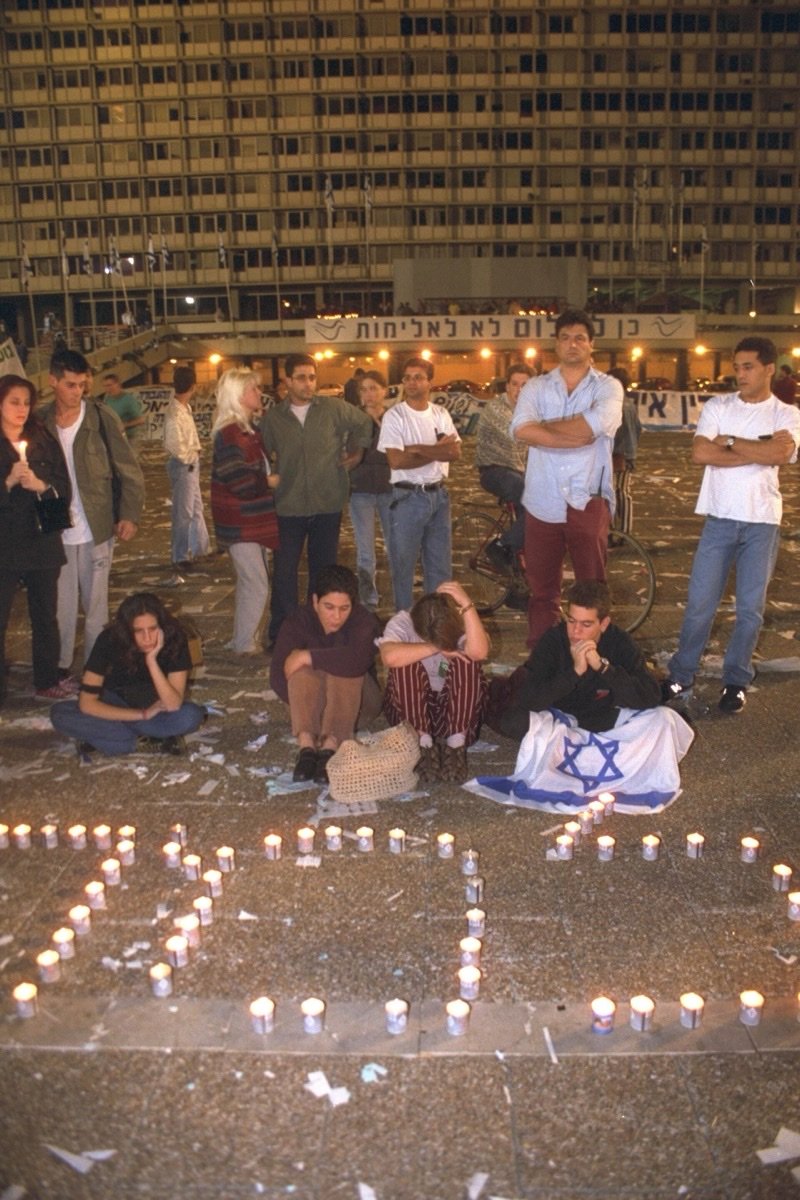
Prime Minister Yitzhak Rabin is assassinated The deal, 1991-95
What happened: Rabin was shot dead after a peace rally in Tel Aviv by Yigal Amir, an Israeli extremist who opposed the Oslo process. Shimon Peres became prime minister and continued the process.
What followed: A series of Hamas suicide bombings in February and March 1996 undercut public support, and Peres lost the May 1996 election to Benjamin Netanyahu, who had campaigned against Oslo.
Oslo II divides the West Bank into Areas A, B and C The deal, 1991-95
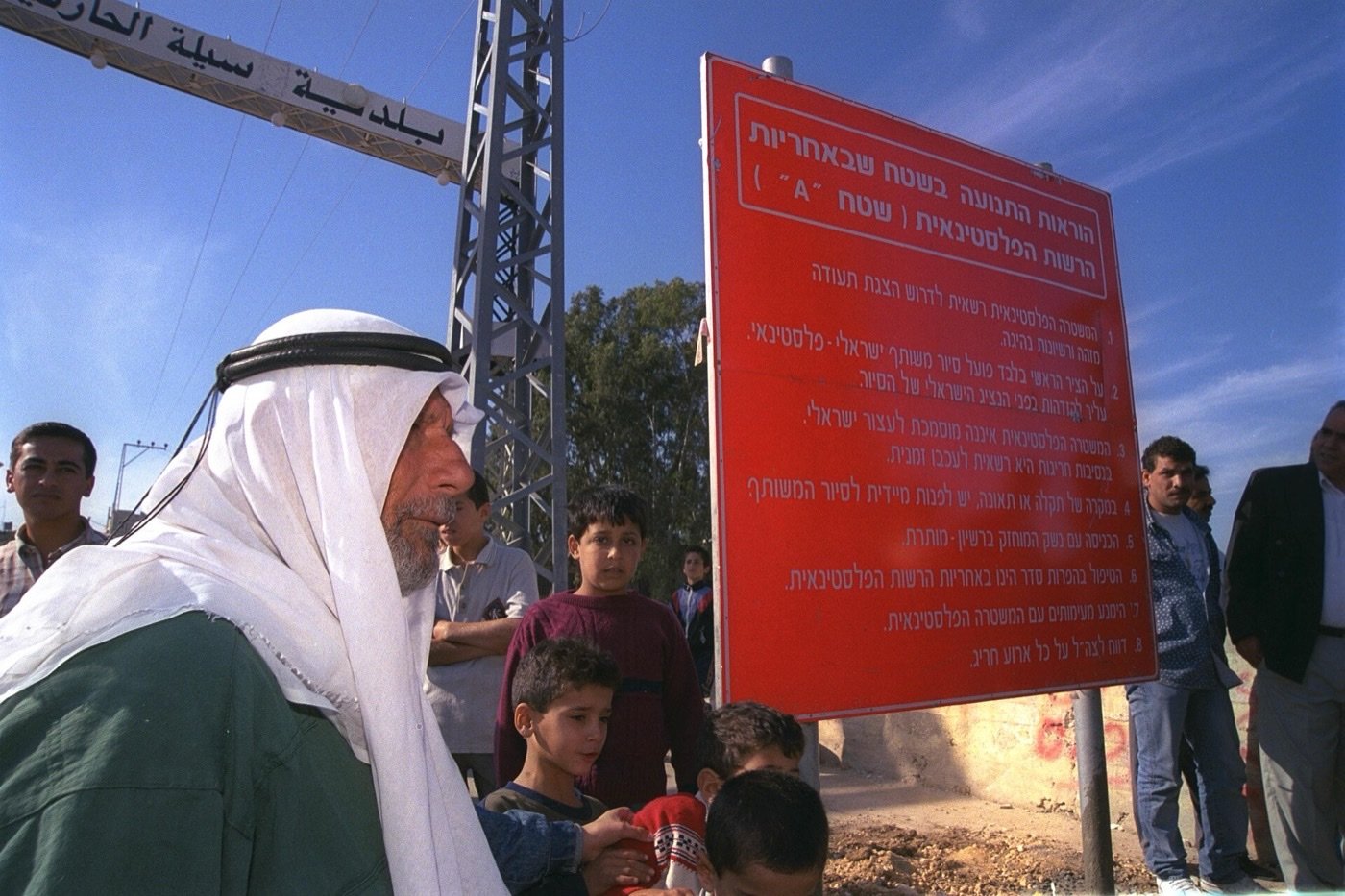
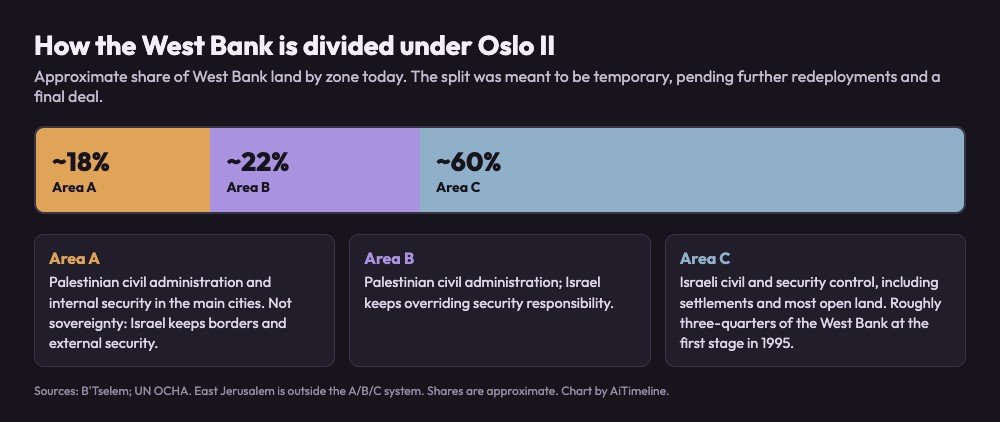
What it set up: The Interim Agreement on the West Bank and the Gaza Strip expanded Palestinian self-government, provided for elections and set out the three-zone system:
- Area A: Palestinian civil administration and internal security responsibility in the main cities.
- Area B: Palestinian civil administration; Israel kept overriding security responsibility.
- Area C: Israeli civil and security control, including settlements and most open land.
Responsibility, not sovereignty: Area A was never fully sovereign Palestinian territory. The agreement transferred defined civil and security responsibilities, and Israel kept control of borders, airspace and external security.
Temporary that stayed: Further redeployments were meant to shrink Area C. Only some happened. Today Area C covers about 60% of the West Bank.
Arafat, Rabin and Peres are named for the Nobel Peace Prize The deal, 1991-95
What happened: The Norwegian Nobel Committee awarded the 1994 Peace Prize jointly to Yasser Arafat, Yitzhak Rabin and Shimon Peres “for their efforts to create peace in the Middle East”.
Already difficult: By then the February 1994 Hebron mosque massacre, in which an Israeli settler killed 29 Palestinian worshippers, and the first Hamas suicide bombings inside Israel that April had shown how fragile the process was. One committee member resigned in protest at Arafat’s inclusion.
The Gaza-Jericho Agreement creates the Palestinian Authority The deal, 1991-95
What happened: Israel and the PLO signed the Cairo agreement on Israeli withdrawal from most of Gaza and the Jericho area and the transfer of defined powers to a new Palestinian Authority. It started the five-year interim clock.
Powers transferred: Education, health, social welfare, direct taxation, tourism and local policing. Israel kept external security, the settlements and overall control of borders. Arafat returned to Gaza on 1 July 1994.
The Paris Protocol: Signed on 29 April 1994 and folded into the agreement, it set up the customs union, the use of the shekel, and the system under which Israel collects taxes for the PA and transfers them, the clearance revenues that are being withheld in 2026.
The Declaration of Principles is signed at the White House The deal, 1991-95
Who signed: Israeli Foreign Minister Shimon Peres and PLO official Mahmoud Abbas signed the Declaration of Principles on Interim Self-Government Arrangements. Prime Minister Yitzhak Rabin and Chairman Yasser Arafat attended and shook hands, with President Bill Clinton between them. US Secretary of State Warren Christopher and Russian Foreign Minister Andrei Kozyrev signed as witnesses.
What it was: An interim framework, not a final peace treaty. It provided for Israeli withdrawal from Gaza and Jericho, an elected Palestinian council, and permanent-status talks to begin no later than the third year, covering Jerusalem, refugees, settlements, security, borders and relations with neighbours.
What it was not: It did not explicitly guarantee a Palestinian state. The outcome was left to later negotiations based on Security Council resolutions 242 and 338.
Israel and the PLO exchange letters of mutual recognition The deal, 1991-95
Arafat’s letter: Arafat recognised “the right of the State of Israel to exist in peace and security”, accepted resolutions 242 and 338, renounced terrorism and other acts of violence, and undertook to change the PLO Charter’s provisions denying Israel’s right to exist.
Rabin’s reply: Israel decided “to recognize the PLO as the representative of the Palestinian people” and to begin negotiations with it.
The asymmetry: The PLO recognised a state; Israel recognised an organisation as a representative. Israel did not recognise a Palestinian right to statehood.
Negotiators initial the draft Declaration of Principles in Oslo The deal, 1991-95
How it happened: After preliminary contacts in December 1992, Israeli academics and then officials met PLO representatives in secret near Oslo from January 1993, hosted by Norway. The Knesset had lifted the ban on contacts with the PLO on 19 January 1993.
The breakthrough: On 20 August 1993 the negotiators initialled the draft Declaration of Principles in Oslo, in the presence of Foreign Minister Shimon Peres and his Norwegian counterpart Johan Jørgen Holst.
The Madrid Peace Conference opens The deal, 1991-95
What happened: After the Gulf War, the United States and the Soviet Union convened Israel, Syria, Lebanon, Egypt and a joint Jordanian-Palestinian delegation in Madrid. The PLO was not formally present.
Why it matters: Madrid launched bilateral talks that continued in Washington. They stalled, and that stalemate led both sides to try the secret Oslo channel.
What Oslo Promised, and What Happened
The original commitments, scored against the record.
| Commitment | What was intended | What happened | Verdict |
|---|---|---|---|
| Mutual recognition | Israel and the PLO accept each other as negotiating partners | Letters exchanged 9-10 September 1993 | Met |
| Palestinian self-government | An elected Palestinian authority runs agreed areas | PA set up in 1994, elections in 1996 and 2006; powers stayed limited and rule split in 2007 | Partly met |
| Israeli redeployment | Gradual withdrawal from Palestinian population centres and further areas | Cities handed over 1994-97; later redeployments partial; Area C still about 60%; forces re-entered Area A in 2002 | Partly met |
| Security cooperation | Joint arrangements to prevent violence | Built in the 1990s; repeatedly broke down, especially after 2000; still exists in reduced form | Partly met |
| Economic framework | Customs union, shekel, tax transfers under the Paris Protocol | Still in force, but in 2026 the UN says it is being bypassed and about US$6 billion is withheld | Eroding |
| Permanent-status talks | Settle borders, Jerusalem, refugees, settlements, security | Opened 1996; Camp David 2000 failed; last sustained talks collapsed 2014 | Not met |
| Five-year transition | Permanent settlement by 4 May 1999 | Deadline passed; interim arrangements now in their 33rd year | Not met |
Areas A, B and C: How the West Bank Is Divided
Oslo II divided responsibilities, not sovereignty. The shares below are today’s approximate figures; at the first stage in 1995 Area C was roughly three-quarters of the West Bank, and it shrank as some redeployments were carried out under Wye and Sharm el-Sheikh before they stopped.
| Zone | Civil affairs | Security | Share of West Bank | Note |
|---|---|---|---|---|
| Area A | Palestinian Authority | Palestinian internal security; Israel keeps external security | About 18% | Main cities; not sovereign territory |
| Area B | Palestinian Authority | Israeli overriding security responsibility | About 22% | Towns and villages |
| Area C | Israel | Israel | About 60% | Settlements, most farmland, roads, reserves |
| H1 (Hebron) | Palestinian Authority | Palestinian | About 80% of Hebron | From the 1997 Hebron Protocol |
| H2 (Hebron) | PA for Palestinian residents | Israel | About 20% of Hebron | Old City and settler enclaves |
| East Jerusalem | Israel (annexed, not recognised internationally) | Israel | Outside the A/B/C system | Its status was left to final talks |
The Oslo Agreements, Document by Document
| Date | Document | Where | Signed by / for |
|---|---|---|---|
| 9-10 Sep 1993 | Letters of mutual recognition | Tunis and Jerusalem | Arafat; Rabin |
| 13 Sep 1993 | Declaration of Principles (Oslo I) | Washington | Peres and Abbas; witnessed by Christopher and Kozyrev |
| 29 Apr 1994 | Protocol on Economic Relations (Paris Protocol) | Paris | Israel and PLO finance teams |
| 4 May 1994 | Gaza-Jericho Agreement | Cairo | Rabin and Arafat |
| 28 Sep 1995 | Interim Agreement (Oslo II) | Washington (initialled at Taba) | Rabin and Arafat |
| 17 Jan 1997 | Hebron Protocol | Jerusalem | Negotiators Dan Shomron and Saeb Erekat |
| 23 Oct 1998 | Wye River Memorandum | Washington | Netanyahu and Arafat |
| 4 Sep 1999 | Sharm el-Sheikh Memorandum | Sharm el-Sheikh | Barak and Arafat |
Why Did the Oslo Accords Fail?
The collapse of the Oslo process cannot be pinned on one event or one side. Five problems reinforced each other.
1. The hardest questions were postponed
The 1993 agreement deliberately left borders, Jerusalem, settlements, refugees, security and the nature of the Palestinian entity for later. The bet was that interim cooperation would build enough trust to settle them. When the parties reached them at Camp David in 2000, the gaps were still too wide.
2. Settlement growth eroded confidence
Oslo did not freeze settlements. Palestinians saw continued expansion as eating into the land of a future state and contradicting the spirit of the process; Israeli governments cited legal, historical and security claims and differed over how much to concede. The UN Security Council later said in resolution 2334 that settlements have no legal validity. For the human side, see our timeline of settler violence in the West Bank.
3. Violence weakened support on both sides
The 1994 Hebron mosque massacre, Hamas and Islamic Jihad suicide bombings in 1994-96, Israeli closures and military operations, and then the Second Intifada each hardened public opinion. Many Israelis concluded that withdrawal brought attacks; many Palestinians concluded that negotiation brought more checkpoints and settlements.
4. Opponents on both sides worked against it
Rabin was killed by an Israeli opponent of the accords. Hamas and other Palestinian factions rejected recognising Israel and used violence to derail the process. Political leaders who campaigned against Oslo won power at key moments.
5. No mechanism forced a final deal
The agreements had timetables but no enforcement. When deadlines passed, nothing happened except new timetables. The UN’s September 2026 report makes the same point about today: the transitional instruments “were not designed to govern the relationship indefinitely and cannot do so.”
The Lasting Impact of the Oslo Accords
- The Palestinian Authority: created in 1994, still the main body of Palestinian self-government in parts of the West Bank, though it has not ruled Gaza since 2007.
- The A, B and C map: still decides where Palestinians can build, farm and travel, and where Israel controls planning.
- Mutual recognition: the 1993 letters remain the formal basis of relations between Israel and the PLO.
- The two-state framework: Oslo helped make it the default reference point of international diplomacy, from the Roadmap to resolution 2803, even though the accords never named it.
- The Paris Protocol economy: customs, the shekel and tax transfers still bind the two economies; the withheld revenues are at the centre of the PA’s 2026 crisis.
- A contested legacy: critics argue a temporary system meant to lead to independence became a permanent structure without sovereignty; supporters point to the institutions and channels it built while accepting that the final settlement never came.
For other parts of the picture, see our timelines of Israel-Gaza ceasefires, the Gaza plan and disarmament standoff, UN resolutions on Gaza and the Abraham Accords, which normalised Israel’s ties with Arab states without a Palestinian settlement.
The Terms Behind the Headlines
Interim, not final
Oslo set up a transition. The final deal was to come from permanent-status talks starting no later than the third year.
Calling Oslo a “peace treaty” is wrong; Israel’s treaties with Egypt (1979) and Jordan (1994) are.
Responsibility, not sovereignty
Area A gave the PA civil powers and internal security. It did not give control of borders, airspace or external security.
Israeli forces have operated in Area A since 2002.
Clearance revenues
Under the Paris Protocol, Israel collects customs and VAT on goods bound for Palestinian areas and transfers them to the PA.
Withholding them, as in 2026, cuts off the PA’s biggest income stream.
Eight things often told wrongly about Oslo
- “Rabin and Arafat signed the accord.” Peres and Abbas signed the 1993 Declaration of Principles. Rabin and Arafat attended and shook hands.
- “Oslo was a peace treaty.” It was an interim framework meant to lead to a permanent agreement.
- “Oslo promised a Palestinian state by 1999.” 1999 was the target for finishing negotiations; statehood was not guaranteed.
- “Area A is sovereign Palestinian land.” It is a zone of Palestinian civil and security responsibility, not sovereignty.
- “Sharon’s visit caused the Second Intifada.” It was the immediate trigger amid deeper political and social tensions.
- “Arafat alone wrecked Camp David.” Accounts of the failure are disputed; no single version is accepted by all participants.
- “The 2005 Gaza pullout implemented Oslo.” It was a unilateral Israeli decision, not a negotiated step or a peace deal.
- “The Hebron Protocol was signed on 15 January.” It was approved then and signed on 17 January 1997.
Explore More Timelines
People Also Ask
Oslo Accords: Frequently Asked Questions
Conclusion: An Interim Deal That Became a Lasting Reality
Oslo began with a real breakthrough. Israel and the PLO recognised each other, the Palestinian Authority was created, and a process existed for negotiating a permanent settlement. Its central weakness was also its design: the hardest questions were left to a final stage that never produced a deal.
The five-year transition became a three-decade arrangement. The West Bank is still divided into Areas A, B and C, Palestinian self-rule is still limited and split, and the disputes over borders, Jerusalem, refugees, settlements and security are unresolved. Oslo changed the diplomatic landscape without ending the conflict, which is why its legacy remains both significant and deeply contested.
Related AiTimeline Stories
⚠️ Editorial Note
Last updated 1 November 2026. This is a contested subject; we attribute disputed accounts rather than adopting one. Agreement texts and recognition letters come from the UN; current figures come from the UNSCO report of 24 September 2026 and the UN Secretary-General’s June 2026 report on resolution 2334. Casualty figures for Gaza are from Gaza’s Health Ministry; figures for Israel are from Israeli authorities. Area shares are approximate. Where sources disagree, as on the Hebron Protocol date, we say so.
Sources & further reading
Every dated entry above was checked against these references. Last reviewed 1 November 2026.
- United Nations Peacemaker: Declaration of Principles on Interim Self-Government Arrangements (1993)
- United Nations: Texts of the letters of mutual recognition, 9 September 1993
- UNSCO: Report to the Ad Hoc Liaison Committee, 24 September 2026
- UN Secretary-General: Implementation of Security Council resolution 2334, 24 June 2026
- US Department of State, Office of the Historian: The Oslo Accords and the Arab-Israeli Peace Process
- United Nations: Historical timeline of the Question of Palestine
- Congressional Research Service: Israeli-Palestinian Agreement, September 1993
- PBS Frontline: Shattered Dreams of Peace, timeline
- United Nations: Hebron Protocol text