Cash-for-Query Scandal: A Timeline of India’s Political Row (2005–2026)
Cash-for-query scandal timeline: the 2005 Operation Duryodhana sting that got 11 MPs expelled, to the Mahua Moitra case in the Supreme Court in 2026.
Latest Story
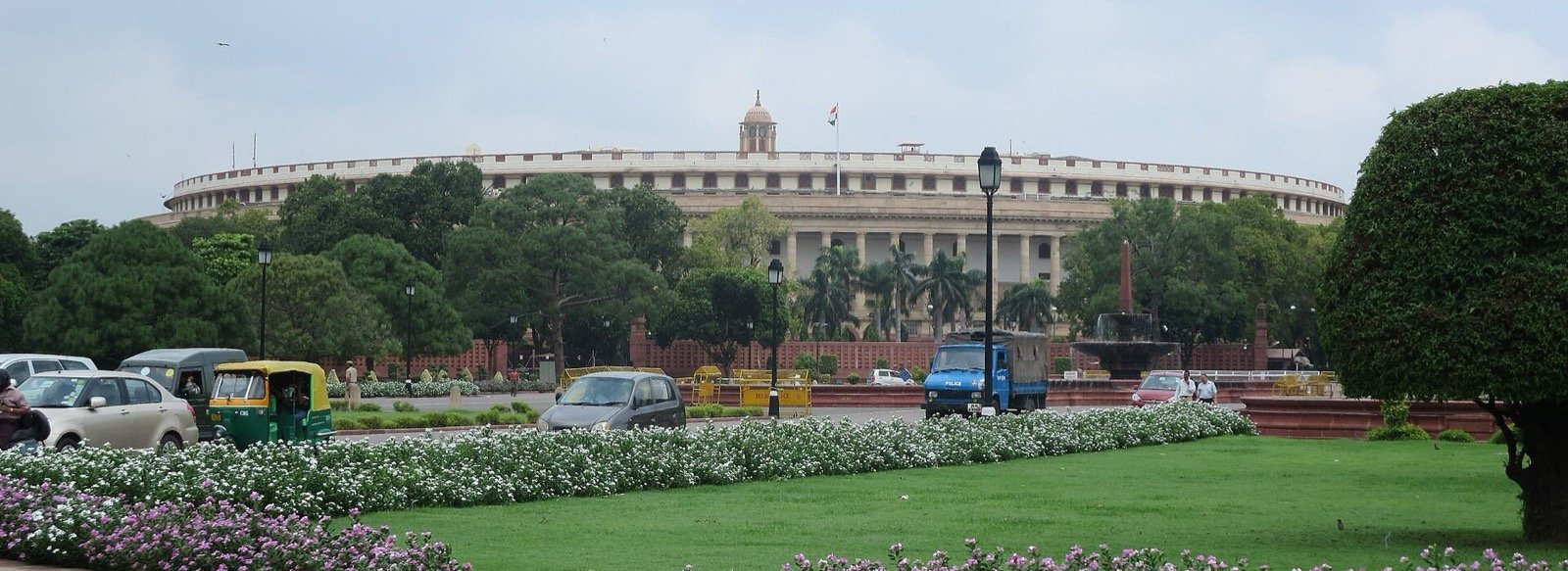
The cash-for-query scandal began on 12 December 2005, when a hidden-camera sting called Operation Duryodhana showed 11 Indian MPs allegedly accepting money to ask questions in Parliament. Eleven days later both Houses expelled all of them, and in 2007 the Supreme Court upheld Parliament’s power to do so. In 2023 a separate case against Trinamool Congress MP Mahua Moitra brought the term back, leading to her expulsion, a CBI investigation and a Lokpal dispute that is still before the Supreme Court in 2026.
💡 Short Answer
The cash-for-query scandal was a 2005 sting by Cobrapost, broadcast on Aaj Tak, in which 11 MPs from the BJP, BSP, RJD and Congress allegedly took money to table questions. Parliament expelled all 11 on 23 December 2005, and the Supreme Court upheld the expulsions in 2007. A court ordered their trial in 2017. The separate 2023 Mahua Moitra case led to her expulsion and a Lokpal sanction fight that is pending.
Cash-for-Query Scandal: Key Questions
The Cash-for-Query Cases in Nine Points
- The sting: Cobrapost’s Operation Duryodhana, broadcast on Aaj Tak on 12 December 2005.
- The accused: 11 MPs, six BJP, three BSP, one RJD and one Congress; 10 in the Lok Sabha, one in the Rajya Sabha.
- The speed: both Houses expelled all 11 on 23 December 2005, 11 days after the broadcast.
- The precedent: the Supreme Court upheld the expulsions 4-1 on 10 January 2007.
- The reporters: charged with abetment in 2009, cleared by the Delhi High Court in September 2010.
- The trial: charges ordered against the 11 former MPs on 10 August 2017, not a conviction.
- The second case: Mahua Moitra was expelled on 8 December 2023 over her login and gifts from Darshan Hiranandani.
- The law changed: in March 2024 the Supreme Court ruled that privilege never protects a legislator who takes a bribe.
- Still open: the Lokpal’s sanction to prosecute Moitra is before the Supreme Court; nothing has been proved in court.
Cash-for-Query Scandal: Complete Timeline, Latest First
From the Supreme Court in 2026 back to the 2005 sting. Each entry is colour-coded, so parliamentary action and the separate criminal process stay distinct: an expulsion is not a conviction.
Supreme Court adjourns the Lokpal’s appeals Courts & agencies
What happened: A bench of Chief Justice Surya Kant and Justices Joymalya Bagchi and V. Mohana adjourned the two appeals filed by the Lokpal after noting that the Union government was not represented. The court gave the Centre one more opportunity to file a counter affidavit, if it wished to.
Where it stands: As of 31 October 2026 we found no report of a further hearing or a judgment. The CBI has not filed a chargesheet against Mahua Moitra, and no court has ruled on whether the allegations against her are true.
Home Ministry made a party to the appeals Courts & agencies
What happened: The Supreme Court added the Ministry of Home Affairs as a party to the Lokpal’s appeals, so the Union government could put its view on how the Lokpal and Lokayuktas Act should be read.
Why it matters: The case has become a test of the Lokpal’s procedure in general, not only of the sanction in Moitra’s case.
Supreme Court issues notice on the Lokpal’s appeal Courts & agencies
What happened: Hearing the Lokpal’s appeal against the Delhi High Court judgment of December 2025, the Supreme Court issued notice to Mahua Moitra, the CBI and BJP MP Nishikant Dubey. The bench of Chief Justice Surya Kant and Justice Joymalya Bagchi agreed to examine whether the High Court had read the Lokpal’s powers correctly.
The interim order: The court stayed the High Court’s direction (paragraph 89 of its judgment) that the Lokpal reconsider sanction within one month, so that direction did not have to be complied with for the time being. In effect the next step against Moitra was put on hold while the court examines the law.
The legal issue: How Sections 20(7) and 20(8) of the Lokpal and Lokayuktas Act, 2013 work: whether the Lokpal may give separate sanction for the CBI to file a chargesheet, or must decide sanction for prosecution in a single composite order.
What it was not: This was an interim order. It is not a finding on whether Moitra did anything wrong.
Delhi High Court sets aside the Lokpal’s sanction Courts & agencies
What happened: A Division Bench of Justices Anil Kshetarpal and Harish Vaidyanathan Shankar set aside the Lokpal’s order of 12 November 2025. It held that the Act does not contemplate a separate sanction just for filing a chargesheet, and directed the Lokpal to decide the question of sanction afresh within one month, after considering Moitra’s submissions.
Moitra’s argument: She had argued that the Lokpal had not properly considered her written and oral response before granting sanction.
What it was not: The ruling concerned the legality of the sanction procedure. It did not decide the truth of the allegations.
Lokpal sanctions a CBI chargesheet against Moitra Courts & agencies
What happened: The Lokpal granted the CBI sanction to file a chargesheet against Mahua Moitra in the cash-for-query case, after considering the CBI’s investigation report and Moitra’s response to it.
Next step: Moitra challenged the order in the Delhi High Court within days. No chargesheet was filed while the challenge was pending.
CBI submits its investigation report to the Lokpal Courts & agencies
What happened: The CBI completed its investigation into Moitra and businessman Darshan Hiranandani and submitted its report to the Lokpal, which then had to decide whether to allow prosecution.
Why the Lokpal decides: Because the case started on a Lokpal reference, the Lokpal and Lokayuktas Act gives the ombudsman, not the government, the power to sanction the next step.
Moitra re-elected to the Lok Sabha Moitra in Parliament
What happened: Six months after her expulsion, Mahua Moitra won the Krishnanagar seat again as the Trinamool Congress candidate in the 2024 general election and returned to the 18th Lok Sabha.
Why it was possible: Expulsion ends membership of the current House only. It is not a disqualification from contesting, and Moitra had not been convicted of any offence.
Lokpal orders a CBI investigation; CBI registers an FIR Courts & agencies
What happened: On 19 March 2024 the Lokpal directed the CBI to investigate all aspects of the allegations and report within six months, saying a deeper probe was needed after the CBI’s preliminary inquiry. On 21 March the CBI registered an FIR against Moitra and Darshan Hiranandani under the Prevention of Corruption Act, and searched her premises in Kolkata and elsewhere two days later.
The preliminary inquiry: The CBI’s preliminary inquiry had begun in November 2023 on a Lokpal reference. Moitra said the action was politically motivated and denied taking any bribe.
Supreme Court ends legislators’ immunity for taking bribes Courts & agencies
What happened: A seven-judge Constitution Bench unanimously overruled the 1998 judgment in P.V. Narasimha Rao v. State, which had held that MPs who took bribes to vote in Parliament were protected by parliamentary privilege.
The rule now: Parliamentary privilege under Articles 105 and 194 does not protect a legislator who takes a bribe to vote or speak in a certain way. The offence is complete when the bribe is accepted, whether or not the vote or speech follows.
Why it matters here: It removed any argument that the speech-and-vote privilege shields a member accused of taking money to ask questions.
Supreme Court issues notice on Moitra’s petition against expulsion Courts & agencies
What happened: Moitra challenged her expulsion under Article 32. The Supreme Court sought a reply from the Lok Sabha Secretary General but refused her interim request to attend the House while the case was pending.
The government’s position: The Lok Sabha Secretariat argued that the petition was not maintainable because the court cannot interfere in the internal proceedings of Parliament, relying on the Raja Ram Pal line of cases.
Status: We found no final judgment on the petition. Her re-election in June 2024 restored her to the House by another route.
Lok Sabha expels Mahua Moitra Moitra in Parliament
What happened: The Ethics Committee’s report was tabled, and the same day the Lok Sabha adopted a motion moved by Parliamentary Affairs Minister Pralhad Joshi to expel Moitra for “unethical conduct”. The motion passed by voice vote after opposition members walked out.
The findings: The committee held that she had shared her Lok Sabha login credentials with Darshan Hiranandani, letting him post questions, and had accepted gifts and benefits from him. It recommended a time-bound legal investigation by the government.
Moitra’s response: She was not allowed to speak in the debate. She called the expulsion a punishment for something not covered by any rule, denied taking cash, and said the committee had no evidence of money changing hands.
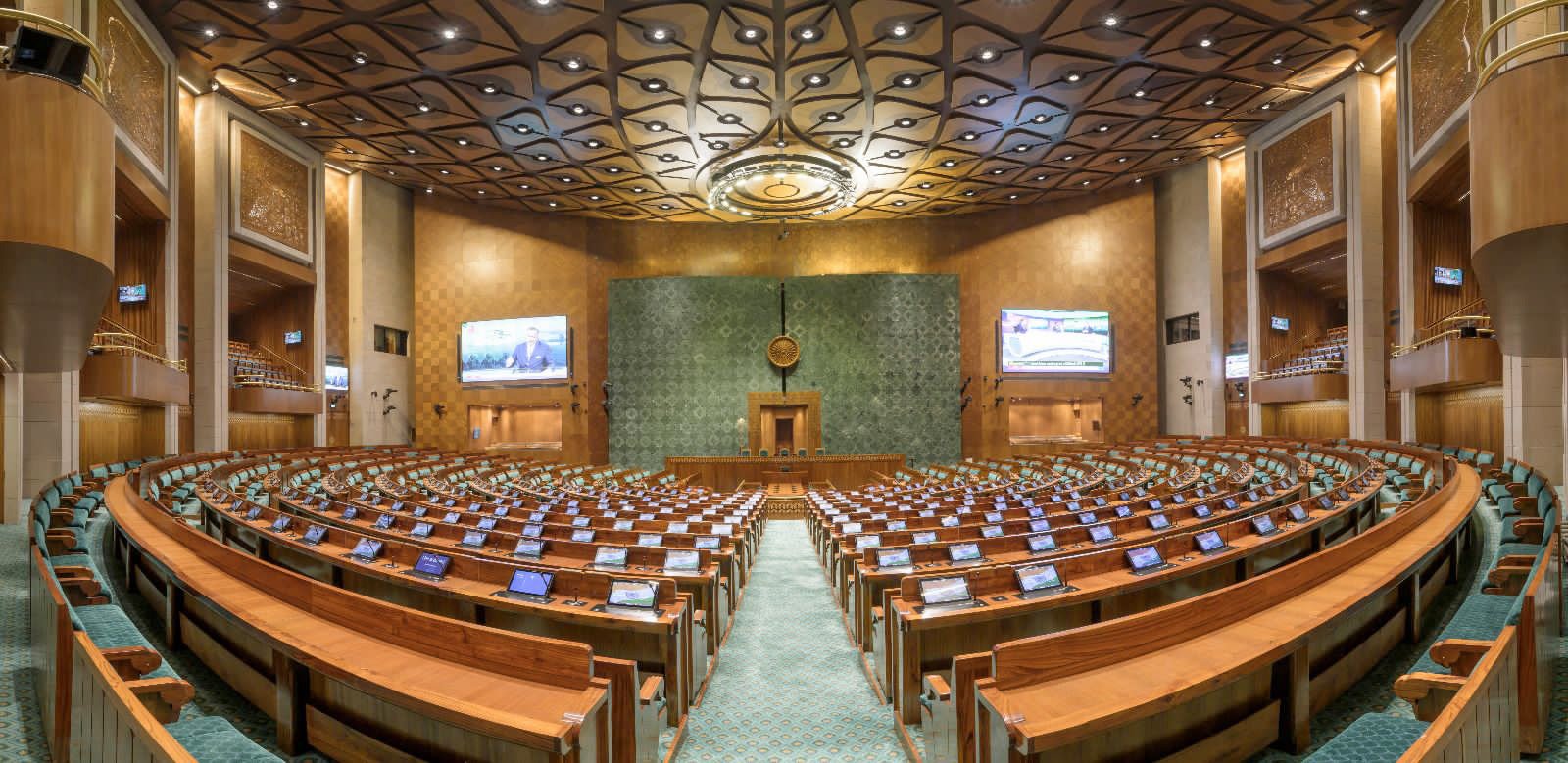
Ethics Committee adopts its report Moitra in Parliament
What happened: The committee, chaired by BJP MP Vinod Kumar Sonkar, adopted its report recommending Moitra’s expulsion. Opposition members filed dissent notes saying the inquiry was conducted with “unseemly haste” and without cross-examination of Hiranandani.
Moitra appears before the Ethics Committee and walks out Moitra in Parliament
What happened: Moitra appeared before the committee. She and opposition members on the panel walked out midway, saying the chairman’s questions about her personal life and travel were irrelevant and degrading. The chairman said she had refused to answer.
Her admission: Moitra had already said publicly that she shared her parliamentary login with Hiranandani so his office could type in her questions, and that the questions were her own. She said this was a common practice and that no rule forbade it.
Hiranandani’s affidavit surfaces Moitra in Parliament
What happened: An affidavit signed by Darshan Hiranandani, chief executive of the Hiranandani Group, was sent to the Ethics Committee. In it he said Moitra had given him her parliamentary login to post questions, many targeting the Adani Group, and that she had asked him for favours including luxury gifts and help with travel and a Delhi bungalow.
The dispute: Moitra questioned the affidavit’s credibility. She said it was on plain paper without a letterhead or notarisation and claimed it had been drafted under pressure from the Prime Minister’s Office. The committee did not call Hiranandani to be cross-examined, a point the opposition raised in its dissent.
Nishikant Dubey writes to the Speaker Moitra in Parliament
What happened: BJP MP Nishikant Dubey wrote to Lok Sabha Speaker Om Birla, citing evidence from Supreme Court advocate Jai Anant Dehadrai, a former associate of Moitra, alleging that she had taken cash and gifts from Hiranandani to ask questions. He said nearly 50 of her 61 questions served Hiranandani’s business interests, and sought her suspension.
Next steps: Dehadrai filed a complaint with the CBI, and Dubey also approached the Lokpal. The Speaker referred the complaint to the Lok Sabha Ethics Committee.
Moitra’s reply: She denied taking money, welcomed any inquiry and filed a defamation suit in the Delhi High Court against Dubey and Dehadrai.
Court orders charges against 11 former MPs Courts & agencies
What happened: A special court in Delhi ordered that charges of corruption under the Prevention of Corruption Act and criminal conspiracy under the Indian Penal Code be framed against the 11 former MPs. It also ordered charges against Ravinder Kumar, who had worked for one of the MPs. Proceedings against one accused who had died were dropped.
What it was: An order to put the accused on trial, nearly 12 years after the sting. It was not a conviction, and every accused was presumed innocent until a verdict.
Since then: We found no reported verdict in the trial as of October 2026.
High Court quashes the case against the sting journalists Courts & agencies
What happened: Justice S.N. Dhingra set aside the trial court’s order of 6 July 2009 that had summoned Cobrapost journalists Aniruddha Bahal and Suhasini Raj as accused. The police had charged them with abetting bribery because they had handed money to the MPs.
The reasoning: The court held that the journalists had no criminal intent: they offered money to expose corruption, not to obtain any favour. Prosecuting them would discourage others from exposing wrongdoing.
What continued: The case against the MPs went on separately.
Trial court takes cognisance of the police chargesheet Courts & agencies
What happened: A Delhi court took cognisance of the Delhi Police chargesheet in the cash-for-query case and summoned the accused, including the former MPs and the two journalists who carried out the sting.
The charge against the journalists: The police said that by offering money they had abetted the offence. The journalists argued that the sting was conducted to expose corruption, not to commit it, and challenged the summons in the High Court.
Supreme Court upholds the expulsions Courts & agencies
What happened: A five-judge Constitution Bench headed by Chief Justice Y.K. Sabharwal ruled 4-1 that each House of Parliament has the power to expel a member for conduct that lowers its dignity, as part of its privileges under Article 105(3). Justice R.V. Raveendran dissented.
Judicial review: The court did not put Parliament beyond review. It held that courts may examine privilege decisions for gross illegality, irrationality, violation of constitutional mandates or of fundamental rights, while respecting the House’s domain.
The petitioners: The case is named after Raja Ram Pal, one of the 10 expelled Lok Sabha members. The challenges by all 11 were heard together and dismissed.

Parliament expels all 11 MPs 2005 in Parliament
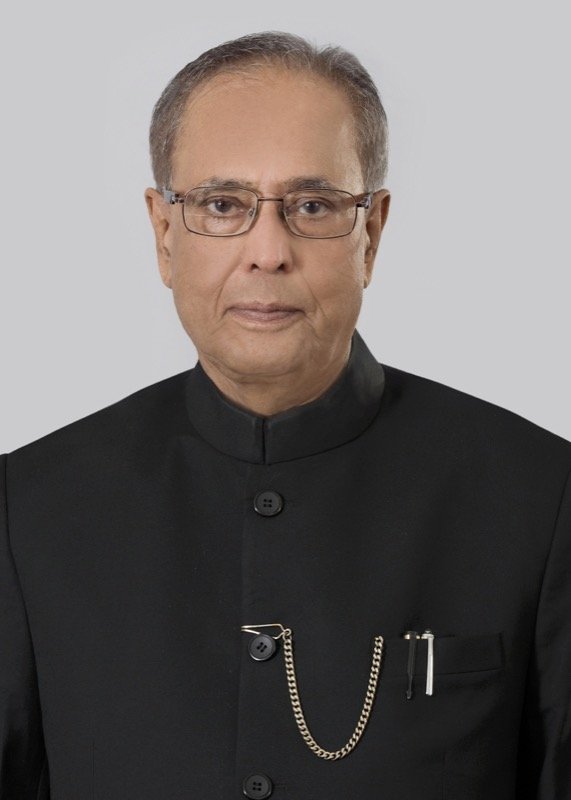
Lok Sabha: Leader of the House and Defence Minister Pranab Mukherjee moved the motion to expel the 10 Lok Sabha members named in the sting. It was adopted by voice vote. The BJP, which had six of the accused, walked out before the vote.
Rajya Sabha: On the same day the Rajya Sabha adopted its Ethics Committee’s report, chaired by Karan Singh, and expelled Chhatarpal Singh Lodha of the BJP. Sharad Joshi was the lone dissenter.
Scale: No Indian Parliament had expelled so many members at once. It came 11 days after the broadcast.
The Bansal committee report is tabled 2005 in Parliament
What happened: The five-member Lok Sabha committee chaired by Pawan Kumar Bansal tabled its report. It found the evidence against the 10 Lok Sabha members convincing and their conduct unbecoming of members, and recommended their expulsion.
The process: The committee had examined the unedited footage, heard the journalists and given the MPs a chance to respond. Several of the accused said the footage was doctored or that they had been entrapped.
A second sting: Operation Chakravyuh 2005 in Parliament
What happened: A week after Operation Duryodhana, Star News broadcast a separate sting, Operation Chakravyuh, which showed seven MPs, five from the Lok Sabha and two from the Rajya Sabha, allegedly agreeing to take a commission for sanctioning work under the MP Local Area Development Scheme (MPLADS).
Not the same case: This sting concerned development funds, not parliamentary questions. It was examined separately, and it is not part of the 11 expulsions.
Operation Duryodhana is broadcast 2005 in Parliament
What happened: Aaj Tak broadcast footage from a Cobrapost sting, Operation Duryodhana, that showed 11 MPs allegedly accepting cash to ask questions in Parliament. The amounts were small, reported at between Rs 15,000 and Rs 1.1 lakh per MP.
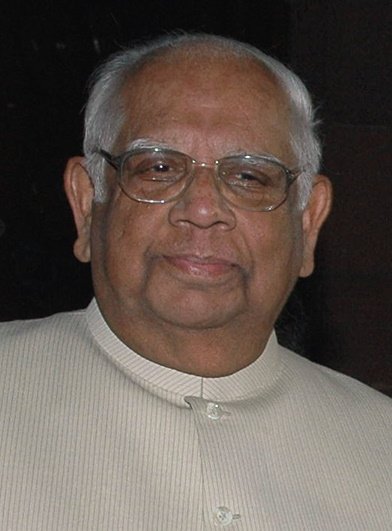
Parliament’s response the same day: Lok Sabha Speaker Somnath Chatterjee called the episode shameful, asked the 10 Lok Sabha members not to attend the House and set up an inquiry committee under Pawan Kumar Bansal. Rajya Sabha Chairman Bhairon Singh Shekhawat referred the case of Chhatarpal Singh Lodha to the House’s Ethics Committee.
The accused: Six were from the BJP, three from the BSP, one from the RJD and one from the Congress.
How the sting was set up 2005 in Parliament
What happened: Cobrapost journalists Aniruddha Bahal and Suhasini Raj posed as representatives of a fictitious lobby group, the North Indian Small Manufacturers Association (NISMA). Over several months they approached MPs directly and through middlemen, offering money for questions to be tabled in Parliament.
What was recorded: Hidden cameras captured conversations about payments and the questions to be asked. Several of the questions were in fact submitted to Parliament.
Who Were the 11 MPs Expelled in the 2005 Scandal?
Four parties, two Houses. The amounts are as widely reported from the footage; the parliamentary findings were not a criminal conviction.
| Party | MPs named in the 2005 sting | Number |
|---|---|---|
| BJP | Y. G. Mahajan, Chhatarpal Singh Lodha, Annasaheb M. K. Patil, Chandra Pratap Singh, Pradeep Gandhi, Suresh Chandel | 6 |
| BSP | Narendra Kumar Kushwaha, Lal Chandra Kol, Raja Ram Pal | 3 |
| RJD | Manoj Kumar | 1 |
| Congress | Ram Sewak Singh | 1 |
| Total | 10 Lok Sabha + 1 Rajya Sabha | 11 |
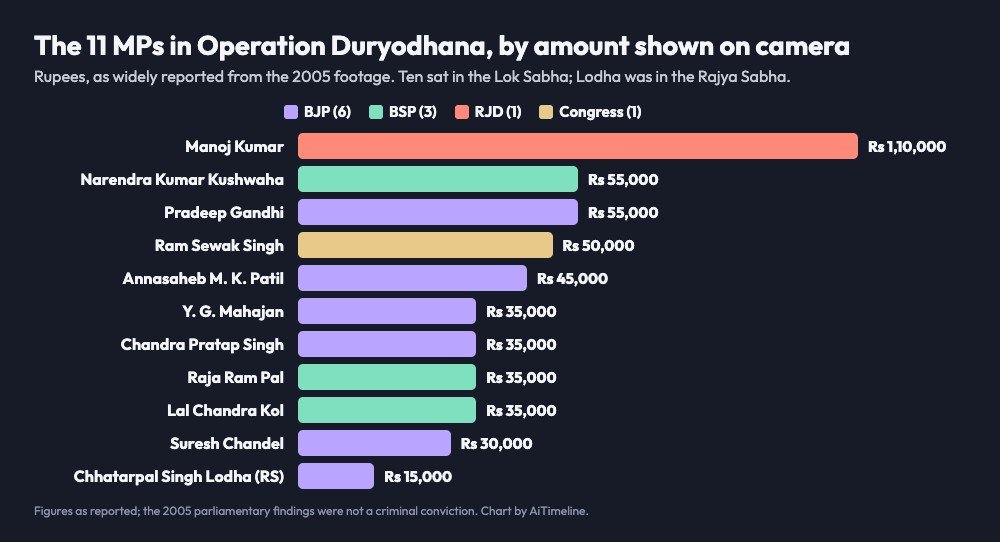
| MP | Party | Constituency / state | House | Amount reported (Rs) |
|---|---|---|---|---|
| Y. G. Mahajan | BJP | Jalgaon, Maharashtra | Lok Sabha | 35,000 |
| Annasaheb M. K. Patil | BJP | Erandol, Maharashtra | Lok Sabha | 45,000 |
| Chandra Pratap Singh | BJP | Sidhi, Madhya Pradesh | Lok Sabha | 35,000 |
| Pradeep Gandhi | BJP | Rajnandgaon, Chhattisgarh | Lok Sabha | 55,000 |
| Suresh Chandel | BJP | Hamirpur, Himachal Pradesh | Lok Sabha | 30,000 |
| Chhatarpal Singh Lodha | BJP | Odisha | Rajya Sabha | 15,000 |
| Narendra Kumar Kushwaha | BSP | Mirzapur, Uttar Pradesh | Lok Sabha | 55,000 |
| Raja Ram Pal | BSP | Bilhaur, Uttar Pradesh | Lok Sabha | 35,000 |
| Lal Chandra Kol | BSP | Robertsganj, Uttar Pradesh | Lok Sabha | 35,000 |
| Manoj Kumar | RJD | Palamau, Jharkhand | Lok Sabha | 1,10,000 |
| Ram Sewak Singh | Congress | Gwalior, Madhya Pradesh | Lok Sabha | 50,000 |
Why Was the Cash-for-Query Scandal So Significant?
1. Parliamentary questions are an accountability tool
Question Hour is how MPs extract information from ministers and put it on the public record. The 2005 sting suggested that this tool could be bought by anyone with a few thousand rupees, which is why the reaction was so sharp. The floor of the House has exposed wrongdoing before: the Mundhra scandal of 1957-58 was first raised there by Feroze Gandhi.
2. It crossed party lines
The 11 MPs came from the BJP, the BSP, the RJD and the Congress, so no party could treat the scandal as its opponents’ problem. That helped Parliament act quickly.
3. Parliament used its harshest power
Expelling 11 members at once was unprecedented. It raised hard questions: should a House act on video evidence without a criminal trial, and should the accused be heard in the House itself?
4. The Supreme Court defined Parliament’s authority
The Raja Ram Pal judgment of 2007 confirmed the power to expel, but held that privilege decisions are not entirely beyond judicial review. That balance was tested again when Moitra challenged her own expulsion.
5. It tested the law on sting journalism
The police charged the reporters as well as the MPs. The Delhi High Court’s 2010 ruling that they lacked criminal intent remains a reference point for undercover reporting, which grew in Indian television news in the 2000s, as the history of Aaj Tak shows.
6. The criminal process lags far behind
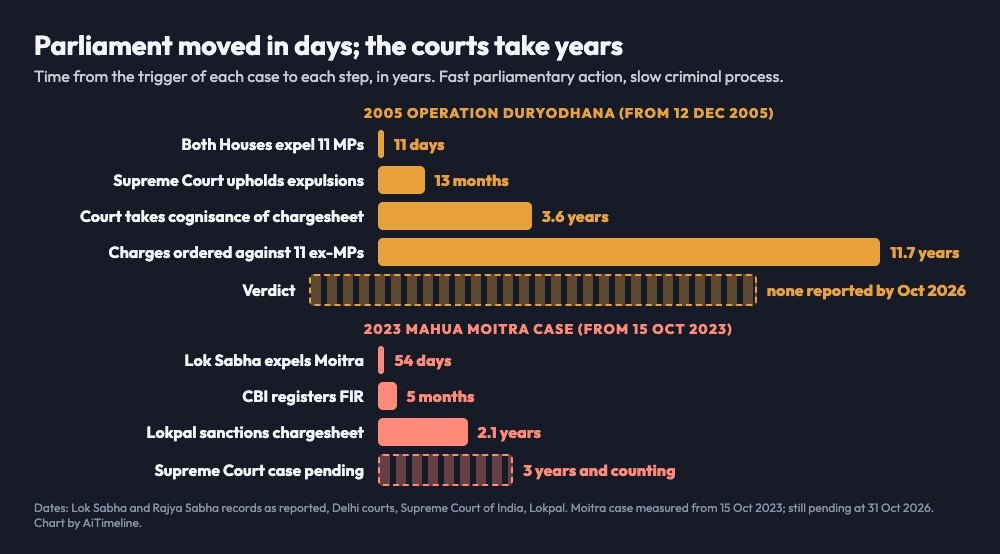
Parliament took 11 days to expel the 2005 MPs; the court took almost 12 years to order their trial. In the Moitra case the expulsion took 54 days, and the prosecution question is still unresolved three years later.
The Law Behind the Cases: Privileges, the Lokpal and the Corruption Act
Three pieces of law decide what Parliament and the courts can do with an MP accused of selling questions.
Parliamentary privileges
Article 105 of the Constitution gives MPs freedom of speech in Parliament and immunity for what they say or how they vote there. Article 105(3) says the other powers and privileges of each House are those it had when the Constitution began, a model borrowed from the British House of Commons, until Parliament defines them by law, which it has never done.
In 2007 the Supreme Court held that this includes the power to expel a member. In 2024 it held that privilege does not protect a member who takes a bribe.
The Lokpal
The anti-corruption ombudsman created by the Lokpal and Lokayuktas Act, 2013, after the 2011 anti-corruption movement. It can inquire into complaints against public servants, including MPs, and refer them to the CBI.
Under Section 20 the Lokpal also decides whether to sanction prosecution after an investigation. How that sanction must be given is exactly what the Supreme Court is now examining in the Moitra case.
The Prevention of Corruption Act
The Prevention of Corruption Act, 1988 makes it an offence for a public servant to accept an undue advantage. In 1998 the Supreme Court held that MPs are public servants under the Act.
The 2005 MPs were charged under this Act, together with criminal conspiracy, and the CBI registered its 2024 FIR against Moitra under it too.
The 2005 and 2023 Cash-for-Query Cases: What Is the Difference?
Often discussed together, the two cases involved different allegations, evidence and procedures.
| Issue | 2005 Operation Duryodhana | 2023 Mahua Moitra case |
|---|---|---|
| Who | 11 MPs from four parties | One MP, Mahua Moitra (Trinamool Congress) |
| Trigger | Television sting, broadcast 12 December 2005 | Complaint by MP Nishikant Dubey and advocate Jai Anant Dehadrai; Hiranandani affidavit |
| Allegation | Cash accepted on camera for tabling questions | Gifts and benefits for questions; sharing the parliamentary login |
| Accused’s response | Several said the footage was doctored or they were entrapped | Admitted sharing login; denied taking cash |
| Parliamentary inquiry | Special Lok Sabha committee (Bansal); Rajya Sabha Ethics Committee | Lok Sabha Ethics Committee (Sonkar) |
| Time to expulsion | 11 days | 54 days from Dubey’s letter |
| Parliamentary outcome | 11 MPs expelled on 23 December 2005 | Moitra expelled on 8 December 2023; re-elected June 2024 |
| Supreme Court question | Can a House expel a member? Yes (Raja Ram Pal, 2007) | Expulsion petition pending; separate Lokpal sanction appeal pending |
| Criminal process | Police chargesheet; charges ordered against 11 ex-MPs in 2017; no verdict reported | Lokpal reference, CBI FIR 2024; sanction set aside 2025; Supreme Court appeal pending |
| Legal status today | Parliamentary findings are not a conviction | No chargesheet filed; no court has ruled on the allegations |
Both cases began with an outside actor, journalists in 2005 and a fellow MP’s complaint in 2023, and both ended in expulsion within weeks. The difference lies in the evidence: in 2005 cash was filmed changing hands, while in 2023 the case rested on an affidavit and on Moitra’s own admission about her login. The Moitra case also unfolded in a political setting shaped by her questions about the Adani Group, a subject that drew national attention after the Hindenburg report of January 2023.
Six things often told wrongly about the cash-for-query cases
- “Parliament expelled the MPs on 24 December 2005.” Both Houses voted on 23 December 2005. The Lok Sabha expelled 10 members and the Rajya Sabha one, the same evening.
- “The 19 December sting involved one Rajya Sabha MP.” Operation Chakravyuh, on Star News, named seven MPs, five from the Lok Sabha and two from the Rajya Sabha, over MPLADS commissions. Chhatarpal Singh Lodha was a Duryodhana case, not a Chakravyuh one.
- “The 2005 MPs were convicted.” No. They were expelled by Parliament; a court ordered in 2017 that they stand trial. We found no reported verdict.
- “Moitra was charged in 2023.” The CBI registered an FIR in March 2024. No chargesheet has been filed: the Lokpal’s sanction was set aside in December 2025, and that ruling is under appeal.
- “The Supreme Court ruled against Moitra in 2026.” It issued notice and an interim stay on 13 March 2026. It has not decided the allegations.
- “Expelled MPs cannot stand again.” Expulsion is not disqualification. Moitra was re-elected in June 2024.
Explore More Timelines
People Also Ask
Cash-for-Query Scandal: Frequently Asked Questions
Conclusion: A Scandal That Changed the Debate on Parliamentary Accountability
The 2005 cash-for-query scandal showed that a basic tool of parliamentary accountability could be bought cheaply. Parliament responded with the largest expulsion in its history, and the Supreme Court confirmed that it had the power to do so, while keeping a door open for judicial review. The criminal case moved far more slowly, and the journalists who exposed the MPs had to fight their own prosecution first.
Nearly two decades later, the Mahua Moitra case raised a new version of the question: who controls access to an MP’s questions in the age of online portals? It has run through the Ethics Committee, an election, the CBI and the Lokpal, and is now before the Supreme Court. The two cases followed different routes, but both ask how Parliament can protect the independence and credibility of the questions it puts to the government. For other cases where power and accountability collided, see the Radia tapes controversy, the AgustaWestland case and our tracker of India’s major political and court cases.
Related AiTimeline Stories
⚠️ Editorial Note
Last updated 31 October 2026. Allegations are described as allegations. A parliamentary expulsion is a disciplinary decision of the House, not a criminal conviction; the 2005 accused have been ordered to stand trial but we found no reported verdict, and no court has ruled on the allegations against Mahua Moitra, who denies taking money. Dates follow court orders and contemporaneous reporting (The Tribune, PTI, The Indian Express, Deccan Herald, Scroll). Amounts paid in 2005 are as reported from the footage. Where our brief or popular accounts differed from the record, we followed the record; see “Common mix-ups”.
Sources & further reading
Every dated entry above was checked against these references. Last reviewed 31 October 2026.
- Supreme Court of India: Raja Ram Pal v. Hon'ble Speaker, Lok Sabha (10 January 2007)
- The Tribune: Parliament expels 11 MPs (24 December 2005)
- The Tribune: Speaker asks exposed MPs to stay away (13 December 2005)
- Outlook: One More Sting, Operation Chakravyuh
- Governance Now: Cash-for-query scam, HC quashes charges against journalists (2010)
- The Indian Express: 2005 cash-for-question scam, 11 former MPs to be put on trial (2017)
- The Indian Express: Lok Sabha expels Mahua Moitra (8 December 2023)
- Scroll: Lokpal orders CBI investigation against Mahua Moitra (March 2024)
- The Indian Express: Supreme Court overturns 1998 legislators' immunity ruling (March 2024)
- Verdictum: Delhi High Court sets aside Lokpal order against Mahua Moitra (December 2025)
- The Indian Express: Supreme Court notice on Lokpal appeal in Mahua Moitra case (March 2026)
- Deccan Herald: SC defers hearing on Lokpal's plea against Mahua Moitra (September 2026)