Libya After Gaddafi: Decisions That Split the Nation, 2011–2026
Libya after Gaddafi, 2011-2026: civil war, rival governments and failed elections, and the Aug 2026 UN-backed election agreement, with sources.
Latest Story
When Muammar Gaddafi’s government fell in 2011, hopes rose for a democratic Libya after Gaddafi. Fifteen years later the country still has two rival governments, no national election since 2014, and an army that is not one army. On 30 August 2026 four camps signed a UN-facilitated agreement to prepare elections within 24 months. It is a step, not a settlement, and as of 2 November 2026 one of Libya’s two chambers has objected.
💡 Short Answer
Libya split because the 2011 revolution left armed groups, oil wealth and the constitution unresolved. A disputed 2014 election produced rival parliaments in Tripoli and the east; the 2015 UN deal, Haftar’s 2019 offensive, the 2020 ceasefire and the failed December 2021 election did not unite them. A UN-facilitated agreement signed on 30 August 2026 targets elections within 24 months, but there is still no unified government.
Libya After Gaddafi: Key Questions
Libya After Gaddafi in Nine Points
- 2011: the old state was dismantled without a unified security structure to replace it.
- 2012: a genuine election was held, but armed groups kept influence outside the state.
- 2014: a disputed transition created rival parliaments and governments.
- 2015–16: a UN-backed government arrived in Tripoli without the eastern parliament’s full endorsement.
- 2019–20: Haftar’s offensive on Tripoli, with outside backers on both sides, ended in a ceasefire.
- 2021: a unity government was formed, but the December elections were not held.
- 2022 onward: two cabinets again; the 2023 Derna floods and 2024 Central Bank dispute showed the costs.
- 2026: a UN-facilitated agreement on the elections commission and legal framework, signed by four camps.
- Now: the agreement is a step, not an election; the High Council of State objects.
Where Libya stands
- Governments: two rival administrations. The Government of National Unity (GNU) under Abdul Hamid Dbeibah in Tripoli, and the Government of National Stability (GNS) under Osama Hamad, backed by the House of Representatives and Khalifa Haftar’s Libyan National Army (LNA).
- Latest deal: on 30 August 2026 four camps signed an agreement on the elections commission and the legal framework, with a target of elections within 24 months under one executive authority.
- Endorsement: the House of Representatives endorsed it on 14 September. The High Council of State has objected.
- UN mission: renewed for 12 months on 30 October, according to a UK statement.
- Not yet achieved: a seated elections commission board (not confirmed), one government, one army, or an election date.
The story in six pictures
Background: A Revolution Without a Settled System
What the state inherited in 2011.
A revolution without a settled system
For more than four decades Muammar Gaddafi ruled Libya through a highly centralised system. When his government fell in 2011, the country had to build institutions able to govern a state with powerful regional interests, competing armed groups and large oil wealth. The National Transitional Council (NTC) became the interim authority, but it inherited weak institutions and a fragmented security system.
The questions that were never settled
The central problem was not simply choosing a leader. Libya needed agreement on who would control the military, how oil revenue would be shared, who would write the constitution and what powers a future government would hold. Those questions stayed open, and they shaped every conflict that followed.
How to read this record
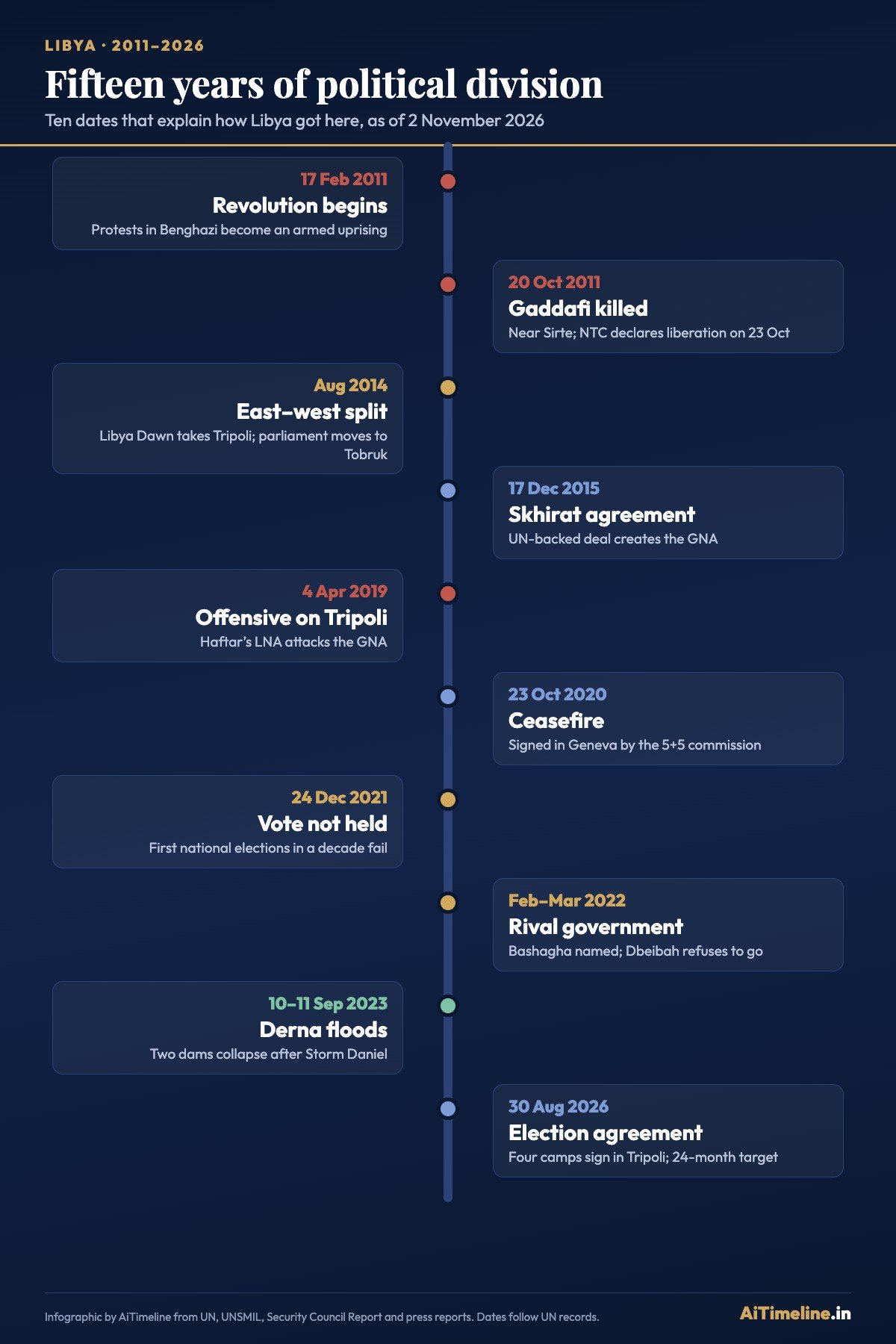
Entries are colour-coded into four tracks: fighting and armed groups, governments and elections, the UN and diplomacy, and oil, money and disasters. Where sources disagree, we say so. Casualty figures and the role of foreign states are reported as press and UN accounts, not as findings of any court. For another case of a divided diplomatic landscape, see our Qatar blockade timeline.
Libya After Gaddafi Timeline, 2011 to 2026, Latest First
Entries are colour-coded by track. Dates follow UN records and press reports, and we say where they differ.
Security Council renews the UN mission in Libya for 12 months UN and diplomacy
What happened: The UK’s statement to the Council on 30 October says the Council adopted Resolution 2835, renewing the mandate of the UN Support Mission in Libya (UNSMIL) for twelve months. The previous mandate, Resolution 2796, expired on 31 October 2026.
What it says: According to the UK statement, the text urges the parties to meet their Smaller Convening commitments, which could bring elections within 24 months, backs unifying judicial, military and security institutions, and gives UNSMIL a basis to help establish a single executive authority.
Caveat: We relied on the UK government’s account. We did not read the resolution text or confirm the vote.
High Council of State rejects the envoy’s description of its position Governments and elections
What happened: The Tripoli-based High Council of State (HCS) said it rejected UN envoy Hanna Tetteh’s suggestion that its stance on the ‘4+4’ meeting showed some members were unwilling to take part in the political process. It said her description ‘trivializes an institutional position’, and asked her to correct it.
Its argument: The Council said its objection concerns the legitimacy of the process and its results, not dialogue itself. It pointed to its role in the earlier ‘6+6’ committee, set up under the thirteenth constitutional amendment, and urged the Security Council to back a process that respects national ownership and constitutional frameworks.
Context: Security Council Report says the HCS reportedly rejected the outcomes of the 30 August agreement and argues they bypass earlier House–Council understandings, including those of the 6+6 committee.
Armed groups squeeze the oil system again Oil, money and disasters
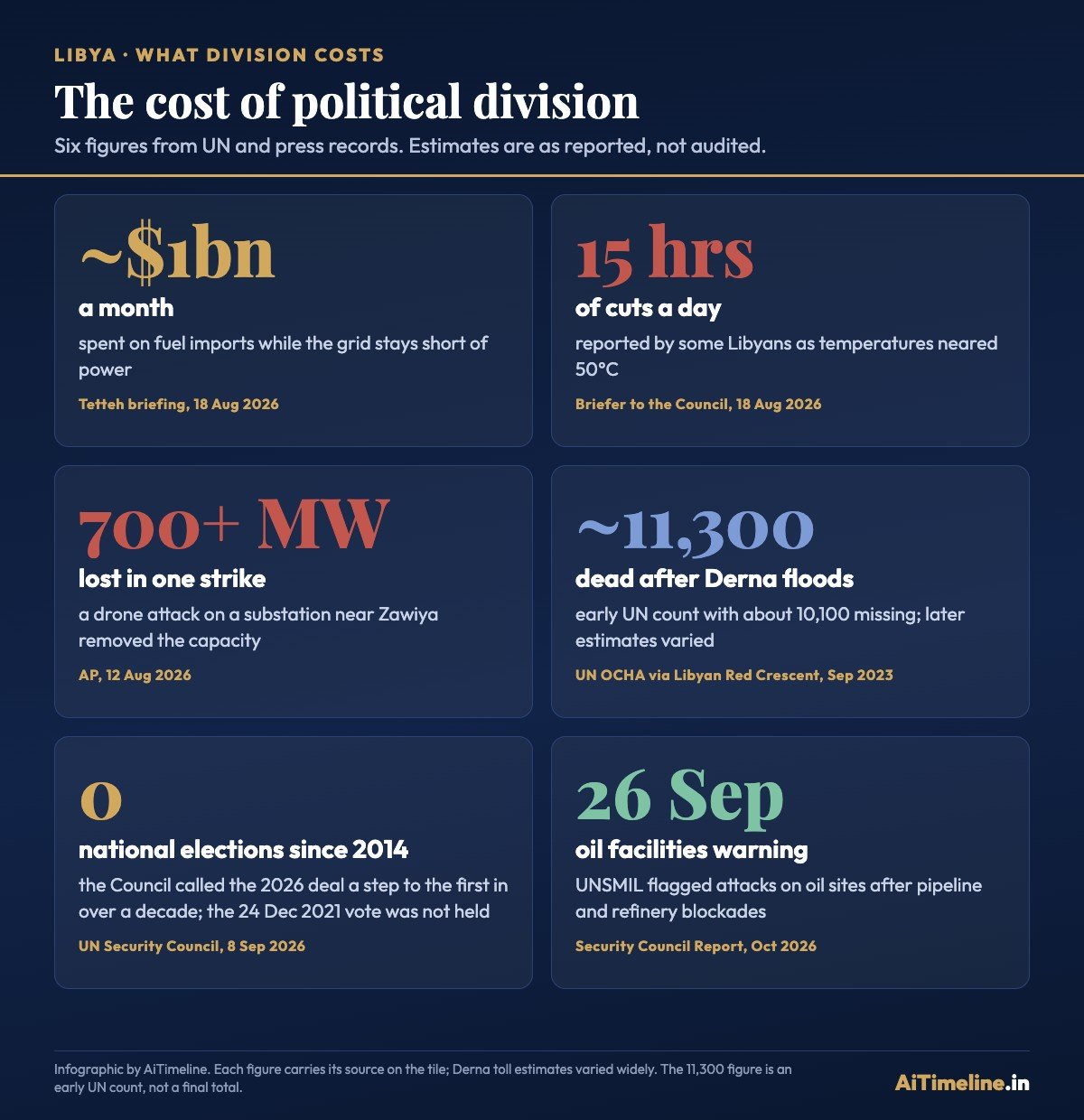
What happened: On 21 September an armed group closed a valve on the Sharara–Zawiya crude pipeline, sharply cutting output at the Sharara field. On 22 September Petroleum Facilities Guard personnel blocked the gates of the Zawiya refinery and other oil facilities. On 26 September UNSMIL voiced concern and called for oil facilities to be protected.
The warning: UNSMIL noted that attacks or actions undermining oil facilities could justify punitive measures under Security Council Resolution 2213 (2015), according to Security Council Report.
House of Representatives endorses the deal; Smaller Convening meets again Governments and elections
What happened: The House of Representatives endorsed the 30 August agreement on 14 September in a session in Benghazi chaired by Speaker Aguila Saleh. On 20 September the Smaller Convening held its ninth meeting in Tunis, chaired by Tetteh, to follow up on implementation.
What is missing: The agreement called for both the House and the High Council of State to endorse it within a month. We found no report that the HCS has done so; it has objected instead.
Security Council welcomes the agreement UN and diplomacy
What happened: The Council called the agreement ‘an important step’ towards the first national elections in more than a decade, urged the parties to move quickly to implementation, and reaffirmed full support for UNSMIL and Hanna Tetteh.
What Tetteh said: She told the Council the deal had helped overcome issues that had stood in the way for many years, that trust remained fragile among both political actors and ordinary Libyans, and that public buy-in and unifying the military, security and economic institutions were the main challenges ahead.
Rival delegations sign an election agreement in Tripoli UN and diplomacy
What was agreed: The deal covers the first two milestones of UNSMIL’s roadmap: reconstituting the board of the High National Elections Commission (HNEC), and resolving outstanding constitutional and legal questions for presidential and parliamentary elections. It provides for those elections under a single executive authority and commits the parties to work towards them within a period not exceeding 24 months.
Who signed: The Smaller Convening has two representatives each from the Government of National Unity (GNU), the High Council of State, the House of Representatives and the Libyan National Army (LNA), the force led by Khalifa Haftar. It followed talks in Rome and Tunis.
What else was reported: Reports say the deal was meant to be endorsed by the House and the HCS within a month, with a follow-up mechanism. Media reports name Dhaou Ibrahim Attia as chair-designate of the HNEC board with Sana al-Lishani as deputy; we found that in a single report and could not confirm it from UN sources.
What it is not: An agreement on preparations is not an election, a unified government or a merged army. Tetteh herself said it must be turned into ‘tangible actions’. It is also separate from a US initiative led by Massad Boulos.
Envoy briefs the Council on an impasse and a power crisis UN and diplomacy
What was said: Tetteh said the political roadmap had advanced but that widespread outages and water disruption showed the cost of diverted public resources and poor coordination. She described drone attacks on vital infrastructure as worrying and said a senior LNA intelligence official had been killed by a car bomb in Benghazi on 10 August.
Numbers given: Libya spends roughly $1 billion a month on fuel imports while its grid stays short of power, and a briefer told the Council that temperatures approached 50°C with some Libyans facing up to 15 hours of power cuts a day.
Clashes in Zawiya, then drone strikes on a refinery and a power station Oil, money and disasters
What happened: On 3 August armed groups involved in trafficking and fuel smuggling fought with heavy weapons in Zawiya and Sorman, with civilian deaths. A drone strike on 4 August killed at least five fighters of the 103rd. On 11 August a drone attack set the Zawiya refinery on fire (Al Jazeera). On 12 August another strike on a nearby substation removed more than 700 megawatts of capacity and caused outages.
Why it matters: The state oil company warned it might declare force majeure and halt the refinery if attacks continued. Zawiya is a key point on the western coastal corridor.
UN envoy presents a three-pillar roadmap UN and diplomacy
What happened: Tetteh proposed (1) a viable legal and electoral framework for presidential and parliamentary elections, (2) unifying state institutions under a new government, and (3) a structured dialogue on governance, security, the economy and reconciliation.
Why it mattered later: The 30 August 2026 agreement addresses the first two of the roadmap’s milestones (the elections commission and the legal framework). It does not complete them.
Central Bank leadership dispute and an oil shutdown Oil, money and disasters
What happened: A fight over who runs the Central Bank intensified in August 2024. Eastern forces backed an oil shutdown during the confrontation, interrupting the country’s main source of revenue.
Why it matters: Control of the bank, which pays salaries across both halves of the country, and of oil income has been central to the rivalry. We did not verify the settlement terms in this record.
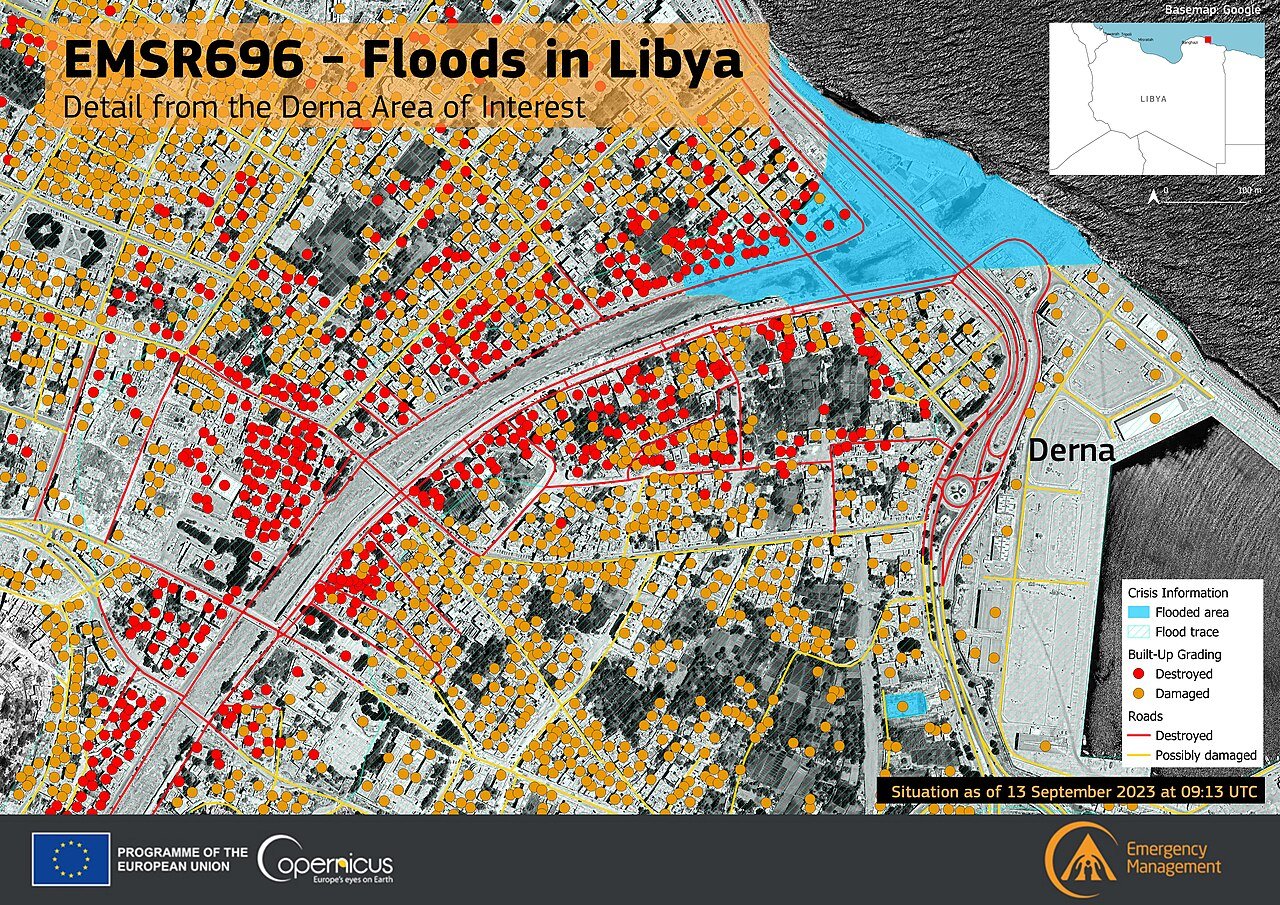
Storm Daniel and the Derna dam collapse Oil, money and disasters
What happened: Storm Daniel brought catastrophic flooding to eastern Libya. Two dams above the coastal city of Derna collapsed and floodwaters swept through populated areas.
The toll: Early UN figures, relaying Libyan Red Crescent counts, reported about 11,300 dead and about 10,100 missing in Derna a week after the storm. Estimates varied widely over time, and we did not find a single agreed final figure.
Why it is in this record: The disaster raised questions about maintenance, warnings and accountability. Many analysts linked the neglect to years of divided and weak public administration; that is a judgement, not a court finding.
Eastern parliament names a rival prime minister Governments and elections
What happened: The House of Representatives designated Fathi Bashagha as prime minister on 10 February 2022 and he was sworn in on 1 March. Dbeibah refused to hand over, saying his government would give way only to an elected one.
What followed: Libya had two governments again. In 2023 the House replaced Bashagha with Osama Hamad, who now heads the eastern-based Government of National Stability (GNS).
The first national elections in a decade do not happen Governments and elections
What happened: Presidential and parliamentary elections set for 24 December 2021 were not held. The date passed without a vote, after disputes over electoral laws, who could stand for president, the powers of the presidency and the constitutional basis for the vote.
The fallout: The postponement left the interim government without an elected mandate and removed the timetable the 2020 roadmap had set.
Dialogue forum picks a unity government Governments and elections
What happened: The UN-facilitated forum chose Abdul Hamid Dbeibah as interim prime minister and Mohamed al-Menfi as head of the Presidential Council in February 2021. In March the House of Representatives approved the Government of National Unity (GNU), replacing the GNA and the eastern interim executive.
Its task: To unify institutions and lead the country to elections on 24 December 2021.
Ceasefire signed in Geneva UN and diplomacy
What happened: Military delegates from the GNA and Haftar’s forces signed a nationwide ceasefire. It called for foreign fighters and mercenaries to leave the country.
Status: The ceasefire has largely held in the sense that the 2019–20 war did not resume as a national conflict. Foreign forces, however, have not all left; we did not verify current numbers.
Berlin Conference on Libya UN and diplomacy
What happened: Participating states backed a political settlement, an arms embargo and an end to foreign interference.
The gap: Commitments did not immediately stop the fighting. Turkish backing for the Tripoli government grew during 2020.
Haftar launches an offensive on Tripoli Fighting and armed groups
What happened: Khalifa Haftar’s LNA began an offensive to take Tripoli from the internationally recognised GNA. It began just before a UN-sponsored national conference planned for mid-April.
Outside involvement: Reports describe Egypt, the UAE and Russia as supporting Haftar’s forces in different ways, and Turkey as providing military support to the Tripoli government.
Islamic State is driven out of Sirte Fighting and armed groups
What happened: Forces aligned with the GNA, backed by US air power, defeated the Islamic State group in Sirte after months of fighting.
Limit: The group lost its main territorial base in Libya, but militant networks and security problems remained.
The UN-backed government arrives in Tripoli Governments and elections
What happened: The GNA, led by Fayez al-Sarraj, began operating from Tripoli. The eastern-based House of Representatives did not fully endorse it.
Effect: The attempt to establish one executive stayed incomplete.
Libyan Political Agreement signed in Skhirat UN and diplomacy
What happened: Libyan representatives signed a framework to create a Government of National Accord and reunify political institutions.
Limit: Disagreement over the agreement and the proposed government’s authority prevented full national acceptance.
Disputed election and a split between east and west Governments and elections
What happened: Libya elected a House of Representatives in June 2014. In July heavy fighting broke out around Tripoli International Airport. In August the Libya Dawn coalition took control of the airport and Tripoli, and the House relocated to Tobruk in the east. Rival bodies then claimed to be the legitimate authority in each half of the country.
Why it matters: From here the country had two parliaments, two governments and, later, two rival military structures.
Mandate dispute and Operation Dignity Fighting and armed groups
What happened: Disagreement over the Congress’s mandate and the direction of the transition deepened in early 2014. In May, former general Khalifa Haftar launched Operation Dignity against Islamist armed groups in eastern Libya, particularly around Benghazi.
Effect: It created a powerful rival centre of authority and reshaped the security landscape.
Militias pressure the government; oil is blockaded Fighting and armed groups
What happened: Armed groups surrounded government buildings and disrupted state operations. Oil production and exports were affected by blockades organised by armed groups and protesters.
Why it matters: The state was unable to control either military formations or oil infrastructure.
Attack on the US consulate in Benghazi Fighting and armed groups
What happened: Militants attacked the US diplomatic compound in Benghazi. Ambassador Christopher Stevens and three other Americans were killed.
Why it matters here: The attack highlighted how weak Libya’s security institutions were after the revolution.
First national election; power passes to the General National Congress Governments and elections
What happened: Libya voted for the General National Congress on 7 July 2012. The transitional council transferred authority to the new assembly on 8 August.
Effect: The vote raised hopes for constitutional reform and representative government, but armed groups kept considerable influence outside the state.
Gaddafi’s regime collapses Fighting and armed groups
What happened: Rebel forces captured Tripoli in August. Muammar Gaddafi was captured and killed near Sirte on 20 October. Three days later the NTC declared Libya liberated.
What was missing: No unified national security structure replaced the old system.
Uprising, UN Resolution 1973 and the NATO campaign UN and diplomacy
What happened: Protests began in Benghazi and other cities on 17 February 2011 and grew into an armed uprising. On 17 March the Security Council adopted Resolution 1973 authorising measures to protect civilians, including a no-fly zone. NATO then conducted air operations against Gaddafi’s forces.
Interpretation: Whether the mandate was stretched to bring about regime change remains debated; we do not settle that here.
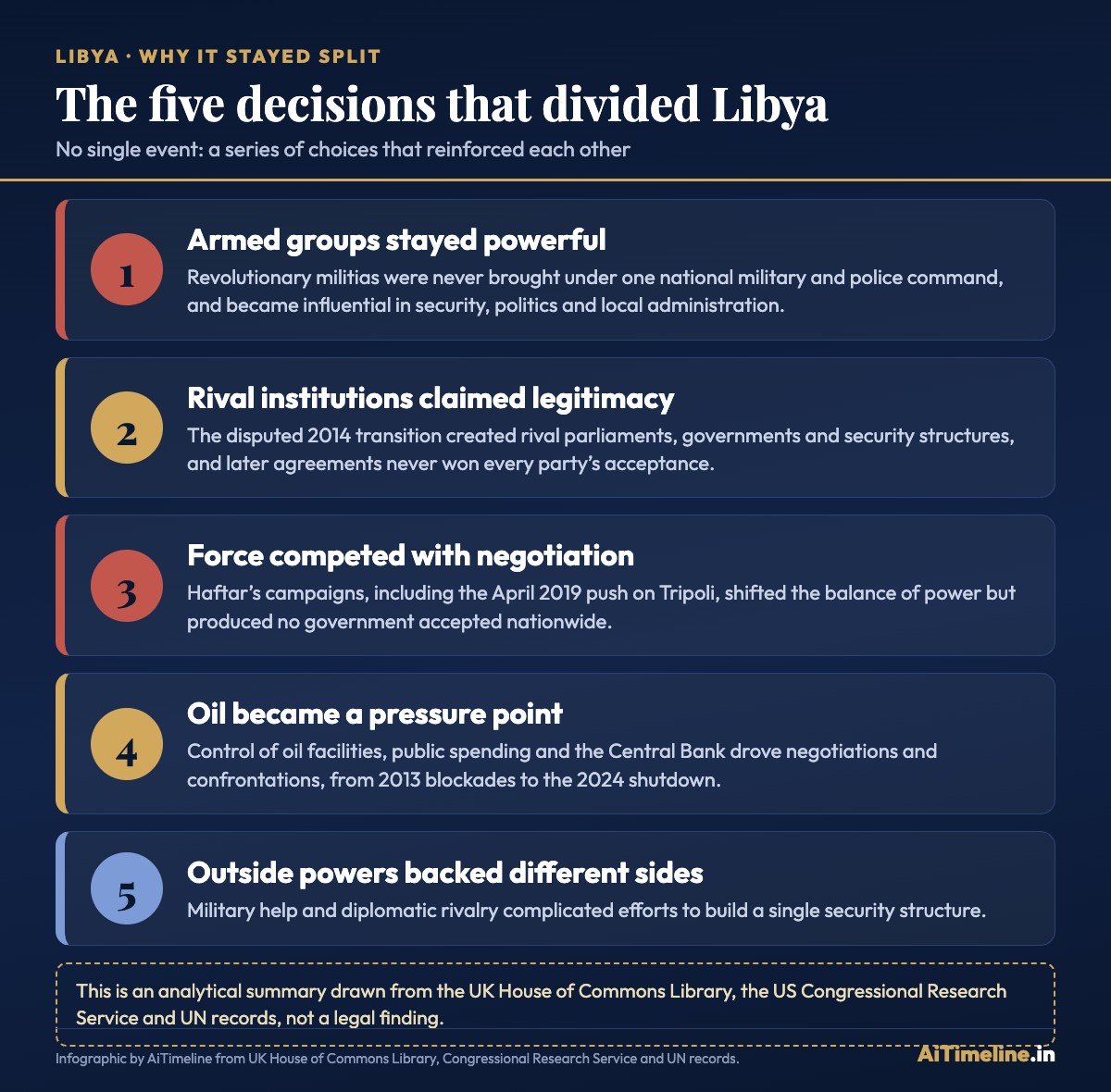
The Five Decisions That Kept Libya Divided
Not one event, but a pattern of choices.
The conflict was not caused by one event. A series of political, military and institutional choices reinforced the divisions. This is an analytical summary, not a legal finding.
- 1. Armed groups stayed powerful after 2011. Revolutionary militias were never brought under one national military and police command, and became influential in security, politics and local administration.
- 2. Competing institutions claimed legitimacy. The disputed 2014 transition created rival parliaments, governments and security structures, and later agreements failed to win lasting acceptance from every major party.
- 3. Military solutions competed with negotiation. Haftar’s campaigns, including the April 2019 offensive against Tripoli, changed the balance of power but did not produce a nationally accepted government.
- 4. Oil revenue became a pressure point. Control of oil infrastructure, public spending and financial institutions became central to negotiations and confrontations.
- 5. Foreign involvement complicated reconciliation. Different outside powers supported different Libyan actors.
Key People and Institutions
Holding an office is not an endorsement of that person’s actions.
| Person or body | Role | Position as documented |
|---|---|---|
| Abdul Hamid Dbeibah | Prime minister, Government of National Unity (Tripoli) | Chosen by the UN-facilitated forum in Feb 2021; refused to hand over in 2022 |
| Osama Hamad | Prime minister, Government of National Stability (east) | Replaced Fathi Bashagha in 2023; backed by the House and the LNA |
| Khalifa Haftar | Commander, Libyan National Army | Launched Operation Dignity in 2014 and the Tripoli offensive in 2019 |
| Mohamed al-Menfi | Head of the Presidential Council | Selected with Dbeibah in Feb 2021 |
| Aguila Saleh | Speaker, House of Representatives | Chaired the 14 Sep 2026 session that endorsed the deal |
| Mohamed Takala | President, High Council of State | Council objects to the 4+4 process; met Turkish intelligence chief, 10 Sep 2026 |
| Hanna Tetteh | UN Special Representative | Presented the Aug 2025 roadmap; chaired the Smaller Convening |
| Fayez al-Sarraj | Head of the GNA, 2016 onward | UN-backed; arrived in Tripoli in March 2016 |
| Fathi Bashagha | Designated prime minister, Feb 2022 | Named by the House; later replaced by Hamad |
| UNSMIL | UN Support Mission in Libya | Facilitates the political process; mandate renewed for 12 months on 30 Oct 2026 |
| HNEC | High National Elections Commission | Board to be reconstituted under the Aug 2026 deal |
Who Controls What? Libya’s Political Divide
A simplified overview, not a map of territorial control.
Libya’s political divide is broadly organised around two rival power centres, but it is not a clean split into two countries. Local authorities, armed groups and other actors keep influence across both halves.
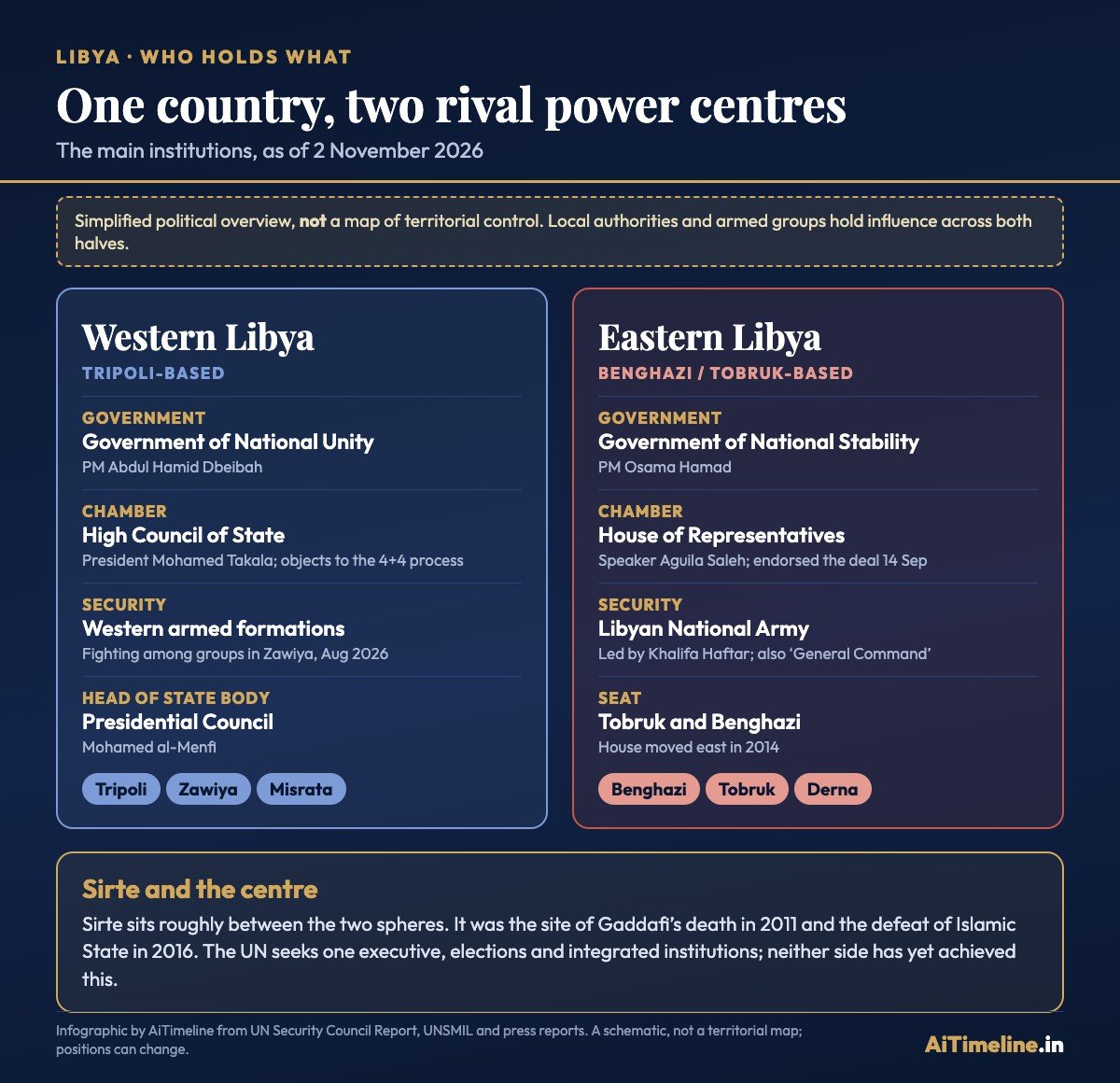
| Western Libya | Eastern Libya | |
|---|---|---|
| Executive | Government of National Unity, PM Abdul Hamid Dbeibah | Government of National Stability, PM Osama Hamad |
| Legislature | High Council of State (Tripoli), President Mohamed Takala | House of Representatives, Speaker Aguila Saleh |
| Armed forces | Western armed formations | Libyan National Army under Khalifa Haftar |
| Standing | Treated by the UN as the interim executive | Backed by the House; also treated as a party at the table |
| Position on 30 Aug deal | GNU and High Council of State delegations took part; the Council has since objected | Signed through the House and LNA delegations; House endorsed on 14 Sep |
The Presidential Council, led by Mohamed al-Menfi, is another part of the national framework. The UN keeps seeking a unified executive, national elections and the integration of state institutions.
Foreign Powers: Who Supported Which Side?
Libya’s internal conflict also became an arena for outside rivalry. Involvement has varied over time, and diplomatic positions have not always matched military relationships. The UN has repeatedly called for respect for Libya’s sovereignty and an end to foreign interference. For how outside powers shape another contested region, see our Gaza UN resolutions timeline.
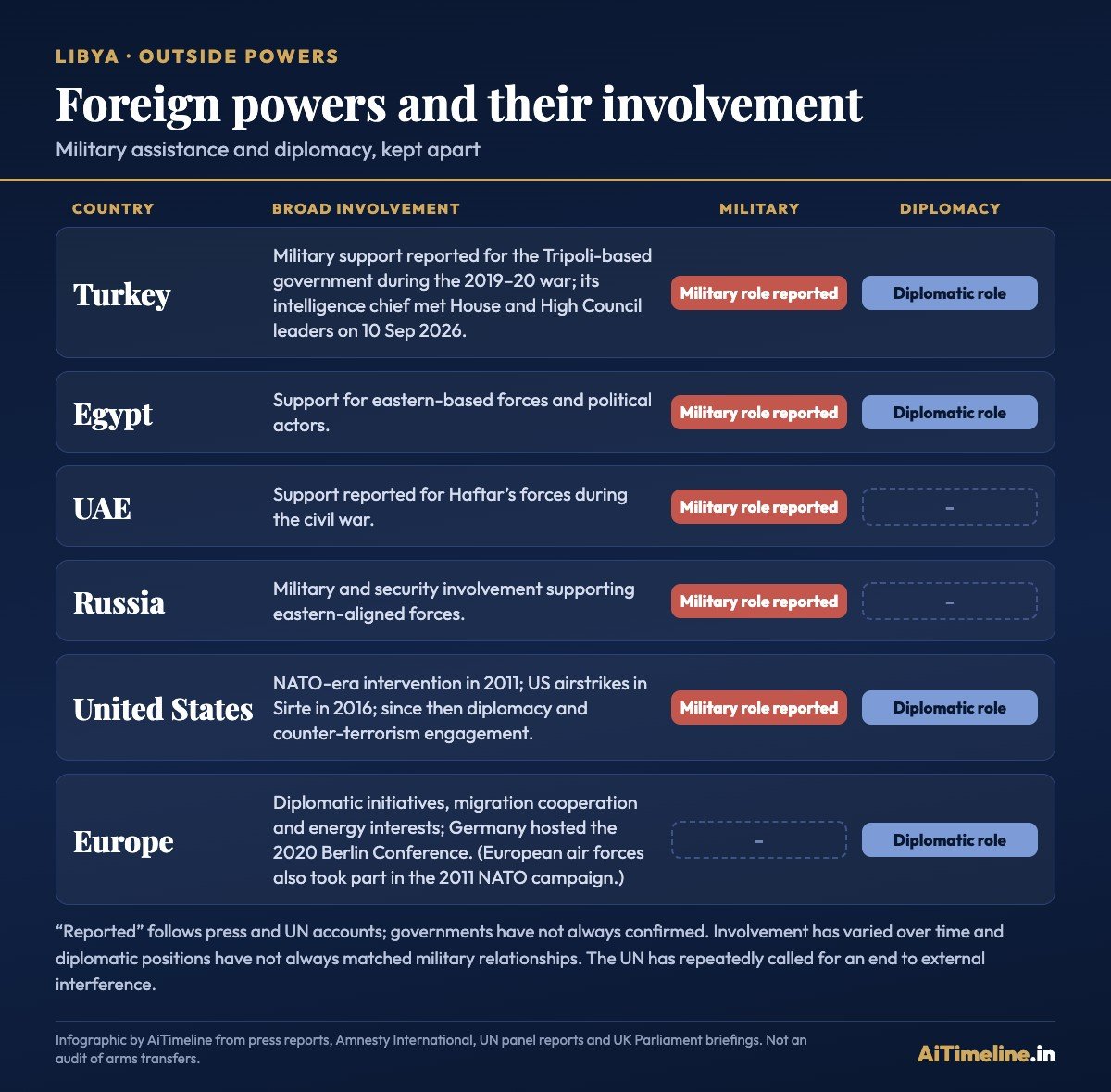
| Country | Broad involvement as reported |
|---|---|
| Turkey | Military support for the Tripoli-based GNA during the 2019-20 conflict; its intelligence chief met House and High Council leaders on 10 Sep 2026 |
| Egypt | Support for eastern-based forces and political actors |
| UAE | Support for Haftar’s forces during the civil war |
| Russia | Military and security involvement supporting eastern-aligned forces |
| United States | NATO-era intervention in 2011; airstrikes at Sirte in 2016; later diplomacy and counter-terrorism; a separate initiative led by Massad Boulos is reported |
| European countries | Diplomatic initiatives, migration cooperation and energy interests; Germany hosted the 2020 Berlin Conference |
These descriptions follow press, UN and parliamentary reporting. Governments have not always confirmed them, and we did not audit arms transfers.
The Economic and Humanitarian Cost
Oil dependence
Disputes over production, exports and revenue distribution repeatedly hit government finances. In 2026 the pattern continued: drone strikes and fire at the Zawiya refinery in August, then a closed pipeline valve and blocked refinery gates in September. For oil-market context, see our Saudi Aramco IPO timeline and our explainer on the Strait of Hormuz.
Public services
The envoy told the Security Council in August that widespread power cuts and water disruption showed the cost of diverted public resources and poor coordination. A briefer said some Libyans faced up to 15 hours of cuts a day in heat near 50°C, and that the country spends roughly $1 billion a month on fuel imports while the grid is short of power.
Disasters
The 2023 Derna floods exposed weaknesses in infrastructure and emergency response. Many analysts tie those weaknesses to years of weak public administration; that is a judgement, not a legal finding.
Insecurity and displacement
Years of conflict have affected civilians, displaced communities and migrants. We did not verify current displacement figures for this record. The stalemate has also made long-term investment, public-sector reform and national budget planning harder.
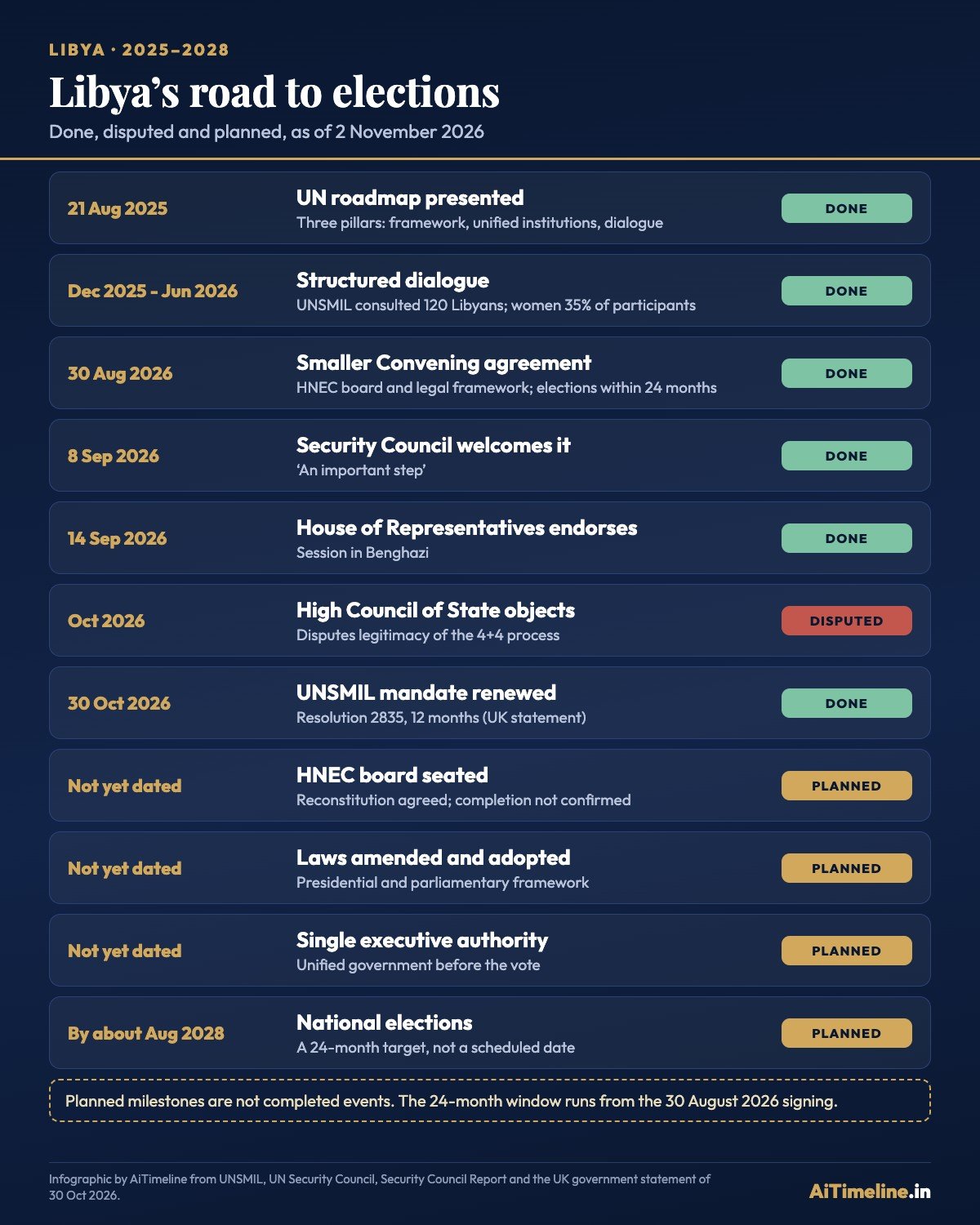
What Changed in 2026, and What Remains Unresolved
Done, disputed and planned.
The 30 August 2026 agreement reopens a pathway to elections. An agreement on preparations is not an election result and not proof that the division has ended. What follows is a record of what is done, what is disputed and what is only planned.
| Issue | Position as of 2 Nov 2026 |
|---|---|
| Election preparation | Agreement reached on the elections commission and legal-framework milestones |
| National elections | Commitment to work towards elections within 24 months; no date set |
| Endorsement | House of Representatives endorsed on 14 Sep; High Council of State objects |
| Elections commission board | Reconstitution agreed; completion not confirmed |
| Unified government | Still unresolved |
| Military integration | Still unresolved |
| Oil and public finances | Further institutional coordination needed; oil sites attacked again in Sep 2026 |
| National reconciliation | Requires continued political dialogue |
On the record
- The October 2020 ceasefire has largely held as a national ceasefire.
- Four camps, including the eastern military command, signed one text on 30 August 2026.
- The House of Representatives endorsed it on 14 September.
- The Security Council backed it and renewed the UN mission.
Not delivered
- The December 2021 elections were not held.
- There is still no single executive or single army.
- Oil facilities remain a pressure point.
- Both chambers have not backed the August deal.
Open on 2 Nov 2026
- Whether the High Council of State will accept the agreement.
- Whether the HNEC board is seated.
- Whether laws are amended in time for a vote.
- Whether the Boulos initiative converges with the UN track.
- An election date.
Explore More Timelines
People Also Ask
Libya After Gaddafi: Frequently Asked Questions
Conclusion: One Government or Still Two?
Libya’s experience since 2011 shows that removing an authoritarian government does not by itself create a stable political system. Unified security institutions, constitutional agreement, a shared oil economy and restraint from outside powers were all missing at different times.
The August 2026 agreement reopens a path to elections. The harder task is turning it into functioning institutions, and the central question is no longer who governs after Gaddafi, but whether Libya’s rival centres can agree on one national government for the whole country.
Related AiTimeline Stories
⚠️ Editorial Note
Last updated 2 November 2026. Developments follow UN, UNSMIL and Security Council Report material and press reports; we did not read every primary document. Items flagged for review: the High Council of State’s position on the 30 August agreement, whether the elections commission board has been seated, an election date, the Resolution 2835 text (we relied on a UK government statement), and the US initiative led by Massad Boulos. Casualty and damage figures, including for Derna, are early or contested estimates. Foreign involvement is described as reported, not as proven. Names of senior officials follow the UN and press usage current in November 2026.
Sources & further reading
Every dated entry above was checked against these references. Last reviewed 2 November 2026.