Uttarakhand President’s Rule: The 2016 Political Crisis Explained
Uttarakhand President's Rule ran 27 March to 11 May 2016. See the High Court and Supreme Court orders, the 33-of-61 floor test and what is unsettled.
Latest Story
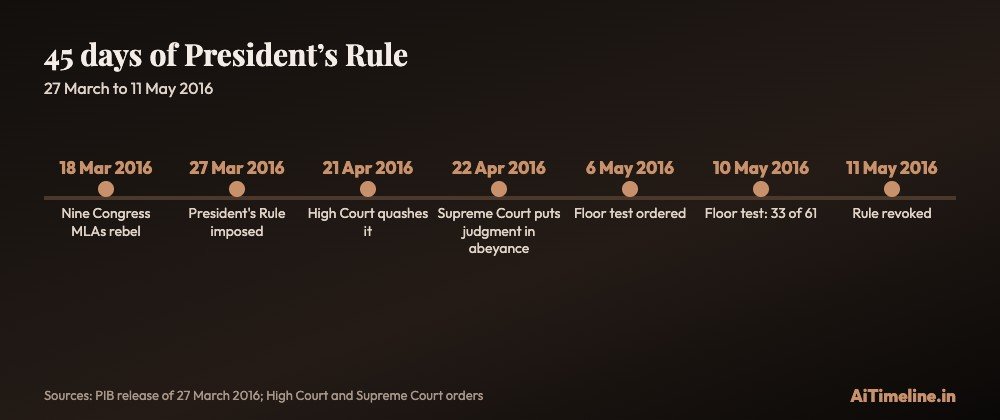
Uttarakhand’s President’s Rule began on 27 March 2016, when the President signed a proclamation under Article 356 after nine Congress MLAs rebelled against Chief Minister Harish Rawat, and ended on 11 May 2016, a day after a Supreme Court-supervised floor test in which Rawat obtained 33 votes out of 61. In between, the Uttarakhand High Court quashed the proclamation on 21 April and the Supreme Court put that judgment in abeyance the next day. The Supreme Court never decided on the merits whether the rule was justified: its 11 May order says that question “will remain alive.” This page follows the crisis step by step, separates court findings from allegations such as the sting video, and states plainly what could not be verified. For related background, see AiTimeline’s timelines of India’s Emergency, the Ankita Bhandari case and the Electoral Bonds ruling.
💡 Short Answer
President’s Rule was imposed in Uttarakhand on 27 March 2016 and revoked on 11 May 2016, about 45 days later. The High Court quashed it on 21 April, the Supreme Court stayed that judgment on 22 April, and a two-hour floor test on 10 May gave Harish Rawat 33 of 61 votes, with nine disqualified MLAs not voting. The Supreme Court allowed the Centre to revoke the proclamation and left the question of its justification open.
Who Did What in the Uttarakhand Crisis?
Last updated: 26 October 2026. Actors, actions and sources.
| Who | Role in the crisis | Position or action | Source |
|---|---|---|---|
| Harish Rawat | Congress chief minister | Said he had a majority and that central rule pre-empted the 28 March vote; got 33 of 61 votes on 10 May | Order |
| Vijay Bahuguna and eight others | Rebel Congress MLAs | Sided with the BJP on 18 March; disqualified on 27 March; released the sting video | WION |
| Govind Singh Kunjwal | Speaker | Declared the Appropriation Bill passed without a division; disqualified the nine | Wikipedia |
| K. K. Paul | Governor | Asked Rawat to prove his majority by 28 March | LiveLaw |
| Union Cabinet and the President | The Centre | Cabinet met on the night of 26 March; the proclamation was signed on 27 March | PIB |
| Mukul Rohatgi | Attorney General | Undertook on 22 April not to revoke; sought modification on 11 May | Order |
Harish Rawat
Congress leader who said he had the majority; won the 10 May floor test with 33 of 61 votes and lost both seats in 2017.
Vijay Bahuguna
Former chief minister and one of the nine MLAs who rebelled on 18 March 2016 and were disqualified on 27 March.
Govind Singh Kunjwal
Declared the Appropriation Bill passed on 18 March and disqualified the nine on 27 March.
K. K. Paul
Asked Rawat to prove his majority by 28 March 2016.
K. M. Joseph and V. K. Bisht
Quashed the proclamation on 21 April 2016, saying “People can go wrong, be it the President or the judges.”
Dipak Misra and Shiva Kirti Singh
Put the judgment in abeyance on 22 April, supervised the floor test and recorded the result on 11 May.
Uttarakhand President’s Rule: Key Questions
The Uttarakhand Crisis in Ten Points
- Trigger: nine Congress MLAs rebelled on 18 March 2016 over the Appropriation Bill.
- Governor: asked Rawat to prove his majority by 28 March.
- Centre: the proclamation was signed on 27 March, a day before the vote.
- Speaker: disqualified the nine the same day, leaving 61 members able to vote.
- High Court: quashed the proclamation on 21 April, saying the President can also go wrong.
- Supreme Court: stayed that on 22 April and kept the stay on 27 April.
- Floor test: 10 May, 33 of 61 votes for Rawat; revoked on 11 May.
- Open question: whether the proclamation was justified was left alive on 11 May 2016.
- Sting video: an allegation; CBI FIR in 2019; no verdict found.
- Politics: the BJP won the 2017 election with 57 of 70 seats.
Uttarakhand President’s Rule Timeline, Latest First
Each entry is tagged and ends with why it matters. Allegations are labelled as such.
2026
Where the record stands today Aftermath
AiTimeline found no new proclamation under Article 356 in Uttarakhand, and no later Supreme Court judgment that settles the question the Court itself left open on 11 May 2016: whether the President’s opinion to impose the rule on 27 March 2016 was justified and whether the High Court’s reasons were within the scope of judicial review (Supreme Court order, 11 May 2016).
The politics moved on: Rawat lost the 2017 election, and the nine disqualified MLAs’ petitions were later reported closed as academic. What survives is the precedent, a CBI case over the sting video that remains an allegation, and Rawat’s own September 2026 call for the sting and the President’s Rule period to be investigated.
2026
Rawat asks for a probe of his whole tenure, including the sting Aftermath
After the Enforcement Directorate searched the Dehradun home of his personal assistant Chandan Singh Jeena on 10 September 2026, in a case over alleged irregularities in the 2016 UKSSSC Gram Panchayat Vikas Adhikari examination, Rawat invited the ED, CBI and other agencies to scrutinise every decision of his three years as chief minister. He asked for the sting operation to be investigated too, and said one of those years was “messed up by President’s Rule” (The News Mill).
The ED case concerns the recruitment exam, not the 2016 constitutional crisis. AiTimeline found no new step in the sting case itself in 2026.
CBI court orders voice samples in the sting case Aftermath
A CBI court ordered voice samples from Rawat and four other people in the 2016 sting case. Rawat called the move “laughable”, asked whether it was “voice testing or voice suppression” and said the CBI had not questioned the person he called the alleged mastermind (First Review, 19 July 2023). AiTimeline found no chargesheet or trial outcome after this.
2019
CBI registers an FIR over the 2016 sting video Aftermath
The CBI registered an FIR against Harish Rawat, former minister Harak Singh Rawat and Samachar Plus chief Umesh Kumar, after the Nainital High Court allowed an investigation on 30 September 2019. The video, dated 23 March 2016, allegedly shows Rawat negotiating to bring the nine rebels back. The CBI said the Gandhinagar forensic laboratory found no tampering (WION). Charges named were sections of the Prevention of Corruption Act. AiTimeline found no chargesheet or court outcome.
(date not confirmed)
Supreme Court closes the disqualified MLAs’ petitions as academic Aftermath
A report says a bench of Chief Justice Dipak Misra and Justices A. M. Khanwilkar and D. Y. Chandrachud held the nine MLAs’ special leave petitions had become academic because a new Assembly had come into being, so their individual grievances did not survive (The Hawk, read via search summaries; the site blocks automated access, and no court copy was found on Indian Kanoon). Misra was Chief Justice from August 2017 to October 2018. The order date is not confirmed here.
2017
BJP wins 57 of 70 seats; Rawat loses both seats Assembly vote
Results declared on 11 March 2017 gave the BJP 57 of 70 seats and the Congress 11, with vote shares of about 46.5% and 33.5%. Harish Rawat lost both seats he contested, Haridwar Rural and Kichha. Trivendra Singh Rawat of the BJP became chief minister (Wikipedia: 2017 Uttarakhand election).
2016
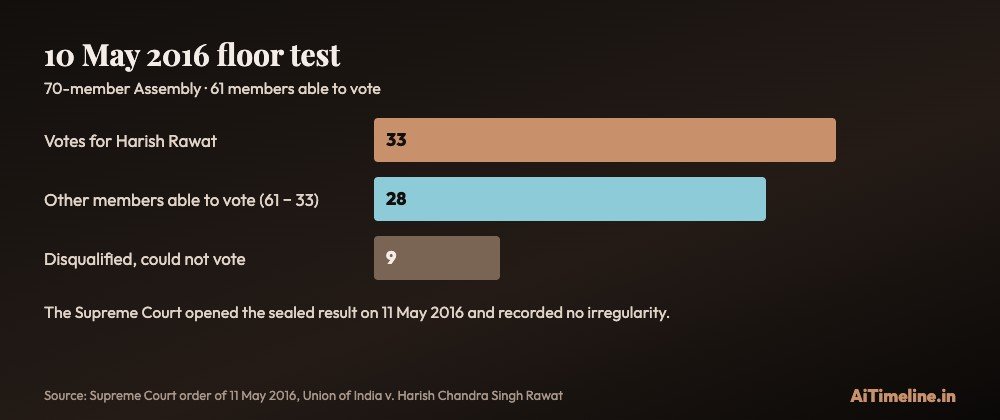
Supreme Court records 33 of 61 votes; Centre allowed to revoke Court
The bench opened the result, produced in a sealed cover, and recorded that Rawat obtained 33 votes out of 61. Nine members “could not vote as they stood disqualified as on that day and even today.” Both sides said there was no irregularity. At the Attorney General’s request the Court varied its 22 April order and gave the Union liberty to revoke the proclamation in the course of the day; Rawat could then assume office (Supreme Court order; SCC Online; The Tribune).
The Court was explicit on two points: the question whether the 27 March proclamation was justified “will remain alive”, and the nine MLAs’ disqualification was a separate petition, with the matter listed for 12 July. The Centre revoked President’s Rule that day.
2016
Special session: a two-hour floor test Assembly vote
A special Assembly session met at 11 a.m. under the Court’s order, with President’s Rule lifted between 11 a.m. and 1 p.m. so that the vote could be held. The only agenda was the confidence motion. The proceedings were observed by the Principal Secretary for Legislative and Parliamentary Affairs and the Assembly Secretary, and the result was delivered to the Court in a sealed cover (LiveLaw; Supreme Court order).
2016
High Court upholds the disqualification; Supreme Court declines a stay Court
On the morning of 9 May Justice U. C. Dhyani of the High Court dismissed the nine rebels’ petition against their disqualification and said they could ask the Speaker to review his decision (Lawyers Law). The rebels went straight to the Supreme Court, which the same day refused interim relief and adjourned the matter to 12 July. The 6 May order had already said the disqualified members could not vote if they remained disqualified (Supreme Court order; LiveLaw). What the effect would be if the disqualification were later set aside, the Court said in its 11 May order, “would be a matter of debate.”
2016
Supreme Court orders a floor test for 10 May Court
On 4 May the Centre told the Court it was “seriously considering” an immediate floor test; earlier the Attorney General had argued that there “cannot be a President’s Rule and a floor test at the same time.” On 6 May the Court fixed a special session for 10 May, 11 a.m. to 1 p.m., with a vote of confidence as the only business, to be videographed, and the nine disqualified members not voting (LiveLaw). The 11 May order refers to orders of 6 and 9 May and says the floor test was directed on the concession of the parties.
2016
Supreme Court keeps the stay; no floor test on 29 April Court
The Court said its stay on the High Court judgment would continue, so the floor test fixed for 29 April would not happen. It framed seven questions on the proclamation, including whether the Speaker’s disqualification of MLAs was relevant under Article 356 and whether the delay in a floor test could justify President’s Rule, and listed the next hearing for 3 May (LiveLaw, a partial excerpt).
2016
Supreme Court puts the High Court judgment in abeyance Court
The Centre went to the Supreme Court the day after the High Court ruling. The bench directed that the High Court judgment “shall remain in abeyance till 27th April, 2016” and recorded the Attorney General’s undertaking that the Union would not revoke the Presidential proclamation until the next hearing (Supreme Court order of 11 May quoting the 22 April order).
2016
High Court quashes the proclamation Court
The Uttarakhand High Court set aside the proclamation, restored the Rawat government and ordered a floor test for 29 April. It held that a proclamation under Article 356 is open to judicial review, and rejected the Centre’s argument that the President’s decision could not be examined: “People can go wrong, be it the President or the judges.” It found an “absolute absence of material” on which the Governor could have apprehended a breakdown, and that the Centre’s reliance on the Speaker’s 27 March decision was irrelevant because the Cabinet could not have anticipated it on 26 March (LiveLaw; The Indian Express).
The disqualification of the nine rebels was a separate track, decided by a single judge on 9 May (High Court judgment, 21 April 2016).
2016
Single judge orders a floor test; a Division Bench puts it on hold Court
On 29 March a single judge, Justice U. C. Dhyani, ordered a floor test for 31 March, allowing the nine disqualified MLAs to vote with their votes kept separately in a sealed result (High Court order). On 30 March a Division Bench of Chief Justice K. M. Joseph and Justice V. K. Bisht kept that order in abeyance, with the next hearing on 6 April, and asked the Centre why it had imposed the rule when the Governor had fixed a date for the floor test (SCC Online).
2016
President’s Rule imposed under Article 356 Centre
The President signed a proclamation under Article 356; all functions of the state government were assumed by the President and exercised by the Governor, subject to the President’s control. Two retired officers, Ravindra Singh and Prakash Mishra, were appointed advisers to the Governor (PIB, Ministry of Home Affairs). The Union Cabinet discussed Uttarakhand in the intervening night of 26–27 March; Rawat’s petition put the meeting at 9:30 p.m. on 26 March (High Court order, 29 March; High Court judgment, 21 April). On 26 March the Governor had written to the President enclosing a pen drive with three audio conversations and one video recording received from the rebels’ side (High Court judgment). The Governor’s deadline for the confidence vote was the next day, 28 March, so the vote never took place.
2016
Speaker disqualifies the nine rebel Congress MLAs Crisis
Speaker Govind Singh Kunjwal disqualified the nine rebels under the anti-defection law. This reduced the House to 61 members able to vote, which is the denominator in the 33-of-61 result later recorded. The proceedings had begun on 26 March; the rebels had filed writ petitions on 25 March to postpone them but got no stay. Both sides in the High Court dated the disqualification 27.03.2016 (High Court judgment, 21 April 2016). The exact hour relative to the proclamation is not recorded in the judgment: Zee News, filing just before midnight on 26 March, reported the decision as coming late that Saturday, while later reports put it hours after President’s Rule (Zee News).
The rebels’ challenge became a separate case. The High Court upheld the disqualification on 9 May, and the Supreme Court declined to stay it the same day.
2016
A sting video is released Crisis
Rebel Congress MLAs led by former chief minister Vijay Bahuguna released a recording that they said showed Rawat offering inducements, two days before the confidence vote. The CBI later said the video was dated 23 March 2016 (WION). The material reached the Governor, who sent it to the President on 26 March (High Court judgment). Rawat’s camp disputed it. It is an allegation: AiTimeline found no court finding that it was proved.
2016
Governor asks Rawat to prove his majority by 28 March Crisis
On 19 March Governor K. K. Paul directed Rawat to seek a vote of confidence “at the earliest but not later than 28.03.2016”, the date the Speaker had fixed for the House to reconvene, and later sent a message under Article 175(2) that the vote be held on 28 March. The same day the Speaker issued show-cause notices to the nine rebels (High Court order, 29 March 2016). The High Court later noted that the Governor’s report to the President spoke of a floor test on 28 March but did not mention that 35 members had sought a division of votes on the Appropriation Bill (LiveLaw).
2016
Nine Congress MLAs rebel over the Appropriation Bill Crisis
On 18 March 2016 nine Congress MLAs, including former chief minister Vijay Bahuguna, sided with the BJP in demanding a division on the Appropriation Bill. Thirty-five members in all pressed for a division, and the Speaker declared the bill passed without one (Wikipedia). The Union government then argued that Rawat had lost his majority, while Rawat said he still had it.
2014
Rawat replaces Bahuguna as chief minister Background
Harish Rawat replaced Vijay Bahuguna as chief minister in early 2014, after the June 2013 floods (Wikipedia). Bahuguna was among the nine rebels in 2016. This is context, not an episode of President’s Rule; AiTimeline did not establish the exact date of the change.
1994
S. R. Bommai: courts can review Article 356, and majority is tested on the floor Background
A nine-judge bench held that a proclamation under Article 356 is not immune from judicial review, that relevant material is a pre-condition, and that a ministry’s majority must be tested on the floor of the House rather than judged by the Governor alone (Wikipedia: S. R. Bommai v. Union of India). Both rulings were central in Uttarakhand in 2016.
2000
Uttarakhand becomes a state Background
Uttarakhand was created on 9 November 2000 out of Uttar Pradesh (Wikipedia: Uttarakhand). The 2016 crisis happened in a state that was barely sixteen years old.
What Is Article 356, and Why Did Uttarakhand Test It?
President’s Rule is a constitutional power with limits.
Article 356 allows the President to take over a state’s government if satisfied that it cannot be carried on in accordance with the Constitution. The Press Information Bureau release of 27 March 2016 describes the effect: the functions of the state government were assumed by the President and exercised by the Governor, subject to the President’s control.
Three questions made Uttarakhand a landmark. First, who decides whether a government has a majority? In S. R. Bommai (1994) a nine-judge bench said a majority is tested on the floor of the House. Second, can the Centre act while a confidence vote is pending? The High Court said the Cabinet could not rely on events it could not have anticipated and found an “absolute absence of material” for the Governor’s apprehension. Third, can courts review the President’s satisfaction? Yes, said the High Court, and the Supreme Court left that question open in 2016 rather than answering it in this case.
This is an explainer by AiTimeline, not legal advice, and it follows the court orders as quoted in the sources listed below.
Court by Court: Who Decided What?
Eight orders in six weeks.
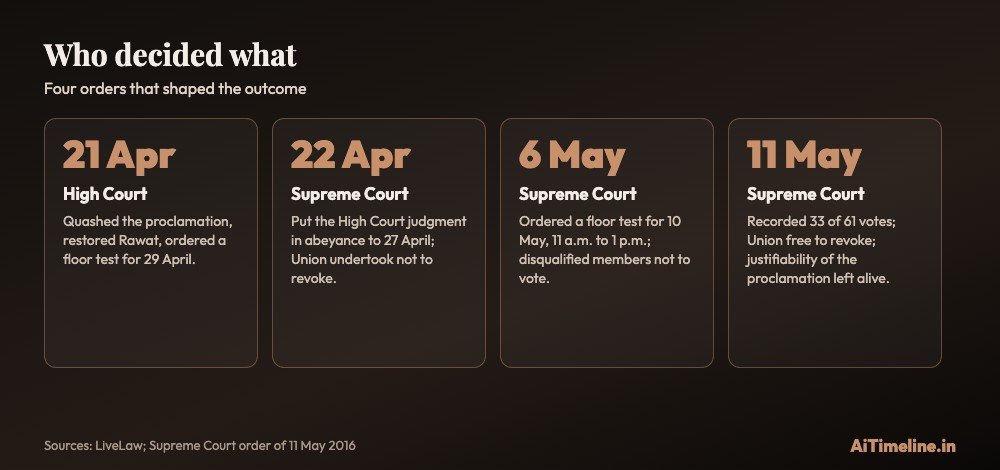
| Date | Court | What it did | Source |
|---|---|---|---|
| 29 Mar 2016 | Uttarakhand High Court, Justice U. C. Dhyani | Ordered a floor test for 31 March, with the nine rebels voting and their votes sealed | Order |
| 30 Mar 2016 | High Court Division Bench (K. M. Joseph, V. K. Bisht) | Kept the floor-test order in abeyance; next hearing 6 April | SCC Online |
| 21 Apr 2016 | High Court Division Bench (K. M. Joseph, V. K. Bisht) | Quashed the proclamation, restored Rawat, ordered a floor test for 29 April | LiveLaw |
| 22 Apr 2016 | Supreme Court (Dipak Misra, Shiva Kirti Singh) | Put the High Court judgment in abeyance to 27 April; Union undertook not to revoke | Order of 11 May |
| 27 Apr 2016 | Supreme Court (bench headed by Dipak Misra) | Kept the stay; no floor test on 29 April; framed seven questions | LiveLaw |
| 6 May 2016 | Supreme Court (bench headed by Dipak Misra) | Ordered a floor test on 10 May, 11 a.m. to 1 p.m.; disqualified members not to vote | LiveLaw |
| 9 May 2016 | Supreme Court | Declined to stay the nine MLAs’ disqualification; listed for 12 July | Order of 11 May |
| 11 May 2016 | Supreme Court (Dipak Misra, Shiva Kirti Singh) | Recorded 33 of 61 votes; allowed the Union to revoke that day; left justifiability “alive” | Order |
What Is Settled and What Is Open, as of 26 October 2026
Kept apart from the timeline because court orders, allegations and reports are different kinds of evidence.
| Question | What the sources show | Status |
|---|---|---|
| Date President’s Rule was imposed | PIB release of 27 March 2016 at 16:21 IST; Supreme Court order calls it “27.03.2016” | Settled |
| Floor-test result | Supreme Court: 33 of 61; nine disqualified members did not vote | Settled |
| Date revoked | 11 May 2016, the day of the order (liberty to revoke “in the course of the day”) | Settled |
| Was the proclamation justified? | High Court: no. Supreme Court: question “will remain alive”; no later final ruling found | Open |
| Sting video claims | CBI FIR of 23 October 2019; forensic lab reported no tampering; no chargesheet or court outcome found | Allegation, unresolved |
| Order of the proclamation and the disqualification on 27 March | Both dated 27 March in the High Court record; the hour of the Speaker’s decision is not stated and press reports conflict | Hour unclear |
| Date the High Court upheld the disqualification | 9 May 2016, Justice U. C. Dhyani; Supreme Court declined a stay the same day | Settled |
| Governor’s 19 March direction | High Court order of 29 March: vote “not later than 28.03.2016” | Settled |
| Supreme Court closing the MLAs’ petitions as academic | One report (bench of Misra, Khanwilkar, Chandrachud), site blocks automated access, no court copy found; date not confirmed | Single-source |
| Any 2026 development | No new proclamation or ruling; Rawat asked in September 2026 for the sting and his tenure to be probed after an ED search on an aide | Statement only |
The Story at a Glance
Oldest first.
| Date | Event | Type |
|---|---|---|
| 9 Nov 2000 | Uttarakhand becomes a state | Background |
| 11 Mar 1994 | S. R. Bommai: courts can review Article 356, and majority is tested on the floor | Background |
| Early 2014 | Rawat replaces Bahuguna as chief minister | Background |
| 18 Mar 2016 | Nine Congress MLAs rebel over the Appropriation Bill | Crisis |
| 19 Mar 2016 | Governor asks Rawat to prove his majority by 28 March | Crisis |
| 26 Mar 2016 | A sting video is released | Crisis |
| 27 Mar 2016 | Speaker disqualifies the nine rebel Congress MLAs | Crisis |
| 27 Mar 2016 | President’s Rule imposed under Article 356 | Centre |
| 29–30 Mar 2016 | Single judge orders a floor test; a Division Bench puts it on hold | Court |
| 21 Apr 2016 | High Court quashes the proclamation | Court |
| 22 Apr 2016 | Supreme Court puts the High Court judgment in abeyance | Court |
| 27 Apr 2016 | Supreme Court keeps the stay; no floor test on 29 April | Court |
| 6 May 2016 | Supreme Court orders a floor test for 10 May | Court |
| 9 May 2016 | High Court upholds the disqualification; Supreme Court declines a stay | Court |
| 10 May 2016 | Special session: a two-hour floor test | Assembly vote |
| 11 May 2016 | Supreme Court records 33 of 61 votes; Centre allowed to revoke | Court |
| 11 Mar 2017 | BJP wins 57 of 70 seats; Rawat loses both seats | Assembly vote |
| 2017–18 (date not confirmed) | Supreme Court closes the disqualified MLAs’ petitions as academic | Aftermath |
| 23 Oct 2019 | CBI registers an FIR over the 2016 sting video | Aftermath |
| Jul 2023 | CBI court orders voice samples in the sting case | Aftermath |
| 15 Sep 2026 | Rawat asks for a probe of his whole tenure, including the sting | Aftermath |
| 26 Oct 2026 | Where the record stands today | Aftermath |
| Term | Meaning | Why it matters here |
|---|---|---|
| Article 356 | Lets the President take over a state when its government cannot be carried on under the Constitution | The power used on 27 March 2016 |
| Floor test | A vote in the Assembly to show a government has a majority | Held on 10 May 2016 under the Supreme Court’s order |
| Appropriation Bill | Authorises spending from the state’s funds | The 18 March dispute began over how it was passed |
| Anti-defection law | Disqualifies members who defect from their party | Used by the Speaker on 27 March against the nine |
| Special leave petition (SLP) | A petition asking the Supreme Court to hear an appeal | The Centre’s appeal and the MLAs’ petitions |
| Abeyance | A judgment kept on hold without being set aside | The Supreme Court’s 22 April order |
| Justifiability | Whether the President’s opinion can be examined by a court | The question left alive on 11 May 2016 |
Common Claims vs the Record
| Common claim | What the record shows |
|---|---|
| The Supreme Court struck down President’s Rule | The High Court quashed it on 21 April; the Supreme Court stayed that, then supervised a floor test and left the justification question open |
| The Supreme Court ordered the Centre to revoke President’s Rule | It gave the Union liberty to revoke it on the Attorney General’s own request, and said Rawat could then assume office |
| Rawat was back in office from 21 April | He was restored on paper for one day; the Supreme Court put the judgment in abeyance on 22 April |
| The nine rebels were allowed to vote | They could not vote: they stood disqualified on 10 May |
| The sting video was proved in court | No court finding was found; the CBI filed an FIR in 2019, which is an investigation, not a verdict |
| President’s Rule can be imposed on any instability | Courts can review it, and the Bommai ruling says a majority is tested on the floor |
Explore More Timelines
People Also Ask
Frequently Asked Questions
A Floor Test Settled It, but Not the Constitutional Question
The Uttarakhand episode of 2016 was more than a contest between two parties. A rebellion over a money bill became a dispute over who could say a government had lost its majority, and the answer the Supreme Court supervised in the end was the simplest one: count the members on the floor. What the courts did not settle is whether the Centre was entitled to impose the rule when it did. The High Court said no; the Supreme Court said the question would stay alive; and the voters gave their own answer in 2017.
The record is firm on dates and numbers and honest about what is allegation or unconfirmed, as the table above shows.
Related AiTimeline Stories
⚠️ Editorial Note
Last updated 26 October 2026. The source brief was corrected on several points. It said the Supreme Court “directed” the Centre to revoke the rule and that the Court declined to let the nine vote; the 11 May order actually gave the Union liberty to revoke at the Attorney General’s request, and the nine were barred because they stood disqualified. It said the Supreme Court “stayed the immediate operation” of the High Court order on 22 April and put restoration on hold; the order was a stay to 27 April, with an undertaking not to revoke. It omitted the 29–30 March High Court orders, the 27 April Supreme Court order that cancelled the 29 April floor test, and the 9 May refusal to stay the disqualification. It presented the sting video without noting that the CBI filed an FIR in 2019 and that no court outcome was found. It gave a vague 2026 section; the newest entries now record Rawat’s September 2026 statement and the July 2023 voice-sample order instead. The Business Standard page cited in the brief returned a block and was not used. A recheck on 26 October 2026 confirmed from the primary High Court orders the Governor’s 19 March direction, the 27 March date of the disqualification and the 26 March letter to the President with the recordings, and from a law report the High Court’s 9 May dismissal of the rebels’ petition. Still open: the exact hour of the disqualification relative to the proclamation, and the date of the Supreme Court order closing the rebels’ petitions, known only from a report that blocks automated access. No photographs of the politicians are used.
Sources & further reading
Every dated entry above was checked against these references. Last reviewed 26 October 2026.
- Press Information Bureau: President's Rule imposed in Uttarakhand (27 March 2016)
- Supreme Court order of 11 May 2016, Union of India v. Harish Chandra Singh Rawat (Indian Kanoon)
- Uttarakhand High Court order of 29 March 2016, Harish Chandra Singh Rawat v. Union of India (Indian Kanoon)
- Uttarakhand High Court judgment of 21 April 2016, Harish Chandra Singh Rawat v. Union of India (Indian Kanoon)
- LiveLaw: Uttarakhand HC strikes down President's Rule (21 April 2016)
- LiveLaw: Supreme Court orders floor test on 10 May (6 May 2016)
- SCC Online: Floor test puts an end to the Uttarakhand Assembly crisis
- The Tribune: Rawat wins Uttarakhand floor test, Centre to lift President's Rule
- WION: CBI registers FIR against ex-Uttarakhand CM Harish Rawat
- Wikipedia: 2016 Uttarakhand political crisis
- Wikipedia: S. R. Bommai v. Union of India