Nagarwala Case 1971: The Rs 60 Lakh SBI Fraud and the Unanswered Questions
Nagarwala case 1971: timeline of the Rs 60 lakh SBI fraud, the phone call in the Prime Minister's name, the three-day conviction, two deaths and the 1978
Latest Story
The Nagarwala case began on 24 May 1971, when a caller purporting to be the Prime Minister’s principal secretary, and then the Prime Minister herself, told the chief cashier of the State Bank of India’s Parliament Street branch in New Delhi to hand over Rs 60 lakh for a secret Bangladesh operation. The money went to a courier, former army captain Rustom Sohrab Nagarwala, who was arrested that night. Within three days he had confessed, pleaded guilty and been sentenced. The conviction was later set aside, the investigating officer died in a road accident, Nagarwala died in custody in March 1972, and a commission of inquiry in 1978 faulted almost everyone without saying who made the call. This record separates what courts and the commission found from the theories that grew around the case.
💡 Short Answer
On 24 May 1971 SBI chief cashier Ved Prakash Malhotra withdrew Rs 60 lakh on telephone instructions from a caller purporting to be the Prime Minister’s office and handed it to Rustom Sohrab Nagarwala. Police recovered Rs 59,95,000 the same night. Nagarwala was convicted within three days, the conviction was set aside on appeal, and he died in custody in March 1972. The 1978 Reddy Commission found no evidence the money was Indira Gandhi’s but never established who made the call.
Nagarwala Case: Key Questions
The Case in Nine Points
- The trick: a phone call using the names of the Prime Minister and her principal secretary, with a Bangladesh cover story that fitted the moment.
- The handover: Rs 60 lakh left the bank on a verbal order, with no cheque or voucher, and was given to a courier near Bible House.
- The warning sign: Deputy Head Cashier Ruhel Singh signed the cash book but demanded a voucher that never came.
- The arrest: Nagarwala was traced the same day and Rs 59,95,000 was recovered from Defence Colony.
- The speed: confession, guilty plea and sentence came on 27 May, three days after the offence.
- The reversal: on appeal the conviction was set aside and a fresh trial ordered; charges were framed again on 9 August 1971.
- The cashier: the Delhi High Court held in November 1971 that Malhotra was duped and showed no dishonesty, though he may have broken bank rules.
- The deaths: investigating officer D.K. Kashyap died in a road accident in November 1971; Nagarwala died in custody in March 1972.
- The inquiry: the 1978 Reddy Commission criticised the process but left the central questions open.
Timeline: The Nagarwala Case, 1971–1978
Entries are colour-coded by track and run newest first. Where sources differ, the entry says so.
The Reddy Commission reports: fault everywhere, no answer Death and inquiry
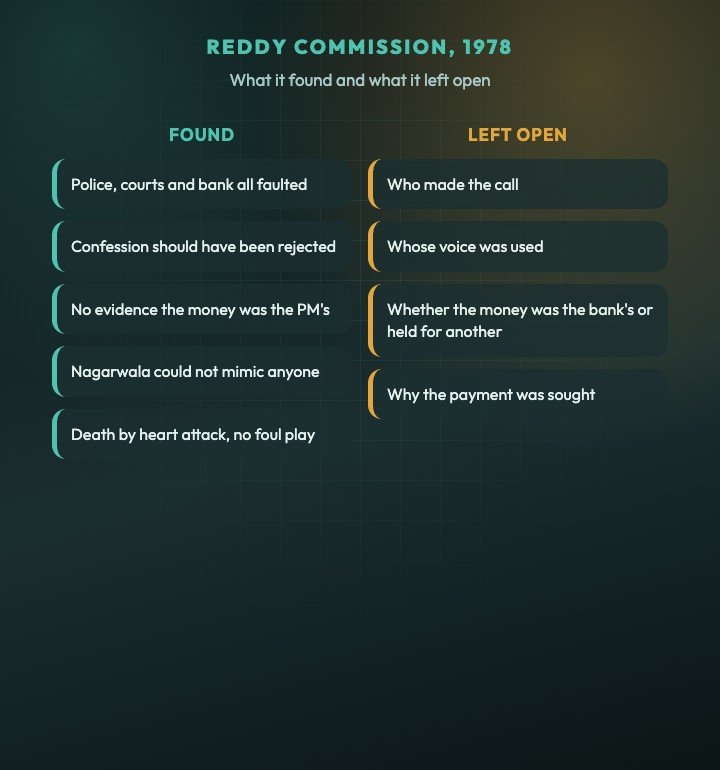
What happened: Retired Supreme Court judge P. Jaganmohan Reddy submitted a report of about 820 pages in 1978. It found fault with the police investigation, the court proceedings, the bank’s procedures and official replies. It found no evidence that the Rs 60 lakh belonged to Prime Minister Indira Gandhi, said Nagarwala could not mimic anyone, and held that his confession should have been rejected as unsupported by evidence.
Why it matters: The commission said a proper investigation would have shown whether the money was the bank’s own or was held by the bank for someone else. It also found that Nagarwala’s death was caused by a heart attack and gave no reason to suspect foul play. It never established who was behind the call or why. Reddy reportedly likened the affair to Churchill’s ‘riddle wrapped in a mystery inside an enigma’.
The Janata government orders a fresh inquiry Death and inquiry
What happened: After the Janata government took office in 1977, it appointed several commissions to examine the Indira Gandhi years. Retired Supreme Court judge Pingle Jaganmohan Reddy was asked to look into the Nagarwala affair.
Why it matters: Giving evidence, Indira Gandhi said the episode did not embarrass her because she ‘had nothing to do with it’ and did not know any of the persons concerned, according to a 2024 book review.
Nagarwala dies in custody Death and inquiry
What happened: Rustom Sohrab Nagarwala died on 22 March 1972, his fiftieth birthday, according to a Business Standard review of the Reddy record. Some accounts give 2 March. The official cause was a cardiac infarction. He had been in and out of hospital in early 1972.
Why it matters: His death ended the criminal case. His appeal and the retrial never reached a verdict, so his account was never tested in a completed trial. The Reddy Commission later found no reason to suspect foul play, but speculation has continued.
Nagarwala recants and refuses bail offers Death and inquiry
What happened: Nagarwala recanted his confession. A review of the Reddy record says he stayed in jail, refusing offers from friends to arrange bail.
Why it matters: Letters he wrote from jail, reported later, said he wanted to reveal the truth behind the crime. He never did.
The Delhi High Court rules on the Malhotra application Trial and courts
What happened: The High Court dismissed Nagarwala’s revision. It held that Malhotra had been duped, that taking out the money might breach bank rules but did not show dishonesty, and that no prima facie case of criminal misappropriation was made out against him.
Why it matters: The judge also remarked that police had finished Nagarwala’s case within three days, yet the investigation against Malhotra was incomplete after about six months. He said the police showed no similar diligence, which gave the accused reasonable grounds for doubt.
Investigating officer D.K. Kashyap dies in a road accident Death and inquiry
What happened: D.K. Kashyap, the police officer who led the investigation, died in a road accident in November 1971. Accounts agree on the month but I found no source for the exact date.
Why it matters: His death, followed by Nagarwala’s within months, fed suspicion. The Reddy Commission is reported to have found no foul play in Nagarwala’s death; I found no official finding that Kashyap’s accident was anything other than an accident.
Nagarwala asks for the cashier to be tried with him Trial and courts
What happened: Nagarwala applied to have Ved Prakash Malhotra made a co-accused for criminal breach of trust. The trial magistrate refused, holding the record did not show Malhotra’s involvement in any crime. The Sessions Judge dismissed a revision.
Why it matters: Malhotra had been arrested a few days after Nagarwala on the bank’s first report, and that investigation was still open after about six months. Nagarwala’s counsel argued the police wanted a quick conviction and kept the cashier under pressure. I found no record in the sources checked that Malhotra was ever charged.
Fresh charges framed after the retrial order Trial and courts
What happened: After the appeal court set aside the first conviction and ordered a fresh trial, new charges of impersonation and cheating were framed against Nagarwala on 9 August 1971.
Why it matters: The remand wiped the 27 May sentence. The retrial was still unfinished when he died.
The appeal court sets aside the 27 May conviction Trial and courts
What happened: On appeal, Nagarwala’s conviction and sentence were set aside and the case was sent back to an Additional Chief Judicial Magistrate for a fresh trial in accordance with law. The High Court’s later judgment records the remand but not the date.
Why it matters: The first trial had run on a guilty plea, entered after a confession recorded the same day. The remand shows the appeal court did not treat that process as final.
Confession, guilty plea and sentence in a single day Trial and courts
What happened: On 27 May Nagarwala made a confessional statement before a magistrate, which he later recanted. The same day police filed a chalan under Sections 419 and 420 IPC, charges were framed before a first-class magistrate, he pleaded guilty and was sentenced. He is widely reported to have received four years.
Why it matters: Within three days of the offence, the case had a conviction. The author S.K. Aggarwal called the speed ‘unique in legal history’. The Reddy Commission later said the confession should have been rejected.
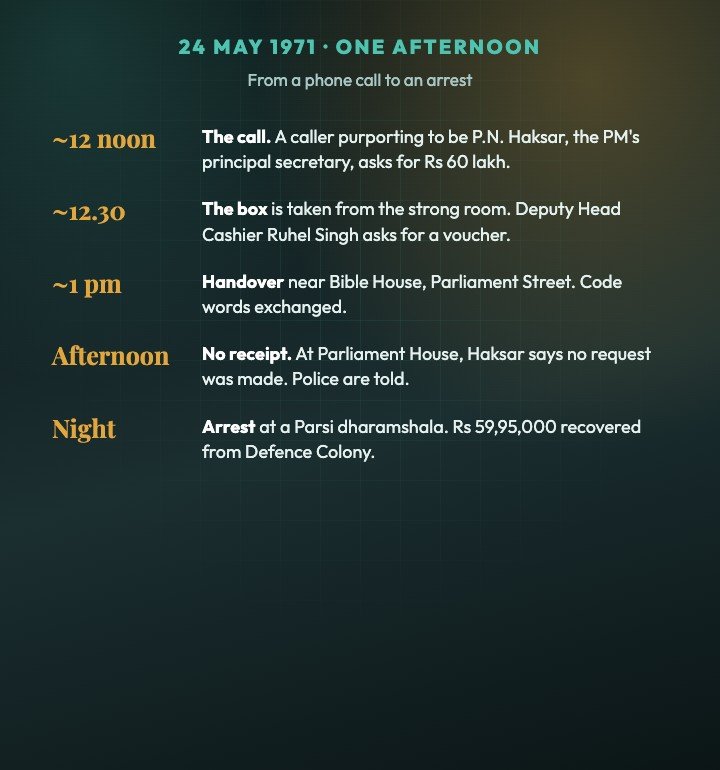
Nagarwala is traced and arrested The heist, 24 May 1971
What happened: Police traced Nagarwala to a Parsi dharamshala in Delhi where he was staying, and arrested him. They recovered Rs 59,95,000 from a house in Defence Colony where he had left the box with a friend. A Business Standard review says all but about Rs 6,000 was recovered.
Why it matters: A fraud against a nationalised bank was solved within hours, which was part of why its later handling looked odd.
Malhotra goes for the receipt and learns he was duped The heist, 24 May 1971
What happened: Malhotra went to the Prime Minister’s residence but could not get access, then to Parliament House. There he met Principal Secretary P.N. Haksar and asked for the receipt. Haksar said neither the Prime Minister nor anyone for her had asked for money. Malhotra told senior police officers.
Why it matters: At the bank, Deputy Head Cashier Ruhel Singh had signed the cash book but demanded a voucher, was told it would come, and repeated the request. When no voucher arrived and Malhotra did not return, he reported it to superiors and to the police.
Rs 60 lakh is handed over near Bible House The heist, 24 May 1971
What happened: Malhotra had the box taken from the strong room by two cash coolies, put it in a bank car and drove off. Near Bible House on Parliament Street he met R.S. Nagarwala, who said he was the courier and gave the code words. A review quotes them as ‘Bangladesh ka babu’ and ‘Bar-at-law’.
Why it matters: The money left the bank on a verbal order with no cheque, voucher or written authority.
The telephone call The heist, 24 May 1971
What happened: At about noon Malhotra received a call from someone purporting to be P.N. Haksar, Principal Secretary to the Prime Minister, saying she needed Rs 60 lakh for Bangladesh and that it was top secret. When Malhotra hesitated, a female voice purporting to be the Prime Minister told him to take the money out himself and hand it to a courier who would use code words. He was promised a voucher and receipt.
Why it matters: East Pakistan was in turmoil and war with Pakistan was widely expected, so a secret payment for Bangladesh sounded plausible to him.
India and the Bangladesh crisis Background
What happened: After the Pakistani military crackdown in East Pakistan in March 1971, millions of refugees crossed into India and a war between India and Pakistan was widely expected. India was backing the Bangladesh liberation movement.
Why it matters: That is the background against which a secret payment for Bangladesh looked believable. The State Bank of India had been state-owned since 1955, and Indira Gandhi had nationalised fourteen other major banks in 1969.
How the Fraud Worked, and Why It Worked
One afternoon, five steps, and no written authority at any point.
Bangladesh, in May 1971
- Refugees were pouring in and war looked likely.
- A secret payment for Bangladesh sounded plausible.
Haksar, then the PM
- A caller claimed to be P.N. Haksar, then a female voice claimed to be the Prime Minister.
- Whose voices they were is unresolved.
No voucher, no cheque
- Ruhel Singh asked for a voucher and did not get one.
- Reddy criticised the bank’s procedures.
Duped, said the court
- The High Court held his conduct showed no dishonesty.
- It said he may have broken bank rules.
Fast on one case
- Nagarwala’s investigation took three days.
- Malhotra’s was incomplete after about six months.
A one-day trial
- Confession, plea and sentence on 27 May 1971.
- Set aside on appeal; retrial never finished.
The Numbers, and Where They Come From
Every figure is attributed. Reports differ on some details.
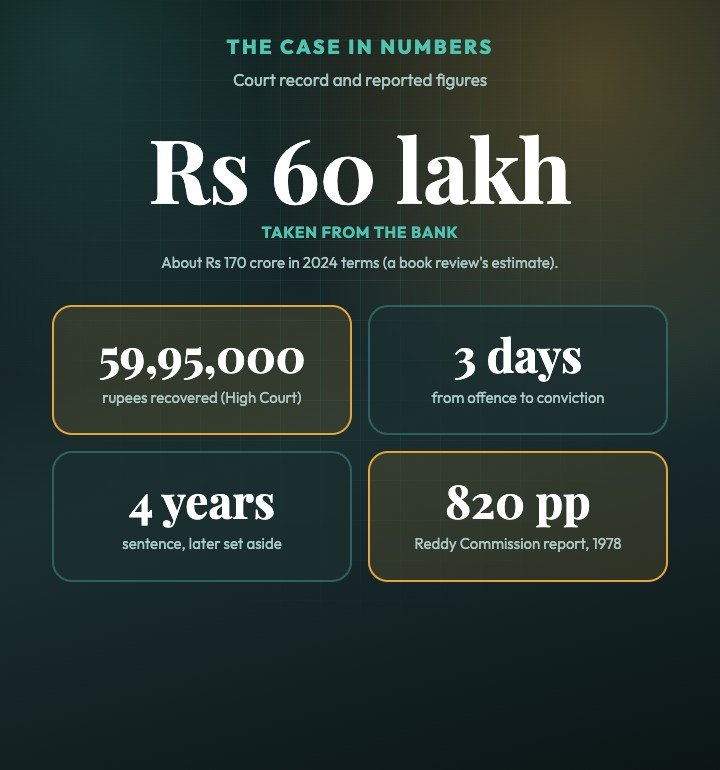
| Measure | Figure | Source / note |
|---|---|---|
| Amount taken | Rs 60 lakh | Delhi High Court judgment, 24 Nov 1971 |
| Amount recovered | Rs 59,95,000 | High Court; a Business Standard review says all but about Rs 6,000 |
| Value in 2024 terms | About Rs 170 crore | Estimate in a 2024 book review; depends on the inflation measure |
| Time to conviction | 3 days (24 to 27 May 1971) | Wikipedia, Business Standard; confession and plea on 27 May per the High Court |
| Sentence | Four years (reported) | Wikipedia and Business Standard; the High Court says only ‘various terms’; set aside on appeal |
| Death | 22 Mar 1972 (some accounts: 2 Mar) | Business Standard review; cause reported as heart attack |
| Reddy Commission report | About 820 pages, 1978 | Wikipedia; Asian Age book review |
Two Investigations, Two Speeds
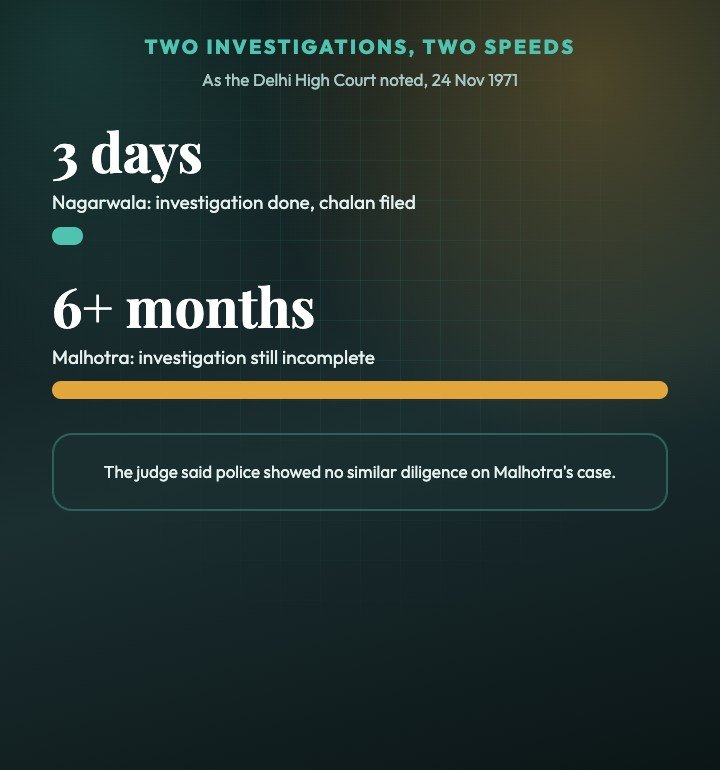
The Delhi High Court itself drew attention to the gap.
What the High Court observed (24 Nov 1971)
- Police finished Nagarwala’s case and filed the chalan within three days.
- The investigation against Malhotra was still incomplete after about six months.
- Had police shown similar diligence there, Nagarwala would have had no reasonable grounds for doubt.
What the court did not do
- It did not stay Nagarwala’s trial.
- It did not find a case against Malhotra.
- It left the weight of Malhotra’s evidence to the trial court.
What Is Established and What Is Theory
Theories below are labelled as such. None was proved by a court or by the Reddy Commission.
On the record
- Nagarwala collected the money and was arrested that night.
- The confession should have been rejected (Reddy).
- No evidence the money was the Prime Minister’s (Reddy).
- Malhotra was duped, with no dishonesty shown (High Court).
Unanswered
- Who made the call and whose voice was used.
- Whether the money was the bank’s or held for someone else.
- Why the payment was sought.
Speculation
- A covert fund for the Bangladesh war.
- Money for a political or private project.
- That Nagarwala did not die in custody.
- Indira Gandhi told the commission she knew none of the persons involved.
Key People and Bodies
Being named is not, by itself, a finding against anyone.
| Name | Role | Part in the story |
|---|---|---|
| Ved Prakash Malhotra | Chief cashier, SBI Parliament Street | Took out the money; held duped, with no dishonesty shown, by the High Court |
| Rustom Sohrab Nagarwala | Former army captain | Recorded as the courier; convicted 27 May 1971, set aside; died in custody 1972 |
| Ruhel Singh | Deputy Head Cashier | Signed the cash book, demanded a voucher and reported the payment |
| P.N. Haksar | Principal Secretary to the Prime Minister | Name used by the caller; told Malhotra no money had been requested |
| D.K. Kashyap | Assistant Superintendent of Police | Led the investigation; died in a road accident, Nov 1971 |
| R.K. Maheshwari | Counsel for Nagarwala | Argued for Malhotra to be tried with him |
| Justice P. Jaganmohan Reddy | Retired Supreme Court judge | Headed the 1977 inquiry; report of 1978 |
Explore More Timelines
People Also Ask
Frequently Asked Questions
Dated facts, and the points on which accounts of the case differ.
⚠️ Editorial Note
This case involves public figures, including a former Prime Minister. Court findings and the commission’s conclusions are kept apart from theories, which are labelled as unproved. Some details, including Nagarwala’s exact date of death, the sentence length and Kashyap’s date of death, differ by source and are flagged. Information current as of 5 November 2026.
Sources & Further Reading
- Delhi High Court: R.S. Nagarwala v. State (24 November 1971)
- Wikipedia: Nagarwala case
- Business Standard: The Nagarwala scandal, unreconstructed (book review, 2024)
- Asian Age: The 1971 Rs 60L SBI heist, did the bank keep Indira’s unaccounted money? (2024)
- Deccan Chronicle: 50 Years On, unanswered questions in India’s first major political-bank scandal
- The Tribune: The Scam That Shook a Nation, recalling the mother of all scams of the 1970s
Related Reading on AiTimeline
Sources & further reading
Every dated entry above was checked against these references. Last reviewed 5 November 2026.
- Delhi High Court: R.S. Nagarwala v. State (24 November 1971)
- Wikipedia: Nagarwala case
- Business Standard: The Nagarwala scandal, unreconstructed (book review, 2024)
- Asian Age: The 1971 Rs 60L SBI heist, did the bank keep Indira's unaccounted money? (2024)
- Deccan Chronicle: 50 Years On, unanswered questions in India's first major political-bank scandal
- The Tribune: The Scam That Shook a Nation, recalling the mother of all scams of the 1970s