Mizo Uprising and Aizawl Bombing Timeline: 1966 to Present
The 1966 Mizo uprising began with Operation Jericho and the bombing of Aizawl by the Indian Air Force. Trace the Mautam famine's political roots, two
Latest Story
The Mizo uprising began on 28 February 1966, when the Mizo National Front launched a coordinated armed offensive against government installations in the Mizo Hills, then part of Assam. Days later, Indian Air Force aircraft struck targets in and around Aizawl — one of the most controversial episodes in independent India’s history, remembered in Mizoram as the bombing of Aizawl. The roots of the revolt lay in a devastating 1959 famine and years of political grievance; its resolution took two decades of counter-insurgency, negotiation and, eventually, the 1986 Mizoram Peace Accord and statehood in 1987. This record keeps the military operation, the civilian experience of it, and the long political settlement that followed as distinct, dated threads.
💡 Short Answer
The Mizo uprising began on the night of 28 February 1966, when the Mizo National Front (MNF) launched Operation Jericho against government and security installations in the Mizo Hills, then declared independence on 1 March. On 5–6 March 1966, the Indian Air Force struck targets in Aizawl to relieve the besieged Assam Rifles garrison — an episode remembered as the bombing of Aizawl, with the scale of civilian harm still disputed. The MNF shifted to guerrilla warfare for two decades until the Government of India and the MNF signed the Mizoram Peace Accord on 30 June 1986. Mizoram became a full state on 20 February 1987.
Mizo Uprising: Key Questions
The Uprising in Ten Points
- The spark: the Mautam famine that began in 1959, caused by a bamboo-flowering rat plague, fed distrust of government relief and gave rise to the Mizo National Famine Front (named in September 1960).
- The turn to politics: on 22 October 1961 the famine-relief body was renamed the Mizo National Front (MNF) under Laldenga, now seeking independence.
- Operation Jericho: launched the night of 28 February 1966 against Assam Rifles posts, offices and communication lines across the Mizo Hills.
- The declaration: on 1 March 1966 Laldenga declared independence; MNF fighters seized the Aizawl treasury and telephone exchange but failed to take the Assam Rifles headquarters, which they besieged.
- The airstrikes: from 5–6 March 1966 the IAF struck MNF-held positions in and around Aizawl — civilian destruction and displacement followed, with casualty figures still disputed.
- Control restored, but not the conflict: the Army reached Aizawl on 7 March and retook every seized place by 25 March 1966, yet the MNF shifted to guerrilla warfare for two decades.
- Village regrouping: from 1967 the government relocated dispersed villages under Operation Accomplishment, a counter-insurgency policy whose lasting effect on public support is now contested by recent scholarship.
- Union Territory status: Mizoram separated from Assam on 21 January 1972, a partial answer to the autonomy demand that did not end the armed conflict.
- The Peace Accord: signed 30 June 1986 between the Government of India and the MNF, ending armed activity and opening the path to statehood.
- Statehood and memory: Mizoram became a full state on 20 February 1987; the bombing and the peace are separately remembered every year as Zoram Ni and Remna Ni.
Timeline: From the Mautam Famine to Forty Years of Peace
Entries are colour-coded by phase of the conflict and settlement. Newest first.
Mizoram marks 40 years of the Peace Accord Remembrance
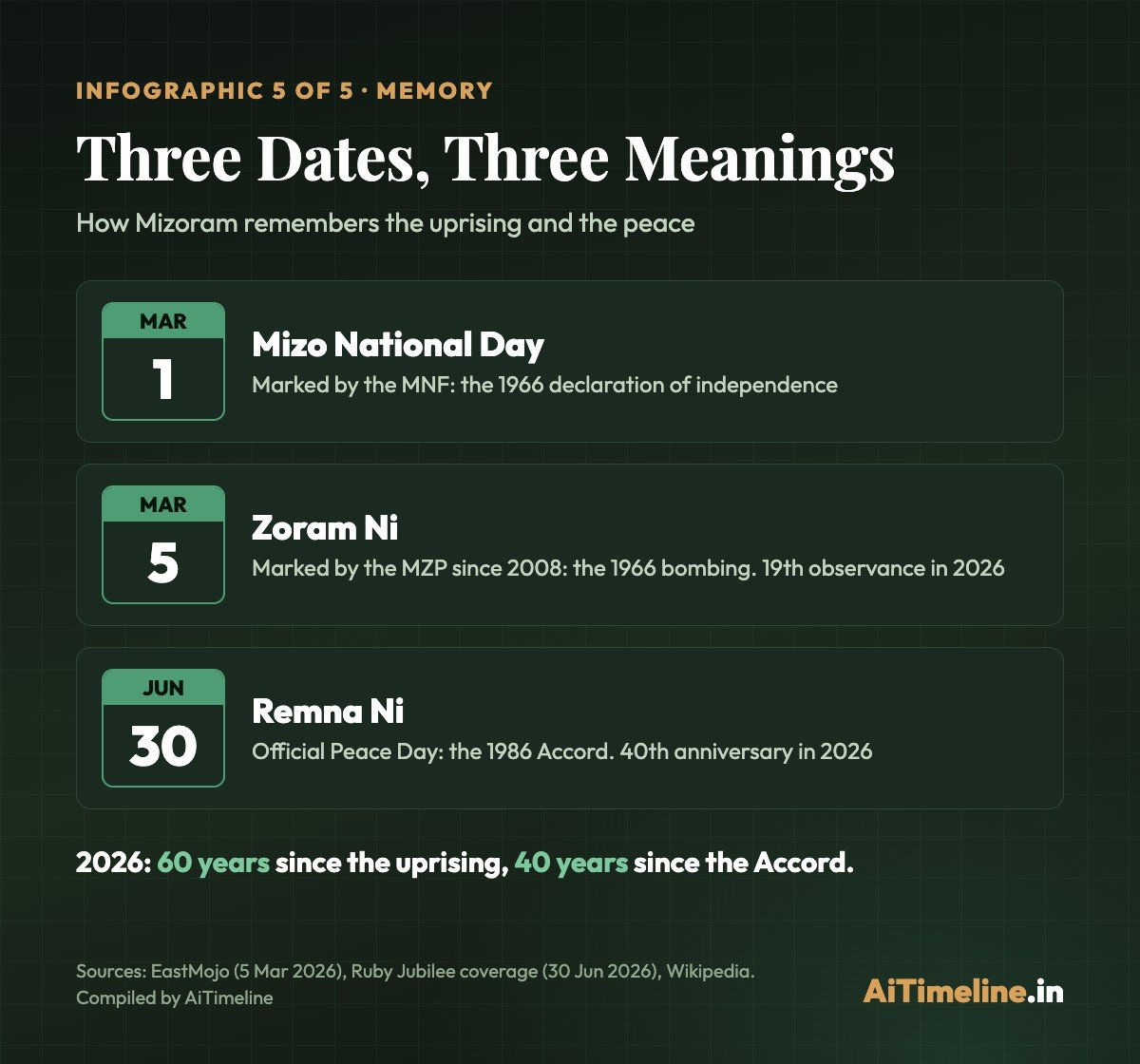
What happened: The 40th anniversary of the 1986 Accord was commemorated as the Ruby Jubilee of Remna Ni. The Zoram Research Foundation and Aijal Club organised an event under the theme “From the Frontlines of ’66 to 40 Years of Peace,” which included the premiere of a documentary series on the Accord.
Governor (Dr) Vijay Kumar Singh launched a project titled The Case Study of the Enduring Legacy of the Mizo Peace Accord, called four decades of uninterrupted peace a remarkable achievement and urged people not to take it for granted.
Mizo Zirlai Pawl holds its 19th Zoram Ni observance Remembrance
What happened: Mizoram’s largest student organisation held its 19th Zoram Ni at its conference hall in Aizawl. The MZP has marked 5 March since 2008 to remember the 1966 bombing; according to EastMojo’s report, its leadership said the remembrance honours those who died or were injured and preserves historical memory, not hatred or renewed rebellion.
Context: The MZP has in past years called on the Centre to apologise for the 1966 air operations. No such apology has been issued.
The 1966 airstrikes are raised in the Lok Sabha Remembrance
What happened: Replying to a no-confidence motion debate, Prime Minister Narendra Modi referred to the Air Force strikes on Mizoram on 5 March 1966, bringing the episode back into national political debate nearly six decades later. The MZP cited the remarks at its 2026 Zoram Ni observance.
What this is not: A parliamentary speech is political argument, not an official inquiry or apology; it did not change the historical record of the event.
The MNF becomes a political party; insurgency gives way to elections Peace
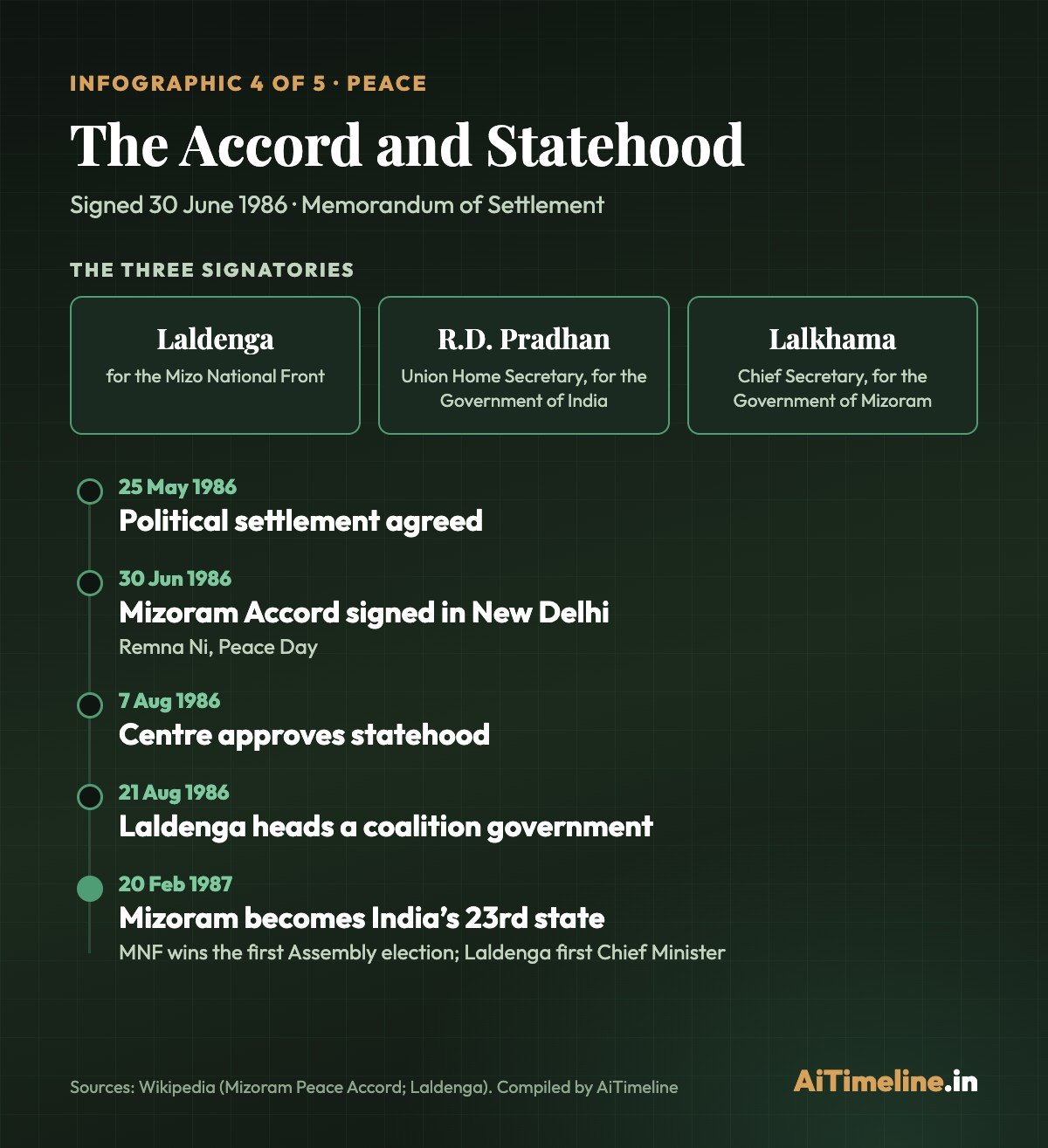
What happened: With the insurgency over, Laldenga headed a coalition government from 21 August 1986, with outgoing Chief Minister Lal Thanhawla as his deputy. After the MNF won the February 1987 Assembly elections, he became the first Chief Minister of the new State. Elections and state institutions replaced armed confrontation as the principal means of political competition in Mizoram.
Mizoram becomes a full state of India Peace
What happened: Following the 1986 Accord and the Centre’s approval of statehood on 7 August 1986, Mizoram was elevated from a Union Territory to become the 23rd state of the Indian Union. This completed a central part of the political settlement that the 1972 Union Territory status had only partly delivered.
What this is not: Statehood is a separate milestone from the Peace Accord signing, eight months earlier — the 2026 Remna Ni anniversary marked the accord, not statehood.
Mizoram Peace Accord signed Peace
What happened: After a political settlement agreed on 25 May 1986, the Government of India, under Prime Minister Rajiv Gandhi, and the Mizo National Front signed the Mizoram Accord, 1986 (Memorandum of Settlement) in New Delhi on the evening of 30 June. The MNF agreed to end armed activity, bring its underground personnel into the constitutional process and surrender weapons; the government undertook to restore normalcy and address rehabilitation, compensation and Mizoram’s path to statehood.
Negotiations between New Delhi and Laldenga gradually advance Transition
What happened: The Union government maintained contacts with MNF leader Laldenga through the early 1980s. Talks explored ending armed activity, bringing underground members into civilian life, restoring administrative normalcy, granting statehood, and addressing compensation, rehabilitation and Mizo cultural interests — the questions the 1986 Accord eventually settled.
MNF accepts a settlement within India’s Constitution Transition
What happened: After Laldenga travelled to Delhi for the first official round of talks, an agreement was signed in which the MNF accepted that Mizoram is an integral part of India and that the problem would be settled within the framework of the Constitution.
What this is not: It was not the final peace. Disputes over its implementation, including the surrender of arms, kept the conflict going for another decade.
Mizoram becomes a Union Territory, separated from Assam Transition
What happened: Negotiations between the Union government and the Mizo Union, the party then leading the Mizo District Council, produced Union Territory status as an intermediate arrangement. This administratively separated the Mizo Hills from Assam under the name Mizoram.
What this is not: UT status addressed part of the autonomy demand but did not end the insurgency — the MNF continued pursuing full independence for another decade and a half.
Village regrouping and counter-insurgency intensify Transition
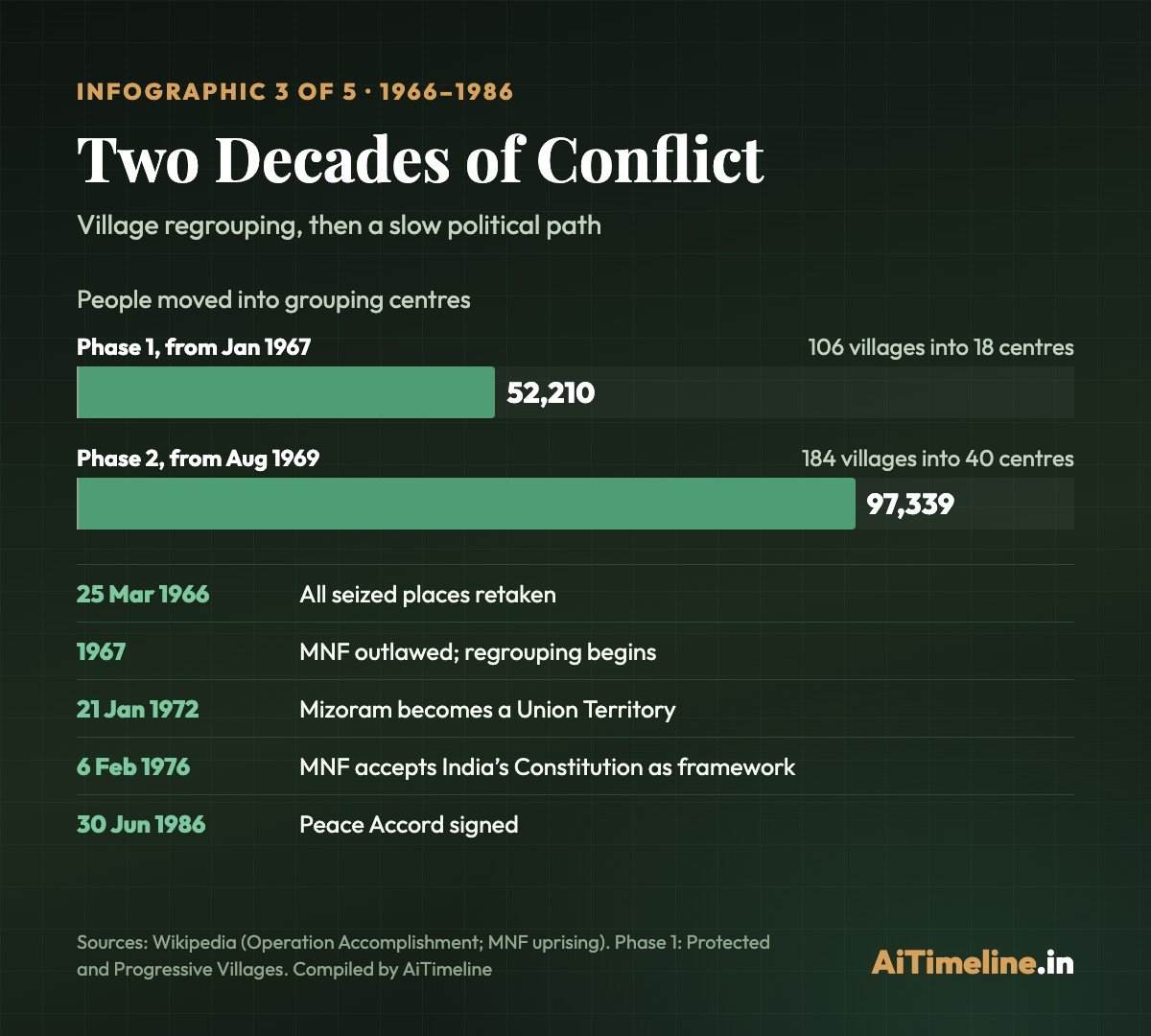
What happened: From January 1967 the government relocated residents from dispersed villages into larger settlements along the main road, aiming to separate insurgents from the civilian population. The first phase grouped 106 villages into 18 centres holding 52,210 people; a second phase from August 1969 grouped 184 villages into 40 centres holding 97,339 people. Residents’ accounts record forced moves, curbs on movement and disrupted farming, and later phases were challenged before the Gauhati High Court in Chhuanvawra v. State of Assam.
What recent research adds: A 2024 academic study by historian Benjamin Holt, published online in War in History (SAGE) on 26 November 2024, challenges the traditional account that this campaign quickly secured lasting public support — it argues coercive practices and civilian grievances helped sustain resentment rather than defeat the MNF outright.
Indian forces regain control; MNF shifts to guerrilla warfare Conflict
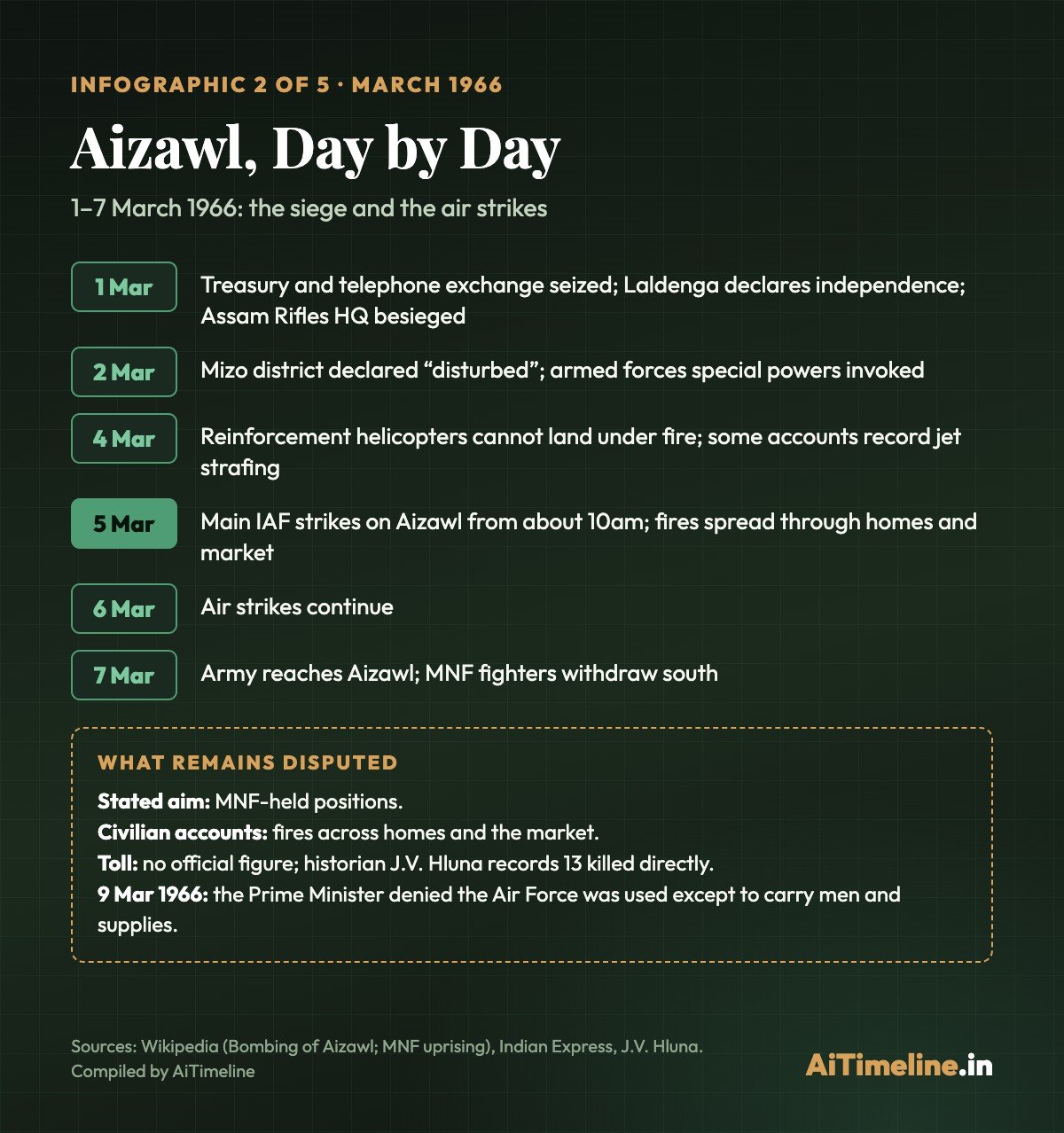
What happened: The Army reached Aizawl on 7 March as MNF fighters withdrew south. Air operations continued against other sites, including Hnahlan near Champhai on 7 March and Demagiri from 9 to 13 March. By 25 March 1966 government forces had recaptured every place the MNF had seized; its leadership and many armed members crossed into then East Pakistan.
What this is not: The defeat of the initial offensive did not end the insurgency — it shifted it to guerrilla warfare for roughly two more decades.
Indian Air Force strikes Aizawl Conflict
What happened: The MNF had besieged the 1st Assam Rifles headquarters in Aizawl, and helicopters carrying reinforcements could not land under fire. Some accounts record jets strafing MNF positions on the afternoon of 4 March; the main strikes came on 5 March 1966, when four Toofani and Hunter aircraft were seen over Aizawl from about 10am, and continued on 6 March. The Indian Express account describes 30mm cannons and T-10 rockets; Mizo eyewitness accounts also describe incendiary bombs, and the weapons used are still debated.
The civilian experience: Residents fled to surrounding hills as fires spread through residential areas and the main market. Historian J.V. Hluna records 13 people killed as a direct result of the bombing; other accounts differ, and no official toll exists. On 9 March 1966 Prime Minister Indira Gandhi told the Hindustan Standard that the Air Force had been used only to carry men and drop supplies — a denial contradicted by later military accounts. The military’s stated aim was rebel positions; civilian accounts document destruction beyond them. Both belong in the record.
MNF declares independence from India Conflict
What happened: In the early hours of 1 March 1966, MNF fighters attacked the Aizawl telephone exchange and looted the District Treasury of money, arms and ammunition, paralysing the civil administration. Laldenga declared independence the same day, calling on all Mizos to join the revolt. The 1st Assam Rifles headquarters in Aizawl, where the Deputy Commissioner had taken shelter, held out against repeated attacks and refused to surrender.
What this is not: The declaration received no recognition from India or the international community. The Indian government treated the action as an armed rebellion and began deploying additional security forces.
Operation Jericho begins Conflict
What happened: On the night of 28 February–1 March, MNF forces launched simultaneous attacks on the Assam Rifles garrisons at Aizawl, Lunglei and Champhai and on Border Security Force posts across the district, after cutting telephone lines. The Champhai post fell quickly; the Aizawl headquarters did not. The operation was named after the biblical fall of Jericho.
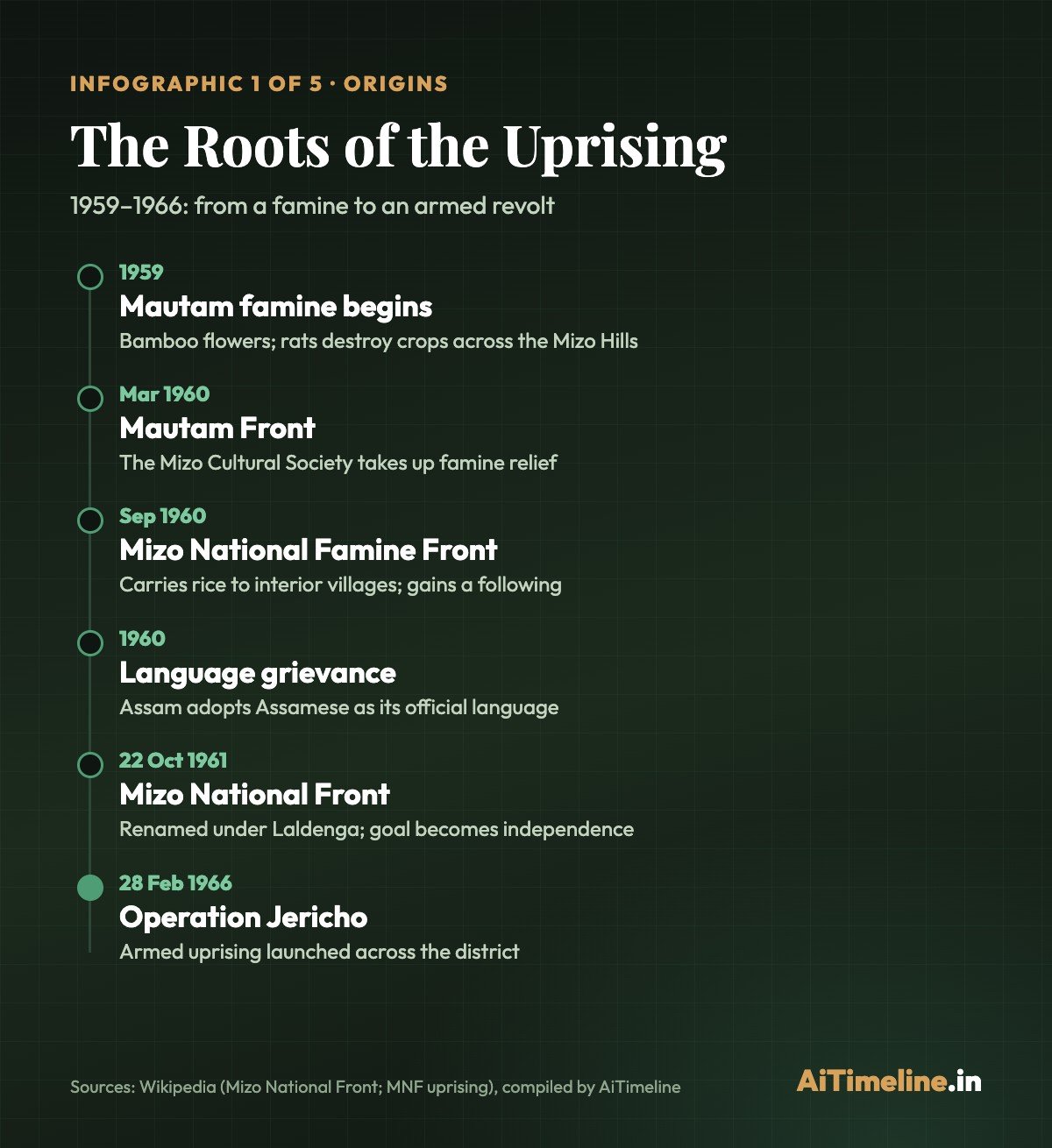
Mizo National Famine Front is renamed the Mizo National Front Origins
What happened: The organisation founded to coordinate famine relief was renamed the Mizo National Front under Laldenga’s leadership, its objective shifting toward political separation and an independent Mizo nation.
The Mautam famine begins; a famine-relief front forms Origins
What happened: Bamboo flowering triggered a surge in rat populations that destroyed crops across the Mizo Hills, producing the severe food crisis known as Mautam. Many residents believed the Assam and Union governments responded inadequately. The Mizo Cultural Society, with Laldenga as secretary, became the Mautam Front in March 1960 and the Mizo National Famine Front in September 1960, moving rice to interior villages and gaining a political following. Assam’s adoption of Assamese as its official language in 1960 deepened the grievance.
The Counter-Insurgency Years, Explained
Village regrouping disrupted ordinary life for years — and recent research questions whether it won the lasting support it claimed to.
After the 1966 offensive was broken, the government pursued a sustained counter-insurgency campaign rather than a quick victory. Its central policy relocated residents from scattered villages into larger, more easily controlled settlements — commonly associated with the names Protected and Progressive Villages and Operation Accomplishment. The stated security objective was to separate insurgents from the population and deny the MNF food, shelter and local support.
For families, the policy meant disrupted homes, interrupted agricultural routines and years of restriction and insecurity. A 2024 academic study by historian Benjamin Holt, published online in the peer-reviewed journal War in History (SAGE) on 26 November 2024, challenges the traditional account that this campaign quickly secured lasting public support for the government. It argues that coercive practices and civilian grievances helped sustain resentment and did not decisively defeat the MNF — a reminder that the fighting in 1966 and the counter-insurgency years that followed are not the same story.
The March 1966 offensive
- 28 Feb 1966 — Operation Jericho launched
- 1 Mar 1966 — MNF declares independence
- 5–6 Mar 1966 — IAF strikes Aizawl
- 25 Mar 1966 — all seized places retaken
The two decades after
- 1967–70 — village regrouping, Operation Accomplishment
- 21 Jan 1972 — Union Territory status granted
- 6 Feb 1976 — MNF accepts the constitutional framework
- 30 Jun 1986 — Mizoram Peace Accord signed
1966 vs 1986: Two Moments in the Same Conflict
Why the Settlement Is Remembered as a Model — and Why Memory Still Matters
The peace agreement did not erase the memories of the conflict it ended.
The 1986 Accord brought the two-decade insurgency to an end and created the foundation for a more stable political environment; the MNF became a political party operating within India’s constitutional framework, and elections replaced armed confrontation as the principal means of political competition. The settlement is often cited as an example of negotiated conflict resolution in India’s Northeast.
But the experience should not be reduced to a single military or political explanation. For the Indian government, the 1966 operation was a response to an armed challenge to state authority. For many Mizo residents, the airstrikes, village relocations and years of military operations became memories of civilian suffering and political alienation. Both the ceasefire’s durability and the continuing remembrance of the bombing are part of the historical record.
Discover: Facts worth knowing
- The 1966 offensive against Aizawl, Lunglei and Champhai was code-named Operation Jericho by the MNF itself.
- A 2024 peer-reviewed study titled “An ‘Elephant Trying to Chase a Rat’: Indian COIN in the Mizo Hills, 1967–1970” directly challenges the older narrative of quick counter-insurgency success.
- Zoram Ni (5 March) and Remna Ni (30 June) are two separate, non-overlapping days of remembrance — one for the bombing, one for the peace.
- The MNF itself marks 1 March, the day of the 1966 declaration, as “Mizo National Day” — a third date, distinct from both Zoram Ni and Remna Ni.
- The Accord was signed late on the evening of 30 June 1986, hours before Home Secretary R.D. Pradhan was due to retire; his service was extended to midnight so he could sign.
- The 2026 Remna Ni Ruby Jubilee marked the Accord’s 40th anniversary, not the 40th anniversary of Mizoram’s statehood — those are different dates, eight months apart.
Who Was Involved
Three parties, three different roles across two decades.
Mizo National Front
Formed from the 1959 famine-relief body, launched Operation Jericho in 1966, waged a two-decade guerrilla campaign, then signed the 1986 Accord and entered electoral politics.
Government of India
Deployed the Army and Air Force in 1966, pursued village-regrouping counter-insurgency through the late 1960s, negotiated through the 1980s and signed the 1986 Accord.
Government of Mizoram
Administered the territory through its transition from District to Union Territory (1972) to full state (1987), and co-signed the 1986 settlement through its Chief Secretary.
Key People and Signatories
Being named in the record is not, by itself, a verdict on anyone’s role.
| Person | Role | Part in the record |
|---|---|---|
| Laldenga | Founder-leader, Mizo National Front (1927–1990) | Led the MNF from its 1961 founding through the 1966 uprising and the 1986 Accord; headed the government from August 1986 and became the State’s first Chief Minister in 1987 |
| Indira Gandhi | Prime Minister of India from January 1966 | Headed the central government during the 1966 military response; on 9 March 1966 publicly denied the Air Force had been used except to carry men and supplies |
| Rajiv Gandhi | Prime Minister of India, 1984–1989 | His government negotiated and concluded the 1986 Accord |
| R.D. Pradhan | Union Home Secretary, Government of India | Signed the Mizoram Accord, 1986 on behalf of the Government of India |
| Lalkhama | Chief Secretary, Government of Mizoram | Co-signed the 1986 Accord for the Mizoram administration |
| Benjamin Holt | Historian | Published a 2024 archival study (SAGE, War in History) challenging the traditional account of early counter-insurgency success |
| General (Dr) Vijay Kumar Singh | Governor of Mizoram, 2026 | Spoke at the 30 June 2026 Ruby Jubilee observance of the Peace Accord’s 40th anniversary |
Zoram Ni vs Remna Ni: Two Commemorations, Not One
They are often confused — here is the distinction in one table, with a third date the MNF marks itself.
| Zoram Ni | Remna Ni | |
|---|---|---|
| Date | 5 March (annual) | 30 June (annual) |
| What it marks | The 1966 Aizawl bombing and the suffering of the uprising | The 1986 Mizoram Peace Accord (“Peace Day”) |
| Organised by | Mizo Zirlai Pawl (MZP), Mizoram’s main student organisation | Government of Mizoram and civil-society bodies, e.g. Aijal Club |
| Not to be confused with | 1 March, the date of the 1966 declaration, which the MNF marks as “Mizo National Day” | |
| 2026 milestone | 19th Zoram Ni observance | 40th anniversary (Ruby Jubilee) |
⚠ What the record does and does not establish
No official civilian death toll for the Aizawl bombing exists. One figure, 13 people killed directly, comes from historian J.V. Hluna and is attributed to him here rather than stated as settled fact; other accounts differ. The military described its targets as rebel positions; civilian accounts and later research document destruction and suffering distinct from that targeting claim. Both belong in the record, and neither cancels the other.
Explore More Timelines
People Also Ask
Quick answers to common follow-up questions.
Frequently Asked Questions
Dated facts and the distinctions most often blurred in popular accounts.
Sources & Further Reading
- Mizo National Front uprising — overview and background, Wikipedia.
- Bombing of Aizawl — the 1966 air operation, Wikipedia.
- Mizoram Peace Accord — the 1986 settlement, Wikipedia.
- Mautam — the bamboo-flowering famine cycle, Wikipedia.
- Operation Accomplishment — the village-regrouping counter-insurgency policy, Wikipedia.
- The Indian Express — “Air Force’s ops in Mizoram: How Operation Jericho was quelled” (16 August 2023).
- War in History (SAGE) — “An ‘Elephant Trying to Chase a Rat’: Indian COIN in the Mizo Hills, 1967–1970” (published online 26 November 2024).
- Laldenga — MNF leader and first Chief Minister of the State, Wikipedia.
- March 5: The day the Indian Air Force bombed Mizoram — EastMojo (5 March 2025).
- MZP remembers 1966 bombing during 19th Zoram Ni event — EastMojo (5 March 2026).
- Four decades after peace accord, Mizoram remains disturbance-free — Ruby Jubilee of Remna Ni coverage (30 June 2026).
- J.V. Hluna & Rini Tochhawng, The Mizo Uprising: Assam Assembly Debates on the Mizo Movement, 1966–1971 (Cambridge Scholars Publishing, 2012).