Madhumita Shukla Murder: Timeline of a Political Crime
Madhumita Shukla murder case timeline: the 2003 Lucknow killing, the CBI probe, Amarmani Tripathi's 2007 conviction and the 2023-2026 remission rulings.
Latest Story
The Madhumita Shukla murder case began on 9 May 2003, when the young Hindi poet was shot dead at her home in Lucknow. The post-mortem found she was pregnant, and a DNA test showed the father was Amarmani Tripathi, then a minister in the Uttar Pradesh government. The CBI charged him, his wife Madhumani and four others with murder and conspiracy. The Supreme Court cancelled their bail, moved the trial to Dehradun, and in 2007 four of them were sentenced to life. The convictions became final in 2013. Since 2023 the case has been about something else: remission, and whether the convicts should walk free early. This record keeps the court findings apart from the prosecution’s allegations and the later executive decisions.
💡 Short Answer
Madhumita Shukla, a Hindi poet, was shot dead in Lucknow on 9 May 2003 while about six months pregnant. DNA showed Uttar Pradesh minister Amarmani Tripathi was the father. A Dehradun court convicted him, his wife Madhumani, Rohit Chaturvedi and shooter Santosh Kumar Rai in October 2007; a second shooter, Prakash Chandra Pandey, was convicted on appeal in 2012. The Supreme Court upheld the verdict in 2013. The Tripathis were released on remission in August 2023, and courts cleared the release of two more convicts in 2026.
Madhumita Shukla Case: Key Questions
The Case in Ten Points
- The murder: Madhumita Shukla was shot dead at her Lucknow home on 9 May 2003.
- The evidence: she was about six months pregnant, and DNA showed Amarmani Tripathi was the father.
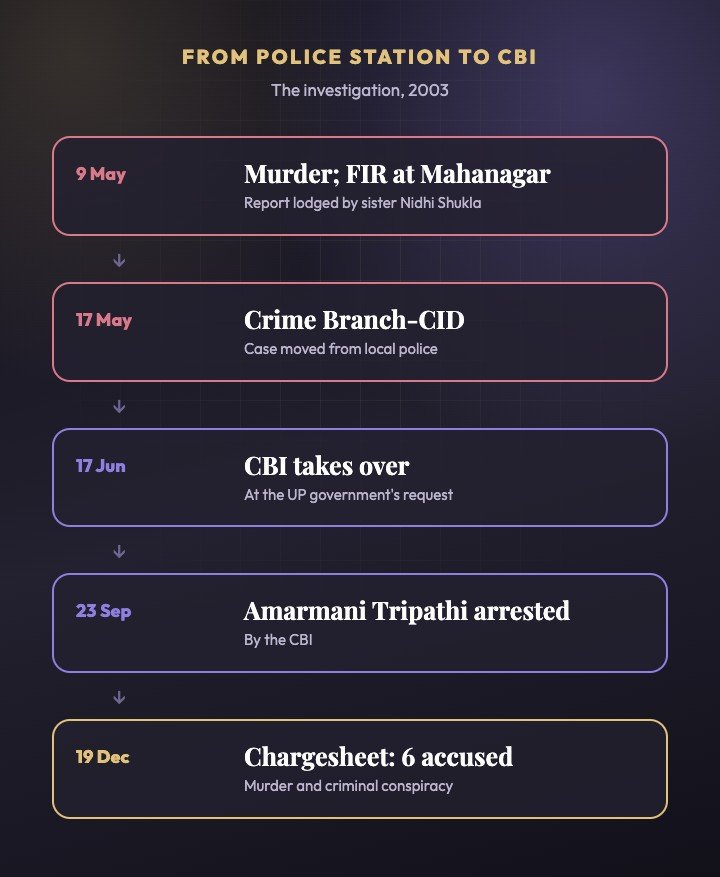
- The probe: local police, then the Crime Branch-CID on 17 May, then the CBI from 17 June 2003.
- The charge: on 19 December 2003 the CBI charged six people with murder and conspiracy.
- The bail fight: the Supreme Court cancelled the Tripathis’ bail on 26 September 2005, citing interference with witnesses.
- The transfer: the trial was moved out of Uttar Pradesh to Dehradun on 8 February 2007.
- The verdict: four life sentences on 24 October 2007; a fifth on appeal in 2012; upheld by the Supreme Court in 2013.
- The release: the Tripathis walked out on Uttar Pradesh remission on 25 August 2023.
- The 2026 rulings: the Supreme Court freed Rohit Chaturvedi in May; the Uttarakhand High Court cleared Santosh Kumar Rai in October.
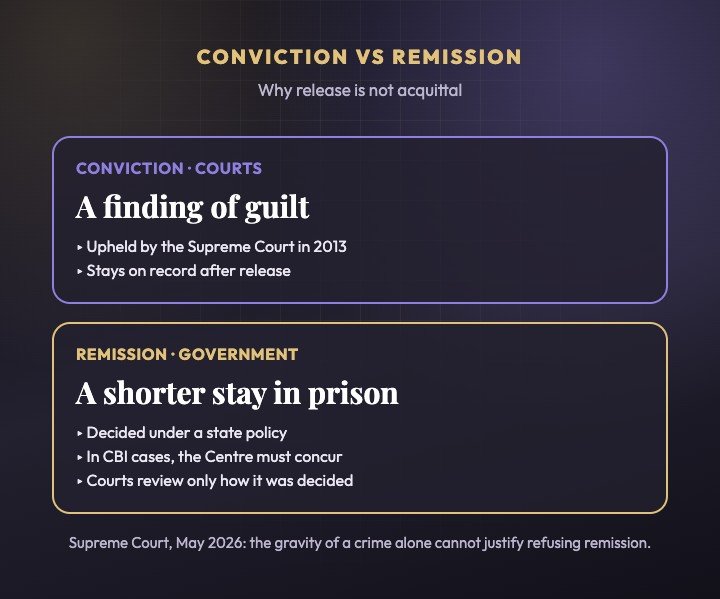
- The distinction: remission shortened their sentences; it did not overturn a single conviction.
Timeline: Madhumita Shukla Murder Case, 2003–2026
Entries are colour-coded by track and run newest first. Allegations are marked as the prosecution’s case.
Uttarakhand High Court clears the way for Santosh Kumar Rai’s release Remission & release
What happened: Hearing a suo motu petition along with pleas from life convicts seeking premature release under Uttarakhand’s remission policy, a division bench cleared the way for the release of Santosh Kumar Rai, one of the two men convicted as the shooters. The Friday order, reported on 31 October, also covered two other life convicts.
What comes next: Officials told The New Indian Express that Rai’s release will follow the state government’s approval, the Governor’s assent and the prescribed formalities. As of 5 November 2026 I found no report that he had actually walked out of jail.
Supreme Court allows Rohit Chaturvedi’s premature release Remission & release
What happened: The Court set aside the Union Home Ministry’s 9 July 2025 rejection of Uttarakhand’s recommendation to release Chaturvedi, calling it arbitrary. Because he was already out on interim bail, it said he need not surrender and should be treated as prematurely released.
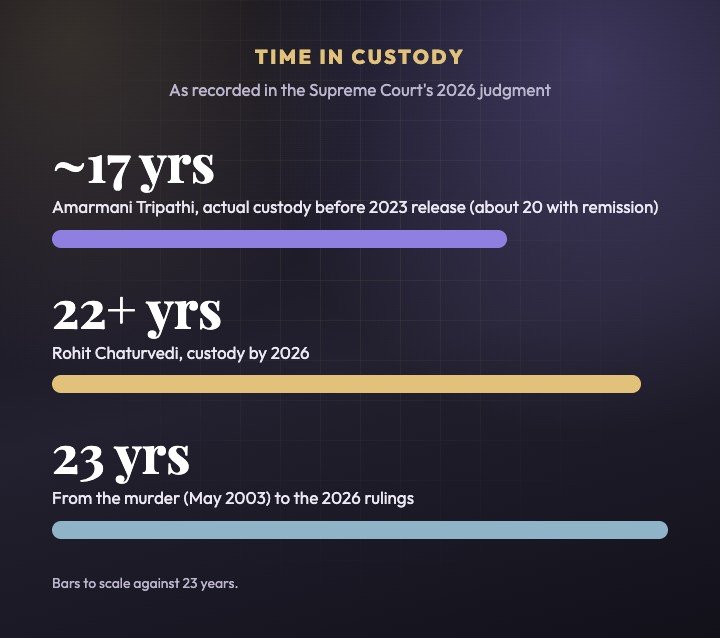
The reasoning: The bench held that the gravity of the crime cannot be the sole ground to refuse remission. It noted he had served more than 22 years, had a good-conduct record, and that co-convict Amarmani Tripathi had been released after about 17 years of actual custody. It said the state’s focus should be reformation, not retribution.
Centre rejects Uttarakhand’s recommendation to release Chaturvedi Remission & release
What happened: Uttarakhand recommended Chaturvedi’s premature release. Because the case was investigated by the CBI, a central agency, the state needed the Centre’s concurrence. The Home Ministry refused it, and Chaturvedi went back to the Supreme Court.
Supreme Court dismisses Nidhi Shukla’s challenge to the Tripathis’ release Remission & release
What happened: The Court dismissed the petition by Madhumita’s sister against the 2023 premature release of Amarmani and Madhumani Tripathi and asked her to approach the High Court concerned. It did not rule on whether the release itself was lawful.
Supreme Court fixes deadlines for Chaturvedi’s remission plea Remission & release
What happened: Unhappy with the delay, the bench ordered Uttarakhand’s state-level committee to place its recommendation before the government within a week, the state to decide within two weeks after that and forward its decision within three days, and the Centre to decide within a month. It listed the case for 28 March 2025 and said it would consider interim bail if the process slipped.
Convict Prakash Chandra Pandey dies of cancer in jail Trial & appeals
What happened: Prakash Chandra Pandey, the second man convicted as a shooter, died of cancer while serving his life sentence in Lucknow jail, ETV Bharat reported. He had been acquitted at trial in 2007 and convicted on the CBI’s appeal in 2012.
Supreme Court takes up Chaturvedi’s remission application Remission & release
What happened: Rohit Chaturvedi, still in prison while the Tripathis had been freed, sought premature release. The Supreme Court passed an order on his application on 15 December 2023, and the question of which government was competent to decide it ran through the litigation that followed. Uttarakhand, where he was convicted, eventually processed it.
Amarmani and Madhumani Tripathi walk out on remission Remission & release
What happened: The Uttar Pradesh government ordered the couple’s premature release under its 2018 remission policy, citing the time they had served, their age and their conduct, and they were released on 25 August 2023. The same day the Supreme Court refused to stay the release and issued notice on Nidhi Shukla’s petition.
The reaction: Madhumita’s family objected strongly, and the release reopened public debate over remission for politically connected convicts.
Supreme Court upholds the convictions Trial & appeals
What happened: The Supreme Court dismissed the appeals against the High Court’s 2012 judgment, leaving the life sentences in place. This ended the convicts’ challenge to the verdict itself.
Uttarakhand High Court upholds four convictions and convicts a fifth man Trial & appeals
What happened: The High Court upheld the life sentences of Amarmani Tripathi, Madhumani Tripathi, Rohit Chaturvedi and Santosh Kumar Rai. On the CBI’s appeal, it also reversed the trial court’s acquittal of Prakash Chandra Pandey and sentenced him to life imprisonment.
Dehradun court convicts four, including the former minister Trial & appeals
What happened: After recording about 79 witnesses, the special court convicted Amarmani Tripathi, Madhumani Tripathi, Rohit Chaturvedi and Santosh Kumar Rai of murder and criminal conspiracy and sentenced each to life imprisonment.
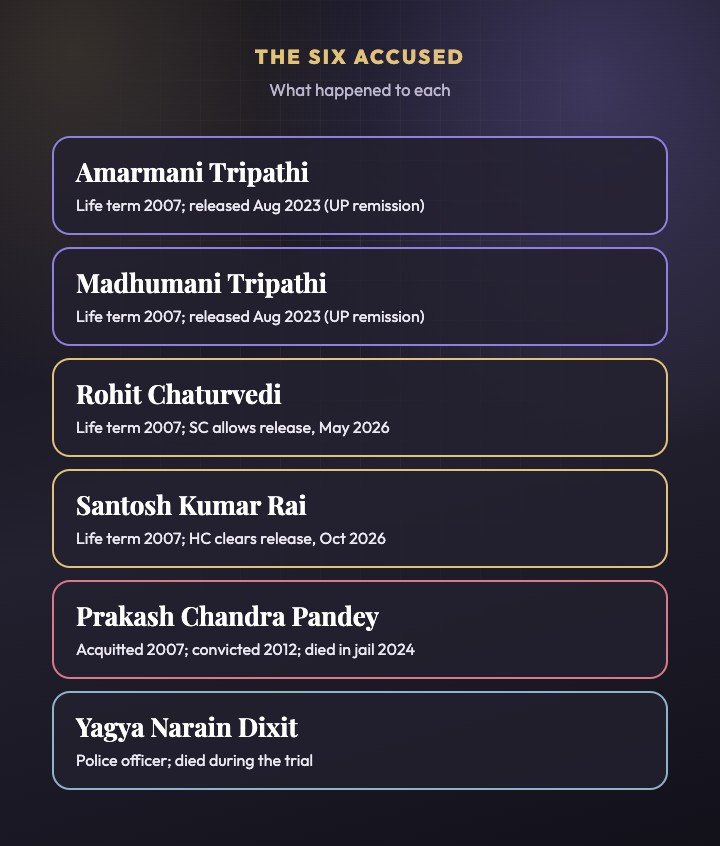
Not convicted: Prakash Chandra Pandey was acquitted for lack of evidence; the High Court later reversed this. The sixth accused, police officer Yagya Narain Dixit, had died during the trial.
Supreme Court moves the trial to Uttarakhand Trial & appeals
What happened: On a plea by Madhumita’s family, who said a fair trial was not possible in Uttar Pradesh, the Supreme Court transferred the case from Lucknow to a special court in Dehradun.
Supreme Court cancels the Tripathis’ bail Trial & appeals
What happened: The Court set aside the Allahabad High Court’s bail orders of 29 April and 8 July 2004 and ordered the couple back into custody.
What the CBI told the Court: The CBI said Amarmani had tried to mislead the investigation, planted false stories in the media, had officers who would not toe his line transferred, and after bail tried to threaten or buy over witnesses, including Nidhi Shukla. The Court found the High Court had not weighed this material.
Allahabad High Court grants bail to the couple Trial & appeals
What happened: In two orders, the High Court granted bail to Amarmani Tripathi and Madhumani Tripathi, reasoning among other things that the chargesheet had been filed and the investigation was over. The CBI appealed.
CBI files chargesheet against six accused Murder & investigation
Who was charged: Amarmani Tripathi, Madhumani Tripathi, Rohit Chaturvedi, Santosh Kumar Rai, Prakash Chandra Pandey and police officer Yagya Narain Dixit.
The prosecution case: The CBI alleged that Madhumani, upset at her husband’s relationship with Madhumita, asked Rohit Chaturvedi, a cousin of Amarmani, to help her teach Madhumita a ‘lesson’. Chaturvedi was alleged to have brought in Santosh Kumar Rai, who brought in Prakash Chandra Pandey.
CBI arrests Amarmani Tripathi Murder & investigation
What happened: Four months after the murder, the CBI arrested Amarmani Tripathi, who had been a minister in the Uttar Pradesh government at the time of the killing. His wife Madhumani was later also taken into custody.
CBI takes over the investigation Murder & investigation
What happened: At the state government’s request, the CBI took over the case from the Crime Branch-CID. The Supreme Court later recorded that the CBI’s investigation revealed a conspiracy involving Amarmani and Madhumani Tripathi.
Case transferred to the Crime Branch-CID Murder & investigation
What happened: The local police investigation was handed to the state’s Crime Branch-CID as questions grew about the victim’s links to a minister.
Madhumita Shukla is shot dead in Lucknow Murder & investigation
What happened: The young Hindi poet was shot dead at her home in the afternoon. Her sister Nidhi Shukla lodged the report at Mahanagar police station the same day.
The post-mortem: It found she was pregnant; the Supreme Court’s 2005 judgment records a foetus of about six months, and a DNA test established that Amarmani Tripathi was the father.
A young poet and a powerful minister Background
Background: Madhumita Shukla was a young Hindi poet who performed at poetry gatherings (kavi sammelans). Amarmani Tripathi was a prominent politician from eastern Uttar Pradesh and a state minister.
The prosecution account: According to the case the CBI put before the courts, the two were in a relationship and Madhumita became pregnant three times; the first two pregnancies were terminated at his instance, and she refused to end the third.
The Case the CBI Proved
What the prosecution alleged, and what the courts accepted.
A pregnancy
- The prosecution said Madhumita was in a relationship with Amarmani and refused to end her third pregnancy.
- DNA from the foetus established his paternity.
A chain of contacts
- Madhumani was alleged to have asked Rohit Chaturvedi to help ‘teach a lesson’.
- He brought in Santosh Kumar Rai, who brought in Prakash Chandra Pandey.
A probe under pressure
- The CBI said Amarmani tried to mislead the probe and had uncooperative officers transferred.
- It said he tried to threaten or buy over witnesses after bail.
How the Case Moved Through the Courts
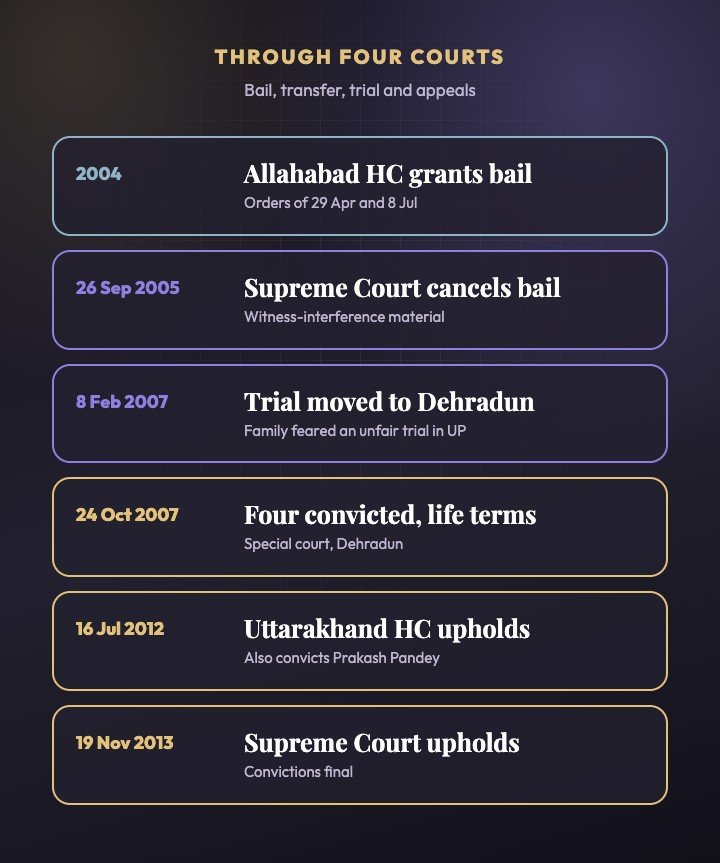
Two interventions by the Supreme Court shaped the trial before it began.
| Date | Court | Decision |
|---|---|---|
| 29 Apr and 8 Jul 2004 | Allahabad High Court | Bail for Amarmani and Madhumani Tripathi |
| 26 Sep 2005 | Supreme Court (Bhan, Raveendran JJ.) | Bail orders set aside; couple back in custody |
| 8 Feb 2007 | Supreme Court | Trial transferred from Lucknow to Dehradun |
| 24 Oct 2007 | Special court, Dehradun | Four convicted, life imprisonment; Pandey acquitted |
| 16 Jul 2012 | Uttarakhand High Court | Convictions upheld; Pandey convicted on CBI appeal |
| 19 Nov 2013 | Supreme Court | Appeals dismissed; convictions final |
Remission: Who Was Released, and by Whom
After 2013 the dispute moved from guilt to the length of the sentence.
| Convict | Decision | By | Status (5 Nov 2026) |
|---|---|---|---|
| Amarmani Tripathi | Premature release, Aug 2023 | Uttar Pradesh government, 2018 policy | Released 25 Aug 2023; SC dismissed challenge 25 Mar 2025 |
| Madhumani Tripathi | Premature release, Aug 2023 | Uttar Pradesh government, 2018 policy | Released 25 Aug 2023 |
| Rohit Chaturvedi | Release allowed, 15 May 2026 | Supreme Court, overturning MHA refusal | Treated as released; need not surrender |
| Santosh Kumar Rai | Release cleared, 30 Oct 2026 | Uttarakhand High Court | Awaiting state approval, Governor’s assent, formalities |
| Prakash Chandra Pandey | — | — | Died in jail, Sep 2024 |
What remission changed
- How long each convict stayed in prison.
- Applied under state policy, with central concurrence in a CBI case.
- Reviewed by courts for fairness of the decision process.
What it did not change
- The convictions, final since 19 November 2013.
- The findings of murder and criminal conspiracy.
- Nidhi Shukla’s right to challenge the 2023 release in the High Court.
Why the Case Still Matters
Five questions it keeps raising.
Five lasting questions
- Power and investigation: the case needed two handovers and a central agency before a minister was charged.
- Fair trial: moving a trial out of state remains an unusual remedy, used here because of fears of influence.
- Scientific evidence: DNA from the foetus gave the prosecution a link no witness could retract.
- Victims’ voice: Nidhi Shukla has been a party at almost every stage, from the FIR to the remission fight.
- Remission: the 2026 ruling says gravity alone cannot bar release, which applies well beyond this case.
Key People
Roles as recorded in court judgments.
| Name | Role | Part in the story |
|---|---|---|
| Madhumita Shukla | Hindi poet | Shot dead in Lucknow on 9 May 2003 |
| Nidhi Shukla | Her sister | Filed the FIR; pursued the transfer and the challenge to remission |
| Amarmani Tripathi | Former Uttar Pradesh minister | Convicted of conspiracy, life term 2007; released 2023 |
| Madhumani Tripathi | His wife | Convicted of conspiracy, life term 2007; released 2023 |
| Rohit Chaturvedi | Amarmani’s cousin | Convicted; Supreme Court allowed his release in 2026 |
| Santosh Kumar Rai | Convicted shooter | High Court cleared his release in October 2026 |
| Prakash Chandra Pandey | Convicted shooter | Acquitted 2007, convicted 2012, died in jail 2024 |
| Yagya Narain Dixit | Police officer, accused | Charged in 2003; died during the trial |
Explore More Timelines
People Also Ask
Frequently Asked Questions
Dated facts from the court record.
⚠️ Editorial Note
Facts about the crime and the motive are drawn from the Supreme Court’s 2005 judgment, which summarises the prosecution’s case, and from later judgments. Where something is the prosecution’s allegation rather than a court finding, it is labelled as such. The convictions are final; remission decisions are executive acts that do not alter them. Reports differ on some details (her age is given as 24 or 26, and the pregnancy as six or seven months); I have used the court’s figure where one exists. Information current as of 5 November 2026; Santosh Kumar Rai’s actual release had not been reported.
Related Reading on AiTimeline
Sources & further reading
Every dated entry above was checked against these references. Last reviewed 5 November 2026.
- Supreme Court of India: State through CBI v. Amarmani Tripathi (26 September 2005), via Indian Kanoon
- Rohit Chaturvedi v. State of Uttarakhand (Supreme Court, 15 May 2026), judgment text
- Bar & Bench: Supreme Court allows premature release of convict Rohit Chaturvedi (15 May 2026)
- The New Indian Express: Uttarakhand HC clears way for premature release of Madhumita Shukla murder convict (31 October 2026)
- ThePrint / PTI: SC fixes timeline for consideration of remission plea of convict (1 February 2025)
- ThePrint / PTI: SC dismisses plea challenging premature release of Amarmani Tripathi (March 2025)
- The Indian Express: UP govt orders premature release of Amarmani and his wife (August 2023)
- The Indian Express: Supreme Court refuses to stay release of Amarmani Tripathi (25 August 2023)
- ETV Bharat: Prakash Pandey, convicted for Madhumita Shukla murder, dies of cancer in Lucknow jail (September 2024)
- ETV Bharat (Hindi): The complete story of the Madhumita Shukla murder case (31 October 2026)