Kandhamal Violence 2008: Timeline, Causes, Deaths and Aftermath
Kandhamal violence 2008: timeline of the December 2007 and August 2008 attacks in Odisha, causes, deaths, displacement, and the 2016 Supreme Court order
Latest Story
Kandhamal, a hilly tribal district in Odisha, saw two waves of communal violence: in December 2007 and, far more severely, in August 2008. The second followed the killing of VHP leader Swami Lakshmanananda Saraswati and four others on 23 August 2008. Mobs attacked Christian villages, homes and churches; government figures count at least 39 Christians killed, and about 54,000 people were left homeless. Behind the trigger lay older quarrels over religious conversion, the Kui-Pana struggle over Scheduled Tribe status, land and political mobilisation. This record keeps what courts and commissions have found apart from what each side claims, and flags figures that differ by source.
💡 Short Answer
The Kandhamal violence was two waves of attacks, mainly on Christians, in Odisha: 24 to 27 December 2007 and from 24 August 2008, after Swami Lakshmanananda Saraswati was shot dead on 23 August. Government figures record at least 39 Christians killed, about 600 villages affected, over 5,600 houses looted or burnt and about 54,000 people displaced. In 2016 the Supreme Court told Odisha to re-examine 315 closed cases and ordered more compensation. Who ordered the Swami’s killing remains disputed.
Kandhamal Violence: Key Questions
The Violence in Nine Points
- Two waves: 24–27 December 2007 at Brahmanigaon and beyond, and from 24 August 2008 across the district.
- The trigger: the 23 August 2008 shooting of Swami Lakshmanananda Saraswati and four others at Jalespata.
- The claim: Maoists claimed it, but Sangh Parivar groups blamed Christians and the retaliation targeted Christians as a community.
- The scale: at least 39 killed (official), about 600 villages affected, over 5,600 houses and hundreds of churches destroyed.
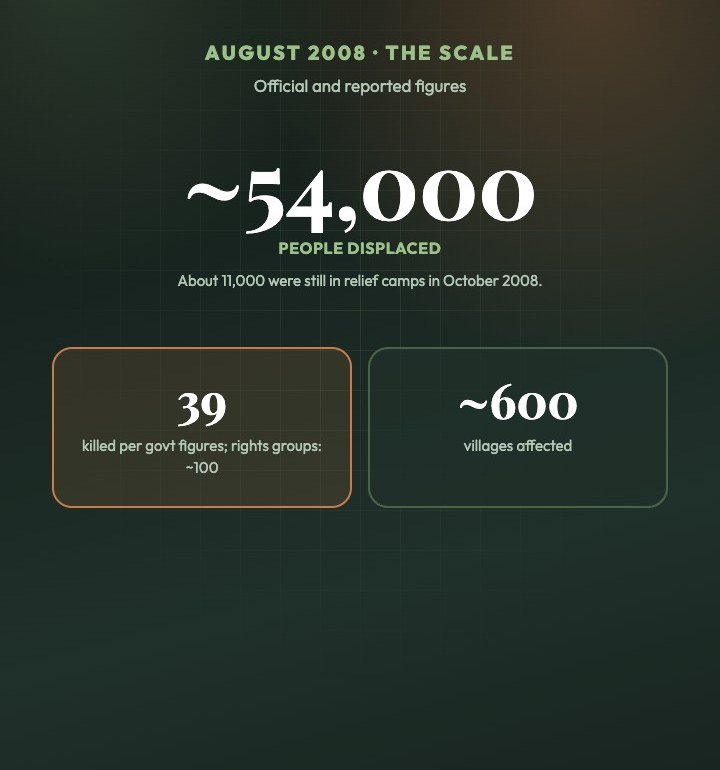
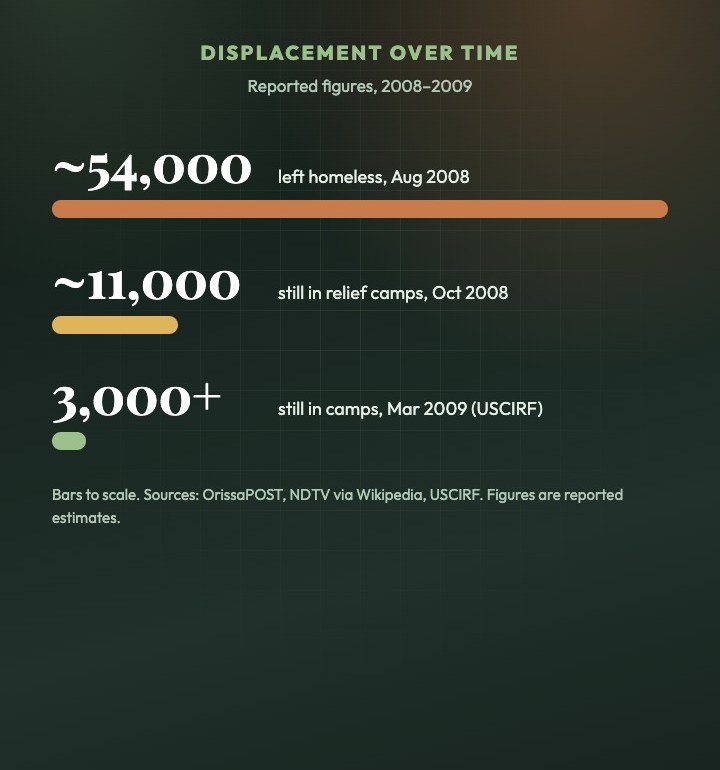
- Displacement: about 54,000 people lost their homes; thousands were still in camps months later.
- Roots: conversion disputes, Kui versus Pana claims to tribal status, land and political mobilisation.
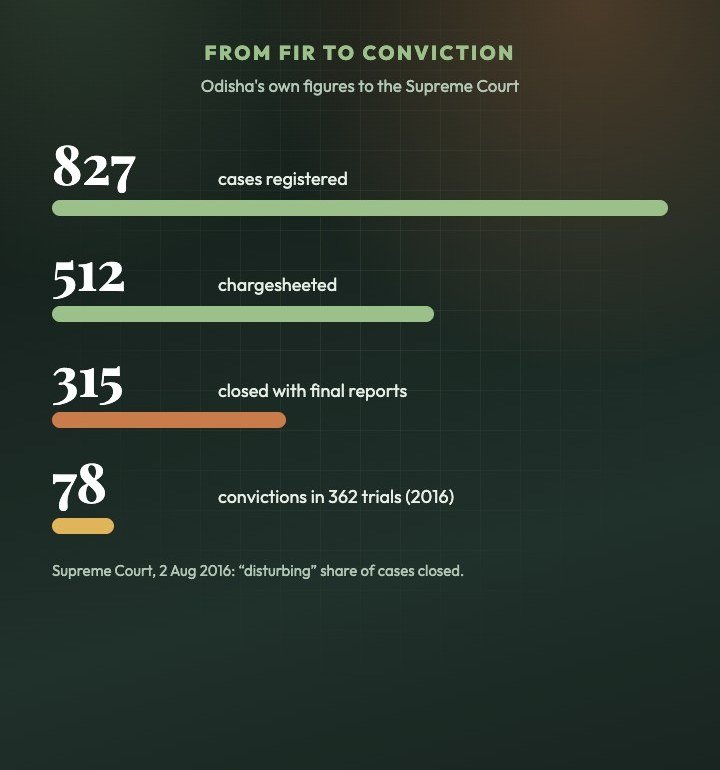
- The cases: 827 registered, 512 chargesheeted, 315 closed; by 2016 only 78 of 362 finished trials ended in conviction.
- The Court: in 2016 it told the state to look again at the 315 closed cases and pay more compensation.
- The open question: accountability and rehabilitation remain incomplete, and the Swami murder verdict is itself disputed.
Timeline: Kandhamal Violence, 1969–2020
Entries are colour-coded by track and run newest first. Figures that differ by source are marked.
Odisha tells the Supreme Court: 827 cases, 79 convictions Courts & accountability
What happened: In a submission to the Supreme Court reported in January 2020, Odisha’s Home Department said 827 cases were registered over the 2008 violence. Chargesheets were filed in 512, and final (closure) reports in 315. Of 342 cases disposed of, only 79 ended in conviction; about 263 ended in acquittal and 170 were still pending trial. The state also said 6,594 people were arrested or surrendered.
Why it matters: These are the state’s own figures. They show that roughly one case in three was closed without a trial, and that most trials that finished did not end in conviction. I found no newer consolidated figures.
Ten years on, both sides say they are still waiting for justice Courts & accountability
What happened: A decade after the violence, survivors said they had received no clear word on the 315 cases the Supreme Court told the state to look at again. A survivors’ advocate noted that the order set no monitoring mechanism and no deadline, and said only about Rs 15 crore of the Rs 21.59 crore set aside for additional compensation had been paid out.
The other side: Supporters of Swami Lakshmanananda marked his death anniversary, and their lawyer repeated that the killers were local Christians, not Maoists. The state VHP leadership asked the Centre for a CBI inquiry. Courts had convicted seven men for the murder in 2013, but the question of who was behind it remains contested.
Supreme Court orders a fresh look at 315 closed cases and more compensation Courts & accountability
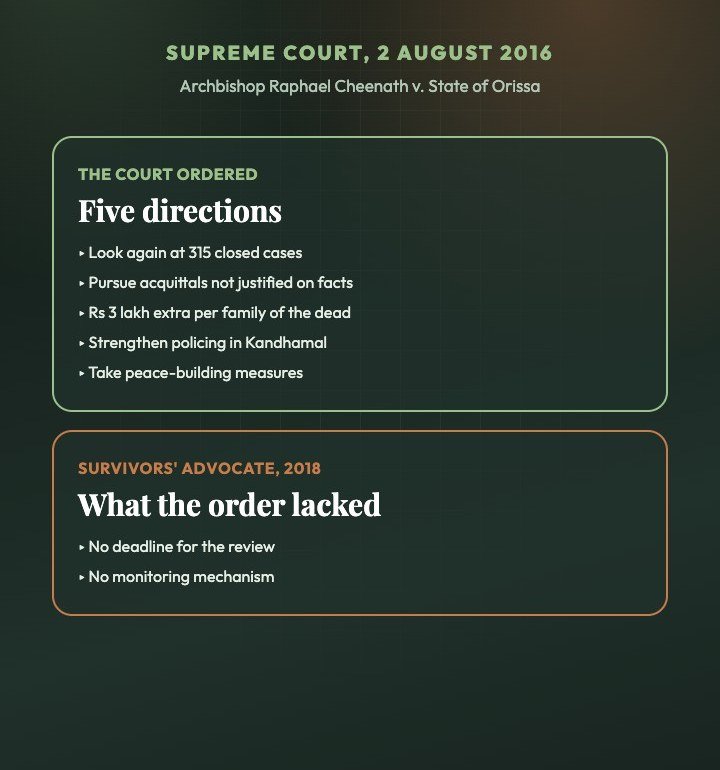
What happened: Deciding the Archbishop’s petition, a bench of Chief Justice T.S. Thakur and Justice Uday U. Lalit (who wrote the judgment) called it “disturbing” that of 362 completed trials only 78 had ended in conviction. It asked the state to look into the 315 cases closed with final reports and to see that offenders were brought to book, and to take up cases where acquittals were not justified on the facts.
Compensation and peace-building: The court directed additional compensation, including Rs 3 lakh for the family of each person killed, and told Odisha to strengthen policing and take peace-building measures in Kandhamal.
Seven men convicted of murdering Swami Lakshmanananda Courts & accountability
What happened: A Phulbani court found seven men guilty of the 23 August 2008 murder of Swami Lakshmanananda Saraswati and four others (reported 30 September 2013) and imposed life terms in early October. Press accounts describe the convicts as Christians from tribal and Dalit communities. Some reports also count a Maoist co-accused among the eight sentenced; accounts differ on the exact tally.
What is contested: The convicts say they are innocent and said they would appeal to the Orissa High Court. Maoist leaders had claimed responsibility in 2008, and a Caravan investigation questioned whether the convictions were safe. Swami’s supporters, in turn, say the court vindicated their view that local Christians were behind the killing.
People’s tribunal publishes ‘Waiting for Justice’ Courts & accountability
What happened: After its August 2010 sittings, the tribunal released its full report on 2 December 2011. The jury, headed by Justice A.P. Shah, had concluded in 2010 that the violence was communal and mainly directed at Christians, and recommended action against police and administrative officials who failed in their duty, plus a special investigation team.
Limits: It was a civil-society tribunal with no legal powers, and no government ministry or commission took part.
BJP MLA Manoj Pradhan sentenced in the Bikram Nayak murder case Courts & accountability
What happened: A fast-track court sentenced Manoj Pradhan, then a BJP MLA, to six years in jail for the 26 August 2008 killing of Bikram Nayak of Budedipada. It was his second conviction that year: on 29 June 2010 another court had given him seven years in the case of Parikhita Nayak, who died on 27 August 2008.
What followed: Pradhan appealed and was released on bail by the Orissa High Court. The Supreme Court set that bail aside; he surrendered in March 2011 and the High Court later granted him conditional bail again. He was acquitted in several other cases. I found no final ruling on his appeals in these two cases.
National People’s Tribunal sits in New Delhi Courts & accountability
What happened: A civil-society jury including former Delhi High Court Chief Justice A.P. Shah and former Justice Rajinder Sachar heard survivors for three days. Its interim findings called the violence “a national shame” and concluded that it was communal and mainly aimed at Christians.
Many survivors still in camps; allegations of forced ‘reconversion’ August 2008 wave
What happened: The US Commission on International Religious Freedom reported that by March 2009 at least 3,000 people were still in government camps, reportedly because they could not return home unless they “reconverted” to Hinduism. Allegations of pressure to renounce Christianity were a recurring theme in rights groups’ reports.
Caution: These are reported allegations from USCIRF and rights groups, not court findings.
Supreme Court declines a CBI probe Courts & accountability
What happened: On 22 October 2008 the Supreme Court rejected the Archbishop’s request for a CBI inquiry into the violence. In mid-October he had also asked the Court for Rs 3 crore to rebuild churches, Rs 5.5 lakh for the family of each person killed and Rs 60,000 for each damaged house.
A second inquiry commission is set up for the August violence Courts & accountability
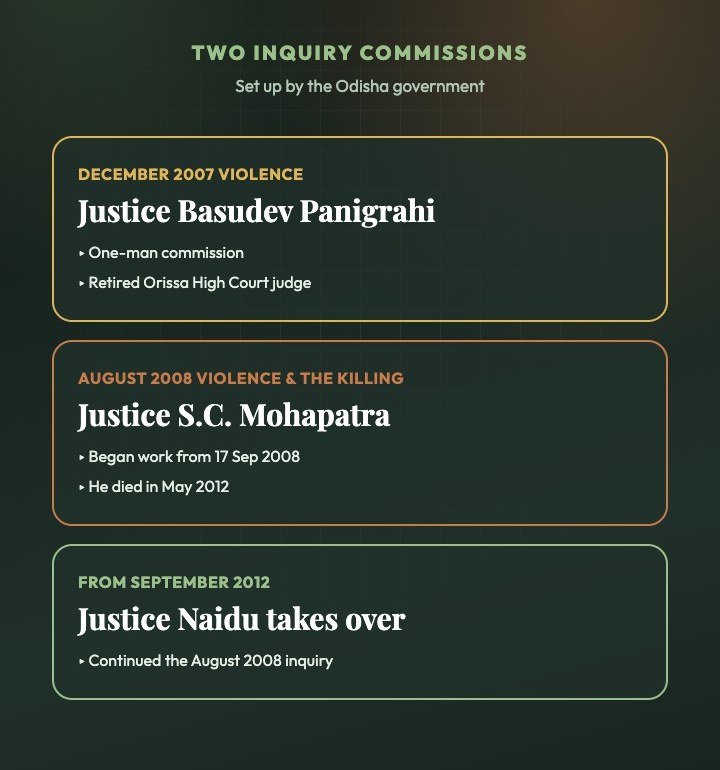
What happened: A judicial commission to inquire into the August 2008 violence and the killing of the Swami began work from 17 September 2008 under Justice Sarat Chandra Mohapatra. After his death in May 2012 it was taken over by Justice Naidu in September 2012.
Not to be confused with: The separate Justice Basudev Panigrahi commission, appointed for the December 2007 violence.
Paramilitary forces deployed; relief camps overflow August 2008 wave
What happened: The Centre and state deployed 12 companies of paramilitary forces, 24 platoons of the Odisha State Armed Police and special operation group teams. Violence gradually ebbed but camps stayed crowded. Camps themselves were threatened: on 4 September a large group is reported to have barged into the Tikabali relief camp and taken supplies.
Supreme Court asks Odisha for a report but does not dismiss the government Courts & accountability
What happened: On a petition by Cuttack Archbishop Raphael Cheenath seeking a CBI inquiry and dismissal of the state government, the Supreme Court asked Odisha to report on the steps taken to restore order, but refused to dismiss the state government.
Violence spreads across Kandhamal; a nun is assaulted at K. Nuagaon August 2008 wave
What happened: Attacks on Christian villages, homes and churches spread through several blocks. A curfew covered all nine towns of the district and police were authorised to shoot, but violence continued in places including Phulbani, Tumudibandh, Baliguda, Udayagiri, Nuagaon and Tikabali. Thousands fled into the forests.
Nuagaon: A Catholic nun said she was raped by a mob at K. Nuagaon on 25 August. She reported it on 30 September and arrests followed in October, which is why the case surfaced weeks after it happened.
Swami’s funeral procession passes through hundreds of villages August 2008 wave
What happened: The funeral procession left the Jalespata ashram at noon on 24 August and reached Chakapad the next afternoon, passing through hundreds of villages. Roadblocks and protests went up across the district and mobs began attacking Christian homes, churches and institutions.
Swami Lakshmanananda Saraswati and four others are shot dead August 2008 wave
What happened: Armed men entered the Jalespata Vanabasi Kanyashram on the night of Janmashtami and killed the octogenarian VHP leader and four others. Police suspected Maoists, and Maoist leaders including Sabyasachi Panda later claimed responsibility.
The contested part: Sangh Parivar groups rejected the Maoist theory and blamed local Christians; the violence that followed was directed at Christians as a community. In 2013 a court convicted seven men, all Christians, of the killing.
First wave: Brahmanigaon and beyond December 2007 wave
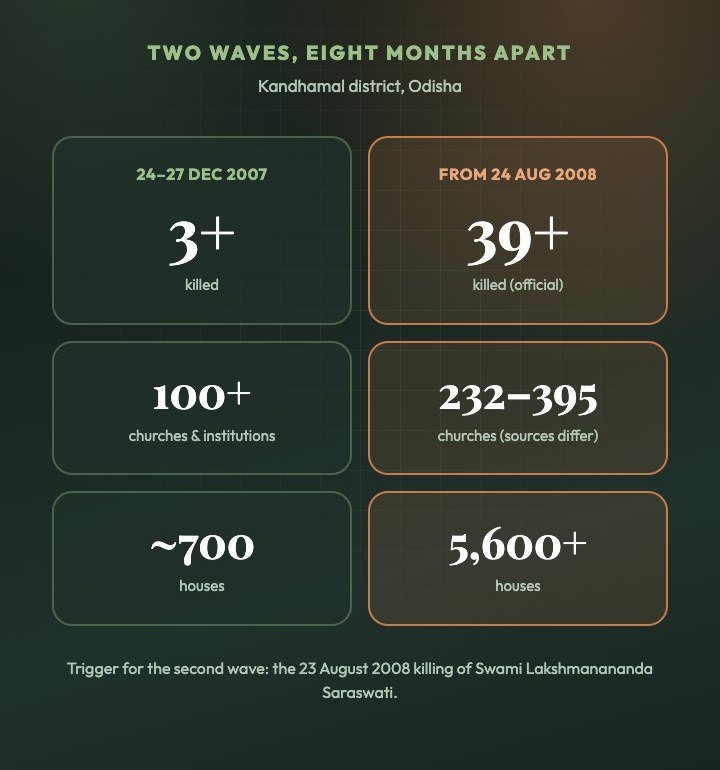
What happened: Trouble began on Christmas Eve at Brahmanigaon, in a dispute over Christmas structures between Kui tribal and Pana Christian groups. Over the next three days, mobs burnt more than 100 churches and church institutions and about 700 houses and other structures, and at least three people were killed.
Who was involved: Accounts of who provoked the first clash differ. Human Rights Watch and press reports placed Hindutva groups and Kui Samaj activists among those involved in the attacks; Hindu organisations said Christians had provoked the trouble. Reports also record attacks on Hindu property in some places.
NHRC sends a team; an inquiry commission is set up December 2007 wave
What happened: On 1 January 2008 the NHRC announced it would send a team and asked Odisha for details of casualties, injuries, property damage, compensation and protection for Christians. The state also set up a one-man commission under retired Justice Basudev Panigrahi to inquire into the December 2007 violence; I could not confirm its exact appointment date.
The Scheduled Tribe status dispute between Kui and Pana Background & context
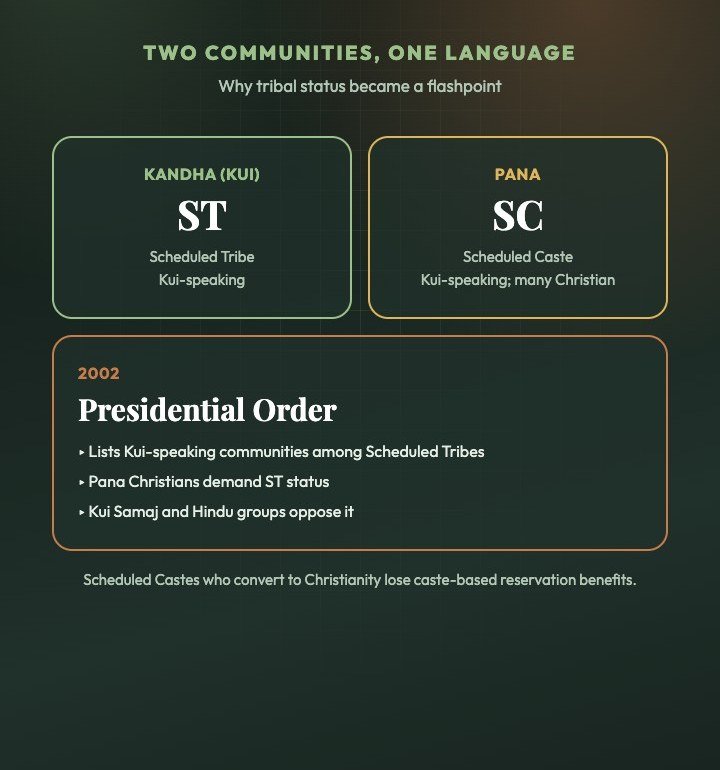
What happened: A 2002 Presidential Order listed Kui-speaking communities among the Scheduled Tribes. Pana Christians, who are Scheduled Caste converts and also speak Kui, demanded ST status. The Kui Samaj, the VHP and other political actors opposed the demand. Scheduled Castes who convert to Christianity lose caste-based reservation benefits, which sharpened the quarrel.
Graham Staines and his sons are burnt to death in Keonjhar Background & context
What happened: Australian missionary Graham Staines and his sons Philip and Timothy were burnt alive in their vehicle at Manoharpur in Odisha’s Keonjhar district, a separate district from Kandhamal. Dara Singh was convicted of leading the attack, and the Supreme Court upheld his life sentence in 2011.
Why included: It is the best-known earlier case of anti-Christian violence in the state and is often cited as part of the backdrop to Kandhamal, but it was not part of the Kandhamal violence itself.
Swami Lakshmanananda begins work among Kandhamal’s tribal communities Background & context
What happened: Swami Lakshmanananda Saraswati is reported to have begun his religious and social work in Kandhamal in 1969, running ashrams and schools and campaigning against religious conversion. Christian organisations, in turn, ran schools, hostels and clinics in the same district.
What Caused the Violence?
There is no single cause. Researchers and commissions point to several overlapping ones.
Competing institutions
- Christian groups ran schools, hostels and clinics among poor communities.
- Hindu organisations alleged forced or induced conversion; Christian groups denied coercion.
Kui versus Pana
- Kandha (Kui) are a Scheduled Tribe; Pana are a Scheduled Caste community with many Christians.
- Pana demand for ST status after 2002 was opposed by the Kui Samaj.
Scarce resources
- Disputes over land ownership and occupation between communities.
- Few jobs, weak infrastructure and competition for government benefits.
23 August 2008
- The killing of the Swami was the immediate trigger for the second wave.
- His funeral procession passed through hundreds of villages.
Organised groups
- Rights groups and tribunals alleged organised groups led attacks.
- Individual and organisational responsibility is contested in court.
Delay and closure
- Survivors reported delayed intervention and difficulty filing complaints.
- 315 cases were closed by police; the Supreme Court called that proportion disturbing.
The Numbers, and Why They Differ
Every figure below is attributed. Counts differ because sources count different things.
| Measure | Figure | Source / note |
|---|---|---|
| Killed, Aug 2008 | At least 39 Christians | Government figures cited by the press and the Supreme Court coverage; rights groups report nearer 100 |
| Killed, Dec 2007 | At least 3 | OrissaPOST summary of the 24–27 Dec 2007 violence |
| Churches destroyed | 232 to 395 | The Indian Express says 232; OrissaPOST cites 395 churches vandalised |
| Houses | Over 5,600 looted or burnt | OrissaPOST; other reports go up to about 6,500 |
| Villages affected | About 600 | OrissaPOST |
| Displaced | About 54,000 | OrissaPOST; about 11,000 still in camps in Oct 2008 |
| Cases registered | 827; 512 chargesheeted; 315 closed | Odisha government affidavit to the Supreme Court |
| Trials and verdicts | 78 convictions in 362 trials (2016); 79 convictions, 263 acquittals (2020) | Supreme Court 2016; state submission reported Jan 2020 |
Did Victims Get Justice?
From registration to conviction, most cases fell away.
What the courts did
- Trial courts returned convictions in 78 cases by 2016, including two against MLA Manoj Pradhan (2010; appeals filed).
- Convicted seven men for the Swami’s murder (2013).
- Supreme Court ordered more compensation and a second look at 315 cases (2016).
What is still unresolved
- No deadline or monitoring for the 315 cases, a survivors’ advocate said in 2018.
- Survivors say compensation was only partly paid.
- The Swami murder verdict is challenged by the convicts.
What Each Side Says, and What Is Established
The same events are described very differently. These are claims, not findings, unless stated.
A targeted attack
- The violence was organised and aimed at Christians.
- Convictions for the Swami’s murder are unsafe.
- The state failed to protect them.
A reaction to a murder
- Local Christians were behind the Swami’s killing.
- Conversions provoked the unrest.
- Hindus were also victims.
Established so far
- The Supreme Court found a disturbing share of cases closed.
- Seven men were convicted of the murder (2013).
- A people’s tribunal found the violence communal.
Why Kandhamal Still Matters
Five themes that keep the case in public debate.
Five lasting themes
- Religious freedom: the violence became a reference point in debates about minority protection and conversion law.
- Tribal and caste identity: it showed how quota and status disputes can turn into religious conflict.
- Accountability: the state’s own data show how few cases ended in conviction.
- Rehabilitation: rebuilding homes did not restore livelihoods, land or a sense of security.
- Contested memory: each community marks different anniversaries and tells a different story.
Key People and Bodies
Being named is not, by itself, a verdict on anyone’s conduct.
| Name | Role | Part in the story |
|---|---|---|
| Swami Lakshmanananda Saraswati | VHP leader, Chakapad ashram | Shot dead on 23 Aug 2008, the trigger for the second wave |
| Naveen Patnaik | Chief Minister of Odisha | Led the state government in 2007 and 2008 |
| Justice Basudev Panigrahi | Retired Orissa High Court judge | One-man commission on the December 2007 violence |
| Justice S.C. Mohapatra | Retired judge | Headed the commission on the August 2008 violence from 17 Sep 2008 |
| Archbishop Raphael Cheenath | Archbishop of Cuttack-Bhubaneswar | Petitioner in the Supreme Court case |
| Manoj Pradhan | BJP MLA | Convicted by fast-track courts in two murder cases (2010); no final appeal ruling found |
| Justice A.P. Shah | Former Delhi High Court Chief Justice | Headed the 2010 National People’s Tribunal |
| CJI T.S. Thakur and Justice U.U. Lalit | Supreme Court bench | Delivered the 2 Aug 2016 judgment |
Explore More Timelines
People Also Ask
Frequently Asked Questions
Dated facts and the distinctions the case is often misreported on.
⚠️ Editorial Note
This is a sensitive subject. Casualty and damage figures differ by source and are attributed where used. Claims by religious, political and rights groups are labelled as claims. Court findings and official data are kept apart from them. Information current as of 5 November 2026; I found no consolidated case-status figures after January 2020.
Sources & Further Reading
- National Human Rights Commission: NHRC to send a team to Orissa (1 January 2008)
- Supreme Court of India: Archbishop Raphael Cheenath S.V.D. v. State of Orissa (2 August 2016)
- The Indian Express: Supreme Court orders re-probe of 315 Kandhamal cases (August 2016)
- The Indian Express: 10 years after Kandhamal riots, both sides say they await justice (2018)
- OrissaPOST: 3,706 acquitted in Kandhamal riots (January 2020)
- USCIRF Annual Report 2011: India
- Christian Solidarity Worldwide: Communal violence in Kandhamal District, Orissa
- Christian Solidarity Worldwide: Aftermath of anti-Christian violence in Orissa
- Business Standard / IANS: Seven convicted for Laxmanananda murder of 2008
- Wikipedia: 2008 Kandhamal violence
Related Reading on AiTimeline
Sources & further reading
Every dated entry above was checked against these references. Last reviewed 5 November 2026.
- National Human Rights Commission: NHRC to send a team to Orissa (1 January 2008)
- Supreme Court of India: Archbishop Raphael Cheenath S.V.D. v. State of Orissa (2 August 2016)
- The Indian Express: Supreme Court orders re-probe of 315 Kandhamal cases (August 2016)
- The Indian Express: 10 years after Kandhamal riots, both sides say they await justice (2018)
- OrissaPOST: 3,706 acquitted in Kandhamal riots (January 2020)
- USCIRF Annual Report 2011: India
- Christian Solidarity Worldwide: Communal violence in Kandhamal District, Orissa
- Christian Solidarity Worldwide: Aftermath of anti-Christian violence in Orissa
- Business Standard / IANS: Seven convicted for Laxmanananda murder of 2008
- Wikipedia: 2008 Kandhamal violence