Taj Corridor Case: Allegations, Evidence and Political Impact
Explore the Taj Corridor case timeline, CBI allegations against Mayawati, the ₹17 crore controversy, Supreme Court proceedings and political impact.
Latest Story
The Taj Corridor case began with a plan to reclaim 75 acres of the Yamuna riverbed beside the Taj Mahal and ended, two decades later, without a trial of the politicians at its centre. In 2003 the Supreme Court ordered the CBI to find out who had cleared the project and how public money was released. The CBI reported Rs 17 crore released without proper approval and Rs 20 crore sanctioned without clearances, and named Chief Minister Mayawati and her Environment Minister Naseemuddin Siddiqui among those to be investigated. The case then split in two. The project FIR stalled when the Governor refused sanction to prosecute in 2007; a separate FIR into Mayawati’s assets was quashed by the Supreme Court in 2012. This page sets out what was alleged, what investigators found, and what the courts actually decided, and keeps those three things apart.
💡 Short Answer
The Taj Corridor case concerns a 2003 Uttar Pradesh project to reclaim Yamuna riverbed between Agra Fort and the Taj Mahal. A Supreme Court-ordered CBI probe alleged Rs 17 crore was released and Rs 20 crore sanctioned without approvals. Mayawati was never tried: the Governor refused sanction in 2007. The Supreme Court’s 2012 ruling quashed only a separate assets FIR.
Taj Corridor Case: Key Questions
The Case in Ten Points
- Project: started 25 March 2003 to reclaim about 75 acres of Yamuna riverbed near the Taj.
- Court: the Supreme Court ordered a CBI inquiry on 16 July 2003.
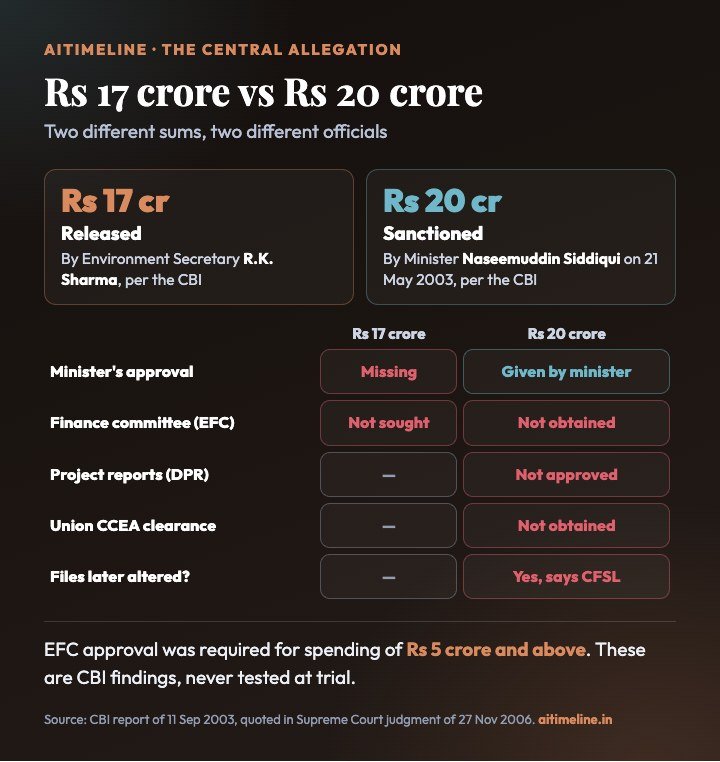
- Rs 17 crore: released by Environment Secretary R.K. Sharma without the minister’s approval, the CBI said.
- Rs 20 crore: sanctioned by Minister Naseemuddin Siddiqui on 21 May 2003 without clearances, the CBI said.
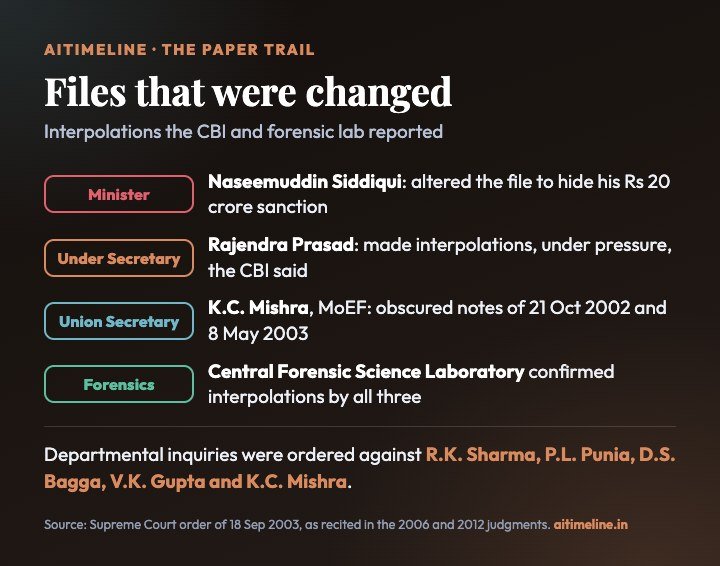
- Records: a forensic lab reported interpolations in files by three officials.
- Politics: Mayawati resigned on 26 August 2003 as her coalition with the BJP collapsed.
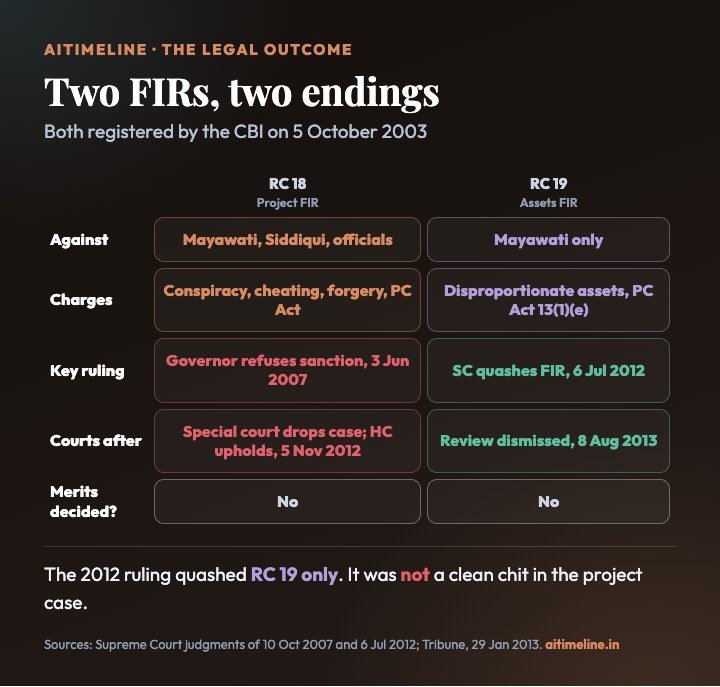
- Two FIRs: RC 18 on the project and RC 19 on her assets, both on 5 October 2003.
- Split: CBI investigators favoured prosecution; the Director and Attorney General did not.
- Sanction: refused by Governor T.V. Rajeswar on 3 June 2007, so there was no trial.
- 2012: the Supreme Court quashed the assets FIR only, on jurisdiction, not merits.
Timeline: From the Riverbed to the Supreme Court
Newest first. Colour shows which phase each event belongs to.
Where the Taj Corridor case stands After 2012
The project FIR (RC 18): Mayawati and Naseemuddin Siddiqui were never put on trial. The Governor refused sanction to prosecute them in June 2007, the special CBI court dropped proceedings against them, and the Allahabad High Court upheld that in November 2012. The Supreme Court issued notice on an appeal in January 2013; we could not find a public record of its final outcome.
The assets FIR (RC 19): Quashed by the Supreme Court on 6 July 2012, on the ground that the CBI had no court direction to register it. A review petition was dismissed on 8 August 2013.
CBI reportedly gets its first prosecution sanction in 20 years After 2012
What was reported: CBI officials said the National Projects Construction Corporation, the agency executing the corridor works, had sanctioned the prosecution of its retired general manager, Mahendra Sharma. The CBI had asked for it in November 2022, and a special CBI court in Lucknow was to take it up on 22 May 2023.
What we could not confirm: We found no report of what the court did next. The sanction concerned a corporation official, not Mayawati or Siddiqui.
Review of the assets judgment dismissed Assets FIR 2003-13
What happened: The Supreme Court rejected a review petition by Kamlesh Verma, argued by Shanti Bhushan, against the July 2012 judgment that quashed the assets FIR. The court found no ground within its review jurisdiction to reopen it.
Effect: The quashing of FIR RC 19 became final.
Supreme Court issues notice on plea to prosecute without sanction Sanction 2007-13
What happened: One of the petitioners whose public interest petitions the High Court had rejected asked the Supreme Court to allow Mayawati’s prosecution in the project case without the Governor’s sanction. The court agreed to examine it.
The defence: Her counsel K.K. Venugopal told the court this was the fourth attempt to prosecute her, and that another bench had already rejected a similar plea.
Allahabad High Court upholds the closure Sanction 2007-13
What happened: The High Court’s Lucknow bench dismissed petitions challenging the June 2007 order of the special CBI court, which had dropped proceedings against Mayawati and Siddiqui because the Governor had refused sanction.
Why it matters: For the project FIR, this was the last reported ruling on the merits of the sanction question below the Supreme Court.
Supreme Court quashes the disproportionate-assets FIR Assets FIR 2003-13
What the court held: Its 18 September 2003 order had directed an FIR only on the Taj Corridor project. Nothing in that order, or in any later one, directed the CBI to register a second FIR into Mayawati’s assets from 1995. The court held that “the CBI exceeded its jurisdiction” in lodging FIR RC 19 and quashed it.
What it did not decide: The judgment was about the assets FIR alone. It did not decide whether the allegations about the corridor project were true, and it did not touch FIR RC 18.
Kamlesh Verma seeks to intervene Assets FIR 2003-13
What happened: Kamlesh Verma, who described himself as a social worker and had challenged the Governor’s refusal of sanction in the Lucknow bench in 2009, applied to join Mayawati’s Supreme Court case to oppose quashing the assets FIR.
Result: The court let him be heard in 2012, but said his intervention could not be cited as a precedent.
Mayawati challenges the assets FIR in the Supreme Court Assets FIR 2003-13
Her argument: The court’s 2003 orders concerned the corridor project and the release of Rs 17 crore, not her assets going back to 1995. Without a court direction, the CBI needed the Uttar Pradesh government’s consent under Section 6 of the Delhi Special Police Establishment Act, and had not obtained it.
Context: By then she was Chief Minister again. Income tax authorities and tribunals later ruled in her favour on the gifts and income shown in her returns for 1995 to 2004.
Supreme Court declines to review the Governor’s refusal Sanction 2007-13
What was asked: Amicus curiae Krishan Mahajan asked the court to examine the Governor’s order and to hold that sanction under Section 197 CrPC was not needed in this case.
What the court held: Its role was to ensure a proper investigation, not to decide guilt. Once a police report is filed, “it is the Magistrate and Magistrate alone” who decides. If the Governor’s order was wrong, the appropriate court could deal with it, “but not this Bench”.
Special CBI court drops proceedings for want of sanction Sanction 2007-13
What happened: The CBI told the special court that the Governor had refused sanction. The judge held that without sanction the court had no jurisdiction to take cognizance against Mayawati and Siddiqui.
Effect: The criminal proceedings against the two of them ended at this stage, without a trial.
Governor T.V. Rajeswar refuses sanction to prosecute Sanction 2007-13
What happened: The Governor of Uttar Pradesh declined to sanction the prosecution of Mayawati and Naseemuddin Siddiqui in FIR RC 18, citing insufficient evidence. The special judge had directed the CBI to obtain it.
Reaction: Mayawati said the BJP-led government at the Centre had “consciously and deliberately filed a false case” against her and had used the CBI.
Supreme Court resolves the split inside the CBI CBI probe 2003-06
The split: The investigating team and the CBI’s law officers favoured a charge-sheet against the 12 accused. The Director of Prosecution disagreed. The CBI Director referred the matter to the Attorney General, who saw no evidence of criminal intent or pecuniary benefit and advised disciplinary action instead.
What the court held: Under Section 173(2) CrPC the opinion that counts is the investigating officer’s. It directed the CBI to place the evidence and the Superintendent of Police’s report before the special judge, and said the opinions of the Attorney General and the CVC should not be sent to the court.
CVC’s view reported: prosecute Mayawati CBI probe 2003-06
What was reported: Press reports said the Central Vigilance Commission had recommended prosecuting Mayawati, Naseemuddin Siddiqui and R.K. Sharma, and closing the case against officials including D.S. Bagga, P.L. Punia, V.K. Gupta and K.C. Mishra.
Why it matters: The CBI’s investigators, its Director, the Attorney General and the CVC had now taken different positions on the same evidence.
CVC submits its report to the Supreme Court CBI probe 2003-06
What happened: The Central Vigilance Commission sent the Supreme Court its analysis of the CBI’s investigation record and the recommendations of officers at each level of the CBI.
Objection: Mayawati’s counsel argued the CVC had no role in a case about state government officials. The CVC said it supervised CBI investigations under the Prevention of Corruption Act.
Records of 12 accused sent to the CVC CBI probe 2003-06
What happened: Faced with a voluminous CBI report and a divergence of opinion inside the agency, the court asked the CVC to scrutinise the records relating to the prosecution of 12 accused and summarise each officer’s recommendation.
Context: The CBI Director’s status report of 31 December 2004 had said the evidence was not sufficient to prosecute and that a closure report would be filed.
Court separates the project case from the assets case CBI probe 2003-06
What happened: Uttar Pradesh said it could not start a second disciplinary inquiry against P.L. Punia, the Chief Minister’s former principal secretary, without the statement the CBI had recorded from Mayawati. Punia’s case was that he had acted on her oral instructions. The court ordered the CBI to hand over the statement within three weeks.
The link question: The court also recorded that no link had been found between the assets matter and the corridor project, a finding that became central in 2012.
Deadlines for both FIRs CBI probe 2003-06
What happened: The court asked the CBI for a self-contained note on its findings against state and central officers, and gave it eight weeks to finish investigating RC 18 and three months for RC 19.
Why it matters: It was the first order to set separate clocks for the project case and the assets case.
CBI registers two FIRs on the same day CBI probe 2003-06
RC 18: Criminal conspiracy, cheating, forgery and use of forged documents under the IPC, and criminal misconduct under the Prevention of Corruption Act, against Mayawati, Siddiqui and officials over the corridor project.
RC 19: Disproportionate assets under Section 13(1)(e) of the Prevention of Corruption Act, against Mayawati alone. It named a Supreme Court registry officer as informant, who, her petition said, had never signed it.
Supreme Court orders an FIR and investigation of Mayawati CBI probe 2003-06
The CBI’s findings: Rs 17 crore was released by Environment Secretary R.K. Sharma without the minister’s approval or the Expenditure Finance Committee clearance required for spending of Rs 5 crore and above. Minister Naseemuddin Siddiqui sanctioned Rs 20 crore on 21 May 2003 without approved project reports or clearances. Files were tampered with, and the Central Forensic Science Laboratory found interpolations.
The directions: Register an FIR; investigate Mayawati, Siddiqui and other officers; and hold departmental inquiries against K.C. Mishra, R.K. Sharma, P.L. Punia, Chief Secretary D.S. Bagga and V.K. Gupta.
CBI’s preliminary report kept in a sealed cover CBI probe 2003-06
What happened: The CBI gave the court its report on the preliminary inquiry, including the findings on the Rs 17 crore and Rs 20 crore and the tampered files. It was kept sealed.
Next: A week later the court acted on it.
Mulayam Singh Yadav becomes Chief Minister Project and fall 2002-03
What happened: After the BSP-BJP coalition collapsed, Mulayam Singh Yadav was sworn in as Chief Minister of Uttar Pradesh.
Why it matters: The CBI investigation now ran under a state government led by Mayawati’s main rival, while the Centre was still run by the BJP, her former ally.
Mayawati resigns as the coalition collapses Project and fall 2002-03
What happened: Mayawati resigned as Chief Minister amid a rift with her coalition partner, the BJP, over the corridor project. The BJP announced it was withdrawing support.
Her account: She later said the BJP-led Centre had used the CBI against her.
Court asks where Rs 17 crore went CBI probe 2003-06
What happened: The CBI told the court that Rs 17 crore had been released from the state treasury without proper sanction. The court allowed it to interrogate the people concerned and verify their assets, to see whether any public money had reached their accounts.
Why it matters: This order is the root of both later FIRs. The CBI read it as a basis for an assets investigation; in 2012 the Supreme Court said it was not.
Supreme Court orders a CBI inquiry Project and fall 2002-03
What the court said: It was “painful”, the court said, that people in power were trying to endanger a World Heritage Site by “hasty/irregular/illegal activities”. It asked who cleared the project, why, and why without the sanction of the competent authority.
What happened next: The CBI was given four weeks for a preliminary report. Work on the site stopped.
Rs 20 crore sanctioned by the Environment Minister Project and fall 2002-03
What the CBI found: The minister sanctioned the release of Rs 20 crore without approved detailed project reports, technical feasibility reports or clearance from the state’s Expenditure Finance Committee and the Union Cabinet Committee on Economic Affairs.
The files: The CBI said he later made interpolations in the file to hide that he had sanctioned it on this date.
Work begins on the Taj Heritage Corridor Project and fall 2002-03
The plan: The Uttar Pradesh government started a project to divert the Yamuna and reclaim about 75 acres of riverbed between Agra Fort and the Taj Mahal for food plazas, shops and amusement facilities.
The problem: The site lay inside the Taj Trapezium Zone, where the Supreme Court had been restricting development since the 1990s.
The proposal reaches the Union Environment Ministry Project and fall 2002-03
What happened: Officials of the Union Ministry of Environment and Forests recorded notes on the corridor proposal. The CBI later said the ministry’s secretary, K.C. Mishra, obscured parts of these notes to show he had not consented to the project.
Why it matters: The case reached into the central government as well as the state.
The Allegations: Rs 17 Crore Versus Rs 20 Crore
The two sums are often merged in coverage. The CBI tied them to different people and different missing approvals.
| Allegation | What the CBI reported | Status |
|---|---|---|
| Unauthorised release | Rs 17 crore released by R.K. Sharma without the minister’s approval; EFC approval needed above Rs 5 crore was not sought | Preliminary finding; not tried |
| Sanction without clearances | Rs 20 crore sanctioned by Naseemuddin Siddiqui on 21 May 2003 without DPRs, feasibility reports, EFC or CCEA clearance | Preliminary finding; sanction to prosecute refused |
| Altered records | Interpolations by Siddiqui, Rajendra Prasad and K.C. Mishra, confirmed by the CFSL | Preliminary finding; not tried |
| Missing approvals | No approved project reports, technical feasibility or central environmental clearance | Led the court to halt the project |
| Personal gain | The Attorney General found no evidence of pecuniary benefit to anyone | Disputed by the CVC, per press reports |
The Legal Outcome: Two FIRs, Two Endings
Most confusion about this case comes from treating the two FIRs as one.
Often claimed
- The Supreme Court acquitted Mayawati in the Taj Corridor case in 2012.
- The case was a Rs 175 crore scam.
- Mayawati was convicted.
What the record shows
- The 2012 ruling quashed the separate assets FIR, on jurisdiction.
- Rs 175 crore was the reported project size; the CBI examined Rs 17 crore and Rs 20 crore.
- She was never tried; sanction to prosecute was refused.
The Project: 75 Acres Between the Fort and the Taj
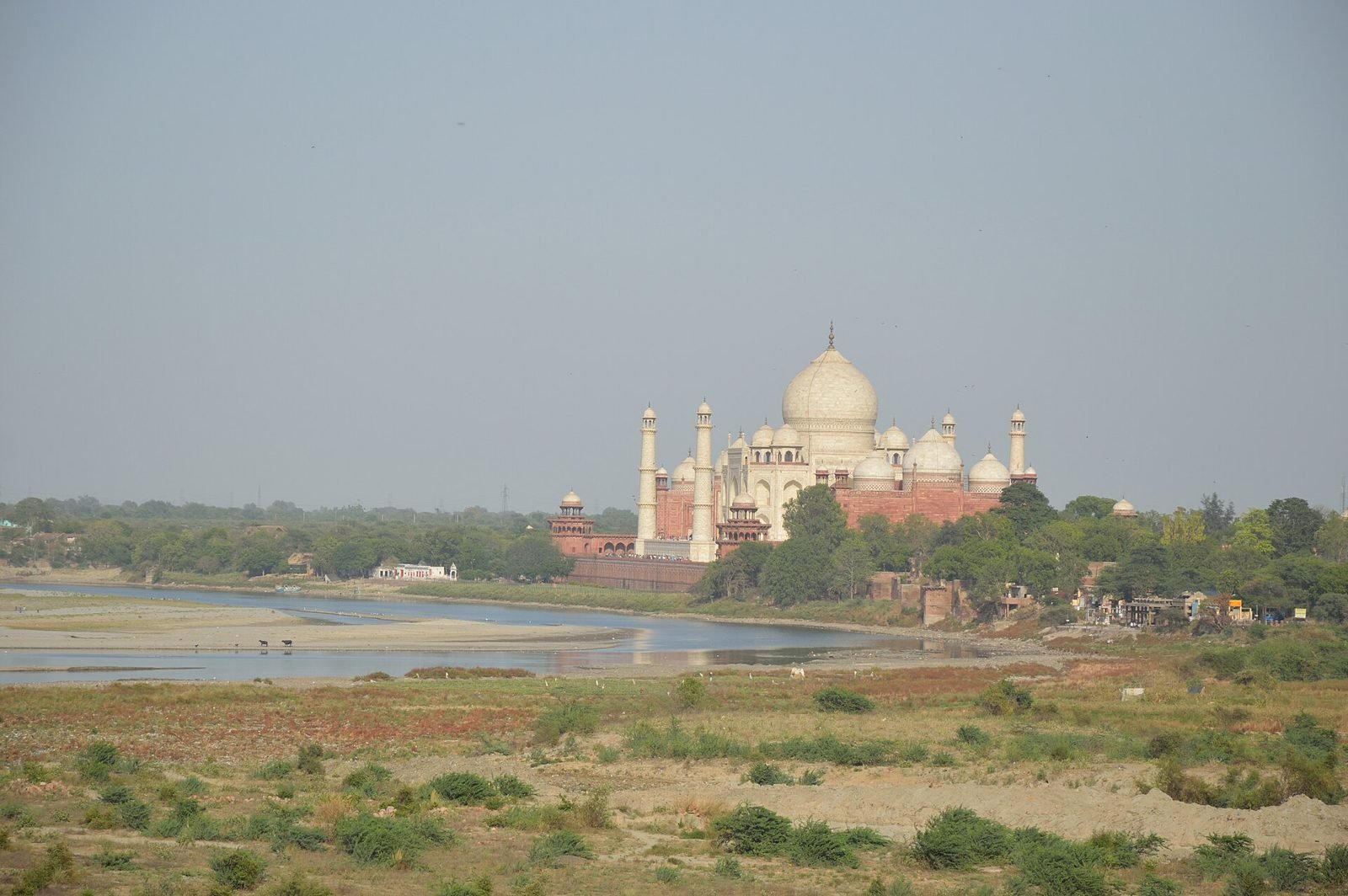
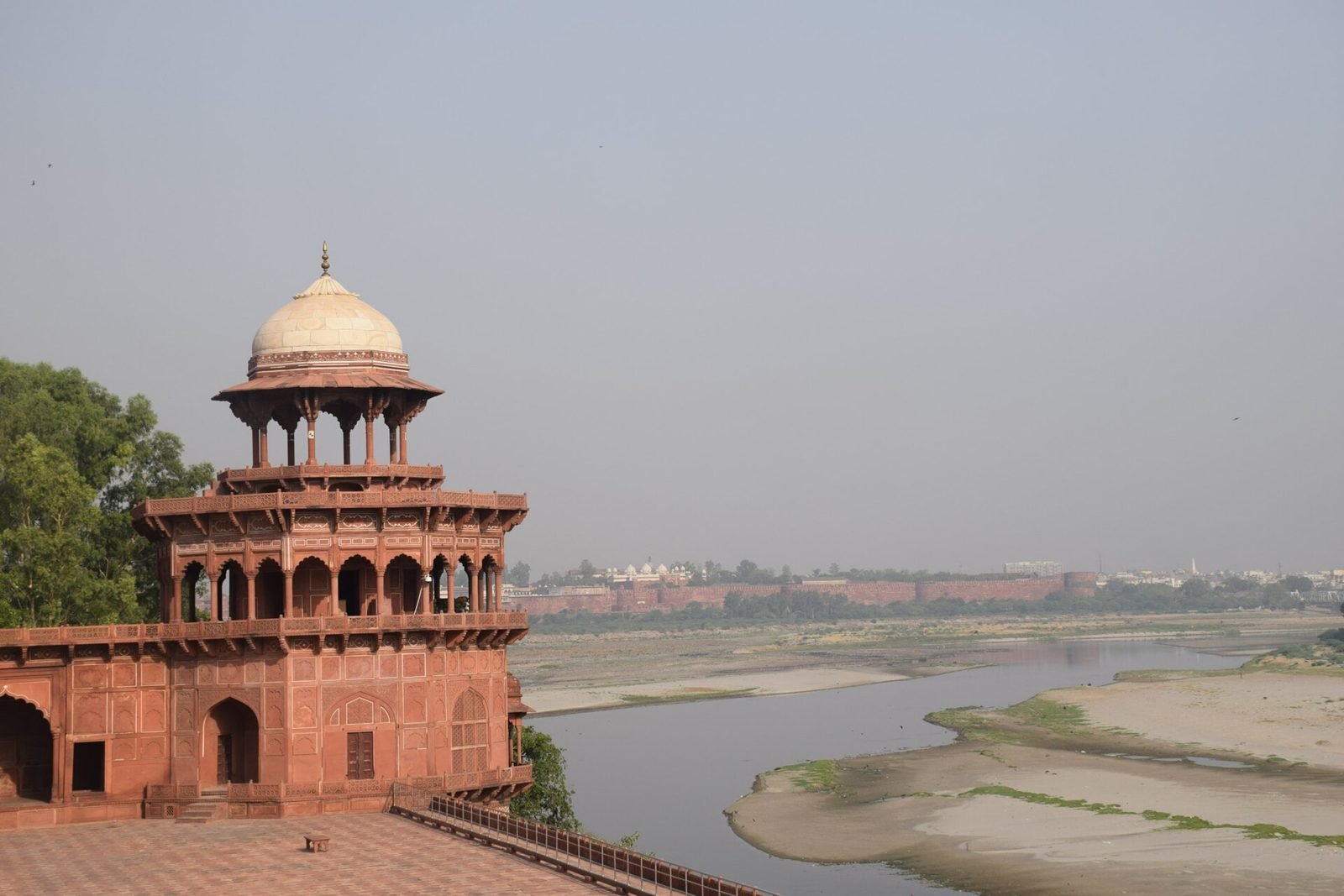
The plan was to divert the Yamuna and reclaim the riverbed between the two Mughal monuments for food plazas, shops and amusement facilities, executed through the central public-sector company NPCC. The site lay inside the Taj Trapezium Zone, the area around the monument where the Supreme Court had been restricting polluting activity since the M.C. Mehta case was filed in 1984. That is why the court, rather than a state agency, took up the matter, and why the first question it asked on 16 July 2003 was who had cleared the project and on whose authority.
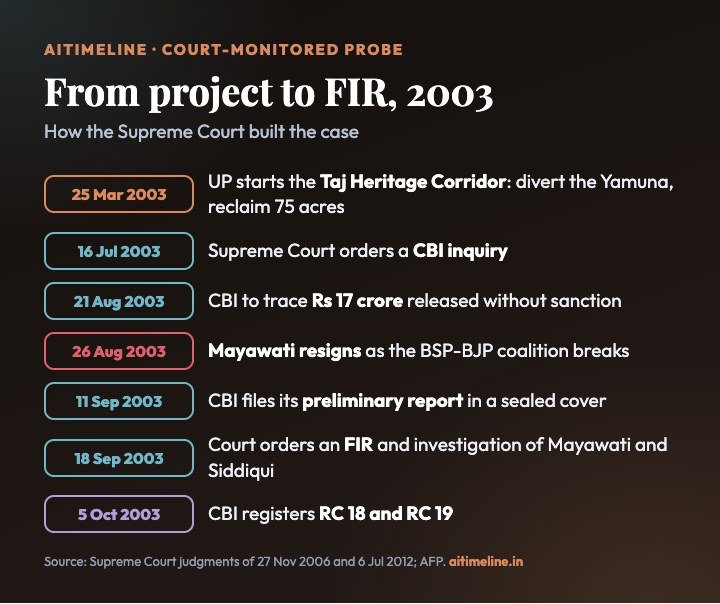
Inside the CBI: Same Evidence, Four Opinions
The 2006 judgment is still cited on who decides whether a case goes to court.
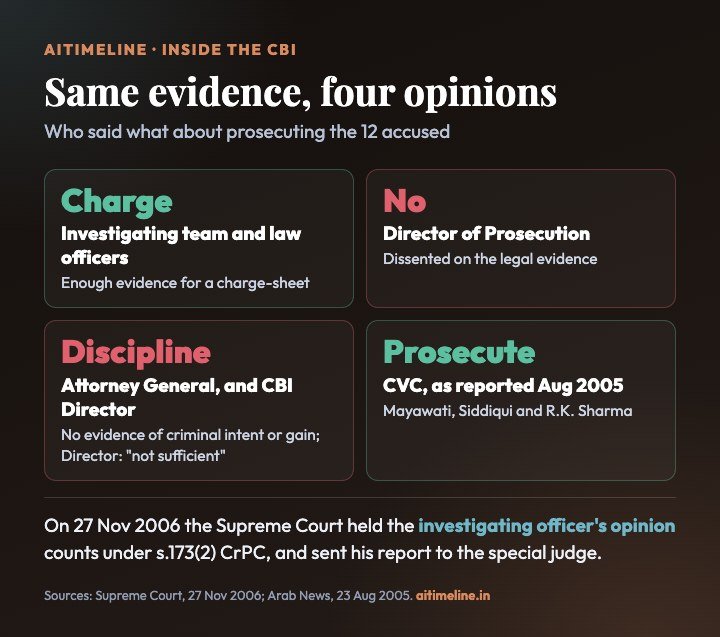
File a charge-sheet
- The IO and SP in Lucknow.
- Backed by the CBI’s law officers.
- Against 12 accused.
Close it
- Director of Prosecution dissented.
- Attorney General: no criminal intent.
- Director: evidence not sufficient.
Let the judge decide
- IO’s opinion counts under s.173(2).
- SP’s report to the special judge.
- No view on the merits.
Why There Was No Trial
Sanction, not evidence, ended the project case against the two politicians.
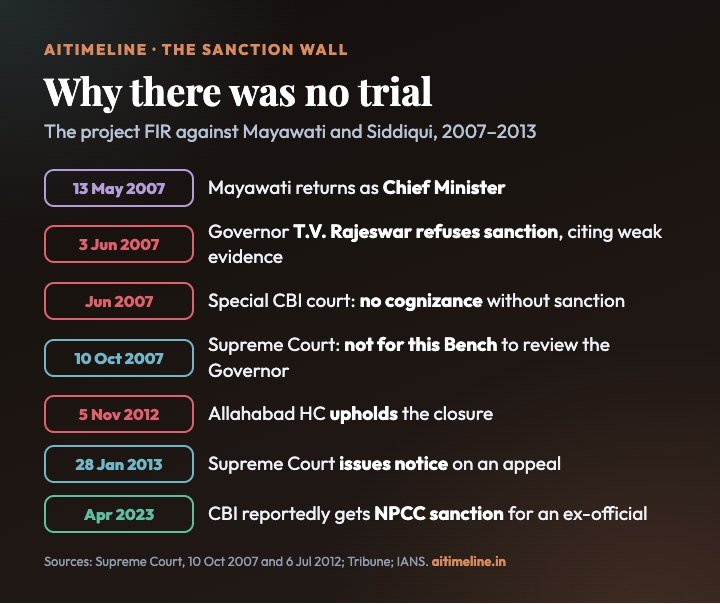
A court cannot take cognizance of an offence against a public servant for official acts without sanction from the competent authority. For a chief minister and a minister, that authority was the Governor. T.V. Rajeswar’s refusal came three weeks after Mayawati returned to power with a BSP majority, which her opponents pointed to and her supporters dismissed: the Governor said the evidence was insufficient, and the Attorney General had said much the same in 2004. The Supreme Court, asked to intervene, said in October 2007 that monitoring an investigation did not make it a trial court. The question went instead to the Allahabad High Court, which upheld the closure in 2012.
Political Impact: Mayawati, the BSP and Uttar Pradesh
| When | Political effect |
|---|---|
| Aug 2003 | The BSP-BJP coalition collapsed; Mayawati resigned on 26 August and Mulayam Singh Yadav took over on 29 August. |
| 2003-2007 | The CBI investigated a former chief minister while her main rival ran the state; Mayawati said the BJP-led Centre had used the CBI against her. |
| May-Jun 2007 | She won a majority and returned as chief minister; the Governor then refused sanction to prosecute. |
| 2012 | The Supreme Court quashed the assets FIR and criticised the CBI’s overreach, a ruling the BSP cast as vindication. |
| Since | The case is still raised by her opponents and remains a reference point in debates about the CBI and the opposition. |
Why the Taj Corridor Case Still Matters
Five lasting lessons
- Heritage: the Supreme Court’s role in protecting the Taj Trapezium Zone extended to stopping a state government’s own project.
- Public money: the case turned on approval rules, such as Expenditure Finance Committee clearance above Rs 5 crore, that are easy to bypass.
- Investigation: the 2006 judgment held that the investigating officer forms the opinion under Section 173(2), not the agency’s hierarchy.
- Sanction: the case shows how the sanction requirement can end a prosecution before any court weighs the evidence.
- Court-monitored probes: the 2012 ruling held that the CBI cannot stretch a court’s direction into a wider investigation it was never given.
Explore More Timelines
People Also Ask
Frequently Asked Questions
Dated facts from the Supreme Court’s orders and contemporary reporting.
⚠️ Editorial Note
This account is based mainly on three Supreme Court judgments: M.C. Mehta v. Union of India of 27 November 2006, which quotes the CBI’s findings and sets out the dates of the 2003 to 2005 orders; the same case on 10 October 2007, on the Governor’s refusal of sanction; and Mayawati v. Union of India of 6 July 2012, on the assets FIR. Later events come from The Tribune, AFP, IANS and Arab News. The brief this page started from dated the CBI’s questioning of Mayawati to 1 September 2003; we could not confirm that date and have not used it. It attributed the “no criminal intent or pecuniary benefit” view to the CBI Director; that was the Attorney General’s opinion, which the Director adopted. It also omitted the special court’s June 2007 order, the High Court’s 2012 ruling, the January 2013 appeal and the 2013 review, which are added here. The post’s earlier draft described a “Rs 175 crore scam”; that figure is the reported size of the project, not a sum found to be misappropriated. We could not find a reported final decision on the 2013 appeal or on the 2023 NPCC sanction. This is not legal advice.
Related Reading on AiTimeline
Sources & further reading
Every dated entry above was checked against these references. Last reviewed 6 November 2026.
- M.C. Mehta (Taj Corridor Scam) v. Union of India, judgment of 27 November 2006, (2007) 1 SCC 110
- M.C. Mehta v. Union of India, judgment of 10 October 2007 on the Governor's refusal of sanction
- Mayawati v. Union of India, judgment of 6 July 2012, (2012) 8 SCC 106
- M.C. Mehta v. Union of India, order of 18 September 2003 directing the CBI FIR
- Kamlesh Verma v. Mayawati, review order of 8 August 2013
- SC notice to Maya in Taj corridor case (28 January 2013)
- Mayawati gets reprieve, attacks BJP, media (5 June 2007)
- CVC Recommends Prosecution of Mayawati in Taj Corridor Scam (23 August 2005)
- Taj corridor scam: CBI procures prosecution sanction in the case (26 April 2023)