Jaswant Singh Khalra Case: Full Timeline of His Disappearance and Murder
Jaswant Singh Khalra case timeline: the 1995 abduction, the CBI inquiry into Punjab's illegal cremations, the 2005 trial and 2011 Supreme Court verdict.
Latest Story
The Jaswant Singh Khalra case began when a Punjab human rights activist studied cremation-ground records in Amritsar and found that police had been cremating large numbers of bodies as unclaimed. On 6 September 1995 he was taken from outside his home by men the courts identified as police. His wife went to the Supreme Court, which handed the case to the CBI, and in 2011 the Court upheld life sentences for five policemen. His body was never found. This timeline separates what the courts established from the estimates and accounts that were never tested.
💡 Short Answer
Jaswant Singh Khalra was abducted on 6 September 1995 after exposing alleged illegal cremations of unclaimed bodies in Punjab. On 15 November 1995 the Supreme Court ordered a CBI investigation. A Patiala court convicted six policemen in 2005, the High Court acquitted one in 2007, and on 4 November 2011 the Supreme Court upheld life sentences for the remaining five. His body was never recovered.
Jaswant Singh Khalra Case: Key Questions
The Case in Ten Points
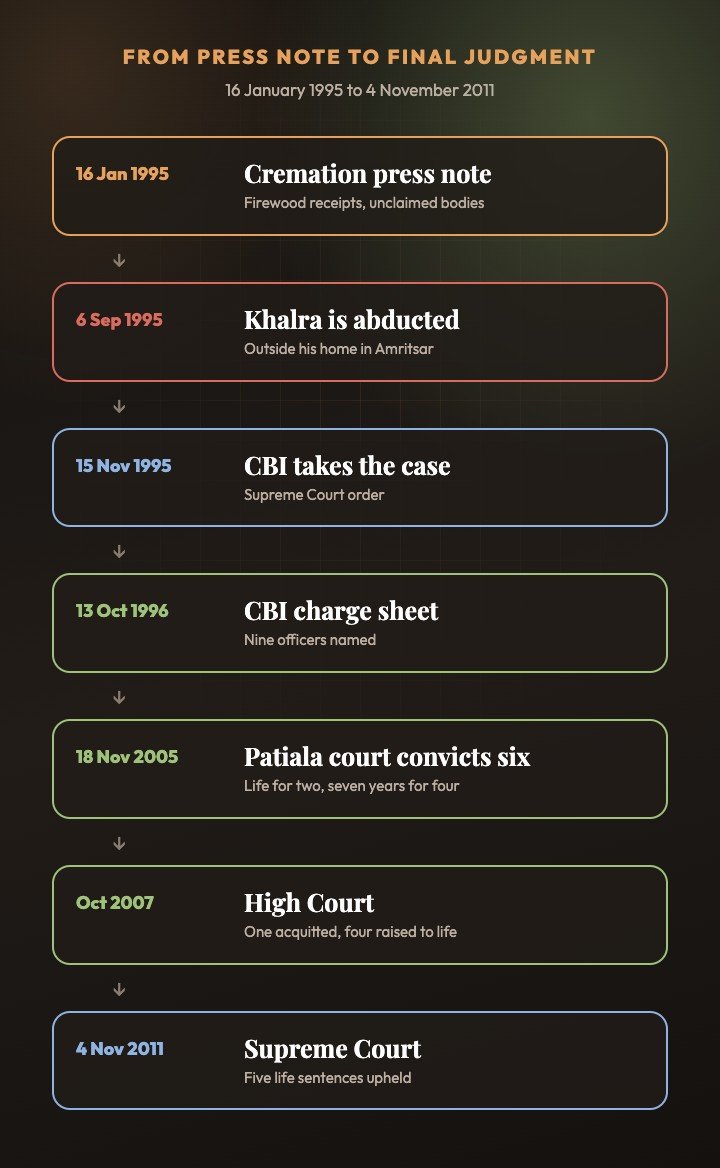
- The evidence: cremation-ground records and firewood receipts, set out in a press note of 16 January 1995.
- The abduction: 6 September 1995 outside his home at Kabir Park, Amritsar, seen by journalist Rajiv Singh.
- The denial: police said Khalra was “neither arrested nor wanted”.
- The turning point: on 15 November 1995 the Supreme Court gave the case to the CBI.
- The findings: 2,097 unidentified cremations examined in Amritsar district and 984 in Tarn Taran.
- The accused: nine officers named; the main one, SSP Ajit Singh Sandhu, died in May 1997.
- The trial: six convicted on 18 November 2005; one acquitted by the High Court in October 2007.
- The final word: life sentences for five upheld on 4 November 2011.
- The gap: no body was found, and the murder conviction rests on witnesses and circumstances.
- The scale: Khalra’s estimate of about 25,000 disappearances was never tested in court.
Timeline: From the Cremation Records to the Supreme Court
Entries are colour-coded by track and run newest first. Court findings are kept apart from estimates and reported claims.
Thirty-one years on, the body has never been found Khalra & aftermath
What happened: The Tribune marked 31 years since the abduction. Khalra’s wife, Paramjit Kaur Khalra, has appealed to the Akal Takht Jathedar to set up a people’s commission to establish the true scale of disappearances and fake encounters in Punjab, saying every government since the 1980s has failed the victims.
What is still open: Only Khalra’s murder went to trial. The Tribune notes that the much larger practice he exposed, which he estimated at about 25,000 disappearances and secret cremations across Punjab, was never separately prosecuted.
The film Satluj is pulled within days of its release Khalra & aftermath
What happened: The biopic Satluj, earlier announced as Ghallughara and later titled Punjab 95, streamed on ZEE5 on 3 July 2026 after about three years of disputes with the Censor Board. The Tribune reports the Board had sought around 127 cuts and changes to the names of characters and places. The film was taken down within about 48 hours, and The Indian Express reports it was later pulled internationally too.
The fallout: The removal turned Khalra’s case into a political argument in Punjab. On 9 July The Indian Express reported that Nabha Open Air Jail had asked Hoshiarpur police to verify the address of convicted ex-DSP Jaspal Singh, a routine check according to the local police chief.
Convicted ex-DSP Jaspal Singh is released, told to surrender, then gets interim bail CBI & trial
What happened: The Indian Express reports, citing sources, that Jaspal Singh was released in November 2021 when prisons were decongested during COVID-19. A court order of 16 August 2022 directed him to surrender. In May 2023 the Chief Judicial Magistrate’s court in Patiala granted him interim bail on bonds of Rs 1 lakh, and he has remained out since. A 2017 request for premature release was reportedly rejected by the Centre.
What did not change: None of this overturned his conviction or life sentence. He remains under the jurisdiction of Nabha Open Air Jail.
Supreme Court dismisses the appeals; five life sentences stand Supreme Court
The ruling: The Court dismissed the appeals of Jaspal Singh, Satnam Singh, Surinderpal Singh, Jasbir Singh and Prithipal Singh, finding no reason to interfere with the High Court’s judgment. It held that a body need not be recovered for a murder conviction and drew an adverse inference because the accused, who held Khalra in custody, gave no explanation of what happened to him.
The words: The judgment said police atrocities are always violative of Articles 21 and 22 and that tolerating them “would amount to acceptance of systematic subversion and erosion of the rule of law.” It approved the findings that police disliked Khalra’s work exposing the killing and cremation of unidentified people in Amritsar and Tarn Taran, and that Sandhu hatched a conspiracy to eliminate him.
High Court acquits one convict and raises four sentences to life CBI & trial
8 October: The High Court dismissed the policemen’s appeals, upholding the convictions, but acquitted ASI Amarjit Singh, who had been given life for murder by the trial court.
16 October: On a revision petition by Paramjit Kaur Khalra, it raised the sentences of Satnam Singh, Surinderpal Singh, Jasbir Singh and Prithipal Singh from seven years to life imprisonment under Section 364 IPC (kidnapping in order to murder). Jaspal Singh already had life for murder.
Patiala court convicts six policemen CBI & trial
The verdict: Jaspal Singh, a DSP, and ASI Amarjit Singh got life imprisonment for murder under Sections 302/34 IPC, plus shorter terms for conspiracy, kidnapping and destroying evidence. Satnam Singh, Surinderpal Singh, Jasbir Singh and Prithipal Singh got seven years for kidnapping and five for conspiracy.
The trial: The prosecution called 22 witnesses and the defence 12. The Supreme Court later recorded that witnesses and the family faced threats and false cases during the investigation and trial, and that one witness turned hostile.
Charges framed against eight policemen CBI & trial
The charges: The trial court framed charges against Ashok Kumar, Satnam Singh, Rachpal Singh, Jasbir Singh, Amarjit Singh, Surinderpal Singh, Prithipal Singh and Jaspal Singh. All faced conspiracy and kidnapping-for-murder charges. Jaspal Singh, Amarjit Singh and Rachpal Singh were also charged with murder and destroying evidence.
Who fell away: No charges could be framed against Sandhu, who died in May 1997, reportedly by suicide. Ashok Kumar died during the trial and Rachpal Singh was discharged before his statement was recorded.
A former special police officer tells the CBI how Khalra died Abduction & murder
His account: Kuldip Singh, a special police officer and bodyguard to SHO Satnam Singh, told the CBI that Khalra was held at Jhabal police station, beaten by senior officers, that he heard two gunshots, and that the body was driven to Harike and thrown into the canal “at midnight just after Diwali” in 1995. He said fear of Sandhu had kept him quiet.
The doubts: He later complained that Paramjit Kaur Khalra had tried to bribe him. The Supreme Court noted that he changed his version and that parts of his story lacked corroboration, but accepted it together with the other evidence, including the accused’s failure to explain what became of Khalra.
Ajit Singh Sandhu, the main accused, dies CBI & trial
What happened: Amnesty International recorded in 1998 that Sandhu, who had been suspended, died in May 1997, reportedly by suicide. The Supreme Court judgment later confirmed he killed himself before charges could be framed.
CBI files its charge sheet against nine police officers CBI & trial
What happened: After Punjab granted the sanction needed to prosecute public servants, the CBI filed its charge sheet naming nine officers, led by Sandhu. The Court had ordered protection for witnesses from central forces, and the state had assured it that it would grant sanction.
Supreme Court sends the 2,097-body report to the NHRC Supreme Court
The findings: The CBI found that 2,097 bodies had been cremated as unidentified in Amritsar district: 585 fully identified, 274 partly identified and 1,238 unidentified. The Court said the report “discloses flagrant violation of human rights on a mass scale” and that Khalra’s press note had been found correct.
The directions: It sent the report to the National Human Rights Commission, asked the NHRC to see that families of the 585 identified victims get compensation, and told the CBI to continue the probe and report every three months.
“The worst crime against humanity”; Rs 10 lakh interim relief Supreme Court
What happened: The Court said that kidnapping a person whose family does not know whether he is dead or alive is “the worst crime against humanity” and ordered Punjab to pay Rs 10 lakh as interim compensation to Paramjit Kaur Khalra. It also recorded that the CBI had enough material to prosecute Sandhu, DSP Ashok Kumar and DSP Jaspal Singh.
CBI says it will prosecute nine policemen for the abduction CBI & trial
What happened: The CBI told the Court it would prosecute Ajit Singh Sandhu, DSP Ashok Kumar, DSP Jaspal Singh, SHOs Satnam Singh, Surinderpal Singh and Jasbir Singh, SI Rachpal Singh, ASI Amarjit Singh and head constable Prithipal Singh. Amnesty International recorded that the CBI found Khalra had been held at Kang police station in Tarn Taran and moved from there on 24 October 1995.
CBI interim report: 984 bodies cremated as unclaimed in Tarn Taran Supreme Court
What happened: The CBI told the Court that prima facie 984 bodies had been cremated as unclaimed by police in Tarn Taran district alone, and that there was sufficient material to register cases against police officials. The Court asked members of the public to give the CBI information.
Court orders three accused officers out of Amritsar and Tarn Taran Supreme Court
What happened: At the CBI’s request, the Court directed the Punjab DGP to transfer DSP Jaspal Singh and SHOs Surinderpal Singh and Satnam Singh out of those districts and not post them in adjoining ones, and ordered full protection for witnesses helping the CBI.
Supreme Court hands the case to the CBI Supreme Court
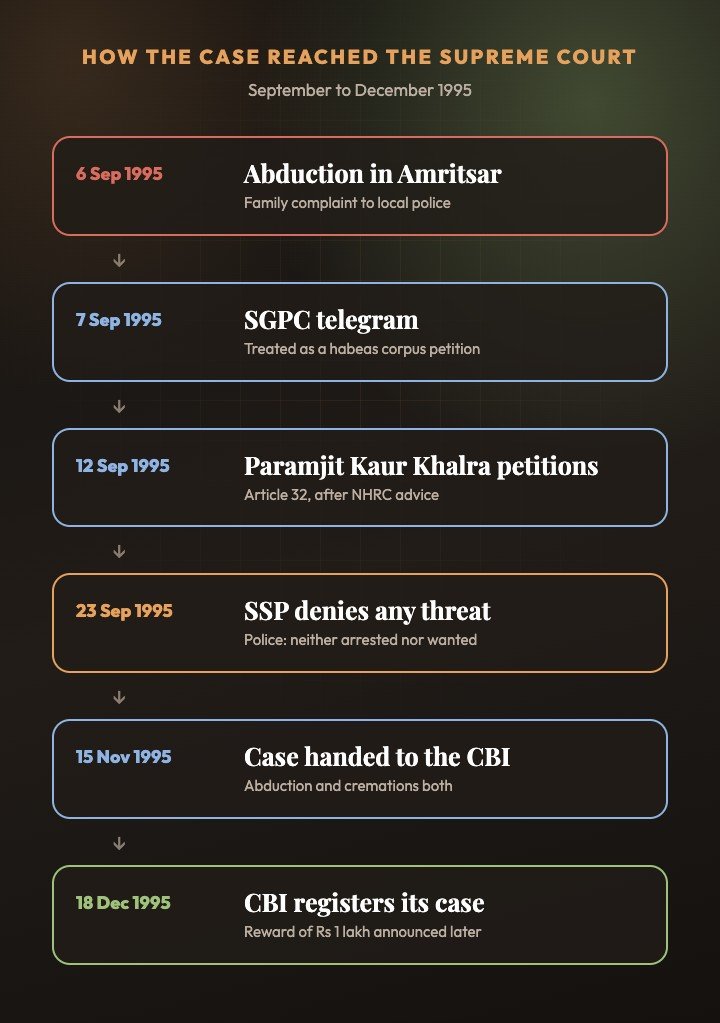
What happened: Joining the SGPC telegram and Paramjit Kaur Khalra’s petition, the Court asked the CBI to investigate both Khalra’s disappearance and the allegations of illegal cremations. It said it could not close its eyes to the press note, which “even if partially true” would be “a gory tale of human rights violations.”
What followed: The CBI registered its case on 18 December 1995 and later announced a reward of Rs 1 lakh for information on his whereabouts. The Court recorded that the Punjab Police did not cooperate with the CBI.
The date the CBI later gave for his murder Abduction & murder
What the courts found: The Indian Express reports that the CBI established 27 October 1995 as the date of the murder. The courts accepted that Khalra was killed in police custody and his body thrown into a canal near Harike. The body was never recovered.
Differing accounts: Kuldip Singh placed his detention at Jhabal police station; another witness told the CBI he saw Khalra at Kang police station, so the accounts of where he was held differ.
A telegram, a petition and a police denial Supreme Court
7 September: SGPC president Gurcharan Singh Tohra sent a telegram to Justice Kuldip Singh saying Khalra had been “kidnapped by the police”. The Court treated it as a habeas corpus petition and issued notice to the Punjab home secretary, the DGP and the SSP Amritsar.
12 and 23 September: Paramjit Kaur Khalra filed her own petition under Article 32 on 12 September, after the NHRC had advised her to go to the Supreme Court. Police said in an affidavit that Khalra was “neither arrested nor wanted”, and SSP Sandhu denied threatening him on 23 September.
Jaswant Singh Khalra is abducted outside his home in Amritsar Abduction & murder
What happened: On the morning of 6 September a Maruti van pulled up outside his house as he was washing his car, and a team of policemen, the courts later found, put him in it, in front of journalist Rajiv Singh, who had come to take him to the Patti cremation ground. Rajiv Singh immediately told Paramjit Kaur Khalra and Justice Ajit Singh Bains.
The response: The Supreme Court later found that the police report of her complaint differed from what she had said, through the connivance of police officials.
Chief Minister Beant Singh is assassinated Khalra & aftermath
Context: Punjab’s Chief Minister Beant Singh was killed in a suicide bombing in Chandigarh. Khalra was abducted six days later, in a state still under heavy security operations.
Khalra and Jaspal Singh Dhillon release the cremation press note Khalra & aftermath
What the note said: Working from cremation-ground records, mainly firewood receipts, the note said police regularly brought bodies to municipal grounds as unclaimed. It put the number cremated near Durgiana Mandir in Amritsar from 1984 to 1994 at about 2,000, and said that for the first year of Beant Singh’s government, 300 bodies came there, 41 with bullet injuries or encounters, and no post-mortem was done on 276.
His wider estimate: Khalra and his wife maintained that at least 25,000 people were disappeared across Punjab. The Supreme Court examined the narrower Amritsar count, which the CBI put at 2,097, and found the note correct.
Militancy, counter-insurgency and disappearances in Punjab Khalra & aftermath
Background: After Operation Blue Star in June 1984, Punjab saw years of militancy and counter-insurgency, with families reporting relatives missing after police detention. Khalra, who worked as a banker and was General Secretary of the Akali Dal’s human rights wing, began searching for two colleagues picked up by police and went on to study cremation records.
What Khalra Found in the Cremation Records
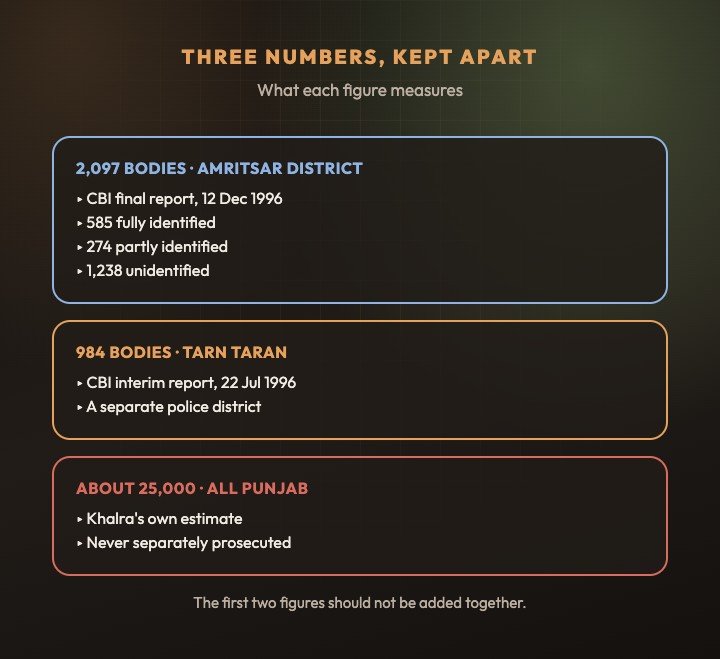
Three different numbers, which should not be added together.
Khalra’s method was simple: he compared how many bodies the police sent to municipal cremation grounds as unclaimed with the firewood receipts issued to burn them. The January 1995 press note said bodies were being burnt with no recorded reason of death and, in many cases, no post-mortem. The CBI later checked the records itself.
| Figure | Where it comes from | Status |
|---|---|---|
| 2,097 bodies | CBI final report on Amritsar district, 12 Dec 1996: 585 fully identified, 274 partly identified, 1,238 unidentified | Examined and cited by the Supreme Court |
| 984 bodies | CBI interim report, 22 Jul 1996, for Tarn Taran police district | Separate area from the 2,097; cited by the Court |
| About 25,000 | Khalra’s and his wife’s estimate for the whole of Punjab, 1984 to 1995 | Estimate; never separately investigated |
📌 Why the numbers matter
The 2,097 figure is the one the CBI verified and the Supreme Court sent to the National Human Rights Commission. The 984 figure covers a different police district, and the two may overlap, so adding them would mislead. The 25,000 estimate is Khalra’s, and it was not the subject of any trial.
The Accused and What Became of Each
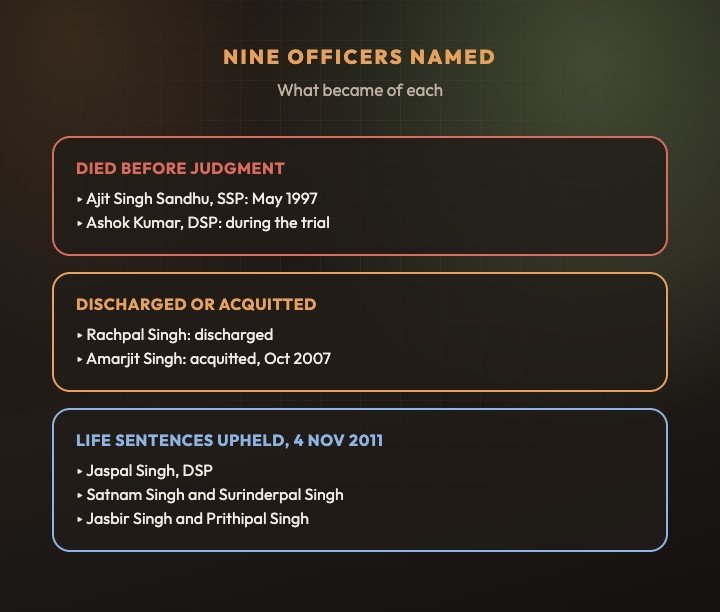
Nine officers were named; five were still convicted in 2011.
| Officer | Rank named by the CBI | Outcome |
|---|---|---|
| Ajit Singh Sandhu | SSP, Tarn Taran | Died May 1997, reportedly by suicide; never charged |
| Ashok Kumar | DSP, Bhikhiwind | Charged in 1998; died during the trial |
| Rachpal Singh | Sub-inspector, Kang | Discharged by the trial court |
| Amarjit Singh | Assistant sub-inspector | Life in 2005; acquitted by the High Court, 8 Oct 2007 |
| Jaspal Singh | DSP, Tarn Taran | Life for murder (2005); upheld 2011; on interim bail since May 2023 |
| Satnam Singh | SHO, Jhabal | Life under Section 364 IPC (2007); upheld 2011 |
| Surinderpal Singh | SHO, Sirhali | Life under Section 364 IPC (2007); upheld 2011 |
| Jasbir Singh | SHO, Manochahal | Life under Section 364 IPC (2007); upheld 2011 |
| Prithipal Singh | Head constable | Life under Section 364 IPC (2007); upheld 2011 |
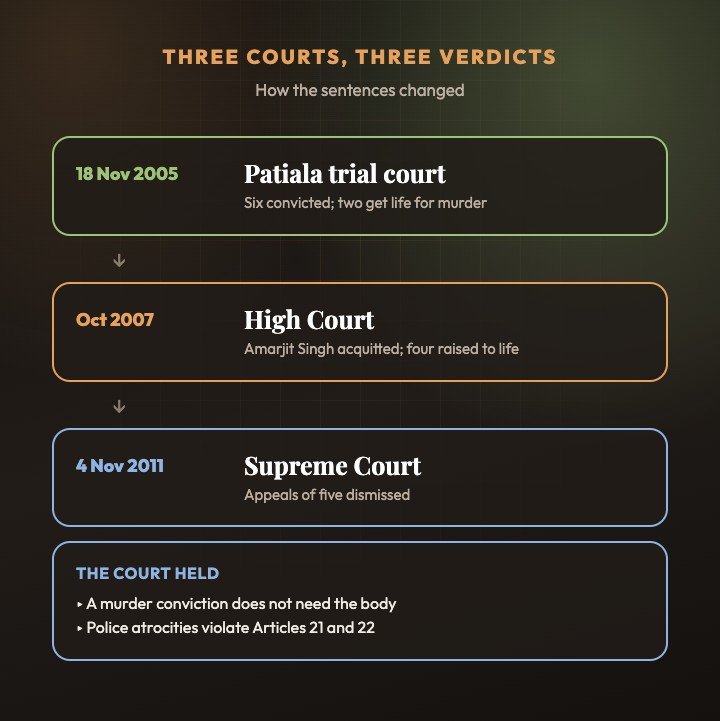
Three Courts, Three Verdicts
The sentences changed at each stage.
Patiala trial court
- Six convicted.
- Jaspal Singh, Amarjit Singh: life for murder.
- Four others: seven years for kidnapping.
High Court
- Amarjit Singh acquitted.
- Four raised to life under Section 364 IPC.
- Revision filed by Paramjit Kaur Khalra.
Supreme Court
- Appeals of five dismissed.
- Life sentences stand.
- Body need not be recovered.
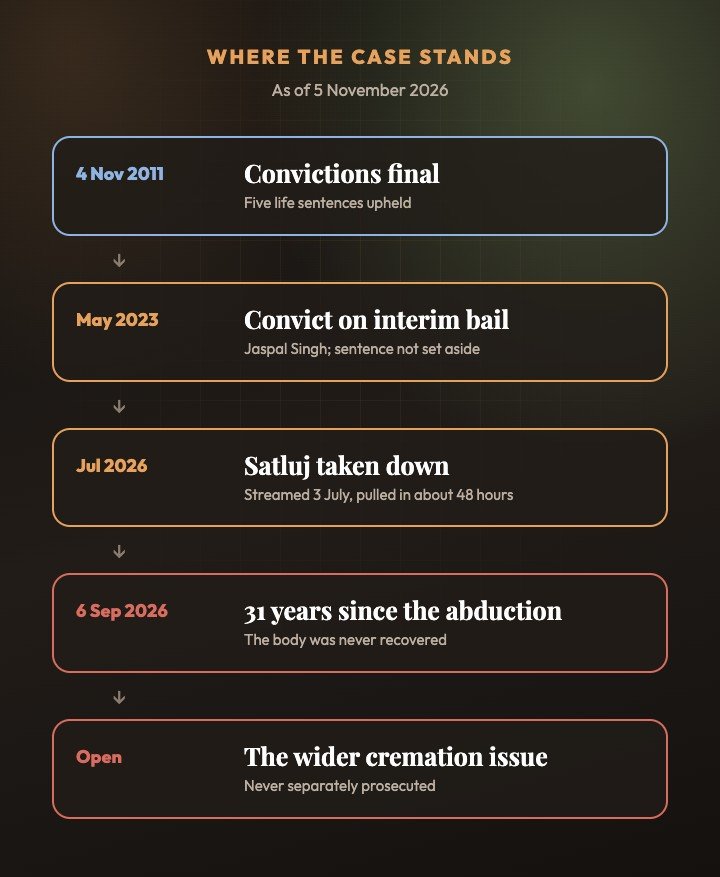
Where the Case Stands in November 2026
Settled by the courts, and still open.
Settled
- Khalra was abducted by police on 6 September 1995.
- He was illegally held and killed.
- Five life sentences were upheld in 2011.
Still open
- The body was never found.
- The wider 25,000 estimate was never tried.
- Officers above those named were not prosecuted, the Tribune reports.
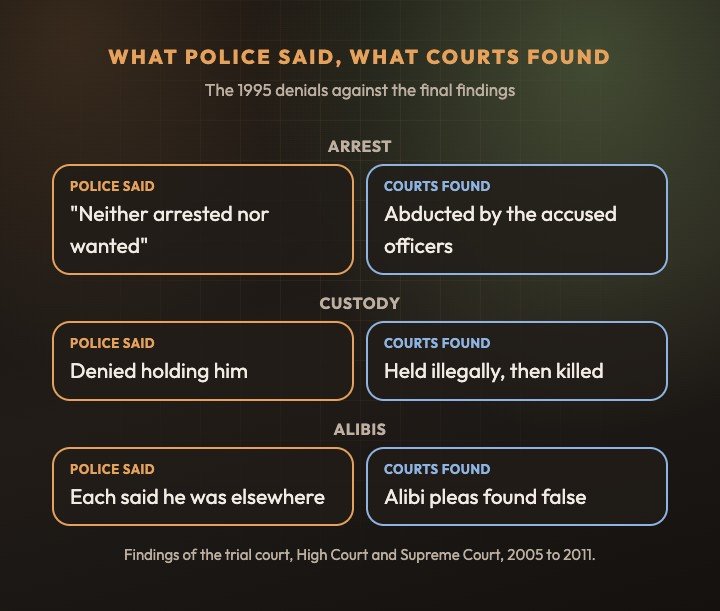
What the Police Said, What the Courts Found
The 1995 denials set against the findings of three courts.
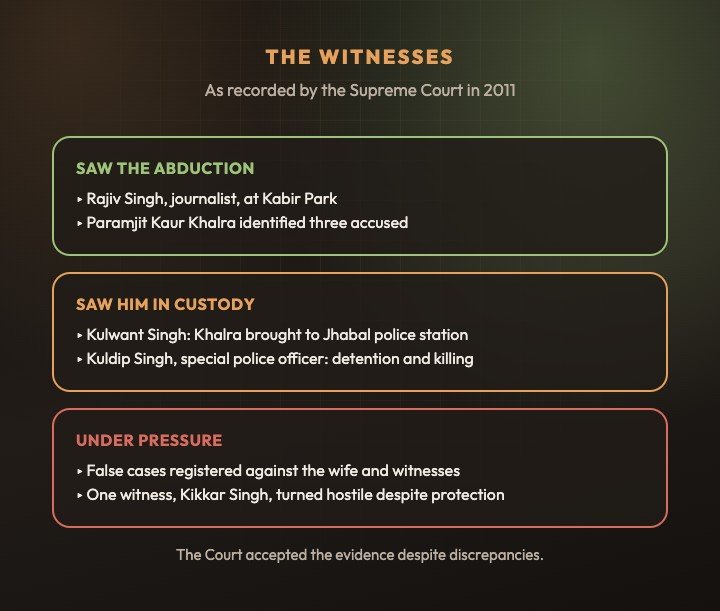
In 1995 the police told the Supreme Court that Khalra had been neither arrested nor wanted. The trial court, the High Court and the Supreme Court later held that the accused officers abducted him, held him illegally and killed him, and they rejected the officers’ alibis. The Supreme Court also recorded that witnesses and Paramjit Kaur Khalra faced threats and false cases, and that it accepted their evidence despite discrepancies.
Key People
Roles as recorded in court orders and reports.
| Name | Role | Part in the story |
|---|---|---|
| Jaswant Singh Khalra | Human rights activist | Exposed the cremations; abducted 6 September 1995 |
| Paramjit Kaur Khalra | His wife | Filed the habeas corpus petition and the revision that raised four sentences |
| Jaspal Singh Dhillon | Associate | Co-issued the 16 January 1995 press note |
| Gurcharan Singh Tohra | SGPC president | His telegram was treated as a habeas corpus petition |
| Rajiv Singh | Journalist, eyewitness | Saw the abduction |
| Kuldip Singh | Former special police officer | Told the CBI on 2 March 1998 how Khalra was killed |
| Ajit Singh Sandhu | SSP, Tarn Taran | Named as the officer who hatched the conspiracy; died 1997 |
| Jaspal Singh | DSP, Tarn Taran | Life for murder; on interim bail since 2023 |
| B.S. Chauhan, P. Sathasivam | Supreme Court judges | Upheld the life sentences on 4 November 2011 |
Explore More Timelines
People Also Ask
Frequently Asked Questions
Dated facts from the court record and reporting.
⚠️ Editorial Note
This account is built from the Supreme Court’s judgment of 4 November 2011, Amnesty International’s 1998 report and reporting by The Indian Express and The Tribune. Some details differ between sources: the judgment text dates the transfer of the case to the CBI to 5 November 1995, while The Indian Express and the Court’s order date it 15 November; the CBI’s charge sheet is dated 13 October 1996 in the judgment but January 1997 in Amnesty’s report; and witnesses place Khalra at different police stations. Where an event rests on a single report, such as the 2021 to 2023 bail history, it is attributed. The 25,000 figure is Khalra’s estimate. Information is current as of 5 November 2026. This is not legal advice.
Related Reading on AiTimeline
Sources & further reading
Every dated entry above was checked against these references. Last reviewed 5 November 2026.
- Supreme Court of India: Prithipal Singh v. State of Punjab, judgment of 4 November 2011 (Indian Kanoon)
- The Indian Express: Satluj row: What legal records reveal about Jaswant Singh Khalra (14 July 2026)
- The Indian Express: Ex-Punjab cop convicted in Khalra case faces prison address check (July 2026)
- The Tribune: 31 years of Jaswant Singh Khalra's kidnapping (7 September 2026)
- Amnesty International: A mockery of justice, the case of Jaswant Singh Khalra (April 1998)
- Supreme Court of India: Mrs Paramjit Kaur v. State of Punjab, order of 15 November 1995