Bilkis Bano Case Timeline: Legal Battles and Verdicts
Explore the Bilkis Bano case timeline, from the 2002 Gujarat riots, CBI probe and 2008 convictions to the Supreme Court's 2024 remission verdict.
Latest Story
The Bilkis Bano case is the record of a survivor who kept going back to court for more than two decades. On 3 March 2002, during the Gujarat riots, Bilkis Bano was gang-raped and 14 people with her were killed, including her three-year-old daughter. The local police closed the case as undetected. She took it to the Supreme Court, which handed the investigation to the CBI and moved the trial to Mumbai; 11 men were sentenced to life in 2008, and seven police officers and doctors were later convicted for burying the evidence. In August 2022 Gujarat released the 11 early. In January 2024 the Supreme Court quashed that decision, holding that Gujarat had no power to make it and that the order it relied on had been obtained by fraud. This timeline follows each stage from the court record.
💡 Short Answer
Bilkis Bano was gang-raped and 14 people with her were killed in Gujarat on 3 March 2002. After police closed the case, the Supreme Court ordered a CBI probe and a Mumbai trial, and 11 men got life sentences in 2008. Gujarat released them in August 2022; on 8 January 2024 the Supreme Court quashed that remission, and they returned to prison.
Bilkis Bano Case: Key Questions
The Case in Ten Points
- The crime: 3 March 2002, near Pannivel in Dahod; 14 killed, Bilkis Bano gang-raped.
- The FIR: recorded without the rape or the names she gave.
- Closure: the police closed the case as undetected; a magistrate accepted it in March 2003.
- CBI: the Supreme Court handed the probe to the CBI in December 2003; 20 were charged in April 2004.
- Mumbai: the trial was moved out of Gujarat on 6 August 2004.
- Verdict: 11 life sentences on 21 January 2008, upheld on 4 May 2017.
- Officials: seven police officers and doctors were convicted for destroying evidence or false records.
- Compensation: Rs 50 lakh, a job and a home, ordered on 23 April 2019.
- Release: Gujarat remitted the sentences on 10 August 2022; the men left jail on 15 August.
- Reversal: the Supreme Court quashed the remission on 8 January 2024; the men surrendered on 21 January.
Timeline: The Crime, the Investigation and the Legal Battles
Newest first. Colour shows which phase each event belongs to.
Where the Bilkis Bano case stands Challenge and reversal 2022-26
The convictions: The life sentences of the 11 men stand. They were upheld by the Bombay High Court in 2017, and the Supreme Court dismissed the petitions against that judgment the same year.
Remission: The Supreme Court held that only Maharashtra, where the men were tried and sentenced, can decide any future remission plea, and that they must be in prison to make one. We found no public report of a decision by Maharashtra.
Gujarat’s review petition dismissed Challenge and reversal 2022-26
What happened: The Supreme Court rejected the Gujarat government’s petition to review the January 2024 judgment, and a second review petition, without an open-court hearing. Gujarat had objected, among other things, to the finding that it had “acted in tandem and was complicit” with the convict who obtained the May 2022 order.
The order: The bench said there was no error apparent on the face of the record and no merit warranting reconsideration.
Two convicts’ challenge withdrawn Challenge and reversal 2022-26
What happened: Two of the convicts filed a fresh writ petition asking the Supreme Court to reconsider its January ruling, arguing that it conflicted with the May 2022 judgment of another bench. The bench called the petition “absolutely misconceived” and it was dismissed as withdrawn.
Why it matters: It closed the convicts’ attempt to reopen the ruling through a new petition.
All 11 convicts surrender in Godhra Challenge and reversal 2022-26
What happened: The 11 men surrendered at the Godhra sub-jail late on the night of 21 January, the last day allowed by the Supreme Court, under police security.
Context: They had spent about 17 months outside prison after their release in August 2022.
Requests for more time rejected Challenge and reversal 2022-26
What happened: Several convicts asked for extensions of four to six weeks to surrender, citing reasons such as illness, family responsibilities and harvest work. The court found no merit in the reasons and refused.
Deadline: The men were told to report to jail by Sunday, 21 January 2024.
Supreme Court quashes the remission orders Challenge and reversal 2022-26
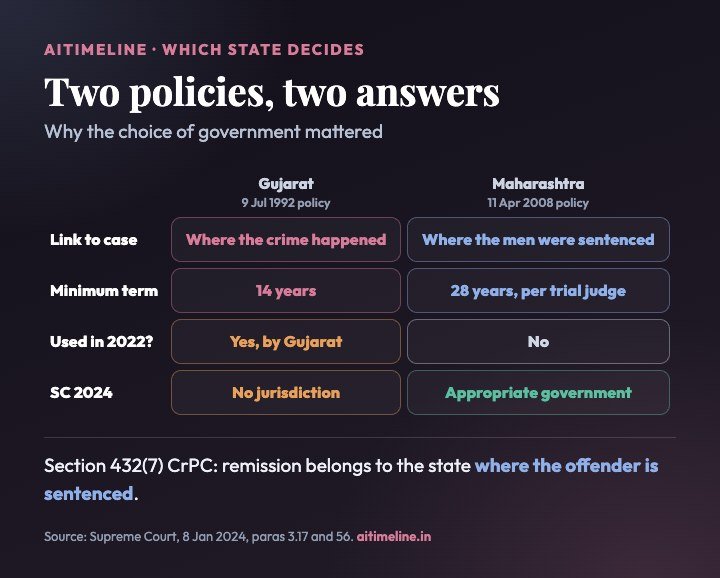
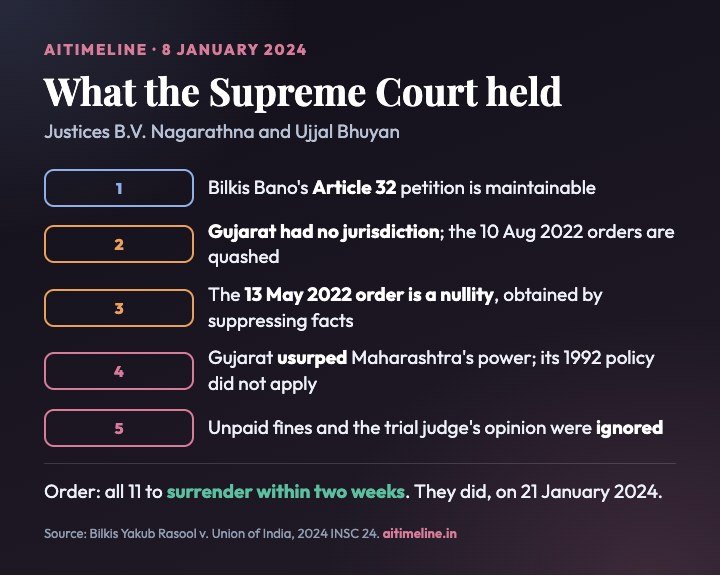
The holding: Under Section 432(7) of the Code of Criminal Procedure, the “appropriate government” is the state where the offender was sentenced. The men were tried and sentenced in Maharashtra, so Gujarat had no jurisdiction and its orders of 10 August 2022 were quashed.
The May 2022 order: The court held that its own order of 13 May 2022 was a nullity, because it was obtained by suppressing material facts and misrepresenting them, including the Gujarat High Court’s earlier rulings that Maharashtra was the appropriate government.
The result: Gujarat had “usurped” Maharashtra’s power. The court refused to let the men stay free under Article 142 and directed them to report to jail within two weeks.
Judgment reserved after 11 days of hearings Challenge and reversal 2022-26
What happened: A bench of Justices B.V. Nagarathna and Ujjal Bhuyan finished hearing Bilkis Bano’s petition and the public interest petitions, and reserved its verdict. It asked the Centre and Gujarat to file the original remission records with translations.
Questions argued: Whether the petitions were maintainable, which state was the appropriate government, and whether the remission orders had been passed properly.
Review of the May 2022 order dismissed Challenge and reversal 2022-26
What happened: The bench that wrote the May 2022 order dismissed Bilkis Bano’s petition to review it, saying no case for review was made out. The dismissal became public on 17 December.
Her writ petition: Her separate writ petition against the remission orders stayed alive. Justice Bela M. Trivedi recused herself from the bench hearing it, without giving reasons.
Bilkis Bano goes to the Supreme Court herself Challenge and reversal 2022-26
What happened: Bilkis Bano filed her own petition to quash the remission orders, along with a petition to review the May 2022 judgment that had sent the remission question to Gujarat.
Why it mattered: As the victim, she had standing that the public interest petitioners might not. The 2024 judgment treated her petition as the lead case and left the PILs’ maintainability open.
Public interest petitions challenge the release Challenge and reversal 2022-26
Who went to court: Former MP Subhashini Ali with journalist Revati Laul and former Lucknow University vice-chancellor Roop Rekha Verma filed the first petition. Others followed from MP Mahua Moitra, the National Federation of Indian Women, lawyer Asma Shafique Shaikh, and former officials including Meeran Chadha Borwankar.
Public reaction: About 6,000 signatories urged the court to revoke the release. Images of the men being welcomed with sweets on their release drew wide criticism.
The 11 convicts walk out of Godhra sub-jail Remission 2019-22
What happened: All 11 men were released under Gujarat’s remission orders. They had spent a little over 14 years in prison, with paroles and furloughs, of life sentences for murder and gang rape.
Reaction: The release prompted protests and statements from opposition parties, women’s groups and former civil servants.
Gujarat signs the remission orders Remission 2019-22
What happened: After the Centre’s approval, Gujarat issued orders granting remission and early release to all 11 convicts.
What the court later found: The orders did not deal with the negative opinions of the CBI and the Mumbai trial court, and the authorities overlooked that the men had not paid the fines imposed on them.
The Centre approves early release Remission 2019-22
What happened: Gujarat wrote to the Union Home Ministry on 28 June 2022 seeking approval, because the case had been investigated by a central agency, the CBI. The ministry conveyed its approval on 11 July.
Why it mattered: Consultation with the Centre is required by law for cases investigated by a central agency.
Jail Advisory Committee recommends release Remission 2019-22
What happened: All members of the committee recommended remission for all 11. The Sessions Judge at Godhra also gave a positive opinion under the 1992 policy.
The dissenting record: The Special Judge in Mumbai who had tried the case, and the Mumbai police unit involved, had opposed release. The 2024 judgment held that the Mumbai court’s opinion was the one that mattered by law.
Supreme Court tells Gujarat to decide Remission 2019-22
The order: On a petition by convict Radheshyam Shah, the court held that Gujarat, where the crime took place, was the appropriate government, and directed it to decide his plea within two months under its 9 July 1992 policy.
What was not disclosed: According to the 2024 judgment, Shah did not tell the court that the Gujarat High Court had twice ruled Maharashtra the appropriate government, or that his application in Maharashtra had drawn negative opinions.
Gujarat High Court rules again: ask Maharashtra Remission 2019-22
What happened: Radheshyam Shah returned to the Gujarat High Court seeking remission. It rejected the plea, holding again that under Section 432(7)(b) the appropriate government was Maharashtra, and let him approach the Bombay High Court.
Why it mattered: The 2024 judgment stressed that this order still held the field when Shah went to the Supreme Court in 2022.
Every authority consulted says no Remission 2019-22
The opinions: On Shah’s application in Maharashtra, the CBI recommended on 14 August 2019 that he serve his full sentence. The Special CBI Court in Mumbai objected on 3 January 2020. The Dahod Superintendent of Police on 3 February and the Collector on 19 February 2020 also opposed release, citing threats feared by the victim’s family.
A year later: In March 2021 the Mumbai Special Judge said Maharashtra’s 2008 policy would apply, under which the minimum term for these offences is 28 years.
First remission plea: Gujarat High Court points to Maharashtra Remission 2019-22
What happened: Shah asked the Gujarat High Court to order consideration of his premature release. Relying on the Constitution Bench ruling in Union of India v. V. Sriharan, it held that Maharashtra was the appropriate government and told him to pursue his remedy there.
Next step: On 1 August 2019 Shah applied to Maharashtra’s Home Department.
Rs 50 lakh compensation, a job and a home Trial and appeals 2004-19
The order: The court directed Gujarat to pay Bilkis Bano Rs 50 lakh within two weeks, and to offer her a government job and government accommodation at a place of her choice if she wished.
Why: Her case “surpass[ed] normal cases”, the court said: she had been forced to live “the life of a nomad and as an orphan” on the charity of NGOs.
The officers: The court was told one convicted police officer’s dismissal had been upheld, three retired officers had lost all their pension, and a two-stage demotion was recommended for IPS officer R.S. Bhagora.
Gujarat offers Rs 5 lakh Trial and appeals 2004-19
What happened: Gujarat offered interim compensation of Rs 5 lakh. Her counsel declined and asked for a final decision. The state also promised to complete disciplinary action against the convicted officers within two weeks.
Background: On 23 October 2017 the court had asked her to seek higher compensation through a separate appeal, as the trial court’s award was meagre.
Supreme Court leaves the High Court verdict intact Trial and appeals 2004-19
What happened: The Supreme Court dismissed the special leave petitions against the Bombay High Court judgment, upholding its findings and the sentences.
Effect: The convictions of all 18 people found guilty, the 11 attackers and the seven police officers and doctors, became final.
Bombay High Court upholds the life sentences Trial and appeals 2004-19
The convicts: The court dismissed the 11 men’s appeals and confirmed their life sentences. It also dismissed the CBI’s appeal seeking the death penalty for three of them, holding the case did not fall in the “rarest of rare” category.
The officers: It set aside the acquittal of five police officers and two doctors and convicted them under Sections 201 and 218 of the IPC, for causing evidence to disappear and framing incorrect records. Head Constable Somabhai Gori had died while his appeal was pending.
On the first investigation: It found the Gujarat police had steered the case in the wrong direction from the day the FIR was recorded, and that the investigation “smacked of dishonest steps to shield the culprits”.
Mumbai court convicts 11 men Trial and appeals 2004-19
The verdict: The court convicted 11 men of the gang rape of Bilkis Bano, the gang rape and murder of her mother and cousin Shamim, and the murder of 14 people including her daughter, and sentenced them to life imprisonment.
The police: Head Constable Somabhai Gori was convicted under Sections 217 and 218 of the IPC for deliberately recording the FIR incorrectly. Five other police officers and two doctors were acquitted.
The twelfth man: Accused number 3, Naresh Modhiya, had died during the trial.
Charges framed in Mumbai Trial and appeals 2004-19
What happened: The court framed charges of rioting, murder and gang rape against the 12 attackers, and charges of conspiracy, destroying evidence and framing incorrect records against the six police officers and two doctors.
Defence: All the accused pleaded not guilty and said they had been falsely implicated.
Supreme Court moves the trial to Mumbai Trial and appeals 2004-19
What happened: Bilkis Bano said she feared for her safety and a fair trial in Gujarat. The Supreme Court transferred the case “in the peculiar facts and circumstances” to a competent court in Mumbai for trial and disposal.
The long consequence: Because the men were tried and sentenced in Maharashtra, Maharashtra became the “appropriate government” for remission, the point on which the 2024 judgment turned.
CBI files its charge-sheet against 20 Investigation 2002-04
Who was charged: Twelve men accused of the attack, six police personnel and two government doctors who conducted the post-mortems.
The allegation against officials: That they suppressed evidence and recorded falsehoods to shield the attackers.
Bodies exhumed; no skulls found Investigation 2002-04
What happened: The CBI exhumed the remains buried after the 2002 inquest and sent them for post-mortem and forensic analysis.
What it showed: Not a single skull was recovered. The High Court later inferred that the attackers did not want the bodies identified.
CBI takes over from Gujarat Police Investigation 2002-04
What happened: The CBI took charge of the case, seized photographs of the bodies taken at the spot, recorded witness statements including Bilkis Bano’s, and drew a new scene-of-offence panchnama in March 2004.
Why it matters: The case had been closed as “true but undetected” less than a year earlier.
Supreme Court orders a CBI investigation Investigation 2002-04
What happened: The Supreme Court set aside the closure and transferred the investigation from the Gujarat Police to the CBI.
Why it mattered: It was the first turning point: an agency outside the state now investigated the crime and the original investigation itself.
Bilkis Bano petitions the Supreme Court Investigation 2002-04
What happened: She asked the Supreme Court to set aside the magistrate’s acceptance of the closure report and to transfer the investigation to the CBI.
Why: She had named her attackers, yet the police had recorded the crime against unknown persons and closed it.
Magistrate accepts the closure report Investigation 2002-04
What happened: The police again asked to close the case as true but undetected. This time the magistrate accepted, ending the state investigation.
Date note: The Supreme Court’s 2024 judgment gives the date of the acceptance order as 25 March 2003; the High Court says the report was re-submitted in February.
Police file the first closure report Investigation 2002-04
What happened: The investigating officer reported the case as true but undetected, saying the culprits could not be found, and sought closure. The court refused and directed the investigation to continue.
Later: Bhagora was among the officers the Bombay High Court convicted in 2017.
Seven bodies, and a statement that named names Investigation 2002-04
The bodies: Police held the inquest on seven bodies, though 14 people had been killed, and two doctors carried out the post-mortems at the spot. Bilkis Bano, who was at the police station, was not taken there.
Her statement: At the Godhra relief camp she described the attack to Collector Jayanti Ravi, and on her instruction an Executive Magistrate recorded a statement naming 12 attackers. She was medically examined at Godhra Civil Hospital on 7 March.
An FIR that left out the rape and the names Investigation 2002-04
What happened: Bilkis Bano reached Limkheda police station with the help of police personnel she met. Head Constable Somabhai Gori recorded her complaint.
What was wrong: The FIR did not record that she had been raped, and stated that she did not know her attackers, although she had named them.
The attack near Pannivel The crime 2002
What happened: A mob of about 25 people arrived in two vehicles and attacked the group. Bilkis Bano, 21 and five months pregnant, was gang-raped. Her mother and her cousin Shamim were gang-raped and killed.
Those killed: Fourteen people were killed, among them her three-and-a-half-year-old daughter Saleha and eight minors in all, including Shamim’s two-day-old baby.
Survival: She lost consciousness, then hid on a hilltop. The next day a local woman gave her clothes.
The family flees Randhikpur The crime 2002
What happened: As houses in Randhikpur were burned and looted, Bilkis Bano left with her daughter and members of her extended family. They moved between villages for several days, sheltering where they could.
On the way: At Kuwajar her cousin Shamim gave birth to a baby girl.
The Godhra train fire The crime 2002
What happened: A fire on the Sabarmati Express near Godhra station killed 59 people, many of them returning from Ayodhya.
Aftermath: Communal violence spread across Gujarat from 28 February.
The Legal Journey in Four Stages
Each stage was decided by a different court, and each reversed what came before.
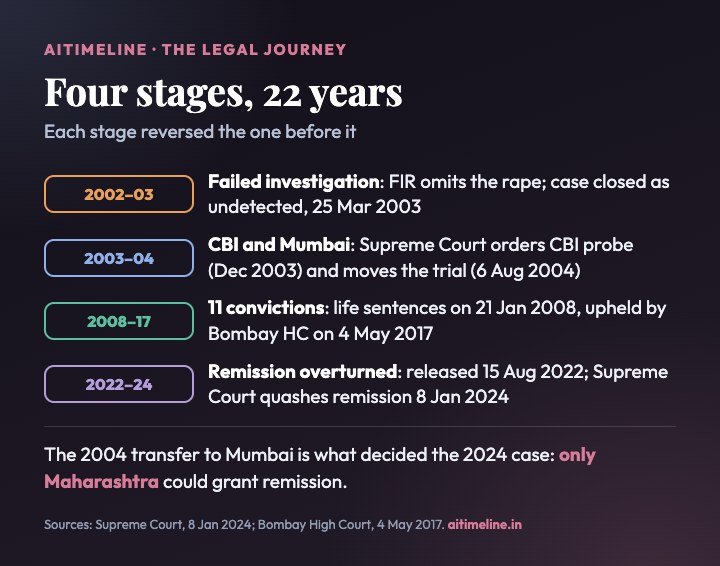
The Supreme Court intervened three times. In 2003 it took the investigation away from the state police; in 2004 it took the trial away from the state; in 2024 it held that the second of those decisions also took away the state’s power to release the men early. That thread, from the 2004 transfer to the 2024 judgment, is the core of the case’s legal significance.
The First Investigation: What Went Wrong
The Bombay High Court called the earlier investigation “the villain” of the case.
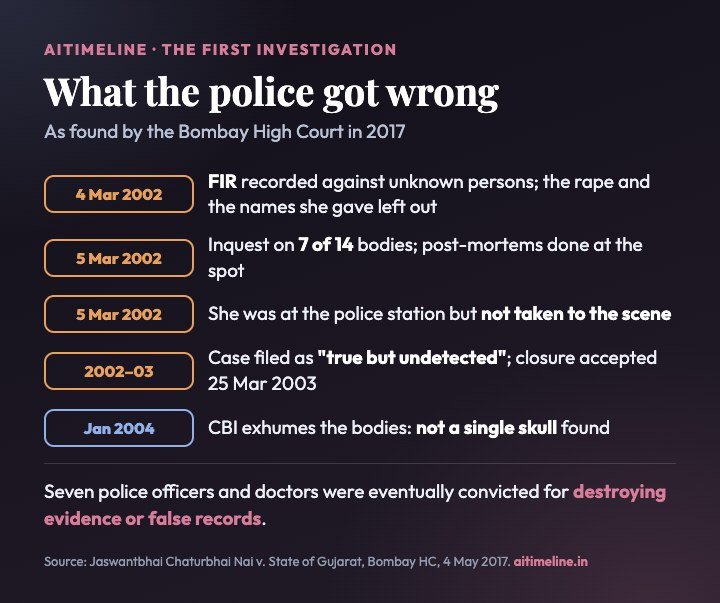
| Stage | What happened | What the courts said |
|---|---|---|
| FIR, 4 Mar 2002 | Recorded against unknown persons; rape not mentioned | Head Constable Gori convicted in 2008 for recording it incorrectly |
| Inquest, 5 Mar 2002 | Seven bodies; post-mortems at the spot | Two doctors convicted in 2017 under Sections 201 and 218 IPC |
| Closure, 2002-03 | “True but undetected”; accepted in March 2003 | Set aside when the Supreme Court sent the case to the CBI |
| Exhumation, 2004 | No skulls recovered | The High Court inferred an attempt to prevent identification |
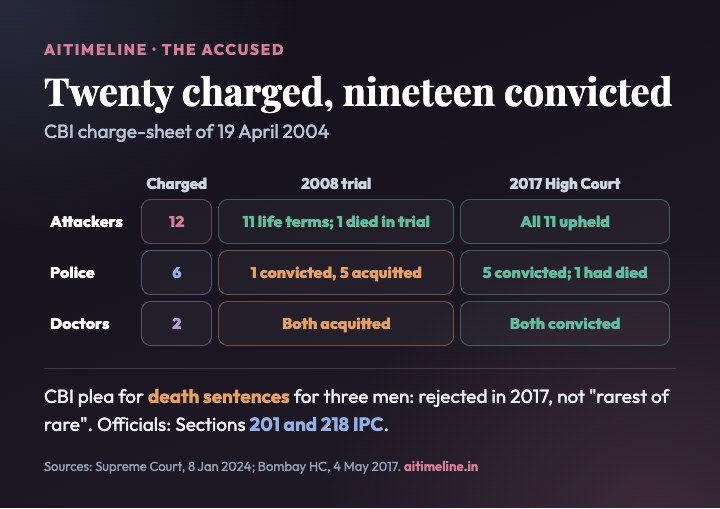
Who Was Charged and Who Was Convicted
Twenty accused: twelve attackers, six police personnel, two doctors.
Often claimed
- The trial convicted only the 11 attackers.
- The 2024 judgment overturned the convictions.
- Bilkis Bano challenged the release in September 2022.
What the record shows
- A police officer was convicted in 2008, and seven more officials in 2017.
- It quashed only the remission orders; the life sentences stand.
- Her petition was filed in November 2022; PILs came first in August.
The Remission Controversy
Three legal questions: which government, which policy, and whether the orders were valid.
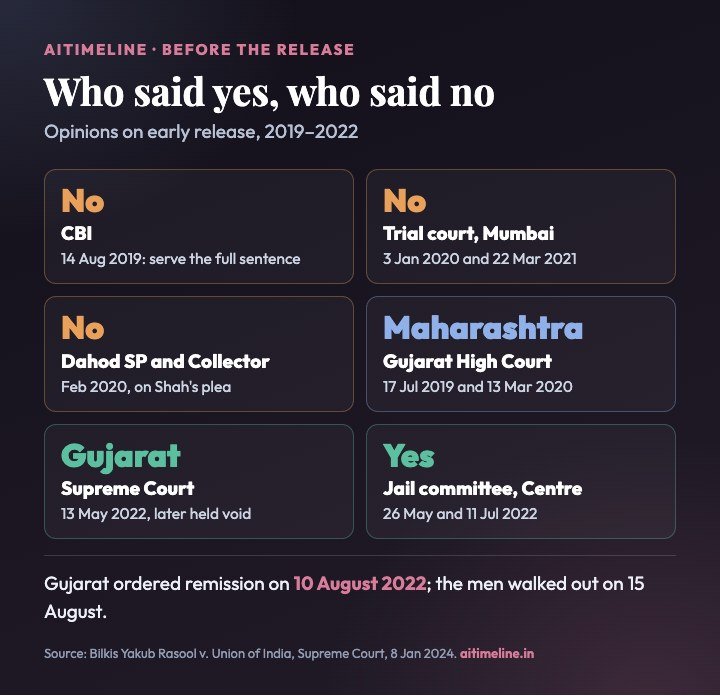
Remission under Section 432 of the CrPC is the government’s power to reduce a sentence; it can bring early release but leaves the conviction intact. The dispute here was over which government held that power. The crime was committed in Gujarat, but the men were tried and sentenced in Maharashtra because the Supreme Court had moved the trial. In May 2022 one bench said Gujarat; in January 2024 another said Maharashtra, relying on Section 432(7) and earlier larger-bench rulings, and held the 2022 order void because the convict who sought it had not disclosed the Gujarat High Court’s contrary orders.
The 8 January 2024 Judgment
Bilkis Yakub Rasool v. Union of India, Justices B.V. Nagarathna and Ujjal Bhuyan.
Wrong government
- Section 432(7) CrPC.
- Sentenced in Maharashtra.
- Gujarat “usurped” its power.
A nullity
- Facts suppressed.
- Misrepresentation to the court.
- Also per incuriam.
Back to prison
- No Article 142 relief.
- Surrender in two weeks.
- Remission only by law.
The Institutional Accountability Question
| Institution | Role in the case |
|---|---|
| Gujarat Police | Recorded an incomplete FIR and closed the case; seven officials were later convicted. |
| CBI | Reinvestigated from 2004, charged 20, and opposed remission in 2019 and 2021. |
| Special court, Mumbai | Convicted 12 in 2008 and opposed early release. |
| Bombay High Court | Upheld the life sentences and convicted seven officials in 2017. |
| Supreme Court | Ordered the CBI probe, moved the trial, awarded compensation, then quashed the remission. |
| Government of Gujarat | Granted remission in 2022; the 2024 judgment held it had no power to do so. |
| Government of India | Approved the early release under Section 435 CrPC in July 2022. |
Why the Bilkis Bano Case Still Matters
Six lasting lessons
- Independent investigation: a case closed as undetected produced 19 convictions once the CBI took over.
- Fair trial: moving the trial out of the state protected the survivor and the witnesses.
- Accountability of officials: police officers and doctors were convicted for hiding the crime, not only the attackers for committing it.
- Victims’ rights: the 2019 order measured compensation by the survivor’s actual loss.
- Limits of executive power: remission must come from the competent government and follow the law.
- Candour before courts: an order won by suppressing facts can be declared void, even an order of the Supreme Court.
Explore More Timelines
People Also Ask
Frequently Asked Questions
Dated facts from the Supreme Court and Bombay High Court judgments.
⚠️ Editorial Note
This account is based on the Supreme Court’s judgment of 8 January 2024 in Bilkis Yakub Rasool v. Union of India, the Bombay High Court’s judgment of 4 May 2017 in Jaswantbhai Chaturbhai Nai v. State of Gujarat, and Supreme Court orders of 23 October 2017, 29 March 2019, 23 April 2019 and 26 September 2024. Later events come from PTI, The Tribune and Verdictum reports. Checking the brief this page started from against those records: the closure report was re-filed in February 2003 but accepted by an order of 25 March 2003; the High Court records the CBI transfer as 16 December 2003, not 6 December; the exhumation ran from 28 January to 1 February 2004; and Bilkis Bano’s own petition against the remission was filed in November 2022, after public interest petitions in August, not in September. We have not named the survivor’s surviving family members or described the crime beyond what the judgments record. This is not legal advice.
Related Reading on AiTimeline
Sources & further reading
Every dated entry above was checked against these references. Last reviewed 6 November 2026.
- Bilkis Yakub Rasool v. Union of India, judgment of 8 January 2024, 2024 INSC 24
- Jaswantbhai Chaturbhai Nai v. State of Gujarat, judgment of 4 May 2017
- Bilkis Yakub Rasool v. State of Gujarat, compensation order of 23 April 2019
- State of Gujarat v. Bilkis Yakub Rasool, review dismissed 26 September 2024
- Bilkis Yakub Rasool v. State of Gujarat, order of 29 March 2019
- Early Release of Bilkis Bano Gangrape Convicts (case tracker)
- SC dismisses Bilkis Bano's plea seeking review of its earlier order (December 2022)
- Absolutely misconceived: apex court dismisses writ petitions of two convicts (19 July 2024)