Prakash Singh Police Reforms: The Seven Directives and 20 Years of Delay
Prakash Singh police reforms explained: the 2006 Supreme Court directives, who must implement each, DGP appointment rules and why compliance lags in 2026.
Latest Story
The Prakash Singh police reforms case is India’s longest-running attempt to change how its police are governed. In 1996 two former police chiefs, Prakash Singh and N.K. Singh, asked the Supreme Court to make governments act on reports that had gathered dust since the National Police Commission of 1977. On 22 September 2006 the court issued seven directives: on who picks the police chief, how long officers stay in post, who decides transfers, who hears complaints, and how investigations are run. Twenty years later, states have created many of the bodies on paper, but monitoring reports have found no state in full compliance, and the court is still hearing disputes over acting DGPs in 2026. This timeline follows each step, and separates what the court ordered from how governments responded.
💡 Short Answer
In Prakash Singh v. Union of India, decided on 22 September 2006, the Supreme Court ordered seven police reforms. Six bind states and Union Territories: a State Security Commission, a UPSC-based process and two-year tenure for the DGP, fixed tenures for field officers, separate investigation wings, a Police Establishment Board and Police Complaints Authorities. The seventh tells the Union to create a National Security Commission. Implementation remains partial in 2026.
Prakash Singh Police Reforms: Key Questions
Police Reform in Ten Points
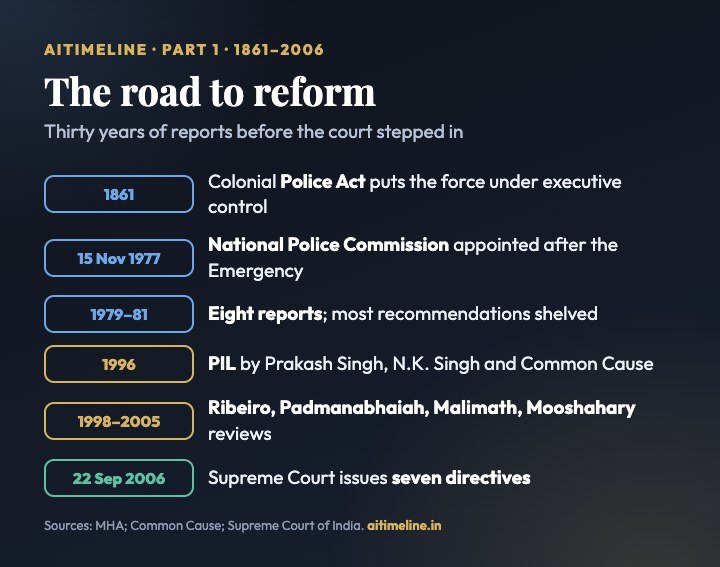
- Colonial base: the Police Act of 1861 put the police under executive control.
- Reports ignored: the National Police Commission (1977) wrote eight reports in 1979-81; most went unimplemented.
- The petition: Prakash Singh, N.K. Singh and Common Cause went to the Supreme Court in 1996.
- The judgment: seven directives on 22 September 2006, to apply until legislation replaced them.
- Six plus one: directives 1-6 bind states and UTs; directive 7 binds the Union.
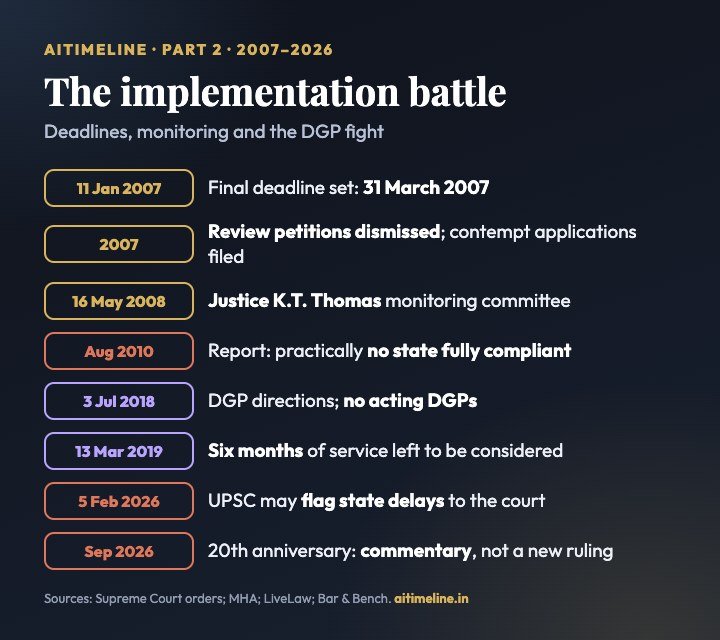
- Deadlines: compliance was due by 31 December 2006, extended to 31 March 2007.
- Monitoring: the Justice K.T. Thomas Committee (2008) reported in 2010 that practically no state had complied fully.
- DGP rules: the court tightened the process in July 2018 and March 2019 and banned acting DGPs.
- Paper vs practice: a commission or complaints authority on paper is not compliance; its independence and powers matter.
- Still live: in 2026 the court is still hearing pleas over acting DGPs.
Timeline: Police Reform in India, 1861 to 2026
Newest first. Colour shows which phase each event belongs to.
Twenty years on: commentary asks when non-compliance becomes contempt Latest 2024-26
What happened: Ahead of the judgment’s twentieth anniversary, a Bar & Bench column by law student Fahas Abdulla argued that “States and UTs have only been partially compliant”, citing studies by the Commonwealth Human Rights Initiative (CHRI) and the earlier Justice K.T. Thomas Committee. It counted more than 10 contempt petitions and about 150 interlocutory applications since 2007, still pending.
The argument: The column says non-compliance becomes contempt at a “measurable point”: once the court has rejected a state’s resource or phased-compliance excuse and the state still does not act.
Supreme Court criticises the “acting DGP” habit and lets UPSC flag delays Latest 2024-26
What happened: Hearing applications in the Prakash Singh case, the court noted that several states were not sending names to the UPSC on time and were running their police forces with acting or in-charge DGPs instead. It directed the UPSC to make recommendations for Telangana within four weeks.
New step: The court allowed the UPSC to remind states and, if a proposal is not sent on time, to move the Supreme Court directly in the Prakash Singh case.
Acting DGPs return to court Latest 2024-26
What happened: Fresh pleas accused states of bypassing the UPSC panel by appointing acting or in-charge DGPs. In December 2024 the court sought responses from several states, including Uttar Pradesh, Andhra Pradesh and Telangana, on a plea alleging violations. In 2025 it asked Tamil Nadu why it had an acting DGP rather than a regular appointment.
Why it matters: The acting-DGP route lets a government pick an officer outside the UPSC shortlist, which is exactly what the 2018 order prohibited.
Six months of service left: a floor for DGP candidates DGP rules
What happened: The court clarified that the UPSC should prepare the panel purely on merit from officers with at least six months of service left before retirement, to curb favouritism.
Why it mattered: The rule was meant to stop states from either picking officers on the eve of retirement or stretching an incumbent’s tenure by choosing who stays in the zone of consideration.
Five states fail to escape the UPSC process DGP rules
What happened: The court dismissed applications by five states that wanted to appoint DGPs under their own police laws instead of through the UPSC panel. It said the July 2018 directions were meant to protect the post from political interference.
What stayed open: The court left room for states with their own legislation to seek modification separately, so the interaction between state laws and the court’s directions remained contested.
Supreme Court tightens DGP appointments and bans acting DGPs DGP rules
The directions: States must send proposals to the UPSC at least three months before the incumbent DGP retires; the UPSC prepares a panel of three under the 2006 judgment; the state must “immediately appoint” one of them; and no state should “ever conceive of the idea” of an acting DGP.
More: Officers in the zone of consideration should normally have two years of service left, and appointing someone on the eve of retirement to give them an extension is “not in conformity with the spirit” of the direction. Contrary state laws and rules were put in abeyance to that extent.
Court asks for status reports again; Centre files an affidavit Compliance fight
What happened: With the Thomas Committee’s findings on record, the court on 16 October 2012 directed the states, Union Territories and the Union to file fresh status reports on implementation. The Home Ministry filed its status report by affidavit on 26 February 2013.
The Centre’s line: In answers to Parliament, the Home Ministry has repeatedly said that police and public order are State subjects and that implementing the reforms is for state governments and Union Territories; the Centre issues advisories and funds modernisation.
Where things stood: By then many states had passed new police Acts or issued executive orders, but compliance was uneven, and some laws were criticised for weakening the bodies the court had ordered.
Thomas Committee reports “total indifference” Compliance fight
Finding: The monitoring committee found that practically no state had fully complied with the directions and expressed dismay at what it called the “total indifference” of states to reform.
Paper versus practice: It noted that bodies created on paper did not always have the composition, powers or independence the court intended.
A three-member monitoring committee under Justice K.T. Thomas Compliance fight
What happened: Faced with incomplete compliance affidavits, the court set up a committee to examine each state’s and Union Territory’s affidavits, assess how far the seven directives had been implemented and suggest ways to deal with practical difficulties.
Review petitions dismissed; contempt applications filed Compliance fight
What happened: Several states, including Gujarat, Karnataka, Maharashtra, Punjab, Tamil Nadu and Uttar Pradesh, asked the court to review the judgment; the review petitions were dismissed, with the dismissal reported as 23 August 2007. The petitioners also moved contempt applications over non-compliance.
Shift: From then on, the case was less about what reform India needed and more about whether governments would obey the court.
No more delay: deadline moved to 31 March 2007 Compliance fight
What happened: States had asked for more time and some had sought review. The court refused to defer implementation, called several directions “self-executory”, and gave a final deadline of 31 March 2007, with affidavits of compliance due by 10 April 2007.
Original timetable: The 2006 judgment itself had asked for compliance by 31 December 2006 and affidavits by 3 January 2007.
The Supreme Court issues seven directives The judgment
The order: Ten years after the petition, the court issued seven binding directions to restructure police administration. Directives 1 to 6 apply to states and Union Territories; directive 7 applies to the Union Government and the central police organisations.
Legal force: The directions were to operate until the Union and states enacted suitable legislation, a stopgap the court chose because decades of commission reports had produced no comprehensive law.
Sorabjee Committee submits the Model Police Act Commissions
What happened: A month after the judgment, the committee handed the Home Ministry a draft Model Police Act to replace the 1861 law. Because police is a State subject, the draft was sent to states to adopt or adapt.
Overlap: The Model Act offered its own versions of a State Police Board, an Establishment Committee and a Complaints Authority, giving states another template alongside the court’s directions.
Mooshahary review picks 49 recommendations Commissions
What happened: The Home Ministry asked a review committee to sift through the earlier commission reports. It identified 49 recommendations for implementation and reported in March 2005.
Padmanabhaiah and Malimath committees Commissions
Padmanabhaiah: A committee under former Union Home Secretary K. Padmanabhaiah, appointed in January 2000, reported in August 2000 on recruitment, training, organisation and modernisation of the police.
Malimath: The Committee on Reforms of the Criminal Justice System, headed by Justice V.S. Malimath, was set up in November 2000 and reported in March 2003. It looked at investigation quality and the wider justice system, not policing alone.
The Ribeiro Committee Commissions
What happened: While the petition was pending, a committee under Julio Ribeiro was set up to review what had become of the National Police Commission’s recommendations. It submitted two reports, in October 1998 and March 1999, proposing bodies such as a State Security Commission and police complaints authorities.
Two former police chiefs take reform to the Supreme Court Commissions
The petition: Prakash Singh, a former DGP of Uttar Pradesh and Assam and former Director General of the BSF, and former CBI officer N.K. Singh filed a public interest litigation, joined by the NGO Common Cause.
What they asked: That the court direct governments to act on the National Police Commission’s recommendations: insulate the police from political control over transfers and postings, make officers accountable, and replace the 1861 Act.
National Police Commission: eight reports Commissions
What it proposed: Fixed tenures, protection from arbitrary transfers, a State Security Commission, a better complaints system, separation of investigation from law and order, and a new Police Act. It even drafted a model law.
What happened: Most recommendations were not implemented. Its work straddled a change of government in 1980, and the reports were largely shelved.
The National Police Commission is appointed Commissions
What happened: After the Emergency years, when the police were widely seen as having been used for political ends, the Union Government set up the first national commission to examine the role, organisation and accountability of the police.
The Police Act of 1861 Commissions
What it did: The colonial government built a centralised force answerable to the executive, with “superintendence” vested in the government, to keep order and protect British rule.
After 1947: Independent India kept the framework. Some states later passed their own police Acts, but the core design of executive control remained.
The Road to the Judgment
Thirty years of reports before the court stepped in.
The Seven Directives: What the Court Ordered
Each directive targets a different weakness. Read the second column carefully.
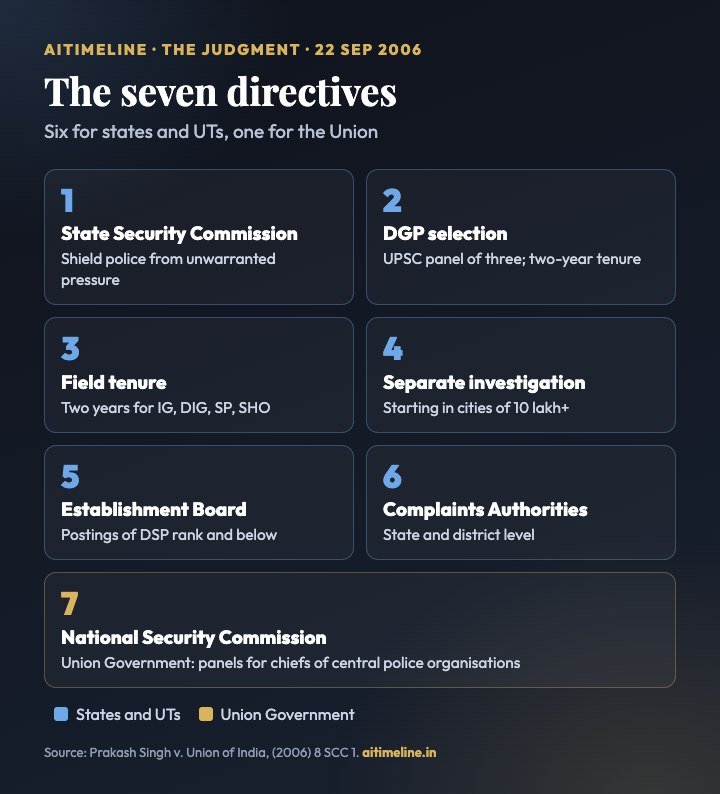
| Directive | Who must act | What it requires | Purpose |
|---|---|---|---|
| 1. State Security Commission | States and UTs | A commission, on the NHRC, Ribeiro or Sorabjee model, to stop unwarranted government pressure, set broad policy and evaluate performance; reports to the legislature | Insulate the police from political interference |
| 2. DGP selection and tenure | States and UTs | DGP chosen from the three senior-most officers empanelled by the UPSC; minimum two-year tenure regardless of retirement date | Protect the police chief from arbitrary appointment and removal |
| 3. Tenure for field officers | States and UTs | Minimum two years for IG (zone), DIG (range), SP (district) and SHO (police station) | Stop punitive transfers |
| 4. Separate investigation | States and UTs | Separate investigating police from law-and-order police, starting in towns of ten lakh or more | Better, faster investigations |
| 5. Police Establishment Board | States and UTs | Decides transfers, postings and promotions of officers of and below DSP rank; recommends for higher ranks; hears appeals | Take postings out of politics |
| 6. Police Complaints Authorities | States and UTs | State level for SP rank and above; district level for DSP rank and below; serious misconduct such as custodial death, grievous hurt or rape; recommendations binding | Independent route for citizens’ complaints |
| 7. National Security Commission | Union Government | Prepares panels for selecting chiefs of central police organisations, with a minimum two-year tenure | Professional leadership of central forces |
Who Must Act: Not Seven Identical Duties
Directives 1-6
- Security Commission, DGP process, tenures.
- Separate investigation wings.
- Establishment Board and Complaints Authorities.
Directive 7
- National Security Commission.
- Panels for chiefs of central police organisations.
- Two-year tenure for those chiefs.
A role, not a directive
- Prepares the DGP panel of three for each state.
- Since 2026 can flag delays to the court.
Paper vs Practice: What Compliance Really Means
The existence of a body does not by itself establish compliance.
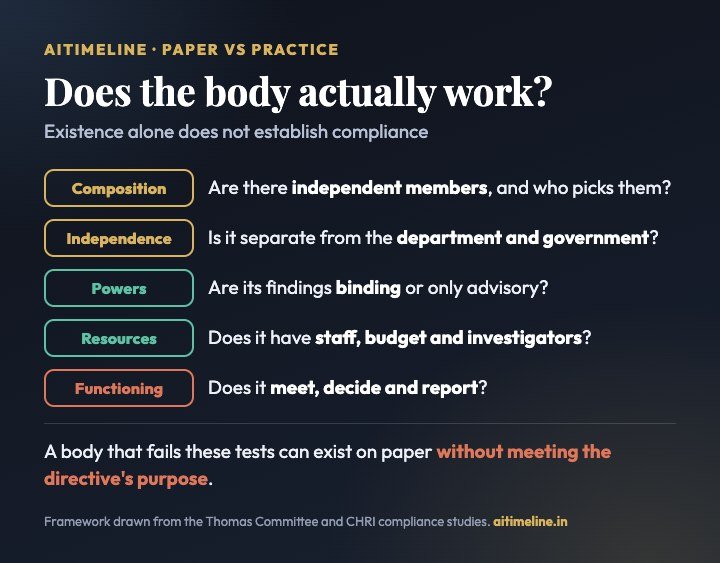
On paper
- A State Security Commission notified by government order.
- A Police Complaints Authority with a chair appointed.
- A Police Establishment Board of senior officers.
- A state police Act that mentions all three.
In practice, ask
- Are independent members on it, and who picks them?
- Are its findings binding, or advisory?
- Does it have staff, money and investigators?
- Does it meet, decide cases and publish reports?
This is why the Thomas Committee and CHRI scored states on composition and powers, not just on whether a body had been notified. A complaints authority made up of serving officials, or a security commission whose advice the government can ignore, can tick the box while leaving the problem the court identified in place.
The Implementation Battle, 2007-2026
How a State DGP Is Supposed to Be Chosen
The directive that has been litigated the most.
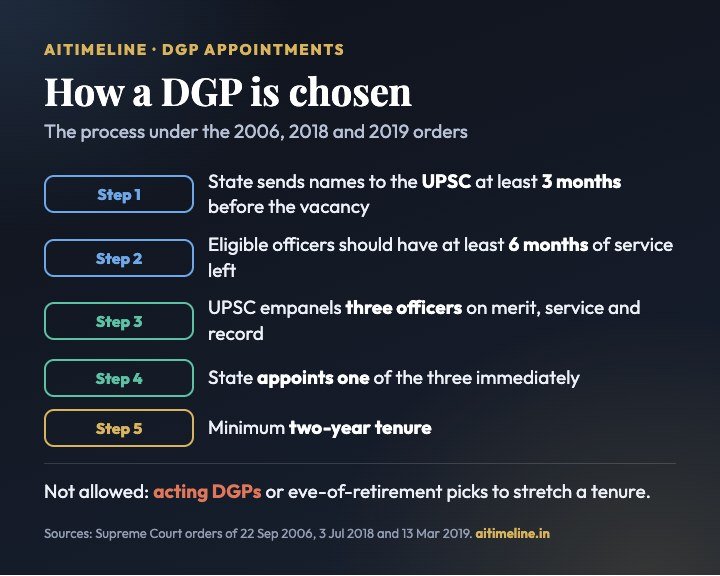
| Order | What it added |
|---|---|
| 22 Sep 2006 | DGP from the three senior-most officers empanelled by the UPSC; minimum two-year tenure |
| 3 Jul 2018 | Proposals three months ahead; appoint from the panel immediately; no acting DGPs; no eve-of-retirement picks; contrary state rules in abeyance |
| 16 Jan 2019 | Five states’ pleas to use their own laws dismissed |
| 13 Mar 2019 | Candidates should have at least six months of service left; empanelment on merit |
| 5 Feb 2026 | UPSC may remind states and move the court if proposals are late |
Why Has Implementation Been So Slow?
No single reason; six working together.
Six obstacles
- A State subject: police and public order are in the State List, so the Union can only advise, fund and legislate for UTs.
- Political control: postings and the choice of police chief have long been levers of power for state governments.
- State laws: new police Acts often created the bodies with weaker composition or powers than the court ordered.
- Hollow institutions: bodies without independent members, staff or binding powers satisfy the form but not the purpose.
- Money and staff: separate investigation wings need more officers, training and forensic capacity.
- Limits of a court: judges can order and monitor, but cannot run police administration in every district.
Independence vs Accountability
The judgment wanted both, not one at the cost of the other.
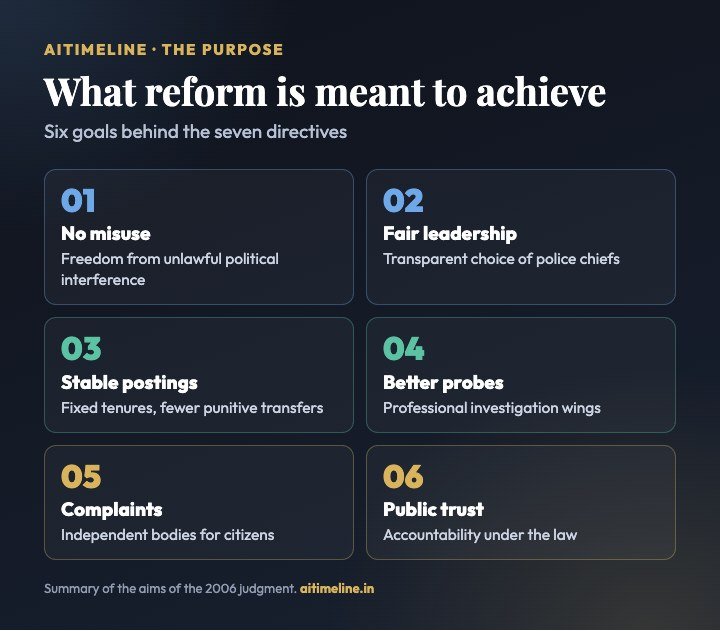
Freedom from misuse
- No unlawful pressure on investigations.
- No punitive transfers.
- Merit-based choice of police chief.
Answerable to law
- Elected governments set policy and budgets.
- Independent complaints authorities.
- Courts and legislatures review.
The risk
- No independence: politicised policing.
- No accountability: unchecked police power.
Key People and Institutions
| Who | Role |
|---|---|
| Prakash Singh | Former DGP of Uttar Pradesh and Assam and DG of the BSF; lead petitioner |
| N.K. Singh | Former senior police officer; co-petitioner |
| Common Cause | Public interest organisation; co-petitioner |
| CJI Y.K. Sabharwal | Led the 2006 bench, with Justices C.K. Thakker and P.K. Balasubramanyan |
| Dharma Vira | Chaired the National Police Commission, 1977-81 |
| Julio F. Ribeiro | Former DGP; headed the 1998-99 review committee |
| K. Padmanabhaiah | Former Union Home Secretary; headed the 2000 committee |
| Justice V.S. Malimath | Headed the criminal justice reform committee, 2000-03 |
| Soli Sorabjee | Former Attorney General; chaired the Model Police Act committee |
| Justice K.T. Thomas | Retired Supreme Court judge; headed the 2008 monitoring committee |
| UPSC | Prepares DGP panels under the court’s orders |
| CHRI | Commonwealth Human Rights Initiative; tracks state compliance |
Where Things Stand
Settled
- The seven directives are binding until replaced by law.
- DGPs come from a UPSC panel of three.
- Acting DGPs are not allowed under the 2018 order.
- Candidates need six months’ service left.
Still open
- Whether state police Acts meet the directives.
- Whether oversight bodies get real independence.
- Whether persistent non-compliance is treated as contempt.
- Whether Parliament or states replace the court’s stopgap with full laws.
Explore More Timelines
People Also Ask
Frequently Asked Questions
Dated facts from court orders, parliamentary answers and reporting.
⚠️ Editorial Note
This account draws on the 2006 judgment and later orders in W.P.(C) 310 of 1996, Ministry of Home Affairs answers in Parliament, the Justice K.T. Thomas Committee’s findings as summarised in official answers, CHRI compliance studies, PRS Legislative Research, and reporting by LiveLaw, Bar & Bench and PTI. The brief this page was built from gave 3 January 2007 as the compliance deadline (the judgment set 31 December 2006; 3 January was the date for affidavits), dated contempt petitions against six states to 23 August 2007 (sources tie that date to the dismissal of review petitions), dated the Malimath Committee to 2002 (it was formed in 2000 and reported in 2003), and said the Establishment Board covers officers below DSP rank (it covers officers of and below that rank). It also gave a specific 1996 filing date we could not confirm, so only the year is used, and cited a 1 April 2025 Home Ministry answer whose link returned page-not-found, so that entry was left out. We added the January 2019, December 2024 and February 2026 hearings. This is not legal advice.
Related Reading on AiTimeline
Sources & further reading
Every dated entry above was checked against these references. Last reviewed 6 November 2026.
- Supreme Court of India: Prakash Singh v. Union of India (22 September 2006), via Indian Kanoon
- Supreme Court of India: Prakash Singh v. Union of India, order on DGP appointments (3 July 2018), via Indian Kanoon
- Supreme Court of India: Prakash Singh v. Union of India, six-month residual service order (13 March 2019), via Indian Kanoon
- Common Cause: Police Reforms, W.P.(C) 310 of 1996
- PRS Legislative Research: Police Reforms in India
- LiveLaw: Appointment of DGPs, Supreme Court's directions (3 July 2018)
- Bar & Bench: Supreme Court slams 'acting DGP' culture, asks UPSC to approach Court (February 2026)
- Bar & Bench: 20 years of Prakash Singh: When does non-compliance become contempt? (11 September 2026)