Shah Commission Report: What It Revealed About India’s Emergency
Shah Commission report explained: 48,500 complaints, three 1978 reports, 1.07 crore sterilisations, Turkman Gate, and what really happened to the report.
Latest Story
The Shah Commission report is the official account of what happened during India’s Emergency of 1975-77. Appointed on 28 May 1977 by the new Janata government and led by former Chief Justice J.C. Shah, the Commission received about 48,500 complaints and examined detentions, censorship, demolitions, forced sterilisation and the misuse of government power. It produced three reports in 1978, and all three were laid before Parliament. What happened next is the contested part: the criminal cases mostly collapsed, Indira Gandhi’s returning government withdrew the report in 1980, and a belief spread that no copy survived. This timeline sets out what the Commission found, what the record shows about the report’s fate, and why it still comes up in Parliament in 2024 and 2025.
💡 Short Answer
The Shah Commission, set up on 28 May 1977 under former CJI J.C. Shah, investigated abuses during the Emergency of June 1975 to March 1977. It received about 48,500 complaints and submitted three reports in 1978. The final report, tabled in Parliament on 31 August 1978, recorded over 1.07 crore sterilisations. It could find facts but not punish, and most cases faded after 1980.
Shah Commission Report: Key Questions
The Shah Commission in Ten Points
- Set up: 28 May 1977, by Morarji Desai’s Janata government.
- Led by: former Chief Justice of India J.C. Shah, as sole member.
- Covered: the Emergency, 25 June 1975 to 21 March 1977.
- Complaints: about 48,500, filed by 31 July 1977.
- Reports: interim reports on 11 March and 26 April 1978; final report on 6 August 1978.
- Tabled: interim reports on 15 May 1978, final report on 31 August 1978.
- Sterilisation: over 1.07 crore procedures recorded in two years.
- No power to punish: by February 1979 only 19 criminal cases had been registered.
- After 1980: the report was withdrawn and cases faded, but copies survived.
- Separate track: the Forty-fourth Amendment changed Emergency rules; the Commission did not.
Timeline: From the Emergency to the Shah Commission and After
Newest first. Colour shows which phase each event belongs to.
Nearly 50 years on, the reports remain the main official record of the Emergency Legacy 1980-2026
Where things stand: The three reports, the papers laid in Parliament in 1978 and the archival collections built since are still the main official source for what happened between June 1975 and March 1977. Ministers cite them in answers to Parliament, and researchers work from surviving copies.
What has not happened: We found no record that the government has placed a fresh “authentic copy” before the Rajya Sabha since the 2024 demand.
Home Ministry gives Parliament the sterilisation figures from the Shah report Legacy 1980-2026
What happened: Answering a question on Emergency-era sterilisations, the Home Ministry cited the Shah Commission and attached its state-wise table: 26,24,755 sterilisations in 1975-76 and 81,32,209 in 1976-77, a total of 1,07,56,964.
Complaints: The answer said 548 complaints of sterilisation of unmarried persons and 1,774 cases of death linked to sterilisation were reported to the Commission. It also stated that the Shah Commission report “was tabled in Parliament on 31.08.1978”.
Rajya Sabha Chairman asks the government to look for an “authentic” copy Legacy 1980-2026
What happened: Deepak Prakash asked the government to publish the report. Chairman Jagdeep Dhankhar backed him, calling it “an issue of grave importance” and saying the government “must examine the possibility of having its authentic report and place it on the table of the House”.
The confusion: Prakash said the report had been destroyed after 1980 and that a copy survived abroad. Parliamentary records show the reports were laid in 1978, and copies are available in India, so “destroyed” and “never tabled” both overstate what the record supports.
Copies resurface in libraries and digital archives Legacy 1980-2026
What happened: Shah Commission papers were made available for research through the Ashoka University Archives of Contemporary India, curated with UC Berkeley and Stanford Libraries. Scans of the third and final report are also hosted by the BJP Central Library and the Internet Archive.
Why it matters: Researchers can now check what the Commission actually found, instead of relying on political speeches or memory.
Era Sezhiyan publishes “Shah Commission Report: Lost, and Regained” Legacy 1980-2026
What happened: Era Sezhiyan, a former parliamentarian, reprinted all three reports in one book. He wrote that the government’s “withdrawal” of the report in 1980 had created a belief that “not a single copy of the Shah Commission Report has survived within India”.
Effect: The book brought the reports back into public debate and showed that the text had not been lost.
Indira Gandhi returns; the Emergency cases fade Follow-up 1978-80
What happened: The Congress swept the January 1980 election. Within weeks the special courts set up to try Emergency cases had largely folded; in February 1980 the last pending case, involving former information minister V.C. Shukla, was sent to an ordinary court.
The report: Era Sezhiyan and others describe the new government withdrawing the report and disapproving of the Commission’s work. An official linked to the Commission told The Indian Express in 2000 that cases were “slowly killed” and that copies were ordered destroyed. That claim has not been independently established.
Morarji Desai resigns Follow-up 1978-80
What happened: Internal splits brought down the Janata government. Desai resigned in July 1979, and the Lok Sabha was dissolved the next month, leading to the January 1980 election.
Effect on the cases: Prosecutions that depended on the political will of the Janata government lost momentum as the coalition collapsed.
Forty-fourth Amendment rewrites the Emergency rules Follow-up 1978-80
What changed: “Internal disturbance” in Article 352 was replaced by “armed rebellion”. An Emergency now needs the Cabinet’s written advice to the President and faster parliamentary approval by a special majority.
Not the Commission’s act: The amendment was Parliament’s response to the Emergency. The Commission documented the abuses; it did not amend the Constitution.
Only 19 criminal cases, and a Special Courts Act Follow-up 1978-80
The count: A Rajya Sabha answer recorded that the CBI’s Special Investigation Unit had registered 19 criminal cases by 20 February 1979: charge-sheets in two, prosecution sanction being sought in three, the rest under investigation. India Today reported the same 19 and called the follow-up “tardy”.
Special courts: To speed up trials of people who had held high office during the Emergency, Parliament passed the Special Courts Act, which received assent on 16 May 1979.
Supreme Court gives its opinion on the Special Courts Bill Follow-up 1978-80
What happened: The President asked the Supreme Court whether a bill to set up special courts for Emergency offences was constitutional. The court upheld the idea but pointed to defects that had to be fixed before the law was passed.
Why it matters: It shows that the Commission’s findings did lead to legal action, and that the action had to pass through ordinary constitutional checks.
Final report laid before Parliament The reports
What happened: The third and final report, with the government’s memorandum on action taken, was laid on the table of Parliament.
Why it matters: The common claim that the Janata government “never tabled” the report is not supported by the parliamentary record. What became controversial later was the report’s circulation and preservation after 1980.
Third and final report submitted The reports
What it covered: The final report dealt at length with the family planning programme and coercion in sterilisation drives, gave state-wise details of arrests and detentions, and described conditions in jails.
Key figures: It recorded more than 1.07 crore sterilisations in two years, 548 complaints involving unmarried people and 1,774 reported deaths linked to sterilisation. A government factsheet based on it says nearly 35,000 people were detained under MISA and 25,962 employees were retired prematurely.
Both interim reports laid in Parliament The reports
What happened: The first and second interim reports were placed before Parliament with the government’s memorandum on action taken.
Objection: Members complained that tabling them on the last day of the session left no time to debate them before adjournment.
Second interim report: Turkman Gate The reports
What it covered: The second interim report dealt with the demolitions at Turkman Gate in Old Delhi and the police firing on residents in April 1976.
Allegation: Sanjay Gandhi was accused of pushing for the demolition. The report’s findings were inquiry findings, not a criminal conviction.
First interim report: misuse of office The reports
What it covered: The first interim report set out cases where the government had bent legal and administrative processes, including appointments to key posts such as RBI Governor, and had abused criminal law through illegal detentions and false complaints.
Why it mattered: It showed how political instructions could override the rules that officials were meant to follow.
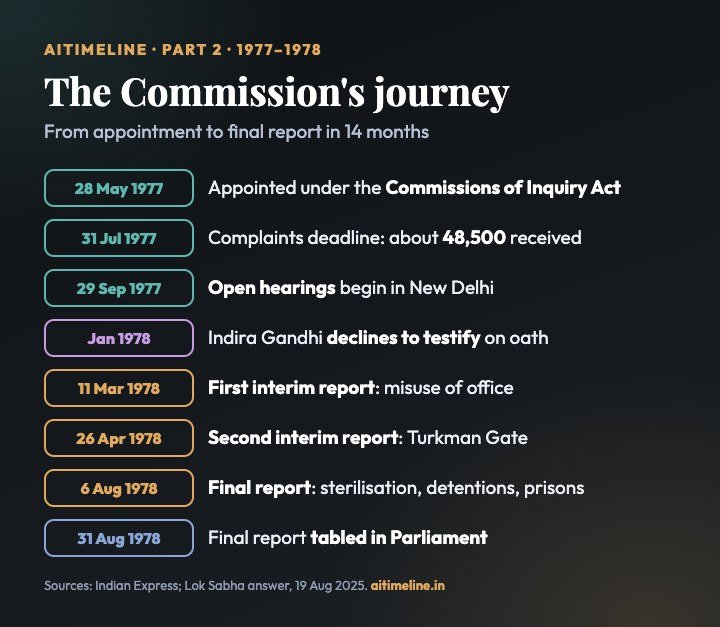
Indira Gandhi refuses to testify The inquiry
What happened: Summoned to give evidence on oath, the former prime minister declined, first citing her oath of secrecy and questioning the Commission’s procedure, then asking to cross-examine other witnesses. The Commission ordered her prosecution for refusing to take the oath and answer.
Others who testified: Former ministers including H.R. Gokhale, C. Subramaniam and Raj Bahadur deposed. Several officials described the orders they had received.
Open hearings begin The inquiry
What happened: The Commission began public sittings to hear witnesses and to let those accused of excesses answer the allegations against them.
Method: It picked representative cases from the complaints instead of investigating each one, and examined government files alongside testimony.
Deadline for public complaints: 48,500 received The inquiry
What happened: The Commission invited anyone affected by Emergency excesses to file a complaint by 31 July 1977. It received about 48,500.
What it did next: It shortlisted key cases for detailed inquiry; it did not hold a separate full inquiry into every complaint.
Shah Commission of Inquiry appointed The inquiry
Mandate: To inquire into allegations of abuse of authority, excesses and malpractices committed during the Emergency, by people holding high public and political office and by others acting with their approval.
Limits: A commission of inquiry can find facts and recommend action. It cannot convict or punish anyone.
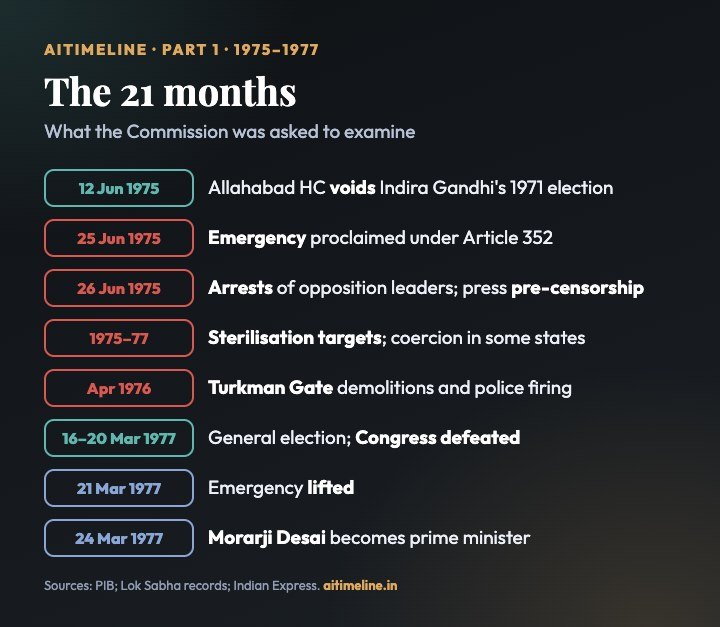
Emergency lifted; Janata Party takes power The Emergency
What happened: The Congress lost the general election. The Emergency was withdrawn on 21 March, and on 24 March Morarji Desai became India’s first prime minister from outside the Congress.
The promise: Investigating the Emergency excesses was central to the Janata government’s agenda.
Turkman Gate demolitions and police firing The Emergency
What happened: A demolition drive in the Turkman Gate area met resistance from residents. Police opened fire, and people were killed and injured.
Why it matters: It became the best-known example of coercive urban “clearance” during the Emergency, and the subject of the Commission’s second interim report.
Sterilisation targets and coercion The Emergency
What happened: The government set sterilisation targets for every state. Officials were pressed to meet them, and in some states access to rations, housing, jobs, loans or healthcare was tied to sterilisation.
Scale: 26.25 lakh sterilisations were recorded in 1975-76 and 81.32 lakh in 1976-77.
Emergency declared; arrests and censorship follow The Emergency
What happened: On the government’s advice the President proclaimed an Emergency late on 25 June. Opposition leaders were arrested overnight, and pre-censorship of newspapers began on 26 June.
Tools: The Maintenance of Internal Security Act (MISA) was the main law for detention without trial.
Allahabad High Court voids Indira Gandhi’s election The Emergency
What happened: The High Court set aside her 1971 election for electoral malpractice under the Representation of the People Act, 1951.
Next: On 24 June the Supreme Court granted a conditional stay: she could remain prime minister but could not vote in the Lok Sabha. The Emergency followed the next night.
The 21 Months the Commission Examined
How the Commission Worked
Fourteen months from appointment to final report.
What the Shah Commission Investigated
Six areas, each tied to how state power was used.
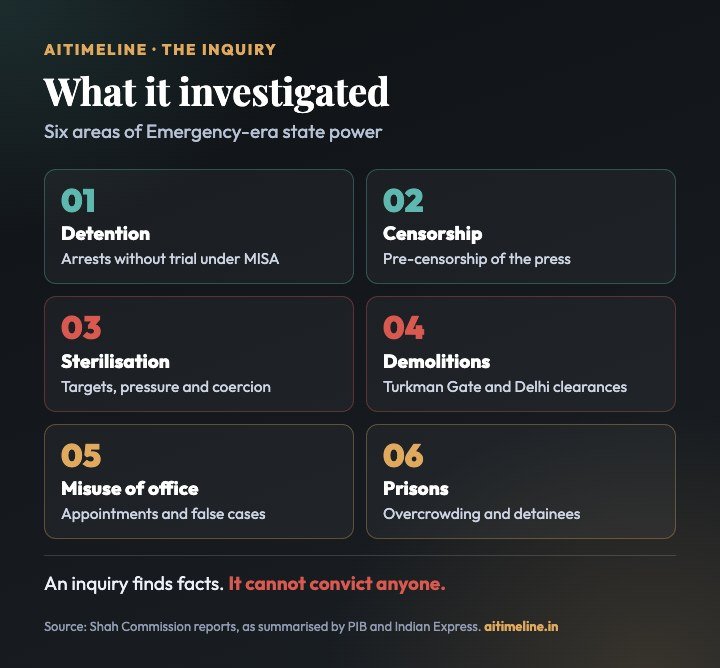
| Area | What it examined | Covered in |
|---|---|---|
| Detention | Arrests of opponents under MISA without trial; nearly 35,000 detained, per a government factsheet based on the report | First interim and final reports |
| Press censorship | Pre-censorship from 26 June 1975, power cuts to Delhi newspaper offices, papers labelled “friendly”, “neutral” or “hostile” | Reports and factsheet summary |
| Sterilisation | Targets, pressure on officials, coercion through rations, jobs and housing; deaths and complaints | Final report |
| Demolitions | Turkman Gate and other clearance drives in Delhi; the police firing of April 1976 | Second interim report |
| Misuse of office | Appointments such as RBI Governor, false criminal complaints, 25,962 premature retirements | First interim and final reports |
| Prisons | Overcrowding and the treatment of detainees | Final report |
The Sterilisation Figures
From the Commission’s own table, as given to the Lok Sabha on 19 August 2025.
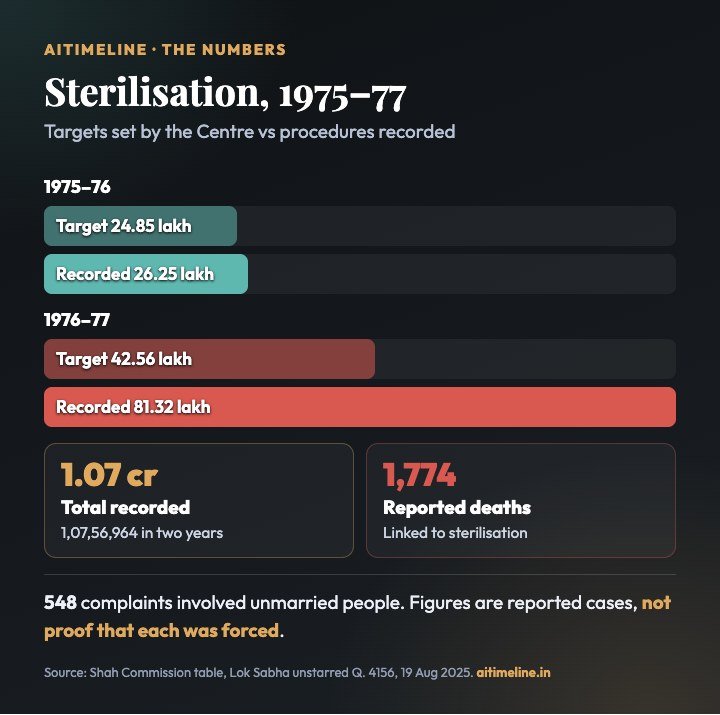
| Year | Target set by Centre | Recorded |
|---|---|---|
| 1975-76 | 24,85,000 | 26,24,755 |
| 1976-77 | 42,55,500 | 81,32,209 |
| Total | 67,40,500 | 1,07,56,964 |
Selected States, 1976-77
Recorded sterilisations against the Centre’s target.
| State/UT | Target | Recorded | Of target |
|---|---|---|---|
| Andhra Pradesh | 4,00,000 | 7,41,713 | 185% |
| Maharashtra | 5,62,000 | 8,33,000 | 148% |
| Madhya Pradesh | 2,67,500 | 10,01,000 | 374% |
| West Bengal | 3,92,500 | 8,80,000 | 224% |
| Uttar Pradesh | 4,00,000 | 8,37,000 | 209% |
| Bihar | 3,00,000 | 6,80,000 | 227% |
| Tamil Nadu | 5,00,000 | 5,69,756 | 114% |
| Delhi | 29,000 | 1,38,517 | 478% |
These numbers should be read with care. They count procedures and complaints reported to the inquiry. They do not show that every procedure was forced, and the 1,774 deaths were reported cases, not individually proven findings of malpractice. What they do show is a target system that pushed officials far past the Centre’s own goals in a single year.
Turkman Gate: The Second Interim Report
In April 1976, a demolition drive in the Turkman Gate area of Old Delhi met resistance from residents. Police opened fire, and people were killed and injured; accounts of the toll differ. The Commission’s second interim report, submitted on 26 April 1978, examined who ordered the demolitions, how residents facing displacement were treated, and how police force was used. Sanjay Gandhi was accused of pushing the drive.
The Commission’s conclusions about individual responsibility were inquiry findings. They were not criminal verdicts, and no court convicted anyone over the firing.
What Happened to the Shah Commission Report?
Tabled, withdrawn, rumoured lost, and republished.
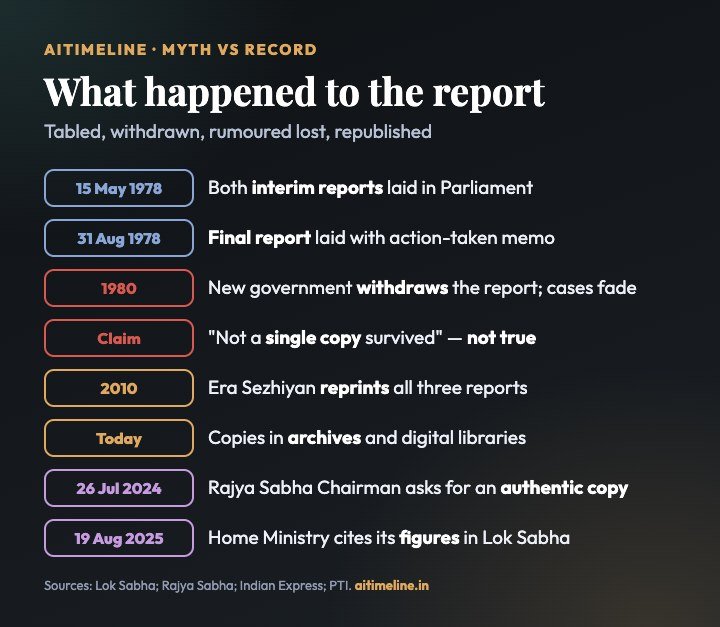
Often claimed
- The Janata government never tabled the report.
- Every copy was destroyed after 1980.
- The only surviving copy is abroad.
What the record shows
- Interim reports tabled 15 May 1978; final report 31 August 1978.
- Copies were withdrawn, but survived and were reprinted in 2010.
- Scans and papers are held in Indian libraries and archives.
Did the Shah Commission Lead to Justice?
Documenting abuse and punishing it turned out to be different things.
Find facts
- Summon witnesses and records.
- Record findings on conduct.
- Recommend action.
Punish
- No power to convict.
- Cases needed the CBI and courts.
- Depended on political will.
19 cases, few trials
- 19 CBI cases by February 1979.
- Special courts from May 1979.
- Cases folded in early 1980.
Why accountability stalled
- Proof: criminal trials need evidence of individual guilt that is admissible in court, a higher bar than an inquiry’s findings.
- Delay: by the time cases were ready, the Janata government was falling apart.
- Politics: the 1980 election returned the very leadership the cases targeted.
- Procedure: the special courts went through a Supreme Court reference before they could even be set up.
- Officials: people who worked for the Commission later reported delayed promotions and cases against them.
Shah Commission vs the Forty-fourth Amendment
Often mentioned together; they did different jobs.
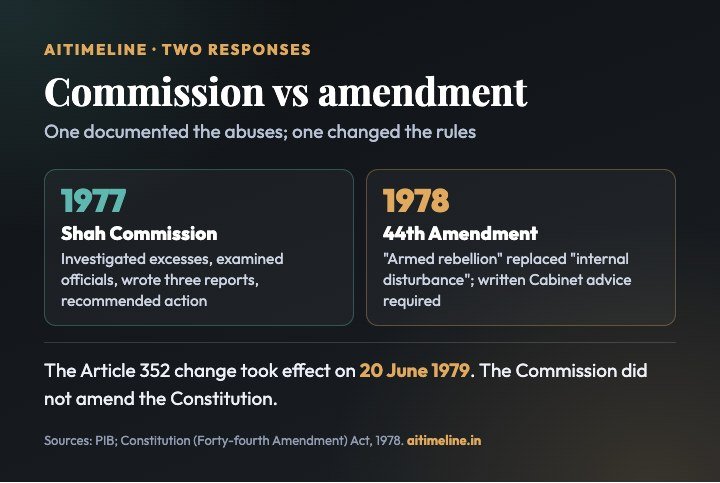
| Shah Commission | Forty-fourth Amendment |
|---|---|
| Appointed 28 May 1977 | Constitution (Forty-fourth Amendment) Act, 1978 |
| Investigated Emergency excesses | Changed constitutional provisions |
| Examined officials and institutions | Narrowed the grounds for Emergency to war, external aggression or armed rebellion |
| Produced three reports | Required the Cabinet’s written advice to the President |
| Recommended action | Bound all future governments |
Key People and Institutions
| Who | Role |
|---|---|
| Justice J.C. Shah | Former Chief Justice of India; sole member of the Commission |
| Indira Gandhi | Prime minister during the Emergency; declined to testify on oath in January 1978 |
| Sanjay Gandhi | Her son; linked to the sterilisation drive and Delhi clearance campaigns, and examined in the Turkman Gate inquiry |
| Morarji Desai | Janata prime minister whose government set up the Commission |
| H.R. Gokhale, C. Subramaniam, Raj Bahadur | Former ministers who deposed before the Commission |
| Era Sezhiyan | Former MP who reprinted the reports in 2010 |
| CBI | Its Special Investigation Unit registered the criminal cases |
| Parliament | Received the reports and action-taken memoranda in 1978 |
Explore More Timelines
People Also Ask
Frequently Asked Questions
Dated facts from the reports, parliamentary records and reporting.
⚠️ Editorial Note
This account draws on a Lok Sabha answer of 19 August 2025 that reproduces the Commission’s sterilisation table, a PIB factsheet based on the final report, Rajya Sabha records of 1978 and 1979, the Supreme Court’s 1978 opinion on the Special Courts Bill, the Ashoka University and BJP Central Library collections, and reporting by The Indian Express, India Today and PTI. The brief this page was built from placed the Rajya Sabha demand for an authentic copy in June 2024 (it was raised on 26 July 2024) and gave 2017 as the year the Ashoka archive opened, which we could not confirm. A PIB factsheet gives 26.42 lakh sterilisations for 1975-76 and says the reports came out in 1978-79; the Commission’s table shows 26,24,755, and all three reports were submitted in 1978. A Ministry of Home Affairs annual report link in the brief returned page-not-found. Claims that the report was destroyed are reported as claims. This is not legal advice.
Related Reading on AiTimeline
Sources & further reading
Every dated entry above was checked against these references. Last reviewed 6 November 2026.
- Lok Sabha: Unstarred Question 4156, Data on Sterilization (19 August 2025)
- Press Information Bureau: Factsheet on the Emergency and the Shah Commission of Inquiry
- Rajya Sabha Debates: Question on action taken on Shah Commission reports (10 May 1979)
- The Indian Express: Fresh call to table Shah Commission probe on Emergency. Where is the lost report? (7 August 2024)
- Ashoka University Archives of Contemporary India: Shah Commission Papers
- BJP Central Library: Shah Commission of Inquiry, Third and Final Report (6 August 1978)
- Supreme Court of India: In re The Special Courts Bill, 1978 (1 December 1978), via Indian Kanoon
- India Today: Despite submission of Shah Commission reports, law yet to catch up with errant Emergency rulers (30 April 1979)