Tandoor Murder Case Timeline: Law, Politics & Verdict
Explore the Tandoor murder case timeline, Naina Sahni's murder, Sushil Sharma's conviction, DNA evidence, Supreme Court verdict and 2018 release.
Latest Story
The Tandoor murder case began with a fire at a restaurant on New Delhi’s Ashoka Road late on 2 July 1995. A police patrol found the manager feeding a tandoor, and inside it the charred body of Naina Sahni. She had been shot at her flat by her husband, Sushil Sharma, then president of the Delhi Youth Congress (I). A second autopsy found the bullets, ballistics tied them to his revolver, and DNA confirmed who she was. Sharma was sentenced to death in 2003, a sentence the Delhi High Court confirmed in 2007. The Supreme Court upheld the conviction in 2013 but changed the sentence to life imprisonment, and in December 2018 the Delhi High Court ordered his premature release. This timeline follows each stage from the court record.
💡 Short Answer
Sushil Sharma, president of the Delhi Youth Congress (I), shot his wife Naina Sahni on 2 July 1995 and tried to burn her body in a restaurant tandoor. He was sentenced to death in 2003, confirmed by the Delhi High Court in 2007. On 8 October 2013 the Supreme Court commuted it to life; on 21 December 2018 the High Court ordered his premature release. The conviction stands.
Tandoor Murder Case: Key Questions
The Case in Ten Points
- The crime: Naina Sahni was shot at Flat 8/2A, Mandir Marg, on 2 July 1995.
- The fire: a police patrol found her body in the tandoor of Bagia Bar-be-Que that night.
- The manager: Keshav Kumar was caught stoking the fire and detained.
- The flight: Sharma fled through Jaipur, Bombay and Madras and was arrested in Bangalore on 10 July.
- The autopsy: a second post-mortem on 12 July found two bullets from his revolver.
- The DNA: the CCMB in Hyderabad confirmed the body’s identity from her parents’ blood.
- The verdict: convicted on 3 November 2003, sentenced to death on 7 November.
- The appeal: the Delhi High Court confirmed the death sentence on 19 February 2007.
- The commutation: the Supreme Court substituted life imprisonment on 8 October 2013.
- The release: the Delhi High Court ordered it on 21 December 2018, after about 23 years in prison.
Timeline: From the Murder to the Final Order
Newest first. Colour shows which phase each event belongs to.
Where the Tandoor murder case stands Release fight 2015-18
The conviction: Sushil Sharma remains convicted of murdering Naina Sahni under Section 302 of the IPC and of destroying evidence under Section 201 read with Section 120-B. The Supreme Court upheld both in 2013.
The sentence: His life sentence was cut short by premature release in December 2018, not set aside. We found no report of an appeal against the 2018 release order.
Delhi High Court orders his release “forthwith” Release fight 2015-18
The order: The court quashed the Sentence Review Board’s recommendation rejecting his premature release, and the Lieutenant Governor’s “non-speaking affirmation” of it, and ordered him released from Tihar jail.
The reasoning: The board was bound by its own guidelines, under which life convicts are considered for release after 20 years, or 25 for heinous crimes. Its brief rejection “suffers from vice of arbitrariness and illegality”, the court held, and the state gave no cogent reasons to keep him in prison.
Time served: His petition said he had served about 23 years and six months without remission, and 29 years counting remission.
“How and why can you keep someone in custody indefinitely?” Release fight 2015-18
What happened: Hearing his habeas corpus petition, the bench asked the Delhi government why he had not been released, called for the board’s original records, and asked the Principal Secretary (Home) and the Law Secretary to appear.
His argument: That he had passed the maximum period the board’s own order prescribes, and that his conduct in jail and on parole had been satisfactory.
Sentence Review Board rejects early release Release fight 2015-18
What happened: The Delhi government’s board rejected 86 pleas for premature release and recommended 22. Sushil Sharma, then about 23 years into his sentence, was among those refused, along with the convicts in the Jessica Lall and Priyadarshini Mattoo murder cases.
The board: Set up in 2004 following Supreme Court directions, it includes representatives of Tihar jail, Delhi Police and the Home Department. The Lieutenant Governor has the final say.
Out on parole for the first time Release fight 2015-18
What happened: The Delhi High Court released him on parole, noting the long period he had spent in jail.
Why it mattered later: In 2018 his lawyers pointed to his conduct on parole and furlough, which they said he had never misused, to support his claim for early release.
Supreme Court commutes the death sentence to life Supreme Court 2013
The conviction: The court upheld his conviction for murder and for destroying evidence. It held that ten circumstances, from the marriage and motive to the fire at his restaurant and his flight to Bangalore, were proved and formed a complete chain.
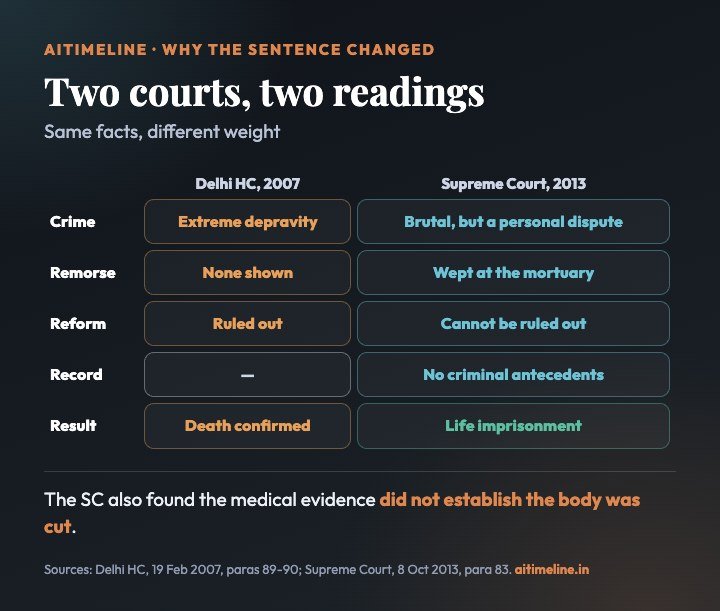
The sentence: It was not a “rarest of rare” case: the murder grew out of a strained personal relationship, he had no criminal antecedents, reform could not be ruled out, and he had spent more than 10 years in the death cell. The medical evidence did not establish that the body had been cut.
Life means life: Life imprisonment is for the whole of his remaining life, subject to remission by the appropriate government under Section 432 of the CrPC and the checks in Section 433-A.
Delhi High Court confirms the death sentence High Court appeal 2003-07
The ruling: Hearing the death reference with his appeal, the court upheld the conviction and confirmed the death sentence, calling the act one of “extreme depravity” that had shocked the judicial conscience.
On reform: It found no remorse and no chance of reform, and rejected the argument that burning the body was merely an attempt to destroy evidence.
High Court reserves judgment High Court appeal 2003-07
What happened: After day-to-day hearings, the court reserved its verdict on both the reference for confirmation of the death sentence and Sharma’s appeal.
Appeal fixed for day-to-day hearing High Court appeal 2003-07
What happened: The High Court listed the appeal and the death reference for hearing on a day-to-day basis.
Sharma appeals; death reference goes to the High Court High Court appeal 2003-07
What happened: Sharma challenged his conviction and sentence. Separately, the trial court had to refer the death sentence to the High Court, which must confirm it before it can be carried out.
Keshav Kumar: The restaurant manager did not appeal his conviction.
Death sentence for Sushil Sharma Trial 1995-2003
Sharma: Death for murder with a fine of Rs 2,000, and seven years’ rigorous imprisonment with a fine of Rs 10,000 for destroying evidence in conspiracy.
Keshav Kumar: Seven years’ rigorous imprisonment and a fine of Rs 10,000 for destroying evidence.
Sushil Sharma convicted of murder Trial 1995-2003
The verdict: Sharma was convicted of murder and, with Keshav Kumar, of destroying evidence in conspiracy. The murder conspiracy charge against Keshav Kumar was not proved.
Acquitted: Jai Prakash, Rishi Raj Rathi and Ram Prakash Sachdeva, charged with harbouring Sharma under Section 212 of the IPC.
Trial court reserves its verdict Trial 1995-2003
What happened: The judge reserved judgment after hearing the prosecution and defence. Some timelines say final arguments began on 2 July 2003; we could not confirm that date.
Judge inspects the restaurant site Trial 1995-2003
What happened: The trial judge visited Ashok Yatri Niwas, the ITDC hotel whose front park had housed the barbecue restaurant and its tandoor.
New amicus curiae appointed Trial 1995-2003
What happened: P.K. Dham was appointed amicus curiae, a lawyer assisting the court, after K.K. Sud was appointed Additional Solicitor General.
Case transferred to Judge G.P. Thareja Trial 1995-2003
What happened: The High Court moved the trial to Additional Sessions Judge G.P. Thareja, who would later convict Sharma.
Whose request: According to the 2007 High Court judgment, the trial judge had been posted to a civil court and the case followed him at Sharma’s own request.
Day-to-day trial begins Trial 1995-2003
What happened: The trial moved to day-to-day hearings to speed up the recording of evidence.
Court begins recording evidence Trial 1995-2003
What happened: The court started examining prosecution witnesses, including the police patrol that found the fire, doctors, ballistic and DNA experts.
Keshav’s confession: During the trial Keshav Kumar applied to plead guilty to destroying evidence, saying he had put the body in the tandoor on Sharma’s orders but had not conspired to murder. He later said he had been promised release.
Charges framed against five accused Trial 1995-2003
The charges: Sharma and Keshav Kumar were charged with murder and destroying evidence in a criminal conspiracy. Jai Prakash, Rishi Raj Rathi and Ram Prakash Sachdeva were charged with harbouring Sharma.
The plea: All five pleaded not guilty.
High Court rejects “media trial” complaint Trial 1995-2003
His plea: Sharma said press coverage and police statements, including a senior officer’s remark that he had material enough to “hang” him, had made a fair trial impossible. He wanted the trial postponed or himself discharged, and contempt action.
The ruling: The court found not a single instance of actual prejudice and disposed of the petition, while noting that a trial judge may hold proceedings in camera if publicity threatens a fair trial.
Delhi Police file the charge-sheet Crime and investigation 1995
What happened: Police charged Sharma with murder, Keshav Kumar with helping burn the body, and three men with harbouring Sharma while he was on the run.
The prosecution’s motive: Sharma suspected Naina Sahni of a relationship with Matloob Karim, a Congress worker and old friend, and did not want to make their secret marriage public, which she was insisting on.
Second post-mortem finds two bullets Crime and investigation 1995
What happened: X-rays found metal in the skull and neck. Two lead bullets were extracted. The board gave the cause of death as coma following a firearm injury to the head.
Why it mattered: The first post-mortem had found no sign of firearm injury, and no X-ray could be done because the machine was out of order.
Sharma arrested in Bangalore Crime and investigation 1995
On the run: He had travelled from Delhi to Jaipur, Bombay and Madras, where a sessions court gave him anticipatory bail that the Madras High Court later cancelled.
The revolver: He led police to a hotel room in Bangalore, where a briefcase held a licensed .32 Arminius revolver in his name and four live cartridges.
Body identified; first post-mortem Crime and investigation 1995
Identification: Her parents could not identify the charred body. Matloob Karim, a Congress worker close to her, identified it on 5 July. DNA testing at the Centre for Cellular and Molecular Biology, Hyderabad, confirmed her identity later.
At the flat: With a ballistic expert present, police seized five cartridge cases, a lead bullet, a piece of plywood with a bullet hole and an air pistol from Flat 8/2A, Mandir Marg.
Abandoned car with blood in the boot Crime and investigation 1995
What happened: Police found Sharma’s car abandoned, with dried blood in the boot and hair on a seat. They also searched his flat on Mandir Marg and found blood-stained articles.
The night before: After leaving the restaurant he had spent the night at Gujarat Bhawan with an acquaintance, D.K. Rao.
Fire at Bagia Bar-be-Que; a body in the tandoor Crime and investigation 1995
What happened: A woman’s cry that the hotel was on fire brought a police patrol to the barbecue restaurant Sharma ran in the hotel’s front park. They found its manager, Keshav Kumar, feeding the tandoor with wood. He said he was burning old Congress banners and posters.
The discovery: Once the fire was put out, police found a woman’s charred body inside. Keshav Kumar was detained with blood on his clothes; Sharma, seen at the gate, slipped away.
Naina Sahni shot dead Crime and investigation 1995
Who she was: Naina Sahni was general secretary of the Delhi Youth Congress (I) Girls Wing. She had married Sushil Sharma, president of the Delhi Youth Congress (I), in secret, and lived at his flat.
What the courts found: Sharma shot her at the flat after relations between them broke down. The bullets were later matched to his licensed revolver.
Death, Then Life, Then Release
Three courts, three different outcomes for the same conviction.
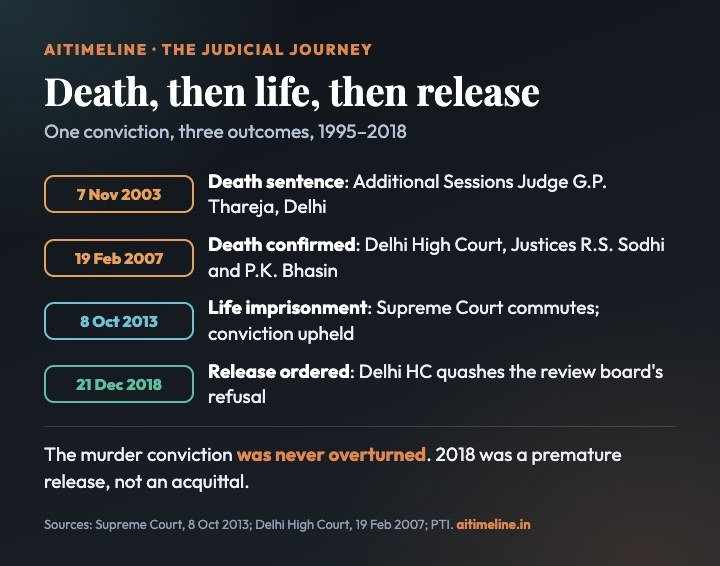
Every court that examined the evidence agreed that Sushil Sharma killed Naina Sahni. What changed was the punishment. The trial court and the High Court saw the burning of the body as proof of depravity that warranted death. The Supreme Court weighed the same facts against the principle laid down in Bachan Singh v. State of Punjab (1980), that death is reserved for the rarest of rare cases, and found mitigating factors the lower courts had not given weight to. Five years later, a different question came up: not whether he was guilty, but whether the state had lawfully refused to release a life convict who had served the period its own guidelines set.
The Evidence: How the Case Was Proved
No eyewitness to the shooting. A conviction built on forensics and circumstance.
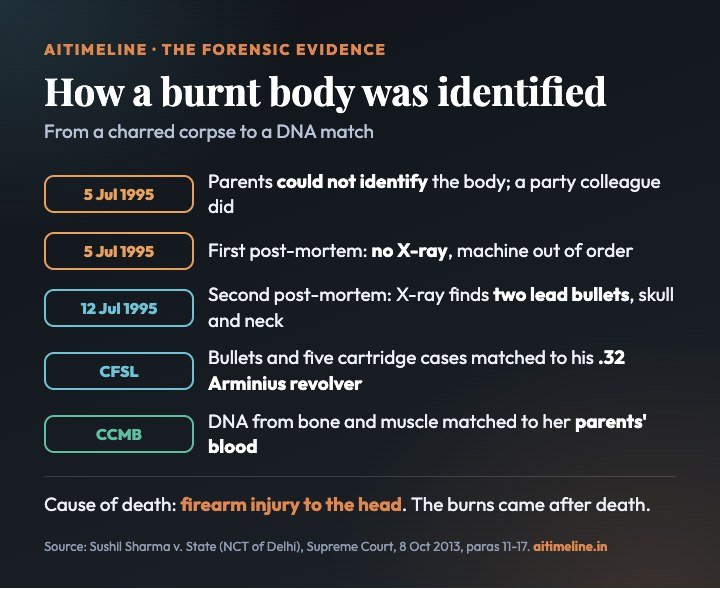
| Evidence | What it showed | Source in the record |
|---|---|---|
| DNA | Remains were the biological child of Jaswant Kaur and Harbhajan Singh, Naina Sahni’s parents | CCMB, Hyderabad; report Ex. PW-87/A |
| Second autopsy | Two lead bullets in skull and neck; death by firearm injury to the head | Board headed by Dr Bharat Singh, 12 July 1995 |
| Ballistics | Bullets, five cartridge cases and a bullet from the flat fired from his .32 Arminius revolver | CFSL ballistic expert Roop Singh, Ex. PW-70/A |
| Blood | Human blood of group B, her blood group, at the restaurant and the flat; dried blood in his car | CFSL serology |
| Police witnesses | Smoke and flames, Keshav Kumar at the tandoor, Sharma at the gate | HC Kunju, Home Guard Chander Pal, SI Rajesh Kumar |
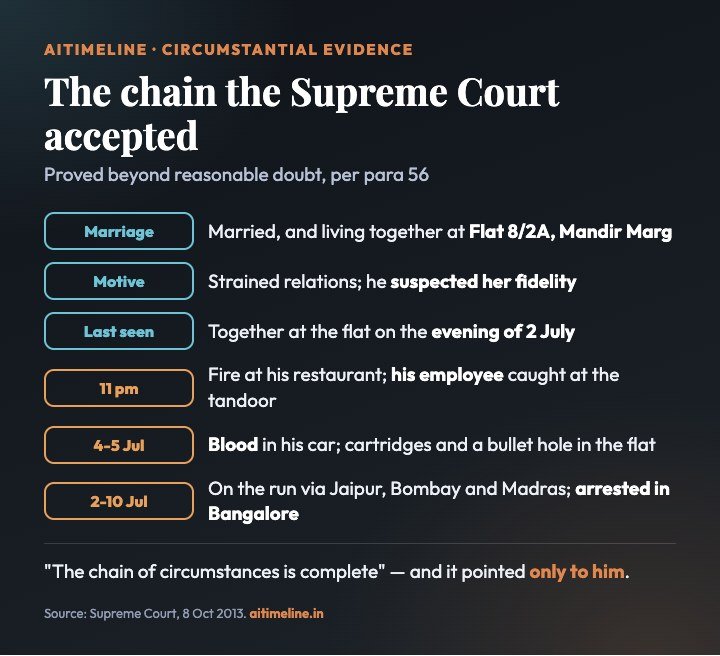
Five Accused, Three Different Outcomes
The courts separated the murder from the attempt to destroy the evidence.
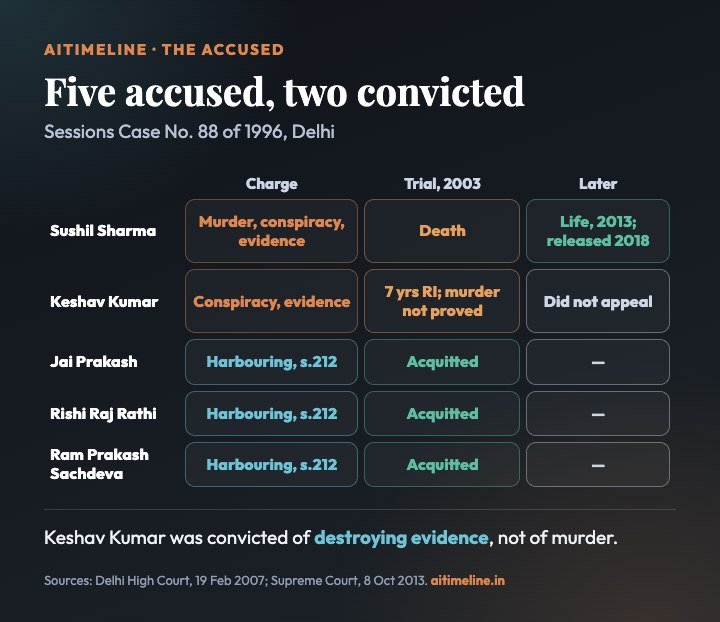
Often claimed
- Keshav Kumar was convicted of murder.
- Naina Sahni’s body was chopped into pieces.
- The High Court acquitted Sharma in 2018.
- DNA identified the body on 5 July 1995.
What the record shows
- He was convicted only of destroying evidence; the murder conspiracy was not proved.
- The Supreme Court said the medical evidence did not establish that the body was cut.
- It quashed the refusal of premature release; the conviction stands.
- A colleague identified it on 5 July; DNA confirmed it later.
Why the Supreme Court Commuted the Death Sentence
Sushil Sharma v. State (NCT of Delhi), 8 October 2013.
Personal, not social
- Strained marriage.
- “Not an offence against the Society”.
- Brutality alone not enough.
Reform possible
- No criminal antecedents.
- Not remorseless.
- 10+ years in the death cell.
Life means life
- Rest of natural life.
- Remission under s.432 CrPC.
- Subject to s.433-A checks.
The 2018 Release: A Question of Administrative Law
The court reviewed a decision by the executive, not the verdict.
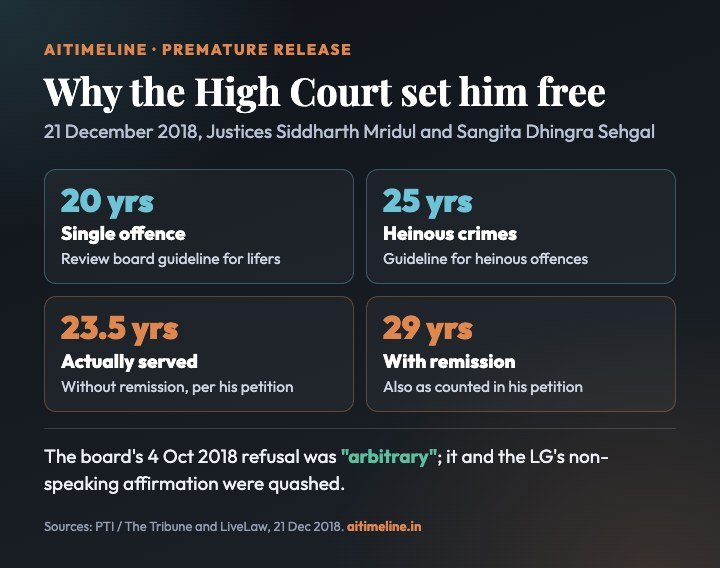
The 2013 judgment left Sharma’s release to “the appropriate Government” under Section 432 of the CrPC. In Delhi that power is exercised on the advice of the Sentence Review Board, with the Lieutenant Governor as the final authority. When the board turned him down on 4 October 2018, Sharma went to the High Court with a habeas corpus petition. The bench of Justices Siddharth Mridul and Sangita Dhingra Sehgal held that the board “owes its very existence” to its guidelines and must follow them, and that keeping a prisoner beyond them requires “cogent and compelling reasons”. It found none in the record. Two principles follow: a life sentence is not automatically cut short after a fixed number of years, but a refusal to release must be lawful and reasoned.
The Political Arc
Why a domestic murder became a national story.
Both Sharma and Naina Sahni were office-bearers of the Delhi Youth Congress (I); he was its president, she was general secretary of its Girls Wing. That made the case an immediate embarrassment for the Congress, then in power at the Centre, while Delhi itself was governed by the BJP. Media coverage was intense enough that Sharma asked the Delhi High Court in 1996 to postpone his trial because of it, citing a senior police officer’s public remark that he had enough material “to hang” him. The court refused. The judgments themselves deal only with individual guilt. They make no finding about the party, and the High Court in 1996 noted that not a single instance had been shown of the investigation being directed by any political party.
| Institution | Role in the case |
|---|---|
| Delhi Police | Patrol found the body; investigated, arrested Sharma with Bangalore Police, filed the charge-sheet on 27 July 1995. |
| CFSL and CCMB | Ballistic, serological and DNA evidence that tied the bullets to his revolver and identified the body. |
| Delhi sessions court | Convicted Sharma and Keshav Kumar in 2003 and sentenced Sharma to death. |
| Delhi High Court | Rejected the media-trial plea in 1996, confirmed the death sentence in 2007, ordered release in 2018. |
| Supreme Court | Upheld the conviction and commuted the sentence to life in 2013. |
| Sentence Review Board and Lieutenant Governor | Refused premature release in October 2018; the refusal was quashed. |
Why the Tandoor Murder Case Still Matters
Six lasting lessons
- Forensic science: DNA testing at the CCMB settled the identity of a body no one could recognise; the case is still cited as a landmark use of DNA evidence.
- The second autopsy: a re-examination with X-rays changed the cause of death from burns to gunshot.
- Circumstantial evidence: with no eyewitness to the shooting, a complete chain of circumstances was enough.
- Capital punishment: the Supreme Court applied the rarest-of-rare test and found brutality alone insufficient.
- Individual liability: the man who burned the body and the man who killed were convicted of different crimes.
- Remission law: a review board must follow its own guidelines and give reasons, even for a notorious convict.
Explore More Timelines
People Also Ask
Frequently Asked Questions
Dated facts from the Supreme Court and Delhi High Court judgments.
⚠️ Editorial Note
This account is based on the Supreme Court’s judgment of 8 October 2013 in Sushil Sharma v. State (NCT of Delhi), the Delhi High Court’s judgments of 19 February 2007 and 1 May 1996, and PTI, LiveLaw and Tribune reports of the 2018 proceedings. Procedural dates from 1995 to 2007 come from PTI chronologies. Checking the brief this page started from against those records: the Supreme Court did not uphold Keshav Kumar’s conviction, because he never appealed; the body was identified by Matloob Karim on 5 July 1995 and only later confirmed by DNA; Sharma was arrested on 10 July and handed to Delhi Police on 11 July; the recording of evidence began in January 1999, not January 1997; the review board refusal the High Court quashed was made on 4 October 2018, and we could not confirm a rejection in January 2016; the High Court’s question about indefinite custody was reported on 15 December 2018, not 19 December; and we could not confirm that final arguments began on 2 July 2003. The prosecution’s account of motive is reported as the courts found it. This is not legal advice.
Related Reading on AiTimeline
Sources & further reading
Every dated entry above was checked against these references. Last reviewed 6 November 2026.
- Sushil Sharma v. State (NCT of Delhi), Supreme Court judgment of 8 October 2013
- State v. Sushil Sharma, Delhi High Court judgment of 19 February 2007
- Sushil Sharma v. State (Delhi Administration), Delhi High Court, 1 May 1996
- Chronology of Tandoor murder case (21 December 2018)
- Tandoor murder case: HC orders release of convict Sushil Sharma
- Delhi HC asks govt why Tandoor murder case convict has not been released yet (15 December 2018)
- Delhi government denies early release to killers of Jessica Lall, Priyadarshini Mattoo, Naina Sahni (4 October 2018)