Nirbhaya Case Timeline: Law, Justice, and Social Change in India
Nirbhaya case timeline: the 2012 Delhi crime, Verma Committee, 2013 Act, court rulings, the 2020 executions and what changed for women's safety.
Latest Story
This Nirbhaya case timeline follows the 16 December 2012 gang rape of a 23-year-old woman on a bus in Delhi, her death in Singapore on 29 December 2012, the nationwide protests, the Justice Verma Committee and the Criminal Law (Amendment) Act, 2013, and the court proceedings that ended with four adult convicts being hanged on 20 March 2020. “Nirbhaya” means fearless; it is the name the public used because Indian law protects the identity of survivors, and this page does not identify her. It then follows the Nirbhaya Fund to July 2026. The case accelerated reform; it was not the only cause of it, and the record here does not show that harsher sentences alone prevent sexual violence. For related AiTimeline reading, see the Ankita Bhandari case, the Women’s Reservation Bill and the Constituent Assembly debates.
💡 Short Answer
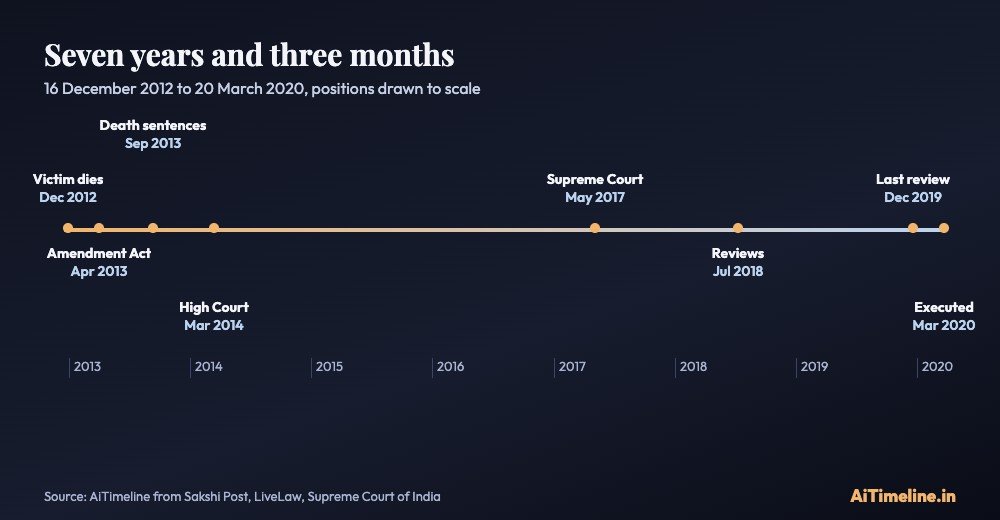
The Nirbhaya case began on 16 December 2012, when a 23-year-old woman was gang-raped on a Delhi bus; she died on 29 December. Protests led to the Verma Committee and the Criminal Law (Amendment) Act, 2013. A fast-track court sentenced four adults to death on 13 September 2013, and they were hanged on 20 March 2020, seven years and three months after the crime.
Nirbhaya Case: Key Questions
The Nirbhaya Case in Ten Points
- The crime: 16 December 2012; the survivor died on 29 December in Singapore.
- The accused: five adults and one juvenile; one adult died in custody in March 2013.
- The trial: verdict on 10 September 2013 and death sentences on 13 September.
- The appeals: High Court 13 March 2014; Supreme Court 5 May 2017.
- A correction: the last review was dismissed on 18 December 2019, not in 2018.
- The execution: 20 March 2020, after four warrants and late-night hearings.
- The reform: the 2013 Act adopted part of the Verma report; it did not adopt all of it.
- The death penalty: the Committee advised against it for rape; the Act allows it in limited cases.
- The juvenile: released on 20 December 2015; a new Juvenile Justice Act followed on 22 December.
- The caution: the case accelerated reform; it did not cause it alone, and sentences alone do not prevent sexual violence.
Nirbhaya Case Timeline, Latest First
Each entry is tagged by stage and ends with why it matters. Use the filter to isolate the crime, the trial and appeals, the law, the execution run or the legacy.
The crime, the courts, the law or the legacy? Filter the Nirbhaya case timeline by stage.
–
The Nirbhaya Fund: ₹1,288 crore unspent, and a record-low 2025-26 allocation Legacy and debate
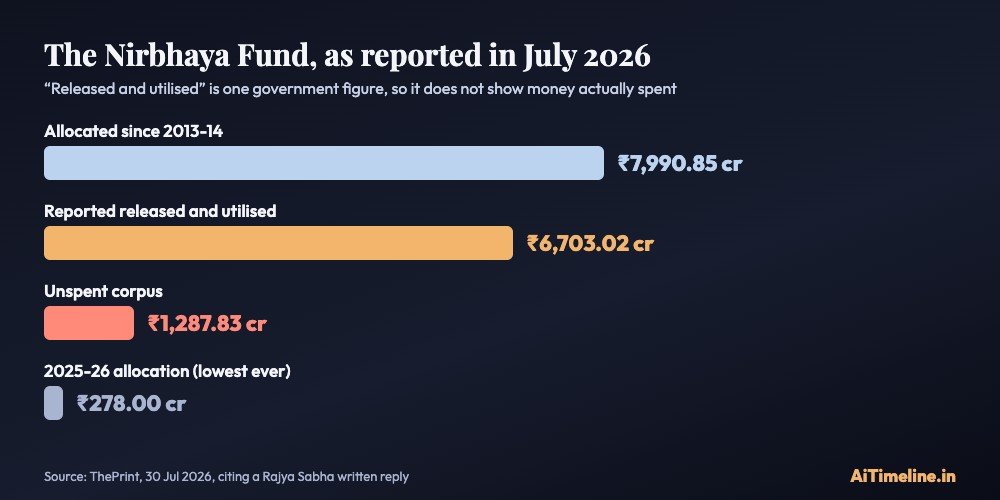
ThePrint reports, from a written Rajya Sabha reply by Minister of State for Women and Child Development Savitri Thakur, that ₹7,990.85 crore has been allocated to the Nirbhaya Fund since 2013-14. The government reports ₹6,703.02 crore (83.9%) as “released and utilised”, a single figure that cannot separate money transferred from money spent. About ₹1,287.83 crore remains unspent, and the 2025-26 allocation of ₹278 crore is the lowest in the fund’s history (ThePrint).
The reply lists projects with no spending recorded, including CCTV and accommodation for women students at Delhi University, a working women’s hostel in Manipur, village-level CCTV and AI-based facial recognition at seven railway stations. The reply was tabled on the Wednesday before the 30 July report. The first figures and the project list were read on ThePrint’s page; the released-and-utilised figure, the 2025-26 allocation and the minister’s name come from the report’s paywalled part as read by an automated tool.
The Bharatiya Nyaya Sanhita replaces the Indian Penal Code Law and policy
Wikipedia records that the Bharatiya Nyaya Sanhita (BNS), passed by Parliament on 20–21 December 2023, commenced on 1 July 2024 in place of the Indian Penal Code, with sexual offences in Sections 63 to 73 and the marital-rape exception retained (Wikipedia). Secondary sources put the main rape punishment in Section 64 (formerly IPC Section 376) at not less than ten years, extendable to life, and gang rape in Section 70. AiTimeline could not open the official text, so the punishment details are not confirmed against it.
The offences added in 2013, such as stalking and voyeurism, were part of the code that the BNS replaced. Readers checking a case should cite the section as it stood on the date of the offence.
2020
Four convicts are hanged at Tihar Jail The execution run, 2020
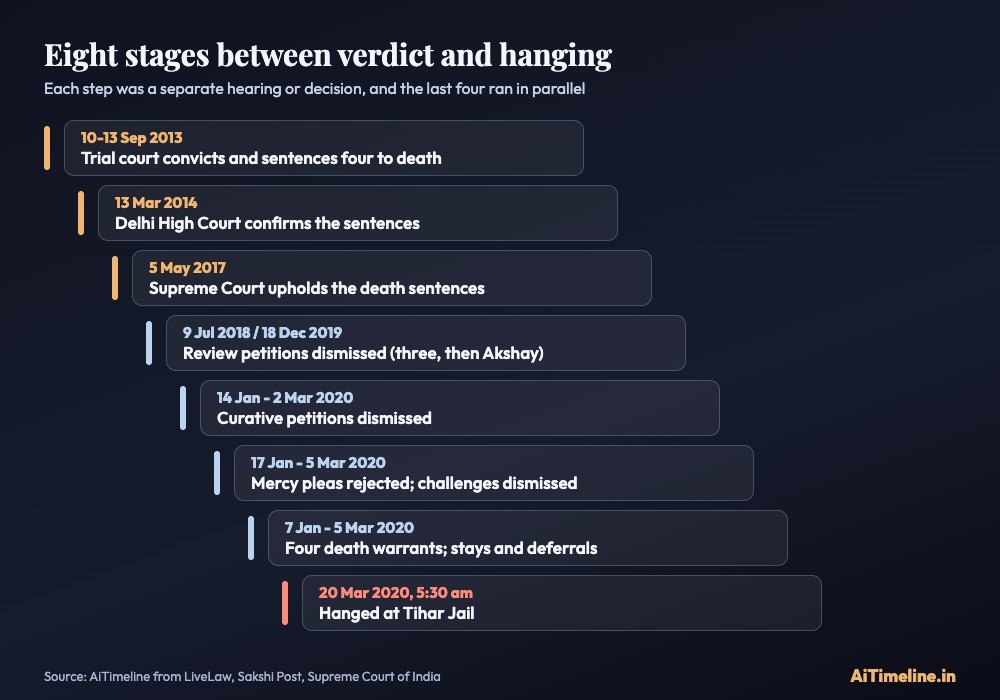
Mukesh Singh, Vinay Sharma, Akshay Kumar Singh and Pawan Gupta were hanged at 5:30 am (LiveLaw; NDTV; India Today). LiveLaw records that a Delhi High Court bench of Justices Manmohan and Sanjeev Narula rejected a stay plea at about midnight, after hearing it at Justice Manmohan’s residence. A Supreme Court bench of Justices R. Banumathi, Ashok Bhushan and A. S. Bopanna began hearing a writ against Pawan Gupta’s mercy rejection at about 2:45 am and dismissed it at about 3:45 am.
The execution came seven years and three months after the crime. Reports say five last-minute petitions were rejected, three by the Supreme Court, one by the Delhi High Court and one by the trial court (SCC Online).
Fresh warrants, a deferral and a last mercy plea The execution run, 2020
After the Supreme Court held on 11 February that the four must be executed together and only once all remedies were exhausted, a trial court issued fresh warrants on 17 February for 3 March at 6 am. On 2 March the date was deferred a day before it arrived, because of Pawan Gupta’s mercy petition; the same day a five-judge bench dismissed his curative petition. A fresh warrant was issued on 5 March for 20 March (LiveLaw). Wikipedia dates the last warrant to 4 March, so sources differ by a day.
Vinay Sharma’s mercy petition was rejected by the President on 1 February and the Supreme Court dismissed his challenge on 14 February (LiveLaw). Akshay Kumar Singh’s challenge to the rejection of his mercy plea was dismissed on 19 March.
A first warrant, the curative petitions and a stay The execution run, 2020
On 7 January 2020 a Delhi court issued the first death warrants, for 22 January at 7 am (Sakshi Post). On 14 January the Supreme Court rejected the curative petitions of Vinay Sharma and Mukesh Singh, and on 17 January the President rejected Mukesh Singh’s mercy plea, which moved the date to 1 February (LiveLaw).
On 31 January the trial court stayed the execution until further orders, noting that the other three convicts had not exhausted their remedies. On 5 February the Delhi High Court ruled that the four must be executed together and gave them seven days to use their remedies; on 11 February the Supreme Court let the Centre seek fresh warrants. Pawan Gupta’s juvenility plea was dismissed by the Supreme Court on 20 January, and his review on 31 January.
2019
The last review petition is dismissed Trial and appeals
A three-judge bench led by Justice R. Banumathi, with Justices Ashok Bhushan and A. S. Bopanna, dismissed Akshay Kumar Singh’s review petition, saying it found no error apparent on the face of the record and that his grounds repeated those already rejected for the other convicts (LiveLaw; Bar & Bench). His curative petition was dismissed by a five-judge bench on 30 January 2020 (LiveLaw).
The draft brief said Akshay’s review was rejected “later in 2018”. The record shows 18 December 2019, more than a year after the 9 July 2018 order that disposed of the other three reviews.
The Criminal Law (Amendment) Act, 2018: death penalty for rape of girls under 12 Law and policy
The Cabinet approved an ordinance on 21 April 2018, after public outrage over the Kathua and Unnao cases, providing the death penalty for the rape of girls below 12 and raising the minimum punishment for rape from seven to ten years. Parliament replaced it with an Act, and the Lok Sabha passed the bill on 30 July 2018 (The Quint; Deccan Herald).
This was not a Nirbhaya-case law, but it continued the 2013 pattern of tightening sentences after a public outcry. The Verma Committee had advised against the death penalty for rape, citing evidence that it does not deter serious crimes ({L(PRSV, ‘PRS’)}).
2018
The Supreme Court dismisses three review petitions Trial and appeals
Justice Ashok Bhushan’s judgment in Mukesh’s review petition (Crl. R.P. 570 of 2017) examined the 5 May 2017 decision and left it standing (Supreme Court of India). Sakshi Post records that the review pleas of three convicts were dismissed that day (Sakshi Post); Vinay Sharma and Pawan Gupta had filed theirs in December 2017.
Human Rights Watch documents barriers to justice for survivors Legacy and debate
Human Rights Watch published “Everyone Blames Me”, a report on barriers to justice and support services for survivors of sexual assault in India (Human Rights Watch). Its summary says that five years after the December 2012 gang rape, which spurred legal and other reforms, girls and women who survive sexual violence continue to face significant barriers to justice and to support services such as health care and counselling. AiTimeline read the summary and release, not the full report.
2017
The Supreme Court upholds the death sentences Trial and appeals
After saying on 3 February 2017 that it would hear the death-penalty question afresh and reserving its verdict on 27 March, the Supreme Court upheld the death sentences of all four, placing the case in the “rarest of rare” category (Sakshi Post). The review judgment of 9 July 2018 records that the petitioner asked the Court to review this judgment of 5 May 2017 (Supreme Court of India).
The juvenile is released, and the law on juveniles changes Law and policy
The sixth accused, who was a juvenile at the time, was convicted on 31 August 2013 and sentenced to the maximum of three years in a reform facility; Wikipedia gives his release as 20 December 2015 (Wikipedia). On 22 December 2015 the Rajya Sabha passed the Juvenile Justice (Care and Protection of Children) Bill, amid public anger over the release; it lets 16–18-year-olds be tried as adults for heinous offences (SCC Online; Wikipedia).
AiTimeline does not name the juvenile. The new law does not alter the sentence he served.
2014
The Delhi High Court confirms the death sentences Trial and appeals
The High Court began hearing the death-sentence reference on 23 September 2013, reserved its verdict on 3 January 2014 and upheld the sentences on 13 March 2014. On 15 March the Supreme Court stayed the execution of Mukesh Singh and Pawan Gupta after they appealed, and later stayed it for the other two (Sakshi Post; Wikipedia).
2013
The fast-track court convicts four men and sentences them to death Trial and appeals
The trial concluded on 3 September 2013. On 10 September the court convicted Mukesh Singh, Vinay Sharma, Akshay Kumar Singh and Pawan Gupta of 13 offences, including gang rape, murder and attempted murder of the male friend, and on 13 September it sentenced all four to death (Sakshi Post).
Final arguments had begun on 22 August. The trial ran about eight months from 17 January 2013; the appeals lasted until 2017, and the last remedies until March 2020.
2013
The Juvenile Justice Board convicts the sixth accused Trial and appeals
On 28 January 2013 the Board found that the sixth accused was a minor. On 11 July it found him guilty of confining and robbing a carpenter on the night of 16 December, and on 31 August it convicted him of gang rape and murder and sent him to a special home for three years, the maximum available under the juvenile law then in force (Sakshi Post).
2013
Ram Singh dies in Tihar Jail Trial and appeals
Ram Singh, the bus driver and one of five adult accused, was found dead in his cell on 11 March 2013 and authorities reported a suicide (Sakshi Post). The proceedings against him ended, and the trial continued against the other four.
2013
The Criminal Law (Amendment) Act, 2013 becomes law Law and policy
After the 3 February 2013 ordinance, the Lok Sabha passed the Criminal Law (Amendment) Bill on 19 March and the Rajya Sabha on 21 March (PRS). The President gave assent on 2 April and the Act took effect from 3 February (Wikipedia).
It widened the definition of rape beyond vaginal penetration, and added offences including acid attack (326A, 326B), sexual harassment (354A), disrobing (354B), voyeurism (354C) and stalking (354D). Gang rape carries 20 years to life. Section 376A allows death where the assault causes death or a persistent vegetative state. The age of consent was raised to 18.
It did not adopt every Verma recommendation: marital rape stayed outside the offence, and the Committee’s advice on armed-forces sanction under AFSPA was not taken up. It keeps the death penalty in limited cases, although the Committee advised against it for rape.
2013
The Justice Verma Committee reports in 29 days Law and policy
PRS records that the committee, chaired by former Chief Justice J. S. Verma with Justice Leila Seth and former Solicitor General Gopal Subramanium, was constituted on 23 December 2012 and submitted its report on 23 January 2013 (PRS). Wikipedia gives 22 December for the appointment.
Among its recommendations: remove the marital-rape exception; revisit AFSPA sanction for sexual offences by armed forces; not impose the death penalty for rape, citing evidence that it does not deter serious crime, and use life imprisonment instead.
A fast-track court is set up and the trial begins Trial and appeals
Chief Justice Altamas Kabir inaugurated a fast-track court on 2 January 2013. Police filed a charge sheet against five adults on 3 January, the court took cognisance on 5 January and ordered in-camera proceedings on 7 January. Proceedings began on 17 January, a date NDTV also gives, and charges were framed on 2 February (Sakshi Post; NDTV). On 22 March the Delhi High Court allowed national media to report the trial.
2012
The young woman dies in Singapore The crime, Dec 2012
She was flown to Singapore on 27 December after a cardiac arrest on 26 December and died on 29 December (Wikipedia; Sakshi Post). Police added a murder charge. AiTimeline uses the widely recognised name “Nirbhaya”, meaning fearless, and does not identify her.
2012
Protests spread; a police constable dies; the survivor is flown abroad The crime, Dec 2012
Wikipedia records seven Delhi Metro stations closed on 22 December and nine on 24 December during the protests. Protesters defied prohibitory orders on 23 December and Constable Subhash Tomar was seriously injured; he died on 25 December (Sakshi Post; Wikipedia). On 26 December the government flew the survivor to Singapore.
The cause of the constable’s death was disputed at the time; AiTimeline reports only the dates.
2012
The last suspects are arrested; the government names a committee The crime, Dec 2012
A juvenile was caught at Anand Vihar on 21 December, and Akshay Kumar Singh was arrested at Aurangabad in Bihar on 21–22 December (Sakshi Post). On 23 December the Centre constituted the Justice Verma Committee (PRS).
2012
The attack and the first arrests The crime, Dec 2012
On the night of 16 December a 23-year-old physiotherapy student and her male friend boarded a private bus in south Delhi. She was gang-raped and both were thrown from the vehicle (Wikipedia). They were admitted to Safdarjung Hospital. On 17 December police named Ram Singh, Mukesh, Vinay Sharma and Pawan Gupta, and on 18 December Ram Singh and three others were arrested (Sakshi Post).
This timeline does not describe the assault in detail.
Court by Court: What Each Decided
The judicial path, from the trial court to the final stay petitions.
| Date | Court | What it decided |
|---|---|---|
| 31 Aug 2013 | Juvenile Justice Board | Convicted the sixth accused; three years in a special home |
| 10 Sep 2013 | Fast-track court, Saket | Convicted four men of 13 offences including gang rape and murder |
| 13 Sep 2013 | Fast-track court, Saket | Sentenced all four to death |
| 13 Mar 2014 | Delhi High Court | Upheld the convictions and death sentences |
| 5 May 2017 | Supreme Court | Upheld the death sentences; “rarest of rare” |
| 9 Jul 2018 | Supreme Court | Dismissed the review petitions of three convicts |
| 18 Dec 2019 | Supreme Court | Dismissed Akshay Kumar Singh’s review petition |
| 14 Jan 2020 | Supreme Court (five judges) | Dismissed the curative petitions of Vinay Sharma and Mukesh Singh |
| 20 Mar 2020 | Delhi High Court, Supreme Court | Rejected the last stay petitions overnight |
The Four Death Warrants
Why an execution date set in January was not carried out until 20 March.
| Warrant issued | Execution date set | What happened |
|---|---|---|
| 7 Jan 2020 | 22 Jan, 7 am | Superseded after Mukesh Singh’s mercy plea was rejected on 17 Jan, which required 14 days’ notice |
| 17 Jan 2020 | 1 Feb, 6 am | Stayed by the trial court on 31 Jan because three convicts still had remedies |
| 17 Feb 2020 | 3 Mar, 6 am | Deferred on 2 Mar because of Pawan Gupta’s mercy petition |
| 5 Mar 2020 | 20 Mar, 6 am | Carried out at 5:30 am on 20 March |
The Verma Committee vs the 2013 Act
Where the law followed the committee and where it did not.
| Question | Verma Committee (23 Jan 2013) | Act of 2013 |
|---|---|---|
| Death penalty for rape | Advised against it, citing evidence that it does not deter serious crime | Kept for rape causing death or a persistent vegetative state, and repeat offences; not mandatory for all rape |
| Marital rape | Remove the exception for a husband | Exception not removed |
| Armed forces (AFSPA) | Revisit AFSPA; no central sanction for sexual offences by personnel | Not taken up |
| Definition of rape | Broader coverage of sexual assault | Widened beyond vaginal penetration; consent presumed absent where the victim says so |
| New offences | Various, including verbal assault and disrobing | Stalking, voyeurism, sexual harassment, disrobing, acid attack |
| Age of consent | – | Raised to 18 |
The Accused and Their Outcomes
Six people were accused. The juvenile is not named.
| Person | Role in the proceedings | Outcome |
|---|---|---|
| Ram Singh | Bus driver; adult accused | Found dead in Tihar Jail on 11 Mar 2013; reported suicide |
| Mukesh Singh | Adult accused | Sentenced to death 13 Sep 2013; hanged 20 Mar 2020 |
| Vinay Sharma | Adult accused | Sentenced to death 13 Sep 2013; hanged 20 Mar 2020 |
| Pawan Gupta | Adult accused | Sentenced to death 13 Sep 2013; hanged 20 Mar 2020 |
| Akshay Kumar Singh | Adult accused | Sentenced to death 13 Sep 2013; hanged 20 Mar 2020 |
| Sixth accused (not named) | Juvenile at the time | Convicted 31 Aug 2013; three years in a special home; released 20 Dec 2015 per Wikipedia |
The Story at a Glance
Dates from the sources listed below.
| Date | Event | Detail |
|---|---|---|
| 16 Dec 2012 | The attack | Bus in Munirka, Delhi |
| 18 Dec 2012 | First arrests | Ram Singh and three others |
| 21–22 Dec 2012 | Last suspects held | Juvenile; Akshay in Aurangabad, Bihar |
| 23 Dec 2012 | Verma Committee constituted | Three members |
| 29 Dec 2012 | Victim dies | Singapore |
| 2 Jan 2013 | Fast-track court opened | CJI Altamas Kabir |
| 23 Jan 2013 | Verma report | 29 days |
| 3 Feb 2013 | Ordinance | Act effective from this date |
| 11 Mar 2013 | Ram Singh dies | Tihar Jail |
| 2 Apr 2013 | Act receives assent | Passed 19 and 21 Mar |
| 10–13 Sep 2013 | Verdict and sentence | Four sentenced to death |
| 13 Mar 2014 | High Court confirms | Delhi High Court |
| Dec 2015 | Juvenile released; new JJ Act | Rajya Sabha 22 Dec |
| 5 May 2017 | Supreme Court upholds | Appeals dismissed |
| 9 Jul 2018 | Three reviews dismissed | Supreme Court |
| 18 Dec 2019 | Last review dismissed | Akshay Kumar Singh |
| 7 Jan 2020 | First death warrant | For 22 Jan |
| 20 Mar 2020 | Four hanged | Tihar Jail, 5:30 am |
| 1 Jul 2024 | BNS replaces IPC | Per secondary sources |
| 30 Jul 2026 | Nirbhaya Fund figures | Rajya Sabha reply |
What Changed After the Nirbhaya Case, and What Did Not
The law became more specific. The 2013 Act added offences for stalking, voyeurism, sexual harassment and acid attack, widened the definition of rape and raised the age of consent to 18. The 2015 Juvenile Justice Act and the 2018 amendment on rape of girls under 12 followed. These laws followed the case and the public outcry; the record here does not show that the case alone caused each one.
The committee’s advice was only partly followed. The Verma Committee advised against the death penalty for rape and proposed removing the marital-rape exception; the Act kept the death penalty in limited cases and left the exception in place. See the US death penalty timeline for another legal system’s long debate on capital punishment.
The courts took years. The first trial was fast; the whole process lasted seven years and three months. The courts’ insistence that all four be executed together meant each remaining petition reset the calendar. For how another landmark Supreme Court ruling unfolded, see the electoral bonds timeline.
Implementation is a separate question. Human Rights Watch’s 2017 report found that survivors still faced significant barriers to justice and to support services such as health care and counselling, five years after the case. The Nirbhaya Fund shows the same gap in money: ₹7,990.85 crore allocated, ₹1,287.83 crore unspent, and a record-low 2025-26 allocation, according to ThePrint in July 2026. The Ankita Bhandari case shows the justice system’s handling of a later case.
A cautious conclusion. Executions ended the criminal proceedings against four men. They do not measure whether survivors can now report safely, receive respectful medical and legal support and get justice without delay. Wider representation is a separate part of that story; see the Women’s Reservation Bill timeline.
| Term | Meaning | Why it matters here |
|---|---|---|
| Fast-track court | A court set up to hear certain cases on a speedier schedule | Inaugurated on 2 January 2013 for this trial |
| In camera | A hearing held in private | Ordered on 7 January 2013; media reporting allowed from 22 March |
| Review petition | A request that the Supreme Court reconsider its own judgment | Dismissed on 9 Jul 2018 and 18 Dec 2019 |
| Curative petition | A last judicial remedy after a review is dismissed, heard by five judges | Dismissed between 14 Jan and 2 Mar 2020 |
| Mercy petition | A plea to the President for clemency | Rejected for each convict in 2020 |
| Death warrant | The court order fixing the date of execution | Issued four times between 7 Jan and 5 Mar 2020 |
| Rarest of rare | The Supreme Court test for imposing the death penalty | Used by the Court on 5 May 2017 |
| Juvenile Justice Board | The body that hears cases of persons under 18 | Convicted the sixth accused on 31 Aug 2013 |
Who Is Who in the Story
Justice J. S. Verma
Former Chief Justice of India who chaired the three-member committee that reported on 23 January 2013.
Justice Leila Seth
Former High Court judge on the Verma Committee.
Gopal Subramanium
Former Solicitor General of India on the Verma Committee.
Altamas Kabir
Inaugurated the fast-track court on 2 January 2013.
Justice R. Banumathi
Led the bench that dismissed Akshay Kumar Singh’s review on 18 December 2019 and the last mercy challenge on 20 March 2020.
Justice Ashok Bhushan
Wrote the 9 July 2018 review judgment and sat on the 2019 and 2020 benches.
Justices Manmohan and Sanjeev Narula
Rejected the stay plea at about midnight before the execution.
Savitri Thakur
Gave the Rajya Sabha reply on the Nirbhaya Fund reported on 30 July 2026.
The Popular Story vs the Record
| Popular version | What the record shows |
|---|---|
| The hanging followed quickly | The trial took about eight months, but the executions came seven years and three months after the crime, after reviews, curative petitions, mercy pleas and four warrants |
| All six accused were executed | One adult died in custody in 2013 and one accused was a juvenile who was released in 2015; four adults were hanged |
| The Verma Committee wanted the death penalty | It advised against it for rape, citing evidence that it does not deter serious crime |
| The 2013 Act made death mandatory for rape | It allows death in limited cases and does not make it mandatory |
| The Act adopted the Committee’s report | It adopted part of it; marital rape and the AFSPA proposals were not accepted |
| This case started the women’s rights movement | Advocates had campaigned for stronger protections before 2012; the case accelerated attention and policy |
| Harsher sentences alone prevent sexual violence | The record here does not show that; reporting, investigation, support services and enforcement are separate questions |
| The Nirbhaya Fund has been fully spent | The government reports ₹6,703.02 crore as “released and utilised” but about ₹1,287.83 crore remains unspent, per ThePrint (July 2026) |
Explore More Timelines
People Also Ask
Frequently Asked Questions
Related AiTimeline Stories
⚠️ Editorial Note
Last updated 22 October 2026. This page reports dates, court findings and legal changes. It does not describe the assault, does not identify the survivor and does not name the juvenile accused. It says reforms followed the case, not that the case alone caused them, and it does not claim that harsher sentences by themselves prevent sexual violence. Corrections to the draft brief: Akshay Kumar Singh’s review petition was dismissed on 18 December 2019, not in 2018 (the other three on 9 July 2018); the Verma Committee’s constitution date is 23 December per PRS, 22 December per Wikipedia; the Act passed Parliament on 19 and 21 March 2013 and took effect from 3 February 2013. Added: the juvenile’s conviction and 2015 release, the Juvenile Justice Act 2015, the 2018 amendment, the four death warrants and the night-before hearings, the Verma-versus-Act comparison and the Nirbhaya Fund figures. The last warrant is dated 5 March 2020 by LiveLaw and 4 March by Wikipedia. Checked in a browser on 22 October 2026: the NDTV and India Today timelines (key dates and the 5:30 am execution agree), the ThePrint fund report (partly paywalled), the Human Rights Watch summary (the brief’s “rural and marginalised” detail is not on the page and was removed), and Wikipedia on the BNS (in force 1 July 2024). Still unverified: the India Code Gazette PDF would not load, the BNS punishment details rest on secondary sources, and NDTV’s 17 January 2020 “pleas rejected” wording is read here as Mukesh Singh’s plea, per LiveLaw. The brief’s claim about 2014 government medico-legal guidelines was not verified and is not included. Verify before republishing.
Sources & further reading
Every dated entry above was checked against these references. Last reviewed 22 October 2026.
- Four Convicts Hanged To Death At Tihar Jail In Nirbhaya Case After Late Night Legal Battles
- Nirbhaya Case: Series of Events from Dec 16, 2012
- Justice Verma Committee report summary
- The Criminal Law (Amendment) Bill, 2013
- Mukesh v. State of NCT of Delhi, review judgment, 9 July 2018
- 2012 Delhi gang rape
- Criminal Law (Amendment) Act, 2013
- Several Nirbhaya Fund projects yet to spend a rupee; Rs 1,288 crore corpus unutilised since 2013-14
- Nirbhaya Case: Key Moments in 2012 Rape-and-Murder Case
- Nirbhaya case: From December 16, 2012 to March 20, 2020, a timeline