Kesavananda Bharati Case: The Basic Structure Doctrine, 1951–2026
Explore the Kesavananda Bharati case timeline, the 1973 Supreme Court verdict, the Basic Structure Doctrine and its impact on Indian constitutional law.
Latest Story
The Kesavananda Bharati case began in March 1970 as a challenge by the head of a religious institution in Kerala to the state’s land-reform laws. By the time it was decided, on 24 April 1973, it had become a test of a much larger question: can Parliament change the Constitution in any way it likes? A 13-judge bench, the largest the Supreme Court has ever assembled, answered by 7 to 6. Parliament can amend any provision, Fundamental Rights included, but it cannot destroy the Constitution’s basic structure. This timeline traces the dispute from the 1951 rulings that came before it to the cases that applied the doctrine afterwards, using the judgments themselves.
💡 Short Answer
On 24 April 1973, in Kesavananda Bharati v. State of Kerala, a 13-judge Supreme Court bench held by 7 to 6 that Parliament may amend any part of the Constitution under Article 368, including Fundamental Rights, but cannot alter its basic structure. It overruled Golak Nath (1967), upheld the 24th and 29th Amendments, and struck down part of the 25th.
Kesavananda Bharati Case: Key Questions
The Case in Ten Points
- The petitioner: Kesavananda Bharati, head of the Edneer Mutt in Kasaragod, Kerala.
- The petition: filed on 21 March 1970 against Kerala’s land-reform laws.
- The amendments: the 24th (1971), 25th (1972) and 29th (1972) widened the dispute.
- The bench: 13 judges, the largest in the court’s history.
- The verdict: 7–6 on 24 April 1973; Golak Nath overruled.
- The rule: Parliament may amend any provision but not the basic structure.
- The amendments’ fate: 24th and 29th upheld; part of Article 31C struck down.
- The backlash: three majority judges were superseded the next day.
- The test: the 1975 review bench was dissolved, and the 42nd Amendment’s bar fell in 1980.
- The legacy: 24 April 1973 is now a legal cut-off date for Ninth Schedule laws.
Timeline: From Land Reform to Constitutional Limits
Newest first. Colour shows which phase each event belongs to.
Where the basic structure doctrine stands Doctrine applied 1975-2026
The rule: Parliament may amend any provision of the Constitution under Article 368, including Fundamental Rights, but an amendment that damages or destroys the basic structure can be struck down by the courts.
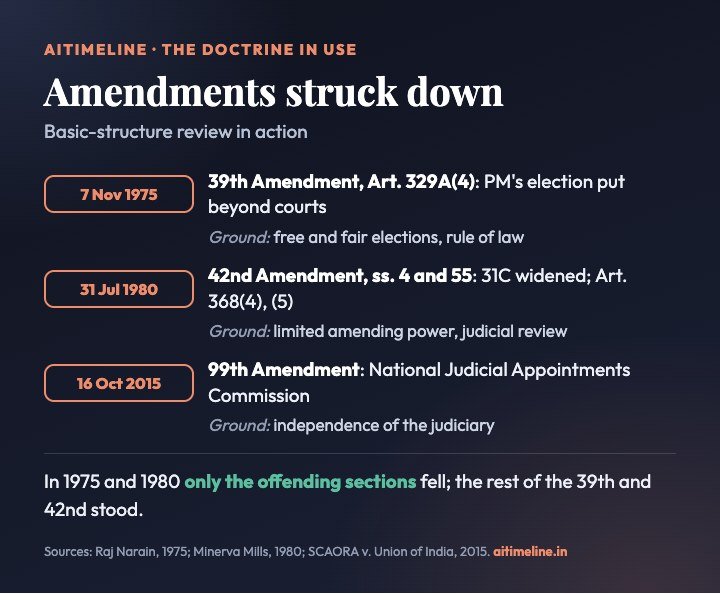
The record: The Supreme Court has applied the test to strike down parts of the 39th, 42nd and 99th Amendments. No larger bench has been constituted to reconsider the 1973 ruling since the 1975 review bench was dissolved.
Supreme Court marks 50 years with a dedicated web page Doctrine applied 1975-2026
What was published: On the judgment’s 50th anniversary the Supreme Court put the case record online on a page titled “The Basic Structure Judgment”: the written submissions, reference material and the judgment, with a Hindi version.
The context: The doctrine had been publicly questioned months earlier. In January 2023 Vice-President Jagdeep Dhankhar criticised it at a conference of presiding officers in Jaipur, and Chief Justice Chandrachud described the basic structure as a “north star” in a lecture later that month.
Kesavananda Bharati dies at the Edneer Mutt Doctrine applied 1975-2026
The petitioner: The seer died at the Edneer Mutt, aged 79, after age-related illness. He had become its head as a young man in 1961.
The irony: His own fight was about land. The Kerala land-reform laws he challenged survived, protected through the Ninth Schedule, yet the case carrying his name became the best-known judgment in Indian constitutional law.
NJAC struck down: judicial independence is basic structure Doctrine applied 1975-2026
The amendment: The 99th Amendment, 2014, and the National Judicial Appointments Commission Act replaced the collegium with a commission that included the Law Minister and two “eminent persons”.
The ruling: The majority held that giving the executive a say that could outvote the judiciary in appointments damaged the independence of the judiciary, a basic feature, and restored the collegium system.
I.R. Coelho: no blanket shield for the Ninth Schedule Doctrine applied 1975-2026
The question: Could Parliament put any law beyond review simply by listing it in the Ninth Schedule under Article 31B?
The answer: No. Laws added to the Ninth Schedule on or after 24 April 1973 can be tested against Fundamental Rights, and struck down if the violation damages the basic structure. Laws added before that date keep their protection, as Waman Rao had held.
Waman Rao fixes 24 April 1973 as the dividing line Doctrine applied 1975-2026
The holding: All Acts placed in the Ninth Schedule before 24 April 1973 receive the full protection of Article 31B. Amendments to the Ninth Schedule made on or after that date are open to challenge on the ground that they damage the basic structure.
Why that date: The court reasoned that titles and transactions had been settled for years on the faith that pre-1973 Ninth Schedule laws were immune.
Minerva Mills: limited amending power is itself basic Doctrine applied 1975-2026
What fell: Section 55 of the 42nd Amendment, which added clauses (4) and (5) to Article 368 to bar courts from questioning amendments and to declare Parliament’s amending power unlimited, and Section 4, which extended Article 31C to all Directive Principles.
The principle: A limited amending power is one of the basic features, so Parliament cannot use that power to make itself unlimited. The Constitution rests on a balance between Fundamental Rights and Directive Principles. Justice P.N. Bhagwati agreed on Section 55 but dissented on Section 4.
The 42nd Amendment tries to close the door Doctrine applied 1975-2026
What it said: No constitutional amendment “shall be called in question in any court on any ground”, and “there shall be no limitation whatever” on Parliament’s constituent power.
What happened: The Supreme Court struck down both clauses in Minerva Mills in 1980.
A 13-judge bench to review Kesavananda is dissolved Doctrine applied 1975-2026
What happened: Chief Justice Ray, who had been in the 1973 minority, assembled a fresh 13-judge bench to reconsider the judgment. Nani Palkhivala argued against any review over two days of hearings.
The end: On the morning of 12 November 1975 the Chief Justice announced that the bench was dissolved. No order on the merits was given.
Indira Gandhi v. Raj Narain: the first strike-down Doctrine applied 1975-2026
The amendment: Article 329A(4), added by the 39th Amendment in August 1975, declared the Prime Minister’s 1971 election valid and beyond challenge, whatever any court had held.
The ruling: The court struck down clause (4) as violating the basic structure, citing free and fair elections and the rule of law. It still upheld Indira Gandhi’s election, applying retrospective changes to election law.
Three judges of the majority are superseded The 1973 verdict
What happened: Chief Justice S.M. Sikri retired the day after the judgment. The government appointed Justice A.N. Ray, who had been in the minority, over three more senior judges from the majority: J.M. Shelat, K.S. Hegde and A.N. Grover.
The response: All three resigned. The supersession became a lasting part of the debate over executive influence on the judiciary.
The 7-6 verdict: Parliament cannot destroy the basic structure The 1973 verdict
The holding: Golak Nath was overruled: Parliament can amend any part of the Constitution, Fundamental Rights included. But Article 368 does not enable it to alter the basic structure or framework of the Constitution.
The amendments: The 24th Amendment was upheld. The 25th was upheld except the second part of Article 31C, which barred courts from asking whether a law declared to give effect to Article 39(b) and (c) actually did. The 29th Amendment was upheld.
The majority: Chief Justice Sikri and Justices Shelat, Grover, Hegde, Mukherjea, Jaganmohan Reddy and Khanna. Justice Khanna’s opinion, accepting the amendment of Fundamental Rights but not the destruction of the Constitution’s basic framework, decided the split.
Six petitions before the largest bench in Indian history The 1973 verdict
The bench: Chief Justice Sikri and Justices Shelat, Hegde, Grover, A.N. Ray, Jaganmohan Reddy, Palekar, Khanna, Mathew, Beg, Dwivedi, A.K. Mukherjea and Y.V. Chandrachud. It was convened because only a larger bench could reconsider the 11-judge ruling in Golak Nath.
The arguments: Six writ petitions raised common questions on the 24th, 25th and 29th Amendments. Nani Palkhivala argued that the amending power had implied limits; Attorney General Niren De and H.M. Seervai, for Kerala, argued that it had none.
The 29th Amendment shields two Kerala land laws Amendments 1971-72
What it did: It placed the Kerala Land Reforms (Amendment) Acts of 1969 and 1971 in the Ninth Schedule, so they could not be challenged for violating Fundamental Rights under Article 31B.
Why it mattered: These were the very laws Kesavananda Bharati had challenged. His petition was amended to attack the amendment itself.
The 25th Amendment adds Article 31C Amendments 1971-72
What it did: It replaced “compensation” in Article 31(2) with “amount”, and inserted Article 31C: laws giving effect to Article 39(b) and (c), on the distribution of material resources, could not be struck down under Articles 14, 19 or 31.
The second limb: Article 31C also said no law declaring that it gave effect to that policy could be questioned on the ground that it did not. In 1973 the court struck down this part.
The 24th Amendment answers Golak Nath Amendments 1971-72
What it did: It amended Article 368 to state that Parliament may amend “by way of addition, variation or repeal any provision” of the Constitution, added Article 13(4) so amendments are not “law” under Article 13, and made the President’s assent to amendment bills mandatory.
The vote: The Lok Sabha passed it 384 to 23 and the Rajya Sabha 177 to 8, according to the judgment.
Kerala amends its land law again Petition 1969-71
What changed: Kerala tightened its land-reform framework further while the petition was pending.
The petition grows: The petitioner was allowed to urge additional grounds, challenging the 1971 Act and the 24th, 25th and 29th Amendments that protected the state’s laws.
Kesavananda Bharati files Writ Petition No. 135 of 1970 Petition 1969-71
The challenge: He sought to strike down the Kerala Land Reforms Act, 1963, as amended in 1969, which restricted the land the Mutt could hold.
The rights invoked: Articles 25 and 26 on religious freedom and the management of religious affairs, together with Articles 14, 19(1)(f) and 31 on equality and property.
Kerala’s land-reform law is tightened Petition 1969-71
The law: The Kerala Land Reforms Act, 1963 (Act 1 of 1964) was already in the Ninth Schedule. The 1969 amendment changed it further, and the petitioner said the amended provisions affected the Mutt’s property and its rights as a religious denomination.
Golak Nath: Fundamental Rights placed beyond amendment Earlier rulings 1951-67
The holding: A constitutional amendment is “law” under Article 13(2), so Parliament cannot amend the Constitution to take away or abridge Fundamental Rights.
The limit: Applying prospective overruling, the court left earlier amendments, including the First, Fourth and Seventeenth, in force.
Sajjan Singh: the power upheld, with doubts Earlier rulings 1951-67
The holding: The 17th Amendment was upheld, and with it Parliament’s power to amend Fundamental Rights.
The doubts: Justices M. Hidayatullah and J.R. Mudholkar concurred but questioned whether the power was unlimited. Justice Mudholkar asked whether changing a “basic feature” was amendment at all, an idea Kesavananda later took up.
Shankari Prasad: amendments are not “law” Earlier rulings 1951-67
The holding: The First Amendment, 1951, which added Articles 31A and 31B and the Ninth Schedule, was valid. An amendment under Article 368 is not “law” under Article 13, so it can abridge Fundamental Rights.
Why it matters: It created the Ninth Schedule device that later amendments, including the 29th, used to protect land-reform laws.
The 7–6 Vote
Thirteen judges, two answers to one question.
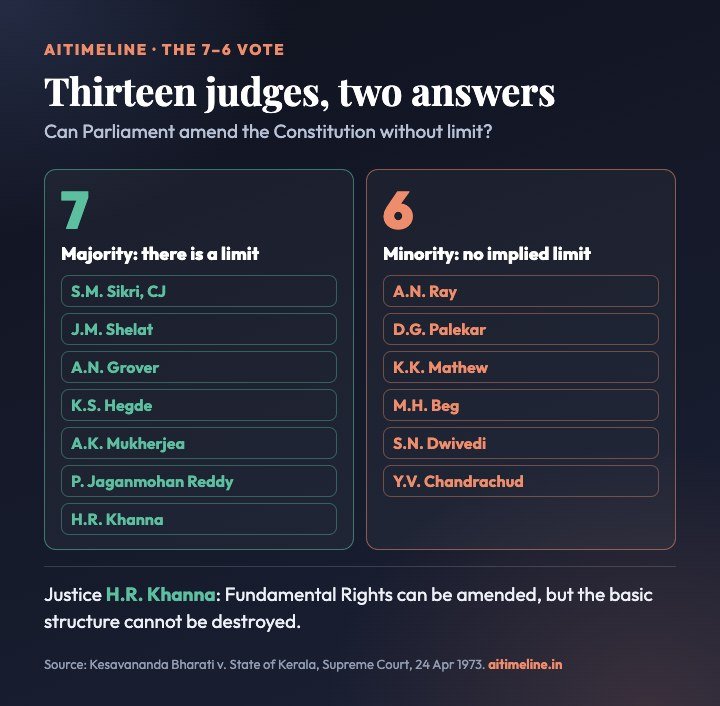
The majority did not reason identically. Six of the seven held that the amending power carried implied limits that protected essential features, including much of Part III. Justice Khanna went further than his colleagues on one point and less far on another: he accepted that Fundamental Rights, including the right to property, could be amended, but held that “amendment” could not mean abrogating the Constitution’s basic structure or framework. That narrower position is the one that commanded a majority, and it is why the doctrine is stated as a limit on destroying the structure, not as a ban on changing Fundamental Rights.
What Exactly Did the Supreme Court Decide?
The summary of the view by majority, point by point.
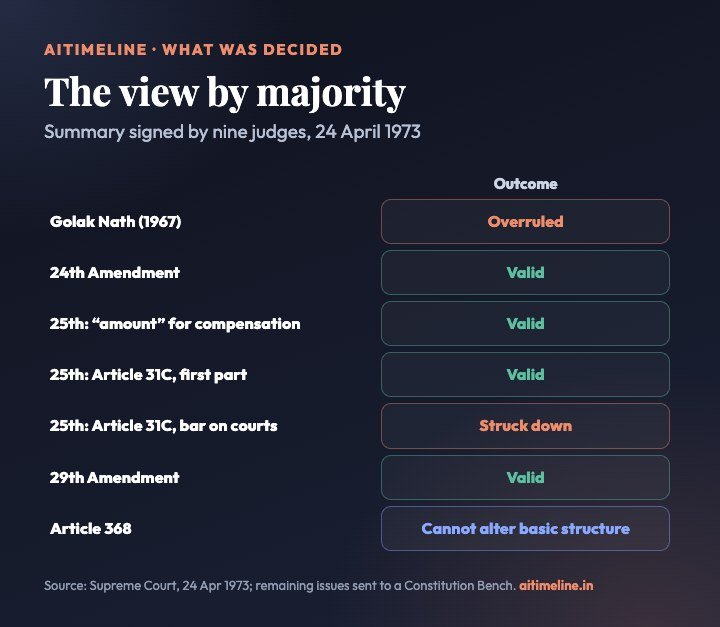
| Question | Answer on 24 April 1973 | What it meant |
|---|---|---|
| Was Golak Nath right? | No, overruled | Amendments are not “law” under Article 13; Fundamental Rights can be amended |
| 24th Amendment | Valid | Article 368 is the source of the amending power |
| 25th, Article 31(2) | Valid | “Amount” instead of “compensation” for acquired property |
| 25th, Article 31C first part | Valid | Laws for Article 39(b) and (c) protected from Articles 14, 19 and 31 |
| 25th, Article 31C second part | Invalid | A legislature’s own declaration cannot shut out the courts |
| 29th Amendment | Valid | Kerala Acts stayed in the Ninth Schedule; the cases went back to a Constitution Bench |
| Limit on Article 368 | Basic structure | Parliament cannot alter the basic structure or framework |
Often claimed
- The court made Fundamental Rights unamendable.
- It struck down Kerala’s land reforms.
- It issued a list of basic features.
- Waman Rao was decided in 1981; Sajjan Singh in 1965.
What the record shows
- It held the opposite: they can be amended, short of destroying the basic structure.
- The 29th Amendment protecting them was upheld.
- Judges named different features; later cases filled in more.
- Waman Rao was delivered on 13 November 1980; Sajjan Singh on 30 October 1964.
What Counts as the Basic Structure?
No closed checklist. Features recognised in 1973 and in later cases.
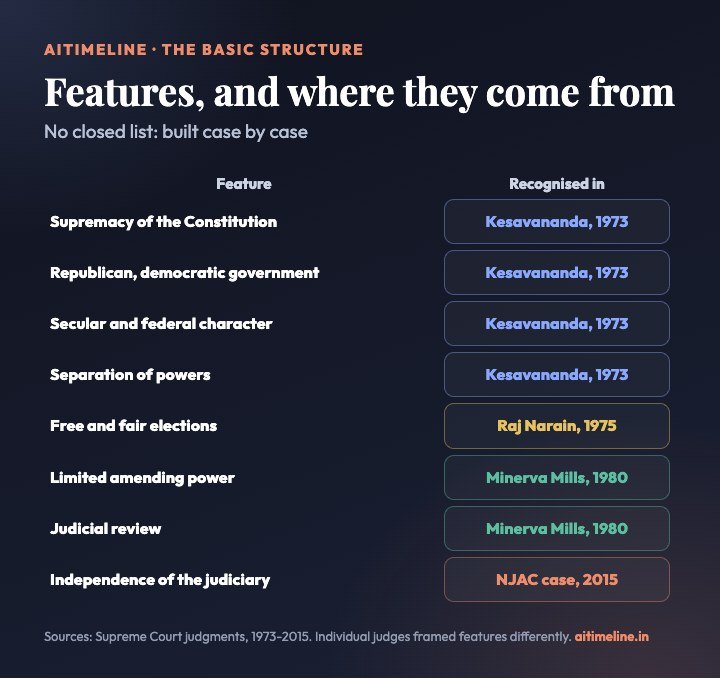
Chief Justice Sikri’s opinion gave the most-quoted examples: the supremacy of the Constitution, the republican and democratic form of government, its secular and federal character, and the separation of powers. Justices Shelat and Grover added the dignity of the individual and the unity and integrity of the nation; Justices Hegde and Mukherjea named sovereignty and the welfare state. None of the judges claimed to be exhaustive. Later benches added free and fair elections, judicial review, limited amending power and judicial independence, each in a dispute about a particular amendment.
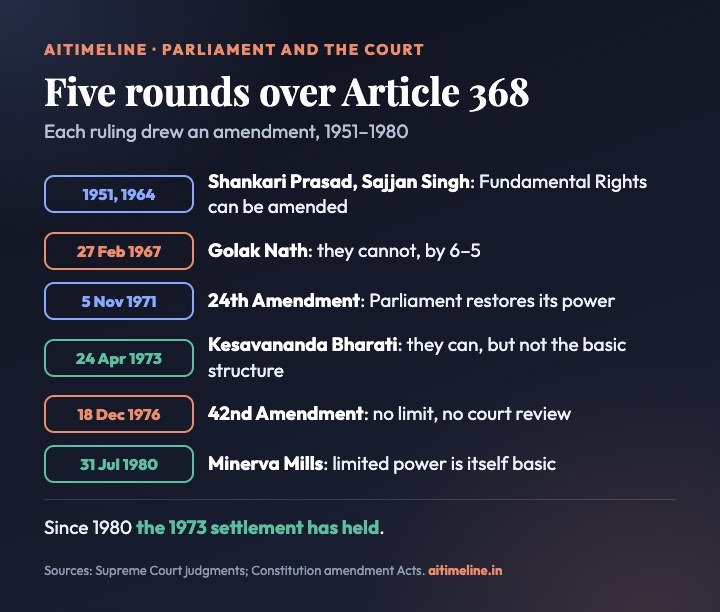
Parliament and the Court: Five Rounds
Each ruling drew an amendment; each amendment drew a ruling.
The Ninth Schedule and the 24 April 1973 Line
How the date of the judgment became a rule of law.
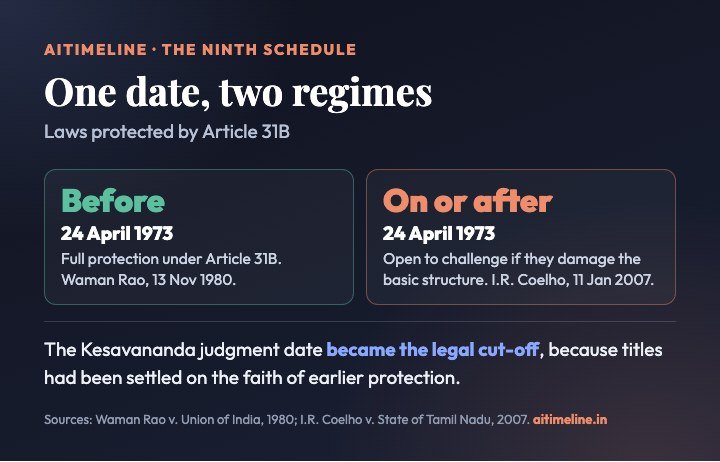
The First Amendment of 1951 created the Ninth Schedule so that land-reform laws placed in it could not be struck down for violating Fundamental Rights. By the 1970s hundreds of laws had been added. Kesavananda raised the obvious question: if an amendment cannot destroy the basic structure, can an amendment that inserts a law into the Ninth Schedule be tested too? Waman Rao said yes for additions made on or after 24 April 1973, and spared earlier ones because titles and transactions had been settled on the faith that they were safe. I.R. Coelho, decided by nine judges in 2007, confirmed that later additions get no blanket immunity: a court can examine whether the law’s effect on Fundamental Rights damages the basic structure.
Why the Case Still Matters, and Why It Is Contested
A safeguard
- Stops a temporary majority from dismantling democracy.
- Tested in the Emergency, 1975–77.
- Leaves Parliament wide power to amend.
A judicial veto
- Not written in Article 368.
- Unelected judges define “basic”.
- Open-ended list of features.
Used sparingly
- Few amendments struck down.
- Applied to parts, not whole Acts.
- Most amendments since 1973 stand.
Six lasting effects
- Amending power: Parliament keeps the power to change any article, but every amendment can be tested against the basic structure.
- Elections: the doctrine stopped a law placing the Prime Minister’s election beyond any court in 1975.
- Judicial review: Minerva Mills held that review of amendments cannot be abolished by amendment.
- Judicial independence: the NJAC was struck down in 2015 on this ground.
- Ninth Schedule: laws added after 24 April 1973 lost their automatic immunity.
- Influence abroad: the idea of unamendable constitutional features has been taken up by courts in Bangladesh and elsewhere in South Asia.
Explore More Timelines
People Also Ask
Frequently Asked Questions
Dated facts from the Supreme Court judgments, 1951 to 2015.
⚠️ Editorial Note
This account is based on the Supreme Court’s judgment of 24 April 1973 in Kesavananda Bharati v. State of Kerala and on the judgments in Shankari Prasad (1951), Sajjan Singh (1964), Golak Nath (1967), Indira Nehru Gandhi v. Raj Narain (1975), Minerva Mills (1980), Waman Rao (1980) and I.R. Coelho (2007), read on Indian Kanoon, with reporting by LiveLaw, SCC Online, Deccan Herald and Onmanorama for the 1975 review bench, the 2023 anniversary page and the petitioner’s death. Checking the brief this page started from against those records: Sajjan Singh was decided on 30 October 1964, not in 1965, and Waman Rao on 13 November 1980, not in 1981; both later years come from law-report citations. Minerva Mills’ reasons of 31 July 1980 followed an order of 9 May 1980. The petition date, the six connected writ petitions, the 24th Amendment’s assent on 5 November 1971 and the vote counts are taken from the 1973 judgment. Basic features are reported as individual judges stated them, not as a list issued by the court. This is not legal advice.
Related Reading on AiTimeline
Sources & further reading
Every dated entry above was checked against these references. Last reviewed 6 November 2026.
- Kesavananda Bharati Sripadagalvaru v. State of Kerala, Supreme Court judgment of 24 April 1973
- I.C. Golak Nath v. State of Punjab, Supreme Court, 27 February 1967
- Sajjan Singh v. State of Rajasthan, Supreme Court, 30 October 1964
- Sri Sankari Prasad Singh Deo v. Union of India, Supreme Court, 5 October 1951
- Indira Nehru Gandhi v. Raj Narain, Supreme Court, 7 November 1975
- Minerva Mills Ltd. v. Union of India, Supreme Court, 31 July 1980
- Waman Rao v. Union of India, Supreme Court, 13 November 1980
- I.R. Coelho v. State of Tamil Nadu, Supreme Court, 11 January 2007
- "This Bench Is Dissolved": the 1975 attempt to review Kesavananda Bharati
- SC dedicates web page detailing Kesavananda Bharati case arguments, submissions and verdict (24 April 2023)
- Kesavananda Bharati, Kerala seer behind landmark Fundamental Rights case, dies (6 September 2020)