Right to Privacy in India: Puttaswamy Case, Timeline and Its Impact
How the 2017 Puttaswamy judgment made privacy a fundamental right in India, and its impact on Aadhaar, LGBTQ+ rights, personal liberty and data protection.
Latest Story
Can the government collect your personal information without legal safeguards? Can it interfere in intimate personal choices? The right to privacy in India answers both questions. It became a fundamental right on 24 August 2017, when a nine-judge bench of the Supreme Court unanimously decided Justice K.S. Puttaswamy (Retd.) v. Union of India (judgment). The case began as a challenge to Aadhaar, but its reach is much wider: it now shapes rulings on identity data, sexual orientation, marriage, surveillance, political donations and digital data protection. The judgment did not make privacy absolute, and it did not ban Aadhaar. What it did was require every intrusion to be justified by law, by a legitimate aim and by proportionality.
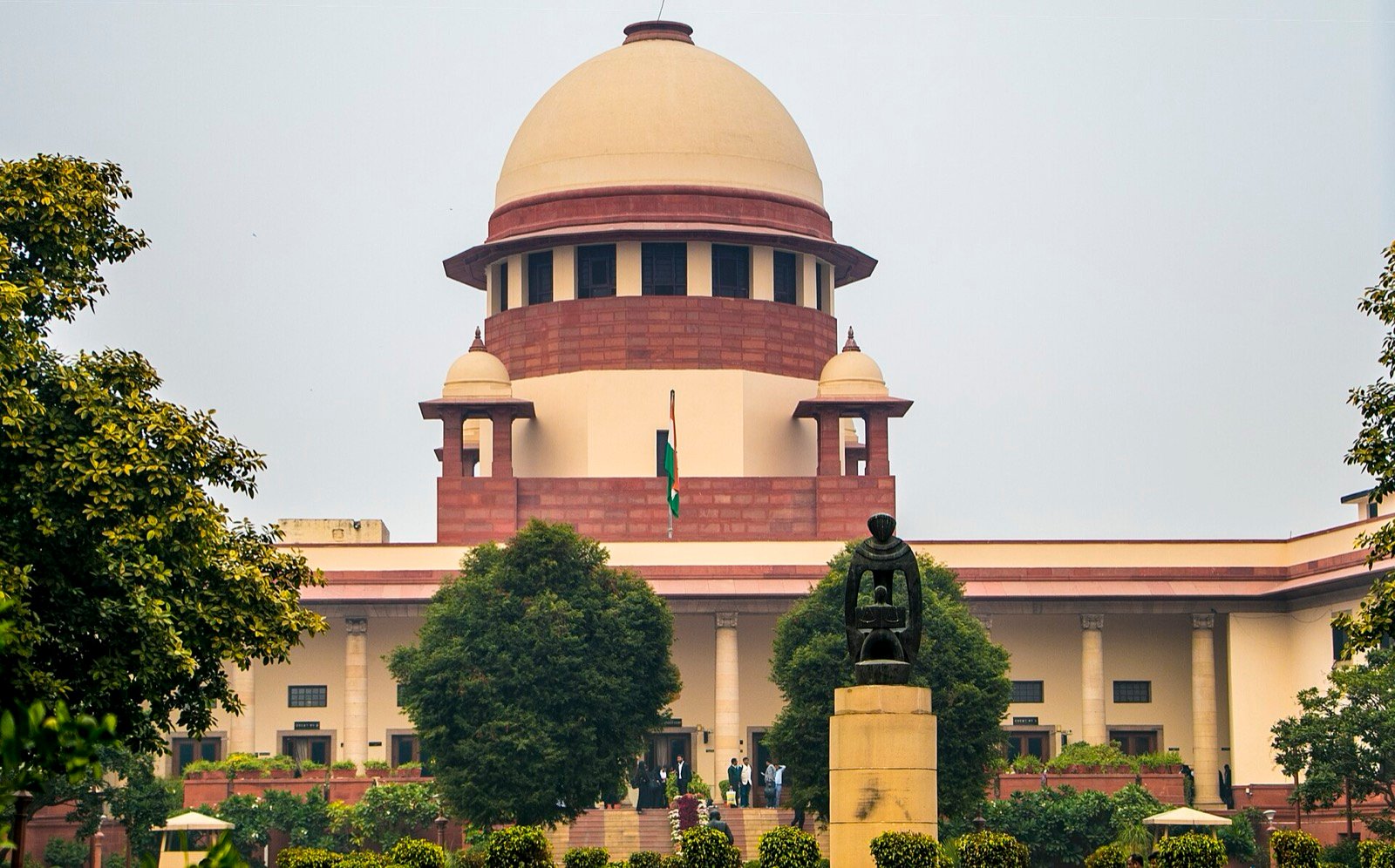
Status: privacy has been a fundamental right since 24 August 2017. India’s data-protection law is in force only in part, and parts of it are under challenge in the Supreme Court.
💡 Short Answer
On 24 August 2017, a nine-judge Supreme Court bench in the Puttaswamy case unanimously held that the right to privacy is a fundamental right under Article 21 and Part III of the Constitution. It overruled the 1954 and 1962 rulings that had denied it. Restrictions must pass a test of legality, legitimate aim and proportionality. The principle shaped the 2018 Aadhaar, Navtej Singh Johar and Joseph Shine rulings and the DPDP Act, 2023, whose main provisions start in May 2027.
Right to Privacy in India: Key Questions
The Right to Privacy Judgment in Nine Points
- Verdict: 24 August 2017, nine judges, unanimous, in six opinions.
- Where it lives: Article 21 and the freedoms of Part III.
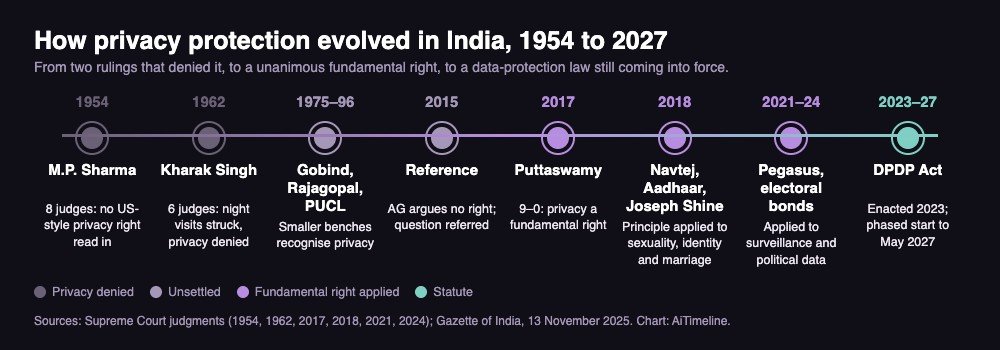
- Overruled: M.P. Sharma (1954) and Kharak Singh (18 December 1962) on privacy.
- Three facets: bodily, decisional and informational privacy.
- The test: legality, legitimate aim and proportionality, plus safeguards.
- Aadhaar: upheld in 2018 with limits. Puttaswamy itself did not rule on it.
- Personal autonomy: cited in Navtej (377) and Joseph Shine (adultery) in September 2018.
- Data law: DPDP Act passed in 2023, Rules notified 13 November 2025, main duties from 13 May 2027.
- Still open: challenges to the DPDP Act are pending in the Supreme Court.
Privacy Cases at a Glance
The rulings that built, applied and tested the right, with the size of each bench.
| Case | Date | Bench | What it decided |
|---|---|---|---|
| M.P. Sharma v. Satish Chandra | 15 Mar 1954 | 8 judges | Searches upheld; no US-style privacy right read in. Overruled on this point in 2017 |
| Kharak Singh v. State of UP | 18 Dec 1962 | 6 judges | Night domiciliary visits struck down; privacy “not a guaranteed right”. Overruled on this point in 2017 |
| Justice K.S. Puttaswamy v. Union of India | 24 Aug 2017 | 9 judges, 9–0 | Privacy is a fundamental right under Article 21 and Part III |
| Navtej Singh Johar v. Union of India | 6 Sep 2018 | 5 judges, 5–0 | Consensual same-sex relations between adults decriminalised |
| Puttaswamy (Aadhaar) v. Union of India | 26 Sep 2018 | 5 judges, 4–1 | Aadhaar Act upheld; private use, bank and mobile mandates struck down |
| Joseph Shine v. Union of India | 27 Sep 2018 | 5 judges, 5–0 | Adultery (Section 497 IPC) struck down as a crime |
| Manohar Lal Sharma v. Union of India | 27 Oct 2021 | 3 judges | Pegasus: expert committee appointed; national security no “free pass” |
| ADR v. Union of India (electoral bonds) | 15 Feb 2024 | 5 judges, 5–0 | Scheme struck down; donor privacy weighed against voters’ right to know |
Timeline of the Right to Privacy Case in India, Latest First
From the 2026 challenges to the data law back to the 1954 ruling. Each entry is tagged and ends with why it matters.
Challenges to the DPDP Act reach the Supreme Court; no stay Latest
Several petitions now question parts of the Digital Personal Data Protection Act, 2023 and its 2025 Rules. They include challenges to Section 44(3), which rewrote the personal-information exemption in Section 8(1)(j) of the Right to Information Act. The Supreme Court issued notice on one such petition, filed by Mazdoor Kisan Shakti Sangathan, on 13 April 2026 (LawBeat).
In late October 2026 a petition by the Digital News Publishers Association came up. The Court declined to stay the Act without first hearing the Union government and listed the matter for 17 November 2026 (MediaNama). The petitions argue, among other things, that the law restricts journalism and weakens the RTI Act. Those are the petitioners’ claims; the Court has not ruled on them.
2025
DPDP Rules notified; the Act starts coming into force in phases Legislation
The Digital Personal Data Protection Rules, 2025 were notified on 13 November 2025. A commencement notification was published in the Gazette of India the same day. The notification is dated 13 November, although some reports gave the date as 14 November. It brought some sections into force immediately: definitions, the Data Protection Board (Sections 18 to 26), rule-making powers, and Section 44(1) and (3), including the RTI amendment.
The consent-manager provisions start one year later, on 13 November 2026. The core duties of data fiduciaries, such as notice, consent, security safeguards and breach reporting, take effect 18 months after notification, on 13 May 2027. A January 2026 proposal by MeitY to shorten that window to 12 months was widely reported, but we found no amending notification as of October 2026. For the full history of the law, see our timeline of India’s data protection law.
2024
Justice K.S. Puttaswamy dies at 98 Background
Justice K.S. Puttaswamy, the lead petitioner, died at his home in Bengaluru aged 98 (PTI via The Week). He had served as a judge of the Karnataka High Court from 1977 to 1986. He was 86 when he filed the 2012 petition that led to the privacy ruling.
2024
Electoral bonds judgment weighs donor privacy against voters’ right to know Court
A unanimous five-judge bench struck down the electoral bonds scheme (judgment). Relying on Puttaswamy, the Court accepted that information about a person’s political affiliation is protected by informational privacy. It said this could extend to contributions made as a genuine form of political support.
But it held that the anonymous scheme was not the least restrictive way to protect that interest. It also held that voters’ right to information about political funding prevailed in this design. Privacy, in other words, was weighed against another right, not treated as a trump. Background: Electoral bonds: history and Supreme Court ruling.
2023
Digital Personal Data Protection Act becomes law Legislation
Parliament passed the Digital Personal Data Protection Act after the Lok Sabha and Rajya Sabha cleared it in August 2023, and it received Presidential assent on 11 August 2023 (text of the Act; PRS Legislative Research). It sets out the duties of “data fiduciaries” and the rights of “data principals”, and creates a Data Protection Board to enforce them.
Critics have pointed to the wide exemptions the Act allows the government. Supporters say it gives India its first general data-protection law. The Act itself did not commence on assent; it needed a separate notification, which came only in November 2025.
2021
Pegasus order: national security is not a ‘free pass’ Court
A bench of Chief Justice N.V. Ramana and Justices Surya Kant and Hima Kohli heard petitions alleging that Pegasus spyware had been used against journalists, activists and politicians. The bench appointed an independent technical committee overseen by retired Justice R.V. Raveendran. Citing Puttaswamy, it said the state could not escape judicial review simply by invoking national security (Columbia Global Freedom of Expression).
The order shows how Puttaswamy is used in surveillance cases. It did not declare surveillance illegal; it required the state to justify it. Full story: Pegasus spyware row timeline.
2021
Aadhaar review petitions dismissed 4:1 Court
Petitioners asked the Court to review its 2018 Aadhaar judgment, mainly because the Aadhaar Act had been passed as a Money Bill. The majority, Justices Khanwilkar, Bhushan, Nazeer and Gavai, found no ground for review. Justice D.Y. Chandrachud dissented. He said the petitions should wait for a larger bench to rule on the Money Bill question (Supreme Court Observer).
Parliament rewrites the Aadhaar law after the judgment Legislation
Parliament responded to the 2018 ruling with the Aadhaar and Other Laws (Amendment) Act, 2019, which received assent on 23 July 2019 (Gazette of India; PRS Legislative Research). It deleted Section 57, which the Court had struck down to the extent it allowed private use. It allowed banks and telecom companies to accept Aadhaar for KYC only if the customer chose to use it, alongside alternatives such as a passport. It also added offline verification and penalties for misuse of Aadhaar data.
2018
Joseph Shine: adultery is no longer a crime Court
A unanimous bench struck down Section 497 of the Indian Penal Code and Section 198(2) of the Code of Criminal Procedure (judgment). Under those provisions, a man could be prosecuted for sex with another man’s wife, but the wife could neither be prosecuted nor bring a complaint herself.
The judges held that the law treated women as their husbands’ property and violated equality and dignity. Several opinions relied on Puttaswamy’s recognition of sexual autonomy and decisional privacy. Adultery can still be a ground for divorce and other civil consequences; the ruling only removed it from criminal law.
2018
Aadhaar judgment upholds the scheme but limits its use Court
The same petition then returned for a ruling on Aadhaar itself (judgment). By 4:1, the Court upheld the Aadhaar Act and its use for welfare subsidies and benefits under Section 7. It also upheld mandatory linking with PAN for income tax.
It struck down the part of Section 57 that let private entities demand Aadhaar on the basis of a contract, and Section 33(2), which allowed disclosure on national-security grounds. It also struck down rules that made Aadhaar compulsory for bank accounts and a Department of Telecommunications circular requiring it for mobile connections. Justice Chandrachud dissented and would have struck down the entire Act.
The case applied the Puttaswamy test of legality, legitimate aim and proportionality to an actual government programme. Aadhaar was not banned; specific uses failed the test.
2018
Navtej Singh Johar: consensual same-sex relations decriminalised Court
A unanimous bench read down Section 377 of the Indian Penal Code so that it no longer criminalised consensual sexual acts between adults in private (judgment). It overruled Suresh Kumar Koushal (2013).
The judges drew on Puttaswamy, which had described sexual orientation as an essential attribute of privacy and criticised Koushal. They also relied on dignity, equality and freedom of expression. The provision continued to apply to non-consensual acts and to acts involving minors or animals.
2017
Nine judges, one answer: privacy is a fundamental right Court
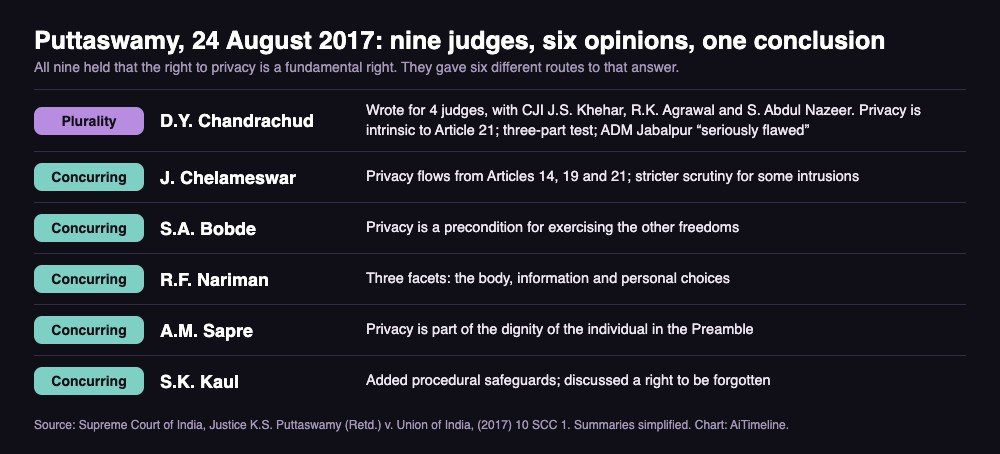
Chief Justice J.S. Khehar and Justices J. Chelameswar, S.A. Bobde, R.K. Agrawal, R.F. Nariman, A.M. Sapre, D.Y. Chandrachud, S.K. Kaul and S. Abdul Nazeer unanimously held that the right to privacy is protected as an intrinsic part of the right to life and personal liberty under Article 21, and as part of the freedoms guaranteed by Part III (judgment).
Justice Chandrachud wrote for himself, the Chief Justice and Justices Agrawal and Nazeer. The other five judges wrote separate concurring opinions. The bench overruled M.P. Sharma and Kharak Singh to the extent they said otherwise. Justice Chandrachud’s opinion also described the Emergency-era ADM Jabalpur majority as “seriously flawed” (see the Emergency, 1975–77).
The order said only that privacy is a fundamental right. It did not decide whether Aadhaar was valid; that question went back to a smaller bench.
2017
A five-judge bench sends the question to nine judges Court
A five-judge Constitution Bench headed by Chief Justice Khehar decided that only a larger bench could settle the question. M.P. Sharma had been decided by eight judges and Kharak Singh by six. A nine-judge bench was formed and heard arguments from 19 July to 2 August 2017 (Inforrm; Supreme Court Observer).
2015
Three-judge bench refers the privacy question Court
During the Aadhaar hearings, Attorney General Mukul Rohatgi argued that Indians had no fundamental right to privacy, relying on M.P. Sharma and Kharak Singh. On 11 August 2015 a three-judge bench held that the question had to be settled by a bench of appropriate strength. The same order limited Aadhaar use to the public distribution system and LPG subsidies for the time being (Supreme Court Observer).
Justice K.S. Puttaswamy challenges Aadhaar Background
Justice K.S. Puttaswamy, a retired judge of the Karnataka High Court, filed Writ Petition (Civil) 494 of 2012 challenging the Aadhaar scheme. At that point, the scheme had been launched by executive notification and had no law of Parliament behind it (2018 judgment, cause title). Other petitions were later heard with it. On 23 September 2013 the Court said no one should suffer for not having an Aadhaar number.
Smaller benches recognise privacy anyway Background
Between the 1960s rulings and 2017, two- and three-judge benches repeatedly recognised a right to privacy. In Gobind v. State of Madhya Pradesh (1975) it was derived from Article 21. R. Rajagopal (1994) applied it to publishing a person’s life story. In PUCL v. Union of India (1996) it led to safeguards for telephone tapping. Smaller benches cannot overrule larger ones, so the law remained in tension for decades (Supreme Court Observer).
1962
Kharak Singh: night visits struck down, privacy denied Background
Kharak Singh challenged police surveillance under the UP Police Regulations, including night-time “domiciliary visits” to his home (judgment). The majority struck down the domiciliary visits as a violation of personal liberty under Article 21. It upheld the other surveillance measures, saying the right to privacy was not a guaranteed right. Justice Subba Rao, joined by Justice Shah, dissented and would have treated privacy as part of personal liberty.
Some versions of this timeline date the case to 1961. The judgment was delivered on 18 December 1962 and reported in 1963.
1954
M.P. Sharma: searches and seizures upheld Background
Searches carried out during an investigation into the Dalmia group of companies were challenged under Article 20(3), the protection against self-incrimination (judgment). The eight-judge bench upheld the searches. It noted that the Constitution had no provision like the US Fourth Amendment, and declined to import a fundamental right to privacy by construction.
That observation was later read as denying privacy any constitutional status. In 2017 it was overruled to that extent.
What Exactly Did the Supreme Court Decide?
Four principles from the 2017 judgment that still guide privacy disputes.
1. Privacy is a fundamental right
Privacy is protected as an intrinsic part of Article 21 and of the freedoms in Part III. It is not a privilege the state grants, and it does not depend on a specific law creating it. Justice Chandrachud put it as a natural right, inherent in being human and recognised, not conferred, by the Constitution (judgment).
2. Privacy protects dignity and autonomy
It covers the ability to make personal decisions without unjustified interference: intimate relationships, family life, marriage, procreation, bodily integrity and sexual orientation. The plurality opinion described these as the core of decisional privacy.
3. Privacy includes informational control
Information about a person can affect their dignity and autonomy. Collecting, storing, using and sharing personal data can therefore raise constitutional concerns, especially when the state holds the data. The plurality asked the government to put in place a robust data-protection regime. That request led to the Srikrishna committee and, eventually, the 2023 Act.
4. Privacy is not absolute
A restriction can be lawful, but it has to pass a test. The plurality set out three requirements; Justice Kaul’s opinion added procedural safeguards against abuse:
- Legality: there must be a law. An executive order alone is not enough.
- Legitimate aim: the law must pursue a valid state objective.
- Proportionality: the means must be rationally connected to the aim and must not go further than needed.
The test does not give the state blanket permission to collect data. It is a framework for deciding whether a particular intrusion is justified.
How the Privacy Test Works
A simplified explainer. Courts apply the relevant legal tests to the facts and rights involved.
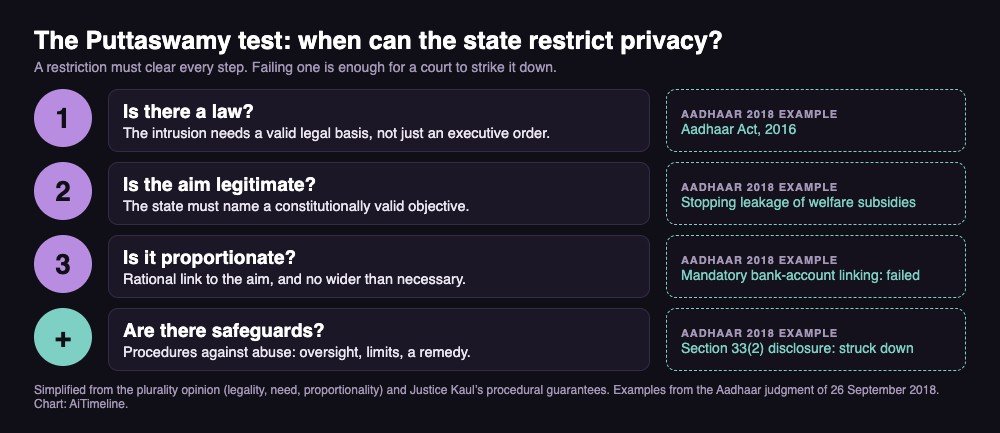
- Is there a law? The interference needs a valid legal basis. Aadhaar ran for years on an executive notification before the 2016 Act.
- Is the aim legitimate? The state must name a constitutionally valid objective, such as preventing leakage of welfare subsidies.
- Is it proportionate? The measure must be connected to the aim and no wider than necessary. Requiring Aadhaar for every bank account failed this step in 2018.
- Are there safeguards? There must be procedures against abuse, such as oversight, limits on retention and a remedy.
How Did the Judgment Affect Ordinary Indians?
Aadhaar and identity data
The 2018 Aadhaar judgment upheld the scheme for welfare benefits and tax, but removed private and compulsory uses that failed the test. The 2019 amendment then made Aadhaar a choice, not a requirement, for bank and mobile KYC. The lesson is that identity systems are allowed, but each use has to be justified.
Personal relationships and intimate choices
Navtej Singh Johar ended the criminalisation of consensual same-sex relations, and Joseph Shine ended the crime of adultery. Both rulings rested on equality and dignity as well as privacy, but both cited Puttaswamy’s idea of decisional autonomy.
Personal information held by companies
Fundamental rights bind mainly the state. Puttaswamy made the case for data protection, but rules on notice, consent, security, retention and penalties for companies needed legislation. That is the DPDP Act, and its core duties begin only in May 2027.
Surveillance and state power
The judgment gives citizens a framework to challenge surveillance. In the Pegasus case, the Court used it to refuse a blanket national-security defence. It does not make every form of surveillance illegal. Whether a particular measure is lawful depends on its legal basis, purpose, safeguards and proportionality.
Political and financial information
In the electoral bonds case the Court treated political affiliation as private information. It still struck the scheme down because voters’ right to know about political funding prevailed. Privacy claims can lose when they are weighed against other constitutional interests.
The Digital Personal Data Protection Act: From Principle to Rules
Enacted in 2023, with Rules notified in November 2025 and a phased start.
The Digital Personal Data Protection Act, 2023 is the statute Puttaswamy called for. It governs how organisations, called data fiduciaries, handle the digital personal data of individuals, called data principals. It is enforced by a new Data Protection Board (text of the Act). The Rules were notified on 13 November 2025 (MeitY), and the Act’s commencement is phased (Gazette notification).
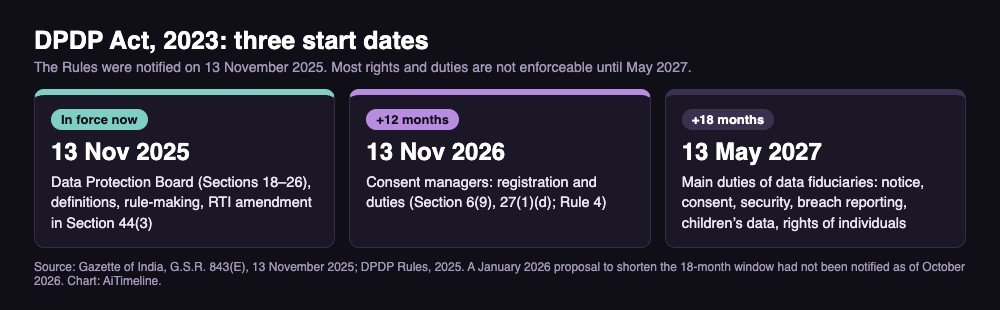
| Issue | What the DPDP framework is meant to do | In force from |
|---|---|---|
| Data Protection Board | Sets up the regulator that hears complaints and imposes penalties | 13 Nov 2025 |
| RTI amendment (Section 44(3)) | Widens the personal-information exemption in Section 8(1)(j) of the RTI Act | 13 Nov 2025 |
| Consent managers | Registered intermediaries through which people give, manage and withdraw consent | 13 Nov 2026 |
| Notice and consent | Tell people what data is collected and why, and obtain consent where required | 13 May 2027 |
| Security and breach reporting | Reasonable safeguards; report personal-data breaches to the Board and affected people | 13 May 2027 |
| Rights of individuals | Access, correction, erasure, grievance redress and nominating someone to act for you | 13 May 2027 |
What the Judgment Does Not Mean
Puttaswamy is sometimes described as giving people control over every piece of information about them. That goes too far.
✅ What Puttaswamy did
- Made privacy a fundamental right under Article 21 and Part III
- Covered bodily, decisional and informational privacy
- Required any restriction to pass legality, legitimate aim and proportionality
- Overruled M.P. Sharma and Kharak Singh on privacy
- Called on the government to put in place a data-protection regime
❌ What it did not do
- Ban Aadhaar, or rule on Aadhaar at all
- Make privacy absolute or override every public interest
- Create a complete data-protection code for private companies
- Make all surveillance automatically unlawful
- Remove the need to balance privacy against other rights
Explore More Timelines
People Also Ask
Frequently Asked Questions About the Right to Privacy
Privacy as a Foundation of Personal Liberty
Puttaswamy changed the constitutional status of privacy in India. It overruled two old judgments and made privacy part of the right to life and liberty. Its influence runs through the Aadhaar ruling, the decisions on sexual orientation and adultery, the Pegasus order and the electoral bonds case. The data-protection law it called for exists, but most of that law is still being phased in.
Puttaswamy does not mean privacy always wins. It means that any restriction has to be justified under the Constitution, and that privacy cannot be treated as an optional benefit.
Related AiTimeline Stories
⚠️ Editorial Note
Last updated 29 October 2026. This is an educational summary of constitutional judgments and legislation, not legal advice. For a specific dispute, consult the judgment, the statute and the current rules. Primary sources are the Supreme Court judgments and the Gazette of India. We corrected the source brief in three places. Kharak Singh was decided on 18 December 1962, not in 1961. The DPDP Rules and the commencement notification are dated 13 November 2025, not 14 November. And the September 2018 rulings run Navtej (6 September), Aadhaar (26 September), then Joseph Shine (27 September). We also added the 2015 and 2017 referral dates, the 2019 Aadhaar amendment, the 2021 Pegasus order and review dismissal, and the 2026 court challenges to the DPDP Act.
Sources & further reading
Every dated entry above was checked against these references. Last reviewed 29 October 2026.
- Supreme Court of India: Justice K.S. Puttaswamy (Retd.) v. Union of India, judgment of 24 August 2017 (Indian Kanoon)
- Supreme Court of India: Puttaswamy (Aadhaar) v. Union of India, judgment of 26 September 2018 (PDF)
- Supreme Court of India: Joseph Shine v. Union of India, judgment of 27 September 2018 (PDF)
- Supreme Court of India: Navtej Singh Johar v. Union of India, judgment of 6 September 2018 (Indian Kanoon)
- Supreme Court of India: Association for Democratic Reforms v. Union of India (electoral bonds), 15 February 2024 (PDF)
- Gazette of India: DPDP Act commencement notification G.S.R. 843(E), 13 November 2025 (PDF)
- Ministry of Electronics and IT: Acts and policies, including the DPDP Rules, 2025
- Supreme Court of India: Kharak Singh v. State of Uttar Pradesh, 18 December 1962 (Indian Kanoon)
- Supreme Court of India: M.P. Sharma v. Satish Chandra, 15 March 1954 (Indian Kanoon)
- Supreme Court Observer: Fundamental Right to Privacy, case background
- MediaNama: Digital news publishers challenge the DPDP Act in the Supreme Court (October 2026)