Sohrabuddin Sheikh Encounter Case: From the 2005 Killings to the 2026 High Court Verdict
Follow the Sohrabuddin Sheikh encounter case from the 2005 killings and CBI investigation to the 2018 acquittals and 2026 Bombay High Court verdict.
Latest Story
In November 2005 Sohrabuddin Sheikh was shot dead by Gujarat police in Ahmedabad. His wife, Kausar Bi, vanished and was later said to have been killed and burnt. A year later Tulsiram Prajapati, the man the CBI called the witness to their abduction, died in another encounter. The Sohrabuddin Sheikh encounter case that followed reached the Supreme Court, put a sitting state home minister in jail, moved a trial from Gujarat to Mumbai and named 38 people. It ended with none convicted: 16 discharged, 22 acquitted in 2018, and those acquittals upheld by the Bombay High Court on 7 May 2026. This timeline separates what police said, what the CBI alleged and what the courts decided.
💡 Short Answer
Sohrabuddin Sheikh was killed in a Gujarat police encounter on 26 November 2005; his wife Kausar Bi and associate Tulsiram Prajapati also died. The CBI alleged staged killings and a conspiracy, and named 38 people. Sixteen, including Amit Shah, were discharged. A Mumbai court acquitted the other 22 in 2018, and the Bombay High Court upheld that on 7 May 2026.
Sohrabuddin Sheikh Case: Key Questions
The Case in Ten Points
- The deaths: Sohrabuddin on 26 Nov 2005, Kausar Bi days later, Prajapati on 28 Dec 2006.
- The petitioner: Sohrabuddin’s brother Rubabuddin took the case to the Supreme Court in 2006.
- The first arrests: three IPS officers, including D.G. Vanzara, on 24 April 2007.
- The handover: the Supreme Court gave the case to the CBI on 12 January 2010.
- The minister: Amit Shah was arrested on 25 July 2010 and discharged on 30 December 2014.
- The move: the trial was transferred from Gujarat to Mumbai on 27 September 2012.
- The arithmetic: 38 named, 16 discharged, 22 tried.
- The witnesses: 92 of 210 turned hostile at trial.
- The verdicts: all 22 acquitted in 2018; acquittals upheld on 7 May 2026.
- The gap: no court has held anyone responsible for the three deaths.
Timeline: From the 2005 Killings to the 2026 High Court Verdict
Newest first. Colour shows which phase each event belongs to.
Where the case stands High Court appeal 2019-2026
The record: All 22 people who stood trial were acquitted in December 2018, and the Bombay High Court upheld those acquittals on 7 May 2026. The 16 others named by the CBI had been discharged before trial, and those discharges were upheld or never successfully challenged.
What is still open: The CBI told the High Court in 2025 that it accepted the acquittals, so the state is not appealing. We found no report, as of 6 November 2026, of the brothers taking the case to the Supreme Court. No court has held anyone responsible for the three deaths.
Bombay High Court upholds all 22 acquittals High Court appeal 2019-2026
The decision: The division bench dismissed the appeals of Rubabuddin and Nayabuddin Sheikh, Sohrabuddin’s brothers, and refused their request for a retrial. It held that the 21 December 2018 judgment was not perverse and rested on the evidence.
The reasoning: The prosecution’s case was circumstantial and, the court said, had “several broken links in the chain of circumstances”. It found the alleged abduction from the bus, the detention at farmhouses and the burning of Kausar Bi’s body unproved, and said medical and ballistic evidence did not back the staged-encounter theory.
The standard: An acquittal, the bench said, “cannot be interfered in a casual or cavalier manner”, and cannot be overturned only because another view of the evidence is possible.
Plea to reopen Amit Shah’s discharge rejected High Court appeal 2019-2026
The application: While judgment was reserved, a Mumbai businessman applied to join the appeals and challenge Amit Shah’s 2014 discharge. The CBI opposed it and placed the earlier discharge orders on record.
The ruling: The bench said the applicant was not a witness, had not explained his interest, had suppressed earlier orders upholding the discharge, and that the application appeared to have been filed “at the instance of some political adversary”.
CBI tells the High Court it accepts the acquittals High Court appeal 2019-2026
What changed: The prosecuting agency had never filed its own appeal against the 2018 verdict. Nearly seven years later it told the court it had accepted the judgment and would not challenge it.
The effect: Only the victims’ family remained as appellants. Their appeal, filed under the victim’s right of appeal in the Code of Criminal Procedure, went on to final hearing.
High Court admits the brothers’ appeal High Court appeal 2019-2026
The order: The bench admitted the appeal and issued notices to the 22 acquitted people. It did not fix a date for hearing.
The delay: The appeal would be pending for almost seven years before judgment.
Sohrabuddin’s brothers challenge the verdict High Court appeal 2019-2026
Their argument: The appeal said the trial judge had relied on “unwarranted assumptions and manifestly erroneous appreciation of evidence”, and that the trial had been conducted “in a manner to defeat the ends of justice”.
What they asked for: They sought the quashing of the acquittal or, alternatively, a retrial under Section 386(a) of the CrPC. They also argued that the prosecution had never summoned the magistrates before whom hostile witnesses had earlier given statements.
Special CBI court acquits all 22 accused Trial in Mumbai 2014-2018
The verdict: In a 358-page judgment the court held that the prosecution had failed to prove conspiracy, abduction or murder beyond reasonable doubt, and found “no iota of evidence” of a politician-police nexus.
On the CBI: The judge criticised the investigation, saying the agency appeared to have worked towards a predetermined theory rather than finding the truth.
On the families: He wrote that it was “a matter of regret” that the killings of Sohrabuddin and Tulsiram, and the disappearance of Kausar Bi, were going unpunished, but that he had no option but to acquit.
Arguments end; judgment reserved Trial in Mumbai 2014-2018
What happened: After the prosecution and defence argued, the court closed the case and later fixed 21 December for its verdict.
No defence case: The accused called no defence witnesses.
Prosecution evidence closes; accused answer the court Trial in Mumbai 2014-2018
The evidence: The examination of prosecution witnesses ended in the third week of November 2018.
The statements: Each accused was then questioned by the judge on the evidence against him. Most said they were innocent and had been falsely implicated. The recording was completed by the end of November.
High Court upholds discharge of senior officers Trial in Mumbai 2014-2018
The officers: The court upheld the discharge of D.G. Vanzara, Rajkumar Pandian, N.K. Amin, Dinesh M.N. and Dalpat Singh Rathod, and allowed the discharge plea of Vipul Aggarwal.
The reason: It said the CBI had not made out a case strong enough to try them, and that it had not obtained the government sanction required to prosecute public servants for acts done on duty.
The trial: 210 witnesses, 92 hostile Trial in Mumbai 2014-2018
The witnesses: The prosecution examined 210 witnesses. Ninety-two turned hostile, departing from the statements the CBI had recorded from them.
Who did not testify: Rubabuddin Sheikh and Tulsiram Prajapati’s mother chose not to depose, saying they had no trust in the court or the prosecution after so many accused had been discharged.
Charges framed against 22 Trial in Mumbai 2014-2018
Who: Twenty-one were police personnel, mostly inspectors, sub-inspectors and constables from Gujarat, Rajasthan and Andhra Pradesh; one was a private individual.
What: They were charged over the alleged conspiracy and the killings of Sohrabuddin, Kausar Bi and Tulsiram Prajapati.
Vanzara and Dinesh discharged Trial in Mumbai 2014-2018
The order: The trial court discharged former Gujarat ATS chief D.G. Vanzara and Rajasthan IPS officer Dinesh M.N., finding insufficient material to proceed against them.
The pattern: With Rajkumar Pandian and others discharged earlier, every IPS officer named by the CBI was out of the case before the trial began.
Supreme Court rejects Harsh Mander’s appeal Trial in Mumbai 2014-2018
The plea: Former civil servant Harsh Mander had asked the court to reopen Amit Shah’s discharge after the family withdrew its own challenge.
The ruling: The bench rejected it on locus standi, saying a person “not even remotely connected” with a case stood differently from someone genuinely aggrieved. A review petition was dismissed in October 2016.
High Court dismisses Mander’s application Trial in Mumbai 2014-2018
The application: Mander had asked for an inquiry into whether Rubabuddin had been pressured into withdrawing his challenge.
The ruling: The court held the application was not maintainable, finding Mander had not shown any legal right of his that had been infringed.
Rubabuddin withdraws his challenge to Shah’s discharge Trial in Mumbai 2014-2018
What happened: Rubabuddin had filed a revision petition against the discharge. He then asked to withdraw it, citing failing health, and the court allowed him to.
Why it mattered: With the only directly aggrieved petitioner gone, later challenges by outsiders failed for lack of standing.
Amit Shah discharged Trial in Mumbai 2014-2018
The order: The court found no sufficient ground to proceed against Shah on the CBI’s material and discharged him, accepting his plea that the case against him was politically motivated.
The others: Fifteen more accused, including former Rajasthan Home Minister Gulab Chand Kataria and senior IPS officers, were discharged in later orders.
What it is not: A discharge means the court found no case to try. It is not an acquittal after trial.
Death of Judge B.H. Loya Trial in Mumbai 2014-2018
What happened: Judge Loya, who had taken over the case in June 2014, died of what was recorded as a cardiac arrest while attending a wedding in Nagpur.
The later inquiry: Questions raised about his death in 2017 led to petitions for an independent probe. On 19 April 2018 the Supreme Court dismissed them, holding that he had died of natural causes.
Supreme Court makes it one case CBI and Supreme Court 2010-2013
The question: The CBI had registered a separate FIR for Tulsiram Prajapati’s killing in 2011 and filed a chargesheet naming Amit Shah in September 2012.
The ruling: The court quashed the second FIR and directed that the Prajapati chargesheet be treated as a supplementary chargesheet in the Sohrabuddin case, since the CBI itself said both deaths arose from one conspiracy.
Supreme Court moves the trial to Mumbai CBI and Supreme Court 2010-2013
The transfer: Allowing the CBI’s petition, the court moved the Sohrabuddin case out of Gujarat to a CBI court in Mumbai, to protect the fairness of the trial.
The bail: In the same judgment it refused the CBI’s plea to cancel Amit Shah’s bail and lifted its order keeping him out of Gujarat.
What it is not: A transfer is a safeguard for the process. It is not a finding against any accused.
CBI ordered to investigate Prajapati’s death CBI and Supreme Court 2010-2013
The order: The Supreme Court directed the CBI to take over the investigation into Prajapati’s killing, which the Gujarat CID had been handling.
The link: His mother argued that he was killed because he would have been a material witness in the Sohrabuddin case.
Gujarat High Court grants Shah bail CBI and Supreme Court 2010-2013
The bail: The High Court released Amit Shah on bail after about three months in custody.
The condition: On the CBI’s plea, the Supreme Court told him to stay out of Gujarat. That order lasted until September 2012.
Amit Shah arrested CBI and Supreme Court 2010-2013
What happened: Shah resigned from the Gujarat government and was arrested by the CBI two days after its chargesheet named him.
His response: He denied the charges and called the case politically motivated.
CBI files its chargesheet CBI and Supreme Court 2010-2013
The allegation: The CBI alleged that the killings were part of a larger conspiracy involving police officers of Gujarat and Rajasthan and political figures.
The accused: Over this and later chargesheets the agency named 38 people, including Amit Shah, Gulab Chand Kataria and senior IPS officers.
What it is: A chargesheet is the investigating agency’s case. It is not proof of guilt.
Supreme Court hands the case to the CBI CBI and Supreme Court 2010-2013
The order: Unsatisfied with the Gujarat CID’s investigation, the court directed the CBI to investigate the Sohrabuddin and Kausar Bi killings, including any larger conspiracy.
On Prajapati: It said the facts of Prajapati’s death raised strong suspicion of “a deliberate attempt” to destroy a human witness.
Supreme Court keeps watch on the CID probe Gujarat CID probe 2006-2009
What happened: Hearing Rubabuddin’s petition, the court questioned the state about changes in the investigating team and asked for a final report.
The family’s view: Rubabuddin kept pressing for an independent agency, which the state opposed until 2010.
Gujarat tells the court Kausar Bi is dead Gujarat CID probe 2006-2009
The admission: The Gujarat government told the Supreme Court that Kausar Bi had been killed and her body burnt and disposed of.
Why it mattered: Her disappearance had been at the centre of the family’s petition since 2006.
Three IPS officers arrested Gujarat CID probe 2006-2009
What happened: Acting on the inquiry led by IPS officer Geetha Johri, CID officer Rajnish Rai arrested Gujarat DIG Vanzara, SP Pandian and Rajasthan SP Dinesh M.N.
The shift: For the first time, the state’s own investigators treated the encounter as a possible crime by the police.
Rubabuddin goes to the Supreme Court Gujarat CID probe 2006-2009
The plea: Rubabuddin wrote to the Chief Justice of India seeking an investigation into his brother’s death and the whereabouts of Kausar Bi.
The response: The court directed the Gujarat CID to investigate, and later set a deadline for its inquiry.
Tulsiram Prajapati killed in an encounter The killings 2005-2006
The police account: Police said Prajapati escaped while being brought back from a court hearing in Ahmedabad on 26 December, and was shot when he fired at them.
The CBI account: The CBI alleged he was killed because he had been with Sohrabuddin when the couple was picked up and could expose what happened.
The date: The CBI’s chargesheet dates his death to 28 December 2006; some timelines give 27 December.
Kausar Bi is allegedly killed The killings 2005-2006
The allegation: The CBI said Kausar Bi was held after her husband’s death, killed, and her body burnt and disposed of.
At trial: The special court and the High Court both held that the burning and disposal of her body was not proved.
Sohrabuddin Sheikh shot dead in Ahmedabad The killings 2005-2006
The police account: The Gujarat ATS said Sohrabuddin was a criminal with terror links planning to assassinate a prominent political leader, and was killed when he resisted arrest.
The CBI account: The CBI alleged he had been in illegal custody for days and was killed in a staged encounter by a joint Gujarat-Rajasthan police team.
Three people taken off a bus The killings 2005-2006
The CBI account: The CBI said police intercepted the bus and took Sohrabuddin and Kausar Bi in one vehicle and Prajapati in another. The couple was allegedly held at a farmhouse near Ahmedabad; Prajapati was sent to prison in Udaipur.
At trial: The courts held the abduction and detention were not proved: no reliable identification evidence linked the accused to the bus.
The Three Deaths
Two police encounters and a disappearance, thirteen months apart.
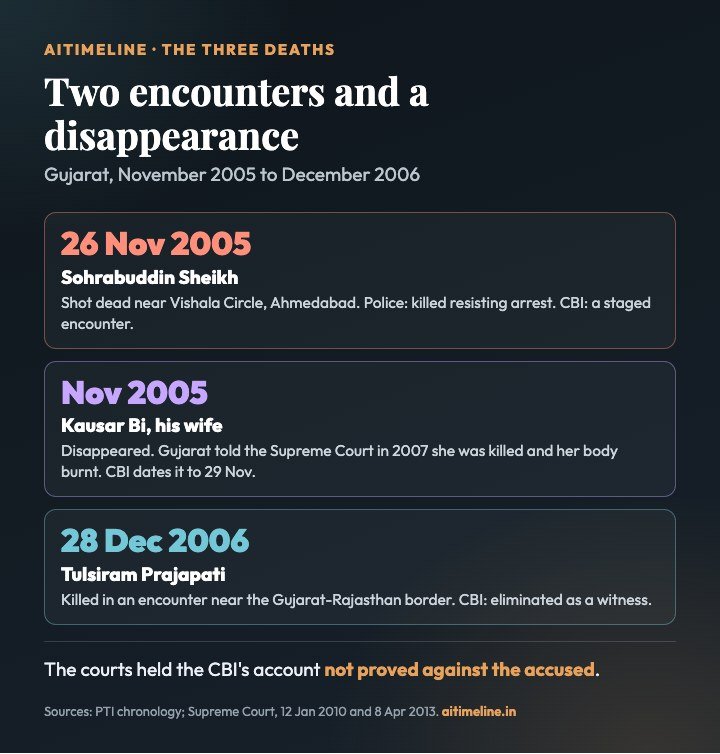
Sohrabuddin Sheikh
Wanted in several criminal cases. Gujarat police said he had terror links and planned a political assassination; the CBI said he was killed in illegal custody. His brother Rubabuddin’s petition began the case.
Kausar Bi
Sohrabuddin’s wife. Gujarat told the Supreme Court in 2007 that she had been killed and her body burnt. At trial the courts held that her killing and the disposal of her body were not proved against the accused.
Tulsiram Prajapati
Sohrabuddin’s associate, alleged by the CBI to have witnessed the couple being taken. The Supreme Court in 2010 said his death raised strong suspicion of an attempt to destroy a witness.
Rubabuddin Sheikh
Sohrabuddin’s brother. He took the case to the Supreme Court, sought its transfer to Mumbai, withdrew his challenge to Amit Shah’s discharge in 2015, and lost his appeal against the acquittals in 2026.
38 Accused, No Conviction
Where every name in the CBI’s chargesheets ended up.
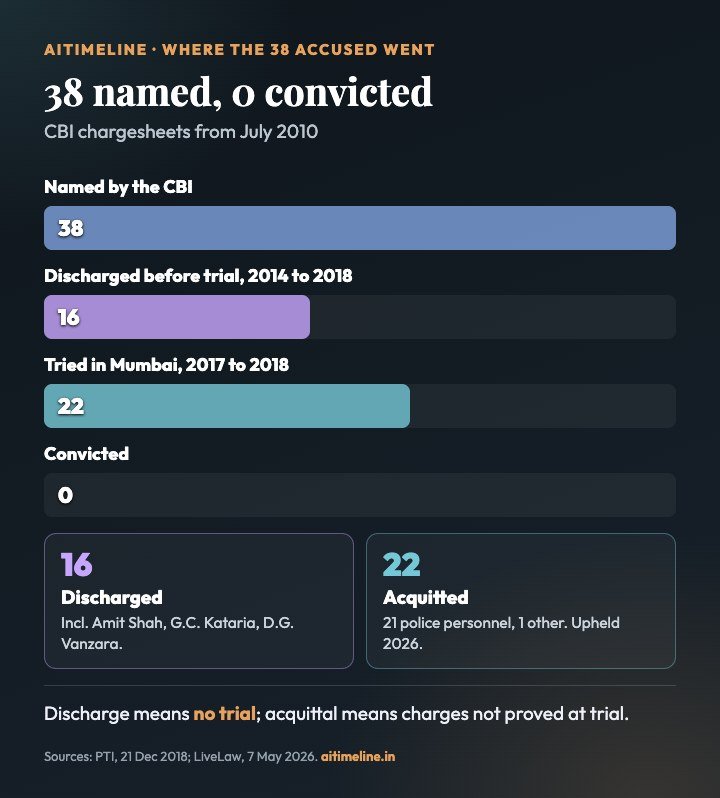
| Stage | Date | Outcome |
|---|---|---|
| CBI chargesheets | From 23 Jul 2010 | 38 people named, including Amit Shah, Gulab Chand Kataria and IPS officers |
| Discharges | 2014 to 2018 | 16 discharged, starting with Amit Shah on 30 Dec 2014; no trial for them |
| High Court on discharges | 10 Sep 2018 | Discharge of Vanzara, Pandian, Amin, Dinesh, Rathod upheld; Aggarwal discharged |
| Trial | Nov 2017 to Dec 2018 | 22 tried: 21 police personnel and one private individual |
| Verdict | 21 Dec 2018 | All 22 acquitted by Special Judge S.J. Sharma |
| Appeal | 7 May 2026 | Brothers’ appeals dismissed; acquittals upheld |
Often claimed
- The courts found the encounters were fake.
- Amit Shah was acquitted after trial.
- The courts declared the encounters genuine.
- The CBI appealed the acquittals.
What the record shows
- That was the CBI’s allegation; no court found it proved.
- He was discharged in 2014; he was never tried.
- They held only that the charges were not proved.
- It accepted the verdict; only the family appealed.
The Witnesses Who Changed Their Story
210 examined, 92 hostile.
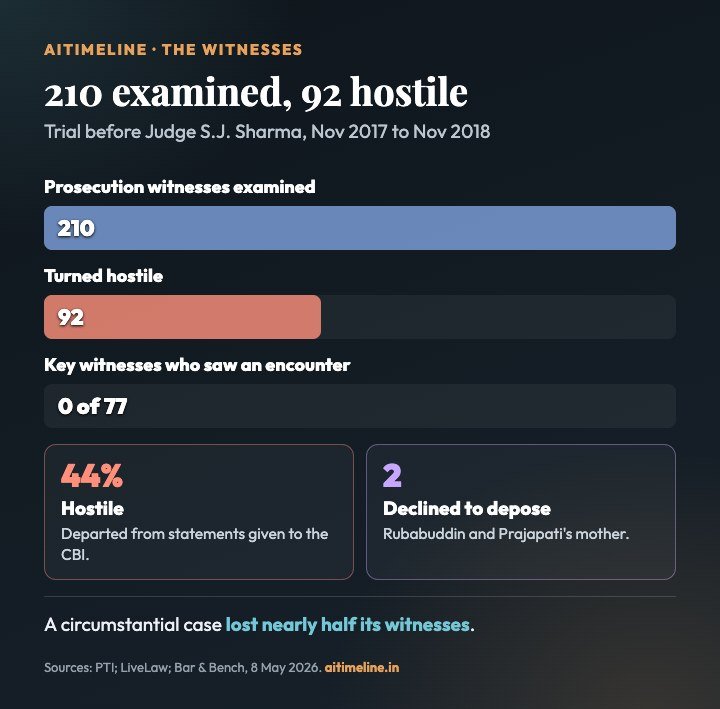
A witness turns hostile when, in court, they depart from the statement they gave investigators. In this case that happened 92 times. The family’s appeal cited witnesses who later said the trial court had not recorded their testimony accurately, and argued that the prosecution should have called the magistrates before whom some earlier statements were made. Two people closest to the victims, Rubabuddin Sheikh and Tulsiram Prajapati’s mother, declined to testify, saying they had lost faith in the process after so many accused were discharged. For a case built entirely on circumstantial evidence, each lost witness was a missing link.
Why the Prosecution Failed
What the trial court and the High Court found missing.
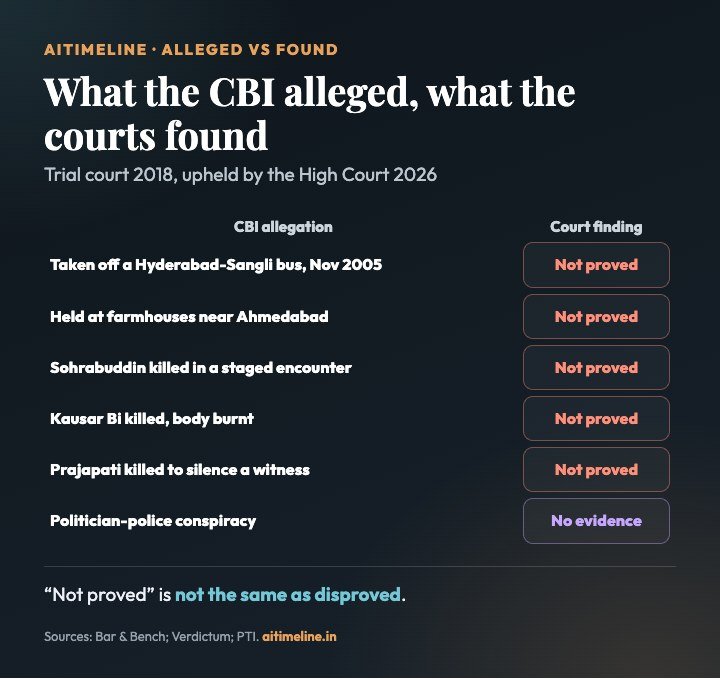
Six gaps the courts identified
- Hostile witnesses: 92 of 210 did not support the prosecution in court.
- Broken chain: the case was circumstantial, and the High Court found “several broken links” in it.
- No identification: no reliable evidence placed the accused at the bus interception or the farmhouses.
- Expert evidence: medical and ballistic experts did not support the theory of staged encounters.
- No conspiracy shown: the trial court found “no iota of evidence” of a politician-police nexus and no proven motive.
- Sanction: for the police accused acting on duty, the absence of government sanction under Section 197 CrPC was a further bar.
The Courts and the Judges
Six forums over two decades.
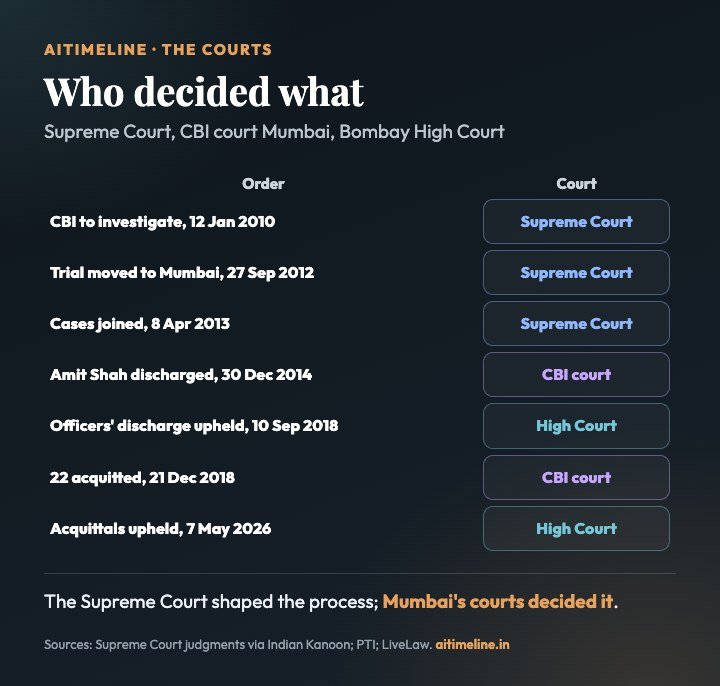
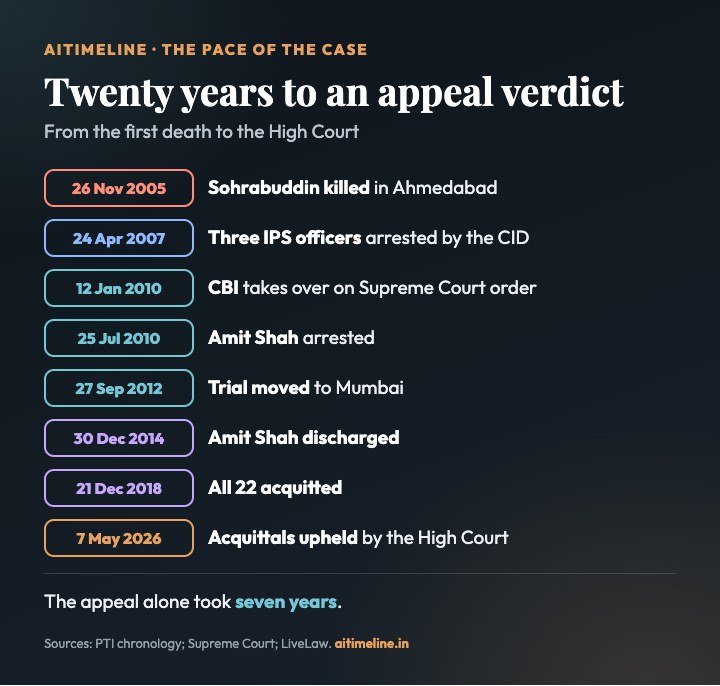
The Supreme Court never tried the case, but it shaped every stage of it. It forced the Gujarat CID to investigate, took the investigation away from the state when it was unsatisfied, joined the Prajapati killing to the Sohrabuddin case, and moved the trial to another state. The decisions on guilt were made lower down. A special CBI court in Mumbai discharged the senior accused between 2014 and 2017 and acquitted the rest in 2018. The Bombay High Court upheld both. The judge hearing the case in 2014, B.H. Loya, died that December; the Supreme Court held in April 2018 that his death was natural.
Why the Case Still Matters
A staged killing
- Three deaths in police hands.
- Witnesses retracted at trial.
- Senior accused never tried.
A theory without proof
- No eyewitness to any encounter.
- Experts did not back the CBI.
- Accused discharged or acquitted.
Who is responsible
- No conviction for three deaths.
- The CBI accepted the verdict.
- Kausar Bi’s death never explained in court.
Six lessons from the case
- Police accountability: deaths in police encounters need independent investigation from the start, not years later.
- The role of the Supreme Court: a family’s letter to the Chief Justice was what brought the case to court at all.
- Fair trial safeguards: moving a trial out of a state protects the process, but cannot repair a weak investigation.
- Witness protection: a case that loses 92 witnesses to hostility shows how fragile testimony is without protection.
- Sanction rules: the requirement of government sanction to prosecute police for acts on duty decided the fate of senior officers.
- Allegation is not proof: a chargesheet, however serious, is not a verdict, and the court record must be read on its own terms.
Explore More Timelines
People Also Ask
Frequently Asked Questions
Dated facts from court judgments and contemporary reports, 2005 to 2026.
⚠️ Editorial Note
This account is based on Supreme Court judgments of 12 January 2010, 8 April 2011, 27 September 2012 and 8 April 2013 (via Indian Kanoon), PTI’s 2018 case chronology, and reporting by LiveLaw, Bar & Bench, Verdictum, Scroll, The Free Press Journal and Business Standard on the 2016, 2019, 2025 and 2026 proceedings. The detailed 2026 judgment is described here from those law reports. Checking the brief this page started from against those records: the CBI’s chargesheet, quoted by the Supreme Court, dates Tulsiram Prajapati’s death to 28 December 2006, not 27 December; the Section 313 statements were recorded in the last week of November 2018, after prosecution evidence closed around 22 November, not on 23 November; the appeal was filed on 18 April 2019; we could not confirm the brief’s date of 16 January 2026 for the High Court reserving judgment, and one report places it in 2025, so it is left out; the 24 April 2007 arrests of three IPS officers, the CBI’s acceptance of the verdict on 8 October 2025 and the death of Judge B.H. Loya were missing and have been added. “Fake encounter” is used only to describe the CBI’s allegation. This is not legal advice.
Related Reading on AiTimeline
Sources & further reading
Every dated entry above was checked against these references. Last reviewed 6 November 2026.
- Rubabbuddin Sheikh v. State of Gujarat, Supreme Court (12 January 2010)
- Narmada Bai v. State of Gujarat, Supreme Court (8 April 2011)
- CBI v. Amitbhai Anil Chandra Shah, Supreme Court (27 September 2012)
- Amitbhai Anilchandra Shah v. CBI, Supreme Court (8 April 2013)
- Timeline in Sohrabuddin Shaikh case (21 December 2018)
- Sohrabuddin case: Amit Shah gets relief from SC (1 August 2016)
- Bombay HC admits appeal filed by Sohrabuddin's brothers (24 June 2019)
- CBI accepts special court acquittal of 22 accused (8 October 2025)
- Bombay High Court dismisses appeals against acquittal of 22 in Sohrabuddin case (7 May 2026)
- Gaps in evidence, high threshold to reverse acquittal: why the Bombay High Court rejected the appeal (8 May 2026)
- Bombay High Court rejects plea against Amit Shah's discharge (10 May 2026)