Cash-for-Votes: India’s 2008 Confidence Vote Scandal, 2005–2026
Explore the 2008 cash-for-votes scandal timeline, the UPA confidence vote, allegations of bribery, WikiLeaks revelations and the 2013 court decision.
Latest Story
On 22 July 2008, as the Lok Sabha debated whether Manmohan Singh’s government should survive, three BJP MPs walked to the table of the House and emptied bags of currency notes. They said they had been paid to vote for the government or stay away. The 2008 cash-for-votes scandal outlived the vote itself, which the government won 275 to 256: it went through a parliamentary inquiry, a stalled police case, WikiLeaks cables, a Supreme Court rebuke, six arrests and, in November 2013, a court order discharging six of the seven accused. This timeline separates what the MPs alleged, what the police charged and what the courts actually decided.
💡 Short Answer
The cash-for-votes scandal began on 22 July 2008, when three BJP MPs displayed currency notes in the Lok Sabha during the UPA government’s confidence vote, alleging bribery. The government won 275 to 256. Police charged seven people in 2011, but on 22 November 2013 a Delhi court discharged six, including Amar Singh, leaving only Sanjeev Saxena to face proceedings.
2008 Cash-for-Votes Scandal: Key Questions
The Scandal in Ten Points
- The trigger: the Left withdrew support on 9 July 2008 over the nuclear deal.
- The moment: three BJP MPs displayed cash in the Lok Sabha on 22 July 2008.
- The vote: the government won 275 to 256, a margin of 19.
- The inquiry: a seven-member committee found no evidence against Amar Singh or Ahmed Patel.
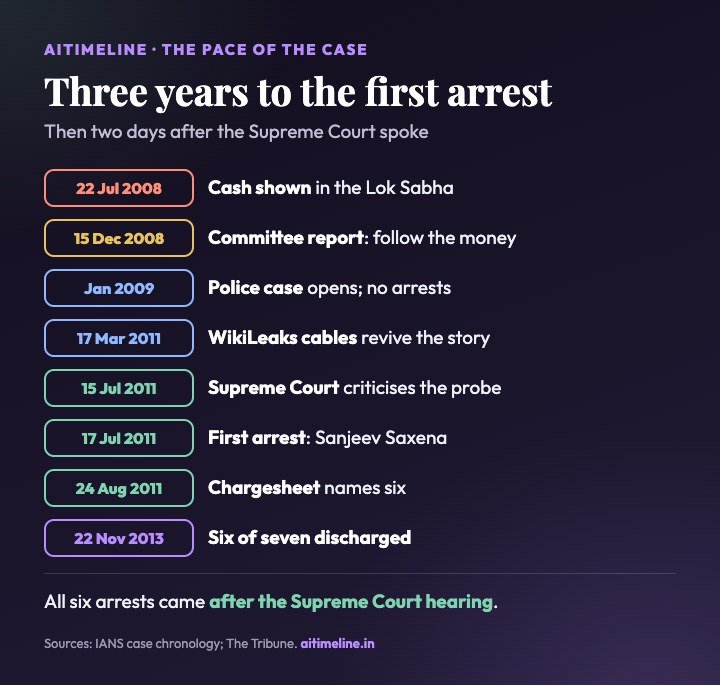
- The delay: the police case opened in January 2009; the first arrest came in July 2011.
- The cables: WikiLeaks in March 2011 reported claims of a Rs 50 crore fund.
- The push: every arrest followed the Supreme Court’s rebuke of 15 July 2011.
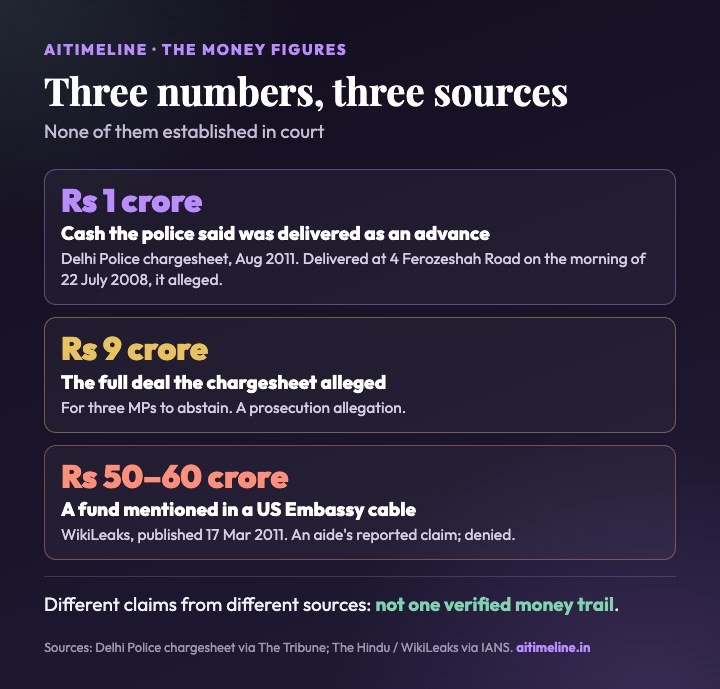
- The charge: police alleged Rs 1 crore paid as an advance on a Rs 9 crore deal.
- The outcome: six of seven accused were discharged on 22 November 2013.
- The gap: no court has established who supplied the money.
Timeline: From the Nuclear Deal to the 2013 Court Order
Newest first. Colour shows which phase each event belongs to.
Where the case stands Court 2013-2026
The record: Six of the seven accused were discharged on 22 November 2013. Only Sanjeev Saxena was ordered to face proceedings, under Section 12 of the Prevention of Corruption Act.
What is still open: We could not find a public record of how the proceedings against Saxena ended, or of a ruling on the Delhi government’s proposed 2014 appeal. The source of the cash shown in the Lok Sabha was never established in court.
Amar Singh dies in Singapore Court 2013-2026
The accused: Amar Singh, the former Samajwadi Party general secretary named in the 2011 chargesheet, died in Singapore while being treated for kidney illness. He had undergone a kidney transplant there before his 2011 arrest.
His case: He was discharged in 2013, after the court found no evidence on record of any promise he made to the BJP MPs.
Delhi’s AAP government says it will appeal Court 2013-2026
The plan: Sisodia said the special public prosecutor believed crucial evidence had been ignored, and that the government would challenge the discharge of six accused in the Delhi High Court.
What followed: The Kejriwal government resigned nine days later, on 14 February 2014. We found no public record of a High Court ruling on the proposed challenge.
Six of seven accused are discharged Court 2013-2026
Who was discharged: Amar Singh, Sudheendra Kulkarni, Ashok Argal, Faggan Singh Kulaste, Mahavir Singh Bhagora and Sohail Hindustani. The court said the facts on record “do not create sufficient grounds” for proceeding against them.
The reasoning: The court said the BJP MPs and others had “the intention to expose horse trading”, corroborated by the fact that the notes were taken to Parliament and shown to the nation.
The exception: Sanjeev Saxena was ordered to be proceeded against under Section 12 of the Prevention of Corruption Act, abetment of an offence relating to illegal gratification. He was discharged of criminal conspiracy.
High Court bails Kulkarni and five others Police and Supreme Court 2009-2011
The order: Regular bail for Kulkarni, Saxena, Kulaste, Bhagora and Hindustani, and anticipatory bail for Ashok Argal, then a sitting MP.
The observation: The judge said they appeared to have taken part only in a sting operation, with no prima facie evidence that a bribe was demanded and paid, and noted that Parliament had taken no action against the MPs.
Sudheendra Kulkarni is arrested Police and Supreme Court 2009-2011
The arrest: Kulkarni, a former aide of L.K. Advani, was sent to judicial custody after the court rejected his plea for interim bail.
His defence: He told the court he was a whistleblower who only intended to expose corruption. The chargesheet called him the “mastermind” of the operation.
Amar Singh is arrested and sent to Tihar Police and Supreme Court 2009-2011
The arrest: Amar Singh appeared in court after seeking exemption on medical grounds. His bail plea was rejected and he was sent to Tihar Jail along with the two former BJP MPs.
The charges: Criminal conspiracy under Section 120B of the IPC and Section 12 of the Prevention of Corruption Act.
Bail: The Delhi High Court released him on bail on medical grounds on 24 October 2011, while he was being treated at AIIMS.
Delhi Police files its chargesheet Police and Supreme Court 2009-2011
Who was named: Amar Singh, his aide Sanjeev Saxena, Sudheendra Kulkarni, Sohail Hindustani, and former BJP MPs Faggan Singh Kulaste and Mahavir Singh Bhagora. Ashok Argal, a sitting MP, was left out pending sanction to prosecute.
The allegation: That Amar Singh conspired with Saxena to deliver Rs 1 crore at 4 Ferozeshah Road at about 11 am on 22 July 2008, as an advance on a deal of Rs 9 crore for the three MPs to abstain.
Its status: These were prosecution allegations. The court did not accept them against Amar Singh in 2013.
BJP activist Sohail Hindustani is arrested Police and Supreme Court 2009-2011
The arrest: Delhi Police took Hindustani into custody after hours of questioning. He was alleged to have acted as a link between Amar Singh’s side and the BJP MPs.
His role: The parliamentary committee had named him, with Saxena and Kulkarni, for further investigation in 2008.
Sanjeev Saxena is arrested Police and Supreme Court 2009-2011
The accused: Saxena, a former aide of Amar Singh, was alleged to have delivered the cash to the BJP MPs on the morning of the vote.
The timing: The arrest came three years after the incident, and immediately after the Supreme Court criticised the investigation.
Supreme Court criticises a “shoddy” probe Police and Supreme Court 2009-2011
The petition: A group of petitioners asked the court to order a special investigation, saying the probe had stalled since the parliamentary report.
The rebuke: Faced with a Delhi Police status report, the court complained that little had been done in two years. On 5 August 2011 it went further, calling the investigation meaningless and asking police to trace the source of the money.
WikiLeaks cables revive the scandal Police and Supreme Court 2009-2011
What a cable said: Five days before the 2008 vote, Nachiketa Kapur, described as an aide to Congress leader Satish Sharma, allegedly showed a US Embassy employee cash and spoke of a fund of Rs 50 to 60 crore to buy MPs’ support.
The denials: Satish Sharma said he had no such aide. The RLD said it had three MPs, not the four the cable claimed were paid.
The weight: A diplomatic cable records what someone told a diplomat. No court has found the Rs 50 crore fund to be real.
A police investigation begins Police and Supreme Court 2009-2011
The brief: To look into the roles of Saxena, Hindustani and Kulkarni, which the parliamentary committee had recommended for further investigation.
The problem: For more than two years there were no arrests, which the Supreme Court later criticised.
Committee reports; Speaker refers the case onward Parliament inquiry 2008
The finding: The committee found no evidence of bribery against Amar Singh or Congress leader Ahmed Patel, who had been accused of offering the money. It said video of a car at Singh’s house did not show what happened inside.
The recommendation: The money trail and the roles of Sanjeev Saxena, Sudheendra Kulkarni and Sohail Hindustani should be probed by an agency such as the CBI or the Income Tax Department.
The split: Some members recorded dissents. The BJP rejected the report as a payback to the Samajwadi Party.
CNN-IBN broadcasts the sting tapes Parliament inquiry 2008
The sting: The channel had filmed the BJP MPs’ attempt to record the alleged offer but held back the footage on legal advice, saying broadcast might prejudice the inquiry.
The pressure: The BJP criticised the channel for not airing it. On 2 August the party gave the committee transcripts and letters from two of the MPs.
Speaker sets up a seven-member committee Parliament inquiry 2008
The members: V. Kishore Chandra Deo (Congress), Vijay Kumar Malhotra (BJP), Mohammed Salim (CPI-M), Devendra Prasad Yadav (RJD), Ram Gopal Yadav (Samajwadi Party), Rajesh Verma (BSP) and C. Kuppusami (DMK).
The task: To examine the MPs’ allegations and the circumstances in which the cash came to be displayed in the House.
CPI(M) expels Speaker Somnath Chatterjee The trust vote, July 2008
Why: Chatterjee refused his party’s demand that he resign as Speaker and vote with the Left against the government. The CPI(M) expelled him.
Other fallout: The BJP expelled eight MPs who cross-voted or abstained. The Samajwadi Party acted against MPs who voted against the government.
UPA wins the confidence vote, 275 to 256 The trust vote, July 2008
The result: 275 for and 256 against, a margin of 19. Most accounts record 10 abstentions; The Tribune reported two abstentions in 487 votes cast.
The crossovers: At least four opposition MPs voted with the government, while seven UPA-side MPs, six of them from the Samajwadi Party, voted against it.
The stakes: Victory let the government go ahead with the India-US nuclear deal.
Three BJP MPs display cash in the Lok Sabha The trust vote, July 2008
What happened: During the debate the three MPs walked to the table of the House with two bags and pulled out bundles of Rs 1,000 notes. They said they had been given the money to vote for the government or abstain.
Whom they accused: They alleged that Samajwadi Party leader Amar Singh, and in Kulaste’s account Congress leader Ahmed Patel, were behind the offer. Both denied it.
What it proved: The display showed cash existed. It did not establish who supplied it or that a bribe had been paid to buy votes.
The confidence debate opens The trust vote, July 2008
The motion: Manmohan Singh sought a vote of confidence in his Council of Ministers after the Left withdrew support.
The arithmetic: In a House of 543, a majority of all members was 272. Small parties and independents were courted by both sides, and MPs were brought in from hospital beds and prison cells.
The Left withdraws support The trust vote, July 2008
Why: The Left parties, with 59 MPs supporting the UPA from outside, objected to the government taking the nuclear deal to the International Atomic Energy Agency.
The effect: The government had to prove its majority on the floor of the Lok Sabha.
The India-US nuclear deal becomes a coalition crisis Nuclear deal 2005-2008
The deal: India would separate civil and military nuclear facilities and place civil ones under IAEA safeguards; the US would work towards full civil nuclear cooperation.
The objection: The Left said the deal would make India subservient to US foreign policy. The BJP said inspections could constrain the weapons programme.
After the vote: The Nuclear Suppliers Group granted India a waiver on 6 September 2008, and the 123 Agreement was signed in Washington on 10 October 2008.
The Vote of 22 July 2008
A margin of 19 in a House of 543.
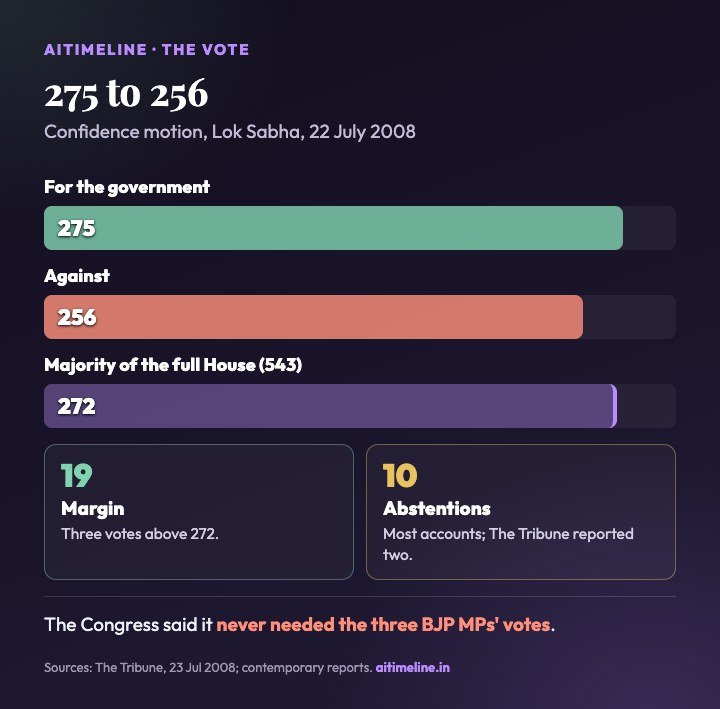
The arithmetic was closer than the margin suggests. The Left’s 59 MPs had gone into opposition, and the Samajwadi Party’s decision to back the government replaced most of them. On the night, at least four opposition MPs voted with the government and several more abstained against their party line; six Samajwadi Party MPs and one Congress MP voted against it. The Congress argued it never needed the votes of three BJP MPs, so had no reason to buy them; the BJP said the point was the attempt, not the arithmetic.
Rs 1 Crore, Rs 9 Crore, Rs 50 Crore: Three Different Claims
Not one money trail. Three figures from three sources.
Often claimed
- The UPA paid MPs Rs 50 crore to win the vote.
- Amar Singh was found to have bribed the MPs.
- The 2013 order acquitted everyone after a trial.
- The money was traced.
What the record shows
- A cable quoted an aide’s claim; it was denied and never proved.
- He was discharged; the court found no evidence of his promise.
- Six were discharged at the charge stage; there was no trial for them.
- No court has identified the source.
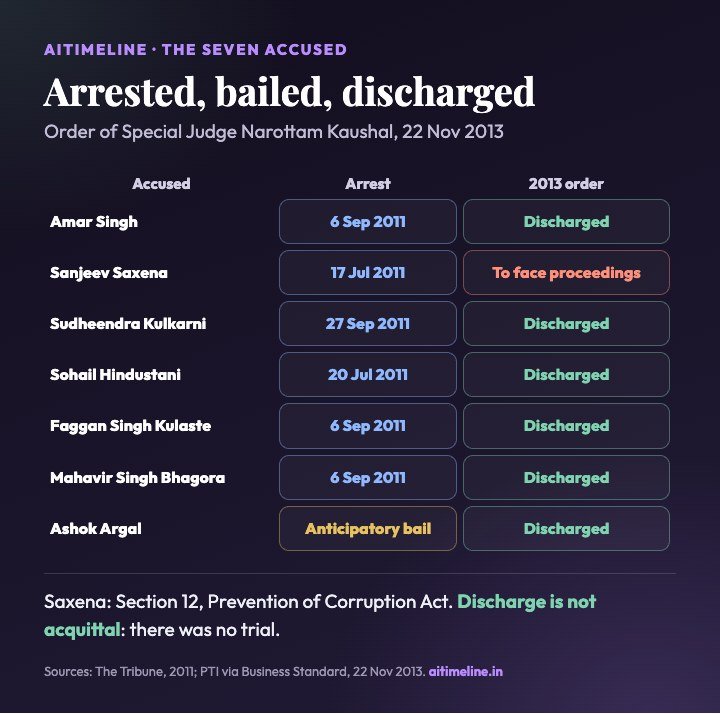
The Seven Accused and What Happened to Each
Arrest, bail and the order of 22 November 2013.
| Accused | Role as alleged | Arrest or bail | 22 Nov 2013 |
|---|---|---|---|
| Amar Singh | Samajwadi Party leader; alleged to have arranged the cash | Arrested 6 Sep 2011; HC bail 24 Oct 2011 | Discharged |
| Sanjeev Saxena | Amar Singh’s aide; alleged to have delivered it | Arrested 17 Jul 2011; HC bail 16 Nov 2011 | Proceedings ordered, Section 12 PC Act |
| Sudheendra Kulkarni | Former Advani aide; called the “mastermind” by police | Arrested 27 Sep 2011; HC bail 16 Nov 2011 | Discharged |
| Sohail Hindustani | BJP youth activist; alleged go-between | Arrested 20 Jul 2011; HC bail 16 Nov 2011 | Discharged |
| Faggan Singh Kulaste | BJP MP who displayed cash | Arrested 6 Sep 2011; HC bail 16 Nov 2011 | Discharged |
| Mahavir Singh Bhagora | BJP MP who displayed cash | Arrested 6 Sep 2011; HC bail 16 Nov 2011 | Discharged |
| Ashok Argal | BJP MP who displayed cash | Anticipatory bail, 16 Nov 2011 | Discharged |
The Parliamentary Inquiry
Seven MPs, seven parties, one recommendation.
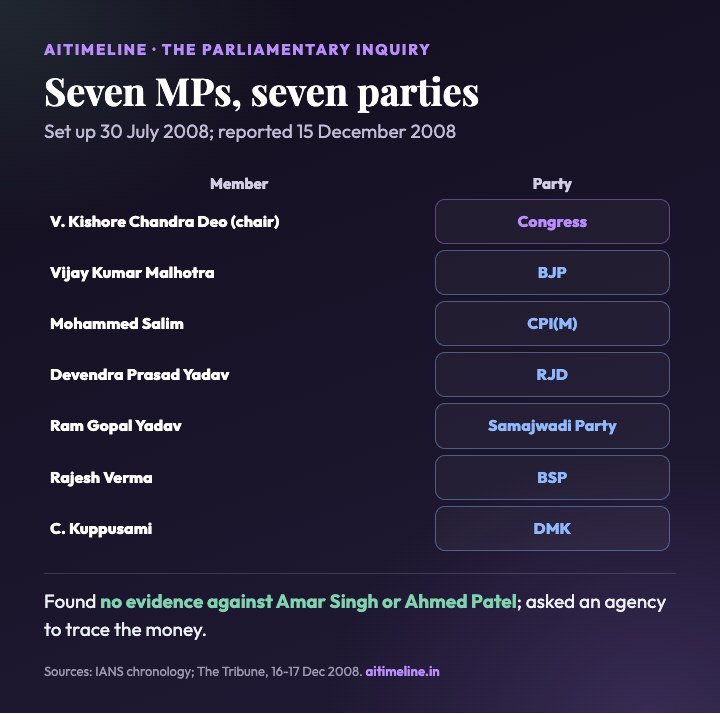
The committee had a narrow brief and no investigative machinery of its own. It examined the MPs, CNN-IBN’s material and the people named, and concluded that the evidence did not show Amar Singh or Ahmed Patel had offered money: video of a car at Singh’s house, it said, did not prove what happened inside. What it did recommend was that a proper agency follow the money and look at the roles of Saxena, Kulkarni and Hindustani. The Speaker sent that recommendation to the Home Ministry on 16 December 2008. Members from some parties recorded dissents, and the BJP rejected the report outright.
What Was Alleged, and What Was Decided
Each source, and the weight it carries.
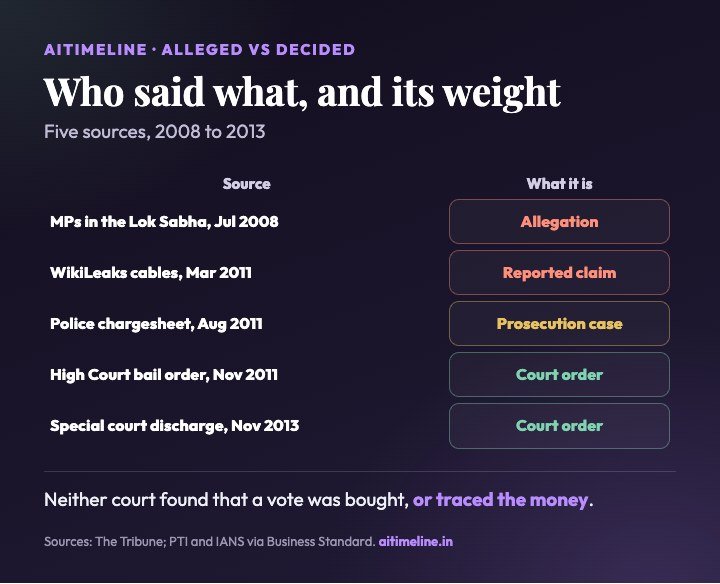
The two courts that looked at the evidence reached the same view from different stages. Granting bail in November 2011, Justice M.L. Mehta said the accused appeared to have taken part in a sting and asked why people who meant to take a bribe would invite a television channel to film it. Two years later Special Judge Narottam Kaushal discharged six accused on the ground that the material did not justify a trial. Neither court found that a bribe had been paid to buy a vote, and neither found that it had not; the question of whose money it was simply went unanswered.
Why the Scandal Still Matters
A sting on horse-trading
- MPs said they were offered money.
- They handed the cash to the Speaker.
- Courts accepted the sting account.
No bribe needed
- Congress said it never needed their votes.
- Committee found no evidence on Amar Singh.
- Amar Singh and Ahmed Patel denied it.
The source
- No court traced the money.
- Arrests came only after the Supreme Court.
- The 2014 appeal plan left no ruling on record.
Six lessons from the case
- Coalition arithmetic: when a government’s survival rests on a handful of MPs, every vote becomes a negotiation, and suspicion follows.
- Parliament’s limits: the House could inquire, but it took no action against any MP and had no power to trace money.
- Investigative delay: the police made no arrest for two and a half years, until the Supreme Court intervened.
- The role of the press: a TV sting and a newspaper’s publication of diplomatic cables kept the case alive.
- Allegation is not proof: a dramatic display in the House did not establish who paid, or whether a bribe was paid at all.
- Discharge is not acquittal: the 2013 order ended the case for six accused before any trial began.
Explore More Timelines
People Also Ask
Frequently Asked Questions
Dated facts from court orders, the chargesheet and contemporary reports, 2008 to 2014.
⚠️ Editorial Note
This account is based on contemporary reporting by The Tribune (the vote of 22 July 2008, the committee report, the chargesheet of 24 August 2011, the arrests and the High Court bail order of 16 November 2011), PTI and IANS via Business Standard (the 22 November 2013 discharge order and a case chronology) and Deccan Herald (the Delhi government’s 2014 appeal plan). Checking the brief this page started from against those records: the chargesheet was filed on 24 August 2011, not 25 August, and the separate “24 August” entry for Amar Singh and Kulkarni describes the same event; the police case began in January 2009; CNN-IBN broadcast its tapes on 12 August 2008, and we could not confirm a 23 July handover or a 25 July joint statement by the MPs, so both were left out; abstentions are reported as 10 in most accounts but two by The Tribune; and the arrests of Amar Singh (6 September 2011) and Kulkarni (27 September 2011) and the bail orders, missing from the brief, were added. Money figures are labelled by source because they are allegations, not findings. This is not legal advice.
Related Reading on AiTimeline
Sources & further reading
Every dated entry above was checked against these references. Last reviewed 6 November 2026.
- Manmohan govt wins trust vote, N-deal can move on (22 July 2008)
- Speaker refers cash-for-vote probe to home ministry (16 December 2008)
- Cash-for-vote scam: Delhi Police chargesheets Amar Singh (24 August 2011)
- Amar Singh arrested in cash-for-vote scam (6 September 2011)
- Cash-for-vote scam: Advani's ex-aide Kulkarni held (27 September 2011)
- Delhi HC grants bail to Kulkarni, 5 others (16 November 2011)
- '08 cash-scam: Amar Singh, Kulkarni, 3 BJP MPs discharged (22 November 2013)
- Timeline of cash-for-vote scam case
- AAP strikes again, govt to reopen cash-for-vote case (6 February 2014)
- Cash-For-Vote Scam: Suhail Hindustani Arrested By Delhi Police (20 July 2011)