Jamia Millia Islamia History: Foundation Day Timeline of Its Rise, Struggles and Growth (1920–2026)
Jamia Millia Islamia history from its 1920 founding at Aligarh to Central University in Delhi: early crises, the move to Okhla, milestones and NIRF 2025.
Latest Story
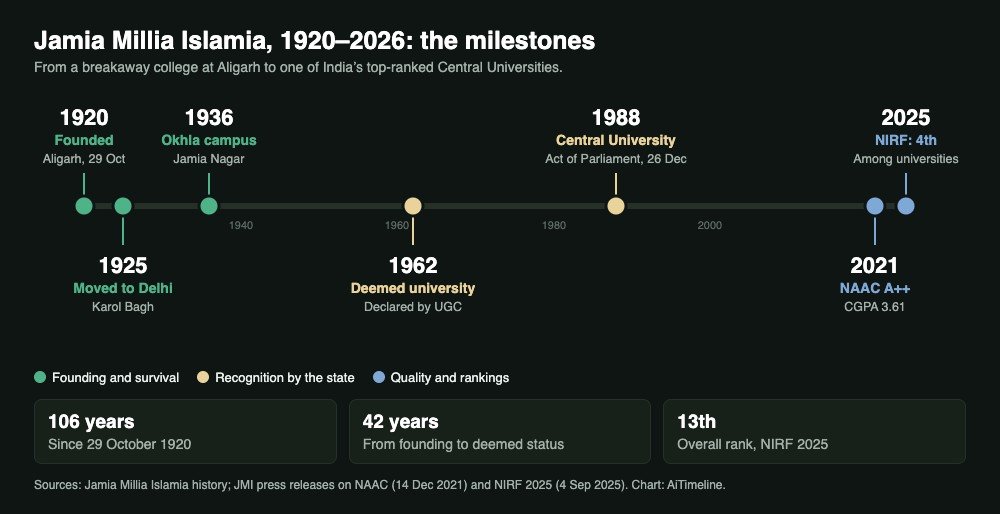
Jamia Millia Islamia’s history begins on 29 October 1920, when teachers and students who had left the college at Aligarh during Gandhi’s Non-Cooperation Movement founded a “national” university of their own. Every year that date is marked as Jamia’s Foundation Day. The name means National Islamic University: Jamia is university, Millia national, and Islamia reflects its Islamic cultural identity. In its first years Jamia nearly closed, moved from Aligarh to Delhi, depended on teachers who worked for capped salaries, and came through Partition. It became a deemed university in 1962 and a Central University by an Act of Parliament in 1988. This timeline runs from the latest events back to its founding.
💡 Short Answer
Jamia Millia Islamia was founded at Aligarh on 29 October 1920, when Maulana Mahmud Hasan laid its foundation stone during the Non-Cooperation Movement. Hakim Ajmal Khan was its first Chancellor and Mohamed Ali Jauhar its first Vice Chancellor. Facing collapse, it moved to Karol Bagh, Delhi in 1925 and to Okhla in 1936. It became a deemed university in 1962 and a Central University in December 1988, and was ranked 4th among Indian universities in NIRF 2025.
Jamia Millia Islamia History: Key Questions
Jamia’s History in Nine Points
- Founded: 29 October 1920 at Aligarh, during the Non-Cooperation Movement.
- First leaders: Hakim Ajmal Khan, Chancellor, and Mohamed Ali Jauhar, Vice Chancellor, from 22 November 1920.
- Near-collapse: the end of Non-Cooperation (1922) and the Caliphate (1924) cut its support.
- Moved: to Karol Bagh, Delhi in 1925, and to its own campus at Okhla in 1936.
- Rebuilt: by Zakir Husain, Vice Chancellor from 1926, and the teachers’ pledge of 1928.
- Partition: the campus was spared, but Maktaba Jamia lost books worth Rs 7 lakh.
- Recognised: deemed university in 1962; Central University in December 1988.
- Today: NAAC A++ (2021) and 4th among universities in NIRF 2025.
- 2026: the 106th Foundation Day came during a student protest; union elections are now promised by August 2027.
Jamia Millia Islamia Timeline, 1920–2026: Latest First
From the 2026 Foundation Day back to the founding at Aligarh. Each entry is tagged and ends with why it matters.
2026
106th Foundation Day amid a students’ union protest Today
Jamia marked its 106th Foundation Day during an 18-day student agitation for the return of an elected students’ union, which has been defunct since 2006. Five students began a hunger strike on 12 October; classes and odd-semester exams were moved online, with an order of 28 October extending online classes to 24 November. Protesters boycotted the official celebrations and held their own “Inquilabi Mela” near Gate 7 (PTI via ThePrint). The university’s Talimi Mela, planned for 29 October to 1 November, was reported called off on safety grounds.
On the evening of 29 October the administration issued a written timeline: the union constitution is to be approved by 15 May 2027, with elections within six weeks of the next academic session, or by the end of August 2027. Disciplinary action against protesters was withdrawn, and the students ended the strike (Scroll).
2025
Fourth among Indian universities in NIRF 2025 Recognition
Jamia ranked 4th in the university category and kept its 13th place overall. It was also 3rd in the new Sustainable Development Goals category, 5th in Architecture and Planning, 8th in Law, 17th in Dental, 20th among research institutions, 24th in Engineering and 28th in Management (JMI press release; NIRF 2025 university list).
The university rank was one place lower than in 2024, when Jamia was 3rd among universities. As of 30 October 2026 the 2026 rankings had not been published, so NIRF 2025 remains the latest edition.
2024
Mazhar Asif becomes the 16th Vice Chancellor People
Prof. Mazhar Asif, a professor at Jawaharlal Nehru University’s School of Languages, took charge as Jamia’s 16th Vice Chancellor for a five-year term (JMI press release). He followed a period under acting Vice Chancellors after Najma Akhtar’s term ended in 2023.
2021
NAAC grade A++ Recognition
In its second accreditation cycle the National Assessment and Accreditation Council gave Jamia its highest grade, A++, with a cumulative grade point average of 3.61 out of 4 (JMI press release). In the previous cycle, in 2015, it had been graded A with 3.09.
2020
Jamia turns 100 Recognition
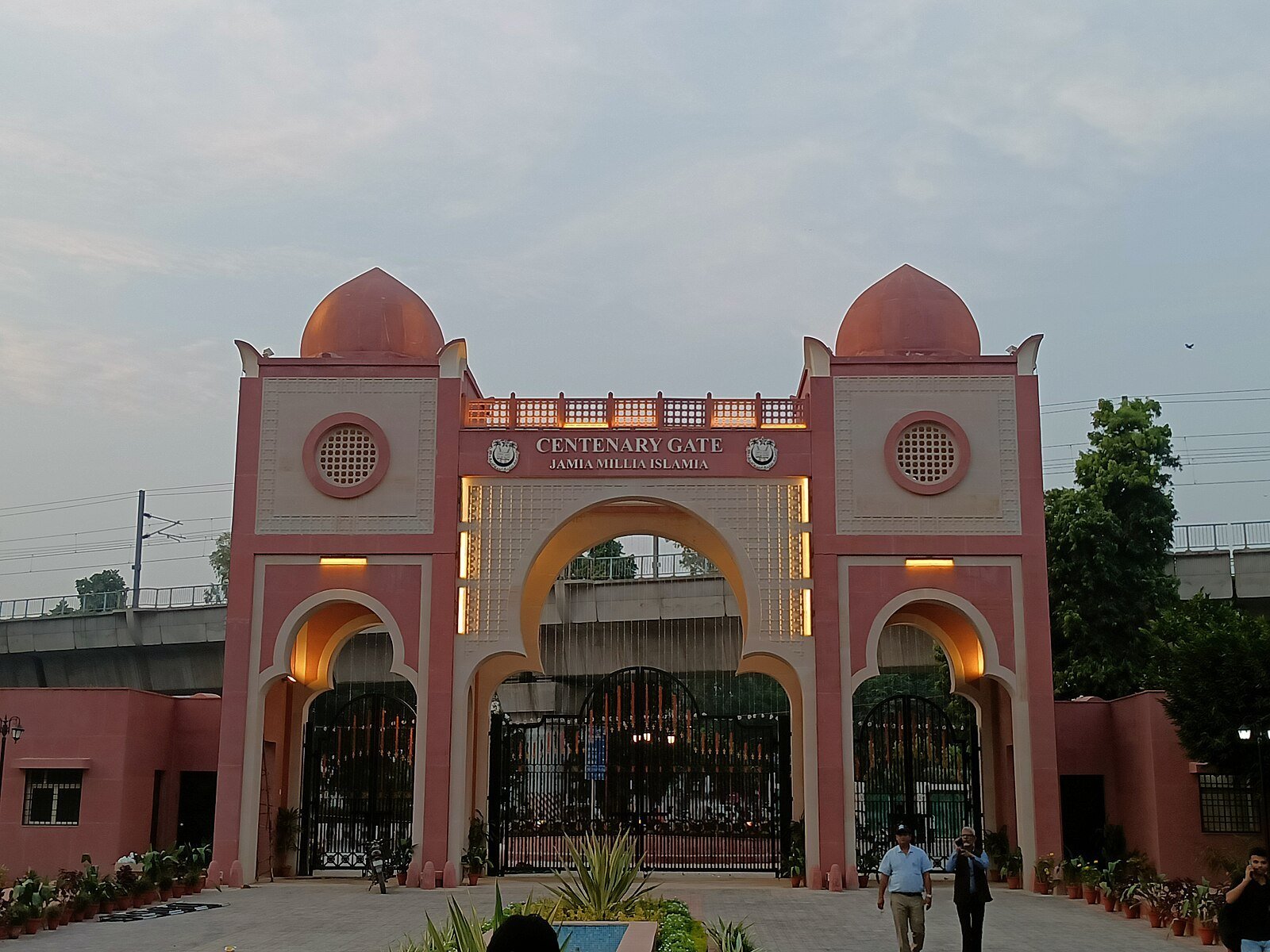
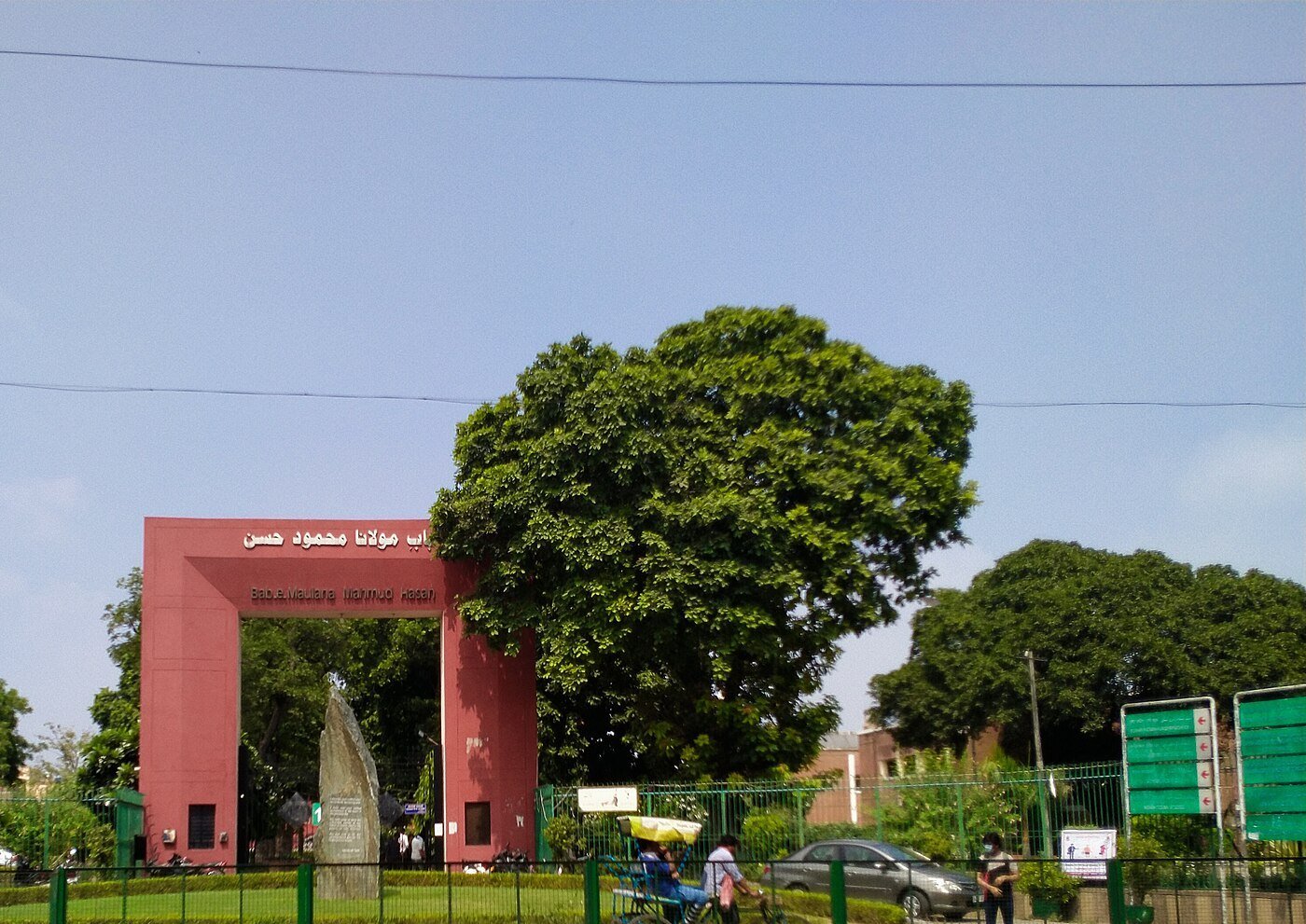
Jamia completed a hundred years on 29 October 2020. With the pandemic limiting gatherings, the university held a scaled-down event and said the centenary celebrations would run for a year (JMI press release). The red-sandstone-coloured Centenary Gate, now one of the campus’s best-known landmarks, marks the milestone.
2019
Police enter the campus during protests against the citizenship law Crisis
During protests against the Citizenship (Amendment) Act, Delhi Police entered the campus, including a library reading room, and a number of students were injured. The university said the police had entered without permission and asked for a judicial inquiry. The National Human Rights Commission later reported on the events; students disputed its findings.
The protests and their aftermath fed into the months of tension in Delhi that preceded the February 2020 riots. See also our timeline of student protests in India.
2019
Najma Akhtar becomes the first woman Vice Chancellor People
Prof. Najma Akhtar took charge as Jamia’s first woman Vice Chancellor in its history (JMI press release). Her term covered the centenary, the A++ accreditation and Jamia’s rise to 3rd among universities in NIRF in 2023 and 2024.
Faculty of Law is added Growth
The Faculty of Law was added the year after Jamia became a Central University (JMI history). It has since become one of the university’s strongest departments, ranked 8th in Law in NIRF 2025.
1988
An Act of Parliament makes Jamia a Central University Recognition
Parliament’s Jamia Millia Islamia Act, 1988 incorporated the university, dissolved the Jamia Millia Islamia Society and transferred its property to the new body; it came into force on 26 December 1988 (Act and Statutes). Jamia’s own history records the change simply as “December 1988” (JMI history).
Central status brought regular funding from the Union government through the University Grants Commission, with the President of India as the university’s Visitor.
Academic Staff College and Academy of Third World Studies Growth
Jamia set up an Academic Staff College in 1987 to train university teachers, and the Academy of Third World Studies in 1988 for research on the developing world (JMI history).
Faculty of Engineering and Technology Growth
The Faculty of Engineering and Technology and the University Computer Centre were set up in 1985 (JMI history), building on the civil engineering degree started in 1978.
Mass Communication Research Centre opens Growth
The Mass Communication Research Centre, later named after Anwar Jamal Kidwai, opened in 1983 alongside the Centre for Coaching and Career Planning (JMI history). The MCRC became widely known for training film-makers, journalists and broadcasters; the coaching centre later developed into a residential academy preparing students for the civil services.
Three new faculties Growth
Jamia founded its faculties of Humanities and Languages, Natural Sciences and Social Sciences, along with a State Resource Centre for adult education (JMI history).
Engineering arrives: BE in Civil Engineering Growth
Jamia began a Bachelor of Engineering degree in Civil Engineering (JMI history), its first step into technical education.
Zakir Husain Institute of Islamic Studies People
Two years after Zakir Husain died in office as President of India on 3 May 1969, Jamia started an institute of Islamic studies in his name (JMI history).
School of Social Work Growth
The School of Social Work was established in 1967 (JMI history), continuing the community and adult education work Jamia had done since the 1920s.
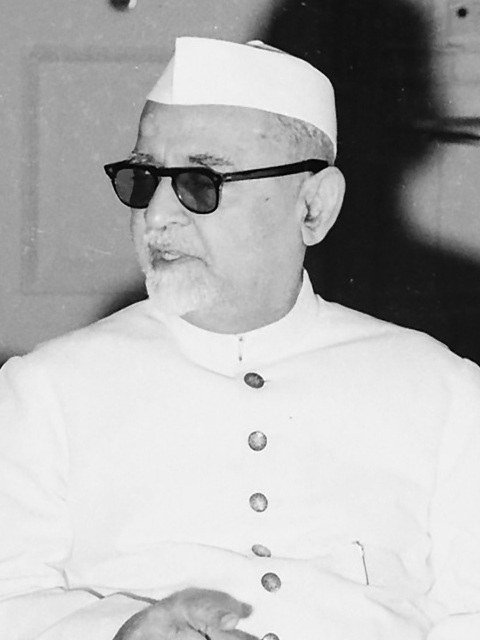
Zakir Husain returns as Chancellor People
Abdul Majeed Khwaja, Chancellor since 1936 and one of the three men who moved Jamia to Delhi, died in 1962. Zakir Husain, by then Vice President of India, became Chancellor in 1963 (JMI history). He became President in 1967 and died in office in 1969.
Deemed-to-be university status Recognition
The University Grants Commission declared Jamia a “deemed to be University” (JMI history), allowing it to award its own degrees with recognition across India.
Partition: violence around Jamia, but not on its campus Crisis
The riots that followed Partition in northern India affected Jamia, though not its Okhla campus. Maktaba Jamia, its publishing house, which was outside the campus, lost books worth about Rs 7 lakh in arson. Gandhi described the campus as “an oasis of peace in the Sahara” of communal violence (JMI history).
Jamia chose to stay in India. For other institutions shaped by the Partition years, see our Anandabazar Patrika timeline.
Silver Jubilee: rival leaders on one stage People
At the delayed silver jubilee, Jamia’s history records Muhammad Ali Jinnah, Fatima Jinnah and Liaquat Ali Khan seated on one side of Zakir Husain, and Jawaharlal Nehru, Asaf Ali and C. Rajagopalachari on the other (JMI history). It was one of the last occasions on which Congress and Muslim League leaders shared a platform before Partition.
A second group of teachers takes the pledge Crisis
A second group of teachers took a pledge similar to the 1928 one, agreeing to serve Jamia for a long period on limited salaries (JMI history).
1939
Jamia is registered as a society Recognition
Jamia Millia Islamia was registered as a society on 4 June 1939, giving it a formal legal structure. The same year Maulana Ubaidullah Sindhi came to Jamia and started the Baitul Hikmah (JMI history).
Teachers’ college and adult education institute Growth
Jamia set up a teacher-training college, the Ustadon ka Madrasa. Its adult education work, which had begun with evening classes, became a separate institution, the Idara-i-Taleem-o-Taraqqi, in October 1938 (JMI history).
Jamia moves to Okhla Growth
Most of Jamia’s institutions moved from Karol Bagh to Okhla in 1936; the press, Maktaba Jamia and library stayed outside the campus for some time. Dr Mukhtar Ahmad Ansari, who had been Chancellor since 1928, died the same year (JMI history).
1935
Foundation stone at Okhla Growth
The foundation stone of a school building was laid at Okhla on 1 March 1935 (JMI history), beginning Jamia’s permanent campus on what was then open land near the Yamuna.
Crisis after Hakim Ajmal Khan’s death, and the teachers’ pledge Crisis
Hakim Ajmal Khan, Jamia’s first Chancellor and main financial backer, died on 29 December 1927, and the institution entered a new crisis in 1928. A group of young teachers led by Zakir Husain pledged to serve Jamia for twenty years on a salary of no more than Rs 150 a month (JMI history). Dr M.A. Ansari became Chancellor.
The same year, the printing and publications department was split into Jamia Press, the Urdu Academy and Maktaba Jamia, which became one of the best-known Urdu publishers.
Zakir Husain becomes Vice Chancellor People
Zakir Husain, who had earned a doctorate in economics at the University of Berlin, became Vice Chancellor in 1926. He was offered Rs 100 a month and later reduced his own salary to Rs 80 (JMI history). He led Jamia until 1948.
The ‘second trio’ sails home from Germany People
Three young scholars who had studied in Germany, Zakir Husain, Abid Husain and Mohammad Mujeeb, decided to serve Jamia and left Germany in early February 1926 aboard the SS Derfflinger (JMI history). Mujeeb later served as Vice Chancellor, and Abid Husain became a noted writer and translator.
From Aligarh to Karol Bagh, Delhi Founding
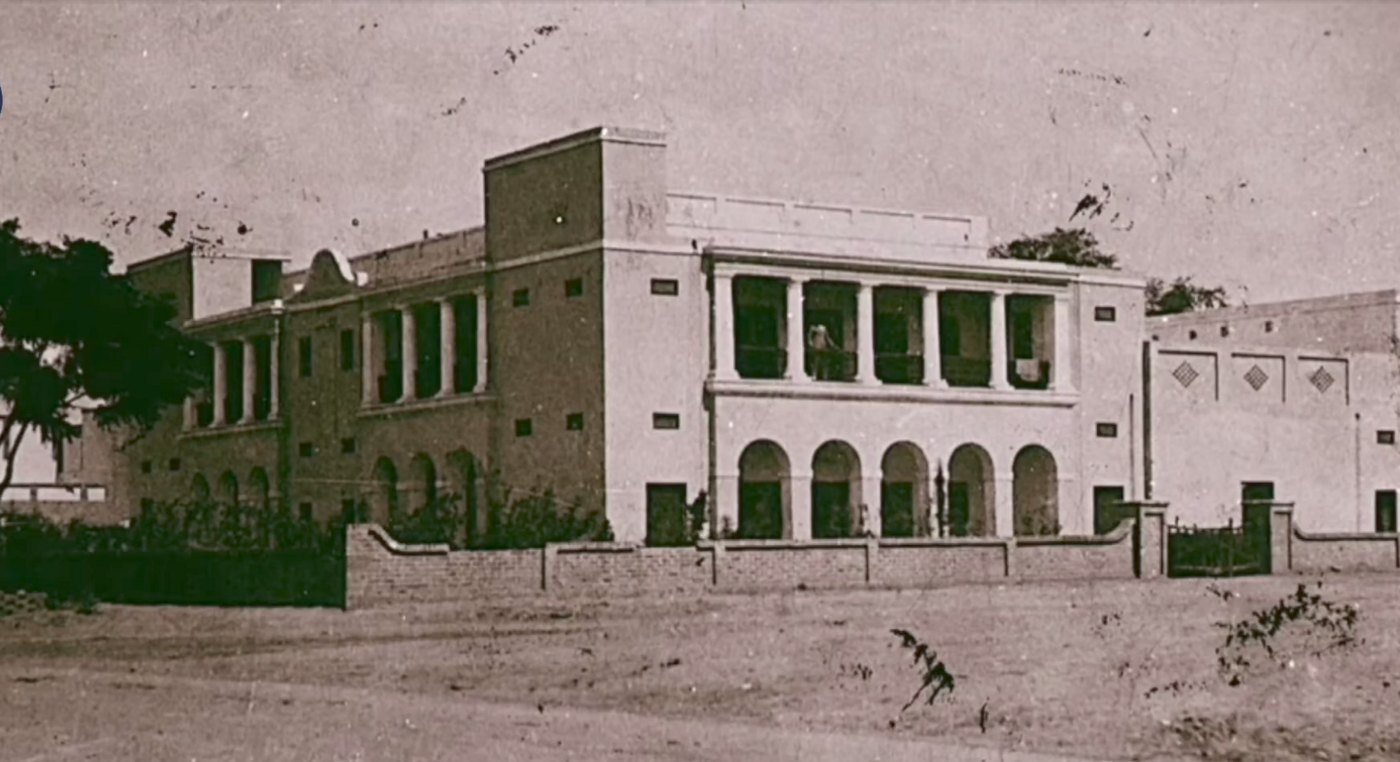
Facing closure, Jamia was moved from Aligarh to rented premises in Karol Bagh, Delhi, by Hakim Ajmal Khan, Dr M.A. Ansari and Abdul Majeed Khwaja (JMI history). Gandhi backed its survival: “The Jamia has to run. If you are worried about its finances, I will go about with a begging bowl,” Jamia’s history quotes him as saying.
1924
The Caliphate is abolished Crisis
Turkey’s Grand National Assembly, under Mustafa Kemal, abolished the Caliphate. The Khilafat Movement in India, which had been allied with Gandhi’s non-cooperation campaign and had helped fund Jamia, lost its purpose, and that support dried up (JMI history).
Gandhi calls off Non-Cooperation Crisis
After a crowd set fire to a police station at Chauri Chaura, killing more than 20 policemen, Gandhi suspended the Non-Cooperation Movement. The campaign that had led students and teachers to leave government-aided colleges in 1920 lost its momentum. Read the full story in our Chauri Chaura and Non-Cooperation timeline.
1920
First Chancellor and Vice Chancellor Founding
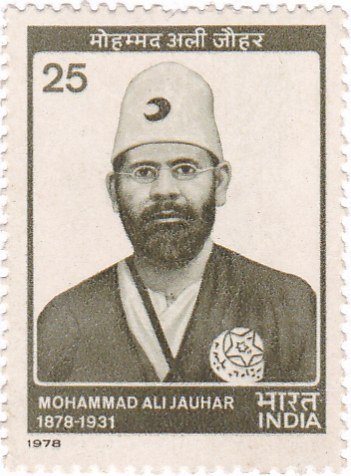
Hakim Ajmal Khan, physician, Congress leader and founder of Delhi’s Tibbia College, was elected Jamia’s first Chancellor, and Maulana Mohamed Ali Jauhar, a leader of the Khilafat Movement and editor of Comrade, became its first Vice Chancellor (JMI history).
1920
Jamia Millia Islamia is founded at Aligarh Founding
Answering Gandhi’s call to boycott government-supported education during the Non-Cooperation Movement, a group of teachers and students left the Muhammadan Anglo-Oriental College at Aligarh. On 29 October 1920 the Foundation Committee met and Shaikhul Hind Maulana Mahmud Hasan laid the foundation stone of Jamia Millia Islamia, the “National Islamic University” (JMI history).
Jamia lists the Foundation Committee’s 18 members, among them Dr Mukhtar Ahmad Ansari, Maulana Abul Kalam Azad, Saifuddin Kitchlew, Abbas Tyabji, Sulaiman Nadvi, Husain Ahmad Madani and Muhammad Iqbal. Zakir Husain, then a student at Aligarh, was among the young people who joined the new institution.
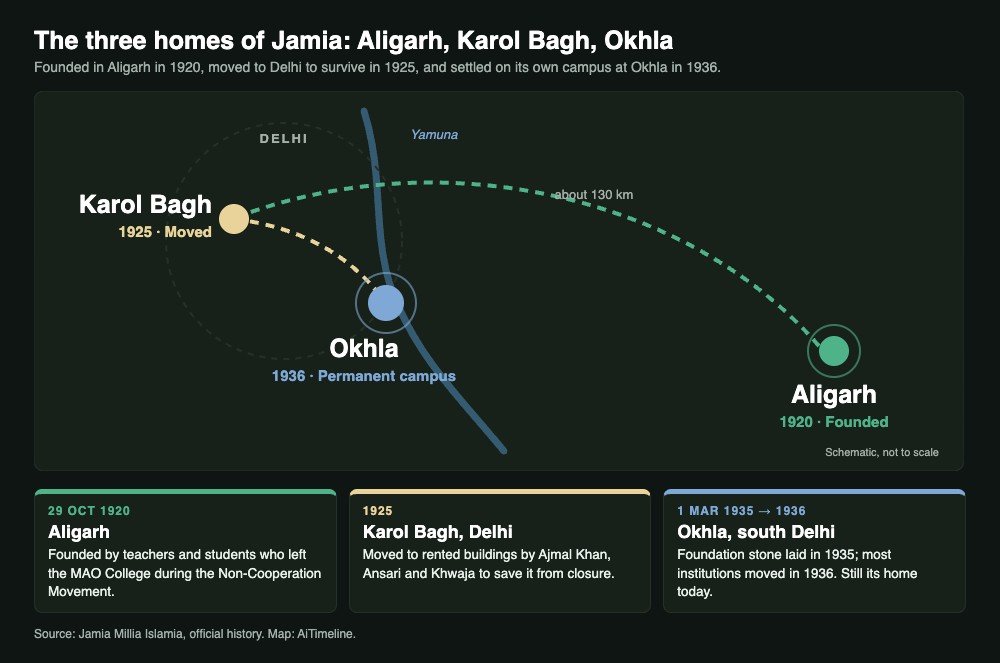
From Aligarh to Karol Bagh to Okhla
How Jamia’s physical home changed as it fought to survive.
Jamia’s first home was Aligarh, where it began in 1920 in temporary premises. In 1925, with closure looming, it moved some 130 km to rented buildings in Karol Bagh, then on Delhi’s western edge. A decade later it began building at Okhla, then a village near the Yamuna south of the city, laying a foundation stone on 1 March 1935; most institutions moved there in 1936. The area around the campus grew into Jamia Nagar.
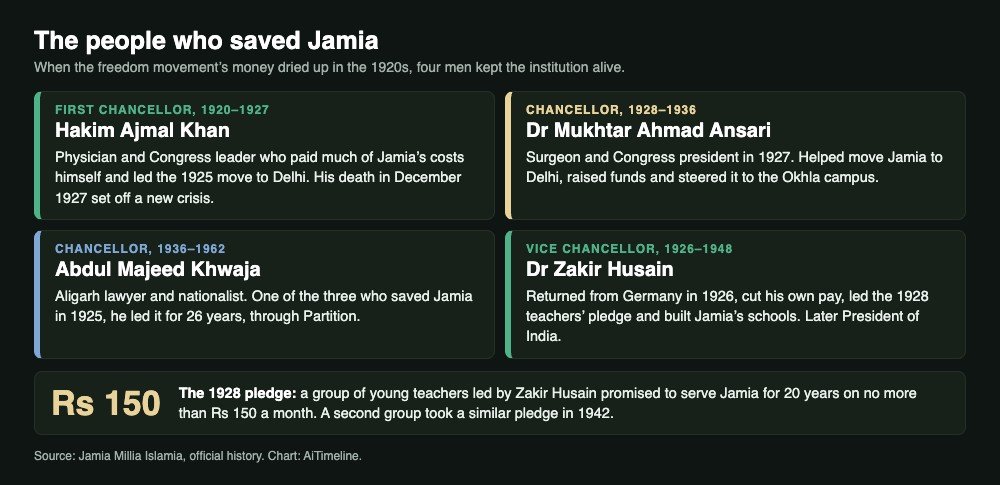
The Founders Who Shaped Jamia
The leaders most closely associated with its founding and survival.
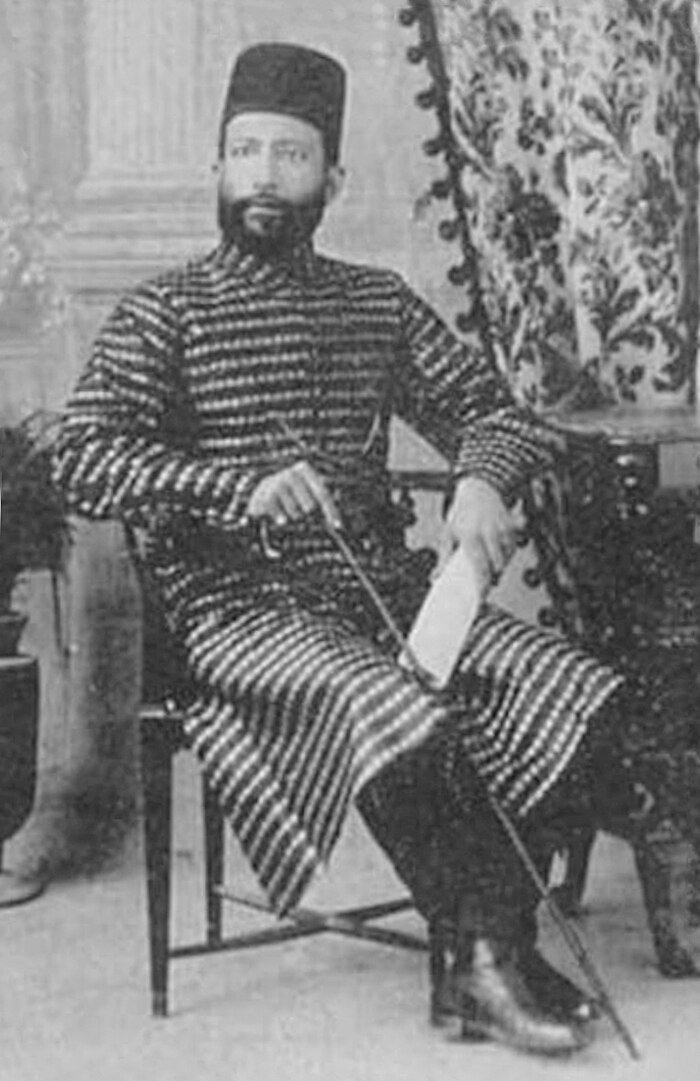
Shaikhul Hind Maulana Mahmud Hasan (1851–1920)
Deoband scholar and anti-colonial leader, recently released from British internment in Malta, who laid the foundation stone on 29 October 1920. He died weeks later, on 30 November 1920.
Maulana Mohamed Ali Jauhar (1878–1931)
Journalist, editor of Comrade and a leader of the Khilafat Movement. He led the break from the Aligarh college and gave Jamia its first leadership.
Hakim Ajmal Khan (1864–1927)
Physician, Congress president in 1921 and founder of Delhi’s Tibbia College. He funded much of Jamia himself and led the move to Delhi.
Dr Mukhtar Ahmad Ansari (1880–1936)
Surgeon and Congress president in 1927, a member of the Foundation Committee, who raised money for Jamia and oversaw the move to Okhla.
Abdul Majeed Khwaja (1885–1962)
Aligarh barrister and nationalist, one of the three men who saved Jamia in 1925 and its Chancellor for 26 years.
Dr Zakir Husain (1897–1969)
Joined as a student in 1920, led Jamia as Vice Chancellor from 1926 to 1948, became Chancellor in 1963 and served as India’s third President from 1967 until his death in 1969.
Jamia’s own history does not use a fixed list of “founders”. It names the 18 members of the Foundation Committee that met on 29 October 1920, including Ansari, Abul Kalam Azad, Saifuddin Kitchlew and Muhammad Iqbal, and records Hakim Ajmal Khan and Mohamed Ali Jauhar as its first Chancellor and Vice Chancellor (JMI history). The six figures above are those most closely associated with its founding and survival.
| Role | Name | Years |
|---|---|---|
| First Chancellor | Hakim Ajmal Khan | 1920–1927 |
| First Vice Chancellor | Maulana Mohamed Ali Jauhar | From 1920 |
| Chancellor | Dr Mukhtar Ahmad Ansari | 1928–1936 |
| Chancellor | Abdul Majeed Khwaja | 1936–1962 |
| Vice Chancellor | Dr Zakir Husain | 1926–1948 |
| Chancellor | Dr Zakir Husain | 1963–1969 |
| First woman Vice Chancellor | Prof. Najma Akhtar | 2019–2023 |
| 16th Vice Chancellor | Prof. Mazhar Asif | From 25 Oct 2024 |
From a Small Institution to a Major University: Five Stages
| Period | Where | Major development |
|---|---|---|
| 1920–1925 | Aligarh | Founded during the Non-Cooperation Movement; lost political and financial support after 1922–24 |
| 1925–1936 | Karol Bagh, Delhi | Moved to survive; Zakir Husain and the teachers’ pledge rebuilt it; Okhla campus begun in 1935 |
| 1936–1962 | Okhla | Teacher training, adult education, registration as a society (1939), Silver Jubilee, Partition |
| 1962–1988 | Okhla | Deemed university (1962); social work, engineering, mass communication and new faculties |
| 1988–2026 | Jamia Nagar, Okhla | Central University; law faculty, NAAC A++ (2021), NIRF 4th among universities (2025) |
Why Does Jamia Millia Islamia’s History Matter?
Jamia’s history is more than the story of a university growing. It shows how an institution founded as a political protest, against British-supported education, survived after the movement behind it faded.
- Education as part of the freedom movement: Jamia was one of several “national” institutions created during Non-Cooperation, alongside the Kashi Vidyapith and Gujarat Vidyapith. Read more in our Chauri Chaura and Non-Cooperation timeline and Gandhi Jayanti history.
- Sacrifice as a funding model: when patrons died and donations dried up, teachers on capped salaries kept it open, twice.
- A composite identity: its founders combined modern education, national identity and Muslim cultural tradition, and it stayed in India in 1947.
- From protest to state recognition: an institution that began by rejecting government aid became a deemed university in 1962 and a Central University in 1988.
- A campus still in the news: from the 2019 police entry to the 2026 union protest, Jamia remains a centre of student politics, as it was in 1920. See our student protests in India timeline.
Explore More Timelines
People Also Ask
Jamia Millia Islamia History: Frequently Asked Questions
A Century of Resilience and Educational Ambition
From a breakaway institution at Aligarh in 1920 to a Central University in Delhi, Jamia Millia Islamia has come a long way. Its history includes financial hardship, two moves, the loss of the patrons who sustained it and the violence of Partition. The commitment of its founders, teachers and supporters carried it through each one.
On its Foundation Day, Jamia’s story is a reminder that institutions are built not only with buildings and money, but with ideas and the willingness of people to work for a shared purpose. More than a century on, the questions of 1920, about education, identity and the right to organise, are still being argued on its campus.
Related AiTimeline Stories
⚠️ Editorial Note
Last updated 30 October 2026. Dates before 1989 follow Jamia Millia Islamia’s official history; rankings and accreditation follow JMI’s press releases and the NIRF portal; 2026 events follow PTI and Scroll reporting. We corrected the source brief in places: Hakim Ajmal Khan died on 29 December 1927, not in 1928 (Jamia’s history dates the resulting crisis to 1928); Jamia was 4th among universities in NIRF 2025 after 3rd in 2024; and Zakir Husain was a student who joined in 1920 rather than one of its senior founders. We added the Foundation Committee members, the 1946 Silver Jubilee seating, Najma Akhtar and Mazhar Asif’s appointments, the December 2019 police entry and the October 2026 students’ union protest. Photos are from Wikimedia Commons under the licences shown; JMI’s own website photographs are not openly licensed, so they are not used here. AiTimeline does not yet have dedicated pages on Zakir Husain or Mohamed Ali Jauhar.
Sources & further reading
Every dated entry above was checked against these references. Last reviewed 30 October 2026.
- Jamia Millia Islamia: Official History
- Jamia Millia Islamia: About JMI
- Jamia Millia Islamia: National Rankings (IQAC)
- NIRF 2025: University Rankings, Ministry of Education
- Jamia Millia Islamia: NIRF 2025 press release, 4 September 2025
- Jamia Millia Islamia: NAAC A++ press release, 14 December 2021
- Jamia Millia Islamia: Act and Statutes (Jamia Millia Islamia Act, 1988)
- Jamia Millia Islamia: University Prospectus 2026-27
- PTI via ThePrint: Protesters mark Jamia Foundation Day with Inquilabi Mela, 29 October 2026
- Scroll: Jamia Millia Islamia agrees to hold student elections after weeks-long protest, October 2026