Parliament Monsoon Session 2026: The Complete Guide to How India Legislates
How Parliament actually works, shown through the Monsoon Session 2026: Question Hour, Zero Hour, committees, and the bills passed and pending by Day 9.
Latest Story
Meera Iyer turned twenty-one in March and cast her first vote in April. On the evening of 20 July, out of something closer to curiosity than duty, she leaves Sansad TV running on her phone while she cooks. She does not follow politics closely, and most of what she hears is unfamiliar the way institutions are unfamiliar to people who have only read about them: a Minister called Jitendra Singh introduces something called a Bill; the Speaker calls for a “voice vote”; someone shouts a point of order; the House is adjourned before eleven in the morning. It looks, for a moment, like noise. It is not. Over the next twenty-five days, the sentences spoken in that chamber will decide how many judges sit on the Supreme Court, what happens to a student whose exam paper leaked, how a small business collects an unpaid invoice, and what counts as an insult to the national anthem. This is the complete, sourced guide to the Parliament of India’s Monsoon Session 2026 — not just what happened on any single day, but how the institution itself works, so a first-time voter watching from her kitchen can follow exactly what it means.
🧠 AI Overview Summary
Parliament’s Monsoon Session 2026 runs 20 July to 13 August, 19 scheduled sittings. It opened amid pressure over Operation Sindoor accountability and the NEET-UG 2026 paper leak, with 28 bills pending and roughly seven government priorities. By Day 9 (30 July), the Rajya Sabha had passed the anti-paper-leak Amendment Bill amid a walkout, while the Lok Sabha separately debated a Bill raising the Supreme Court’s judge count from 34 to 38. Most other priority bills, on income tax, MSME payments, national honour and civil registration, remained introduced or under consideration, not yet passed. A Joint Parliamentary Committee separately finalised its report on the 130th Constitution Amendment Bill.
Who, what, when, where, why and how
Ten things this session shows about how Parliament actually works
- A session is not one story; it is dozens running in parallel. On Day 9 alone, the Rajya Sabha was passing an examination-law amendment while the Lok Sabha separately debated raising the Supreme Court’s judge count — two unrelated constitutional stories in the same hour.
- Most legislative “passage” news is one House’s approval, not enacted law. A bill needs both Houses in identical form, then presidential assent, then Gazette publication, before it has legal force.
- Ordinances create a hidden legislative clock. The Supreme Court Judges Bill exists because an Ordinance issued 16 May 2026 must legally be replaced by an Act within weeks of Parliament reassembling, or it lapses.
- Disruption is itself a form of parliamentary speech. A washed-out Question Hour is a recorded, documented event with its own procedural consequences, not simply an absence of news.
- Committees do real work outside the cameras. A Joint Parliamentary Committee finalised its report on the 130th Constitution Amendment Bill before the session even opened.
- The government sets the agenda; the Opposition sets the pace. Roughly seven bills were flagged as government priorities; how many actually pass depends heavily on floor time surviving disruption.
- Foreign and defence accountability can dominate a session without producing a single new law. Sixteen hours of Lok Sabha time went to debating Operation Sindoor — accountability for a military operation, not a bill.
- A single sitting day is genuinely called a “day” only by convention. Day 9 fell on 30 July, ten calendar days after the session opened on 20 July, because weekends are not sitting days.
- Passage counts are unevenly distributed. As of Day 9, only one of roughly seven priority bills had confirmed passage through both Houses — a normal mid-session ratio, not evidence the session had stalled.
- This session is a case study, not an exception. Disrupted Question Hours, walkouts, and a mix of passed and pending bills are the modal outcome of an Indian parliamentary session.
How Parliament Works: The Constitutional Framework
What Parliament is, why it meets in sessions, and the mechanics behind every headline this page describes.
Parliament of India is bicameral: the Lok Sabha (House of the People), directly elected for a five-year term unless dissolved earlier, and the Rajya Sabha (Council of States), a permanent body that never dissolves, whose members serve staggered six-year terms, roughly a third retiring every two years. Article 79 establishes Parliament as consisting of the President and the two Houses together — the President, though not a sitting member, is constitutionally part of Parliament.
Parliament does not sit continuously. Article 85 requires the gap between two sessions not exceed six months, which is why India holds three sessions a year by settled convention: the Budget Session (February–April), the Monsoon Session (July–August), and the Winter Session (November–December). The President formally summons each session on the Cabinet’s advice; the Ministry of Parliamentary Affairs then coordinates the government’s legislative agenda with the Lok Sabha and Rajya Sabha Secretariats, the permanent administrative bodies running each House’s day-to-day business.
Each sitting day is structured. Question Hour, ordinarily the first hour, is when members put oral and written questions to ministers about government policy and administration — a formal accountability mechanism with published rules on notice and admissibility. Zero Hour, which follows and takes its name from typically starting around noon, has no formal constitutional or rule-book status; it evolved as an informal practice for raising urgent matters without Question Hour’s advance notice. Legislative Business — introducing, debating and passing government bills — is scheduled for the remainder of a sitting, alongside Private Members’ Business, reserved time for bills moved by non-minister MPs, which rarely passes but remains a recognised channel for raising issues.
Underneath floor proceedings sits the committee system: Departmentally Related Standing Committees, permanent bodies of MPs from both Houses that scrutinise a ministry’s budget demands and can examine bills referred to them in detail, away from adversarial floor pressure; and ad hoc Select or Joint Parliamentary Committees, constituted for a specific bill or inquiry and dissolved once their report is submitted. Much of Parliament’s most substantive work — clause-by-clause redrafting, expert testimony, cross-party consensus — happens here, not in the debates that make the news.
Examination integrity, judicial capacity, small-business cash flow, tax policy on foreign investment, and the rules for registering a birth or a death are, on paper, unrelated subjects. What connects them this session is that all required the same constitutional machinery — introduction, debate, passage in both Houses, assent, Gazette notification — to become binding, decided by the same 788 elected and nominated members sitting roughly nine kilometres from where Meera Iyer was cooking dinner on 20 July.
Question Hour and Zero Hour are older, and more contested, than most citizens realise. Question Hour dates to the earliest years of the Central Legislative Assembly under British rule, one of the few pieces of pre-independence parliamentary practice preserved almost unchanged. Zero Hour has no such lineage: it is an Indian innovation of the 1960s, born from journalists’ shorthand for the informal slot that opened around noon once Question Hour ended, and it was never written into the Rules of Procedure the way Question Hour was. That asymmetry has a practical consequence still visible in 2026: a presiding officer has clear rule-book authority to protect Question Hour’s time, however imperfectly exercised, but no equivalent formal obligation for Zero Hour — which is why Zero Hour is very often the first casualty when a sitting runs short or descends into disruption.
🏛 Constitution Insight · Why parliamentary debate remains central to democratic accountability
A Bill’s operative clauses could, in principle, be voted on without a word of floor debate. India’s Parliament does not, by design. Debate creates a public, permanent record of why a law exists, what it was meant to fix, and what objections were raised and left unanswered — a record courts consult when interpreting ambiguous statutory language, and one citizens can consult when judging whether a government kept its word. Mallikarjun Kharge calling an amendment “cosmetic” on the Rajya Sabha floor is not merely theatre; it becomes part of the Rajya Sabha’s official, citable-indefinitely proceedings.
📜 Legislative Insight · Why committee scrutiny improves legislation before implementation
A bill drafted inside a ministry reflects that ministry’s own priorities and blind spots. A Standing or Select Committee, drawing members from every major party and often taking outside expert evidence, exists to catch what a single ministry cannot see on its own. Not every bill gets this scrutiny. The Public Examinations Amendment Bill moved from introduction to passage in three sitting days without committee referral, a fact the Opposition raised as a process objection — a documented opportunity for scrutiny that bill forwent, not proof of worse drafting.
👥 Citizen Insight · How this session reaches a student, a taxpayer, a farmer and a small-business owner
A student sitting NEET-UG or a UPSC exam is affected by the examinations amendment’s penalties and fast-track courts. A foreign portfolio investor, and indirectly anyone whose pension holds Indian government bonds, is affected by the Income Tax (Amendment) Bill’s changes to sovereign-debt taxation. A small manufacturer waiting months for a government buyer to pay an invoice is the intended beneficiary of the MSME Development (Amendment) Bill. A litigant whose appeal has sat in the Supreme Court’s backlog for years is affected by whether that court has 34 judges or 38. None of these constituencies sit in the press gallery, and none appear in most “Day 9” headlines — but all of them are why the session exists.
💻 Technology Insight · How digital tools are changing legislative work itself
Beyond the bills it debates, Parliament has been steadily digitising its own operations: the Digital Sansad initiative has moved bill texts, amendment notices, committee reports and voting records that once existed only on paper into searchable digital form, making it easier to verify what was actually said or voted rather than relying on a single reporter’s paraphrase. This is separate from any single bill’s own technology provisions — the examinations amendment’s references to encryption govern exam security, not Parliament’s internal workings — but both point the same direction: a legislature whose paper trail is increasingly searchable and verifiable.
🏛 Explainer: How a Bill Becomes an Act in India
1. Introduction: a Minister (Government Bill) or any other MP (Private Member’s Bill) introduces the Bill in either House, except that a Money Bill must originate in the Lok Sabha.
2. Committee stage (optional): the presiding officer or House may refer a Bill to a Standing Committee or a specially constituted Select or Joint Committee. Not every Bill is referred.
3. Debate and passage, first House: members debate general principles, move clause-by-clause amendments, then vote by voice vote or a recorded division.
4. Debate and passage, second House: an Ordinary Bill must pass the second House in identical form; a persistent deadlock can, under Article 108, be resolved by a rare joint sitting of both Houses.
5. Presidential assent: under Article 111, the President may assent, withhold assent, or (for a non-Money Bill) return it once for reconsideration.
6. Gazette notification and commencement: only publication in the Official Gazette gives the Act legal force, taking effect immediately, on a fixed date, or on a date the Central Government separately notifies.
Definitions: The Vocabulary of a Parliamentary Session
Fourteen constitutional and procedural terms that recur throughout this page.
Article 79
Establishes Parliament as consisting of the President and the two Houses together.
Article 107
Sets out the general procedure for introduction and passage of Bills in either House.
Article 108
Provides for a joint sitting of both Houses to resolve deadlock on an Ordinary Bill.
Money Bill
Deals exclusively with taxation, borrowing or spending from the Consolidated Fund, certified by the Speaker; the Rajya Sabha can only recommend changes.
Ordinary Bill
Any Bill that is not a Money Bill or Constitution Amendment Bill; requires passage in identical form by both Houses.
Constitution Amendment Bill
Amends the Constitution under Article 368, generally needing a special majority and, for federal-structure provisions, ratification by half the states.
Joint Sitting
A rare combined sitting of both Houses under Article 108, presided over by the Speaker.
Question Hour
The formally defined first hour in which members question ministers on policy and administration.
Zero Hour
An informal practice, no fixed rule-book basis, for raising urgent matters without advance notice.
Calling Attention
A device by which a member draws a minister’s attention to an urgent matter and seeks an authoritative statement.
Voice Vote
The presiding officer judges the outcome from spoken “ayes” and “noes,” without a recorded tally.
Division
A formal, recorded vote used when a voice vote’s outcome is challenged.
Standing Committee
A permanent committee of MPs from both Houses that scrutinises a ministry’s budget and referred bills.
Select / Joint Committee
Constituted for a specific bill or inquiry, joint if it draws members from both Houses, dissolved once its report is submitted.
📊 Session Statistics: Monsoon Session 2026 So Far
- Sitting days elapsed by Day 9: 9 of 19 scheduled — roughly the halfway point by sitting count, though not by calendar, since 14 further calendar days remained to 13 August.
- Confirmed bills passed by both Houses: 1 (the Public Examinations Amendment Bill).
- Bills introduced or listed but not yet confirmed passed: at least 5 (Supreme Court Judges Bill, Income Tax Bill, MSME Bill, Registration of Births and Deaths Bill, Prevention of Insults to National Honour Bill), out of 28 pending overall.
- Major non-legislative debate: 16 hours allocated in the Lok Sabha to Operation Sindoor accountability, alongside a pending privilege motion.
- Documented disruption: Question Hour washed out and Zero Hour curtailed on multiple sitting days, per government and Opposition statements alike.
The Session Timeline: Day by Day
Sixteen milestones, newest first. Each entry separates confirmed proceedings from government statements and Opposition viewpoints.
30 JUL
Three separate constitutional stories unfold in the same sitting
Confirmed proceedings: the Rajya Sabha passed the Public Examinations Amendment Bill by voice vote amid an Opposition walkout, completing Parliament’s approval. The Lok Sabha separately took up the Supreme Court (Number of Judges) Amendment Bill, while the Rajya Sabha’s own agenda also listed the MSME Development (Amendment) Bill.
30 JUL
The MSME Development (Amendment) Bill, 2026 reaches the Rajya Sabha
Confirmed proceedings: the Bill, amending the MSME Development Act, 2006, was listed on the Rajya Sabha’s agenda for 30 July, addressing delayed payments to small businesses, arbitral-award enforcement, and giving states more latitude on implementing regulations.
Editorial caution: being listed confirms scheduling; this page does not assert passage that day unless independently confirmed.
27–29 JUL
The Public Examinations Amendment Bill is introduced and passes the Lok Sabha
Confirmed proceedings: Dr Jitendra Singh introduced the Bill on 27 July; it passed by voice vote on 29 July, with Leader of Opposition Rahul Gandhi speaking in the debate, in direct response to the NEET-UG 2026 leak and cancellation.
Related coverage: AiTimeline’s dedicated timeline on this Bill covers its full legislative history and FAQs; this entry summarises it only in the context of the wider session.
SESSION
Parliament debates Operation Sindoor and a privilege motion is pressed against the Defence Minister
Confirmed proceedings: Parliament allocated substantial floor time, reported at 16 hours in the Lok Sabha, to debate Operation Sindoor, the military operation launched in 2025 following the Pahalgam terror attack that killed 26 people. Opposition members separately pressed for privilege proceedings against Defence Minister Rajnath Singh, alleging he had misled Parliament on casualty figures.
Government position: the government maintained its official casualty accounting. Opposition viewpoint: Opposition parties pressed for a fuller statement from the Prime Minister and greater clarity on the operation’s objectives.
SESSION
Standing Committee reports on food distribution grants are tabled
Confirmed proceedings: DMK MP Kanimozhi Karunanidhi and BJP MP Rao Rajendra Singh presented two reports of the Standing Committee on Consumer Affairs, Food and Public Distribution, on Demands for Grants for 2026–27.
SESSION
Question Hour and Zero Hour are repeatedly disrupted
Confirmed proceedings: sustained sloganeering and protest over the NEET-UG paper leak, student protests, and Operation Sindoor accountability led presiding officers to adjourn both Houses on more than one occasion, with Question Hour washed out and Zero Hour curtailed.
Government statement: Parliamentary Affairs Minister Kiren Rijiju characterised the disruptions as the Opposition prioritising political confrontation over legislative business. Opposition viewpoint: Opposition parties framed the disruptions as a legitimate response to inadequate government answers and debate time.
AGENDA
Two further bills are listed: national symbols and civil registration
Confirmed proceedings: the agenda listed the Prevention of Insults to National Honour (Amendment) Bill, 2026, amending the 1971 Act — including making insult or obstruction of singing Vande Mataram a punishable offence — and the Registration of Births and Deaths (Amendment) Bill, 2026, tightening Section 13(3) of the 1969 Act.
AGENDA
An FCRA amendment bill is also listed among the session’s priorities
Confirmed proceedings: a bill to amend the Foreign Contribution (Regulation) Act was included among roughly seven bills the government hoped to move this session, several addressing what officials termed “legacy laws.”
21 JUL
The Income Tax (Amendment) Bill, 2026 is pushed for introduction
Confirmed proceedings: the government moved to introduce the Bill early in the session, replacing an earlier ordinance and adjusting tax treatment, including exemptions on certain government securities for foreign institutional investors, to strengthen India’s sovereign debt market.
20 JUL
The Monsoon Session opens; the Supreme Court (Number of Judges) Amendment Bill is introduced amid uproar
Confirmed proceedings: the session opened Monday, 20 July 2026. Law Minister Arjun Meghwal introduced the Supreme Court (Number of Judges) Amendment Bill in the Lok Sabha amid opposition uproar; it replaces an Ordinance issued 16 May 2026 and seeks to raise the court’s sanctioned strength from 33 to 37 judges excluding the Chief Justice of India — 34 to 38 including the CJI.
Political context: the opening day was already contentious, with Opposition members raising Operation Sindoor accountability and an electoral-roll dispute alongside the NEET-UG 2026 paper leak.
Ahead of the session, a Joint Parliamentary Committee finalises its report on the 130th Constitution Amendment Bill
Confirmed proceedings: the Joint Parliamentary Committee examining the 130th Constitution Amendment Bill met on 17 July 2026 to finalise and adopt its report, ahead of the Monsoon Session’s opening.
Parliament’s own operations continue digitising alongside the bills it debates
Institutional context, not a confirmed session-specific event: the Digital Sansad initiative — digitised bill texts, amendment notices, committee reports and member devices — continued to underpin how MPs and the public accessed session documents.
What remains: ten further sitting days through 13 August
Expected, not confirmed: as of Day 9, roughly ten further scheduled sitting days remained before the 13 August close, during which the remaining priority bills were expected to be taken up for passage, alongside formal tabling of the JPC’s report on the 130th Constitution Amendment Bill.
WATCH
Session conclusion and what will be tracked once it closes
What this page will track: the session’s formal adjournment sine die, expected on or before 13 August 2026; the Speaker’s and Chairman’s customary closing remarks on sittings, hours lost, and bills passed; the final list of bills receiving presidential assent; and the JPC report’s tabling on the 130th Constitution Amendment Bill.
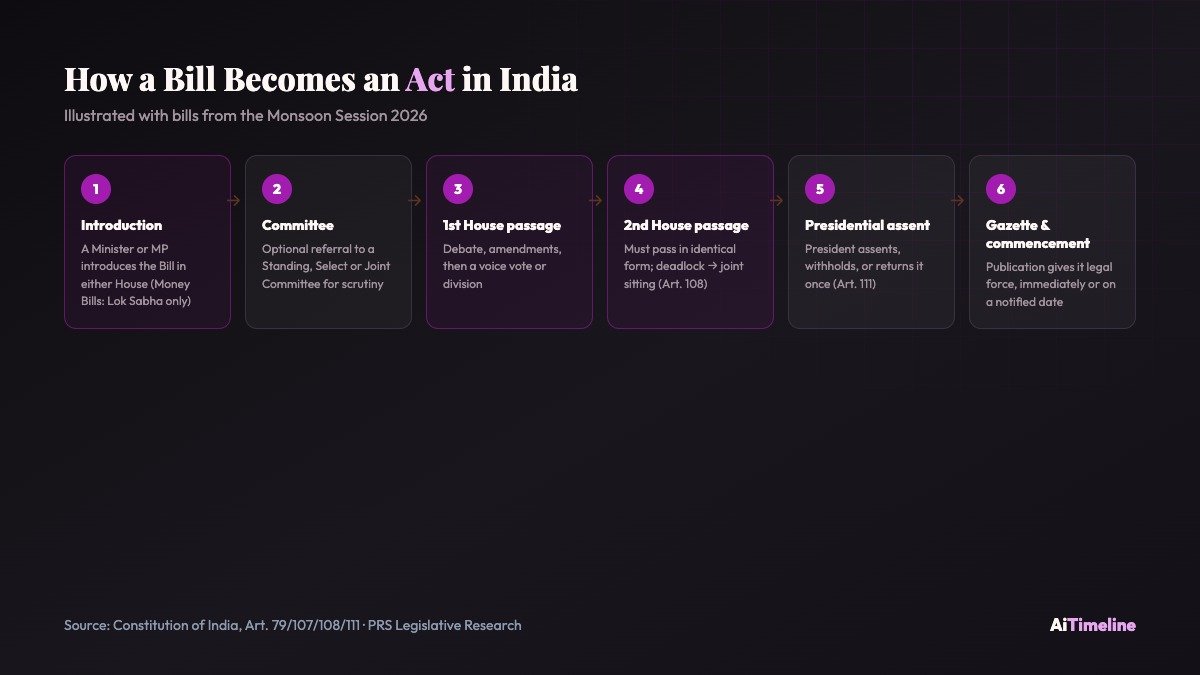
How a Bill Becomes an Act: the six-step constitutional sequence, illustrated with this session’s bills.
Comparison Tables: The Mechanics, Side by Side
Six tables covering the two Houses, the two accountability hours, the major bill categories, and a flat date-by-date summary.
1. Lok Sabha versus Rajya Sabha
| Feature | Lok Sabha | Rajya Sabha |
|---|---|---|
| Full name | House of the People | Council of States |
| How chosen | Directly elected by voters | Elected by state legislators; some nominated |
| Term | Five years, or earlier dissolution | Permanent body; staggered six-year terms |
| Money Bills | Must originate here; final say | Can only recommend changes within 14 days |
| Government formation | Government formed by, answerable to, this House | No role in confidence votes |
| Presiding officer | Speaker | Chairman (the Vice President, ex officio) |
2. Question Hour versus Zero Hour
| Feature | Question Hour | Zero Hour |
|---|---|---|
| Rule-book status | Formally defined | Informal practice, no fixed basis |
| Timing | Ordinarily first hour | Follows immediately, historically around noon |
| Notice required | Advance written notice | Little to none |
| Purpose | Structured questioning of ministers | Raising urgent matters of public importance |
| Vulnerability to disruption | Frequently the first casualty | Often curtailed once already disrupted |
3. Ordinary Bill versus Money Bill
| Feature | Ordinary Bill | Money Bill |
|---|---|---|
| Where introduced | Either House | Only the Lok Sabha |
| Rajya Sabha’s power | Full power to amend or reject | Can only recommend changes |
| Certification | Not applicable | Must be certified by the Speaker |
| Deadlock resolution | Joint sitting under Article 108, if needed | None; Lok Sabha’s decision prevails |
4. Bill versus Act
| Feature | Bill | Act |
|---|---|---|
| Legal status | A proposal, not enforceable | Binding law from its notified commencement |
| Requires | Introduction, usually passage by both Houses | Also presidential assent and Gazette publication |
| Can change | Freely, through amendment during debate | Only through a further amending Act |
| Example this session | MSME Development (Amendment) Bill, as of Day 9 | Public Examinations (Prevention of Unfair Means) Act, 2024, in force |
5. Government Bill versus Private Member’s Bill
| Feature | Government Bill | Private Member’s Bill |
|---|---|---|
| Who introduces it | A Minister | Any non-minister MP |
| Scheduled time | Most sitting days | Reserved time only |
| Likelihood of passage | High, given government majority | Historically very low |
| Example this session | Public Examinations (Prevention of Unfair Means) Amendment Bill | None reached passage by Day 9 |
6. Timeline summary
| Date | Parliamentary event | National significance |
|---|---|---|
| 17 Jul 2026 | JPC finalises report on 130th Constitution Amendment Bill | Major constitutional review completed ahead of session |
| 20 Jul 2026 | Session opens; SC Judges Bill introduced | Begins expansion of the top court’s capacity |
| 21 Jul 2026 | Income Tax (Amendment) Bill pushed for introduction | Affects sovereign-debt taxation |
| Mid-session | 16-hour Operation Sindoor debate; privilege motion | Major defence-accountability episode |
| 27–29 Jul 2026 | Examinations Bill introduced, passes Lok Sabha | Direct response to NEET-UG 2026 leak |
| 30 Jul 2026 (Day 9) | Examinations Bill passes Rajya Sabha; SC Judges and MSME Bills also on agenda | Parliament’s approval of anti-paper-leak law; three threads converge |
| Ahead, to 13 Aug 2026 | Remaining priority bills expected for passage; session closes | Determines the session’s final legislative scorecard |
Was This a Productive Session? Fact Versus Viewpoint
Confirmed proceedings
- 19 sittings scheduled across 25 calendar days.
- 28 bills were pending when the session opened.
- One bill had confirmed passage by both Houses as of Day 9.
- Question Hour was disrupted on multiple documented sitting days.
- 16 hours were allocated in the Lok Sabha to the Operation Sindoor debate.
Contested political framing
- Government: disruptions reflect the Opposition prioritising confrontation over legislative business.
- Opposition: disruptions reflect the government’s unwillingness to give adequate answers or debate time.
- Government: the session’s bill flow shows a focused, prioritised legislative agenda.
- Opposition: fast-tracked bills without committee referral show inadequate scrutiny.
- Neither framing is independently verifiable from the sitting record alone.
💡 Did You Know
- Every Act of Parliament begins as a Bill, and almost every Bill requires passage in identical text by both Houses before presidential assent — the main exception is a Money Bill.
- Question Hour dates to the Central Legislative Assembly under British rule; Zero Hour is a 1960s Indian invention with no equivalent standing in the Rules of Procedure.
- A joint sitting under Article 108 has been used only a handful of times in India’s parliamentary history.
- A walkout removes members from the vote but does not itself stop the remaining House from proceeding to a voice vote or division, as happened with the examinations Bill on Day 9.
Common Misconceptions About Parliamentary Sessions
“A bill passed by one House is now law.”
It is not. An Ordinary Bill needs passage in identical form by both the Lok Sabha and the Rajya Sabha, then presidential assent, then Gazette publication.
“Zero Hour is a formal, rule-book part of Parliament’s schedule.”
It is an informal practice with no fixed basis in the Rules of Procedure, unlike Question Hour.
“Every bill goes through a Parliamentary Standing Committee.”
Referral is discretionary, not mandatory. Several bills this session, including the examinations amendment, passed without it.
“Disruptions mean Parliament did nothing that day.”
A disrupted Question Hour or Zero Hour is itself a recorded event, and legislative and committee work frequently continue the same day.
“The Rajya Sabha can block any bill indefinitely.”
It cannot block a Money Bill beyond a 14-day window, and deadlock on an Ordinary Bill can, in principle, go to a joint sitting under Article 108.
“The Monsoon Session is defined by the Constitution to run July to August.”
No specific dates are constitutionally fixed. Article 85 only requires the gap between sessions not exceed six months; the July–August window is convention.
Who’s Involved: The Institutions Behind This Session
Parliament of India
The bicameral national legislature comprising the President and the two Houses.
Lok Sabha
The directly elected House; government bills, including the Supreme Court Judges Bill, are typically introduced here.
Rajya Sabha
The Council of States, chaired by the Vice President; passed the anti-paper-leak Bill on Day 9.
President of India
Formally summons each session under Article 85 and grants or withholds assent under Article 111.
Ministry of Parliamentary Affairs
Coordinates the government’s legislative agenda and liaises between the Cabinet and both Houses.
Lok Sabha & Rajya Sabha Secretariats
The permanent administrative bodies responsible for each House’s day-to-day functioning and records.
PRS Legislative Research
An independent, non-partisan organisation whose bill summaries and session tracking are widely cited.
Constitution of India
The source of Parliament’s structure and powers, including Articles 79, 85, 107, 108 and 111.
Supreme Court of India
The apex court whose sanctioned judicial strength is the direct subject of one of this session’s bills.
National Testing Agency
Conducts JEE-Main, NEET-UG, UGC-NET and CUET; central to the examinations amendment debated this session.
Explore More Timelines
Why Parliamentary Sessions Matter in a Constitutional Democracy
Strip away the shouting, and the Monsoon Session 2026 did three things every functioning legislature must do. It made law — the anti-paper-leak amendment, confirmed and passed by both Houses. It scrutinised the executive — through Question Hour, however often disrupted, through the Operation Sindoor debate, through a privilege motion that will run its own procedural course. And it represented citizens with no other formal channel into this decision-making — a fixed-rate mortgage, a small-business invoice, a medical-entrance exam, all routed through the same 788 people and the same twenty-five days.
None of that is guaranteed by holding a session on schedule. A Parliament that meets on time but debates nothing would technically satisfy Article 85 while doing almost none of the substantive work Question Hour, Zero Hour, committee scrutiny and a bicameral check were built for. Conversely, a session defined entirely by disruption fails just as completely, even if the House technically sat its scheduled 19 days. The 2026 Monsoon Session sits between those failure modes, as most real sessions do: some bills debated at length, some rushed through without committee referral; some Question Hours conducted in full, others washed out; genuine cross-party committee work on food-distribution grants happening quietly while a privilege motion over Operation Sindoor dominated the visible debate.
What distinguishes a healthy version of that mixture from an unhealthy one is not the absence of disruption, but whether the institution’s other functions keep working underneath it: whether committees still take evidence and file reports even when the cameras are on a walkout; whether the Gazette still gets published, the assent still gets sought, regardless of how loud any single day was. Meaningful legislative outcomes depend on committee review that happens whether or not anyone is watching, on public accountability mechanisms surviving disruption often enough to matter, and on constitutional procedure being followed precisely rather than assumed. Readers who want to track what this session actually produced should consult the official Lok Sabha and Rajya Sabha records, PRS Legislative Research’s session tracking, and the Gazette notifications for each bill discussed here — not any single day’s headline, including this one.
People Also Ask
60 Frequently Asked Questions
Grouped by what Parliament is, how sessions work, procedure, this session’s bills, committees, and disruptions.
Related Timelines on AiTimeline
✉ Editorial note, sources and limitations
Last reviewed: 31 July 2026. Every provision and figure is attributed to the source reporting it. Where a bill’s status is “introduced” or “listed” rather than “passed,” this page says so explicitly. Political statements are reported as statements, not findings of fact.
Primary and near-primary sources used:
- PRS Legislative Research — Monsoon Session 2026, Session Alert
- PRS Legislative Research — The Supreme Court (Number of Judges) Amendment Bill, 2026, bill summary
- PRS Legislative Research — The Public Examinations (Prevention of Unfair Means) Amendment Bill, 2026, bill summary
- Press Information Bureau — Supreme Court (Number of Judges) Amendment Bill press release
- SCC Online — “28 Bills Pending as Parliament’s Monsoon Session Begins,” 20 July 2026
Sources & further reading
Every dated entry above was checked against these references. Last reviewed 15 September 2026.