Windrush Scandal Timeline: Policies, Impact, and Justice
Windrush scandal timeline: from the 1948 arrival and hostile environment checks to wrongful deportations, the Williams review and 2026 compensation reform.
Latest Story
People who had lived legally in Britain for decades were treated as illegal immigrants because they could not produce papers the state had never given them. The Windrush scandal timeline runs from the arrival of HMT Empire Windrush in June 1948, through the Immigration Act 1971 and the “hostile environment” checks introduced from 2012, to the 2018 apologies, the Wendy Williams review and a compensation scheme that had paid £127 million by March 2026 while most closed claims ended with nothing. This page separates what the law granted from what people could prove, and tracks the redress up to October 2026. For another British public inquiry into institutional failure, see AiTimeline’s Grenfell Tower fire timeline.
💡 Short Answer
The Windrush scandal was the wrongful treatment of lawfully settled Commonwealth migrants, mostly from the Caribbean and arriving before 1973, as illegal immigrants because they lacked documents proving their status. Hostile environment checks from 2012 cost some their jobs, homes and healthcare; at least 83 were wrongly deported. Exposed in 2017–18, it led to apologies, a documentation scheme and compensation that is still being decided.
Windrush Scandal: Key Questions
The Windrush Scandal in Nine Points
- Rights, not papers: most of those affected had a lawful right to live in Britain; they lacked documents proving it.
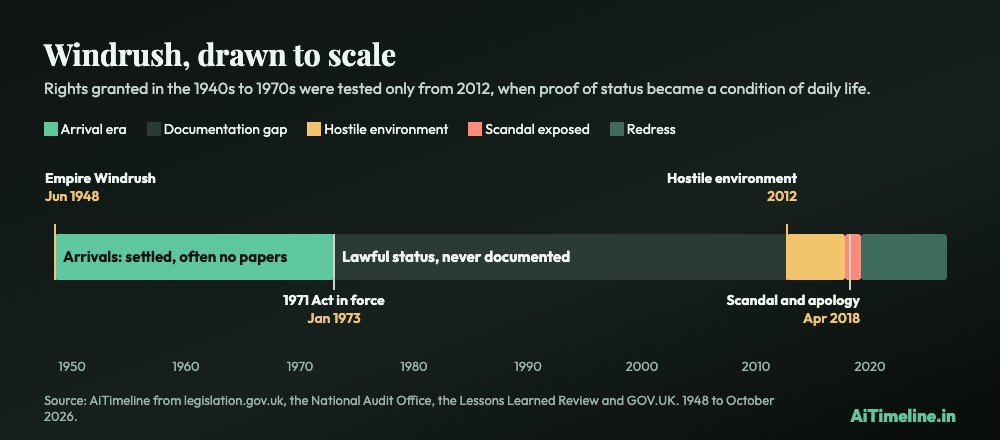
- The roots: the 1971 Act let settled residents stay from 1973 but did not document them.
- The records: arrival landing cards were destroyed in 2010.
- The trigger: hostile environment checks from 2012 and the 2014 Act multiplied demands for proof.
- The harm: lost jobs, homes, benefits and NHS care; 83 wrongful deportations confirmed in 2018.
- The reckoning: apologies in April 2018 and Amber Rudd’s resignation on 29 April.
- The review: Wendy Williams found the scandal foreseeable and avoidable in March 2020.
- The money: £127.09 million paid by March 2026, but most closed claims got nothing.
- The reset: a Windrush Commissioner from 2025 and wider compensation rules from January 2026.
Windrush Scandal Timeline, Latest First
Each entry is tagged by thread and ends with why it matters. Use the filter to isolate the redress, the reviews and court rulings, the scandal, the policies or the roots.
Show only the compensation and documents, the reviews and court rulings, the 2017–18 scandal, the policies behind it, or the post-war roots.
–
2026
The Windrush Commissioner asks for funded legal help for every claimant Redress
Reverend Clive Foster led an open letter asking the Home Office to pay for independent legal advice for compensation applicants, both before a first decision and at review. Co-signatories included 13 parliamentarians, law centres, survivors and public figures (Black Current News).
The letter cites a 10-case study by JUSTICE, the University of Sussex and Dechert in which average awards rose from about £11,400 to £83,200 once claimants had lawyers, while noting the study cannot prove legal help was the only factor. The signatories want a commitment at the Windrush National Organisation conference on 30 October 2026.
2026
A report calls for the scheme to be taken away from the Home Office Reviews and courts
The Black Equity Organisation launched a report at Parliament recommending that compensation be run outside the Home Office, that councils be trained on Windrush cases and that the Right to Rent checks be abolished. It said 66% of applicants are initially refused any payment and that the claim form runs to 44 pages (The Community Reporter). The Commissioner said he “agreed in principle” with moving the scheme but would keep working with the Home Office.
Official data: 11,759 claims, £127 million paid Redress
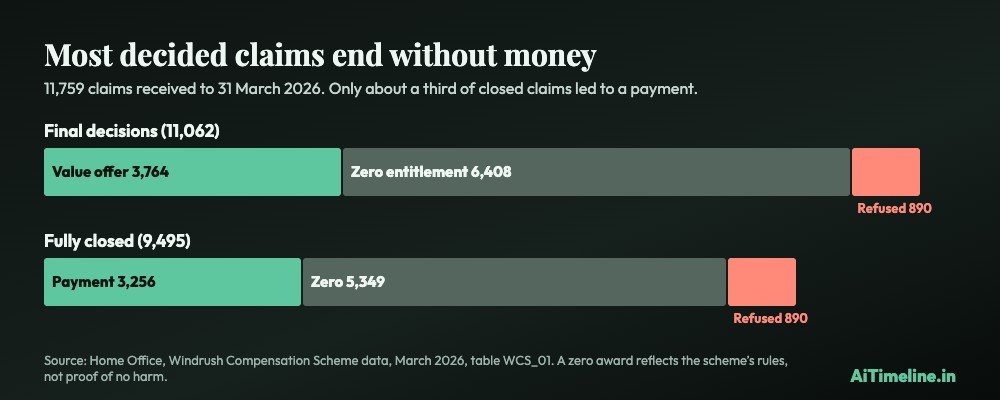
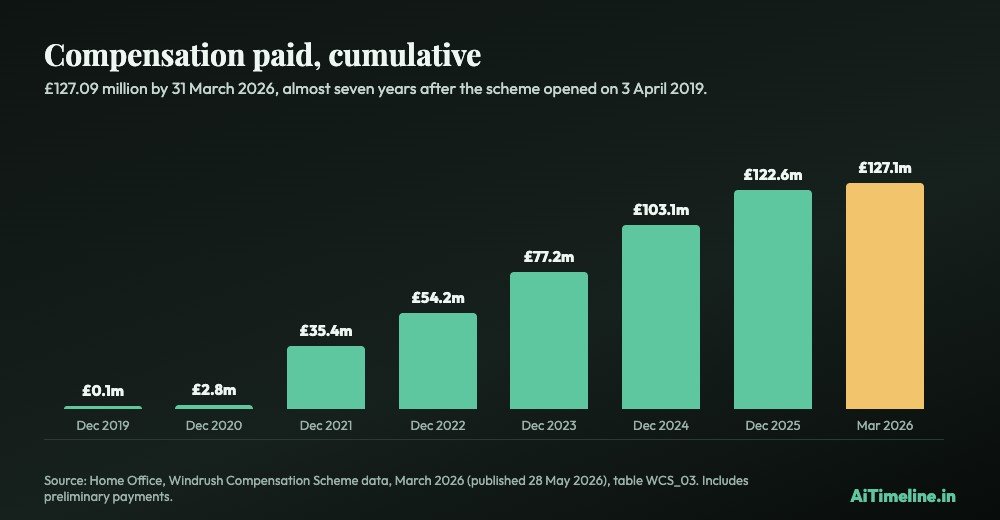
The Home Office’s transparency tables show 11,759 claims received since April 2019 and 11,062 final decisions. Of 9,495 claims fully closed, 3,256 ended with a payment, 5,349 with a zero entitlement and 890 were refused on eligibility. Cumulative payments reached £127.09 million, and 3,978 claims had received some money, including preliminary payments (Home Office data, March 2026). A House of Commons Library briefing (CBP-10852) summarises the scheme and its progress (Commons Library).
2026
Expanded compensation rules come into force Redress
The reforms announced in October 2025 took effect. Claimants challenging a decision can receive up to three-quarters of their expected final award while the review runs; lost workplace and personal pension contributions and pension withdrawals made to cover living costs are now compensable; immigration fees paid by people who could not prove their status are refunded; and the scheme reflects wage inflation and the difficulty of returning to work. Claims from people aged 75 or older are prioritised, alongside those with serious health conditions (GOV.UK).
2025
The government announces a compensation overhaul Redress
Migration minister Mike Tapp announced the package of advance payments, pension compensation, fee refunds and priority handling at the Windrush National Organisation conference (GOV.UK). The government said the changes responded to the Windrush Commissioner’s recommendations.
2025
Clive Foster becomes the first Windrush Commissioner Reviews and courts
Home Secretary Yvette Cooper appointed Reverend Clive Foster MBE, a Nottingham pastor, founder of the Nottingham Windrush Support Forum and vice-chair of the Windrush National Organisation, whose parents came from Jamaica in 1959 (GOV.UK). The role gives independent oversight of the government’s response (Office of the Windrush Commissioner).
2024
New Labour government restores the Windrush Unit and funds advocacy Redress
Yvette Cooper announced £1.5 million to help victims apply for compensation, re-established the Home Office Windrush Unit that the previous government had disbanded in July 2023, and promised a Windrush Commissioner to hold the government to account on the Williams recommendations (GOV.UK).
2024
High Court: dropping two Windrush reforms was unlawful Reviews and courts
Ruling on a judicial review brought by Windrush victim Trevor Donald, the High Court quashed the Home Office’s decision to abandon a Migrants’ Commissioner and a review of the powers of the Independent Chief Inspector of Borders and Immigration. It found indirect discrimination under Article 14 of the European Convention on Human Rights and a failure of the public sector equality duty. The decision to drop reconciliation events was not found unlawful (Public Law Project).
2023
Suella Braverman drops three of the 30 recommendations Reviews and courts
Home Secretary Suella Braverman confirmed the Home Office would not create a Migrants’ Commissioner, would not strengthen the remit of the borders inspector and would not hold reconciliation events, three commitments the department had accepted in 2020 (ITV News). Wendy Williams criticised the decision.
Wendy Williams says progress is too slow Reviews and courts
Williams reported that the Home Office had not yet done enough to show lasting change and that many of her recommendations were not fully met (Wikipedia summary).
MPs call the compensation scheme a further injustice Reviews and courts
The Home Affairs Committee found delays, heavy evidence requirements and low payments, and recorded that 23 claimants had died before receiving compensation (Home Affairs Committee; Wikipedia).
2021
National Audit Office: the scheme was not ready when it launched Reviews and courts
The NAO concluded that the scheme had not met its aim of compensating people quickly, that it had been launched before it was ready and that operational problems had slowed payments (National Audit Office).
2020
Equality watchdog: the Home Office broke equality law Reviews and courts
After a statutory assessment, the EHRC said the Home Office had broken equality law by failing to properly consider the impact of hostile environment policies on Black members of the Windrush generation (Wikipedia).
The Home Office publishes its improvement plan Reviews and courts
Home Secretary Priti Patel accepted all 30 recommendations on 23 June 2020 and on 30 September published a Comprehensive Improvement Plan, including a review of the “compliant environment” and a new community engagement function (GOV.UK).
2020
The Windrush Lessons Learned Review is published Reviews and courts
The independent review found that the scandal was foreseeable and avoidable, that the Home Office showed “institutional ignorance and thoughtlessness” on race and the history of the Windrush generation, and that its culture, policy-making and treatment of people needed deep change (GOV.UK). It made 30 recommendations.
2019
The Windrush Compensation Scheme opens Redress
The scheme began compensating eligible people, and some relatives and estates, for losses caused by being unable to show lawful status: lost work, housing, healthcare, education, detention, removal and the impact on daily life (Commons Library). The Home Office data show 528 claims in its first quarter and payments of just £62,198 by the end of 2019 (Home Office data).
83 wrongful deportations confirmed Scandal
The Home Office confirmed 83 cases in which people had been wrongly deported and said it feared 81 more; at least 11 of those removed had died. By April 2020 it had identified 164 people from Caribbean countries who had been wrongly detained or removed (Wikipedia). The NAO had found in December 2018 that the department had not properly assessed the risk to this group (National Audit Office).
2018
The Windrush Scheme starts issuing documents Redress
A scheme opened to give eligible people free documentation of their status or British citizenship. By the end of March 2024 more than 17,000 people had received documents or citizenship through it (Commons Library).
2018
Amber Rudd resigns as Home Secretary Scandal
Rudd resigned after it emerged that she had been sent information about targets for enforced removals, having told MPs she was unaware of them. Sajid Javid became Home Secretary the same day (Wikipedia).
2018
Apologies, a taskforce and the landing cards Scandal
Amber Rudd apologised for the Home Office’s treatment of the Windrush generation and set up a taskforce to resolve cases. The next day Theresa May apologised to 12 Caribbean heads of government in London for the Commonwealth summit, after first declining a meeting. It was also reported that the Home Office had destroyed the arrival landing cards of Windrush-era migrants in 2010 (Wikipedia).
A man is denied NHS cancer treatment Scandal
The Guardian reported that a Londoner who had lived in Britain for 44 years had been told to pay about £54,000 for radiotherapy because he could not prove his status, and that the prime minister declined to intervene (Wikipedia).
2017
Reports expose long-term residents treated as illegal immigrants Scandal
Journalists, led by Amelia Gentleman at The Guardian, began reporting cases such as Paulette Wilson, who had lived in Britain since childhood and was held in immigration detention (Wikipedia: Paulette Wilson). Others had lost jobs, homes or benefits or been refused re-entry after travelling abroad (Wikipedia). Caribbean governments had raised such cases with the Foreign Office in 2016.
The Immigration Act 2014 builds checks into everyday life Policy
The Act required landlords to check tenants’ status and extended checks into bank accounts, driving licences and NHS charging (legislation.gov.uk). An earlier exemption from removal for long-resident Commonwealth citizens was not carried into it (Wikipedia). The Act did not create every later problem, but it multiplied the moments at which a person had to prove their status.
The “hostile environment” is launched Policy
Theresa May told The Telegraph in 2012 that the aim was “to create here in Britain a really hostile environment for illegal migration”. An inter-ministerial working group pushed checks onto employers, landlords, the NHS and other services, with measures taking effect from October 2012 (Wikipedia; Wikipedia).
Arrival landing cards are destroyed Policy
The Home Office destroyed a store of registry slips recording arrivals, a decision taken in 2009 and implemented in 2010. The loss was revealed in April 2018, when the cards were described as one of the few records that could have helped people prove when they arrived (Wikipedia).
1973
The Immigration Act 1971 takes effect Roots
The Act ended the automatic right of most Commonwealth citizens to settle in Britain. Those already settled were given indefinite leave to remain, but many were never issued any document showing it (legislation.gov.uk; National Audit Office).
First controls on Commonwealth immigration Roots
The 1962 Act introduced the first restrictions on Commonwealth migration, through a work-voucher system, ending years of open entry for citizens of Britain’s colonies and Commonwealth (Wikipedia).
1948
HMT Empire Windrush arrives at Tilbury Roots
The ship brought more than 1,000 passengers to Tilbury, a large share of them from Jamaica and other Caribbean colonies, many recruited or encouraged to fill post-war labour shortages (Wikipedia). The British Nationality Act passed that July made people from the colonies Citizens of the United Kingdom and Colonies. “Windrush generation” now refers to Commonwealth migrants who arrived before 1973, not only those on the ship.
What Caused the Windrush Scandal?
No single law or decision. Six failures combined.
| Cause | What the record shows | Effect |
|---|---|---|
| Status never documented | Settled residents kept indefinite leave when the 1971 Act took effect in 1973, but many were never given papers | Lawful residents could not prove it |
| Records lost or incomplete | Arrival landing cards destroyed in 2010; the Home Office held no complete list of the group | The state could not confirm what it had granted |
| Checks moved into daily life | Hostile environment from 2012; the 2014 and 2016 Acts added checks on renting, work, banking and the NHS | Many more points of refusal |
| Burden of proof on individuals | People were asked for years of evidence, sometimes four documents for each year of residence | Ordinary gaps in paperwork became exclusion |
| Removal targets and culture | Williams found institutional ignorance and thoughtlessness on race; targets for enforced removals existed | Cases were pushed toward removal |
| Warnings not acted on | Caribbean governments raised cases in 2016; the NAO found the risk to this group was not properly assessed | The problem grew before it was admitted |
Rights were granted but not recorded. People who arrived as British subjects, or who were settled when the Immigration Act 1971 took effect on 1 January 1973, kept the right to remain. Many were never issued a document saying so, and many children travelled on a parent’s passport (National Audit Office).
Checks moved into everyday life. From 2012 the hostile environment pushed immigration checks onto employers, landlords, banks and the NHS, and the Immigration Act 2014 put many of them into law (legislation.gov.uk). A person without papers could be refused at each step, whatever their legal position.
The department failed people. The Williams review found the Home Office had shown institutional ignorance and thoughtlessness about race and the history of the Windrush generation, and had not assessed the effect of its policies on them (Lessons Learned Review).
The harm went far beyond paperwork. People lost jobs, homes, benefits and medical treatment; some were detained, removed or left stranded abroad. For how state power can turn on lawful residents elsewhere, see AiTimeline’s far-right rise in Germany timeline.
Legally Entitled vs Able to Prove It
The distinction at the centre of the scandal.
| Legally entitled to remain | Able to prove it | |
|---|---|---|
| What it means | The law gave the person settled status or citizenship | The person holds documents an employer, landlord or official will accept |
| Who decided | Parliament, through the 1948, 1962 and 1971 Acts | The Home Office and, after 2012, every organisation running checks |
| Typical Windrush case | Yes, often since childhood | No: no passport, or only an old one from a parent |
| What went wrong | Nothing changed in law for this group | The demand for proof rose while records stayed missing |
How Did the Government Respond?
Two routes: confirming status, and compensating for harm. Oversight came later.
| Response | Date | What it does |
|---|---|---|
| Windrush Taskforce | Apr 2018 | Urgent help to resolve individual cases |
| Windrush Scheme | 30 May 2018 | Free documents confirming status or citizenship; over 17,000 by March 2024 |
| Windrush Compensation Scheme | 3 Apr 2019 | Pays for losses caused by being unable to prove status |
| Lessons Learned Review | 19 Mar 2020 | 30 recommendations on culture, policy and accountability |
| Comprehensive Improvement Plan | 30 Sep 2020 | Home Office plan to implement the review |
| Advocacy fund and Windrush Unit | 24 Oct 2024 | £1.5 million for claimant support; unit restored |
| Windrush Commissioner | 18 Jun 2025 | Independent oversight, three-year term |
| Scheme reforms | 15 Jan 2026 | Advance payments, pensions, fee refunds, over-75s first |
The existence of a scheme does not mean every affected person has been found, documented or compensated. Three of the 30 Williams recommendations were dropped in January 2023; the High Court quashed that decision for two of them in June 2024 (Public Law Project).
Windrush Compensation: What the Latest Figures Show
Home Office transparency data to 31 March 2026, published 28 May 2026.
| Measure (to 31 March 2026) | Figure |
|---|---|
| Claims received since April 2019 | 11,759 |
| Final decisions | 11,062 |
| Claims fully closed | 9,495 |
| Closed with a payment | 3,256 |
| Closed with zero entitlement | 5,349 |
| Refused on eligibility | 890 |
| Claims that received any payment (incl. preliminary) | 3,978 |
| Cumulative amount paid | £127.09 million |
| Claims still in progress | 566 |
Read the figures with care. A fully closed claim is not the same as a paid claim, and a zero award reflects the scheme’s eligibility and evidence rules rather than proof that a person was unaffected (Home Office data). The Home Office says its figures come from a live system and can change.
Money cannot measure everything. Compensation can cover defined losses, but not years of family separation, disrupted retirements or the sense of belonging the scandal damaged. The Black Equity Organisation’s June 2026 report and the Commissioner’s September 2026 letter both argue that claimants need independent legal help to get fair outcomes (The Community Reporter; Black Current News).
What Justice Means for the Windrush Generation
Justice involves more than an apology or a payment. It means recognising lawful status, resolving each case, treating claimants fairly and changing how the Home Office makes policy and keeps records.
The 2025–26 reforms address long-standing complaints about delay, pension losses and the burden on people challenging decisions, and the Commissioner gives affected communities a formal voice (GOV.UK; GOV.UK). The test is whether outcomes become timely and fair for a generation now mostly in old age. AiTimeline’s Berlin Airlift history covers the same post-war years in which the Windrush passengers arrived.
Who Is in the Story
The Windrush generation
Commonwealth migrants who arrived before 1973 and their children; the people wrongly treated.
The Home Office
Ran the immigration checks and removals, and still runs the documentation and compensation schemes.
Wendy Williams
Led the independent Lessons Learned Review published in March 2020.
Rev. Clive Foster MBE
First Windrush Commissioner, appointed June 2025 for three years.
Amelia Gentleman
The Guardian reporter whose 2017–18 stories brought individual cases to national attention.
May, Rudd, Javid, Patel, Braverman, Cooper
From the 2012 hostile environment to the 2024–25 reset, each shaped the policy or the response.
Trevor Donald
Brought the 2024 High Court case over the dropped recommendations.
NAO, EHRC, Home Affairs Committee
Audited, investigated and criticised the department and the compensation scheme.
Common Assumptions vs the Record
| Common assumption | What the record shows |
|---|---|
| Everyone affected came on the Empire Windrush | The ship is a symbol. Those affected arrived at any time before 1973, many as children, and not only from the Caribbean |
| They were illegal immigrants | Most had a lawful right to remain or were British; what they lacked was documentary proof |
| Everyone affected was deported | Most lost jobs, housing, benefits or healthcare; 83 wrongful deportations were confirmed in 2018, and 164 detentions or removals by 2020 |
| The scandal was one bad law | It came from decades of missing records combined with checks introduced from 2012 onward |
| A zero award means the person was not harmed | It means the scheme’s rules did not support a payment; campaigners dispute how those rules work |
| Compensation has settled it | Claims are still being decided, and the Commissioner is pressing for funded legal help in 2026 |
Explore More Timelines
People Also Ask
Frequently Asked Questions
Related AiTimeline Stories
⚠️ Editorial Note
Last updated 23 October 2026. This page distinguishes the historical Windrush generation from the wider group affected by the scandal: not everyone affected arrived on HMT Empire Windrush, and not every case involved deportation. Being legally entitled to remain and being able to prove it are treated separately throughout. Compensation figures are taken directly from the Home Office’s March 2026 transparency tables (published 28 May 2026), which match the draft brief’s figures, and are not a measure of the scandal’s full human cost. Added to the brief: the 1962 Act, the 2010 landing-card destruction, the March 2018 cancer-treatment case, the Windrush Scheme launch, the 2018 deportation figures, the 2020 improvement plan and EHRC finding, the 2022 progress review, the January 2023 dropped recommendations and the June 2024 High Court ruling, the June 2026 Black Equity Organisation report and the September 2026 open letter. The government’s response to that letter, sought for 30 October 2026, was not known at the time of writing.
Sources & further reading
Every dated entry above was checked against these references. Last reviewed 24 October 2026.
- Home Office: Windrush Compensation Scheme data, March 2026 (published 28 May 2026)
- House of Commons Library: Windrush Compensation Scheme (CBP-10852, 2026)
- GOV.UK: Greater and faster compensation for Windrush victims (15 Jan 2026)
- GOV.UK: Windrush Compensation Scheme overhaul to deliver faster justice (24 Oct 2025)
- GOV.UK: Reverend Clive Foster appointed as first Windrush Commissioner (18 Jun 2025)
- GOV.UK: Home Secretary launches new support for Windrush victims (24 Oct 2024)
- House of Commons Library: The government's response to the Windrush scandal (CBP-8779, Sep 2024)
- GOV.UK: Windrush Lessons Learned Review, Wendy Williams (19 Mar 2020)
- GOV.UK: Windrush Lessons Learned Review response, Comprehensive Improvement Plan (30 Sep 2020)
- National Audit Office: Investigation into the Windrush Compensation Scheme (May 2021)
- National Audit Office: Handling of the Windrush situation (Dec 2018)
- House of Commons Home Affairs Committee: The Windrush Compensation Scheme (Nov 2021)
- Public Law Project: Home Office acted unlawfully by dropping Windrush recommendations (19 Jun 2024)
- ITV News: Home Secretary rows back on Windrush reforms (26 Jan 2023)
- The Community Reporter: Black Equity Organisation report and the Windrush Commissioner (9 Jun 2026)
- Black Current News: Open letter calling for funded legal support (6 Oct 2026)
- legislation.gov.uk: Immigration Act 2014
- legislation.gov.uk: Immigration Act 1971
- Office of the Windrush Commissioner
- Wikipedia: Windrush scandal
- Wikipedia: HMT Empire Windrush