India’s Farmers’ Protest: The 378-Day Fight That Repealed 3 Farm Laws
India's farmers' protest timeline: the three farm laws, the MSP dispute, Republic Day clashes, the Supreme Court stay and the 2021 repeal by Parliament.
Latest Story
India’s farmers’ protest began as opposition to three agricultural laws of 2020. The government presented them as a way to widen farmers’ choices, encourage private investment and open more routes to market. Many farmers, particularly in Punjab and Haryana, feared they could weaken the APMC mandi system and the practical security of minimum support price (MSP) procurement, and leave them dependent on large buyers. Farmers reached the capital’s borders in November 2020 and stayed through a year of talks that failed. The Supreme Court stayed the laws in January 2021, but it was Parliament that repealed them, on 29 November 2021. This page keeps government rationale, protest claims, court steps and counts apart. For related stories, see India’s Green Revolution on how MSP and procurement began, India’s food security schemes, how Parliament legislates and the 1975 Emergency, which the protesters invoked.
Tap a stage. The key event is the repeal by Parliament, not a court ruling.
Choose a stage above.
💡 Short Answer
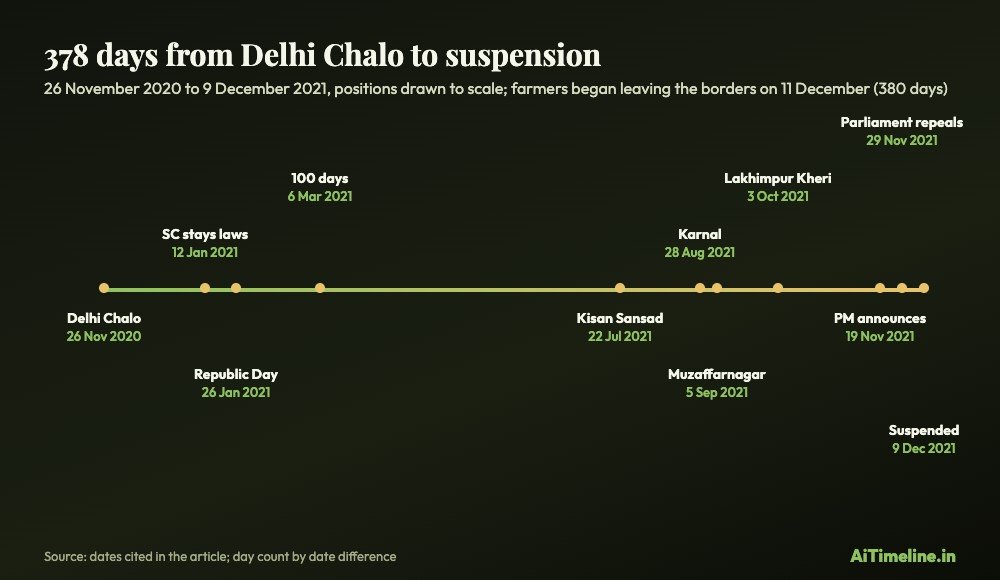
Parliament passed three farm Acts in September 2020. Farmers camped at Delhi’s borders from 26 November 2020, talks failed, and the Supreme Court stayed the laws on 12 January 2021 without ruling on them. The Prime Minister announced withdrawal on 19 November 2021, and Parliament repealed the laws on 29 November. The farmers suspended the protest on 9 December, after 378 days.
India’s Farmers’ Protest: Key Questions
The Farmers’ Protest in Ten Points
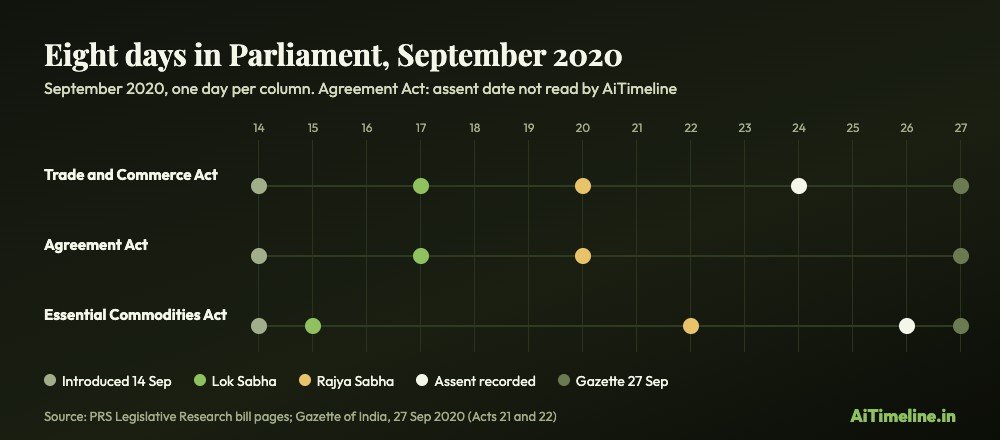
- The start: three ordinances on 5 June 2020, replaced by Acts passed between 15 and 22 September 2020.
- The Acts: Nos. 20, 21 and 22 of 2020, with assent recorded on 24 and 26 September for two of them and the Gazette dated 27 September.
- The march: farmers reached Delhi’s borders on 25 and 26 November 2020.
- The talks: eleven rounds, ending in deadlock on 22 January 2021 after a suspension offer.
- The court: the Supreme Court stayed the laws on 12 January 2021, an interim order and not a ruling on validity.
- Republic Day: a permitted tractor parade turned violent in parts of Delhi, and one farmer died near ITO.
- The repeal: announced 19 November 2021, passed by both Houses on 29 November, assent on 30 November.
- The end: the SKM suspended the protest on 9 December 2021, 378 days after 26 November 2020.
- The open question: no statutory MSP guarantee; an MSP committee was notified in July 2022, and talks with other farmer groups were still going in 2025.
- The caution: death counts, case withdrawals and compensation could not be verified.
How the Protest Unfolded: The Timeline, Latest First
Each entry is tagged as Parliament or government, protest on the ground, talks or settlement, court step, or aftermath, and ends with why it matters.
Who did what? Filter the timeline by Parliament or government, protest, talks, court steps, and aftermath.
–
Talks resume, then police clear the Punjab border camps Aftermath and counts
Union ministers held three rounds of talks with the protesting farmer groups in Chandigarh, on 14 February, 22 February and 19 March 2025. Agriculture Minister Shivraj Singh Chouhan led the central side, with Pralhad Joshi and, in March, Piyush Goyal; Punjab minister Gurmeet Singh Khudian and farmer leader Jagjit Singh Dallewal attended. Chouhan called the 19 March talks constructive and set a next round for 4 May (All India Radio). The unions kept pressing for a legal MSP guarantee.
On 19 and 20 March, after the talks, Punjab Police detained farmer leaders including Dallewal, removed the camps and vehicles at Shambhu and Khanauri, and Haryana removed its barricades, reopening the highway after about 13 months (All India Radio). Dallewal had been on a hunger strike since 26 November 2024; the Punjab government told the Supreme Court on 28 March that he had broken his fast (LiveLaw), while other reports date the formal end to a mahapanchayat in early April (Deccan Chronicle). AiTimeline did not verify the outcome of the May talks.
The Supreme Court sets up a committee for the Shambhu standoff Court step
Hearing Haryana’s challenge to a High Court order to remove its blockade at the Shambhu border, a bench of Justices Surya Kant and Ujjal Bhuyan on 2 September 2024 set up a five-member committee headed by former Punjab and Haryana High Court judge Nawab Singh to talk to the protesting farmers. It asked the panel to persuade farmers to move tractors and trolleys off the national highway, and said the protest should not be politicised (LiveLaw, The Wire).
The farmers’ listed demands included a legal MSP guarantee, the Swaminathan Commission’s recommendations, pensions, a debt waiver and compensation for families of farmers who died in 2020-21. The committee was a mediation route, not a ruling on the demands.
Farmers march again for a legal MSP guarantee Aftermath and counts
On 13 February 2024 farmers under the banner of Samyukta Kisan Morcha (Non-Political) and the Kisan Mazdoor Morcha began a new “Delhi Chalo” march and were stopped at the Punjab-Haryana border points of Shambhu and Khanauri. Their demands included a legal guarantee for the minimum support price and a farm-loan waiver (Deccan Herald). On 18 February a panel of Union ministers offered to have government agencies buy pulses, maize and cotton at MSP for five years; the farmer leaders rejected the offer.
On 21 February a 21-year-old protester, Shubhkaran Singh, died at Khanauri. Haryana police said protesters attacked security personnel with stones and sticks, while farmers said rubber bullets were fired; the Samyukta Kisan Morcha blamed the Centre (Scroll). Punjab Police registered a murder case about a week later, and on 7 March 2024 the Punjab and Haryana High Court ordered a judicial probe into his death (PTI via Udayavani). AiTimeline did not verify the outcome.
Keep it separate: the 2024 march was called by different groups. The Samyukt Kisan Morcha that led the 2020-21 protest was not part of the call, though it extended support.
The government notifies a committee on MSP and natural farming Aftermath and counts
The Agriculture Ministry’s gazette notification of 12 July 2022 named Sanjay Agrawal, a former Agriculture Secretary, as chairman of the committee the Prime Minister had announced in November 2021. It was to promote zero-budget farming, change crop patterns and make MSP “more effective and transparent”. News reports of its formation appeared on 18 and 19 July (Down To Earth, The Quint).
The notification reserved three seats for the Samyukt Kisan Morcha, marked “names to be added”. The SKM rejected the panel, saying farmer leaders who had backed the laws had been named to it (The Wire). In the sources AiTimeline checked, no statutory MSP guarantee had been enacted.
2022
A committee member releases the Supreme Court panel’s report Court step
Anil Ghanwat, a member of the four-person committee, released its report on 21 March 2022, saying he had written to the Supreme Court three times without a response. The report says the committee could interact directly with 73 farmer organisations: 61, representing more than 3 crore farmers, supported the laws; 4, representing 51 lakh farmers, opposed them; and 7 supported them with changes (Verdictum). The report gives the share as 85.7 percent; 61 of 73 works out to about 84 percent.
The committee was against total repeal. It suggested letting states make MSP legal, leaving procurement at a specified price to the states and ending open-ended procurement, scrapping the Essential Commodities Act and drafting a model contract agreement (The Tribune). The SKM called the report “fake, plain bogus and trashy”, and Yogendra Yadav said most of its online responses came from non-farmers (The Tribune). The unions leading the protest had not taken part in its sessions.
Read it with care: these are the committee’s own findings from the groups that chose to meet it. They are not a survey of all farmers, and they came after Parliament had already repealed the laws.
2021
The farmers suspend the agitation after a letter from the Centre Talks or settlement
The Samyukt Kisan Morcha, an umbrella of about 40 unions, decided on 9 December 2021 to suspend the movement after receiving a letter from the Centre. The letter, from Agriculture Secretary Sanjay Agrawal, said a committee on MSP would include officials, farmer representatives, including from the SKM, and agriculture scientists, and that the status quo on MSP procurement would continue. It said Uttar Pradesh, Madhya Pradesh, Uttarakhand, Himachal Pradesh and Haryana had agreed to withdraw cases against protesters, and that Haryana and Uttar Pradesh had given in-principle approval to compensation for families of farmers who died (Down To Earth).
Farmers began leaving the Delhi borders from 11 December. Counting by date, 26 November 2020 to 9 December 2021 is 378 days; to 11 December it is 380, so the “length of the protest” depends on the end date you choose (The Indian Express). In January 2022 the SKM said the promises had not been kept (Down To Earth); AiTimeline did not verify how many cases were later withdrawn.
2021
The government says it has no record of protest deaths Aftermath and counts
In a written reply, Agriculture Minister Narendra Singh Tomar told the Lok Sabha that the ministry had “no record” of farmers who died during the protests, so the question of compensation “does not arise” (The Week; The Wire dates the reply to 1 December, The Wire). The ministry gave a similar answer in the Monsoon Session.
Farmer organisations gave much higher numbers: the SKM said nearly 700 on 19 November 2021, and leader Rakesh Tikait later spoke of about 750; the Wikipedia infobox gives 789 (Wikipedia). These are union and compiled figures that AiTimeline could not verify, and the government’s reply is about what its ministry held on record, not a count of its own.
2021
Parliament repeals the three laws Parliament or government
The Farm Laws Repeal Bill, 2021 was introduced and passed by the Lok Sabha on 29 November 2021 and passed by the Rajya Sabha the same day (PRS). Bar and Bench reported that the Lok Sabha passed it by voice vote, without discussion, within eight minutes of its introduction, and that the Rajya Sabha also passed it without discussion (Bar and Bench). The President’s assent is dated 30 November, and it was gazetted on 1 December (India Code).
The Act repeals the Farmers (Empowerment and Protection) Agreement on Price Assurance and Farm Services Act (Act 20 of 2020), the Farmers’ Produce Trade and Commerce (Promotion and Facilitation) Act (Act 21 of 2020) and the Essential Commodities (Amendment) Act (Act 22 of 2020), and omits sub-section (1A) of section 3 of the Essential Commodities Act, 1955 (bill text).
Who repealed them: Parliament did, by statute. The Supreme Court had only stayed the laws in January 2021.
2021
The Prime Minister announces the withdrawal Parliament or government
On 19 November 2021, the day of Guru Nanak Jayanti, the Prime Minister announced in an address to the nation that the government would withdraw the three laws, and that the constitutional process would be completed in the coming session of Parliament (PIB). He said that despite its efforts the government could not convince a section of farmers, and, apologising to the nation, that perhaps something had been lacking in its efforts (Anadolu, Christian Science Monitor). English translations of the Hindi speech differ slightly.
He also announced a committee to look at natural farming, crop-pattern change and making MSP more effective and transparent. The announcement came months before the 2022 state elections in Punjab and Uttar Pradesh; the repeal bill itself says only that a group of farmers was protesting despite the government’s efforts (bill text). AiTimeline does not attribute the decision to any single cause.
2021
Eight people die in violence at Lakhimpur Kheri Protest on the ground
On 3 October 2021, during a protest against a visit by the state’s Deputy Chief Minister, eight people died in Tikunia, Lakhimpur Kheri: four farmers who were hit by an SUV, and a journalist, two BJP workers and a driver (Deccan Herald). The Special Investigation Team filed a charge sheet of about 5,000 pages in January 2022 naming 17 people, including Ashish Mishra, the son of Union Minister of State Ajay Kumar Mishra, and said the incident was a pre-planned conspiracy.
A court framed charges on 6 December 2022, and in September 2023 the Supreme Court relieved the SIT after the charge sheet was filed (The Tribune). The Supreme Court granted Ashish Mishra interim bail on 25 January 2023 and made it absolute on 22 July 2024, when it directed the trial court to expedite the case because only 7 of 117 witnesses had been examined; farmers accused in the related case were also granted bail (The Tribune). On 6 August 2026 the Court refused to relax his bail conditions further (Bar and Bench).
The trial was still under way as last reported. Those charged are presumed innocent until a verdict; AiTimeline did not find a verdict.
2021
A mahapanchayat in Muzaffarnagar and a call for a Bharat Bandh Protest on the ground
On 5 September 2021 the SKM held a Kisan Mahapanchayat at the Government Inter College ground in Muzaffarnagar. Organisers claimed more than 10 lakh farmers attended, which AiTimeline could not verify; reports said it served as the launch of the SKM’s campaign in Uttar Pradesh and Uttarakhand before the 2022 elections (Sabrang India). The gathering called for a Bharat Bandh on 27 September.
The 27 September bandh was reported to have had limited impact (Wikipedia). Its place in the story is that the movement had moved from the Delhi borders to the 2022 election states.
2021
Police lathicharge at Karnal’s Bastara toll plaza and a siege of the mini-secretariat Protest on the ground
On 28 August 2021 police charged farmers at the Bastara toll plaza near Karnal. Karnal’s sub-divisional magistrate, Ayush Sinha, was allegedly heard in a video telling police to break the heads of farmers who crossed barricades; a farmer, Sushil Kajal, died, and the unions linked his death to the charge, a link AiTimeline could not verify; the government later agreed to a job for his family. The SKM besieged the Karnal mini-secretariat from 7 September, and on 11 September the government agreed to a judicial inquiry, with the officer sent on leave while it ran (The Quint).
The inquiry commission was headed by retired Justice Somnath Aggarwal. He later said his report was ready but that the government had not taken it up (The Tribune). AiTimeline did not find the report in the public domain.
2021
Farmers hold a Kisan Sansad at Jantar Mantar Protest on the ground
From 22 July 2021, the day the Monsoon Session began, SKM members held a “Kisan Sansad” at Jantar Mantar. The Delhi Disaster Management Authority permitted a staggered protest of at most 200 farmers a day between 11 am and 5 pm until 9 August, citing Covid rules. Farmers were brought by bus from the Singhu border (The Quint).
The mock session debated the farm laws, MSP and the APMC bypass. For how Parliament itself works during such a session, see AiTimeline’s guide to how Parliament legislates.
2021
Seven months: Raj Bhavan marches on the Emergency anniversary Protest on the ground
On 26 June 2021 the SKM called demonstrations outside Raj Bhavans across the country, with memorandums addressed to the President to be handed to Governors. It marked seven months of the agitation and the anniversary of the 1975 Emergency, which speakers called an “undeclared emergency”. Farmer leaders claimed about 40,000 people from Punjab and Haryana reached Chandigarh and faced water cannon; police stopped or detained marchers in several other cities (Sabrang India).
The crowd figures and the comparison come from the farmer leaders; AiTimeline found no official count. For the 1975 event itself, see India’s Emergency, 1975-77.
2021
The Supreme Court’s committee files a sealed report Court step
The four-member committee appointed by the Supreme Court submitted its report in a sealed cover on 19 March 2021; one member, Anil Ghanwat, said it was based on consultation with about 85 farmer organisations (Sabrang India). The report was released by a committee member only on 21 March 2022, after the laws had been repealed (Wikipedia).
The report stayed sealed while the laws were in force. Its findings, released a year later, are in the March 2022 entry above. The protest unions had refused to appear before the committee.
2021
The protest reaches 100 days Protest on the ground
By 6 March 2021 the protest had run for 100 days at the Delhi borders, counted from 26 November 2020. The unions kept demanding repeal of all three laws, having rejected the government’s offers of amendments and of a suspension. The Supreme Court’s stay was in place.
AiTimeline derived the day count by date difference and did not find a single official count of the number of people at the borders on that date.
2021
A tractor parade turns violent in parts of Delhi Protest on the ground
Unions had received permission for a tractor parade on three set routes. On 26 January 2021, sections of the procession broke through barricades at Singhu, Ghazipur and Tikri and reached central Delhi; clashes were reported at ITO and other places, and some protesters entered the Red Fort complex and hoisted a religious flag on a flagpole (BOOM). Delhi Police said more than 300 personnel were injured; other accounts give different numbers. Police later booked at least 37 farmer leaders in an FIR.
A farmer, Navreet Singh, died near ITO. Delhi Police released CCTV footage showing his tractor overturning after hitting a barricade; his family alleged police firing. In February 2021 the Delhi and Uttar Pradesh Police told the Delhi High Court that the cause of death was shock and haemorrhage from a head injury, not a gunshot (Business World).
Keep it separate: the people accused of specific acts of violence are not the whole movement, and the cases against them are for courts to decide. AiTimeline did not verify the status of those cases.
2021
The government offers to suspend the laws; the unions say no Talks or settlement
At the tenth round of talks on 20 January 2021, Agriculture Minister Narendra Singh Tomar offered to put the laws on hold for one to one-and-a-half years and to form a joint committee (Business Today). The SKM unanimously rejected the proposal on 21 January, keeping its demand for full repeal. At the eleventh round on 22 January, the minister repeated the offer of an 18-month suspension, the farmers declined, and the talks broke off in deadlock (Deccan Herald). They were the last formal round.
Sources date the offer to 20 or 21 January and describe its length in different ways, so the exact wording is not stated here.
2021
The Supreme Court stays the laws and appoints a committee Court step
On 12 January 2021 a bench headed by Chief Justice S. A. Bobde, with Justices A. S. Bopanna and V. Ramasubramanian, stayed implementation of the three laws and appointed a four-member committee: Bhupinder Singh Mann, Ashok Gulati, Pramod Kumar Joshi and Anil Ghanwat. The order said the stay could encourage farmers to come to the negotiating table, and that the MSP system as it stood before the laws should continue (LiveLaw).
Mann withdrew from the committee a day later. Farmer unions rejected the panel, partly because its members had backed or suggested improvements to the laws (The Quint).
What the order was: an interim stay and a mediation device. It was not a ruling on whether the laws were constitutional, and the Court did not repeal them.
Talks fail and the unions reject the government’s written proposal Talks or settlement
The government held eleven rounds of talks with farmer representatives between 14 October 2020 and 22 January 2021; none resolved the dispute (Wikipedia). Talks on 3 December were limited to selected unions. A strike was held on 8 December, and on 9 December the unions rejected the government’s written proposal, which included assurances on MSP and changes to the laws.
The government offered amendments, and the unions insisted on repeal. With neither side moving on its central position, the camps at the borders stayed through the winter.
2020
Delhi Chalo: farmers reach the capital’s borders Protest on the ground
Farmers, mainly from Punjab and Haryana, began marching on Delhi on the “Delhi Chalo” call. On 25 November police stopped marchers at state borders with barricades, tear gas and water cannon (Wikipedia). By 26 November large camps formed at the capital’s borders, notably Singhu, Tikri and Ghazipur, and remained the centre of the agitation for the next year.
The protest began while the country was still under pandemic restrictions; for that background, see AiTimeline’s COVID-19 lockdown and migrant crisis timeline.
2020
Rail roko, a Bharat Bandh call and the Akali Dal’s exit from the NDA Protest on the ground
Harsimrat Kaur Badal resigned from the Union Cabinet on 17 September 2020 in protest against the bills, and the Shiromani Akali Dal pulled out of the NDA on 26 September, citing the Centre’s refusal to give a statutory guarantee on MSP purchase (The Quint, The News Minute). A “rail roko” campaign began in Punjab on 24 September and the unions called a Bharat Bandh on 25 September (Wikipedia).
The Akali Dal had first defended the ordinances. Its shift shows how fast the Punjab farmer protest moved party politics before the laws were even gazetted.
2020
The President assents to the laws Parliament or government
The Farmers’ Produce Trade and Commerce Act (No. 21 of 2020) records presidential assent on 24 September 2020 and was published in the Gazette on 27 September (Act text). The Essential Commodities (Amendment) Act (No. 22 of 2020) records assent on 26 September (Act text). The Agreement Act is No. 20 of 2020 (Act text).
Many reports give 27 September as the date of assent; that is the date of the Gazette. Wikipedia gives 28 September. AiTimeline did not read the assent line of Act 20.
2020
Parliament passes the bills in a week Parliament or government
All three bills were introduced in the Lok Sabha on 14 September 2020. The Essential Commodities bill passed the Lok Sabha on 15 September and the Rajya Sabha on 22 September (PRS). The Trade and Commerce bill and the Agreement bill passed the Lok Sabha on 17 September and the Rajya Sabha on 20 September (PRS, PRS). Reports said the Rajya Sabha passed them by voice vote while opposition members protested.
The Trade Act allowed trade outside APMC market premises with no market fee, and gave disputes to the sub-divisional magistrate (PRS summary). The Agreement Act set rules for pre-production farming agreements, and the stock-limit changes are in the next entry.
2020
The reforms begin as three ordinances Parliament or government
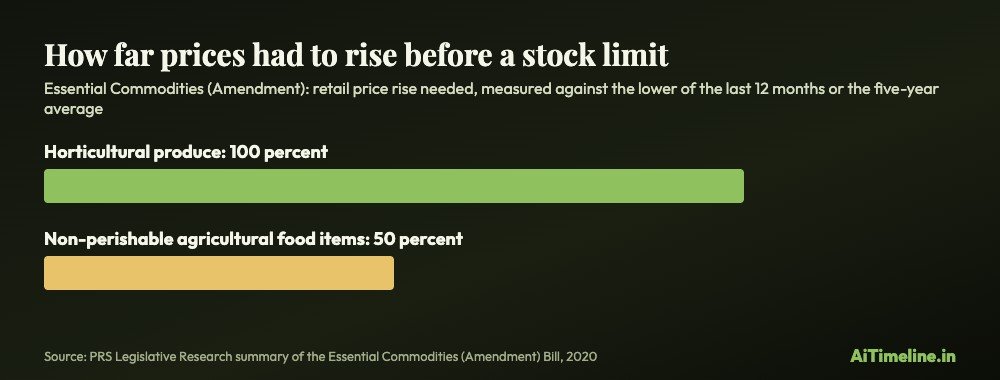
The government promulgated three ordinances on 5 June 2020 covering trade in farmers’ produce, farming agreements and the Essential Commodities Act (PRS ordinance summary). Under the Essential Commodities amendment, stock limits on agricultural produce could be imposed only after a steep price rise: a 100 percent rise in retail price for horticultural produce, or 50 percent for non-perishable agricultural food items (PRS).
The ordinances were issued while the country was still under COVID-19 restrictions. Unions later said the laws lacked consultation; the government’s own account is that the reforms followed years of expert and farmer demand (bill text).
The Three Laws and the Repeal Act, With Official Texts
Each row links to the Act or its legislative summary.
| Law | Act number | What it did | Main concern raised by opponents | Official text |
|---|---|---|---|---|
| Farmers’ Produce Trade and Commerce (Promotion and Facilitation) Act, 2020 | 21 of 2020 | Allowed trade in farmers’ produce outside APMC market premises, with no state market fee there; disputes to the sub-divisional magistrate | Trade could shift away from mandis and weaken them | Gazette text (PRS) |
| Farmers (Empowerment and Protection) Agreement on Price Assurance and Farm Services Act, 2020 | 20 of 2020 | Set a framework for farming agreements made before production, up to five years in most cases, with conciliation and magistrate-level dispute resolution | Unequal bargaining power with large buyers; dispute resolution outside civil courts | Act text (PARI); PRS summary |
| Essential Commodities (Amendment) Act, 2020 | 22 of 2020 | Limited stock limits on agricultural produce to a 100 percent (horticulture) or 50 percent (non-perishables) retail price rise | Hoarding and price risk once limits are harder to impose | Gazette text (PRS); PRS summary |
| Farm Laws Repeal Act, 2021 | 40 of 2021 | Repealed the three Acts above and omitted section 3(1A) of the Essential Commodities Act, 1955 | Not applicable | India Code; bill text (PRS) |
Why Did Farmers Oppose the Three Farm Laws?
Different unions raised overlapping but not identical objections.
MSP and procurement. MSP is a price announced by the government for specified crops. Government procurement at MSP matters most for certain crops and regions, and not every farmer benefits equally. Many protesters feared that encouraging trade outside regulated mandis could gradually weaken procurement. The laws did not themselves abolish MSP; the absence of a statutory guarantee was central to the protesters’ concern. How many farmers MSP reaches is itself disputed: the Shanta Kumar committee said in 2015 that wheat and paddy procurement directly benefited no more than about 6 percent of agricultural households, using NSSO survey data (Wikipedia summary), while a Research and Advocacy Society analysis finds about 13 percent of paddy sellers and 16 percent of wheat sellers benefit (RAS). That concentration, mostly in Punjab and Haryana, helps explain where the protest was strongest.
Bargaining power. Some unions argued small farmers could struggle to negotiate prices or settle disputes with large companies, and questioned dispute resolution by the sub-divisional magistrate instead of civil courts. Supporters said more buyers and direct trading would improve competition.
The mandis. The Trade Act allowed trade outside APMC yards without state market fees. Supporters saw a wider market; opponents feared that the difference in regulation could draw business away from the yards that many farmers and local businesses relied on.
Consultation and trust. The reforms began as ordinances during the pandemic and passed Parliament in eight days. Farmer unions demanded consultation and rejected assurances that the laws would help them. As the standoff went on, it became as much about trust in safeguards as about the legal text.
Government’s Position vs Farmers’ Concerns
A summary of the arguments, not proof that every predicted benefit or risk occurred.
| Issue | Government’s stated rationale | Main concern raised by opponents |
|---|---|---|
| Trade outside APMC markets | More buyers and more choice for farmers | Possible weakening of mandis and the institutions around them |
| Contract farming | A legal framework for pre-agreed prices and farm services | Unequal bargaining power and dispute resolution outside civil courts |
| Essential commodities | Fewer stock restrictions to attract investment in storage | Hoarding and price risk when stock limits are harder to impose |
| MSP | The laws did not abolish MSP; the government said it would continue | No statutory guarantee, and fear of indirect erosion of procurement |
| Process | Years of expert demand and consultation, per the repeal bill | Ordinances in June 2020 and a fast passage in September, with little consultation |
Claim, Concern or Fact?
The same story, sorted by how strong each statement actually is.
| Statement | Where it came from | Type | What the record shows |
|---|---|---|---|
| The laws would let farmers sell to any buyer and get better prices | Government, statement of objects of the repeal bill | Government’s stated rationale | The laws were stayed in Jan 2021 and repealed in Nov 2021, so their effect was never tested |
| The laws would weaken mandis and the MSP system | Protesting unions | Concern about a future effect | Neither the PRS summaries nor the repeal bill describe a provision abolishing MSP; the laws never took full effect |
| Only a group of farmers is protesting | Repeal bill, statement of objects | Government statement | The government nevertheless withdrew the laws on 19 Nov 2021 |
| A farmer was shot by police on 26 Jan 2021 | His family and early social media posts | Allegation | Delhi Police CCTV shows the tractor overturning; police told the High Court the cause was a head injury, not a gunshot |
| Nearly 700 farmers died during the protest | SKM, 19 Nov 2021 | Union figure | The Agriculture Ministry said on 30 Nov 2021 it had no record; AiTimeline could not verify either |
| The Centre did not keep its December 2021 promises | SKM, January 2022 | Union claim | The Dec 2021 letter promised an MSP committee and withdrawal of cases; the committee was notified in Jul 2022; case withdrawals not verified |
| Lakhimpur Kheri was a pre-planned conspiracy | SIT charge sheet, Jan 2022 | Investigative claim | Charges framed 6 Dec 2022; no verdict found |
| 61 of 73 farmer organisations supported the laws | Supreme Court committee report, released 21 Mar 2022 | Committee finding | Based on groups that chose to meet it; the protesting unions stayed away and the SKM called the report fake |
| The Supreme Court struck down the farm laws | Common misconception | Incorrect | The Court only stayed them on 12 Jan 2021; Parliament repealed them |
Where Each Strand Stands
As verified on 23 October 2026. “Not verified” means AiTimeline did not check it, not that nothing changed.
| Strand | Body | Latest outcome AiTimeline verified | Final? |
|---|---|---|---|
| The three farm laws | Parliament | Repealed by the Farm Laws Repeal Act, 2021 (assent 30 Nov 2021) | Yes |
| The Supreme Court stay and petitions | Supreme Court | Stay of 12 Jan 2021; AiTimeline did not find an order disposing of the petitions after the repeal | Not verified |
| The Court’s committee report | Supreme Court committee | Filed sealed on 19 Mar 2021; released by Anil Ghanwat on 21 Mar 2022; opposed total repeal | Public; findings summarised from press reports |
| The MSP committee | Agriculture Ministry | Notified 12 Jul 2022 under Sanjay Agrawal; SKM seats left unfilled | Outcome not verified |
| A statutory MSP guarantee | Parliament | None found enacted in the sources checked | No |
| Cases against protesters | States and Delhi Police | Dec 2021 letter promised withdrawal; how many were withdrawn is not verified | Not verified |
| Karnal inquiry | Haryana commission, Justice Somnath Aggarwal | Judge said the report was ready but not taken up | No action found |
| Lakhimpur Kheri trial | Trial court, Uttar Pradesh | Charges framed 6 Dec 2022; Ashish Mishra on bail (interim Jan 2023, regular Jul 2024); Supreme Court refused to relax bail terms 6 Aug 2026; no verdict found | No |
| The February 2024 march | Farmer groups and the Centre | Shubhkaran Singh died 21 Feb 2024; murder case and High Court-ordered judicial probe | Outcome not verified |
| Shambhu and Khanauri camps | Supreme Court committee; Punjab Police | Court panel set up 2 Sep 2024; camps cleared 19-20 Mar 2025 | Camps ended |
| Centre-farmer talks on MSP | Union ministers and farmer groups | Rounds on 14 Feb, 22 Feb and 19 Mar 2025; next set for 4 May 2025 | Outcome not verified |
What Changed Because of the Farmers’ Protest?
The three laws were repealed. The most direct outcome was Parliament’s repeal of all three central farm laws in November 2021. The legislative framework behind a year-long confrontation was withdrawn.
Agricultural reform became a wider public debate. The protest brought MSP, procurement, mandis, private investment, contract farming and the position of small farmers into the open. These issues are related but not interchangeable: a change in marketing rules does not settle price support or income security.
The movement showed it could sustain itself. The camps lasted through winter, summer and the second wave of the pandemic, and the SKM kept its unions coordinated. It also showed how hard it is to negotiate when each side treats its central position as non-negotiable.
Unresolved questions remained. The repeal did not create a universal statutory MSP guarantee. In February 2024 other farmer groups marched on the same demand, camped at the Punjab border for 13 months and held three rounds of talks with Union ministers in 2025. For other protest movements in India, see AiTimeline’s opposition protests timeline and the Singur and Nandigram land protests.
The Story at a Glance
Dates from the sources listed below, with the type of each entry.
| Date | Event | Type |
|---|---|---|
| 5 Jun 2020 | Three ordinances promulgated | Parliament or government |
| 14-22 Sep 2020 | Bills introduced and passed | Parliament or government |
| 24-27 Sep 2020 | Assent and Gazette | Parliament or government |
| 26 Sep 2020 | Akali Dal quits the NDA | Protest on the ground |
| 26 Nov 2020 | Delhi Chalo; camps at the borders | Protest on the ground |
| 9 Dec 2020 | Unions reject the written proposal | Talks or settlement |
| 12 Jan 2021 | Supreme Court stays the laws | Court step |
| 20-22 Jan 2021 | Suspension offer; talks end in deadlock | Talks or settlement |
| 26 Jan 2021 | Republic Day tractor parade turns violent | Protest on the ground |
| 6 Mar 2021 | 100 days at the borders | Protest on the ground |
| 19 Mar 2021 | Court committee files sealed report | Court step |
| 26 Jun 2021 | Seven months; Raj Bhavan marches | Protest on the ground |
| 22 Jul 2021 | Kisan Sansad at Jantar Mantar | Protest on the ground |
| 28 Aug 2021 | Karnal lathicharge | Protest on the ground |
| 5 Sep 2021 | Muzaffarnagar mahapanchayat | Protest on the ground |
| 3 Oct 2021 | Lakhimpur Kheri violence | Protest on the ground |
| 19 Nov 2021 | Prime Minister announces withdrawal | Parliament or government |
| 29-30 Nov 2021 | Parliament passes repeal; assent | Parliament or government |
| 30 Nov 2021 | Minister says no record of deaths | Aftermath and counts |
| 9 Dec 2021 | SKM suspends the agitation | Talks or settlement |
| 12 Jul 2022 | MSP committee notified | Aftermath and counts |
| 21 Mar 2022 | Court committee report released | Court step |
| 13-21 Feb 2024 | New march; Shubhkaran Singh dies | Aftermath and counts |
| 2 Sep 2024 | Supreme Court sets up Shambhu committee | Court step |
| 26 Nov 2024 | Dallewal begins hunger strike | Aftermath and counts |
| 19-20 Mar 2025 | Punjab border camps cleared | Aftermath and counts |
| Term | Meaning | Why it matters here |
|---|---|---|
| APMC | Agricultural Produce Market Committee, which regulates state market yards | The Trade Act allowed sale outside these yards |
| Mandi | A regulated agricultural market yard | Unions feared trade would drift away from it |
| MSP | Minimum support price, announced by the government for specified crops | The central demand was a legal guarantee of it |
| Statutory guarantee | An assurance written into an Act, enforceable in law | The government gave assurances but not a statute |
| Ordinance | A temporary law issued by the executive when Parliament is not sitting | The reforms began as three ordinances on 5 Jun 2020 |
| Stay order | A court order that suspends a law’s operation | The Court stayed the laws; it did not strike them down |
| Repeal | Parliament withdrawing a law by passing another law | The route the laws actually ended by |
| Rail roko | A protest blocking railway tracks | Began in Punjab on 24 Sep 2020 |
| Mahapanchayat | A mass community gathering | Held at Muzaffarnagar on 5 Sep 2021 |
| SKM | Samyukt Kisan Morcha, an umbrella of about 40 farmer unions | Led the 2020-21 protest and suspended it on 9 Dec 2021 |
Who Is Who in the Story
Samyukt Kisan Morcha (SKM)
An umbrella of about 40 farmer unions that led the 2020-21 protest and suspended it on 9 December 2021.
Agriculture Ministry and Narendra Singh Tomar
The ministry piloted the bills; Tomar, the Agriculture Minister, led the talks and made the January 2021 offer.
Parliament
Passed the three Acts in September 2020 and repealed them on 29 November 2021.
Supreme Court bench of CJI S. A. Bobde
Stayed the laws on 12 January 2021 and appointed a four-member committee.
Mann, Gulati, Joshi, Ghanwat
Bhupinder Singh Mann withdrew a day later; the committee filed a sealed report on 19 March 2021.
Shiromani Akali Dal
Harsimrat Kaur Badal resigned from the Cabinet on 17 September 2020; the party left the NDA on 26 September.
Delhi Police
Granted the Republic Day parade routes, reported 300 plus injured, and filed cases against farmer leaders.
SKM (Non-Political) and Kisan Mazdoor Morcha
Called the February 2024 Delhi Chalo and camped at Shambhu and Khanauri until March 2025; separate from the SKM that led the 2020-21 protest.
The Popular Story vs the Record
| Popular version | What the record shows |
|---|---|
| The Supreme Court scrapped the farm laws | It stayed them on 12 Jan 2021 as an interim measure. Parliament repealed them by statute in Nov 2021 |
| The laws abolished MSP | The summaries and the repeal bill do not describe such a provision. The unions’ fear was that procurement could weaken indirectly, and they wanted a legal guarantee |
| The protest lasted exactly 378 days | That is the date difference from 26 Nov 2020 to 9 Dec 2021. Farmers began leaving on 11 Dec, which makes 380 days |
| The repeal ended the protest on 29 November | The protest continued until the SKM suspended it on 9 Dec 2021 |
| Repeal brought a legal MSP guarantee | No. A committee was notified in Jul 2022 and AiTimeline found no statutory guarantee enacted |
| The government admitted the laws were wrong | The Prime Minister said the government could not convince a section of farmers; the repeal bill defends the laws’ intent |
| The talks made steady progress | Wikipedia reports 11 rounds ending without agreement, with consensus on only two minor points |
| The Red Fort violence was the whole movement | It was one day. Specific acts by some people are for the courts; the movement continued for another 10 months |
Explore More Timelines
People Also Ask
Frequently Asked Questions
Sources and Further Reading
- India Code: The Farm Laws Repeal Act, 2021 (Act 40 of 2021)
- PRS Legislative Research: The Farm Laws Repeal Bill, 2021 (bill text)
- PRS Legislative Research: The Farm Laws Repeal Bill, 2021 (bill track)
- Bar and Bench: Farm Laws Repeal Act 2021 gets Presidential assent
- PIB: Prime Minister’s address to the nation, 19 November 2021
- Gazette of India via PRS: Farmers’ Produce Trade and Commerce (Promotion and Facilitation) Act, 2020
- Gazette of India via PRS: Essential Commodities (Amendment) Act, 2020
- PARI: Farmers (Empowerment and Protection) Agreement on Price Assurance and Farm Services Act, 2020
- PRS Legislative Research: Farmers’ Produce Trade and Commerce Bill, 2020
- PRS Legislative Research: Farmers (Empowerment and Protection) Agreement Bill, 2020
- PRS Legislative Research: Essential Commodities (Amendment) Bill, 2020
- PRS Legislative Research: Farmers’ Produce Trade and Commerce Bill, 2020 summary
- PRS Legislative Research: Agriculture ordinances, 2020
- The Indian Express: Farmers end year-long protest, a timeline of how it unfolded
- Down To Earth: Samyukt Kisan Morcha suspends farm protests after letter from Centre
- Deccan Herald: 11 rounds and 45 hours of talks, yet deadlock over farm laws continues
- Business Today: Govt offers to suspend farm laws for 18 months, next meeting on Jan 22
- LiveLaw: Supreme Court stays farm laws, forms committee
- The Quint: Supreme Court committee members have supported the farm laws
- Sabrang India: Farm laws, SC-appointed committee submits report
- The Wire: No record of farmers dying during protests, so no question of compensation, Centre
- The Week: No data on deaths during farmers’ protests, so no question of compensation
- The Quint: Farmers call off Karnal protest after govt promises inquiry
- The Tribune: Bastara toll case, government didn’t take report, Justice S N Aggarwal
- The Quint: Harsimrat Kaur Badal resigns over farm bills
- The News Minute: Shiromani Akali Dal quits NDA over farm Bills
- Deccan Herald: SIT files 5,000-page charge sheet in Lakhimpur Kheri case
- The Tribune: Supreme Court relieves SIT in Lakhimpur Kheri violence case
- Down To Earth: Two years on, what has been the progress on the Committee on MSP
- The Quint: Modi govt sets up MSP panel 8 months after withdrawing farm laws
- The Wire: SKM rejects govt panel on MSP
- BOOM: Farmers’ tractor rally, Red Fort and Republic Day violence
- Business World: Farmer died during R-Day violence due to shock, haemorrhage, Delhi and UP Police tell HC
- Sabrang India: Save Agriculture, Save Democracy Day protests
- The Quint: Farmers refute govt’s claims at Kisan Sansad at Jantar Mantar
- Sabrang India: Lakhs of farmers flood Muzaffarnagar mahapanchayat
- Deccan Herald: Saddened by farmer’s death, action will be taken, Bhagwant Mann
- Scroll: SKM blames Centre for protester’s death
- PTI via Udayavani: High Court orders judicial probe into death of Shubhkaran Singh
- Anadolu Agency: India to repeal 3 farm laws after months of protests
- Christian Science Monitor: After year of protests, Modi to repeal Indian farm laws
- Verdictum: 61 out of 73 farmer unions supported farm laws, SC-appointed committee’s report
- The Tribune: SC panel opposed repeal of laws
- The Tribune: Farmers’ bodies dismiss SC panel report as fake
- The Tribune: Supreme Court gives bail to Ashish Mishra (July 2024)
- Bar and Bench: Supreme Court refuses to relax Ashish Mishra’s bail terms (August 2026)
- LiveLaw: Supreme Court forms committee to negotiate with farmers at Shambhu border
- The Wire: SC forms high-powered committee to hold talks with farmers at Shambhu border
- All India Radio: Centre holds fresh talks with farmers in Chandigarh
- All India Radio: Punjab Police remove protesting farmers from Shambhu and Khanauri borders
- LiveLaw: Dallewal ended fast, highway opened, Punjab tells Supreme Court
- Deccan Chronicle: Jagjit Singh Dallewal ends hunger strike
- Wikipedia: Shanta Kumar Committee
- Research and Advocacy Society: Minimum support prices in India
- Wikipedia: 2020-2021 Indian farmers’ protest
Related AiTimeline Stories
⚠️ Editorial Note
Last updated 23 October 2026. This is editorial information, not legal advice. The page separates the government’s stated objectives from concerns raised by protesting farmers: the fears about MSP and market power are not presented as proven consequences of the laws, and the government’s objectives are not presented as guaranteed outcomes. The Supreme Court’s January 2021 stay was an interim measure, not a ruling on constitutional validity; Parliament, not a court, repealed the laws. Corrections to the draft brief: the Acts record presidential assent on 24 September 2020 (Act 21) and 26 September 2020 (Act 22), with the Gazette dated 27 September, so 27 September is not the assent date for all three, and AiTimeline did not read Act 20’s assent line; the bills passed the Lok Sabha on 15 and 17 September and the Rajya Sabha on 20 and 22 September, with exact dates per bill shown above; the repeal Act has assent on 30 November and Gazette on 1 December 2021; the SKM suspended the protest on 9 December after a letter from the Agriculture Secretary, and farmers left from 11 December, so 378 days is a date difference and 380 counts to departure; the brief omitted Lakhimpur Kheri (3 October 2021) and gave the Karnal lathicharge only as “August” (28 August). Verification pass, 23 October 2026: added the Supreme Court committee’s report findings (released 21 March 2022), Lakhimpur Kheri bail and trial status to August 2026, the September 2024 Supreme Court committee on the Shambhu standoff, the 2025 Chandigarh talks and the clearing of the border camps, Jagjit Singh Dallewal’s hunger strike, and data on how many farmers sell at MSP; the Prime Minister’s words and the speed of the repeal vote are now attributed to named reports. Unverified and flagged: death counts, the outcome of the May 2025 talks, how many cases were withdrawn, what compensation was paid, the Lakhimpur Kheri trial outcome, the content of the Court committee’s report, whether a statutory MSP guarantee exists in 2026, and whether the Supreme Court disposed of the petitions after repeal. No person named on this page has been convicted of any offence in connection with these events; those charged are presumed innocent.
Sources & further reading
Every dated entry above was checked against these references. Last reviewed 23 October 2026.
- India Code: The Farm Laws Repeal Act, 2021 (Act 40 of 2021)
- PRS Legislative Research: The Farm Laws Repeal Bill, 2021 (bill text)
- PRS Legislative Research: The Farm Laws Repeal Bill, 2021 (bill track)
- Bar and Bench: Farm Laws Repeal Act 2021 gets Presidential assent
- PIB: Prime Minister's address to the nation, 19 November 2021
- Gazette of India via PRS: Farmers' Produce Trade and Commerce (Promotion and Facilitation) Act, 2020
- Gazette of India via PRS: Essential Commodities (Amendment) Act, 2020
- PARI: Farmers (Empowerment and Protection) Agreement on Price Assurance and Farm Services Act, 2020
- PRS Legislative Research: Farmers' Produce Trade and Commerce Bill, 2020
- PRS Legislative Research: Farmers (Empowerment and Protection) Agreement Bill, 2020
- PRS Legislative Research: Essential Commodities (Amendment) Bill, 2020
- PRS Legislative Research: Farmers' Produce Trade and Commerce Bill, 2020 summary
- PRS Legislative Research: Agriculture ordinances, 2020
- The Indian Express: Farmers end year-long protest, a timeline of how it unfolded
- Down To Earth: Samyukt Kisan Morcha suspends farm protests after letter from Centre
- Deccan Herald: 11 rounds and 45 hours of talks, yet deadlock over farm laws continues
- Business Today: Govt offers to suspend farm laws for 18 months, next meeting on Jan 22
- LiveLaw: Supreme Court stays farm laws, forms committee
- The Quint: Supreme Court committee members have supported the farm laws
- Sabrang India: Farm laws, SC-appointed committee submits report
- The Wire: No record of farmers dying during protests, so no question of compensation, Centre
- The Week: No data on deaths during farmers' protests, so no question of compensation
- The Quint: Farmers call off Karnal protest after govt promises inquiry
- The Tribune: Bastara toll case, government didn't take report, Justice S N Aggarwal
- The Quint: Harsimrat Kaur Badal resigns over farm bills
- The News Minute: Shiromani Akali Dal quits NDA over farm Bills
- Deccan Herald: SIT files 5,000-page charge sheet in Lakhimpur Kheri case
- The Tribune: Supreme Court relieves SIT in Lakhimpur Kheri violence case
- Down To Earth: Two years on, what has been the progress on the Committee on MSP
- The Quint: Modi govt sets up MSP panel 8 months after withdrawing farm laws
- The Wire: SKM rejects govt panel on MSP
- BOOM: Farmers' tractor rally, Red Fort and Republic Day violence
- Business World: Farmer died during R-Day violence due to shock, haemorrhage, Delhi and UP Police tell HC
- Sabrang India: Save Agriculture, Save Democracy Day protests
- The Quint: Farmers refute govt's claims at Kisan Sansad at Jantar Mantar
- Sabrang India: Lakhs of farmers flood Muzaffarnagar mahapanchayat
- Deccan Herald: Saddened by farmer's death, action will be taken, Bhagwant Mann
- Scroll: SKM blames Centre for protester's death
- PTI via Udayavani: High Court orders judicial probe into death of Shubhkaran Singh
- Anadolu Agency: India to repeal 3 farm laws after months of protests
- Christian Science Monitor: After year of protests, Modi to repeal Indian farm laws
- Verdictum: 61 out of 73 farmer unions supported farm laws, SC-appointed committee's report
- The Tribune: SC panel opposed repeal of laws
- The Tribune: Farmers' bodies dismiss SC panel report as fake
- The Tribune: Supreme Court gives bail to Ashish Mishra (July 2024)
- Bar and Bench: Supreme Court refuses to relax Ashish Mishra's bail terms (August 2026)
- LiveLaw: Supreme Court forms committee to negotiate with farmers at Shambhu border
- The Wire: SC forms high-powered committee to hold talks with farmers at Shambhu border
- All India Radio: Centre holds fresh talks with farmers in Chandigarh
- All India Radio: Punjab Police remove protesting farmers from Shambhu and Khanauri borders
- LiveLaw: Dallewal ended fast, highway opened, Punjab tells Supreme Court
- Deccan Chronicle: Jagjit Singh Dallewal ends hunger strike
- Wikipedia: Shanta Kumar Committee
- Research and Advocacy Society: Minimum support prices in India
- Wikipedia: 2020-2021 Indian farmers' protest