Jayalalithaa Disproportionate Assets Case: From the 1996 Complaint to the 2017 Verdict
Follow the Jayalalithaa disproportionate assets case from the 1996 complaint and 2014 conviction to the 2017 Supreme Court ruling and 2025 asset transfer.
Latest Story
In June 1996, weeks after J. Jayalalithaa lost power in Tamil Nadu, Subramanian Swamy accused her of amassing wealth far beyond her income during her five years as Chief Minister. The case that followed lasted more than two decades. It was moved to another state, cost her the Chief Minister’s chair in 2014, was thrown out by the Karnataka High Court in 2015, and reached the Supreme Court only after her death. This Jayalalithaa disproportionate assets case timeline follows the court record, from the 1996 complaint to the 2017 judgment that sent V.K. Sasikala to prison, and on to the 2025 handover of the seized jewellery to Tamil Nadu.
Jayalalithaa was convicted by the trial court in 2014 and acquitted by the High Court in 2015. She died before the Supreme Court ruled, so the appeal against her abated: no court gave a final verdict on her guilt. In 2025 the Supreme Court said this is not an acquittal. The convictions of her three co-accused were restored in full.
💡 Short Answer
The Jayalalithaa disproportionate assets case alleged she and three associates held Rs 66.65 crore beyond their known income during 1991-96. A Bengaluru court convicted all four on 27 September 2014; the Karnataka High Court acquitted them on 11 May 2015. On 14 February 2017 the Supreme Court restored the convictions of Sasikala, Ilavarasi and Sudhakaran. The case against Jayalalithaa, who died in December 2016, abated.
Jayalalithaa Assets Case: Key Questions
The Case in Ten Points
- The allegation: Rs 66.65 crore beyond known income, 1 July 1991 to 30 April 1996.
- The accused: Jayalalithaa, Sasikala, Sudhakaran and Ilavarasi, plus 32 firms in their names.
- The start: Swamy’s complaint on 14 June 1996; FIR on 18 September 1996.
- The chargesheet: 4 June 1997, for conspiracy and criminal misconduct.
- The transfer: moved to Bengaluru on 18 November 2003 after 64 recalled witnesses went back on their evidence.
- The conviction: all four guilty on 27 September 2014; Jayalalithaa lost office.
- The acquittal: the High Court found only 8.12% disproportion on 11 May 2015.
- The death: Jayalalithaa died on 5 December 2016, with judgment reserved.
- The final ruling: three convictions restored on 14 February 2017; her appeal abated.
- The assets: confiscated property handed to Tamil Nadu in February 2025.
Three Courts, Four Outcomes
Why “convicted” and “acquitted” are both half the story.
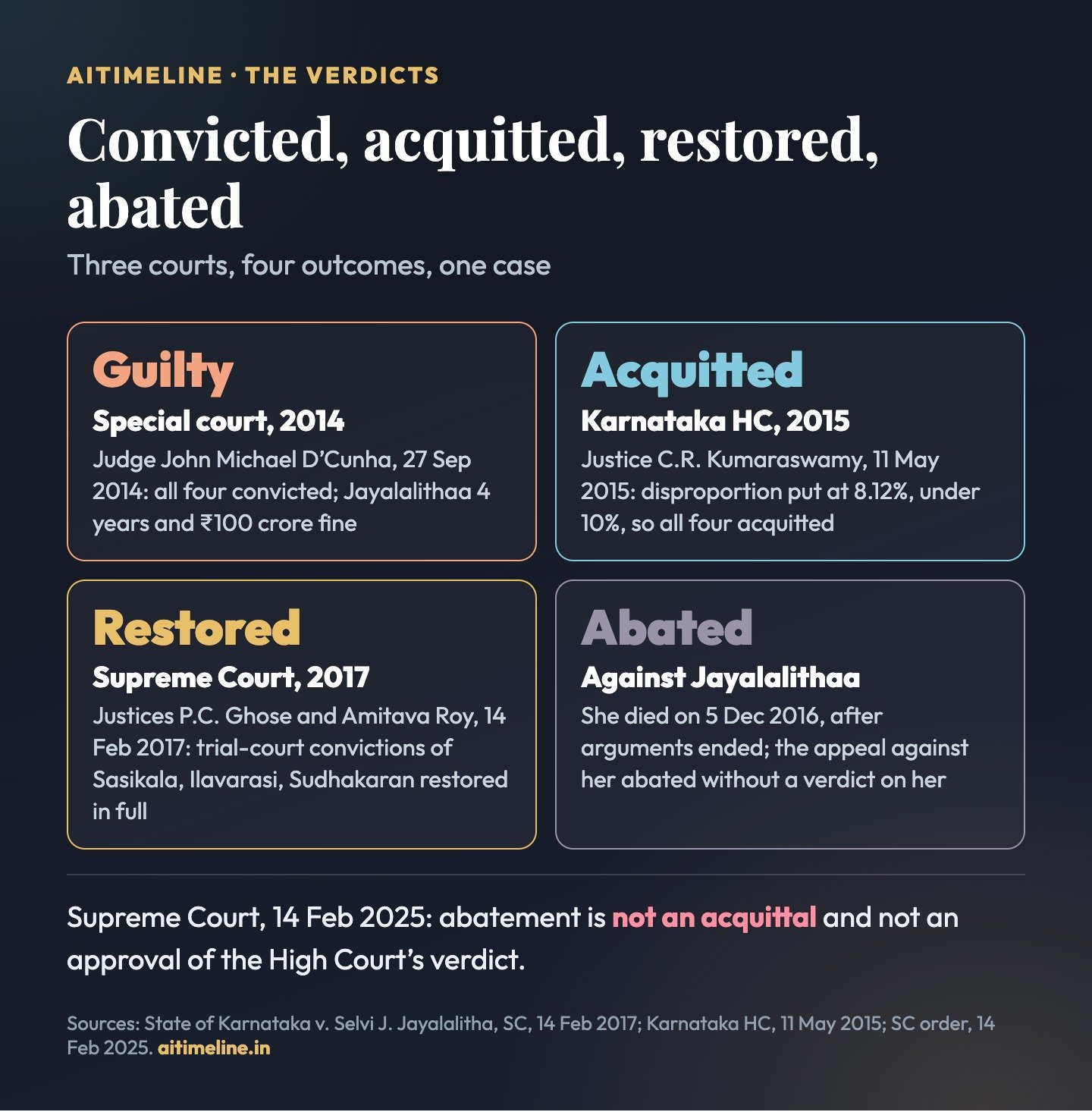
The trial court said guilty. After a trial that began in Chennai in 1997 and finished in Bengaluru in 2014, Judge John Michael D’Cunha convicted all four accused and ordered the confiscation of property.
The High Court said not guilty. Eight months later Justice C.R. Kumaraswamy recalculated the accounts and found too little disproportion to convict.
The Supreme Court restored the convictions, for three. Jayalalithaa had died after arguments ended. The court ruled for the state against Sasikala, Ilavarasi and Sudhakaran, and recorded that the appeals against her abated.
What the Prosecution Alleged
Five years, four people and 32 firms.

A household at Poes Garden. Sasikala lived with Jayalalithaa at 36 Poes Garden, Chennai. Her nephew Sudhakaran and her sister-in-law Ilavarasi joined the household in the early 1990s. The prosecution said none had significant means of their own when they arrived.
A “sudden spurt”. In the prosecution’s account, firms such as J. Farm Houses, Jaya Contractors and Builders, Super Duper TV and the Kodanad Tea Estate were floated or acquired after July 1991. Many did little business and mostly bought land, buildings and machinery. Cash was deposited in large amounts and moved between accounts.
The formula. Assets acquired, plus spending, minus lawful income. On the prosecution’s numbers that came to Rs 66.65 crore. That was the allegation, not a finding; the trial court found Rs 53.60 crore.
The Arithmetic That Decided the Case
Four courts and parties, four very different totals.

| Stage | Disproportion found | Outcome |
|---|---|---|
| Prosecution, 1997 | Rs 66.65 crore | Chargesheet against four accused |
| Special court, 2014 | Rs 53.60 crore | All four convicted |
| Karnataka High Court, 2015 | Rs 2.82 crore (8.12%) | All four acquitted; under 10% treated as acceptable |
| Karnataka’s correction | Rs 16.32 crore (76.7%) from the loan error alone | Grounds of appeal |
| Supreme Court, 2017 | 8.12% figure rejected | Trial-court convictions restored |
Where the High Court went wrong. The state showed that the High Court’s own table of loans treated as income added up to about Rs 13.5 crore more than the loans listed in it. It also accepted only Rs 28.68 lakh of the Rs 6.45 crore the prosecution attributed to Sudhakaran’s wedding.
The Supreme Court’s view. The bench found the High Court’s approach “untenable” and held the evidence “unassailably” proved disproportionate assets.
Jayalalithaa Assets Case Timeline, Newest First
Tagged by thread: complaint and probe, the Chennai trial and transfer, the Bengaluru trial, the appeals, and the assets and estate.
Income Tax Department warns it may auction attached properties Assets and estate
What happened: On 5 February 2026 the Income Tax Department told the Madras High Court that, as of 31 January 2026, income-tax arrears with interest stood at about ₹9.17 crore and wealth-tax arrears at about ₹11.8 crore. If the legal heirs did not pay, it said, it would move to auction the attached properties, including Veda Nilayam at Poes Garden.
Where it stands: The court had stayed recovery in January 2026 because the heirs had not been told the exact final liability. J. Deepak had agreed to pay his share of ₹6.75 crore in six instalments and had paid about ₹1.12 crore. The matter was listed for 18 February 2026; we found no report of a final order after that.
Why it is separate: This is a civil tax-recovery dispute over her estate. It is not a new conviction and does not reopen the criminal case.
Seized jewellery and land papers handed to Tamil Nadu Assets and estate
What happened: Officials of the Tamil Nadu government took custody of the valuables Karnataka had held since the trial moved to Bengaluru, and took them to the state treasury in Chennai.
What was handed over: Reports list about 27.5 kg of gold and diamond jewellery, including a gold sword and crowns, about 1,116 kg of silver and documents for about 1,526 acres of land.
Why it matters: The trial court had ordered the property confiscated in 2014, and the Supreme Court restored that order in 2017. The handover carried it out, eight years later.
Supreme Court: abatement is not acquittal Assets and estate
What happened: The Supreme Court dismissed a plea by Jayalalithaa’s niece J. Deepa to get back the attached properties.
What the court said: Abatement means the question of whether the High Court was right to acquit is simply not considered further. It is not an approval of her acquittal, and the High Court’s judgment does not become final because of it.
Why it matters: It settled the argument that her death had left her legally acquitted. Her position is neither convicted nor cleared by the Supreme Court.
Karnataka High Court dismisses the heirs’ appeals Assets and estate
What happened: The High Court dismissed appeals by J. Deepa and J. Deepak against the special court’s refusal to return the seized property.
The reasoning: The attachment had already ended in confiscation, which the Supreme Court left untouched in 2017. So a plea to lift the attachment was not maintainable.
A door left open: The court said that if the heirs proved some seized items were acquired before the check period began, they would be entitled to their value.
Special court refuses to return the assets Assets and estate
What happened: The special court rejected applications by Deepa and Deepak for the return of jewellery, other movables and attached land.
Their argument: Because the appeal against Jayalalithaa abated, they said, she could not be treated as a convict, so her property could not be confiscated.
The outcome: The court disagreed. The heirs appealed to the High Court, which slowed the transfer of the assets to Tamil Nadu.
Sasikala walks out of prison Appeals
What happened: Sasikala completed her four-year sentence and was formally released while being treated for Covid-19 in a Bengaluru hospital.
The others: Ilavarasi was released soon after. Sudhakaran, who had not paid his ₹10 crore fine, served extra time and was released in October 2021.
Why it matters: Her return came months before the 2021 Assembly election, but she stayed out of electoral politics.
Supreme Court restores the convictions Appeals
What happened: The Supreme Court set aside the 2015 acquittal and restored the trial court’s conviction and sentence of Sasikala, Ilavarasi and Sudhakaran “in full including the consequential directions”, including confiscation.
On the arithmetic: It held that the High Court’s 8.12% figure was based on a “completely wrong reading of the evidence” and incorrect arithmetic.
On Jayalalithaa: Because she had died after arguments ended, the appeals against her abated. The court still examined her role, since the conspiracy charge was framed against all four.
Jayalalithaa dies as Chief Minister Appeals
What happened: Jayalalithaa died in office, having led the AIADMK back to power in the May 2016 election.
Legal effect: The Supreme Court had finished hearing the appeals and reserved judgment on 7 June 2016. Her death meant the appeal against her acquittal would abate.
Political effect: O. Panneerselvam was sworn in as Chief Minister within hours, and Sasikala soon took control of the party.
Karnataka High Court acquits all four Appeals
What happened: The High Court set aside the convictions and the confiscation order and acquitted all four accused.
The reasoning: It recalculated assets, income and spending, put the disproportion at about ₹2.82 crore, or 8.12% of income, and held that disproportion under 10% entitled the accused to acquittal.
What followed: Jayalalithaa was sworn in again as Chief Minister on 23 May 2015 and won the R.K. Nagar by-election on 27 June. Karnataka and K. Anbazhagan appealed.
Supreme Court rules on the prosecutor Appeals
What happened: A three-judge bench held that G. Bhavani Singh’s appearance for the state in the High Court appeal was “bad in law”.
The remedy: It refused to order a fresh hearing. Instead it let Anbazhagan and Karnataka file written submissions by 28 April 2015 for the High Court to consider.
Why it matters: Karnataka brought back B.V. Acharya, and the High Court gave judgment two weeks later.
Supreme Court grants bail Appeals
What happened: The Supreme Court suspended the sentences and granted bail to all four, after the Karnataka High Court had declined to on 7 October.
Conditions: In December 2014 it asked the High Court to set up a special bench and decide the appeals within three months, hearing them day to day.
Time in jail: Jayalalithaa left Parappana Agrahara on 18 October 2014 after 21 days and returned to Chennai.
All four convicted; Jayalalithaa loses office Bengaluru trial
What happened: The special court convicted all four. It found that Jayalalithaa held assets of about ₹53.60 crore she could not account for, lower than the prosecution’s ₹66.65 crore.
Sentences: Jayalalithaa: four years’ simple imprisonment and a ₹100 crore fine. Sasikala, Ilavarasi and Sudhakaran: four years and ₹10 crore each. The court also ordered properties confiscated.
Political effect: The conviction disqualified her as an MLA at once under the Supreme Court’s 2013 Lily Thomas ruling, so she lost the Chief Minister’s post. O. Panneerselvam was sworn in on 29 September.
The fight over the Special Public Prosecutor Bengaluru trial
What happened: B.V. Acharya stepped down and Karnataka appointed G. Bhavani Singh. Within months it tried to withdraw the appointment, saying the Chief Justice of the High Court had not been properly consulted.
The litigation: The accused went to the Supreme Court, which stayed the removal, and Bhavani Singh continued at the trial.
Why it matters: His role later became the ground for challenging the appeal hearing itself in 2015.
Jayalalithaa answers the court in person Bengaluru trial
What happened: Jayalalithaa, Chief Minister again since May 2011, appeared in person in Bengaluru over several days to answer the court’s questions on the evidence against her.
Why it mattered: The questioning of the accused is the step where an accused explains the evidence in her own words before the defence case.
The pace: After years of applications and appeals, it was a sign the trial was finally moving.
A special court and prosecutor in Bengaluru Bengaluru trial
What happened: Karnataka set up the special court in December 2003 and on 19 February 2005 appointed B.V. Acharya, a former Advocate General, as prosecutor.
The files: The main case became Spl. C.C. 208/2004 and a related case over alleged foreign assets became Spl. C.C. 209/2004.
Delays: Defence petitions repeatedly went up to the Supreme Court before the trial resumed in earnest.
Supreme Court moves the trial to Bengaluru Chennai trial and transfer
What happened: On transfer petitions filed on 5 February 2003 by DMK general secretary K. Anbazhagan, the court sent the case to a special court in Bengaluru.
Why: After the trial resumed on 7 November 2002, 76 witnesses were recalled and 64 went back on their earlier evidence, without the new prosecutor treating them as hostile. The court found the prosecution appeared to be acting “hand in glove” with the accused.
Why it matters: It became a leading example of a criminal trial moved out of a state to protect its fairness.
Jayalalithaa returns as Chief Minister Chennai trial and transfer
What happened: After winning the Andipatti by-election, Jayalalithaa was sworn in again as Chief Minister.
Background: She had first returned after the May 2001 election, but the Supreme Court held on 21 September 2001 that she could not hold office while disqualified by her conviction in the separate TANSI land case.
Effect on the trial: With the change of government, three public prosecutors and the state’s senior counsel resigned.
Chargesheet against four accused Chennai trial and transfer
What happened: The Directorate of Vigilance and Anti-Corruption charged Jayalalithaa, Sasikala, Sudhakaran and Ilavarasi.
The charges: Conspiracy under Section 120-B IPC, criminal misconduct under Section 13(1)(e) read with 13(2) of the Prevention of Corruption Act, 1988, and abetment under Section 109 IPC.
The figure: Assets of ₹66.65 crore disproportionate to known income, held through the accused and 32 business firms.
Arrest and the Poes Garden search Complaint and probe
What happened: Jayalalithaa was arrested on 7 December 1996 in a separate case over the purchase of colour TVs for village panchayats.
The search: Investigators in the assets case searched her Poes Garden home and other premises, listing jewellery, silver, sarees, footwear and property papers.
What came of it: The trial court later excluded the value of the sarees and footwear and cut the valuation of the jewellery from ₹5.53 crore to ₹2.52 crore.
FIR registered Complaint and probe
What happened: After a court-ordered inquiry, the Directorate of Vigilance and Anti-Corruption registered an FIR against Jayalalithaa.
The probe: Searches of her home and other premises yielded documents showing large cash deposits and frequent transfers between the accused and their firms.
Context: The DMK had swept the May 1996 election, and Jayalalithaa had lost her own seat.
Subramanian Swamy files the complaint Complaint and probe
What happened: Subramanian Swamy, then Janata Party president, filed a private complaint alleging that Jayalalithaa had acquired property far beyond her known income while Chief Minister.
The court’s order: On 21 June 1996 the judge directed an investigation under Section 17 of the Prevention of Corruption Act.
Why it matters: This is the starting point of the case, 21 years before the Supreme Court’s final judgment.
The Sudhakaran wedding Complaint and probe
What happened: V.N. Sudhakaran, Sasikala’s nephew whom Jayalalithaa had called her foster son, married in a lavish ceremony.
In the case: The prosecution counted the wedding as spending of about ₹6.45 crore. The High Court accepted only ₹28.68 lakh, one of the biggest swings in its arithmetic.
Why it matters: The wedding fed public anger before the 1996 election, which the AIADMK lost heavily.
The check period Complaint and probe
What happened: Jayalalithaa became Chief Minister on 24 June 1991. The prosecution examined assets, income and spending from 1 July 1991 to 30 April 1996.
The numbers: Assets of about ₹2.02 crore at the start; about ₹64.43 crore acquired during the period; income of about ₹9.34 crore and spending of about ₹11.57 crore.
A spurt of firms: Firms such as J. Farm Houses, Jaya Contractors and Builders and the Kodanad Tea Estate were floated or acquired, many with little business activity, the prosecution said.
Why the Trial Left Tamil Nadu
A case against a sitting Chief Minister, tried by her own government.
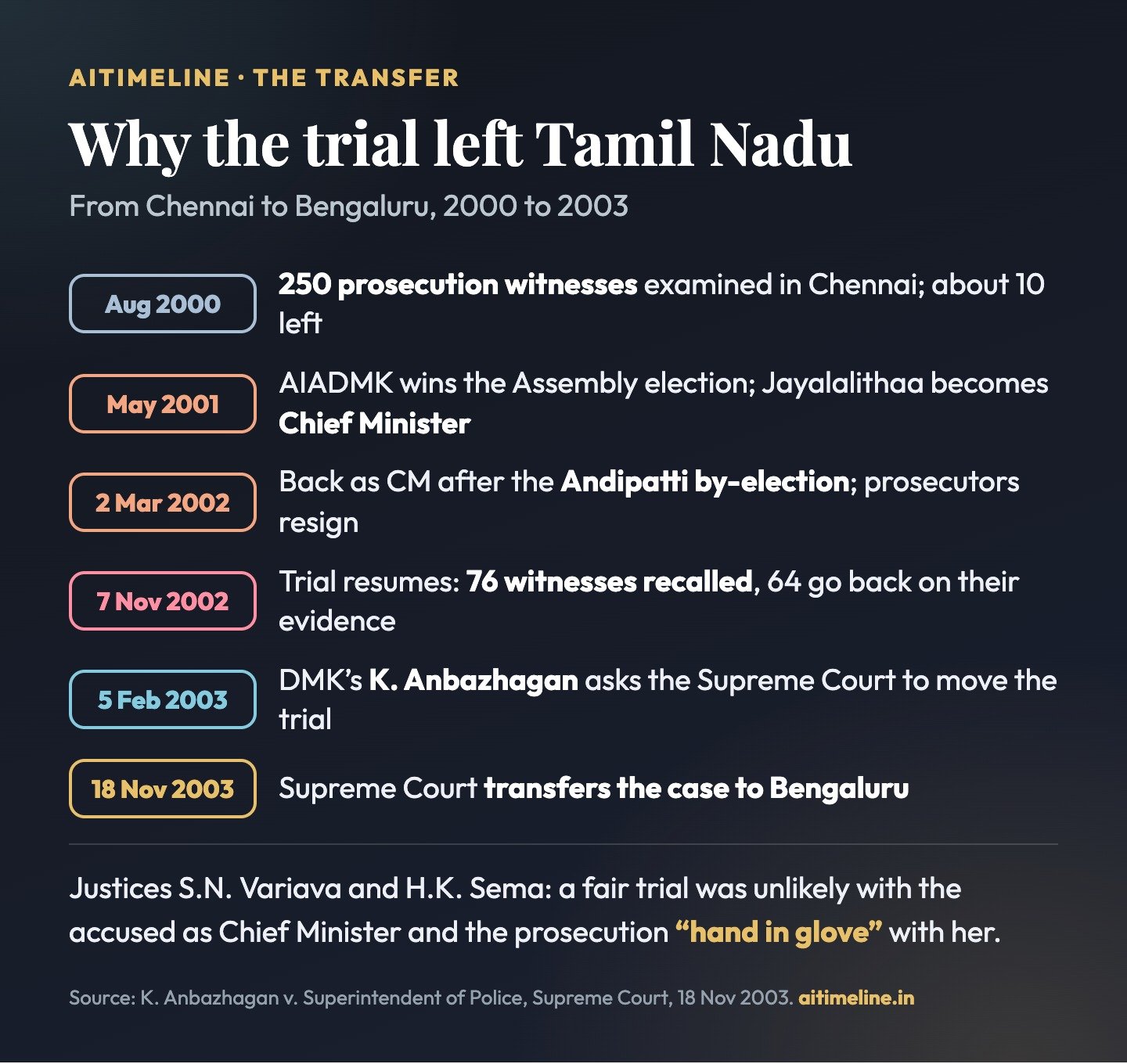
A trial almost done. By August 2000, 250 prosecution witnesses had testified and only about ten remained. Then the AIADMK won the 2001 election.
Witnesses turn. When the trial resumed on 7 November 2002, 76 witnesses were recalled for cross-examination and 64 retracted what they had said. The new prosecutor did not declare them hostile or seek perjury action.
The Supreme Court steps in. Justices Variava and Sema held that the prosecution appeared to be acting “hand in glove” with the accused and moved the case to a special court in Bangalore, with a prosecutor chosen in consultation with the Karnataka High Court’s Chief Justice.
The Fight Over the Prosecutor
Who could speak for the state, and when.
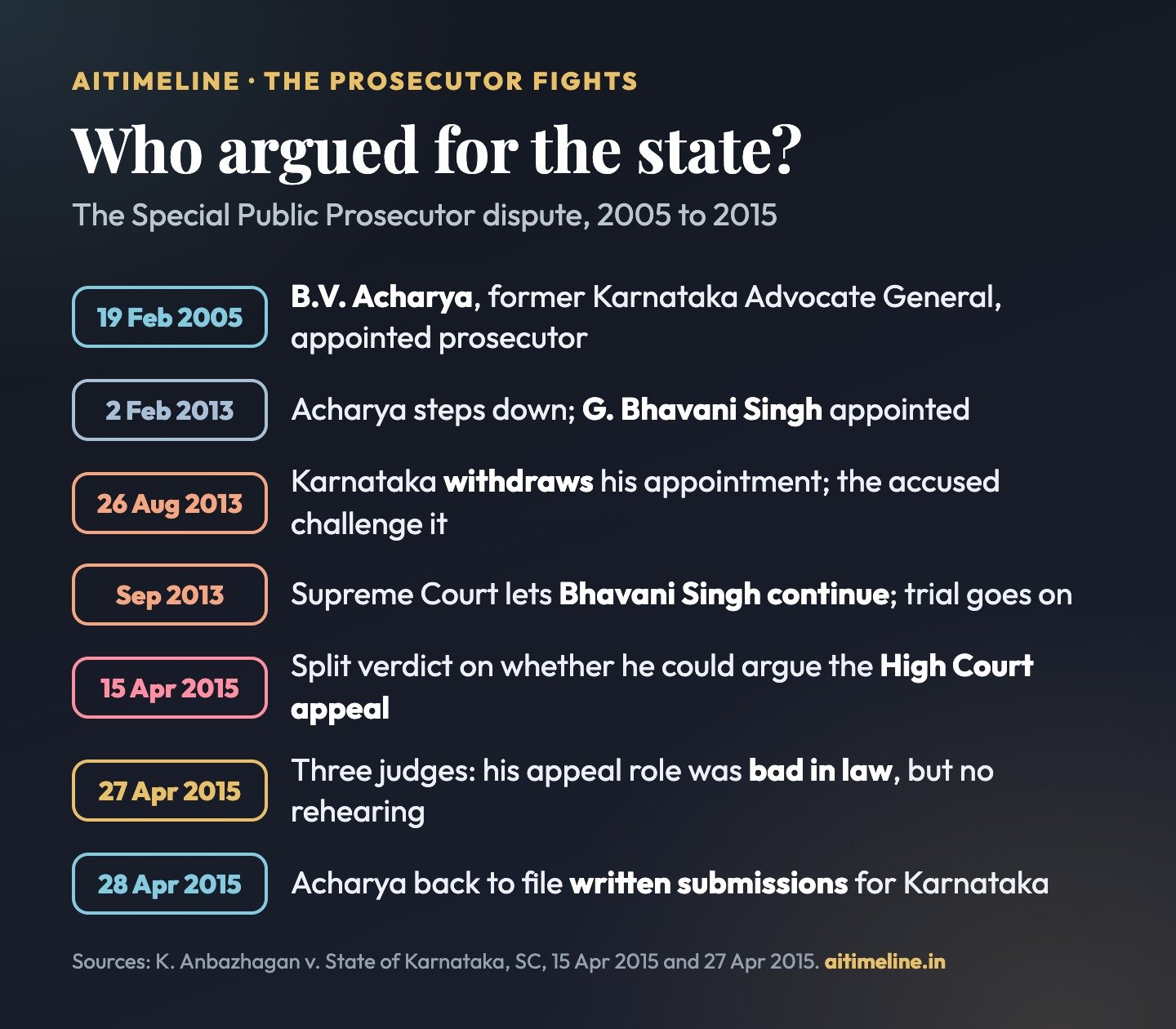
Who argued the appeal? Bhavani Singh, appointed for the trial, also appeared for the prosecution in the High Court appeal, though Karnataka had not appointed him for it.
Bad in law, but no rehearing. The Supreme Court held that appearance unlawful but said a fresh hearing was unnecessary, given the appellate judge’s duty to examine the whole record himself. Written submissions were enough.
Abatement: Why There Is No Final Verdict on Jayalalithaa
What happens to an appeal when the accused dies.
Timing. The Supreme Court finished hearing the appeals and reserved judgment on 7 June 2016. Jayalalithaa died on 5 December 2016. Judgment came on 14 February 2017.
What abatement does. Criminal proceedings against a dead person end. The court therefore never decided whether the High Court had been right to acquit her.
Why her role was still discussed. She was the only public servant, and the conspiracy charge covered all four. The court said reference to her role and the evidence against her was unavoidable in deciding the others’ case.
What the court said in 2025. Rejecting her niece’s plea for the assets, the Supreme Court said abatement is “not an imprimatur on her acquittal”.
Jayalalithaa vs Her Co-Accused
After the Judgment: Prison, Politics and the Assets
What followed 14 February 2017.

A Chief Minister who never was. AIADMK legislators had elected Sasikala their leader on 5 February 2017. The conviction nine days later ended her claim, and Edappadi K. Palaniswami became Chief Minister on 16 February.
Four years. Sasikala served her sentence in Bengaluru’s Parappana Agrahara prison and was released on 27 January 2021.
The Seized Assets and the Estate
Confiscation, the heirs’ claim, and a separate tax dispute.

The heirs’ argument. J. Deepa and J. Deepak, declared her legal heirs in 2020, argued that since the appeal against her abated she was not a convict and her property should come back to them.
Three courts said no. The special court in July 2023, the Karnataka High Court in January 2025 and the Supreme Court in February 2025 rejected that, because confiscation had been ordered and left in place in 2017.
A different dispute. The Income Tax Department’s 2026 claim for unpaid income and wealth tax on her estate, and its threat to auction Veda Nilayam, are civil matters in the Madras High Court. They do not reopen the criminal case.
Legal and Political Impact
Why the case still matters.
A Chief Minister in the dock
A sitting Chief Minister was convicted, jailed and removed from office, and her closest aide went to prison.
Moving a trial out of state
The 2003 transfer is a leading example of the Supreme Court protecting a trial from the accused’s political power.
Lily Thomas in action
The 2014 conviction was the first time a sitting Chief Minister lost office at once under the 2013 rule on convicted legislators.
How to count unexplained wealth
The 2017 judgment is cited on calculating disproportionate assets and on convicting private abettors of a public servant.
AIADMK after Jayalalithaa
The verdict stopped Sasikala becoming Chief Minister and reshaped the party’s leadership fights.
Twenty years to judgment
The case is a byword for how long high-profile corruption trials take in India, and how much happens while they wait.
Established, Alleged and Misreported
- Sasikala, Ilavarasi and Sudhakaran are convicted.
- The High Court’s 8.12% figure was wrong.
- Confiscation of the property stands.
- Abatement is not acquittal.
- The full Rs 66.65 crore figure; the trial court found Rs 53.60 crore.
- The Rs 6.45 crore wedding valuation.
- That the Supreme Court convicted Jayalalithaa after death.
- That she was finally acquitted.
- That the FIR was filed in June 1996.
- That the 2026 tax case reopened the trial.
Key People and Institutions
J. Jayalalithaa
Chief Minister 1991-96 and four more times; AIADMK leader; died in office on 5 December 2016.
V.K. Sasikala
Her closest aide; convicted, served four years, released January 2021.
V.N. Sudhakaran
Sasikala’s nephew and Jayalalithaa’s foster son, later disowned; convicted.
J. Ilavarasi
Sasikala’s sister-in-law, part of the Poes Garden household; convicted.
Subramanian Swamy
Janata Party president who filed the June 1996 complaint; testified as a witness.
K. Anbazhagan
DMK general secretary who won the 2003 transfer and fought the case through the appeals.
| Person or institution | Role |
|---|---|
| John Michael D’Cunha | Special Judge who convicted all four, 27 September 2014 |
| Justice C.R. Kumaraswamy | Karnataka High Court judge who acquitted all four, 11 May 2015 |
| Justices Pinaki Chandra Ghose and Amitava Roy | Supreme Court bench that restored the convictions, 14 February 2017 |
| Justices S.N. Variava and H.K. Sema | Supreme Court bench that moved the trial to Bengaluru, 18 November 2003 |
| B.V. Acharya | Special Public Prosecutor from 2005; returned for the appeal in 2015 |
| G. Bhavani Singh | Special Public Prosecutor from 2013; his appeal role ruled bad in law |
| DVAC, Tamil Nadu | Investigating agency; filed the FIR and chargesheet |
| State of Karnataka | Ran the prosecution after 2003; appealed the acquittal; held the seized assets |
| J. Deepa and J. Deepak | Niece and nephew; legal heirs who sought the assets |
Did You Know?
- Three months: the FIR came on 18 September 1996, three months after Swamy’s complaint.
- Two case numbers: Spl. C.C. 7/97 in Chennai became Spl. C.C. 208/2004 in Bengaluru.
- 21 days: how long Jayalalithaa spent in jail in 2014.
- Eight years to the day: the Supreme Court rejected Deepa’s plea on 14 February 2025, eight years after its main judgment.
- 56,000 invitations: evidence on the 1995 wedding cited the postage for 56,000 invitations.
- Back as CM: after the 2015 acquittal she was Chief Minister again within 12 days, on 23 May 2015.
Explore More Timelines
People Also Ask
Frequently Asked Questions
Based on the 2003, 2015 and 2017 Supreme Court judgments, the 2015 and 2025 Karnataka High Court rulings, and published reports.
⚠️ Editorial Note: What We Corrected and What We Could Not Confirm
We checked the brief we started from against the court records. The FIR was filed on 18 September 1996, not 18 June: Swamy’s complaint was filed on 14 June and the judge ordered an investigation on 21 June. Jayalalithaa’s 7 December 1996 arrest was in the separate colour-TV case, not the assets case. After the Andipatti by-election on 21 February 2002 she was sworn in on 2 March 2002. The trial court recorded 27,588 grams of gold and diamond jewellery seized; press reports of the 2025 handover say about 27.5 kg. We could not confirm the brief’s 1 October 1997 Madras High Court ruling or its April 2026 tax-case report, so we left them out. Tax figures from 2026 differ between reports and the case had no final order when we checked. Jayalalithaa was never posthumously convicted, and nothing here says she was.
Related Reading on AiTimeline
Sources & further reading
Every dated entry above was checked against these references. Last reviewed 18 November 2026.
- Supreme Court of India: State of Karnataka v. Selvi J. Jayalalitha & Ors (14 February 2017), via Indian Kanoon
- Karnataka High Court: Selvi J. Jayalalitha v. State (acquittal, 11 May 2015), via Indian Kanoon
- Supreme Court of India: K. Anbazhagan v. Superintendent of Police (transfer to Bangalore, 18 November 2003), via Indian Kanoon
- Supreme Court of India: K. Anbazhagan v. State of Karnataka (Special Public Prosecutor, 27 April 2015), via Indian Kanoon
- Karnataka High Court: J. Deepa v. Superintendent of Police (heirs' appeals dismissed, 13 January 2025), via Indian Kanoon
- DT Next: SC junks plea of Jayalalithaa's niece seeking return of confiscated assets in DA case (14 February 2025)
- India TV: 27 kg gold jewellery among J. Jayalalithaa's seized assets transferred to Tamil Nadu government (15 February 2025)
- DT Next: Jayalalithaa's properties may be auctioned if Rs 20 crore tax dues not cleared (5 February 2026)
- The Tribune: Sasikala released from prison after serving 4-year term (27 January 2021)