Kharg Island: Iran’s Oil Hub, History and Attacks
Explore Kharg Island's history, its role in Iran's oil exports, Iraqi attacks during the Tanker War and the 2026 US strikes and naval blockade.
Latest Story
Kharg Island is a coral-limestone island of about 20 square kilometres in the northern Persian Gulf, roughly 25 km off Iran’s coast. Reports put 85-90% of Iran’s crude exports through its deep-water terminals, which is why Iraq bombed it in the 1980s and why it sits at the centre of the 2026 US-Iran conflict. The contrast between its size and its weight is the story.
The March 2026 strikes, the blockade and the November convoy reports are three different things. In March the US struck military targets on the island and said oil infrastructure was spared. From April (and again from mid-July) a naval blockade of Iranian ports cut exports. In November, reports of a tanker convoy emerged that no source has confirmed. Only the first two are established.
💡 Short Answer
Kharg Island handles up to about 90% of Iran’s crude exports and stores around 30 million barrels. Iraq raided it repeatedly in 1982-1986, including 44 raids in August-November 1985. On 13-14 March 2026 US forces struck more than 90 military targets there while saying oil infrastructure was spared. A US naval blockade then cut exports, and by October no tanker had docked since late August.
Why a Small Island Matters So Much
Deep water, pipelines, storage and berths in one place.
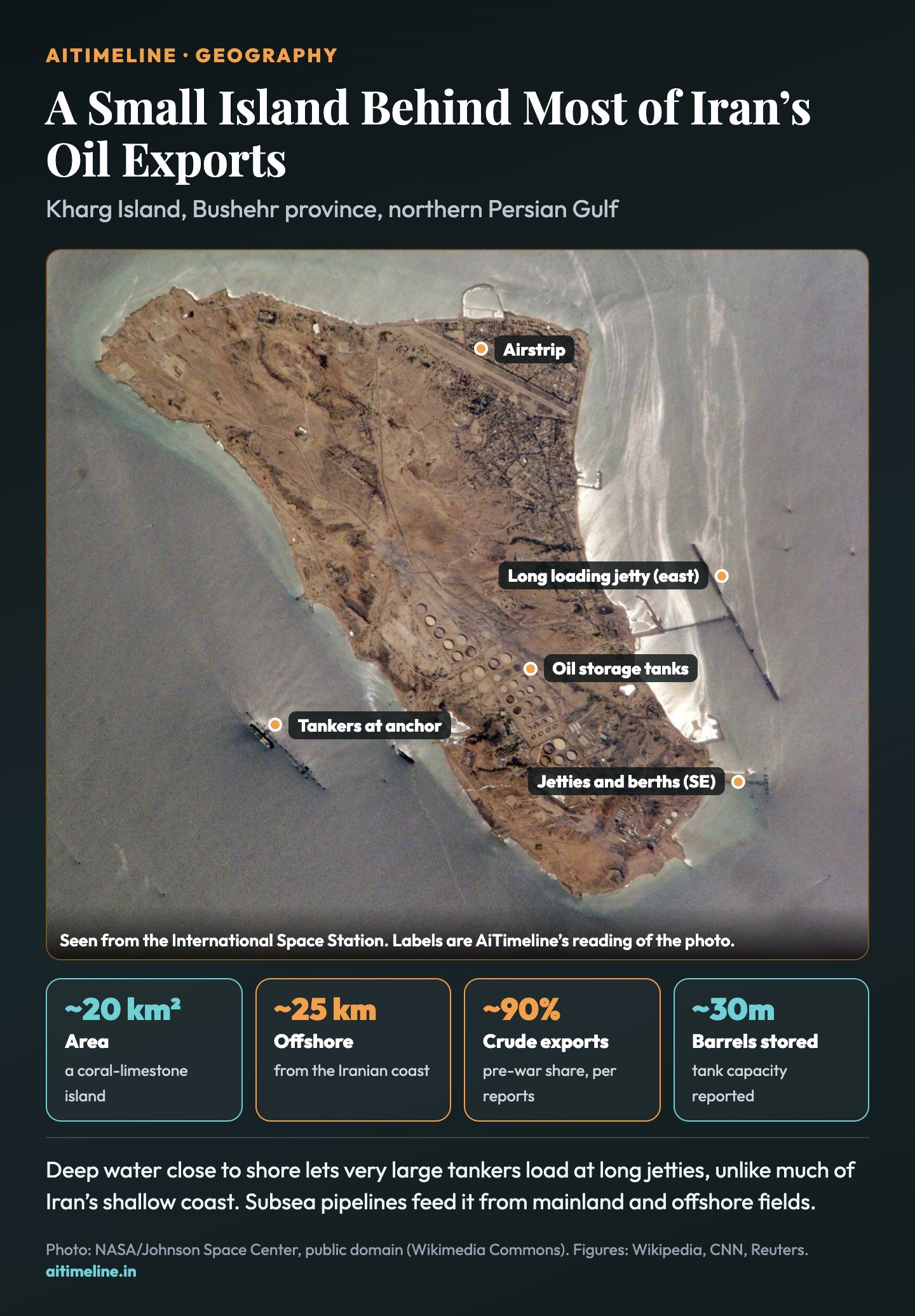
Much of Iran’s coastline is shallow, so very large crude carriers cannot load there. Kharg has deep water close to shore, and long jetties and offshore platforms reach it. Subsea pipelines bring crude from mainland and offshore fields, tanks store it, and jetties load it. That concentration is both its value and its weakness: a disruption at one site touches most of the country’s export revenue.
Kharg Island: Key Questions
What to Know About Kharg Island
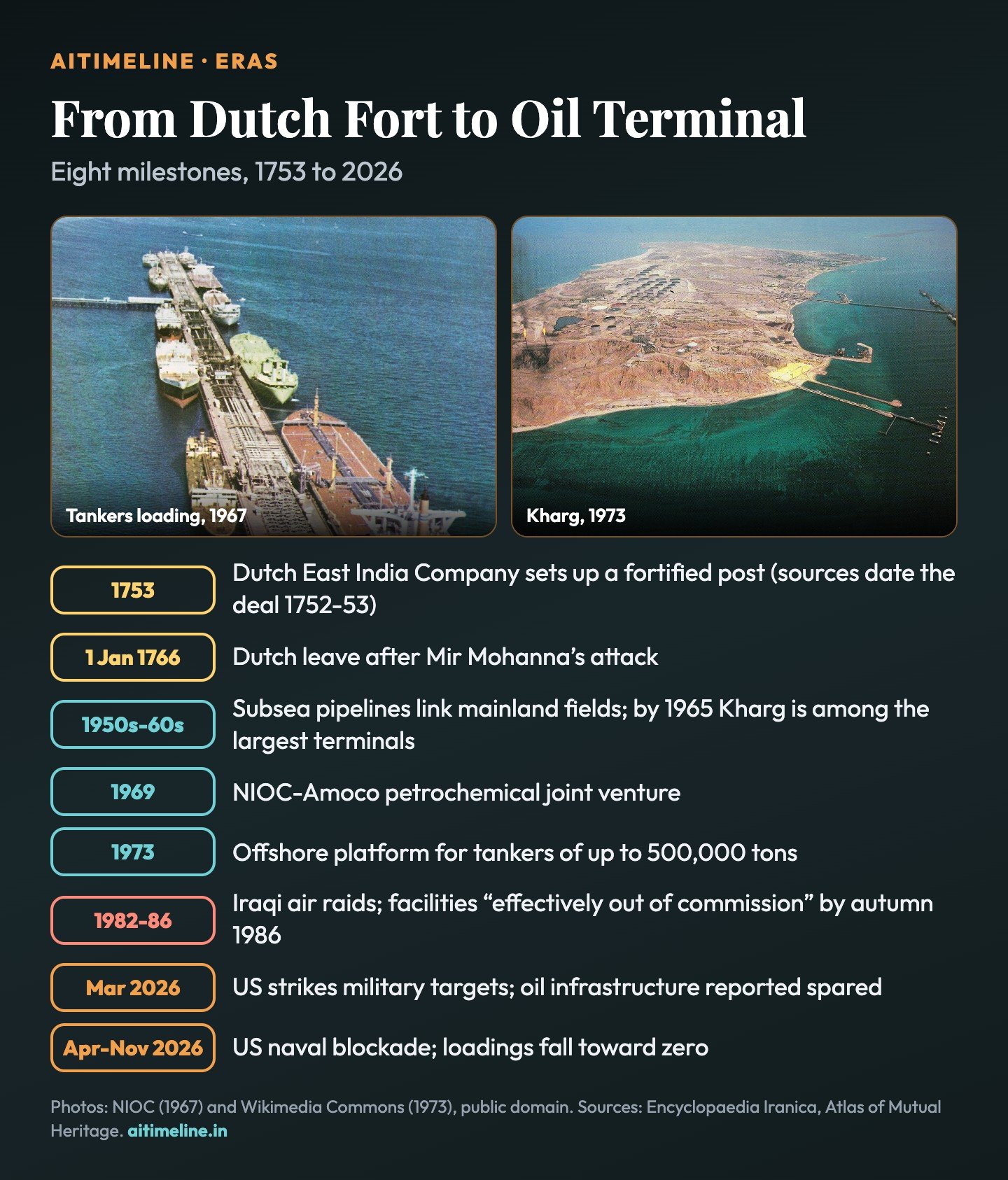
- 1753-1766: the Dutch East India Company held a fortified post until Mir Mohanna’s attack; they left on 1 January 1766.
- 1960s-1973: subsea pipelines and a supertanker platform made Kharg a giant terminal, with a 3 million barrel-a-day capacity.
- 1982-1986: Iraqi air raids, including 44 in August-November 1985, left the terminal effectively out of commission by autumn 1986.
- 1988: Operation Praying Mantis hit Iranian platforms such as Sassan, not Kharg.
- 13-14 March 2026: US forces struck 90+ military targets; oil infrastructure was reported spared.
- 13 April-18 June 2026: the first US naval blockade of Iranian ports; reimposed in mid-July.
- 31 August 2026: a claim that Kharg was destroyed was found to have no evidence.
- 19 October 2026: no tanker had docked at the crude terminals since late August.
- 20-23 November 2026: convoy reports and Iran’s vow to confront the blockade remain unconfirmed or unresolved.
Timeline: From a Dutch Fort to the 2026 Blockade
Newest first. Labels mark early history, build-up, attacks, blockade and verification.
Tanker-convoy reports and a satellite check, still unresolved Verification
What was reported: Euronews reported on 20 November that more than 14 tankers had gathered near Kharg and might test the US blockade, with ship-to-ship transfers in the Gulf. A satellite-based report said no tankers were visible at Kharg’s loading berths on 21 November. On 23 November Iran’s Foreign Ministry said Tehran would use all available tools to confront the blockade.
What is not established: No source we could open confirms an authorised convoy, a crude loading or a successful sailing. Ships anchored nearby do not show that oil was loaded. We could not open the Euronews page ourselves, so the convoy detail is attributed, not verified.
Kharg’s terminals reported empty since late August Blockade
Finding: Bloomberg said no tanker had docked at Kharg’s crude-export terminals since late August, the longest idle stretch since the war began in February. Crude exports fell from almost 1 million barrels a day in July to nothing since late August, per vessel tracking and Kpler and Vortexa data.
Detail: A small product tanker berthed on 10 October, and two vessels used LPG and sulphur jetties at the island’s south-east tip in mid-September. Jask, the alternative port, also showed no tankers.
A claim that Kharg was destroyed, and no evidence of it Verification
What happened: A social-media post, accompanied by an AI-generated video, said Kharg was being destroyed. Reuters reported there was no evidence of an attack and that a US official said the military had not targeted the island. The head of the National Iranian Oil Company called the claims laughable and said conditions were calm.
Why it matters: Kharg is a magnet for rumour because of its weight in Iran’s exports. Check imagery and official statements before treating damage as fact.
Blockade reimposed; loadings stop on 31 July Blockade
What happened: The United States reimposed its naval blockade of Iranian ports in mid-July after an interim agreement to reopen the Strait of Hormuz collapsed. July’s loadings were concentrated in the first half of the month. The Financial Times, citing Kpler and Energy Aspects, said operations at Kharg halted on 31 July.
Enforcement: US forces have since disabled several tankers, including one off Kharg. The exact day of reimposition varies by outlet, so we say mid-July.
The first US naval blockade of Iranian ports Blockade
Start: CENTCOM said the blockade would begin on 13 April after weekend talks failed, covering all Iranian ports and coastal areas while letting ships between non-Iranian ports pass the Strait of Hormuz.
End: On 18 June CENTCOM said the blockade had been lifted as part of an agreement suspending military operations during negotiations. Its forces stayed in the area.
US strikes 90+ military targets on Kharg; oil infrastructure reported spared Attack
What was said: On 13 March President Trump said US forces had ‘totally obliterated’ military targets on Kharg and chosen not to destroy the oil infrastructure, adding he would reconsider if Iran interfered with passage through Hormuz. On 14 March CENTCOM said more than 90 Iranian military targets were struck, including naval-mine storage and missile bunkers.
Iran’s account: Fars reported more than 15 explosions and said air defences, a naval base and airport facilities were hit, with no damage to oil infrastructure. IRNA, citing a provincial official, said exports continued normally.
Operation Praying Mantis hits Iranian oil platforms, not Kharg Attack
What happened: After USS Samuel B. Roberts struck a mine on 14 April 1988, US forces attacked Iranian naval vessels and oil platforms, including Sassan, on 18 April.
Common mix-up: The operation is often linked to Kharg because of the oil theme, but it did not strike Kharg Island.
Escorts begin as the Tanker War spreads Attack
What happened: As attacks on merchant shipping continued across the Gulf, the United States began escorting reflagged Kuwaiti tankers in 1987.
Link to Kharg: Much of the Tanker War grew out of Iraq’s effort to cut Iran’s oil income at Kharg and Iran’s response against Gulf shipping.
Kharg ‘effectively out of commission’; Iran loads at Sirri and Larak Attack
What happened: In July 1986 Iraq intensified air attacks on Iranian industrial sites. By the autumn Kharg’s facilities were effectively out of commission, and Iran relied on makeshift installations at Sirri and Larak islands.
Reach: Iraqi jets, refuelling in mid-air or using a Saudi base according to Iranica, hit Sirri and Larak too.
44 Iraqi raids in three months; the main loading jetty hit Attack
The raids: Between August and November 1985 Iraq raided Kharg 44 times. On 15 August an eastern jetty was badly damaged and, an Iranian source said, fixed in a few days. The Christian Science Monitor reported that the main western loading jetty was hit on the Thursday before 24 September (19 September).
Cost: A North Korean tanker at the jetty was hit, killing two sailors. Exports had been running at about 1.5 million barrels a day before the attack.
Iraq steps up attacks on Kharg and the tankers serving it Attack
What happened: Iraq attacked the island’s oil transshipment facility in March 1984 with French-supplied Super Etendard jets firing Exocet missiles, and began attacking tankers going to and from Kharg.
Date caution: Some sources give 27 March for the first direct strike. We could not confirm that day, so we say March 1984.
Iraqi air raids on the terminal begin Attack
What happened: Iranica dates Iraqi air strikes that ‘had all but destroyed most of the terminal facilities’ to 1982 through 1986. The war began on 22 September 1980.
Detail dropped: Specific August 1982 dates for missile hits on a ‘T-jetty’ were not confirmed in sources we could open, so they are left out.
Offshore platform for supertankers Build-up
What was built: An artificial island and loading platform was built in 1973 more than a kilometre off the south-eastern shore. It could take tankers up to 500,000 tons at a depth of up to 32 metres.
Scale: By the late 1970s Kharg’s capacity was around 3 million barrels a day, second only to Ras Tanura in Saudi Arabia.
NIOC-Amoco petrochemical complex Build-up
What was built: A 1969 joint venture of the National Iranian Oil Company and Amoco set up a facility able to produce about 186,000 tons of sulphur and 1.85 million tons of liquid gas a year (Iranica, citing a US Area Handbook).
Subsea pipelines make Kharg a giant terminal Build-up
What happened: A subsea pipeline loop from Bandar Ganaveh in 1964 and a 106-mile line from Aghajari in 1965 raised capacity. By 1965 Kharg was regarded as the largest oil shipment terminal in the world. Heavy crude from Gachsaran and offshore fields such as Faridun, Darius, Cyrus and Ardashir also reach it.
Naming: Writer Jalal Al-e-Ahmad had called the island ‘the Orphan Pearl of the Persian Gulf’ before oil changed it.
The Dutch leave Kharg Early history
What happened: Mir Mohanna attacked the Dutch fort, and the Dutch left on 1 January 1766, ending their presence on the island. Sources differ on whether it was a surrender or an expulsion.
The Dutch East India Company builds a fortified post Early history
What happened: A Dutch agent paid the ruler of Bandar Rig, Mir Nasir, for ownership of the island. Al Jazeera dates the agreement to 1752 and the garrisoned fort to the following year; Wikipedia says 1753.
Name caution: The brief called the ruler ‘Mir Naser al-Zaabi’. We use ‘Mir Nasir of Bandar Rig’, which the sources support.
A freshwater island with monastery ruins and Portuguese maps Early history
What survives: The island holds ruins of a Christian monastery possibly dating to the 7th century, tombs, temples and an Achaemenid cuneiform inscription from 550-330 BCE. The Portuguese controlled it from the 16th to the 17th century, and it appears on 16th-century Portuguese maps.
The Tanker War: Iraq’s Campaign Against Kharg
1982-1986, in dated steps.
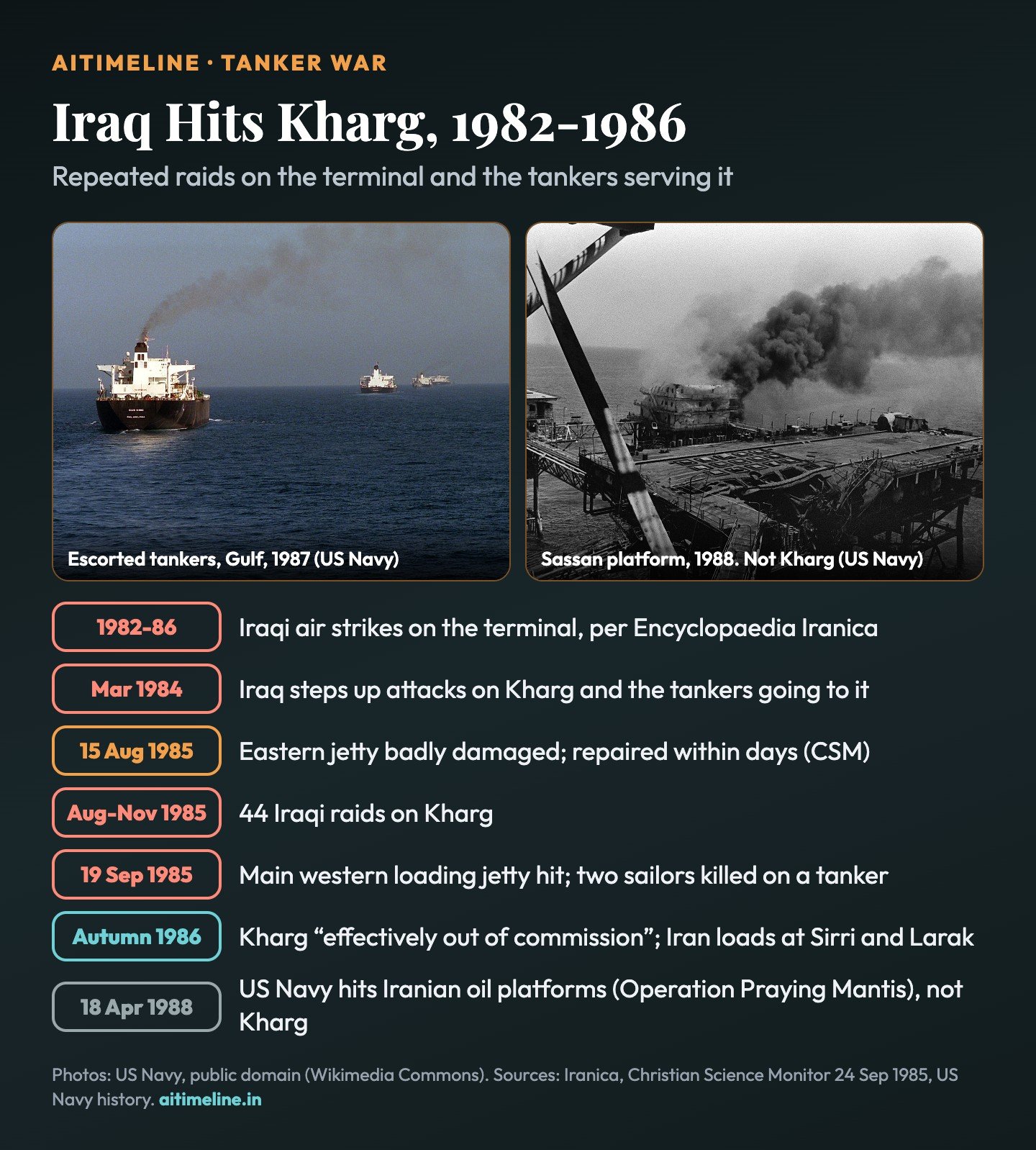
The oil logic was simple. Kharg paid for Iran’s war, so Iraq tried to close it. Repairs were often quick, and Iran answered by moving loading east to Sirri and Larak. The wider Tanker War then drew in other Gulf shipping and, in 1987-88, US escorts and Operation Praying Mantis. The photos above show that wider conflict; only the repairs and raids described in the timeline concern Kharg itself.
2026: Strikes, Blockade and Convoy Reports
Three developments, three levels of certainty.
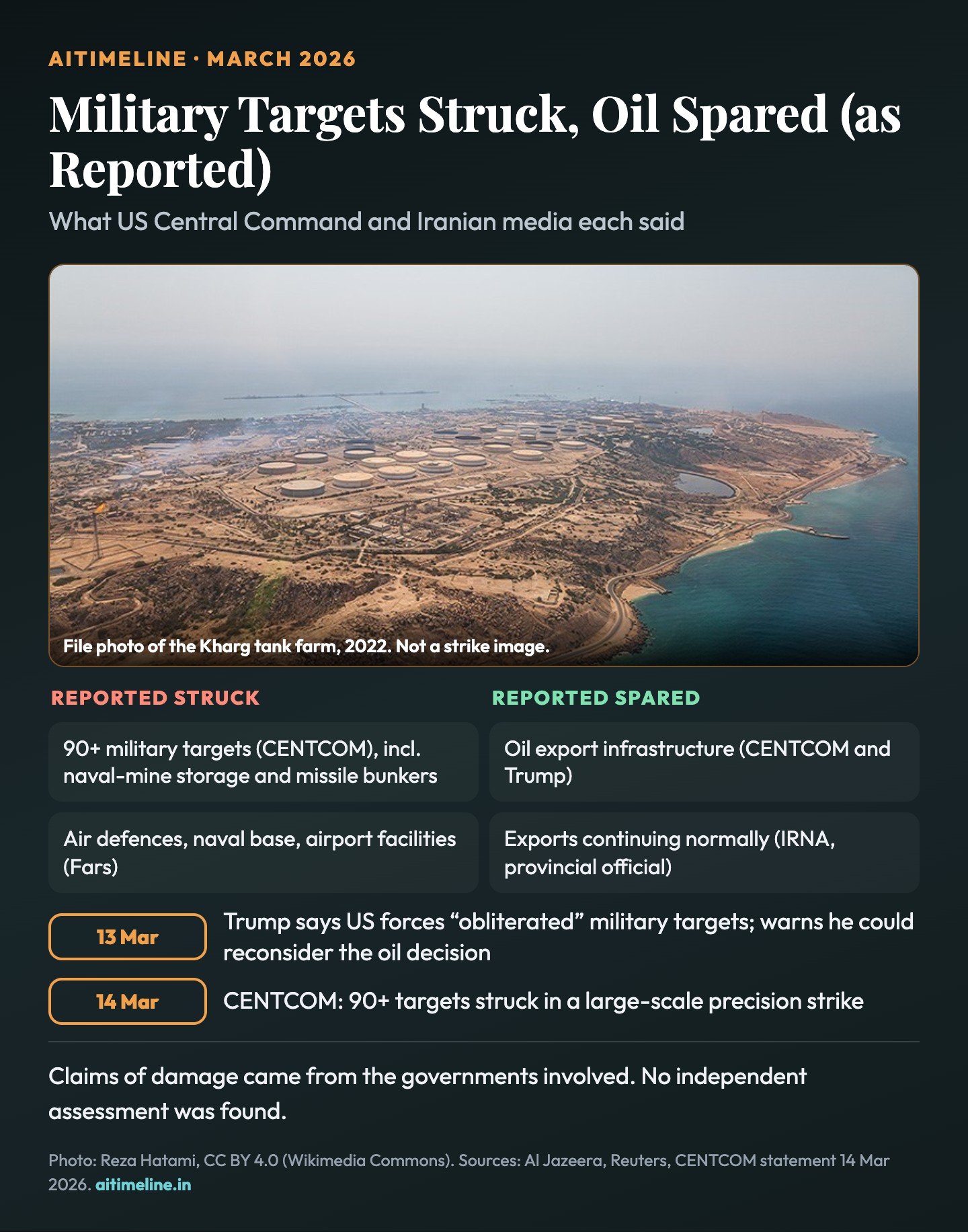
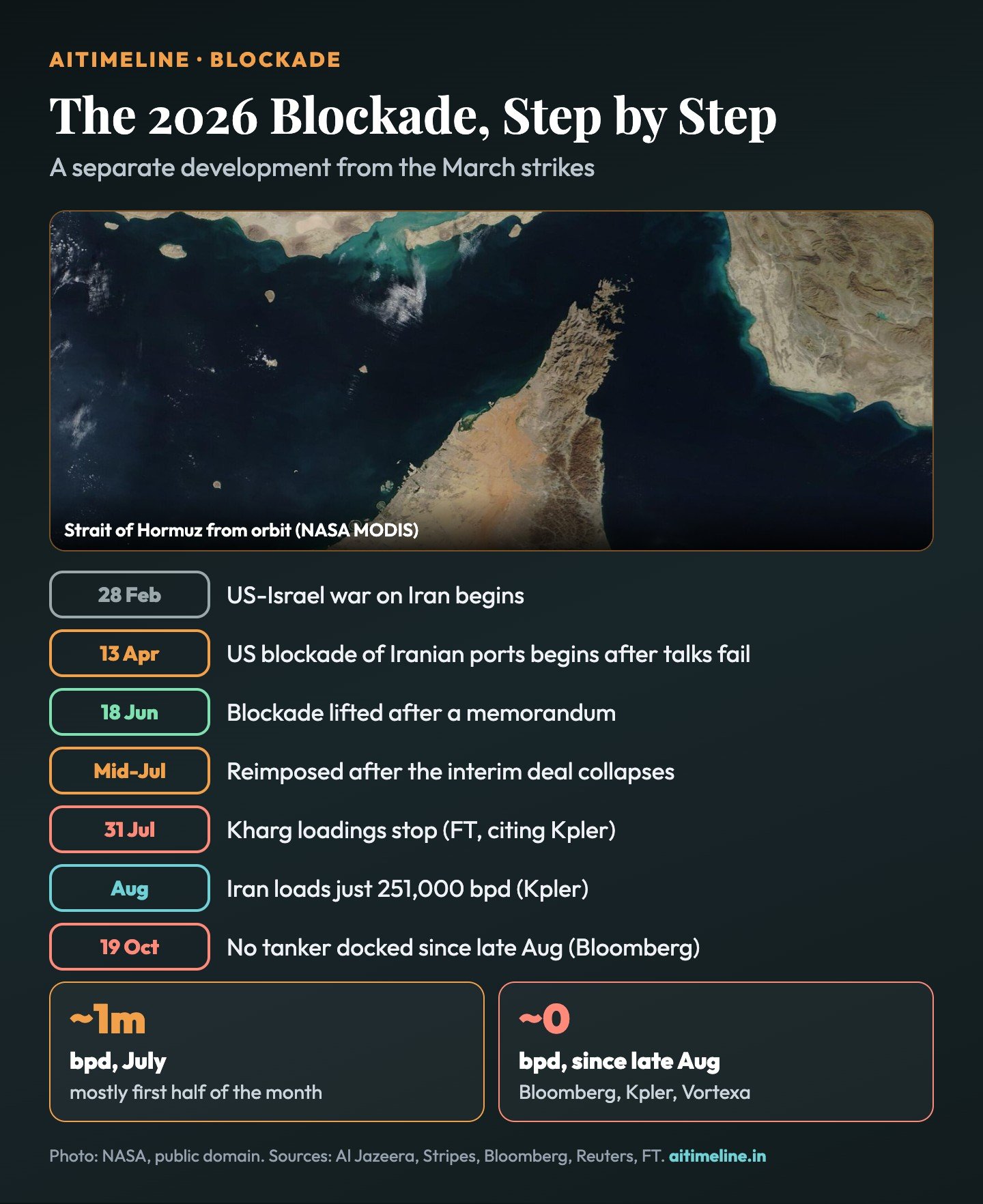
The strike came first and was a one-off attack on military sites. The blockade is slower and bites harder: with no safe way out, tankers stopped loading. By mid-October Bloomberg’s satellite review found no crude tanker at the terminals since late August. The November convoy reports are the newest and the least certain.
Kharg vs Jask: Why Replacement Is Hard
An outlet outside the Strait of Hormuz exists. It is small.
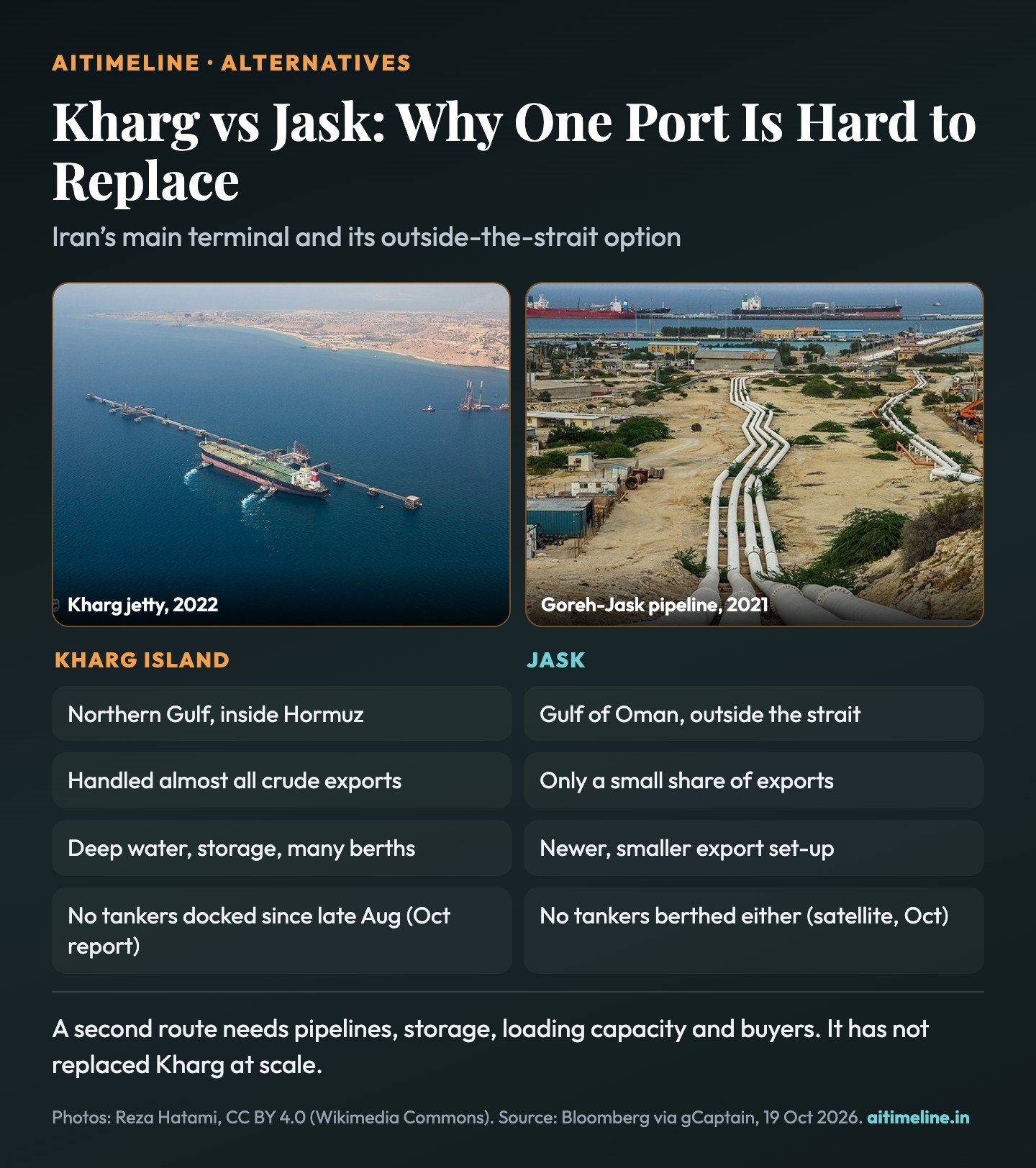
| Feature | Kharg Island | Jask |
|---|---|---|
| Position | Northern Persian Gulf, inside Hormuz | Gulf of Oman, outside the strait |
| Role | Main crude-export hub | Alternative route |
| Share of exports | 85-90% before the war | A small percentage (Bloomberg) |
| Infrastructure | Pipelines, tanks, many jetties | Goreh-Jask pipeline and terminal |
| Oct 2026 satellite check | No crude tanker since late August | No tankers berthed either |
Why Kharg Matters to Oil Markets
Supply. Reuters has reported that a prolonged interruption could remove up to about 2 million barrels a day from potential supply, depending on production and export conditions. Buyers. China has taken most Iranian crude: about 650 million barrels in the year through April 2026, per tanker-tracking data cited by Bloomberg. With Iranian barrels off the market, Chinese refiners have competed for other crude and ships, pushing prices and freight higher. Hormuz. Anything leaving Kharg must pass the Strait of Hormuz, so a Kharg crisis can become a shipping crisis. Risk premium. Markets react to threats as well as to losses, through higher insurance and shipping costs.
What Is Confirmed, Reported or Unconfirmed
Our grading of the 2026 claims.
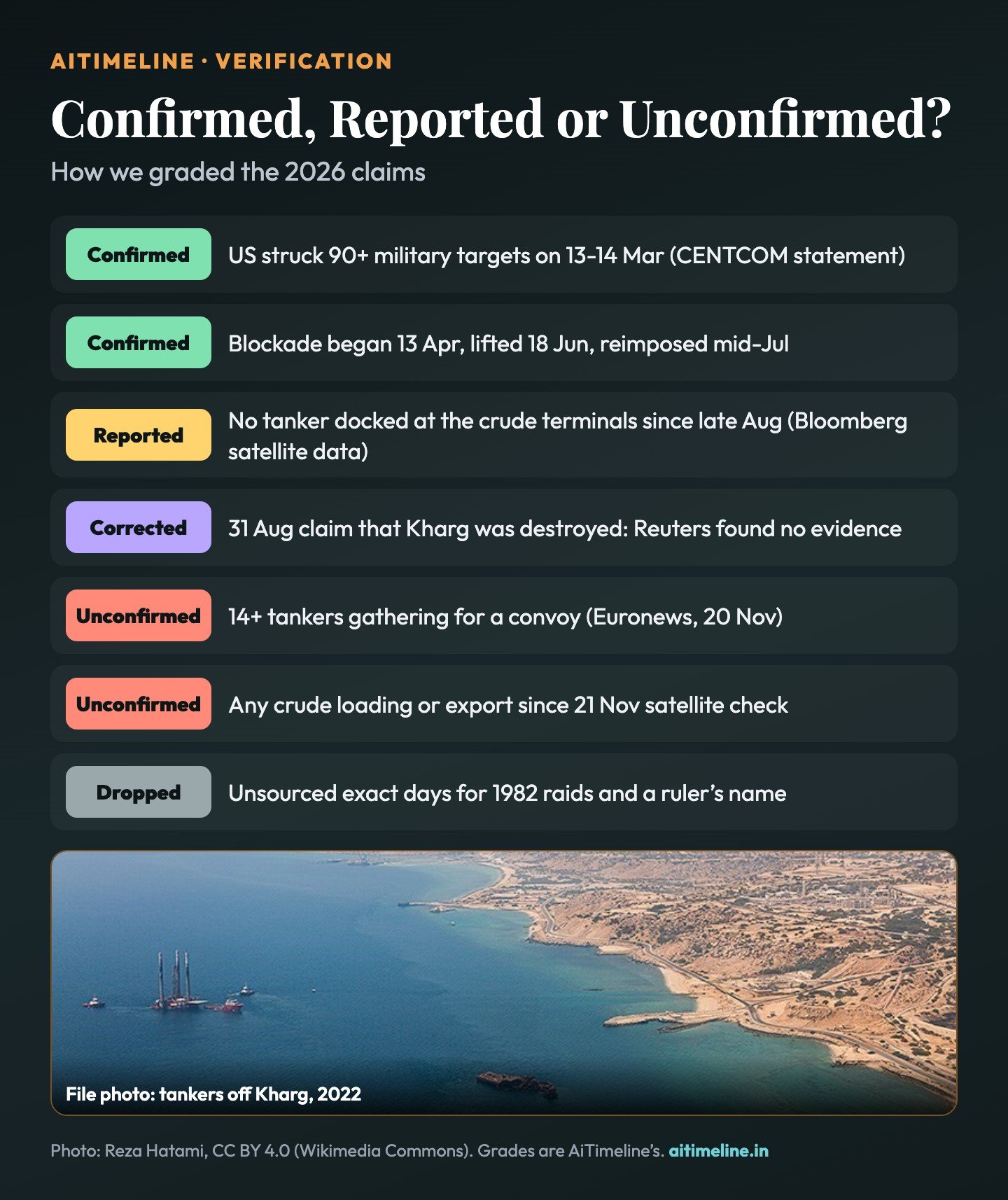
| Claim | Status | Source |
|---|---|---|
| US struck 90+ military targets, 13-14 Mar | Confirmed (official statement) | CENTCOM, Reuters, Al Jazeera |
| Oil infrastructure spared in March | Stated by both sides; no independent review | CENTCOM, Fars, IRNA |
| Blockade 13 Apr to 18 Jun, reimposed mid-Jul | Confirmed | CENTCOM, Stripes, Al Jazeera |
| No tanker at crude terminals since late Aug | Reported (satellite and tracking) | Bloomberg, 19 Oct |
| Kharg destroyed, 31 Aug | No evidence | Reuters factbox |
| Convoy of 14+ tankers, 20 Nov | Unconfirmed | Euronews (not opened by us) |
Conclusion: A Small Island With an Outsized Role
Kharg shows how geography turns a few square kilometres into a strategic asset. From a Dutch trading post it became, through pipelines and platforms, the gate for most Iranian crude. Iraq’s raids in the 1980s showed how exposed that concentration is, and Iran rebuilt and carried on.
In 2026 the threat changed shape. The March strikes hit military sites and left the oil terminals standing; the blockade then cut the routes the terminals depend on. The open question is whether Iran can sell oil without one island and one strait. Until another outlet works at scale, Kharg stays one of the Gulf’s most consequential places, and every claim about it deserves a source.
Explore More Timelines
People Also Ask
Frequently Asked Questions
⚠️ Editorial Note
History follows Encyclopaedia Iranica, the Christian Science Monitor (24 September 1985), and Wikipedia (including Operation Praying Mantis). 2026 events follow CENTCOM statements, Al Jazeera, Stripes, Reuters, Bloomberg (via gCaptain) and the Financial Times. Damage claims in March come from the governments involved. The November convoy and berth reports could not be independently confirmed. Where sources differ on dates, we say so. Photos are public domain or CC BY 4.0, credited on each image; the Sassan platform photo is from 1988 and is not Kharg.
Related Stories
Sources & further reading
Every dated entry above was checked against these references. Last reviewed 23 November 2026.
- Encyclopaedia Iranica: Kharg Island, developments since the 1950s
- Christian Science Monitor: Latest Iraqi attack reportedly knocks Iran's largest oil-export facility out of order (24 Sep 1985)
- Al Jazeera: US attacks military sites on Iran's Kharg island (14 Mar 2026)
- Reuters via Al-Monitor: Kharg Island, struck by US, is key hub for Iran oil exports
- Stars and Stripes: US forces lift naval blockade (18 Jun 2026)
- Bloomberg via gCaptain: Iran's main oil terminals remain empty as US blockade bites
- Al Jazeera: US, Iran engaged in tanker war (6 Sep 2026)
- Wikipedia: Operation Praying Mantis (18 Apr 1988)
- Atlas of Mutual Heritage: Kharg (Dutch East India Company)
- Wikipedia: Kharg Island