Hashimpura Massacre Timeline: Trial, Verdicts and Facts
Explore the Hashimpura massacre timeline: the 1987 killings of 38 Muslim men by PAC personnel, the investigation, 2015 acquittal and 2018 convictions.
Latest Story
On the evening of 22 May 1987, during communal riots in Meerut, personnel of Uttar Pradesh’s Provincial Armed Constabulary loaded between 42 and 45 Muslim men from the Hashimpura neighbourhood into a truck, drove them to two canals in Ghaziabad district, shot them and threw them into the water. Thirty-eight died; five survived to testify. The Hashimpura massacre then took nine years to reach a chargesheet, 28 years to reach an acquittal and 31 years to reach a conviction. This page follows the case from the round-up to November 2026, using the Delhi High Court’s 2018 judgment as its main record, and keeps the court’s figures separate from the shorthand used in many headlines.
42 to 45 is the number of men taken away; 38 is the number the High Court recorded as killed; five survived. The 2015 acquittal was set aside by the 2018 conviction, which is in force. The 2024 bail orders and the 2025 furlough ruling concern custody only; they are not acquittals. The convicts’ Supreme Court appeals are pending. Where the brief we started from or common accounts get a fact wrong, we say so in the entry and the editorial note.
💡 Short Answer
The Hashimpura massacre took place on 22 May 1987 in Meerut, Uttar Pradesh, when PAC personnel took 42 to 45 Muslim men from Hashimpura in a truck and shot them at two canals. The Delhi High Court recorded 38 killed and five survivors. A trial court acquitted 16 accused in 2015; on 31 October 2018 the High Court convicted all 16 and sentenced them to life. Their Supreme Court appeals are pending.
Hashimpura Massacre: Key Questions
The Hashimpura Case in Ten Points
- The setting: communal riots in Meerut from April 1987, with a shoot-at-sight curfew from 20 May.
- The round-up: about 644 men were detained in Hashimpura on 22 May 1987.
- The truck: 42 to 45 of them were taken in PAC truck URU-1493 of C-Company, 41st Battalion.
- The killings: men were shot at the Upper Ganga canal at Murad Nagar and the Hindon canal near Makanpur.
- The toll: 38 killed, five survivors, 11 bodies identified.
- The delay: chargesheet in 1996, case moved to Delhi in 2002, charges framed in 2006.
- The acquittal: all 16 surviving accused acquitted on 21 March 2015 for want of identification.
- The reversal: PAC General Diary entries admitted on appeal; 16 convicted and sentenced to life on 31 October 2018.
- Bail is not acquittal: ten convicts were bailed in December 2024; the convictions stand.
- Still open: the Supreme Court appeals had not been decided as of 16 November 2026.
From Two Canals to the Supreme Court
The whole case on one page, 1987 to 2026.
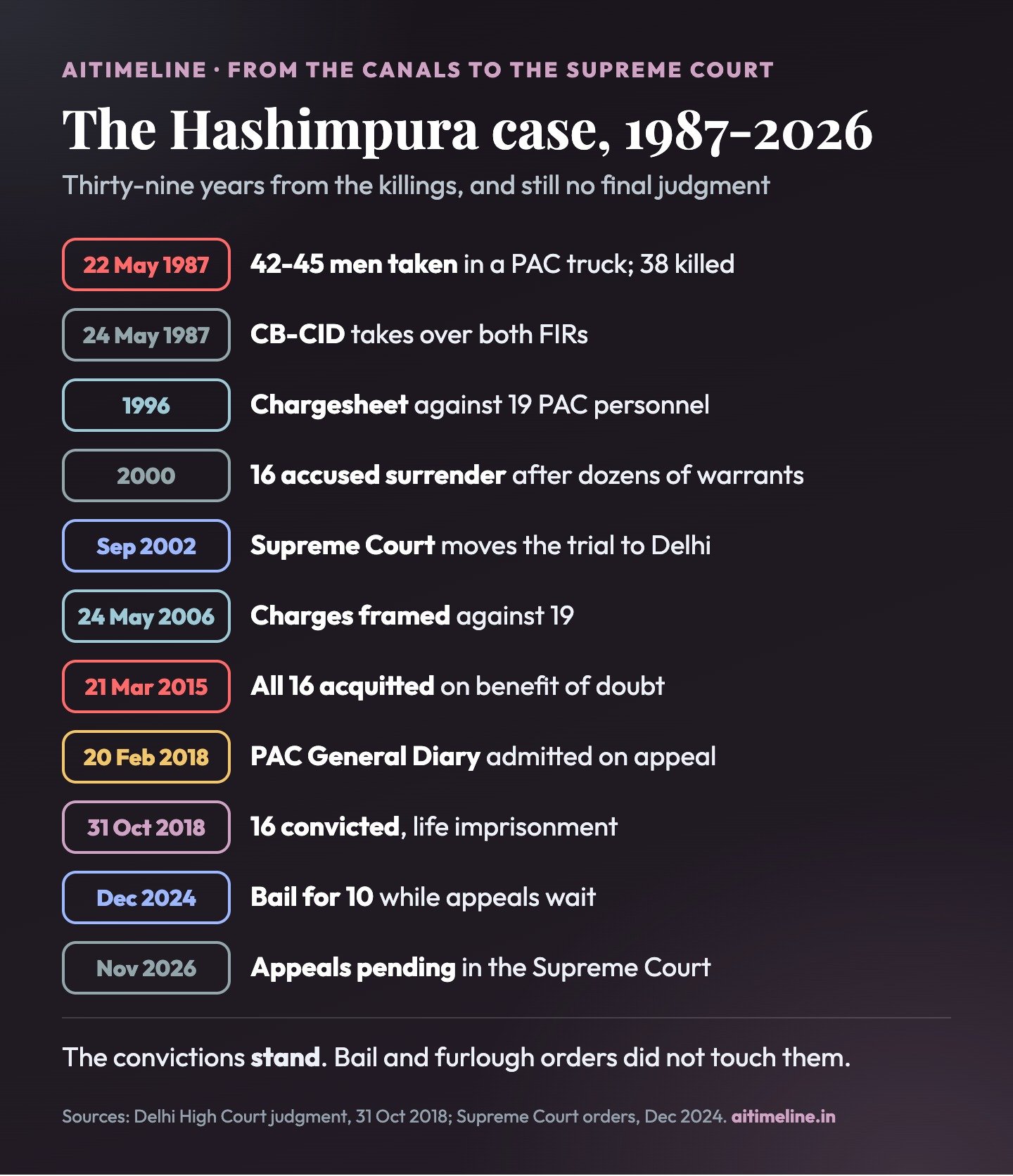
Hashimpura is unusual among India’s communal-violence cases because the killers were not a mob. The men were in the custody of an armed police force, in its vehicle, when they were shot. That made the facts easy to state and, for three decades, hard to prove: the survivors had been taken at dusk by men in uniform they did not know, and the documents that could say which platoon was in the truck sat in police records.
The case moved forward each time survivors and families pushed it: to the Lucknow Bench in 1995 to see the inquiry report, to the Supreme Court in 2001 to move the trial out of Uttar Pradesh, to RTI in 2007, and to the High Court in 2015 after the acquittal.
What Happened on 22 May 1987
The Delhi High Court’s reconstruction.
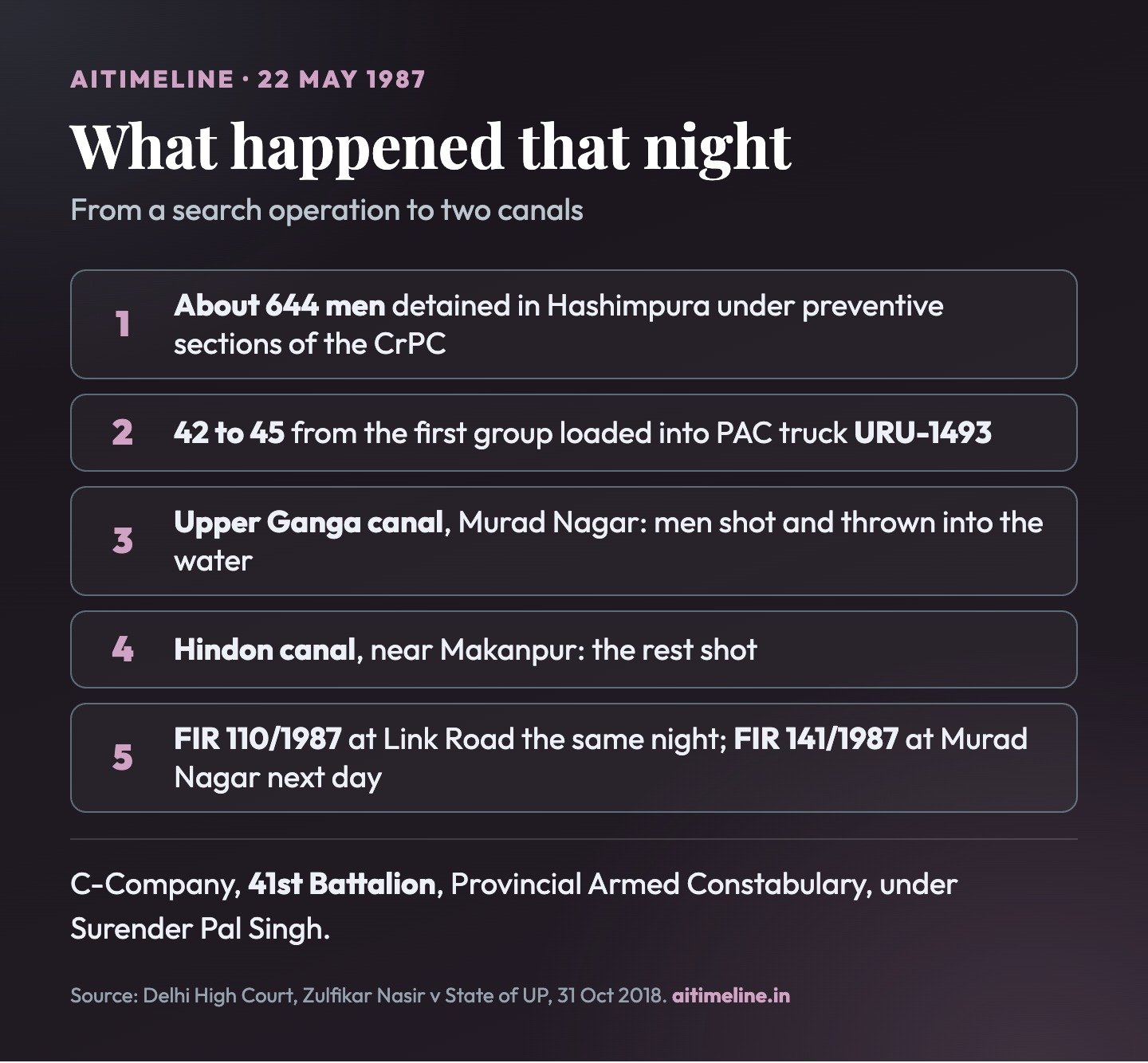
Meerut had been under curfew since riots flared again around 19 May. On 21 May, according to the High Court, a man named Kaushik, the brother of an Army Major, was killed near Hashimpura and two PAC rifles were looted. The next afternoon police, PAC and Army personnel searched the neighbourhood and arrested about 644 men under preventive provisions of the Criminal Procedure Code. Most were taken to police lines. From the first group, 42 to 45 men, “old and young, all Muslim”, were packed into a PAC truck.
The truck did not go to a police station. It went to the Upper Ganga canal at Murad Nagar, where men were shot and thrown in, and then to the Hindon canal near Makanpur, where the rest were shot. Ghaziabad’s Superintendent of Police, Vibhuti Narain Rai, reached the Hindon canal that night, and FIR 110/1987 was registered at Link Road police station. Survivors from the Murad Nagar canal lodged FIR 141/1987 the next day.
42 or 38? The Numbers Explained
Why reports quote different figures.
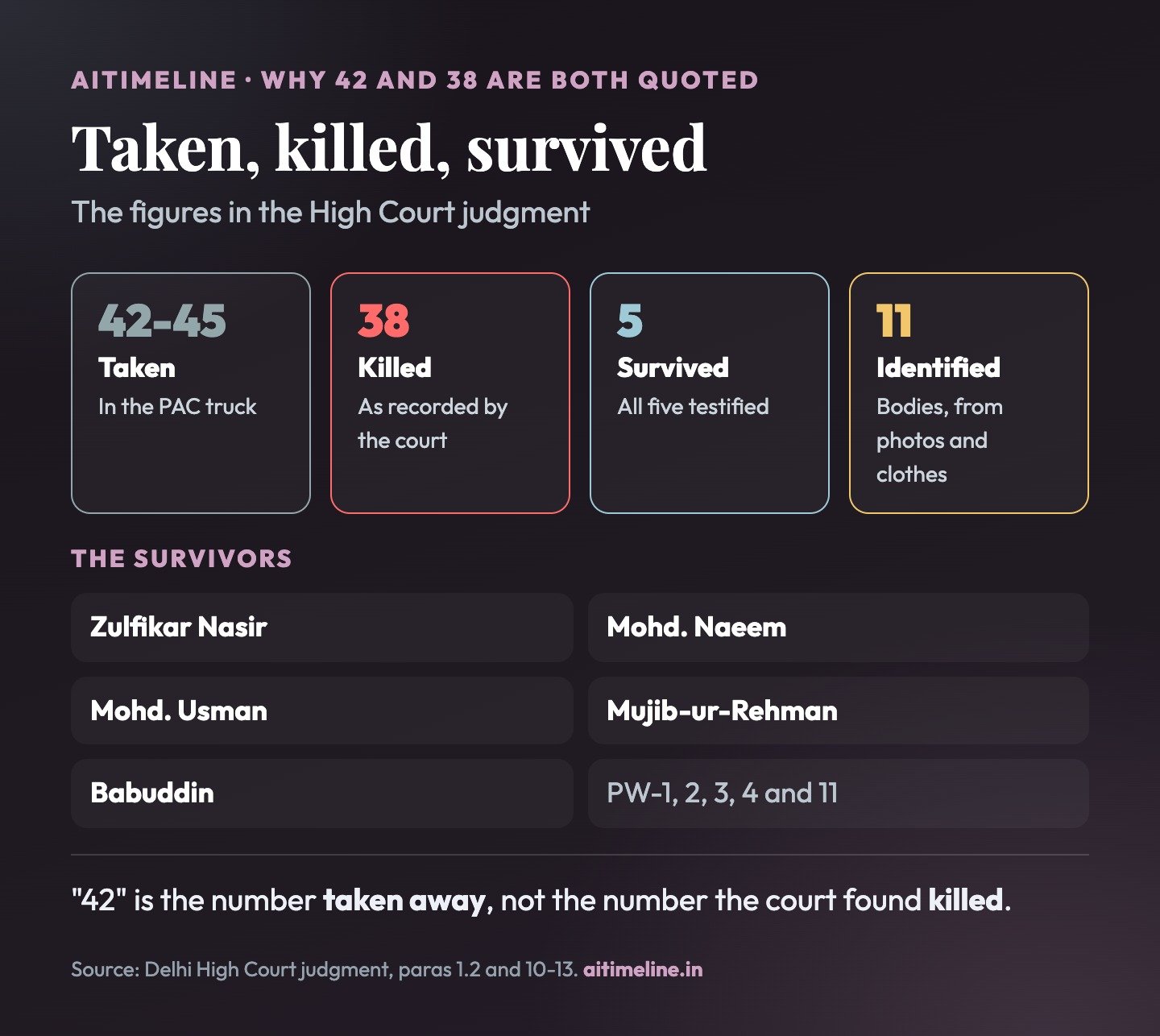
| Figure | What it counts | Source |
|---|---|---|
| About 644 | Men detained in Hashimpura on 22 May 1987 | High Court, para 1.4 |
| 42-45 | Men loaded into the PAC truck | High Court, paras 1.2, 10 |
| 38 | Men killed | High Court, para 1.2 |
| 5 | Survivors who testified | High Court, para 10 |
| 11 | Bodies identified by relatives | High Court, paras 1.2, 11 |
| 19 / 16 | PAC personnel charged / convicted (three died) | High Court, paras 1.6, 16 |
The bodies of most victims were never recovered from the canals, and relatives identified the 11 who were found from photographs and clothing, not by seeing the bodies. That is why the number killed rests on survivor testimony and the missing, not on post-mortems.
Why Justice Took 31 Years
Each stage, measured from the night of the killings.
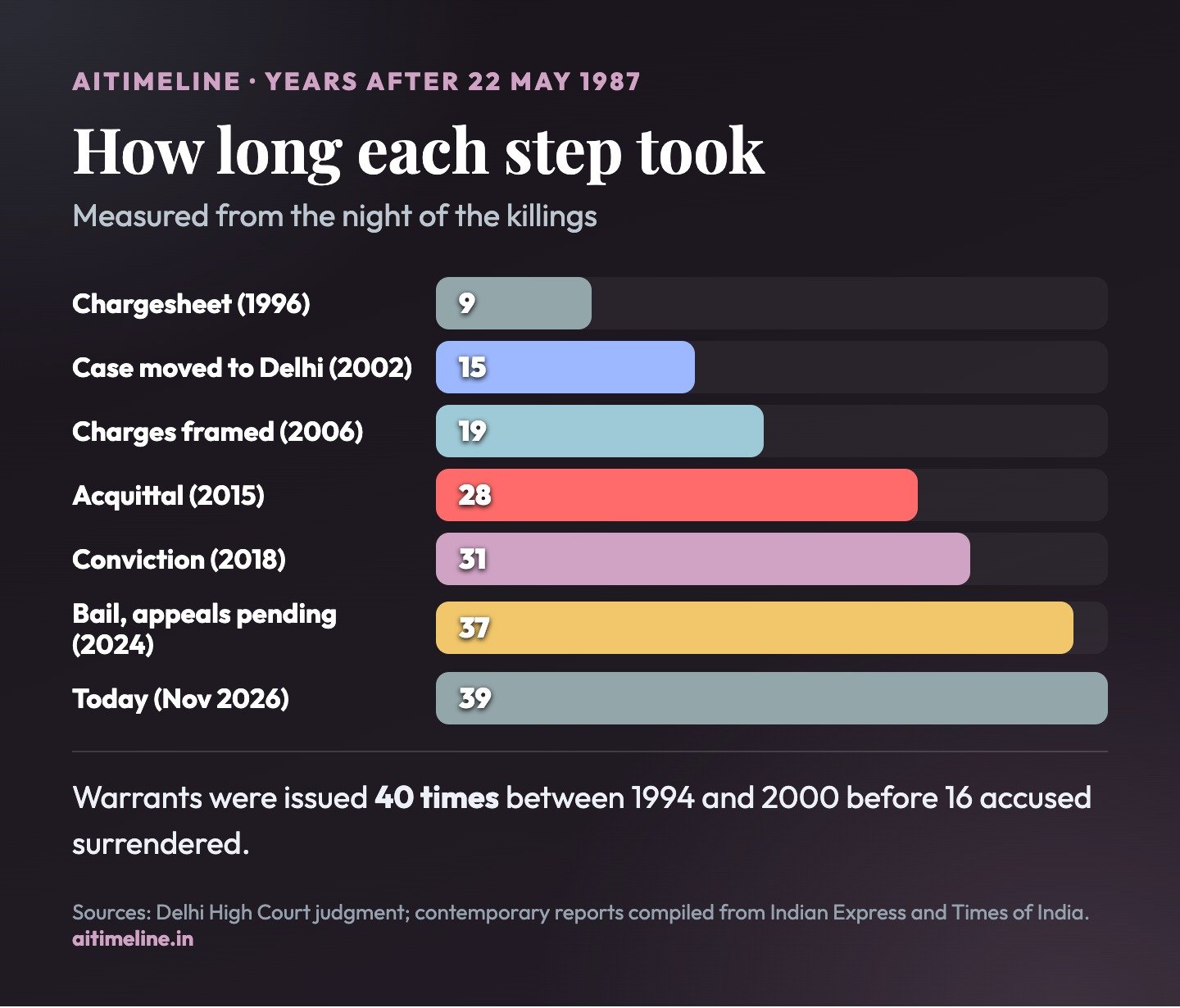
| Stage | Date | What held it up |
|---|---|---|
| Investigation | 1987-1989 | Handled by the CB-CID, part of the same state police as the PAC |
| Inquiry report | 1994-1995 | Kept from the public until families went to the High Court |
| Prosecution sanction | 1 June 1995 | Granted for 19 of the 37 recommended |
| Chargesheet | 1996 | Filed nine years after the event |
| Appearance | 1994-2000 | 23 bailable and 17 non-bailable warrants before surrender |
| Transfer | September 2002 | Supreme Court moved the trial to Delhi |
| Prosecutor | to November 2004 | No special public prosecutor appointed |
| Trial | 2006-2015 | Records late from UP; 161 listed witnesses |
2015 vs 2018: Why the Verdict Flipped
The trial court’s doubts, and the documents that answered them.
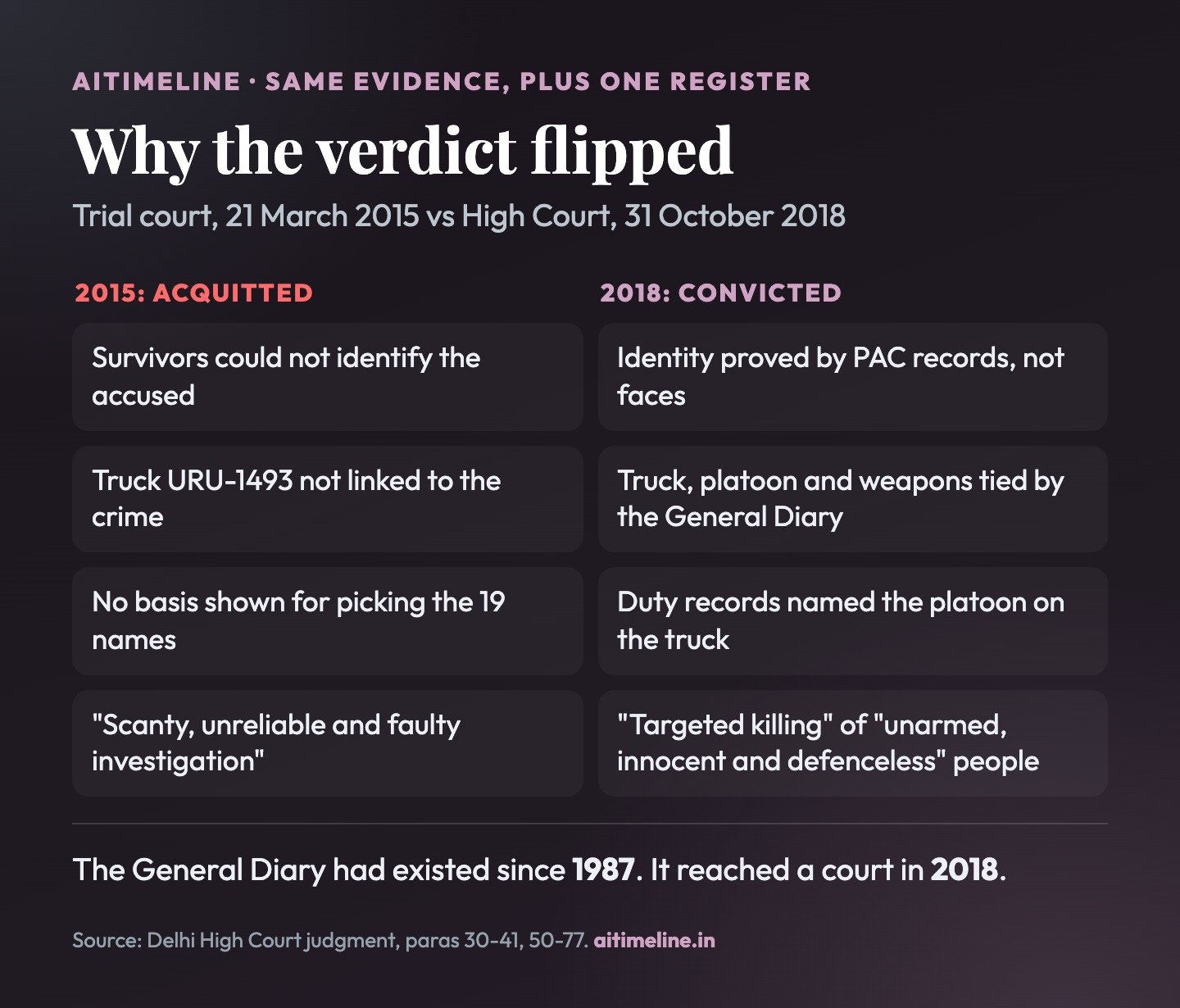
The trial court did not doubt that the killings happened. It accepted that 42 to 45 men were abducted and that the survivors were shot. Its problem was who did it: no survivor could identify any accused after two decades, no recovery or disclosure tied them to the crime, and the prosecution could not explain how it had chosen the 19 names. It concluded that the accused “cannot be convicted on the basis of scanty, unreliable and faulty investigation which has gaps and holes.”
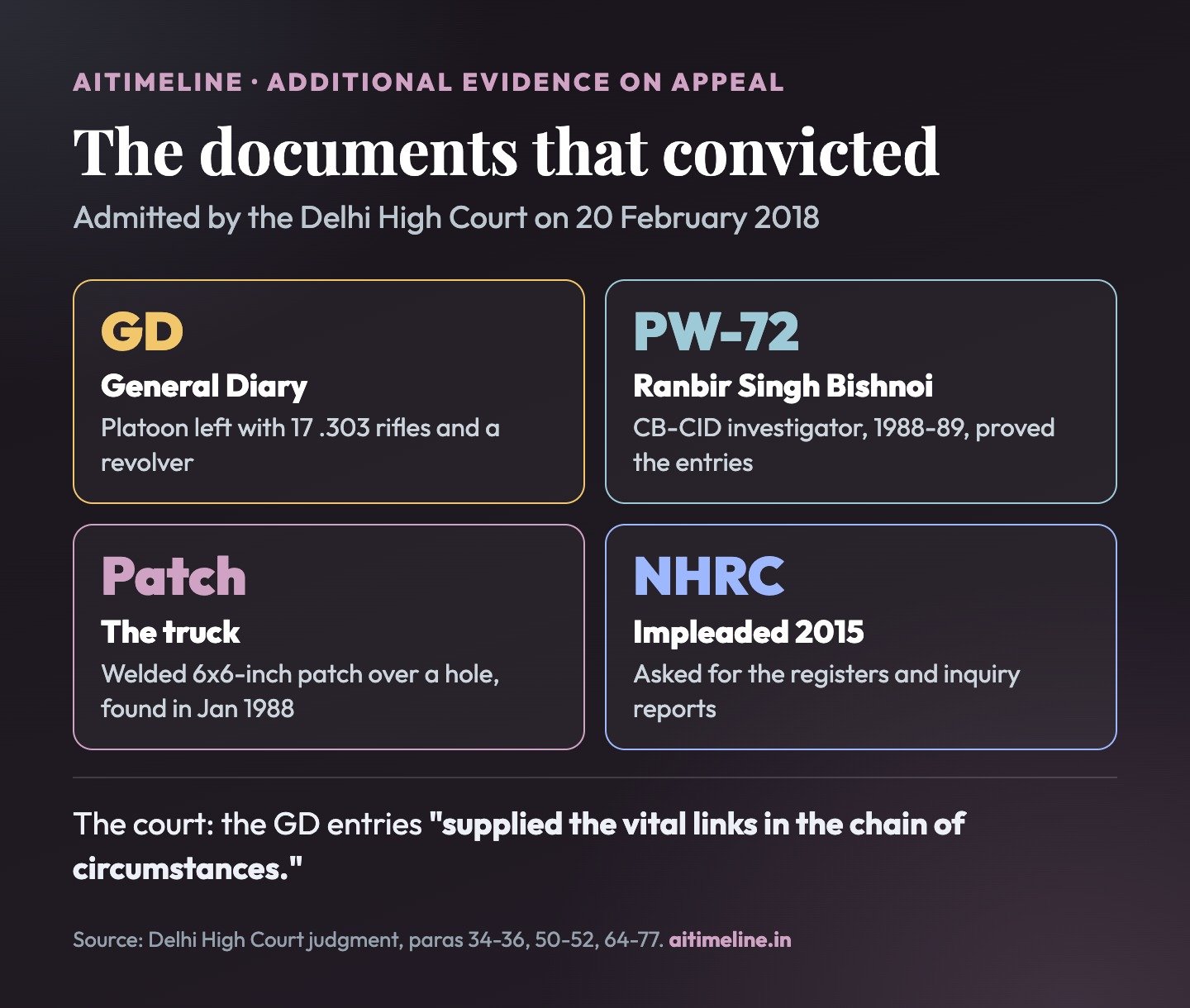
On appeal, the NHRC asked the High Court to call for the PAC’s own registers. On 20 February 2018 the court admitted extracts of the General Diary, proved by the original CB-CID investigator, recording the C-Company platoon leaving with its rifles. Together with the forensic findings on the truck, they “supplied the vital links in the chain of circumstances.” The court stressed that this was “not a case of mere re-appreciation” of the trial evidence.
Timeline: The Hashimpura Massacre Case, 1987-2026
Newest first. Colour shows the strand: Meerut 1987, the investigation, the trial, the appeal and verdict, or after the verdict.
Where the case stands After the verdict
Convictions stand: The Delhi High Court’s 31 October 2018 judgment convicting 16 former PAC personnel remains the operative decision. Their appeals, filed in the Supreme Court from November 2018, are pending; we found no hearing that decided them.
Custody: Ten of the 16 were granted bail by the Supreme Court in December 2024. We could not confirm the custody status of the other six.
Still invoked: On 14 November 2026, at a rally in Meerut, AIMIM chief Asaduddin Owaisi cited Hashimpura and Maliana while attacking the Samajwadi Party and Congress ahead of the 2027 Uttar Pradesh election.
Hashimpura back in a Meerut campaign speech After the verdict
What happened: Asaduddin Owaisi, defending his alliance with Chandrashekhar Azad, invoked Hashimpura, Maliana and the 2013 Muzaffarnagar riots to argue that the Samajwadi Party and Congress had failed Muslim voters, reported by Amar Ujala and ANI.
Why it matters: Congress governed both Uttar Pradesh and the Centre in May 1987. The killings remain a political reference point in western UP.
Delhi HC: a pending appeal is no bar to furlough After the verdict
The question: Note 2 to Rule 1224 of the Delhi Prison Rules says furlough “will not be granted” while a convict’s appeal is pending before the High Court. Hashimpura convicts challenged how that rule was read when their appeal was in the Supreme Court; reports of the challenge appeared in February 2025.
The ruling: The Division Bench held that the mere pendency of a criminal appeal or special leave petition in the Supreme Court does not bar prison authorities from considering parole or furlough, reported by India Legal.
What it did not do: The ruling concerned temporary release. It did not touch the convictions.
Bail for two more, one aged 82 After the verdict
Order: The same bench granted bail to two more convicts, one of them 82 and said to be ill. The order recorded: “Applicants have undergone incarceration for almost 6 years. Therefore, applicants are entitled to bail.”
Total: With the 6 December order, 10 of the 16 convicts were on bail pending their appeals.
Supreme Court grants bail to eight convicts After the verdict
Order: The bench granted bail to eight of the 16 former PAC personnel, noting that they had been in jail since 2018 and that their appeals had been listed several times but not heard. Senior Advocate Amit Anand Tiwari argued for them.
Legal position: The bail order did not set aside the convictions, reported by Scroll and LawBeat.
Convicts surrender and appeal Appeal & verdict
Surrender: The High Court had ordered the 16 to surrender by 22 November 2018. They surrendered in batches at Tis Hazari, Delhi, during November.
Appeal: Their appeals against conviction reached the Supreme Court; one, filed on 27 November 2018, lists Zulfikar Nasir, the first survivor to testify, among the respondents.
Delhi High Court convicts 16; life imprisonment Appeal & verdict
Verdict: The Division Bench set aside the 2015 acquittal and held all 16 surviving accused guilty of murder, kidnapping, attempt to murder and causing disappearance of evidence, read with criminal conspiracy. Each was sentenced to life imprisonment.
Finding: “We hold that this was targeted killing by armed forces of the unarmed, innocent and defenceless members of a particular community.” The court also called the case an example of “systemic failure that results, not infrequently, in a miscarriage of justice.”
The evidence that changed it: Extracts of the PAC’s General Diary, admitted as additional evidence on appeal, placed named personnel on duty with the truck. The court said they “supplied the vital links in the chain of circumstances.”
Judgment reserved Appeal & verdict
What happened: After hearing the State of Uttar Pradesh, the NHRC, the survivors and the accused, the bench reserved its judgment on the three appeals, Crl.A. 574, 629 and 884 of 2015.
The General Diary is admitted Appeal & verdict
Order: The High Court allowed the prosecution to lead additional evidence on extracts of the PAC’s General Diary register. They were proved through Ranbir Singh Bishnoi, the CB-CID’s investigating officer from 1988-89.
What it showed: The entries recorded the C-Company platoon leaving with its weapons on 22 May 1987: 17 .303 rifles, a revolver and their rounds.
NHRC joins the appeal Appeal & verdict
What happened: The National Human Rights Commission was impleaded. Its application sought the platoon’s duty, attendance and General Diary registers, the CB-CID report and the Gian Prakash inquiry report.
Why it mattered: This was the route by which the documentary evidence missing at trial reached the court.
Appeals filed; compensation announced Appeal & verdict
Appeals: The Uttar Pradesh government and the victims’ families challenged the acquittal in the Delhi High Court.
Compensation: The UP government announced Rs 5 lakh for each victim’s family on 22 May 2015, the 28th anniversary. The trial court had recommended compensation; the High Court later oversaw its disbursal in a connected appeal.
Trial court acquits all 16 Trial
Verdict: The court accepted that 42 to 45 men had been taken away and that the survivors had been shot, but acquitted the 16 surviving accused on the benefit of the doubt.
Reasons: No survivor could identify the accused. The court found no reliable evidence tying truck URU-1493 or its driver to the crime, and no clear basis for how the 19 names had been chosen. “The accused persons cannot be convicted on the basis of scanty, unreliable and faulty investigation which has gaps and holes.”
Accused examined Trial
What happened: The accused’s statements were recorded under Section 313 of the Criminal Procedure Code, the stage at which they answer the evidence against them. All denied involvement.
Subramanian Swamy’s plea dismissed Trial
The plea: On 16 October 2012 Subramanian Swamy asked the court to examine the role of P. Chidambaram, Minister of State for Internal Security in 1987.
Outcome: The Additional Sessions Judge dismissed the plea in March 2013. It was separate from the prosecution of the PAC personnel.
Witnesses who could not identify anyone Trial
Progress: Four years into the trial, 63 of the 161 listed prosecution witnesses had been examined. On 19 May 2010 four more deposed; none could identify any of the accused.
Why it mattered: Identification after more than 20 years was the weak point the defence pressed and the trial court finally accepted.
615 RTI applications Trial
What happened: Two survivors and 36 family members filed 615 Right to Information applications with the UP Police headquarters.
What they found: The answers, reported in September 2007, showed the accused were still in service and that the incident was not mentioned in their annual confidential reports.
The trial opens with a survivor Trial
First witness: Zulfikar Nasir, who had survived being shot at the Hindon canal, began his evidence as PW-1.
Delay: A week earlier the judge had adjourned the case and issued notices to UP’s Chief Secretary because the state had not sent the case records. Three accused, including the company commander Surender Pal Singh, had died.
Charges framed against 19 Trial
Charges: Charges under the IPC sections for murder, attempt to murder, kidnapping, causing disappearance of evidence and criminal conspiracy were framed against 19 accused.
Timing: It was 19 years and two days after the killings.
Supreme Court moves the case to Delhi Trial
What happened: On a petition filed by survivors and families in 2001, the Supreme Court transferred the trial from Ghaziabad to the Sessions Court in Delhi. A second transfer order followed in July 2007.
Why: The petitioners argued that proceedings in Uttar Pradesh had stalled for years.
Sixteen accused surrender Investigation
What happened: After bailable warrants issued 23 times and non-bailable warrants 17 times between April 1998 and April 2000, 16 of the accused surrendered in Ghaziabad and were released on bail.
Context: They had not appeared in court since the chargesheet was filed.
Chargesheet filed against 19 Investigation
What happened: The CB-CID charged 18 PAC personnel, adding a 19th in a supplementary chargesheet. The High Court later noted that the chargesheet came “nine years after the event”.
Sanction: The state had approved prosecution of 19 personnel on 1 June 1995, after its investigating officer recommended 37 PAC and police employees.
The inquiry reports stay secret Investigation
What happened: The three-member inquiry headed by former Comptroller and Auditor General Gian Prakash reported to the state government in 1994. It was not made public until 1995, after families went to the Lucknow Bench of the Allahabad High Court.
Numbers: Reports have said as many as 66 personnel were examined during the investigations; the figure that matters in court is 19.
CB-CID investigation Investigation
Investigation: Investigating officer Ranbir Singh Bishnoi examined the case from July 1988 to June 1989. A CB-CID Superintendent of Police reported on 22 June 1989.
The truck: Forensic examination of truck URU-1493 on 4 January 1988 found a welded 6×6-inch patch over a hole and dents, which the High Court later linked to the shooting.
Case handed to the CB-CID Meerut 1987
What happened: Two days after the killings, investigation of both FIRs was transferred from the Ghaziabad police to the Crime Branch-CID of the UP Police.
Concern: The CB-CID is part of the same state police structure as the PAC, a point survivors and rights groups raised for years.
Maliana, and a second FIR Meerut 1987
FIR 141/1987: Survivors from the Upper Ganga canal at Murad Nagar lodged a second FIR.
Maliana: The same day, in Maliana village near Meerut, at least 63 people were killed in violence in which the PAC was also accused. A Meerut court acquitted the accused in March 2023; appeals are pending in the Allahabad High Court.
The Hashimpura killings Meerut 1987
The round-up: During a search of Hashimpura, about 644 men were arrested under preventive sections of the Criminal Procedure Code. From the first group, 42 to 45 Muslim men, old and young, were loaded into truck URU-1493 of C-Company, 41st Battalion, PAC.
The killings: The truck was driven to the Upper Ganga canal (Gang Nahar) at Murad Nagar, where men were shot and thrown into the water, and then to the Hindon canal near Makanpur, Ghaziabad, where the rest were shot.
The toll: The High Court recorded 38 killed and five survivors: Zulfikar Nasir, Mohd. Naeem, Mohd. Usman, Mujib-ur-Rehman and Babuddin. Only 11 bodies were identified, from photographs and clothes.
First FIR: FIR 110/1987 was registered at Link Road police station, Ghaziabad, that night. Ghaziabad’s SP, Vibhuti Narain Rai, reached the Hindon canal and later wrote the book Hashimpura 22 May.
A killing and two looted rifles Meerut 1987
What happened: In violence near Hashimpura, a man named Kaushik, the brother of an Army Major, was killed, and two rifles belonging to PAC personnel were looted, according to the High Court.
Why it matters: The search operation that followed the next day was carried out in this atmosphere.
Communal violence in Meerut Meerut 1987
Background: Communal riots broke out in Meerut in April 1987. They flared again around 19 May; the Army was called in and a shoot-at-sight curfew was ordered on 20 May.
Forces deployed: Police, the PAC, paramilitary forces and the Army were all on the streets. C-Company of the PAC’s 41st Battalion was posted to the Hashimpura area.
Legal Status: Conviction, Bail and Appeal Are Different
Four orders that are easy to confuse.

| Order | Date | What it means |
|---|---|---|
| Acquittal | 21 March 2015 | Set aside in 2018; no longer in force |
| Conviction | 31 October 2018 | 16 guilty, life imprisonment; operative today |
| Bail (8) | 6 December 2024 | Custody suspended pending appeal |
| Bail (2) | 20 December 2024 | Same, including an 82-year-old |
| Furlough ruling | July 2025 | Prison authorities may consider leave while an SC appeal is pending |
| Supreme Court appeals | Pending | The only route left to change the convictions |
Key People and Institutions
| Name | Role |
|---|---|
| Zulfikar Nasir | Survivor; first prosecution witness in 2006; lead appellant against the acquittal |
| Mohd. Naeem, Mohd. Usman, Mujib-ur-Rehman, Babuddin | The other four survivors who testified |
| Surender Pal Singh | Commander of the C-Company platoon; first accused; died before the verdict |
| Vibhuti Narain Rai | SP, Ghaziabad, in 1987; author of Hashimpura 22 May |
| Ranbir Singh Bishnoi | CB-CID investigating officer, 1988-89; proved the General Diary in 2018 |
| Justices S. Muralidhar and Vinod Goel | Delhi High Court bench that convicted the 16 in 2018 |
| Justices A.S. Oka and A.G. Masih | Supreme Court bench that granted bail in December 2024 |
| NHRC | Joined the appeals in 2015 and sought the PAC registers |
Why the Hashimpura Case Matters
Accountability of armed police. The 2018 judgment is one of the clearest findings by an Indian court that an armed police unit carried out a targeted killing of people in its custody, and it led to life sentences for the personnel involved.
Custody means protection. The victims were detained under preventive law. The case is a reminder that detention places the state under a duty to protect life, not just to hold people.
Communal targeting. The court found the victims were chosen as members of “a particular community”. Hashimpura and Maliana, a day apart, remain reference points in debates on policing during riots.
Survivor testimony. Five men who survived the shooting carried the case for 31 years. Their evidence established what happened; the documents established who did it.
Delay. The evidence that convicted existed in 1987. That it reached a court only in 2018 is the strongest argument in the case for independent investigation of police killings.
Explore More Timelines
People Also Ask
Frequently Asked Questions
Based on the Delhi High Court judgment of 31 October 2018, Supreme Court orders of December 2024, and reporting to 16 November 2026.
⚠️ Editorial Note: What We Corrected and What We Could Not Confirm
This page uses the Delhi High Court’s 31 October 2018 judgment, read on Indian Kanoon, as its primary record. It separates the 42 to 45 men taken from the 38 the court recorded as killed. Some details in common accounts, including the brief we started from, needed correcting or qualifying. The investigation was transferred to the CB-CID on 24 May 1987, not first ordered in 1988; 1988-89 is when its investigating officer worked on the case. We found no February 1994 CB-CID report: the judgment cites an SP, CB-CID report of 22 June 1989, and the Gian Prakash inquiry reported in 1994. The investigating officer recommended prosecution of 37 personnel and sanction was given for 19 on 1 June 1995; the figure of 66 appears only in press accounts. We could confirm the chargesheet’s year, 1996, but not the date of 20 May. The judgment gives the acquittal date as both 21 and 23 March 2015. The convicts’ challenge to the Delhi Prison Rules was reported in February 2025; we could not confirm the brief’s figure of 12 petitioners or the exact date of the July 2025 ruling. We could confirm compensation of Rs 5 lakh announced in May 2015 and High Court supervision of its disbursal, but not the full terms of the October 2016 direction. Bail and furlough are not acquittals. As of 16 November 2026 we found no Supreme Court judgment on the appeals.
Related Reading on AiTimeline
Sources & further reading
Every dated entry above was checked against these references. Last reviewed 16 November 2026.
- Delhi High Court: Zulfikar Nasir & Ors v State of U.P. & Ors, Crl.A. 574/2015 and connected, judgment of 31 October 2018 (Indian Kanoon)
- Scroll: Supreme Court grants bail to 8 convicts in 1987 Hashimpura massacre case (6 December 2024)
- LawBeat: Supreme Court grants bail to 8 convicts in 1987 Hashimpura massacre (7 December 2024)
- LawBeat: Supreme Court grants bail to 2 more convicts in 1987 Hashimpura massacre (20 December 2024)
- India Legal: Liberty Over Limbo, pendency of criminal appeal no bar to furlough, Delhi High Court (July 2025)
- LawChakra: Who approves furloughs in Delhi? Convicts challenge prison rule in High Court (February 2025)
- The Hindu: 16 acquitted in 1987 Hashimpura massacre (21 March 2015)
- Indian Express: Hashimpura massacre, UP government and kin of victims move High Court (23 May 2015)
- ThePrint: Delhi High Court sentences 16 ex-cops to life imprisonment in Hashimpura massacre case (31 October 2018)
- Scroll: Meerut court acquits 39 accused in 1987 Maliana riots case (31 March 2023)
- Amar Ujala: Owaisi raises Hashimpura and Maliana at Meerut rally (15 November 2026)
- Wikipedia: Hashimpura massacre (chronology with contemporary press citations)