India’s LPG Import Dependence: Why Cooking Gas Became an Energy-Security Risk
Explore India's LPG import dependence, from the first cylinders in 1955 to Ujjwala, the Strait of Hormuz disruption and new US supply contracts for 2027.
Latest Story
India’s LPG import dependence is the gap between what the country cooks with and what it makes. In FY 2024-25 India consumed 31.33 million tonnes (Mt) of LPG, produced about 12.94 Mt and imported 20.67 Mt, roughly two-thirds of consumption. Ujjwala and rising incomes put cylinders in more than 33 crore households, but refineries did not follow. When the Strait of Hormuz was disrupted in 2026, that gap became a household problem.
The annual numbers and the 2026 news are different layers. The FY 2024-25 figures are official ministry statistics. The 2026 events (the March emergency order, the September supplier mix, the November 2027 contracts) come from briefings and press reports. And 66% is gross imports over consumption, not exact net dependence: exports, stocks and accounting differences also matter.
💡 Short Answer
India imported 20.67 Mt of LPG in FY 2024-25 against domestic production of about 12.94 Mt and consumption of 31.33 Mt, so imports were about 66% of consumption. Production has been flat at 12-13 Mt since 2019-20 while access grew through Ujjwala. Officials said in March 2026 that nearly 90% of imports normally pass through the Strait of Hormuz. India has since added US term contracts, with about 2.75 Mt reportedly awarded for 2027.
The Gap: Domestic Production vs Imports
Official MoPNG statistics, FY 2019-20 to FY 2024-25.
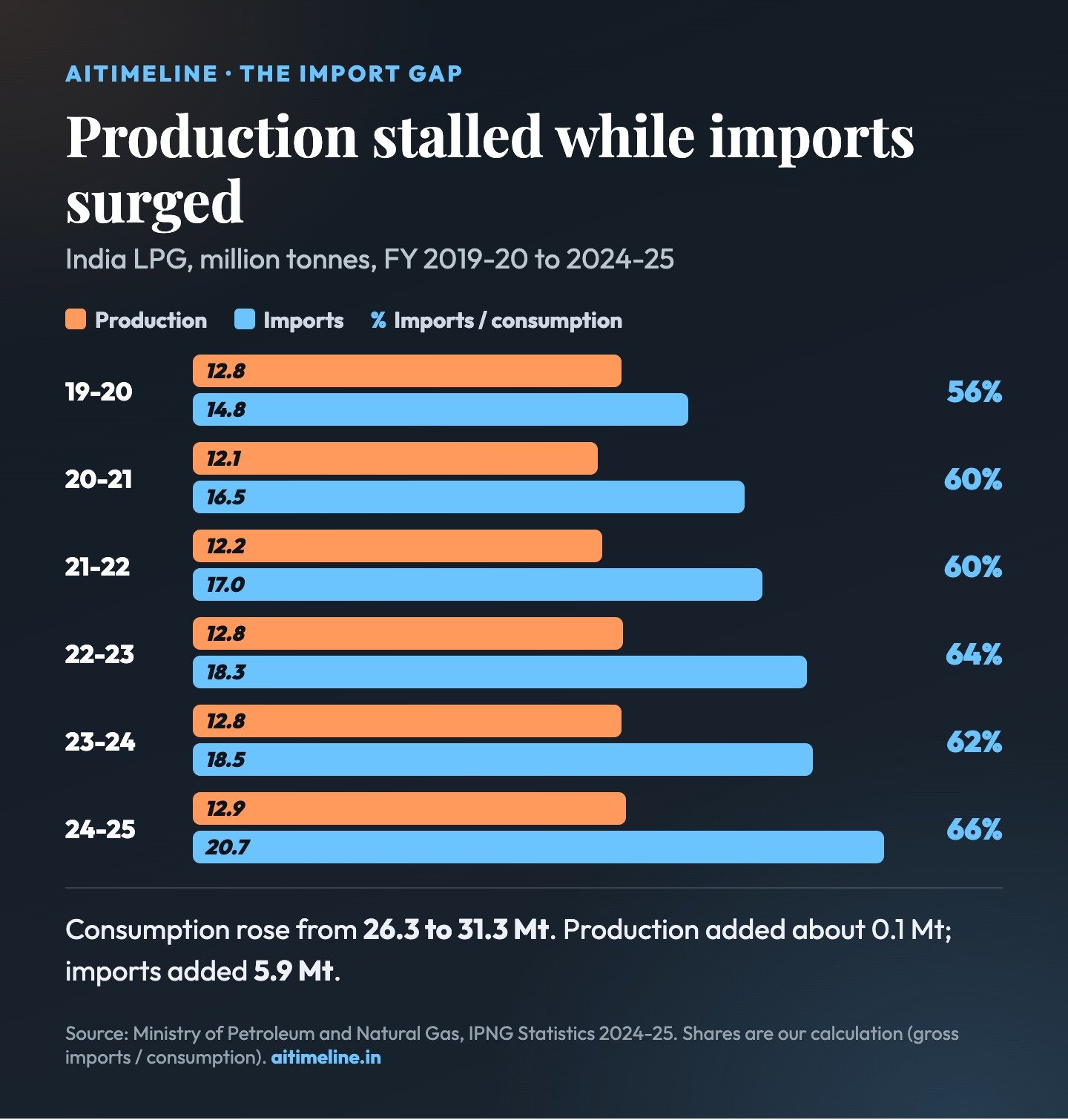
Between 2019-20 and 2024-25, consumption rose by 5 Mt and production by about 0.1 Mt. Imports covered the difference. The import share dipped in 2023-24 (62%) before reaching 66% in 2024-25.
| Financial year | Production (Mt) | Imports (Mt) | Consumption (Mt) | Imports / consumption |
|---|---|---|---|---|
| 2019-20 | 12.82 | 14.81 | 26.33 | 56% |
| 2020-21 | 12.07 | 16.48 | 27.56 | 60% |
| 2021-22 | 12.24 | 17.04 | 28.25 | 60% |
| 2022-23 | 12.83 | 18.34 | 28.50 | 64% |
| 2023-24 | 12.78 | 18.51 | 29.66 | 62% |
| 2024-25 | 12.94 | 20.67 | 31.33 | 66% |
Source: Ministry of Petroleum and Natural Gas, Indian Petroleum and Natural Gas Statistics 2024-25. Shares are our calculation. Exports were 0.55 Mt in 2024-25.
India’s LPG Imports: Key Questions
What to Know About India’s LPG Dependence
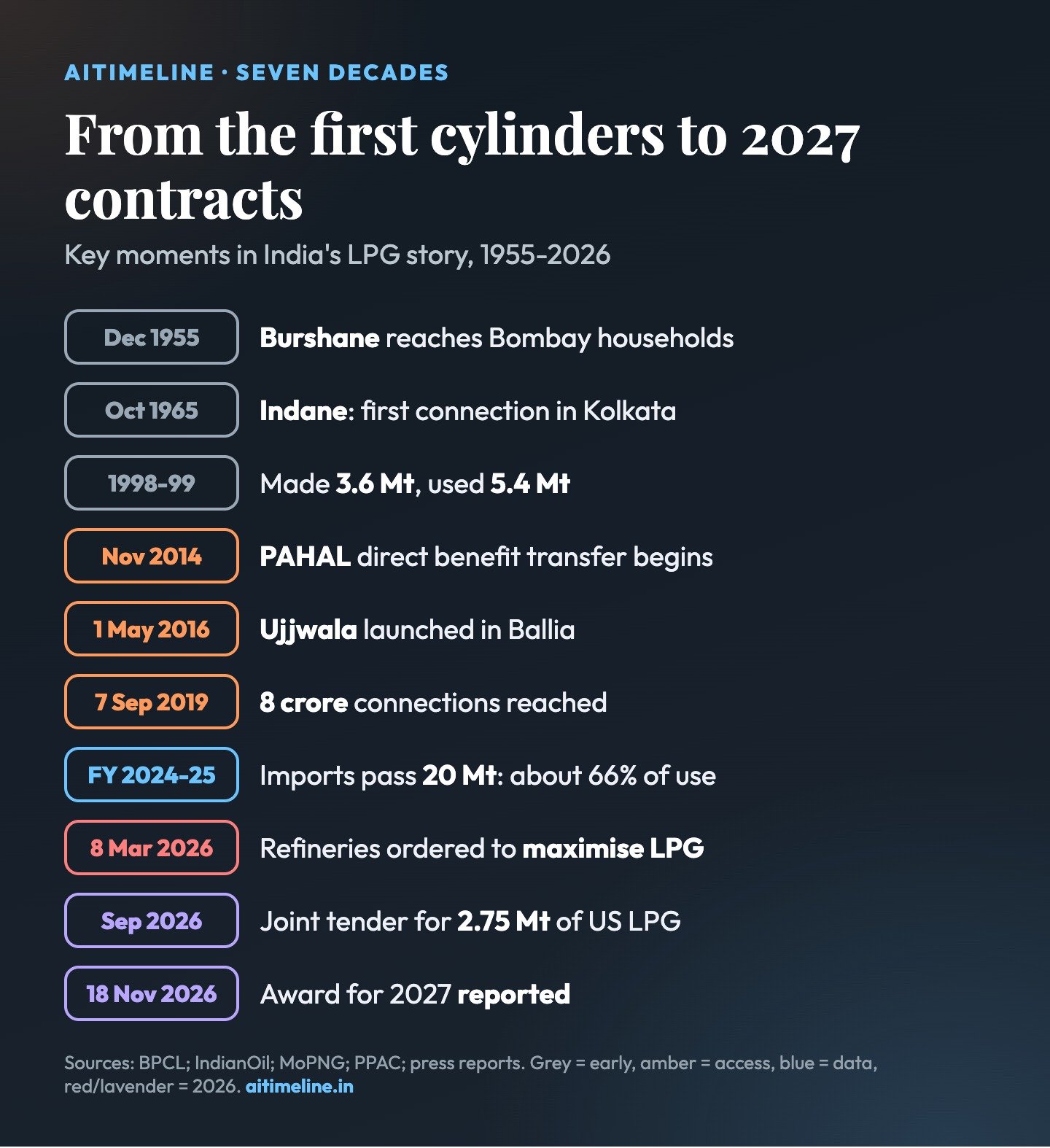
- 1955: LPG reached Bombay households as Burshane; 1965 brought Indane.
- 1998-99: India already made 3.6 Mt and used 5.4 Mt.
- 2014-15: imports were 8.3 Mt; by 2024-25 they were 20.7 Mt (about 9.5% a year).
- 2016-2019: Ujjwala launched on 1 May 2016 and hit 8 crore connections on 7 September 2019.
- 2019-2025: production stayed between 12.1 and 12.9 Mt; consumption rose from 26.3 to 31.3 Mt.
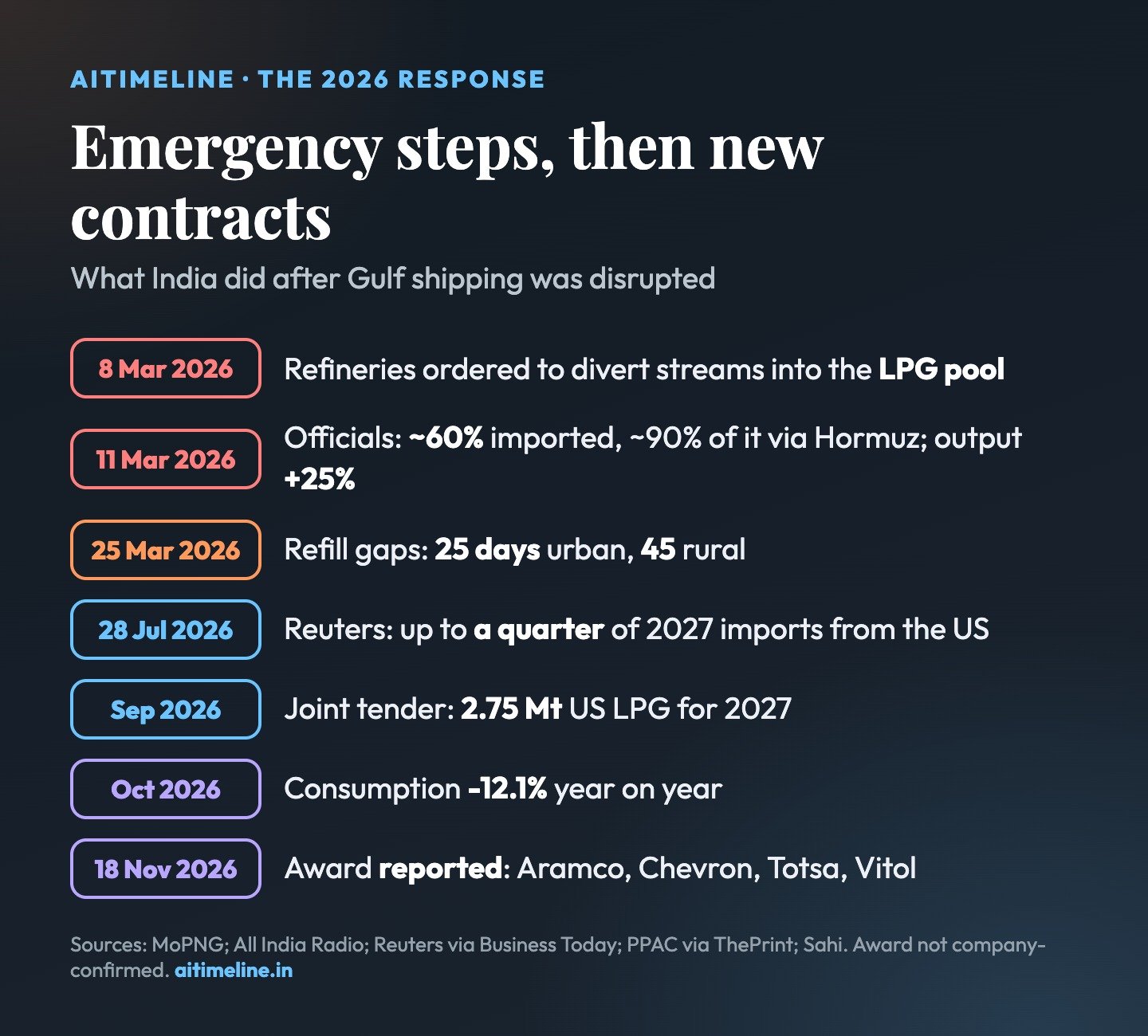
- March 2026: an 8 March order pushed refineries to maximise LPG; officials said about 60% is imported and about 90% of that transits Hormuz.
- Autumn 2026: consumption fell year on year (September -9.15%, October -12.1%).
- Diversifying: the US reached the top spot for six months; the UAE retook it in September.
- 2027: about 2.75 Mt of US LPG reportedly awarded; the government wants at least 15% of 2027 imports via US term deals.
Why Does India Import So Much LPG?
Three trends moved together.
LPG is mainly propane and butane. It cooks food in homes, restaurants and hotels and fuels some industry and transport. It is made in two places: refineries and natural-gas processing plants.
1. Household demand grew. Urbanisation, rising incomes and schemes such as PAHAL and Ujjwala widened access. Active consumers reached 32.97 crore by 31 March 2025.
2. Domestic production stalled. Output stayed in a 12.1-12.9 Mt band from 2019-20 to 2024-25. India has a large refining industry, but LPG is only one product of crude oil and refineries optimise for petrol, diesel and jet fuel.
3. Imports were concentrated. Imports came mainly from Gulf suppliers (Qatar, the UAE, Saudi Arabia, Kuwait), shipped through one narrow passage. Press reports on the CEEW study put West Asia at more than 91% of India’s LPG in 2025.
Timeline: From Burshane to the 2027 US Contracts
Newest first. Labels mark policy, access, supply, data and crisis events.
State refiners reportedly award 2.75 million tonnes of US LPG for 2027 Supply
What was reported: Reports on 18 November 2026 said Indian Oil, Bharat Petroleum and Hindustan Petroleum had awarded a joint contract for about 2.75 million tonnes of US LPG for delivery in 2027. The awardees named in those reports were Saudi Aramco, Chevron, TotalEnergies and Vitol.
Structure: The deal gives the refiners four delivered very large gas carrier (VLGC) cargoes a month plus one free-on-board cargo a month through 2027. The tender had been launched in September and ran to 22 October.
Caution: We found the award only in secondary reports citing Reuters; the companies had not published the details. Read the supplier names as reported.
October data: LPG consumption still falling year on year Data
The numbers: India used about 2.61 million tonnes of LPG in October 2026, down 12.1% from 2.97 million tonnes a year earlier. From April to October consumption fell 14.5% to 16.31 million tonnes.
Context: Reports link the fall to supply constraints after the West Asia crisis began in late February 2026. September consumption was 2.64 million tonnes (down 9.15%), so October was not higher than September.
September imports: the UAE overtakes the US as top supplier Data
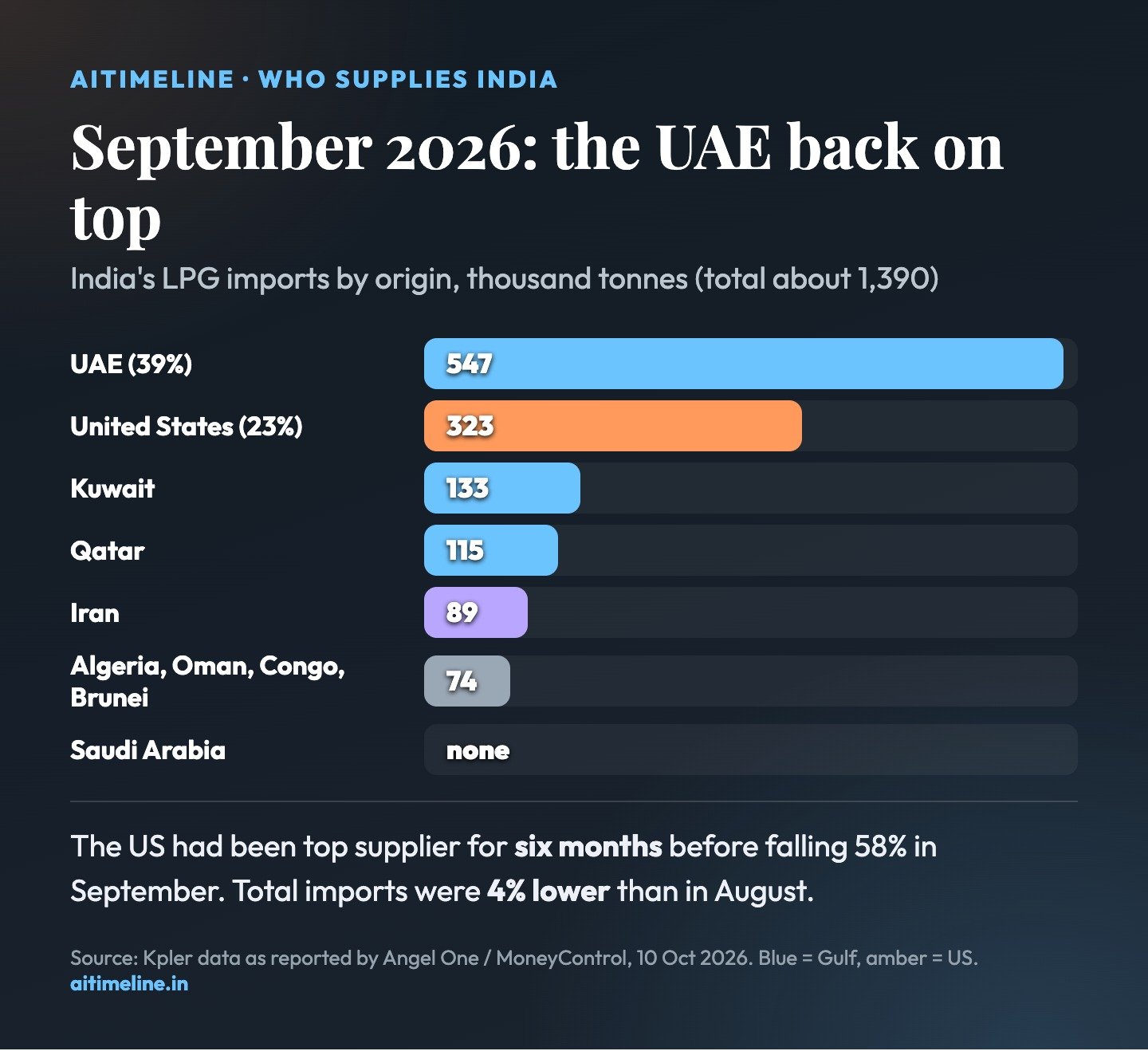
The mix: The UAE supplied about 547,000 tonnes (39% of September imports), up from 193,000 tonnes in August. The US fell 58% to about 323,000 tonnes (23%), ending six months as India’s largest source. Kuwait sent about 133,000 tonnes, Qatar 115,000 and Iran about 89,000.
What it shows: Supply patterns moved month to month. India received no Saudi LPG in September, and Gulf cargoes were returning even as the US ramped up. Diversification was real but not yet settled.
Rural refill gap reportedly cut back to 25 days Policy
What was reported: A 7 September report said the Centre had reduced the minimum gap between rural LPG refill bookings from 45 days to 25 days, matching urban areas, after the longer gap was used as a temporary demand-management step in March.
Caution: We could not find the official notice. Booking rules can vary by connection and region, so treat this as a report until confirmed.
Joint tender for 2027 US LPG is issued Supply
What happened: The three state refiners issued a joint term tender for about 2.75 million tonnes of US LPG for 2027 delivery, seeking four VLGC cargoes a month plus one 45,000-tonne free-on-board cargo each month.
Why: Term contracts lock in volumes and avoid depending on spot purchases while the Gulf route is uncertain.
Reuters: India plans up to a quarter of 2027 LPG imports from the US Supply
Plan: Reuters reported on 28 July that India planned to source up to 25% of its 2027 LPG imports from the United States, a big shift from a supply base long dominated by the Gulf.
Numbers: US LPG imports topped 1 million tonnes in June for the first time. A source said 2026 consumption would fall to about 30 million tonnes because of low supplies, with imports rising to about 20 million tonnes in 2027 as demand recovers to around 31 million tonnes.
CEEW calls LPG a hidden household energy-security vulnerability Data
Findings: CEEW’s June 2026 study said LPG serves more than 330 million households and that aggregate import exposure is close to 95%, once domestic LPG made from imported crude is counted alongside direct imports.
Where from: Press reports of the study put West Asia at more than 91% of India’s LPG in 2025. CEEW also argued that refiners favour petrol, diesel and jet fuel, which helps explain flat LPG output.
Government rejects viral claims of a 45-day limit for Ujjwala users Policy
What happened: After social-media posts claimed refill gaps had been revised to 45 days for Ujjwala (PMUY) connections, the ministry said existing timelines still applied: bookings are allowed after 25 days in urban areas and 45 days in rural areas, irrespective of connection type.
Why it matters: Several outlets had described a blanket 45-day rule. The official position was narrower, and the aim was to discourage panic booking and hoarding.
Government confirms the scale of import exposure Crisis
What officials said: At a briefing on 11 March, officials said India imports about 60% of its LPG and that nearly 90% of those imports typically transit the Strait of Hormuz. They said domestic LPG production was up about 25% (a later briefing cited 28%) and that all domestic output was being directed to households.
Priorities: Household cooking gas was prioritised, with essential users such as hospitals and schools next, while commercial buyers faced tighter supply.
Refineries ordered to push every available barrel into the LPG pool Policy
What happened: The government directed refineries and petrochemical complexes to divert propane, butane, propylene and butenes streams into the LPG pool, putting household supply first.
Limits: It is an emergency lever: it moves hydrocarbons between products but does not add refining or gas-processing capacity.
West Asia conflict disrupts Gulf shipping Crisis
What happened: Conflict following the US-Iran war in late February 2026 disrupted Gulf shipping through the Strait of Hormuz, where most of India’s imported LPG passes.
Effect: Cargoes from several Gulf exporters were exposed at once. The US became India’s largest LPG source for six months from March to August.
India’s first joint US LPG term tender is awarded Supply
What happened: In November 2025 Indian state refiners awarded their first joint long-term tender for US LPG, for 2026 delivery. Reuters-based reports named Chevron, Phillips 66 and TotalEnergies Trading.
Why: India wanted about 10% of 2026 LPG imports from the United States, ahead of the 2026 shock.
Imports pass 20 million tonnes; two-thirds of consumption Data
The balance: India produced about 12.94 million tonnes of LPG, imported 20.67 million, exported 0.55 million and consumed 31.33 million tonnes. Imports were about 66% of consumption.
The trend: Imports have grown at about 9.5% a year since 2014-15, when they were 8.3 million tonnes.
33 crore active LPG consumers, 10 crore of them Ujjwala Access
Reach: India had 32.97 crore active LPG consumers by 31 March 2025. PMUY connections stood at 10.33 crore on 1 July 2024; the scheme reports 10.35 crore, with a further 25 lakh approved (target 10.6 crore).
Access is not use: A connection is not regular use. Whether households can afford refills decides how much LPG they actually burn.
Cabinet approves 75 lakh more Ujjwala connections Access
What happened: The Cabinet approved 75 lakh additional PMUY connections over FY 2023-24 to 2025-26, with Rs 1,650 crore to the oil marketing companies. MoPNG says the target was reached by July 2024.
Date check: Our source brief placed this in 2024; the approval was on 13 September 2023.
Imports reach 64% of consumption Data
The gap: Imports of 18.3 million tonnes met about 64% of consumption of 28.5 million tonnes, against domestic production of about 12.8 million tonnes. ORF puts dependence at 49% in 2016-17.
Correction: Some summaries say dependence ‘approached 60%’ in 2022-23; the official figures give 64%.
Ujjwala 2.0 hits its first targets Access
What happened: Ujjwala 2.0, launched in August 2021 with simplified paperwork for migrants, reached its first 1 crore additional connections on 31 January 2022. The target was raised to 1.6 crore and met on 31 December 2022.
COVID relief: free LPG refills for Ujjwala households Access
What happened: As part of the pandemic relief package announced on 26 March 2020, eligible Ujjwala beneficiaries received free refills for several months.
Why it matters: It showed LPG had become an essential household fuel and part of the welfare system, not just a convenience.
Eight crore Ujjwala connections reached, ahead of schedule Access
What happened: The original PMUY target of 8 crore connections was met on 7 September 2019. The initial target had been 5 crore and was later raised to 8 crore.
Pradhan Mantri Ujjwala Yojana launched in Ballia Access
What happened: PM Narendra Modi launched PMUY in Ballia, Uttar Pradesh, on 1 May 2016 to give deposit-free LPG connections to women in poor households that cooked on firewood, coal and dung cakes.
Result: Access expanded fast. Domestic production did not follow, so imports covered the extra demand.
‘Give It Up’ asks better-off households to surrender subsidy Policy
What happened: The government invited relatively better-off consumers to give up their LPG subsidy so that connections could go to poorer households.
PAHAL direct benefit transfer begins Policy
What happened: The DBTL (PAHAL) scheme began on 15 November 2014 in 54 districts and was extended to 622 districts from 1 January 2015, sending subsidies straight to bank accounts to cut diversion.
Where imports stood: FY 2014-15 LPG imports were about 8.3 million tonnes, a base that would more than double within a decade.
A supply gap already exists: 3.6 Mt made, 5.4 Mt used Data
The gap: India produced about 3.6 million tonnes of LPG in 1998-99 and consumed about 5.4 million, so imports were needed long before household access exploded.
Indane launched; first connection issued in Kolkata Supply
What happened: IndianOil began marketing LPG as Indane in 1965. The first connection was released in Kolkata on 22 October 1965, widening organised LPG distribution beyond its first metropolitan markets.
LPG reaches Indian households: Burshane in Bombay Supply
What happened: In December 1955 Burmah Shell introduced LPG under the Burshane brand in Bombay. The gas was first imported and later supplied from the company’s Mumbai refinery; within months it reached towns in Gujarat and Maharashtra.
How Ujjwala Changed Demand
Access expanded quickly; supply did not.
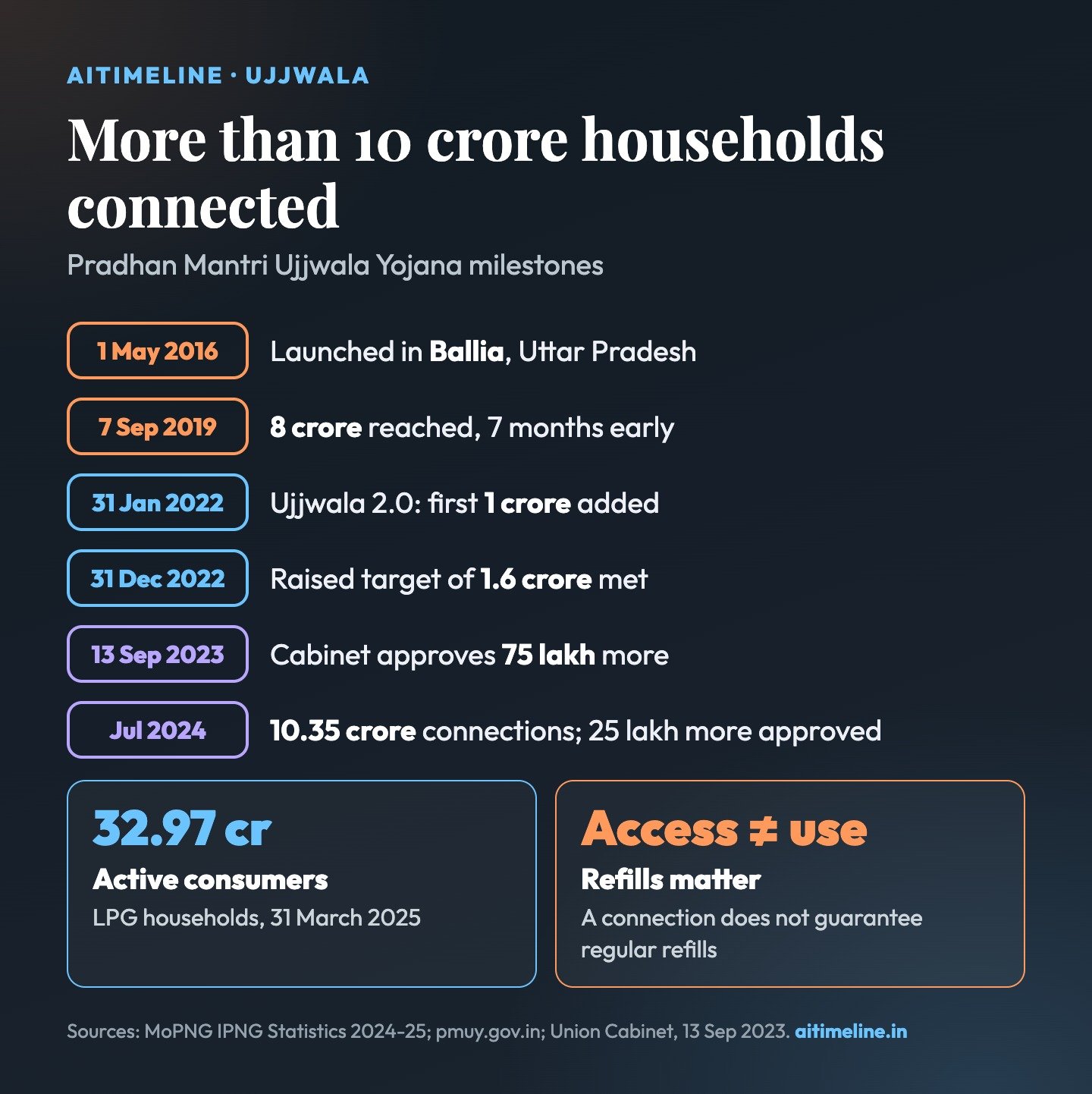
PMUY gave deposit-free connections to women in poor households. That was a clean-cooking success, and it is part of why consumption rose. But a connection is not consumption. Households that cannot afford refills may use LPG only occasionally, so access numbers do not tell you how much gas is burned.
Why the Strait of Hormuz Matters
One passage, several suppliers.
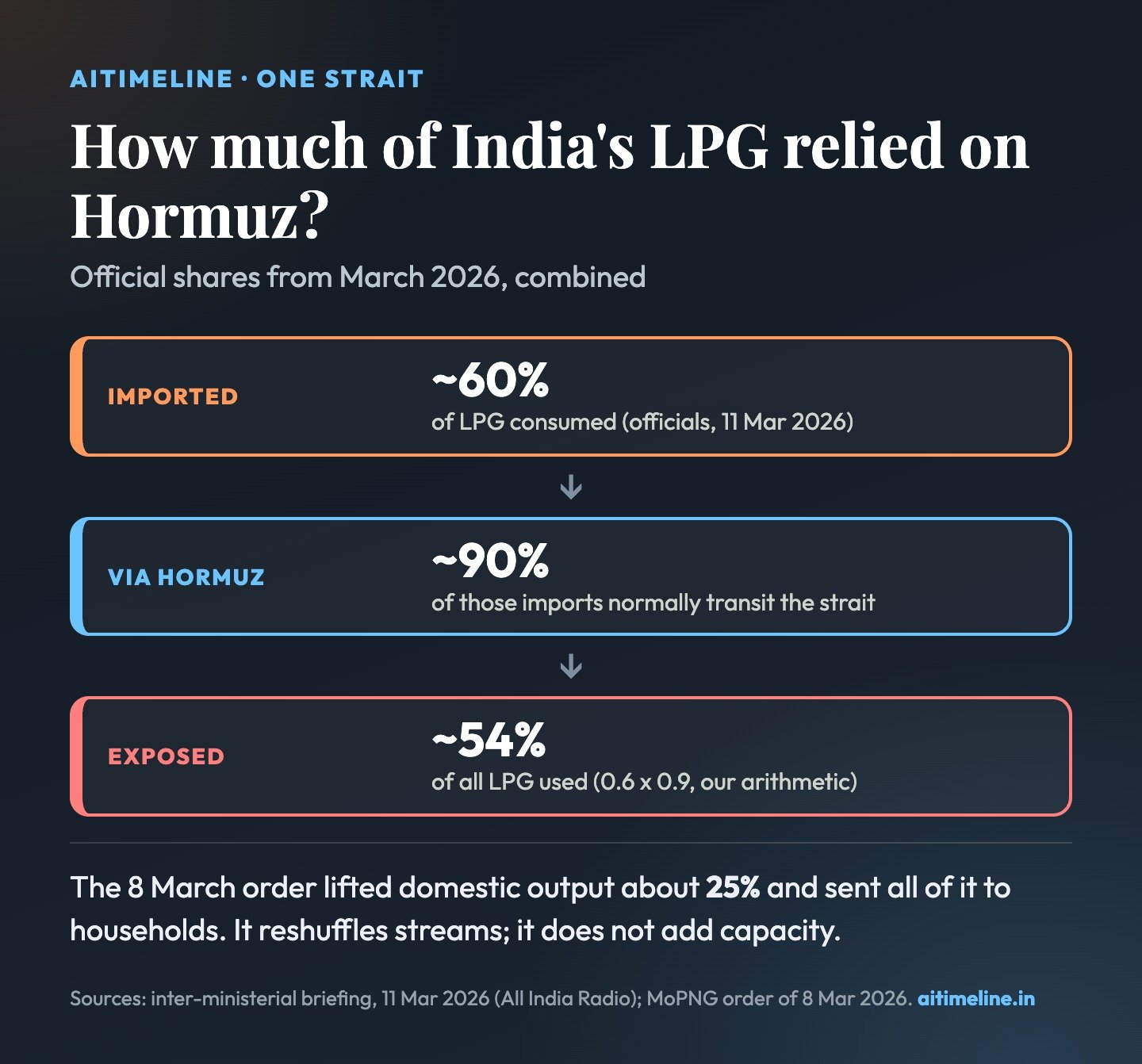
The Strait of Hormuz links the Persian Gulf with the Gulf of Oman and the Arabian Sea. LPG cargoes from several large Gulf exporters normally leave through it. A disruption therefore hits multiple suppliers at once, even when their plants are working. The 2026 episode followed conflict after the US-Iran war in late February; our timelines on the Strait of Hormuz and India’s economic exposure cover the wider crisis.
Where Does India’s Imported LPG Come From?
The mix shifted month to month in 2026.
| Source | Role |
|---|---|
| Qatar, UAE, Saudi Arabia, Kuwait | Traditional Gulf suppliers; exposed to Hormuz |
| United States | Long-haul alternative; top source for six months in 2026; term contracts for 2026 and 2027 |
| Algeria, Oman, Congo, Brunei | Smaller 2026 sources (Oman is outside the strait) |
| Iran | About 89,000 tonnes in September 2026 per Kpler |
Diversification is a direction, not a finish line. The US cargoes travel much farther, and the September data shows Gulf supply returning as soon as shipping eased. The government’s own target for 2027 is at least 15% of imports through US term contracts, with Reuters reporting a goal of up to a quarter.
Why Can’t India Simply Produce More LPG?
- By-product: LPG output depends on crude type, refinery design and propane and butane from gas processing.
- Incentives: refiners earn more from petrol, diesel and jet fuel. CEEW argues this explains flat LPG output as refining capacity grew.
- Plateau: between 12.1 and 12.9 Mt every year since 2019-20, while imports rose from 14.8 to 20.7 Mt.
- Investment: more LPG needs new units, refinery changes and gas-processing plants. The March 2026 diversion helps in a crisis but does not add capacity.
What Does This Mean for Energy Security?
| Risk | Potential impact |
|---|---|
| Strait of Hormuz disruption | Delayed or reduced cargo arrivals |
| Supplier concentration | Several suppliers exposed to the same crisis |
| Price volatility | Higher import cost and subsidy pressure |
| Flat domestic output | Structural dependence persists |
| Thin storage buffers | Less time to respond to a long disruption |
| Freight and insurance | Higher delivered prices |
| Household reliance | Pressure on cooking fuel in emergencies; commercial users squeezed first |
What Can India Do to Reduce Dependence?
Six levers, each with limits.
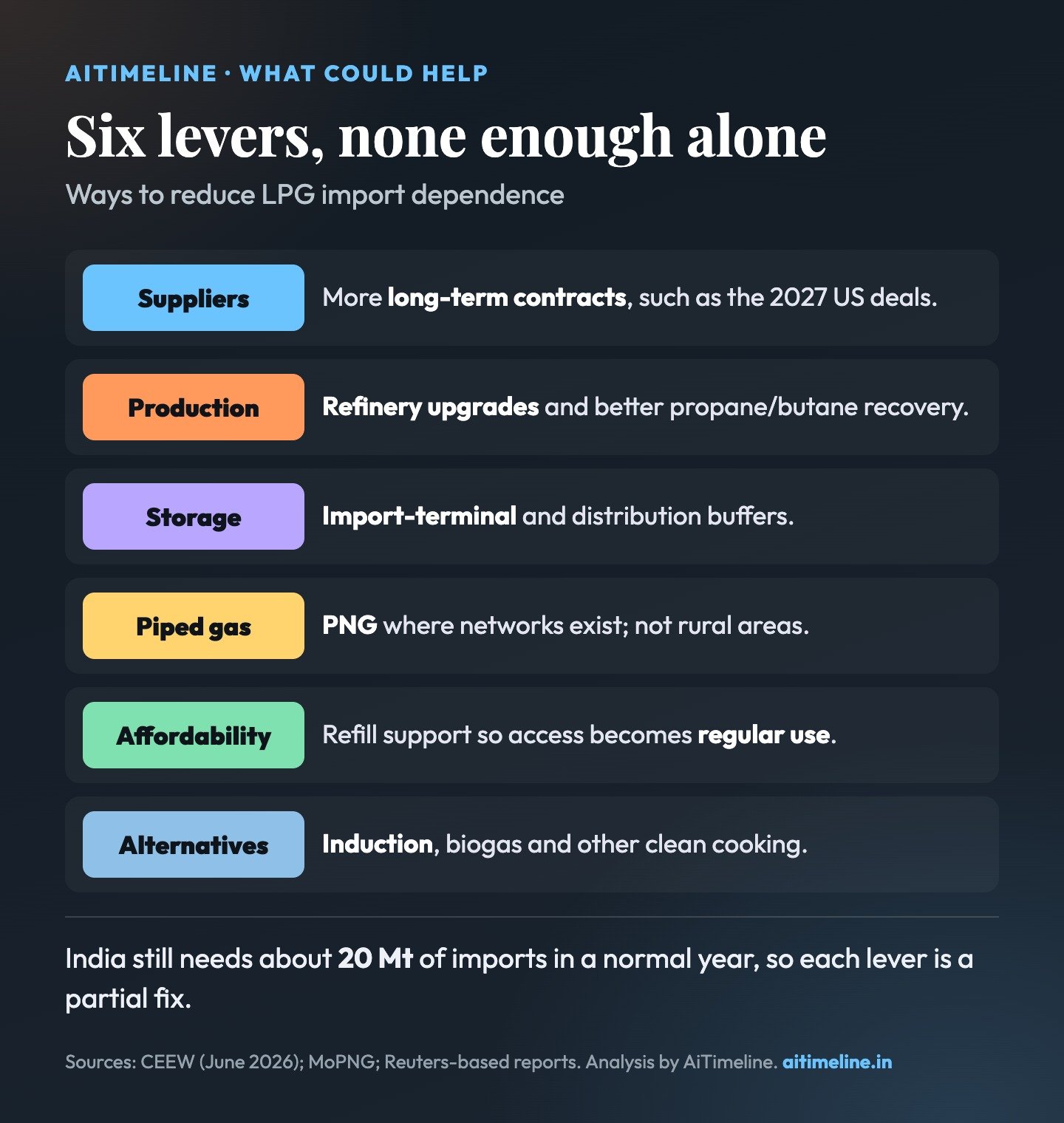
The 2027 US contracts show the first lever. The others need investment and time. Piped gas works only where networks exist, and rural households still depend on cylinders. Electric cooking depends on reliable power and affordability. Storage needs its own economic case; strategic crude reserves do not solve an LPG problem.
Key Facts at a Glance
| Question | Answer |
|---|---|
| First LPG in India | December 1955, Bombay (Burshane) |
| Indane first connection | 22 October 1965, Kolkata |
| PMUY launch | 1 May 2016, Ballia |
| Domestic production FY 2024-25 | about 12.94 Mt |
| Imports FY 2024-25 | 20.67 Mt |
| Consumption FY 2024-25 | 31.33 Mt |
| Imports / consumption | about 66% (gross) |
| Key chokepoint | Strait of Hormuz |
| Emergency refinery order | 8 March 2026 |
| October 2026 consumption | about 2.61 Mt, down 12.1% year on year |
| 2027 US LPG volume | about 2.75 Mt (reported award, 18 Nov 2026) |
Conclusion: Access Grew Faster Than Supply
India built one of the world’s largest LPG distribution networks and extended it to hundreds of millions of people. That raised the importance of reliable international supply, because domestic production did not grow with it. The 2026 disruption showed how a regional crisis can reach a kitchen thousands of kilometres away.
The US contracts, emergency refinery measures and a wider supplier base are real responses. They do not remove the dependence. The central question has shifted from connecting households to keeping the fuel available and affordable when a shipping route is disrupted. Watch the PPAC monthly data: consumption was still falling year on year in October 2026.
Explore More Timelines
People Also Ask
Frequently Asked Questions
⚠️ Editorial Note
Annual figures follow the Ministry of Petroleum and Natural Gas (Indian Petroleum and Natural Gas Statistics 2024-25) and PPAC. 2026 events follow ministry briefings (reported by All India Radio), PPAC monthly data, Kpler data as reported, and Reuters-based press reports. The November 2027 contract awardees were not confirmed by the companies. Where outlets differ we say so. Figures may be revised.
Related Stories
Sources & further reading
Every dated entry above was checked against these references. Last reviewed 23 November 2026.
- Ministry of Petroleum and Natural Gas: Indian Petroleum and Natural Gas Statistics 2024-25
- PMUY: About Pradhan Mantri Ujjwala Yojana
- BPCL: A pioneering approach to LPG in India (Burshane, December 1955)
- All India Radio: India's LPG production increases by 25% (inter-ministerial briefing, 12 March 2026)
- All India Radio: Government refutes claims of 45-day LPG booking timelines (25 March 2026)
- CEEW: How Secure Is India's Energy Future? (June 2026)
- Angel One: UAE becomes India's largest LPG supplier in September (Kpler data, 10 October 2026)
- ThePrint: Petrol, diesel consumption rises in October, demand for LPG falls 12% (PPAC, 2 November 2026)
- Business Today: India plans to buy a quarter of its LPG imports from the US in 2027 (28 July 2026)