Children’s Shoes as Memorials: The Gaza Tributes, Explained
A city square on a Sunday morning does not usually ask anything of the people crossing it. Then the rows begin. Small trainers with the laces still tied. A pair of sandals with a cartoon strap. Winter boots, scuffed at the toe in the way that only a real child scuffs a boot. They are laid out in lines that run the length of the paving stones, and they are all empty. Nobody is holding a placard at the front of them. A loudspeaker, somewhere near the middle, is reading names and ages, one after another, and it does not stop.
What makes an installation like this land is not scale but familiarity. Almost everyone who walks past has, at some point, tied a shoe like that. The object carries the shape of a specific body: a size, a wear pattern, a preference. That is why an empty pair of children’s shoes can communicate something that a statistic on a news bulletin often cannot — not because it proves anything the statistic did not, but because it converts an abstraction into a scale a person can walk alongside. This guide traces where that practice comes from, how the recent tributes to children killed in Gaza were organised and documented, and how historians and museum curators read memorials like these. It also addresses, directly and early, a question of attribution that surrounds this particular story.
A documented timeline of the children's shoe memorials held across the Netherlands since 2023, the wider history of shoe memorials, and what is unverified.
Latest Story
Since December 2023, a recurring series of public memorial installations in the Netherlands has laid out thousands of children’s shoes in city squares, with the names and ages of children killed in Gaza read aloud over several hours. The series is organised by the Dutch foundation Stichting Plant een Olijfboom (“Plant an Olive Tree”), which publishes its own dated record of each event. The installations have travelled from Rotterdam and Amsterdam to Utrecht, Haarlem, The Hague, Leiden, Almere, Maastricht and beyond, and comparable displays have been reported in other countries. The practice itself is much older than the current conflict: shoes have functioned as memorial objects in Holocaust museum collections, in a permanent 2005 monument on the Danube in Budapest, in a Mexican artist’s response to femicide, and in a 2018 protest on the lawn of the United States Capitol. This guide sets out the documented record, the symbolism, and the limits of what can be verified.
🧠 AI Overview Summary
Children’s shoes have been used as public memorial objects for decades because an empty shoe represents one specific person. Since December 2023, the Dutch foundation Plant een Olijfboom has laid out thousands of children’s shoes in Netherlands city squares, reading aloud the names of children killed in Gaza. Similar installations have been documented in Budapest, Washington and Mexico.
The Six Questions People Ask First
What to Understand About These Memorials
- The documented Dutch shoe memorials are a recurring organised series, not a single event: the organisers’ own record lists eighteen dated installations between December 2023 and August 2026.
- The organiser is Stichting Plant een Olijfboom, a Dutch foundation that states its aim as achieving a just peace with equal rights for all citizens; the shoe installations are one strand of its wider activity.
- Every installation follows the same basic form: shoes laid in rows, names read aloud, removal the same day. The repetition is deliberate and is part of what makes the series legible as a single practice.
- Shoe counts cited at each event are organiser figures, described by them as corresponding to reported child deaths. They are not independently audited totals and should be read as stated figures.
- Using shoes as memorial objects has a long documented history, including museum collections from Nazi camps, a permanent 2005 monument in Budapest, and installations addressing femicide in Mexico and gun deaths in the United States.
- A memorial is a form of public expression. Historians treat it as evidence of how a community chose to remember, not as evidence about the underlying events themselves.
- Temporary memorials mostly reach the public as photographs. The image outlives the installation by years, which is one reason organisers design them to read clearly from above.
- These installations do not substitute for humanitarian assistance, official investigation or legal process, and the organisers do not present them as doing so.
- The framing of this story as a “Caribbean Netherlands” tribute appears to originate in a video-agency region tag. We found no independently documented children’s-shoe memorial in Bonaire, Sint Eustatius or Saba.
- Casualty figures for Gaza are contested and attributed, published primarily by the Gaza Ministry of Health and cited with caveats by United Nations bodies. This guide does not assert any figure as its own finding.
What the Tribute Actually Is — and Where It Took Place
Establishing the verified record before the symbolism
The core object of this story is a recurring public memorial installation known in Dutch as a herdenkingsprotest — literally a “commemoration protest”, a compound that captures the form precisely. It is not a march and it is not a rally. Participants do not move; the shoes do not move; the only thing that progresses is the reading of names. Organisers obtain permission for a public square, lay out donated children’s footwear in ordered rows, and read names and ages aloud continuously, in the Leiden edition for five hours without interruption.
The organiser of the Dutch series is Stichting Plant een Olijfboom, a foundation whose published mission describes working towards a just peace with equality for all citizens, including the right of return for Palestinian refugees. That is the organisation’s own statement of position, reproduced here as such. It matters for reading the events accurately: these are installations organised by a group with a declared political stance, which is a different thing from a state commemoration, a museum exhibition or a spontaneous public shrine, and it changes how a historian would classify and weigh them.
The documented locations are in the European Netherlands. The organisers’ own event record lists Rotterdam, Amsterdam, Utrecht, Haarlem, The Hague, Breda, Groningen, Hilversum, Leiden, Almere, Apeldoorn, Maastricht, Den Bosch and Scheveningen. Independent Dutch and international coverage corroborates several of these individually — the Utrecht installation of March 2024 in particular was reported by regional broadcaster RTV Utrecht, the English-language NL Times, wire photography services and international outlets.
An Editorial Verification Note on “Caribbean Netherlands”
This article carries the phrase “Caribbean Netherlands” in its title history, and readers arriving from search may reasonably expect an account of a tribute on Bonaire, Sint Eustatius or Saba, the three special municipalities that make up the Caribbean Netherlands. We were unable to verify that any such event took place there.
What we did find is that the phrase attaches to at least one syndicated video listing of a shoe memorial — whose own headline places the event in Leiden, in the European Netherlands. Stock and agency video platforms carry a region or territory field alongside the story, and that field can be populated with a value that does not describe the filming location. Our assessment, offered as independent analysis rather than established fact, is that the “Caribbean Netherlands” framing most likely propagated from a metadata field of that kind rather than from reporting of a distinct Caribbean event.
We state this openly for three reasons. First, because the alternative — writing a detailed narrative about an unverified event on Saba or Bonaire — would mean inventing a public record for a small community that did not create one. Second, because how a claim spreads is itself worth documenting: it is a clean, checkable example of how a data field becomes a headline becomes a fact. Third, because if a documented tribute in the Caribbean Netherlands does exist in local reporting we have not reached, this guide should be corrected, and saying so plainly is the only way to invite that correction. If you have a primary source, we want it.
📜 History Insight
Ordinary everyday objects often become powerful memorial symbols precisely because they represent individual human lives. A monument in bronze commemorates a category — the fallen, the lost, the victims. A worn shoe commemorates a person, because it was shaped by one body and no other. This is why archives and museums treat personal effects as among the most affecting objects in any collection, and why memorial designers have returned to them repeatedly across very different histories and continents.
The Complete Timeline: From Camp Collections to City Squares
Each entry labelled by evidence type: documented history, institutional record, organiser record, or independent reporting
Shoes Become Evidence: Liberation of Majdanek
Historical background. Concentration and extermination camps systematically confiscated the belongings of arriving prisoners. Footwear was collected in bulk because leather had material value and could be redistributed or resold.
Event. When Soviet forces reached the Majdanek camp in July 1944 — the first major camp to be encountered largely intact — among the evidence they found were vast quantities of shoes left behind. These objects were preserved rather than dispersed, and became part of the physical record of the camp.
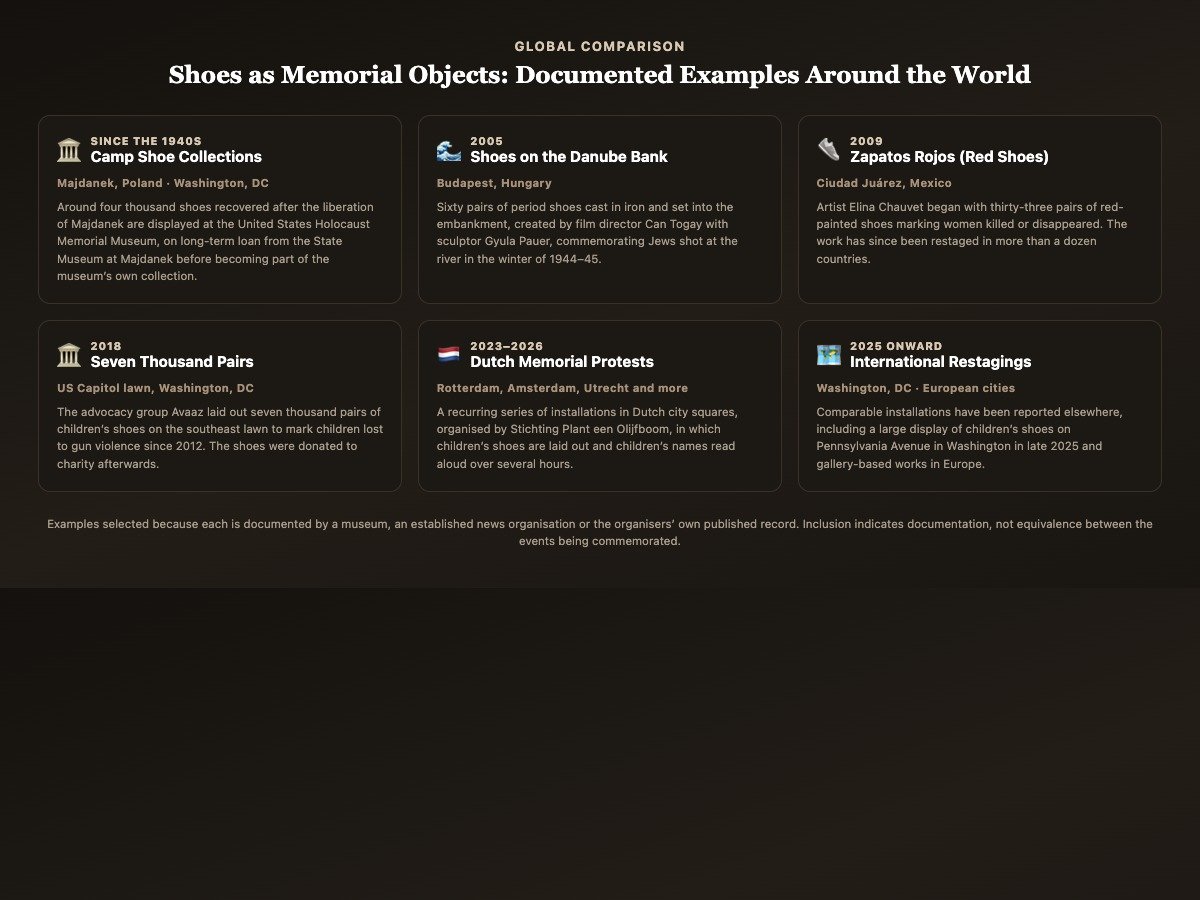
Current relevance. The Majdanek shoes are the origin point for the modern museum convention of displaying massed footwear as testimony. Roughly four thousand of them are shown at the United States Holocaust Memorial Museum in Washington, initially on long-term loan from the State Museum at Majdanek in Poland and later gifted permanently to the museum’s own collection.
The Museum Display That Set the Template
Background. The United States Holocaust Memorial Museum opened in 1993 with a permanent exhibition built around physical artefacts rather than narrative panels alone.
Event. A room of victims’ shoes was placed on the visitor route. Curators have described arranging the shoes deliberately to preserve variety — different sizes, styles and states of wear — specifically so the display would read as many individuals rather than as undifferentiated mass.
Public response. The room became one of the most frequently described sections of the museum by visitors and reviewers, widely reported as the point at which scale becomes personal.
Shoes on the Danube Bank: A Permanent Monument
Historical background. During the winter of 1944–45, members of the Arrow Cross militia killed Jewish civilians on the Pest bank of the Danube. Victims were ordered to remove their shoes at the water’s edge.
Event. Film director Can Togay, working with sculptor Gyula Pauer, created a memorial of sixty pairs of 1940s-style shoes cast in iron and set into the stone embankment, several hundred metres from the Hungarian Parliament building. Men’s, women’s and children’s shoes are included.
Current relevance. It is now among the most-visited memorials in Budapest and the single most cited reference point when a shoe installation appears anywhere else. Visitors regularly leave candles and flowers inside the iron shoes — an unplanned participatory layer that has become part of the site.
Zapatos Rojos: The Practice Becomes Portable
Background. Ciudad Juárez had for years been the focus of national and international attention over the killing and disappearance of women.
Event. In August 2009 the artist Elina Chauvet placed thirty-three pairs of red-painted shoes in a public street, each representing an absent woman. Chauvet has spoken publicly about the killing of her own sister in a domestic-violence case as part of what led her to the work.
Public response and spread. Zapatos Rojos has since been restaged in more than a dozen countries across the Americas and Europe, usually by local groups rather than the artist, making it one of the most-replicated participatory memorial forms of the last two decades.
Seven Thousand Pairs on the Capitol Lawn
Background. In February 2018, seventeen people were killed at a school in Parkland, Florida, prompting a wave of organised responses across the United States.
Event. On 13 March 2018, the advocacy organisation Avaaz laid seven thousand pairs of children’s shoes across the southeast lawn of the United States Capitol, one day before a planned national school walkout. Organisers said the number represented children killed by gunfire since the Sandy Hook shooting in 2012, derived from Centers for Disease Control estimates. Some shoes were donated by victims’ families.
Aftermath. All seven thousand pairs were donated to charity after the installation was cleared — a disposal decision that later installations have often repeated.
Context: Escalation in Gaza and Israel
Background. Beginning in October 2023, a major escalation of the conflict involving Israel and Hamas led to sustained hostilities in the Gaza Strip and a large-scale humanitarian emergency, extensively documented by United Nations agencies including OCHA and by the ICRC.
Why it appears here. This entry establishes the context in which the memorial series began. This guide does not adjudicate the conduct of the conflict, assign responsibility, or assert casualty figures. Those questions are addressed by the bodies with the mandate and access to do so, and by our companion guide to the humanitarian health situation.
Humanitarian information. Reported casualty totals in Gaza are published principally by the Gaza Ministry of Health. United Nations bodies have cited those figures while noting verification constraints in an active conflict zone. Any number appearing later in this guide is presented as an organiser’s stated figure, not as a finding of ours.
Rotterdam: The First Installation in the Series
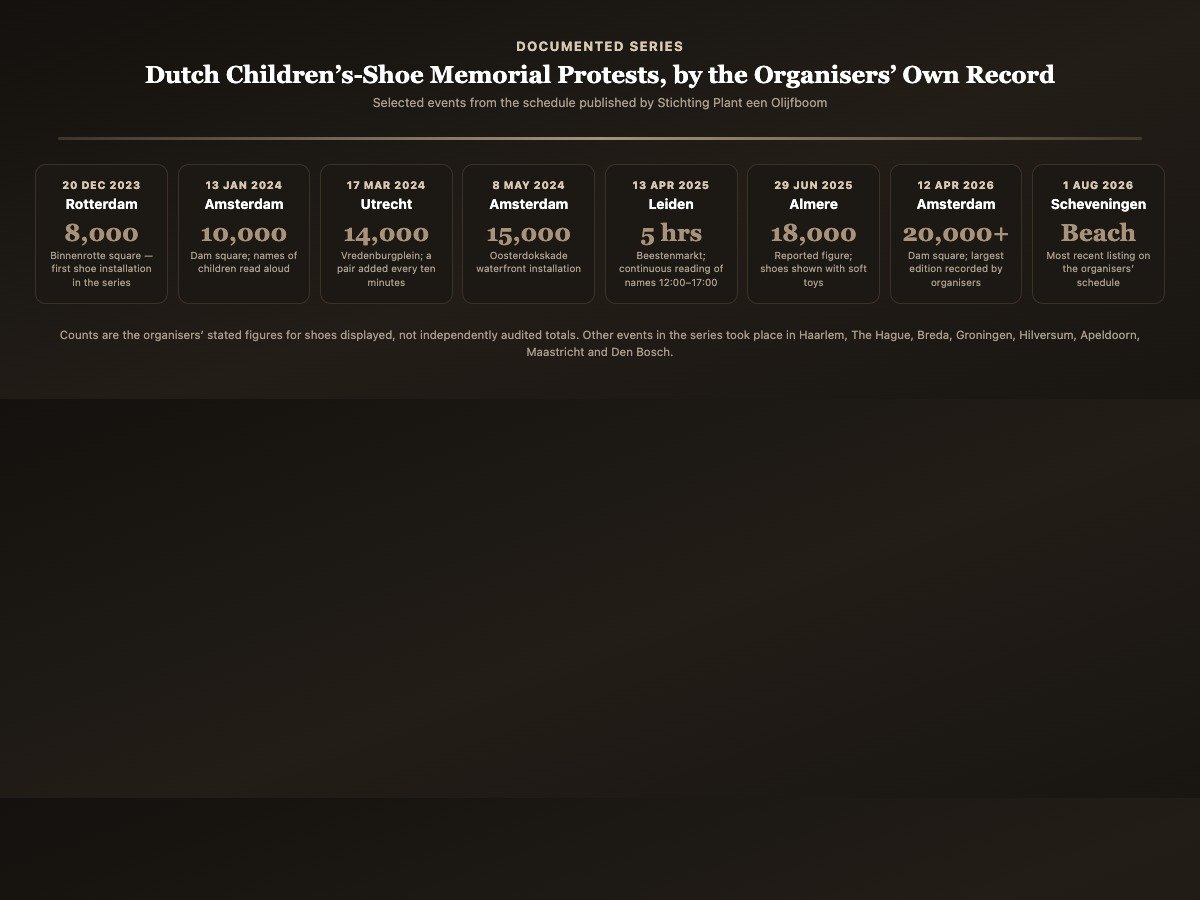
Event. According to the dated schedule published by Stichting Plant een Olijfboom, the first shoe installation in the series was held on 20 December 2023 at the Binnenrotte, a large open market square in central Rotterdam. The organisers record eight thousand children’s shoes at this event.
Form. The template established here — rows of donated children’s shoes, names read aloud, a fixed daytime window, removal the same evening — was retained essentially unchanged for every subsequent edition.
Amsterdam: Ten Thousand Shoes on the Dam
Background. Two days before the event, the organisers issued a press release under the heading “10,000 children’s shoes for 10,000 child victims”, setting the count as the organising principle of the installation.
Event. On 13 January 2024, Dam Square — the ceremonial centre of Amsterdam, directly in front of the Royal Palace and the National Monument — was covered with ten thousand pairs of children’s shoes. Names of children were read aloud. Dutch broadcasters and news outlets including NOS and AT5 covered the installation.
Significance. Placing the installation on the Dam moved it into a space already carrying national commemorative meaning, where the Netherlands holds its annual Remembrance Day ceremony.
Utrecht: Adding a Pair Every Ten Minutes
Event. On 17 March 2024, around fourteen thousand children’s shoes were laid out on Utrecht’s Vredenburg square. This is the best-documented single edition of the series, covered by regional broadcaster RTV Utrecht, the English-language NL Times, Anadolu Agency, Al Jazeera and international wire photography.
The design change. Reporting from the event describes a new element: a further pair of shoes was added every ten minutes through the day while names were read, so that the installation visibly grew as visitors stood in it. Organisers stated this was intended to convey rate rather than total.
Public response. The Utrecht images circulated widely and became the most-reproduced photographs associated with the series.
Amsterdam Waterfront and Haarlem
Event. The organisers record an installation on 8 May 2024 at the Oosterdokskade in Amsterdam, a waterfront site beside the city’s central public library, with a stated count of fifteen thousand pairs. A further memorial protest followed in Haarlem on 12 May 2024.
Pattern. From this point the series settles into a cadence of roughly monthly events rotating between cities, rather than concentrating on the two largest.
The Hague, Breda, Groningen and Rotterdam Again
Event. The organisers’ schedule records further editions through 2024: The Hague on 23 May, Breda on 22 June, Groningen on 21 July, and a return to Rotterdam on 7 September.
Note on The Hague. The Hague is the seat of the Dutch government and of several international courts. Holding an edition there placed the installation in a city where questions of international law are professionally argued — a resonance the organisers did not need to state explicitly.
Hilversum: The Media Park Edition
Event. On 4 November 2024 the installation was staged at the Mediapark in Hilversum, the campus that houses much of Dutch public broadcasting. Reporting on the event describes it as commemorating both children and journalists killed in Gaza.
Significance. Addressing an installation to broadcasters rather than to legislators is a distinct choice of audience, and it reflects a recognised feature of contemporary memorial protest: the target is often the coverage, not the policy.
Leiden: Five Continuous Hours of Names
Event. On 13 April 2025 the memorial protest was held on the Beestenmarkt in Leiden. The organisers describe an open window from 12:00 to 17:00 during which visitors could walk among the shoes, hear names read by well-known and lesser-known Dutch participants, and leave notes, flowers or soft toys.
Note on attribution. A syndicated video listing of a Leiden shoe memorial carries “Caribbean Netherlands” in its region field while its own headline places the event in Leiden. This appears to be the source of the widespread mislabelling discussed earlier in this guide.
Almere: Shoes and Soft Toys
Event. The organisers list an Almere edition on 29 June 2025. International coverage of a Netherlands installation that summer reported around eighteen thousand shoes together with soft toys, describing the reading of names and ages as continuing throughout the event.
A note on figures. Some aggregated reports of this edition give differing dates in early June. Where an organiser’s own dated record and a secondary aggregator disagree, this guide follows the organiser’s record and flags the discrepancy rather than silently choosing one.
Utrecht, Apeldoorn and Maastricht
Event. The published schedule records a return to Utrecht on 24 August 2025, Apeldoorn on 14 September 2025 and Maastricht on 11 October 2025 — extending the series into the east and the far south of the country.
Pattern. By the end of 2025 the installation had reached most major Dutch population centres, and the organisers’ record shows the cadence holding at roughly one event per month.
Washington: The Form Travels Again
Event. In November 2025, an installation of around seventeen thousand children’s shoes was reported along Pennsylvania Avenue in Washington, DC, coinciding with other demonstrations in the city. Arts publication Hyperallergic covered it as a public art installation.
Continuity. The site is a short distance from the Capitol lawn used for the 2018 Avaaz installation, and the form is essentially identical — the same city, the same avenue, a different cause, seven years apart.
Amsterdam: The Largest Recorded Edition
Event. On Sunday 12 April 2026 the series returned to Dam Square for what the organisers describe as the sixteenth shoe memorial protest, with more than twenty thousand pairs of children’s shoes.
Participants. The organisers published a named list of those reading children’s names, including actors Georgina Verbaan, Thekla Reuten, Kim Pieters and Nilüfer Öder, journalist Hanneke Groenteman, anthropologist Gloria Wekker, writer Rasha Hilwi and a number of musicians and filmmakers.
Stated purpose. In their own words, the organisers said they aimed to create visibility for the number of children killed over the preceding thirty months and to raise awareness of the impact of Dutch policy. The associated figure of more than twenty thousand children is the organisers’ stated basis for the count and is reproduced here as their claim.
Den Bosch and Scheveningen: The Latest Listed Events
Event. The organisers’ schedule lists a Den Bosch edition on 14 June 2026 and a further event on 1 August 2026 at Scheveningen — the North Sea beach beside The Hague, and the first listed edition sited on open sand rather than in a paved square.
Why the site matters. A beach removes the architectural framing that a city square supplies. Photographs from a shoreline installation read very differently: the rows extend towards water with no buildings to bound them.
Status. As of this update, the Scheveningen event is the most recent entry on the organisers’ published schedule. This guide will record subsequent editions as they are documented.
🤔 Did You Know?
Children’s shoes have been used in multiple countries over the years as symbols of remembrance in response to wars, genocides, accidents and humanitarian crises — and the objects themselves have often had a second life. The seven thousand pairs laid out on the United States Capitol lawn in 2018 were donated to charity afterwards; shoes gathered for the Dutch series are stored and reused at subsequent installations; and the footwear recovered at Majdanek is now conserved as museum collection material, individually tagged and mapped before being placed.
Glossary: The Vocabulary of Public Memory
Terms used precisely throughout this guide
Temporary Memorial
A commemorative installation created for a limited period, then removed. Distinguished from a monument by its impermanence, its usually low cost, and the fact that it is often assembled from donated everyday objects rather than commissioned materials.
Grassroots Memorial
A memorial created by members of the public or by a civil-society group rather than commissioned by a state or institution. Scholars use the term to mark a different chain of authority over who decides what is remembered and how.
Spontaneous Shrine
An accumulation of flowers, candles, notes and objects that appears at a site of death without organisation, common after accidents and public tragedies. Distinct from the Dutch series, which is planned, scheduled and permitted in advance.
Collective Memory
A society’s shared account of its past, sustained through commemoration, education and repetition rather than through individual recollection. Associated with the sociologist Maurice Halbwachs, who argued that memory is socially framed rather than purely personal.
Site of Memory
A translation of the French lieu de mémoire, from historian Pierre Nora: a place, object or practice in which a community’s memory has become concentrated. A square used repeatedly for commemoration can become one.
Surrogate Object
An item that stands in for an absent person because it once belonged to, or was shaped by, a body. Shoes, spectacles and suitcases are the classic examples, and are precisely why massed personal effects affect visitors more than lists of names.
Herdenkingsprotest
Dutch compound meaning “commemoration protest”, the organisers’ own term for these events. It signals a hybrid: the emotional register of a memorial combined with the public-space claim of a demonstration.
Participatory Memorial
An installation designed to be completed by its visitors — who add objects, read names or walk a route — rather than viewed from outside. Participation is what converts an audience into mourners, at least for the duration.
Counter-Monument
A memorial form that deliberately resists the permanence and authority of the traditional monument, sometimes by disappearing over time. Developed in post-war German memorial practice and influential on temporary installations since.
Reading of Names
The sequential recitation of individual names, used at commemorations worldwide. Its effect comes from duration: hearing that a list takes hours to finish conveys scale in a way a printed total does not.
Documentation Layer
The photographs, video and reporting through which a temporary memorial reaches almost everyone who encounters it. For most audiences the documentation is the memorial, since the installation itself lasted a single afternoon.
Source Separation
The editorial discipline of labelling each claim by its evidentiary status — verified fact, official statement, organiser claim, reported account or analysis — rather than blending them into a single authoritative voice.
Metadata Artefact
A factual error that originates in a structured data field — a region tag, a category, a filename — rather than in the body of a report, and then propagates because downstream systems treat the field as authoritative.
Evergreen Explainers
The background that stays true regardless of what happens next
1. Why Children’s Shoes Are Used as Memorial Symbols
The effectiveness of a shoe as a memorial object rests on three properties that few other everyday items combine. It is individuated: shoes come in sizes, and wear patterns record how one specific person walked. It is paired, which makes absence structurally obvious — two shoes together with nobody in them reads as a gap, not as an object. And it is universally legible: no caption is required in any language.
Children’s shoes intensify each property. The smaller the shoe, the more precisely it specifies an age. A toddler’s sandal is not merely small; it is a statement about how long the person who wore it had been alive. This is why the form recurs across otherwise unrelated histories — the Holocaust, femicide in Mexico, gun deaths in the United States, the war in Gaza. The symbol is not owned by any one cause, and its repeated use across causes is a matter of documented record rather than interpretation.
There is also a practical dimension that is easy to miss. Shoes are donatable at scale. A community can produce ten thousand of them in weeks through ordinary household donation, at essentially no cost, without a commission, a sculptor or planning permission for a permanent structure. Few other memorial forms can be assembled that quickly by that many hands.
2. Temporary Memorials Versus Permanent Monuments
A permanent monument makes a claim about how something should be remembered indefinitely. Because of that, it is usually preceded by committees, funding, design competitions and negotiation over wording. That process takes years, and the resulting object is durable, sited by agreement, and maintained by an institution.
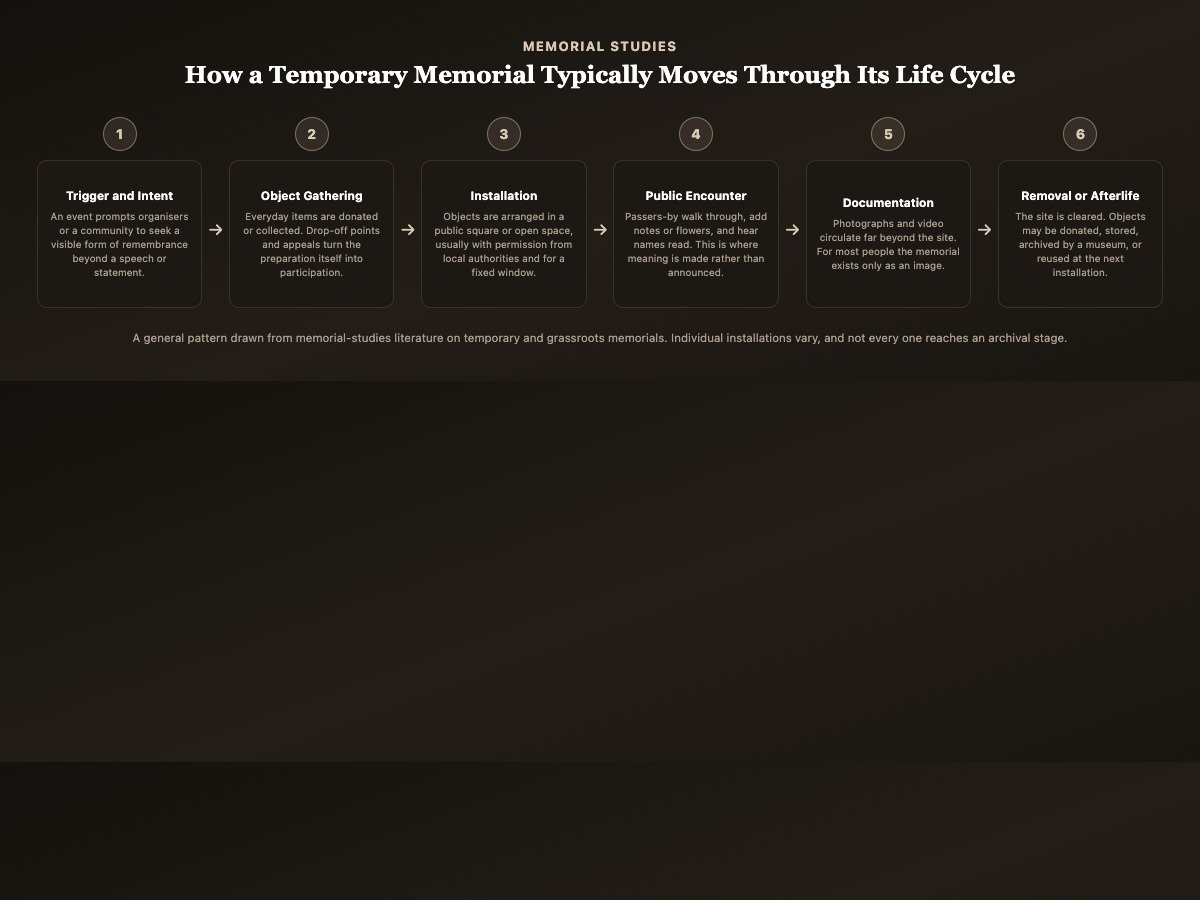
A temporary memorial makes a different claim: this matters now, in this place, to us. It requires no consensus, only permission for an afternoon. It can appear while events are still unfolding, which is precisely when a permanent monument cannot. The trade-off is that it commits nothing to the future and leaves no maintained trace — unless someone photographs, archives or collects it.
Historians tend to regard these as complementary rather than competing. Temporary memorials frequently function as the first draft of a permanent one: the practices they establish, the objects they use and the images they generate become the raw material that later, slower commemoration draws on.
3. The Role of Public Art in Remembrance
Placing a memorial in a working public square rather than a gallery changes who encounters it and on what terms. Gallery visitors have chosen to attend and arrive prepared. People crossing a square on a Sunday have not chosen, and the encounter is involuntary — which is the point, and also the reason such installations are sometimes contested.
Public art of this kind is generally judged by different criteria than studio work: whether it is legible without a caption, whether it survives being photographed from a phone at eye level, whether it accommodates people who want to participate and people who want to pass by, and whether it manages the space respectfully for those who did not ask to be there. The Dutch series scores highly on legibility and on participation, and its recurring form suggests deliberate iteration on all four.
4. How Historians and Curators Study Memorials
A memorial is evidence about the people who made it, and only indirectly about the events it commemorates. A historian examining these installations in fifty years would ask: who organised them, who attended, what objects were used, who granted permission, which media covered them, what language was used, what was contested, and what was preserved.
They would treat the organisers’ published record as a primary source with a known position — extremely valuable for dates, locations and stated intent, and requiring corroboration for contested claims. They would treat independent news coverage as a check on scale and reception. They would treat the photographs as evidence of framing choices as much as of the scene itself. And they would keep, throughout, a firm line between what the memorial asserts and what the historical record independently supports.
5. How to Verify Claims About a Memorial Event
The verification method used for this guide is reproducible and worth stating, because the same story circulates in many distorted versions. First, find the organiser’s own dated record, which for an organised series almost always exists and is the best source for dates and locations. Second, corroborate individual events with independent local reporting — a regional broadcaster is often more reliable than an international aggregator. Third, treat counts as claims and attribute them. Fourth, check the origin of any geographic label that does not match the reporting, because platform metadata is a common source of confident, wrong location claims. Fifth, state what you could not verify instead of narrating around the gap.
🎭 Culture Insight
Temporary public memorials have been used around the world to commemorate wars, disasters and humanitarian tragedies. Their persistence across cultures suggests they answer a need that formal commemoration does not: the need to respond immediately, collectively and physically, at a moment when official processes have not concluded and may not have begun. That immediacy is their strength and, equally, the reason they are sometimes criticised as responding to events before those events are fully understood.
Comparison Tables
The distinctions that matter when classifying a memorial
| Dimension | Temporary Memorial | Permanent Memorial |
|---|---|---|
| Lead time | Weeks; can respond while events are ongoing | Years; usually requires events to have concluded |
| Approval needed | Public-space permission for a fixed window | Planning consent, funding, often legislation |
| Materials | Donated everyday objects; reusable | Stone, bronze, engineered structures |
| Cost | Minimal; labour and logistics dominate | Substantial; design, build and maintenance |
| Who decides the message | Organisers, sometimes with visitor contributions | Committees, commissioning bodies, sometimes governments |
| Duration of the object | Hours to days | Decades to centuries |
| How most people encounter it | Photographs and video after the fact | In person, often years later |
| Revisability | Each edition can change form freely | Very difficult to alter once installed |
| Dimension | Symbolic Installation | Traditional Monument |
|---|---|---|
| Primary mode | Substitution — an object stands for a person | Representation — a figure or form depicts a subject |
| Authorship | Often collective or anonymous | Usually a named artist or architect |
| Scale logic | Quantity carries the meaning | Singular form carries the meaning |
| Viewer position | Inside it, walking among the objects | Outside it, looking at the object |
| Interpretation | Open; visitors supply much of the meaning | More closed; inscriptions guide reading |
| Institutional status | Rarely official | Frequently official or state-sanctioned |
| Dimension | Public Art | Protest Art |
|---|---|---|
| Stated aim | Aesthetic, civic or commemorative enrichment of a shared space | To advance a position or demand a change |
| Commissioning | Often commissioned by a city or institution | Rarely commissioned; usually self-initiated |
| Permanence | Frequently permanent or long-term | Almost always temporary |
| Relationship to authority | Generally works with it | Generally addresses or challenges it |
| Where the Dutch series sits | Both. The organisers’ own term, herdenkingsprotest, names the hybrid explicitly, and classifying it as purely one or the other misdescribes it. | |
| Example | Year | Place | Scale | Commemorating |
|---|---|---|---|---|
| Majdanek shoe collection | 1944 onward | Lublin; displayed in Washington, DC | ~4,000 shoes in the museum display | Victims of Nazi camps |
| Shoes on the Danube Bank | 2005 | Budapest, Hungary | 60 iron pairs, permanent | Jews killed on the riverbank, 1944–45 |
| Zapatos Rojos | 2009 onward | Ciudad Juárez and 12+ countries | From 33 pairs; varies by restaging | Women killed or disappeared |
| Avaaz Capitol installation | 2018 | Washington, DC | 7,000 pairs | Children killed by gunfire since 2012 |
| Plant een Olijfboom series | 2023–2026 | 13+ Dutch cities | 8,000 to 20,000+ per edition (organiser figures) | Children reported killed in Gaza |
| Pennsylvania Avenue display | 2025 | Washington, DC | ~17,000 shoes (reported) | Children reported killed in Gaza |
| Source type | What it is good for | What it cannot establish | How this guide used it |
|---|---|---|---|
| Organiser’s own record | Dates, locations, stated intent, participant lists | Independent verification of counts or of contested claims | Primary source for the event schedule, always attributed |
| Regional news reporting | On-the-ground detail, scale, local reception | Wider context beyond the reporting area | Corroboration for the Utrecht, Amsterdam and Hilversum editions |
| International wire and agency material | Photographic record, broad reach | Precise local facts; region metadata can be wrong | Used for imagery and reach; metadata treated with caution |
| Museum and archive records | Provenance and conservation of historical objects | Anything about current events | Basis for the Majdanek and Holocaust museum entries |
| Humanitarian agency publications | Situation reporting and methodological caveats | Resolution of contested casualty totals | Context only; no figure asserted in our own voice |
| Academic memorial studies | Frameworks, terminology, comparison | Facts about any specific recent event | Glossary and the explainer sections |
🩺 Humanitarian Insight
Memorial installations seek to raise awareness but do not replace humanitarian assistance or official investigations. The organisations that deliver aid, verify conditions and document alleged violations — United Nations agencies, the International Committee of the Red Cross, national societies and independent monitors — operate under mandates, methodologies and access constraints that a public installation neither has nor claims. Treating a memorial as a substitute for that work misreads what it is; treating it as worthless because it is not that work misreads it equally.
Timeline Summary Table
Every documented milestone at a glance
| Date | Event | Historical significance |
|---|---|---|
| 1944–45 | Shoes recovered at Majdanek after liberation | Footwear enters the historical record as physical evidence |
| 1993 | Shoe room opens at the US Holocaust Memorial Museum | Establishes the curatorial convention of massed personal effects |
| 2005 | Shoes on the Danube Bank installed, Budapest | Moves the form from museum interior to permanent public monument |
| Aug 2009 | Zapatos Rojos begins, Ciudad Juárez | Creates a low-cost, replicable participatory template |
| 13 Mar 2018 | 7,000 pairs on the US Capitol lawn | Demonstrates national-scale delivery in days |
| Oct 2023 | Escalation of the conflict in Gaza and Israel | Context in which the Dutch series begins |
| 20 Dec 2023 | Rotterdam, Binnenrotte — 8,000 shoes | First installation in the recurring Dutch series |
| 13 Jan 2024 | Amsterdam, Dam Square — 10,000 shoes | Places the form in a nationally significant commemorative space |
| 17 Mar 2024 | Utrecht, Vredenburgplein — 14,000 shoes | Introduces timed addition of pairs; most widely reported edition |
| 8 May 2024 | Amsterdam, Oosterdokskade — 15,000 shoes | Monthly cadence and city rotation established |
| May–Sep 2024 | Haarlem, The Hague, Breda, Groningen, Rotterdam | Series reaches government seat and mid-sized cities |
| 4 Nov 2024 | Hilversum, Mediapark | Addressed to broadcasters; commemorates journalists alongside children |
| 13 Apr 2025 | Leiden, Beestenmarkt — five-hour reading | Duration becomes an explicit design element |
| 29 Jun 2025 | Almere — ~18,000 items reported | Soft toys added to the object vocabulary |
| Aug–Oct 2025 | Utrecht, Apeldoorn, Maastricht | Nationwide geographic coverage completed |
| Nov 2025 | Pennsylvania Avenue, Washington, DC — ~17,000 shoes | Form travels internationally for the same cause |
| 12 Apr 2026 | Amsterdam, Dam Square — 20,000+ shoes | Largest edition on the organisers’ record |
| Jun–Aug 2026 | Den Bosch; Scheveningen beach | First shoreline siting; most recent listed events |
📸 Media Insight
Photographs of symbolic memorials often become influential because they communicate complex events through simple visual imagery. That strength carries a corresponding risk: an image travels faster than its caption, and by the third or fourth republication the location, date and organiser may have been lost or altered. The mislabelling examined in this guide is an ordinary instance of that process, not an unusual one. Anyone citing a memorial photograph should trace it back to the outlet that first published it and check the location against the organiser’s own record.
How These Events Are Actually Organised
The practical mechanics behind an installation of this scale
Collecting Ten Thousand Shoes
The logistical core of the Dutch series is a distributed donation network. The organisers publish drop-off points across the country where members of the public can leave children’s shoes in the weeks before an event. This is not merely a supply mechanism; it is the first stage of participation, and it means several thousand households have already engaged with the memorial before a single shoe reaches the square.
Because shoes are stored and reused between editions, the collection is cumulative rather than repeated from zero. That is the practical explanation for why the counts rise steadily across the series rather than fluctuating: the stock grows, and each event adds to it.
Permissions and Public Space
An installation covering a major city square requires notification to and permission from the municipality, typically under the same framework that governs demonstrations. Dutch law provides for public assembly with advance notification, and the events in this series have proceeded as permitted gatherings in permitted spaces — a mundane but important point, since it distinguishes them from unauthorised occupations of public space.
The Layout Itself
Laying out ten to twenty thousand pairs is several hours of volunteer work before the public window opens. Reporting and photographs of the events show shoes arranged in regular rows with walkable gaps, which serves two purposes: it lets visitors move through rather than around, and it produces a legible aerial image. Both are design decisions, and both recur across editions.
Reading the Names
The continuous recitation is the element organisers have emphasised most consistently. Its function is temporal: a visitor who stays ten minutes hears a few dozen names and can extrapolate what five hours means. This is the same mechanism used at commemorations of many kinds worldwide, and it is the part of the installation that cannot be photographed — which is precisely why people who attended describe it as the part they remember.
Removal and Afterlife
The square is cleared the same day. Shoes are collected, sorted and stored for the next edition; visitor contributions such as notes and flowers are handled separately. Nothing structural remains. What persists is the documentation: the organisers’ own record, press photography, broadcast footage and the accounts of people who were there.
Key Entities in This Story
Organisations, institutions and places that appear in the documented record
Stichting Plant een Olijfboom
Dutch foundation that organises the recurring memorial protests and publishes the dated record this guide relies on for the event schedule. Its stated aim is a just peace with equality for all citizens, including the right of return for Palestinian refugees.
Caribbean Netherlands
The three special municipalities of Bonaire, Sint Eustatius and Saba, part of the Netherlands but located in the Caribbean. Frequently attached to this story in aggregated listings; we found no verified shoe memorial there.
Gaza
The territory whose reported child casualties the Dutch installations commemorate. Conditions there are documented by United Nations agencies and humanitarian organisations; casualty totals are published by the Gaza Ministry of Health and cited with caveats.
United Nations
Through OCHA and other bodies, the principal publisher of situation reporting on humanitarian conditions in Gaza. UN sources are the appropriate reference for conditions on the ground; a memorial installation is not.
UNICEF
The United Nations agency for children, which publishes on the protection of children in armed conflict. Its reporting is a standard reference for how children are affected in emergencies and for the applicable protection frameworks.
International Committee of the Red Cross
The ICRC holds a mandate under the Geneva Conventions relating to protection in armed conflict and publishes extensively on international humanitarian law. It is a primary reference for the legal framework surrounding civilian protection.
United States Holocaust Memorial Museum
Holds and displays roughly four thousand shoes recovered at Majdanek, initially on long-term loan from the State Museum at Majdanek and later gifted to the museum’s permanent collection.
Shoes on the Danube Bank
Permanent 2005 memorial in Budapest by Can Togay and Gyula Pauer: sixty pairs of iron shoes on the Pest embankment, commemorating Jews killed at the river in 1944–45.
Zapatos Rojos
Elina Chauvet’s red-shoe installation, begun in Ciudad Juárez in 2009 and restaged in more than a dozen countries. The most-replicated participatory shoe memorial of the modern period.
Avaaz
International advocacy organisation that laid seven thousand pairs of children’s shoes on the US Capitol lawn in March 2018 to mark children killed by gunfire since 2012. The shoes were donated to charity afterwards.
🔭 Future Watch
Documented, non-speculative developments worth following: whether any museum or civic archive formally collects material from these installations, as institutions have done with objects from spontaneous memorials elsewhere; whether the organisers’ published schedule continues at its established cadence beyond the Scheveningen listing; whether academic memorial-studies research produces peer-reviewed analysis of the 2023–2026 series, which would move it from journalism into scholarship; and whether educational institutions incorporate the material into teaching on public memory. Each of these is checkable against a published record. We do not forecast where the practice goes next, and this guide will be updated only when a documented development occurs.
Common Misconceptions
What the record supports, and what it does not
✅ Supported by the record
- A recurring series of children’s-shoe memorial installations has been held in the Netherlands since December 2023, with a dated public schedule.
- The organiser is Stichting Plant een Olijfboom, a Dutch foundation with a publicly stated position.
- Names and ages of children are read aloud during the events, in some editions for five continuous hours.
- Shoes have been used as memorial objects for decades, in museums, permanent monuments and protest installations across several countries.
- The Utrecht edition of March 2024 introduced adding a pair every ten minutes, and was reported by multiple independent outlets.
- Shoe counts cited at each event are figures stated by the organisers.
❌ Not supported, or frequently misstated
- That a children’s-shoe tribute took place in the Caribbean Netherlands. We found no verified record of one on Bonaire, Sint Eustatius or Saba.
- That the tributes were held on Caribbean beaches. The documented sites are Dutch city squares, plus one North Sea beach at Scheveningen.
- That the installations began spontaneously without organisation. They are planned, permitted and scheduled in advance.
- That shoe counts are independently audited totals. They are stated figures, and should be attributed as such.
- That the practice originated with this conflict. It is documented in museum collections, in Budapest since 2005 and in Ciudad Juárez since 2009.
- That a memorial installation constitutes humanitarian assistance, an investigation or a legal finding. It is none of those, and is not presented as such by its organisers.
💡 Interesting Facts
- The Dutch word the organisers use, herdenkingsprotest, has no single-word English equivalent. “Commemoration protest” is the closest literal rendering, and the awkwardness of the translation is itself informative about the form.
- Shoes for the Dutch series are stored between editions and reused, which is why the counts accumulate steadily across nearly three years rather than resetting.
- The Budapest memorial’s iron shoes are period-accurate 1940s styles, cast rather than preserved — a sculptural reconstruction, not recovered objects.
- Visitors leave candles and flowers inside the Budapest iron shoes. That participatory layer was not part of the original design and emerged from the public.
- At the US Holocaust Memorial Museum, each shoe in the display was individually tagged and mapped to an assigned position, so that the arrangement preserves visible variety rather than uniform mass.
- The 2018 Capitol installation and the 2025 Pennsylvania Avenue display sit within walking distance of each other, seven years and two entirely different causes apart.
- Elina Chauvet’s Zapatos Rojos is now more often staged by local groups than by the artist herself, making it closer to an open protocol than a conventional artwork.
- The Scheveningen edition of August 2026 is the first in the Dutch series listed on open sand rather than paving, which changes how the rows photograph entirely.
Explore More Timelines
People Also Ask
Frequently Asked Questions
Seventy questions on the tributes, the symbolism and the history of memorial practice
Why Symbolic Memorials Continue to Shape Public Memory
Nearly three years after the first rows of shoes were laid on a Rotterdam market square, what is most striking about the practice is not its scale but its ordinariness. There is no commissioned sculpture, no permanent site, no committee, no inscription. There is a donation network, a permit, a sound system, a list of names and several hours of volunteer labour. That is the entire apparatus. And yet the photographs of it have travelled further than most commissioned monuments manage in a decade.
The reason is the object. A shoe is not a symbol that has to be explained, and a small shoe is not a symbol that can be softened. It carries the shape of one body and the absence of that body simultaneously, which is exactly the double meaning that memorial designers spend years trying to engineer into stone. The Majdanek curators did not invent that effect; they found it in the evidence and chose not to conceal it. Everyone working in the form since — in Budapest, in Ciudad Juárez, on the Capitol lawn, in a Dutch city square — has been working with a property the object already had.
Understanding events like these, though, requires careful attention to verified historical records, official documentation and responsible journalism. This particular story arrived attached to a location that the record does not support, and it would have been easy to write around that gap: to describe a Caribbean beach, name an island, invent a founding meeting, and produce something more satisfying to read and entirely untrue. The discipline of saying what can be documented, attributing what is claimed, and naming what could not be verified is not a limitation on this kind of writing. It is the whole of it.
What remains, finally, is a question of dignity. Every one of these installations concerns real people, remembered by other real people who chose to spend a Sunday laying out shoes in the cold. The right response to that is neither to inflate it into something it is not nor to dismiss it as gesture. It is to record accurately what was done, by whom, on what date, in what place, and in whose name — and to leave the reader with the material to think for themselves. Ordinary objects can help communities remember humanitarian tragedies and encourage public reflection. Ordinary accuracy is what keeps that remembering worth anything at all.
Related Reading on AiTimeline
Sources & further reading
Every dated entry above was checked against these references. Last reviewed 15 September 2026.
- Stichting Plant een Olijfboom - Herdenkingsprotesten (organiser record)
- Plant een Olijfboom - Dam Square memorial protest, 12 April 2026
- Al Jazeera - Thousands of shoes laid out as memorial to children killed in Gaza
- NL Times - Thousands of shoes lined up in Utrecht
- Yad Vashem - The Shoes on the Danube Promenade
- United States Holocaust Memorial Museum - Collections
- ABC News - 7,000 children's shoes laid out on the Capitol lawn
- Institute for Public Art - Red Shoes (Zapatos Rojos), Elina Chauvet