Israeli Settler Violence in the West Bank: The Historical, Legal and Humanitarian Record
A UN- and ICJ-sourced historical, legal and humanitarian guide to Israeli settler violence in the West Bank, with the August 2026 incident in context.
Latest Story
In the last week of January and the first weeks of February, field teams from the United Nations Office for the Coordination of Humanitarian Affairs (OCHA) moved between herding communities in the Jordan Valley, recording displacement counts, photographing damaged water lines, and logging each incident against a standardized set of categories that humanitarian agencies have refined over two decades of monitoring the occupied West Bank. Their reports do not assign blame beyond what has been confirmed; they record what happened, where, to whom, and what remains disputed. That distinction — between what has been verified and what is still being investigated — is the organizing principle of this guide. It is also the lens through which this article examines a specific, recent, and still-developing case: the shooting of a Palestinian child near the West Bank village of Al-Mughayyir on August 1, 2026, and the broader pattern of Israeli settler violence in which it sits.
🧠 60-Second Overview
Israeli settler violence refers to acts of intimidation, assault, arson and shooting carried out by Israeli civilians living in West Bank settlements against Palestinian residents, often in areas where Israeli military law applies to settlers and Israeli military occupation law applies to Palestinians. UN monitors recorded settler violence at record levels through 2026. On August 1, 2026, a 10-year-old Palestinian boy was shot in the back near Al-Mughayyir village; Israeli police arrested an off-duty Israeli soldier on suspicion of the shooting. This guide places that incident inside the decades-long legal and historical record.
Who, What, When, Where, Why and How
What the Record Actually Shows
- One incident, one investigation: The August 1, 2026 shooting near Al-Mughayyir is an active police matter. An arrest is not a conviction, and this article does not assert guilt.
- Part of a documented trend: UN monitors recorded 2026 as the highest-ever pace of settler attacks on record, with 18 Palestinians killed by mid-July 2026 alone.
- Settlements and international law are separate from any single incident: The 2024 International Court of Justice advisory opinion addressed the settlement regime broadly, not this case specifically.
- Two different actors, two different bodies of law: Israeli settlers are generally subject to Israeli civil and criminal law; Palestinians in the West Bank live under Israeli military law — a structural asymmetry that international bodies have repeatedly flagged.
- Verification takes time: Initial field reports (often from local or Palestinian sources) can differ from later official findings; both deserve to be reported, clearly labeled, not merged into one claim.
- Children are disproportionately affected: UN reporting for 2026 documents dozens of children among those injured or displaced by settler-related violence in the West Bank.
- Humanitarian and legal tracks run in parallel: OCHA and OHCHR document humanitarian conditions; the ICJ and ICC address legal questions; police and military justice systems address individual criminal cases. These are not the same process.
- Advisory opinions are not enforcement: The ICJ’s 2024 opinion carries legal authority but is not binding, and Israel disputes its findings — a distinction that matters for how the ruling is reported.
- Displacement is a growing, separately tracked harm: Settler violence has driven Palestinian communities from their land independent of, and in addition to, casualty figures.
- This is a living reference: As the Al-Mughayyir investigation, and the broader 2026 pattern, produce new official findings, this article will be revised — not replaced with a new one.
Understanding Settler Violence in International Reporting
What the term means, why civilian protection is a legal category and not just a moral one, and how conflict reporting tries to stay accurate under pressure.
What “Settler Violence” Refers To
In UN and human-rights reporting, settler violence is a defined monitoring category: acts of physical assault, arson, property destruction, livestock theft, land seizure, or intimidation carried out by Israeli civilians residing in West Bank settlements or outposts against Palestinian residents, their land, or their property. OCHA, OHCHR and independent monitors such as B’Tselem log these incidents individually — date, location, type of harm, whether Israeli security forces were present — rather than treating “settler violence” as a rhetorical label. The term does not, on its own, indicate who is criminally responsible for any specific incident; that determination belongs to an investigation, which is why this article is careful to separate the pattern from the individual case.
Why Civilian Protection Is a Legal Category
Civilian protection is not simply a humanitarian preference; it is a body of binding treaty law. The Fourth Geneva Convention of 1949 obliges an occupying power to protect the civilian population of the territory it occupies, and separately prohibits it from transferring its own civilian population into that territory. Protection obligations apply regardless of nationality, religion or political affiliation of the civilians involved — a principle repeated throughout this guide because it is the standard this article applies when describing harm to any civilian, Israeli or Palestinian.
The Role of International Humanitarian Law
International humanitarian law (IHL) — the law of armed conflict and occupation — governs the conduct of an occupying power and the treatment of protected persons. It exists alongside, but is legally distinct from, international human rights law (IHRL), which applies to states at all times, including in occupied territory. Both bodies of law are relevant to the West Bank; the comparison table later in this guide sets out how they differ in scope and enforcement.
Conflict Reporting Challenges
Reporting inside an active occupation involves structural obstacles that do not exist in most news environments: restricted press access, competing narratives from parties with a direct stake in the outcome, language and translation gaps, and the physical difficulty of reaching a rural village like Al-Mughayyir quickly enough to document a scene before it changes. Reputable outlets manage this by clearly attributing early claims to their source (a wire service, a local news agency, a party’s spokesperson) rather than presenting them as independently confirmed fact until they can be corroborated.
Why Verification Is Essential
The initial report of the August 1 shooting, from the Palestinian news agency Wafa, described a settler attack. Israeli police then confirmed the arrest of an off-duty Israeli soldier as a suspect. Both facts are true and both are reported here — but they are not the same fact, and conflating them (either by assuming the initial characterization was wrong, or by assuming the arrest proves premeditated settler violence) would misrepresent an active investigation. This is the single clearest illustration in this article of why verification standards exist.
How Humanitarian Organizations Document Incidents
OCHA’s West Bank monitoring uses a standing methodology: incidents are logged from multiple sources (protection partners, hospitals, community focal points), cross-checked where possible, and published in periodic “Humanitarian Situation Updates” that separate confirmed casualty figures from displacement estimates and access restrictions. This is slower than real-time news reporting by design — the trade-off is a dataset that researchers, journalists and courts can rely on months or years later.
What “Verified,” “Confirmed” and “Alleged” Mean in This Article
These words are used precisely, not interchangeably, throughout this guide. Verified means corroborated by more than one independent source or an official record — for example, the IDF’s confirmation of the soldier’s arrest. Confirmed is used the same way UN humanitarian reporting uses it: cross-checked against hospital or protection-partner data before publication. Alleged or reported marks a claim sourced to a single party or outlet that has not yet cleared that bar — the initial Wafa characterization of the shooting, for instance. Readers who see a claim without one of these qualifiers should assume it falls into the “verified” category as of this article’s last update.
How This Guide Uses Sources
Every specific claim in this article is traceable to a named source: a UN agency report, a court document, or a named news outlet. Where a claim comes from an advocacy organization such as B’Tselem, Human Rights Watch or Amnesty International, the organization is named in the text rather than folded into an unattributed “reports say.” Where two sources conflict, both are described, with their respective sourcing, rather than one being silently preferred. This approach is slower to read than a single confident narrative, and that trade-off is deliberate.
Journalism Insight
Reliable reporting distinguishes confirmed information from allegations and developing claims. A source saying something happened is a fact about what was said; it is not, by itself, proof that the underlying event occurred exactly as described. Good reporting carries both, clearly labeled.
Historical Timeline: From Occupation to the 2026 Escalation
Reverse-chronological. Each entry separates historical background, legal context, humanitarian developments, official responses and current relevance.
A Child Is Shot Near Al-Mughayyir; a Soldier Is Arrested
What happened: On Friday, August 1, 2026, a 10-year-old Palestinian boy was shot in the back during an alleged raid on a sheep farm west of Al-Mughayyir village, northeast of Ramallah. Wafa, the Palestinian official news agency, first reported it as a settler attack.
Official response: Israeli police arrested an off-duty Israeli soldier on suspicion of carrying out the shooting; the IDF confirmed the arrest to Haaretz. The suspect has been arrested, not charged or convicted — the investigation was ongoing at the time of this update.
Current relevance: The case is being watched as a test of whether an investigation involving a uniformed suspect proceeds differently, and how quickly, compared with the broader pattern of largely unresolved settler-violence cases documented since 2020.
UN: West Bank Settler Violence Reaches an “All-Time High”
Humanitarian developments: By July 20, 2026, OHCHR recorded 18 Palestinians killed in West Bank settler-related and military violence that year — 12 attributed to settlers, three to Israeli forces, three disputed or unclear — against 1,835 settler attacks recorded across all of 2025 and an early-2026 pace of roughly 190 attacks per month, a 24 percent increase over 2025’s monthly rate.
Official statements: OHCHR spokesperson Ravina Shamdasani said settlers and Israeli security forces had “often acted together” against Palestinian communities and described new movement restrictions as unprecedented; UN Deputy Humanitarian Coordinator Ramiz Alakbarov said there is “no military or violent solution to this conflict.” OHCHR called on third states to help “halt the continuing killing and dispossession of the Palestinian people.”
Legal context: This is a humanitarian and human-rights assessment, not a court finding; OHCHR’s statements are official UN reporting, distinct from any criminal or judicial determination about individual incidents.
A Winter Displacement Wave, Documented Incident by Incident
Humanitarian developments: OCHA’s Humanitarian Situation Update #356, covering January 20–February 2, 2026, recorded three Palestinians killed (including one child) and 111 injured (12 of them children) in that two-week window alone, and nearly 700 people displaced across nine communities since the start of the year — including the full displacement of the Ras Ein Al Auja Bedouin community in the Jordan Valley after settler attacks.
Why it matters here: This update illustrates OCHA’s standing methodology — incident-by-incident logging, cross-checked casualty and displacement counts — used to document the broader pattern this article discusses. It is not a source for the August 1 Al-Mughayyir incident specifically.
The International Court of Justice Rules Israel’s Occupation Unlawful
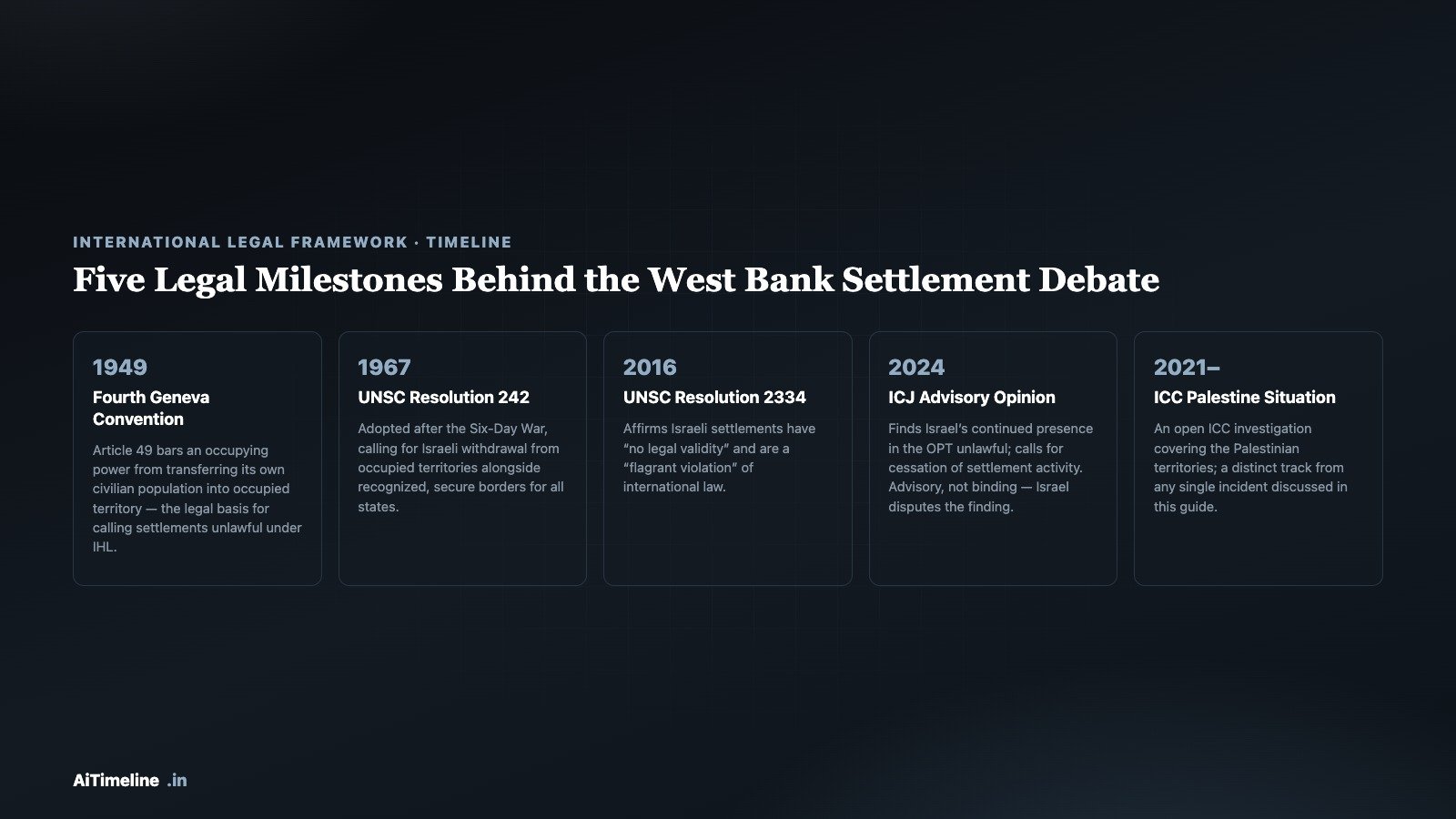
Legal context: On July 19, 2024, the International Court of Justice issued an advisory opinion finding that Israel’s continued presence in the Occupied Palestinian Territory is unlawful, that Israeli settlements and the associated regime have been established and are maintained in violation of international law, and that related Israeli legislation and measures breach the international prohibition on racial segregation. The Court called for an immediate end to new settlement activity and the evacuation of settlers, and for reparations to affected persons.
Official responses: The opinion is advisory, not legally binding in the way a contentious-case judgment is, though the Court and UN human-rights experts describe it as carrying significant legal authority. Israel disputes the opinion’s findings and has continued settlement activity since.
West Bank Settler Violence Rises Sharply After the Gaza War Begins
Humanitarian developments: Following the October 7, 2023 Hamas-led attack on Israel and the start of the Gaza war, OCHA, OHCHR and independent monitors documented a marked rise in settler attacks and Israeli military operations across the West Bank, alongside a sharp increase in Palestinian displacement from herding and rural communities.
Current relevance: UN reporting treats this period as the start of the sustained escalation that continued through 2025 and into 2026, providing the immediate historical backdrop — distinct from the deeper 1967–2016 legal history above — against which the July 2026 “all-time high” assessment and the August 2026 Al-Mughayyir incident should be read.
UN Security Council Resolution 2334: Settlements Have “No Legal Validity”
Legal context: Resolution 2334, adopted December 23, 2016, reaffirmed that Israeli settlements in territory occupied since 1967, including East Jerusalem, have “no legal validity” and constitute “a flagrant violation under international law,” and called for a halt to all settlement activity.
Current relevance: It remains the primary Security Council statement on settlement legality, cited by UN agencies and independent monitors as the baseline legal position referenced throughout later reporting, including the 2024 ICJ opinion above.
Gaza Disengagement Shows Settlement Evacuation Is Politically Possible
Historical background: In 2005, Israel unilaterally withdrew all settlers and military installations from the Gaza Strip and four small West Bank settlements, over strong domestic opposition from the settler movement.
Current relevance: The disengagement is frequently cited, on differing sides, as evidence that settlement evacuation is administratively achievable and as evidence of the political cost such evacuations carry — a tension still visible in Israeli domestic debate over the 2024 ICJ opinion’s evacuation call.
The Second Intifada Reshapes Access, Security and Settlement Growth
Historical background: The Second Intifada, a period of intense Israeli-Palestinian violence beginning in September 2000, led to the construction of the separation barrier, an expansion of Israeli military checkpoints across the West Bank, and continued settlement growth despite the security deterioration.
Legacy: The access-control infrastructure built in this period — checkpoints, the barrier, permit regimes — still governs Palestinian movement in the West Bank today and is a recurring subject of OCHA access-and-movement reporting.
The Oslo Accords Divide the West Bank Into Areas A, B and C
Legal context: The Oslo I (1993) and Oslo II (1995) Accords created an interim division of the West Bank into Area A (full Palestinian civil and security control), Area B (Palestinian civil control, joint security control) and Area C (full Israeli civil and security control, roughly 60 percent of the West Bank and home to the great majority of Israeli settlements).
Current relevance: This division, intended as a five-year interim arrangement, remains in force three decades later. Most settler-violence incidents documented by OCHA, including the one near Al-Mughayyir, occur in or near Area C.
Settlement Growth Brings Rising Land Disputes and Friction
Historical background: As the number and population of settlements grew through the 1980s, so did friction over land: Palestinian human-rights groups and journalists began documenting recurring incidents of land confiscation, damage to Palestinian agricultural property (olive groves in particular), and settler harassment of Palestinian communities.
Legacy: This decade is generally treated by historians and monitors as the period in which “settler violence” became a distinct, recurring category of harm rather than an occasional incident.
Gush Emunim Becomes the Ideological Engine of Settlement
Historical background: Founded in 1974, the religious-Zionist movement Gush Emunim (“Bloc of the Faithful”) argued for Jewish settlement throughout the biblical Land of Israel, including the newly occupied West Bank, and organized the establishment of some of the earliest civilian settlements, often beginning as military outposts before being formally civilianized.
Current relevance: Successor organizations and ideological currents from this movement remain part of the settler movement’s political and religious landscape today.
The Six-Day War Begins the Israeli Occupation
Historical background: Following the June 1967 Six-Day War, Israel occupied the West Bank (including East Jerusalem), the Gaza Strip and the Golan Heights. UN Security Council Resolution 242, adopted later that year, called for Israeli withdrawal from territories occupied in the conflict alongside recognition of every state’s right to live in secure, recognized borders — a formula whose interpretation remains disputed to this day.
Legacy: The 1967 occupation is the foundational fact from which every subsequent legal, humanitarian and political development in this timeline follows, including the settlement enterprise and the violence associated with it.
The Legal and Institutional Framework
The bodies and legal concepts that appear throughout UN, ICRC and court reporting on the West Bank.
Occupation, Defined
Under international law, territory is considered occupied when it is actually placed under the authority of a hostile army, whether or not that authority is contested. The West Bank has been under Israeli military occupation since 1967; this is not a disputed factual premise among the UN, the ICJ, or the vast majority of states, though Israel disputes some legal consequences that follow from that status, including the applicability of the Fourth Geneva Convention’s settlement-transfer prohibition.
Settlements, Defined
A settlement, in this context, is a community of Israeli civilians established in the West Bank following the 1967 occupation, generally with Israeli government authorization (an unauthorized version, without formal state approval, is usually termed an “outpost”). As of the ICJ’s 2024 opinion and prior UN reporting, several hundred settlements and outposts house several hundred thousand Israeli civilians across the West Bank, concentrated in Area C.
The Israeli Government’s Legal Position
Israeli governments have consistently disputed the “occupied territory” characterization used throughout this article and by most UN bodies, generally describing the West Bank instead as “disputed territory” whose final status remains to be negotiated, on the argument that no other state held internationally recognized sovereignty over it immediately before 1967 (Jordan’s earlier annexation was not widely recognized). On this basis, successive Israeli governments have argued the Fourth Geneva Convention’s settlement-transfer provision does not apply as a matter of law. A government-commissioned 2012 legal review (the Levy Report) concluded Israeli settlement activity is not, in its authors’ view, illegal under international law; the report was not formally adopted as binding government policy but is frequently cited in Israeli official statements. Israeli officials also cite security considerations — control of strategic terrain in the Jordan Valley and hilltops overlooking Israeli population centers — as a rationale distinct from the religious-nationalist arguments associated with the settler movement. This position is a minority one among states and international courts, as the timeline above shows, but it is the official Israeli government position and is presented here on that basis, not adopted as this article’s own conclusion.
Human Rights Investigations
Independent human-rights investigations — by UN-mandated bodies, national human-rights institutions, or NGOs like B’Tselem, Human Rights Watch and Amnesty International — differ from criminal investigations. They assess patterns of conduct against human-rights and humanitarian-law standards and issue findings and recommendations; they do not have police powers, cannot compel evidence, and cannot themselves prosecute anyone. Their findings can, however, inform ICC referrals, UN Human Rights Council resolutions, or domestic-court proceedings elsewhere under universal jurisdiction.
Conflict Documentation and Evidence Verification
Credible documentation of a conflict incident typically requires more than one source: physical evidence (medical records, ballistic findings, photographs with verifiable metadata), witness testimony gathered independently from multiple people, and, where available, official statements from the parties involved. Organizations like OCHA cross-check incident reports against hospital and protection-partner data before publishing casualty figures, which is part of why humanitarian reporting on a fast-moving incident often lags real-time news coverage by days.
Independent Monitoring
B’Tselem, Human Rights Watch, Amnesty International and Yesh Din are the principal non-governmental organizations that maintain ongoing, incident-level databases of West Bank settler violence, home demolitions and related harms. Their findings are independent of government or UN funding structures but are not neutral in the sense of representing “official” positions; like any advocacy or research organization, their reports should be read as one evidentiary source among several, attributed by name, not treated as an unattributed fact.
Accountability Mechanisms
Several distinct systems can, in principle, hold individuals or states accountable for violations in this context: Israeli domestic criminal and military justice (the process now underway in the Al-Mughayyir case); the International Criminal Court, which has an open situation on Palestine opened in 2021 and issued arrest warrants in November 2024 against Israeli Prime Minister Benjamin Netanyahu and former Defense Minister Yoav Gallant over alleged war crimes and crimes against humanity related to the conduct of the Gaza war — a separate matter from West Bank settler violence, included here only as an example of the ICC mechanism, not as evidence about this incident; the International Court of Justice, which rules on state responsibility rather than individual guilt; and universal-jurisdiction prosecutions in third countries, which remain rare in practice.
Legal Insight
International humanitarian law establishes protections for civilians regardless of political affiliation. The same body of law that obliges Israel, as the occupying power, to protect Palestinian civilians also protects Israeli civilians — including settlers — from unlawful attack. Reporting that applies the law asymmetrically misrepresents it.
Detailed Sections
The Role of Humanitarian Organizations
OCHA coordinates humanitarian response and produces the West Bank’s most consistently cited incident and displacement data. OHCHR monitors and publicly reports on human-rights conditions and can refer patterns of concern to UN political bodies. UNICEF focuses specifically on children’s welfare, including grave violations against children in situations of armed conflict — killing, maiming, attacks on schools and hospitals — tracked under a UN Security Council-mandated monitoring framework that predates this incident by nearly two decades. The ICRC’s role is distinct again: it works to promote compliance with international humanitarian law, visits detainees, and facilitates protection activities, generally without public incident-by-incident commentary on individual cases, which is why no ICRC statement on the Al-Mughayyir shooting specifically has been identified for this article.
Documentation Standards
Humanitarian documentation standards generally require: a described time and place precise enough to be checked against other records; a description of harm categorized consistently across incidents (killed, injured, displaced, property destroyed); and, where possible, corroboration from more than one independent source before a figure is included in an aggregate statistic. This is why OCHA’s periodic updates carry reporting-period dates rather than claiming real-time completeness.
Media Verification Process
Reputable news organizations verify a breaking incident by triangulating: a wire-service or local-agency initial report, an official statement from the relevant authority (here, Israeli police confirming an arrest through the IDF), and, where possible, independent confirmation from hospitals, witnesses, or monitoring groups. A claim that has cleared only the first stage — a single source’s initial account — should be reported as exactly that: an initial, single-sourced account, not an established fact.
Protection of Children in Armed Conflict
Children hold enhanced protection status under international humanitarian law and under the UN Security Council’s Children and Armed Conflict agenda, which tracks six categories of “grave violations,” including killing and maiming of children and attacks on schools. UNICEF and UN-mandated monitoring and reporting mechanisms compile these figures for public reporting and, in some cases, referral to the UN Security Council’s Working Group on Children and Armed Conflict. This article does not name the child involved in the August 1 incident; that omission is a deliberate choice consistent with standard child-protection reporting practice, not a gap in the available information.
Emergency Medical Response
Gunshot injuries in West Bank settler-violence and military-operation incidents are typically first stabilized at the nearest Palestinian Ministry of Health facility, sometimes complicated by movement restrictions or checkpoint delays that OCHA separately tracks under “access to healthcare” reporting. In rural areas like Al-Mughayyir, ambulance transit to a fully equipped trauma center in Ramallah can take considerably longer than in an urban setting, a logistical factor OCHA’s health-access reporting has flagged as a recurring contributor to poorer outcomes in West Bank casualty incidents generally. Verified reporting for the August 1 incident does not include hospital-level clinical detail, and this article does not speculate about the child’s medical condition beyond what has been publicly confirmed.
Impact on Local Communities
Beyond individual casualties, OCHA’s displacement data shows settler violence driving entire communities — particularly herding and Bedouin communities in Area C and the Jordan Valley — off land they have used for generations, through a combination of direct attacks, livestock theft, and access restrictions that make continued residence untenable. January 2026 displacement from settler violence alone, per OCHA, already exceeded all of 2024’s annual total. Communities that depend on grazing land, such as the sheep-farming households near Al-Mughayyir, are especially exposed, because livestock theft or a single violent incident on pastureland can end a family’s livelihood even where no one is physically harmed.
Challenges of Reporting Active Conflicts
Restricted access, safety risks for local journalists, rapidly evolving official statements, and the emotional weight of incidents involving children all create real pressure toward premature or overstated claims. The standard applied throughout this article — separating verified fact, official statement, humanitarian reporting, legal context and independent analysis into clearly labeled categories — exists specifically to manage that pressure.
Humanitarian Insight
Conflict reporting requires careful verification because early reports may change as investigations progress. The characterization of the August 1 shooting shifted within the same day, from an initial “settler attack” report to confirmation of a soldier’s arrest — both are part of the honest record.
Who Documents This: The Institutions Involved
OCHA
UN Office for the Coordination of Humanitarian Affairs. Publishes the West Bank’s primary incident, casualty and displacement data through periodic Humanitarian Situation Updates.
OHCHR
UN Office of the High Commissioner for Human Rights. Monitors and publicly reports on human-rights conditions, issues official statements, and can refer patterns of concern to UN political bodies.
UNICEF
Focuses on children’s welfare in conflict, including grave-violations monitoring under the UN’s Children and Armed Conflict framework.
ICRC
International Committee of the Red Cross. Promotes compliance with international humanitarian law and supports protection of civilians and detainees, generally without public incident-level commentary.
International Court of Justice (ICJ)
UN’s principal judicial organ. Issued the July 2024 advisory opinion on the legality of Israel’s presence in the Occupied Palestinian Territory.
International Criminal Court (ICC)
Prosecutes individuals for war crimes, crimes against humanity and genocide. Has an open situation on Palestine (opened 2021) and issued 2024 arrest warrants related to the Gaza conflict.
B’Tselem
Israeli human-rights organization maintaining an incident-level database of settler violence and occupation-related harms in the West Bank.
Human Rights Watch & Amnesty International
International NGOs that independently research, document and publish reports on settler violence, occupation policy, and related human-rights conditions.
Palestinian Authority
Administers civil affairs in West Bank Areas A and B under the Oslo framework; does not govern Area C, where most settlements and documented settler-violence incidents are located.
Israeli Civil Administration (COGAT)
The Israeli military body administering civil affairs for Palestinians in Area C, including planning, permits and coordination with humanitarian actors on access and movement.
Comparisons: Getting the Distinctions Right
International Humanitarian Law (IHL)
- Applies specifically during armed conflict and occupation
- Governs the conduct of an occupying power toward protected persons
- Rooted in the Geneva Conventions and their Additional Protocols
- Enforced through state responsibility, war-crimes prosecution, and diplomatic pressure
International Human Rights Law (IHRL)
- Applies at all times, in peace and in conflict alike
- Governs a state’s conduct toward all individuals within its jurisdiction or effective control
- Rooted in treaties such as the ICCPR and ICESCR, plus customary law
- Enforced through UN treaty bodies, regional courts, and domestic litigation
Verified Facts
- Confirmed by multiple independent sources or an official record
- Example: the IDF’s confirmation that police arrested a suspect
- Safe to state without qualification
- Still subject to revision if new official information emerges
Developing Reports
- Sourced to a single party or a single outlet at time of writing
- Example: the initial Wafa characterization, pending corroboration
- Reported with clear attribution, not asserted as settled
- Updated or removed as the investigation clarifies the facts
Official Investigation
- Conducted by a state authority with legal powers (police, military justice)
- Can result in charges, prosecution, or formal closure
- Findings are generally not public until concluded
- Here: the Israeli police investigation into the August 1 shooting
Independent Investigation
- Conducted by NGOs, journalists, or UN human-rights mechanisms
- Cannot compel evidence or prosecute; produces findings and recommendations
- Often published openly, in real time or near real time
- Here: ongoing monitoring by B’Tselem, OCHA and OHCHR of the broader pattern
✅ What International Humanitarian Law Can Do
- Establish binding obligations on an occupying power toward protected civilians
- Provide a legal basis for war-crimes prosecution at the ICC or in domestic courts
- Give UN bodies and courts a framework for advisory opinions like the ICJ’s 2024 ruling
- Set enforceable standards for the treatment of children, detainees and the wounded
⛔ What International Humanitarian Law Cannot Do
- Compel a state to comply with an advisory opinion or Security Council resolution
- Independently arrest, charge or convict any individual — that requires a prosecuting authority
- Resolve the underlying political dispute over sovereignty and borders
- Substitute for a completed criminal investigation in an individual case such as this one
History Insight
The issue has evolved over decades through political negotiations, legal disputes and recurring violence — from the 1967 occupation, through the Oslo Accords’ interim division of the West Bank, to the 2024 ICJ opinion. No single ruling or agreement has resolved it, which is why current reporting keeps referring back to this history.
Glossary: Key Terms in This Guide
Defined once here; used consistently throughout the article.
| Term | Definition |
|---|---|
| Settler violence | Acts of assault, arson, property destruction or intimidation by Israeli civilian settlers against Palestinians or their property, as tracked by UN and independent monitors. |
| Occupation | Control of territory by a hostile army without the sovereign’s consent; triggers specific obligations under international humanitarian law. |
| Occupying power | The state exercising effective control over occupied territory; bears legal obligations toward its civilian population. |
| Fourth Geneva Convention | 1949 treaty protecting civilians in wartime and occupation, including a prohibition on an occupying power transferring its own civilians into occupied territory. |
| International Humanitarian Law (IHL) | The body of law governing armed conflict and occupation; sometimes called the law of war. |
| International Human Rights Law (IHRL) | The body of law governing a state’s treatment of individuals at all times, in peace or conflict. |
| Settlement | An Israeli civilian community established in the West Bank since 1967, generally with Israeli government authorization. |
| Outpost | A settlement established without formal Israeli government authorization. |
| Area A / B / C | The three-way administrative division of the West Bank created by the Oslo Accords, defining differing levels of Israeli and Palestinian civil and security control. |
| Advisory opinion | A non-binding but legally authoritative ruling issued by the ICJ at the request of a UN body, as distinct from a binding judgment in a contentious case between states. |
| War crime | A serious violation of international humanitarian law giving rise to individual criminal responsibility. |
| Crime against humanity | A serious offense (e.g. murder, persecution) committed as part of a widespread or systematic attack on a civilian population. |
| Universal jurisdiction | The principle allowing certain domestic courts to prosecute grave international crimes regardless of where they occurred or the nationality of those involved. |
| Punitive demolition | Demolition of a structure by Israeli authorities as a punitive measure, distinct from demolitions carried out for lack of an Israeli-issued building permit. |
| Collective punishment | Penalizing a group for the actions of an individual; prohibited under the Fourth Geneva Convention. |
| Forced displacement | The movement of people from their homes or land due to violence, intimidation or destruction of livelihood, as distinct from voluntary relocation. |
Data Tables: The Documented Record
Five reference tables condensing the history, legal instruments, institutions, protection mechanisms and open investigations covered above into a single scannable record.
| Year | Event | Historical Importance |
|---|---|---|
| 1967 | Six-Day War; Israel occupies the West Bank | Establishes the occupation from which all later developments follow |
| 1974 | Gush Emunim founded | Becomes the ideological engine of early settlement expansion |
| 1980s | Escalating land disputes | Settler violence becomes a recurring, documented category of harm |
| 1993–95 | Oslo Accords | Creates the Area A/B/C division still governing West Bank administration |
| 2000–05 | Second Intifada | Produces the barrier, checkpoint and permit infrastructure still in use |
| 2005 | Gaza disengagement | Shows settlement evacuation is administratively possible, politically costly |
| 2016 | UNSC Resolution 2334 | UN Security Council affirms settlements have “no legal validity” |
| 2024 | ICJ advisory opinion | Most significant international legal ruling on the settlement regime to date |
| 2026 | Record-pace settler violence; Al-Mughayyir shooting | Most recent documented escalation and the incident anchoring this article |
| Instrument | Year | Core Content |
|---|---|---|
| Fourth Geneva Convention | 1949 | Protection of civilians in occupied territory; prohibits transfer of the occupying power’s civilians |
| UNSC Resolution 242 | 1967 | Calls for withdrawal from occupied territories alongside secure, recognized borders |
| Oslo I & II Accords | 1993 / 1995 | Interim self-government arrangement; creates Areas A, B and C |
| Rome Statute (ICC) | 1998 | Establishes the International Criminal Court and its jurisdiction over war crimes and crimes against humanity |
| UNSC Resolution 2334 | 2016 | Reaffirms settlements have no legal validity |
| ICJ Advisory Opinion | 2024 | Finds continued occupation and settlement regime unlawful; calls for cessation and evacuation |
| Organization | Mandate | Reports Individual Incidents? |
|---|---|---|
| OCHA | Humanitarian coordination and data | Yes, aggregated in periodic updates |
| OHCHR | Human-rights monitoring and reporting | Selectively, in official statements |
| UNICEF | Children’s welfare in conflict | Via the Children and Armed Conflict mechanism |
| ICRC | IHL compliance, detainee and civilian protection | Rarely, publicly, at incident level |
| B’Tselem | Independent Israeli human-rights monitoring | Yes, incident-level database |
| Human Rights Watch / Amnesty International | International independent human-rights research | Yes, in published reports |
| Mechanism | What It Protects | Enforcement Path |
|---|---|---|
| Fourth Geneva Convention protections | Civilians under occupation | State responsibility; war-crimes prosecution |
| Children and Armed Conflict monitoring | Children in conflict zones | UN Security Council Working Group referral |
| Domestic criminal law | Any individual victim of a crime | Police investigation, prosecution, courts |
| Military justice systems | Conduct by uniformed personnel | Military police investigation, court-martial |
| ICC jurisdiction | Victims of war crimes / crimes against humanity | International prosecution, where admissible |
| Investigation | Authority | Status (as of this update) |
|---|---|---|
| Al-Mughayyir shooting, Aug 1, 2026 | Israeli police | Active; suspect arrested, not charged or convicted |
| Broader 2026 settler-violence pattern | OCHA / OHCHR | Ongoing humanitarian monitoring, periodic public reporting |
| Occupation & settlement regime | International Court of Justice | Advisory opinion issued July 2024; implementation disputed |
| Palestine situation (Gaza conduct) | International Criminal Court | Open; arrest warrants issued November 2024 |
💡 Did You Know?
- UN agencies and humanitarian organizations use standardized methodologies to document civilian harm, so a figure published in one OCHA update can be directly compared with the same category in an update from a different month or year.
- The Ramallah and el-Bireh governorate, where Al-Mughayyir is located, recorded the highest number of settler attacks of any West Bank governorate across 2025 and the first half of 2026.
- An ICJ advisory opinion, unlike a contentious-case ruling, cannot be “appealed” — but it also cannot be directly enforced through the Court itself.
- The Oslo Accords’ Area A/B/C division was designed as a five-year transitional arrangement in the mid-1990s and has now been in place for roughly three decades.
- OCHA’s incident categories distinguish harm caused by settlers from harm caused by Israeli security forces, and log a third “disputed or unclear” category rather than forcing every incident into one of the first two.
- The Levy Report, an Israeli government-commissioned legal opinion, and the ICJ’s 2024 advisory opinion reach opposite conclusions on settlement legality — both are described in this article, attributed to their source, rather than one being presented as the only view.
Future Watch
What to watch next, based only on official processes already underway: the outcome of the Israeli police investigation into the August 1 shooting; further OCHA and OHCHR humanitarian updates tracking whether the 2026 pace of settler attacks continues; and any state or UN response to the 2024 ICJ opinion’s call for an end to settlement activity. This section will be updated as official findings are published — not with speculation in the meantime.
Explore More Timelines
People Also Ask
Frequently Asked Questions
85 questions, organized from definitions through to this specific case, the documentation process, the institutions involved, the history, child protection, accountability, and how to use this article responsibly.
Related AiTimeline Coverage
Global Geopolitical Conflicts and Shifting Alliances
Iran Attacks US Bases in the Middle East
Russia-Ukraine War: Full Timeline and History
US-Iran Tensions and the Strait of Hormuz
Explore All AiTimeline Stories
⚠️ Editorial Note & Disclaimer
This is a sensitive, contested and actively developing subject involving an ongoing criminal investigation and a decades-long, unresolved international legal and political dispute. This article separates verified fact, official statement, humanitarian reporting, legal context and independent analysis throughout, and does not assign responsibility for the August 1, 2026 shooting beyond what Israeli authorities have officially confirmed: that a suspect has been arrested, not charged or convicted.
Sourcing includes UN bodies (OCHA, OHCHR), the International Court of Justice, named news outlets (Haaretz, Wafa, IMEMC, Al Jazeera, CNN, UN News) and independent human-rights organizations (B’Tselem, Human Rights Watch, Amnesty International), each cited by name so readers can evaluate the claim at its source. This article does not name the child involved or the arrested suspect, consistent with responsible reporting on a minor in an active case.
AiTimeline is an independent editorial publication, not a party to this conflict, a legal authority, or a substitute for official investigative or judicial findings.
Methodology & update note: This article was compiled from the primary and secondary sources listed above and in the sources section. It is maintained as a living reference and will be revised as the Israeli police investigation into the August 1, 2026 shooting, further OCHA/OHCHR reporting, or relevant court proceedings produce new, officially confirmed findings. Last substantive update: August 2026.
Why Careful Documentation Matters During Armed Conflict
The shooting of a child near Al-Mughayyir on August 1, 2026, is, in the strict sense, a single criminal matter now in the hands of Israeli police. It is also, inescapably, one data point in a pattern that UN monitors describe as the worst on record: 18 Palestinians killed by mid-2026, a settler-attack rate up nearly a quarter over the previous year, and displacement already outpacing entire prior years within the first months of the current one. Holding both of those things at once — the specific case, still unresolved, and the broader trend, extensively documented — without collapsing one into the other, is the discipline this article has tried to model throughout.
That discipline is not a stylistic preference. It is what separates reporting that can withstand scrutiny from reporting that cannot. An arrest is not a conviction. An advisory opinion is not an enforcement order. A single agency’s initial account is not, on its own, a settled fact. None of these distinctions soften the seriousness of what is being described; they are what allow the seriousness to be taken seriously, by courts, by researchers, and by readers trying to understand a conflict that has now spanned six decades.
Incidents involving civilians — and especially children — should be understood within the framework this article has set out: the historical record stretching back to 1967, the legal instruments from the Fourth Geneva Convention through the 2024 ICJ opinion, the humanitarian documentation maintained by OCHA and OHCHR, and the ongoing investigations that have not yet concluded. Readers who want to follow this story further than any single article can take it are best served by going to those primary sources directly, cited throughout this piece, rather than to any one summary of them — including this one.
What can be said with confidence, based on the record assembled here, is this: the rate of documented settler attacks and associated displacement in the West Bank reached its highest recorded level in 2026; the legal status of the settlement enterprise underlying that violence has been addressed by the UN Security Council in 2016 and, more comprehensively, by the International Court of Justice in 2024; and the shooting of a child near Al-Mughayyir on August 1, 2026 is, as of this update, an open Israeli police investigation with an arrested suspect and no public charge or conviction. Each of those three claims rests on a named, checkable source. None of them requires speculation to state. That is the standard this guide has tried to hold to throughout, and the standard by which any update to it should be judged.
Sources & further reading
Every dated entry above was checked against these references. Last reviewed 15 September 2026.
- UN News: West Bank settler violence at 'all-time high' (July 2026)
- OCHA: Humanitarian Situation Update #356, West Bank
- ICJ: Summary of the Advisory Opinion of 19 July 2024
- OHCHR: Experts hail ICJ declaration on illegality of Israel's presence in the OPT
- Haaretz: Off-duty IDF soldier arrested on suspicion of shooting Palestinian child in West Bank
- B'Tselem — The Israeli Information Center for Human Rights in the Occupied Territories
- Human Rights Watch: Israel/Palestine
- Al Jazeera: Mapping Israeli settler violence in the West Bank