Capital One and the Trump Organization: Inside the 2021 Account-Closure Lawsuit
Capital One says an internal AML review closed 300+ Trump-linked accounts in 2021; Trump Org disputes it. A court-filing-sourced guide to the pending case.
Latest Story
Inside a large bank’s financial-crime compliance unit, analysts spend their days doing work almost no customer ever sees: comparing transaction patterns against risk models, flagging accounts that trip a threshold, and building files that either clear a relationship or recommend it for closure. Banks are required by federal law to run programs like this, and they close or decline accounts for reasons ranging from routine risk management to specific regulatory pressure — most of the time without ever explaining why, because the law generally does not require them to, and in some cases affirmatively bars them from disclosing the details. That ordinary, largely invisible process is the backdrop against which a very public dispute is now playing out in federal court: in 2021, Capital One closed several hundred bank accounts connected to the Trump Organization. In 2025, the Trump Organization sued, alleging the closures were political retaliation. In 2026, Capital One told the court, for the first time in detail, that the accounts were closed after a months-long anti-money-laundering review. The Trump Organization calls that explanation an after-the-fact fabrication. Neither claim is a proven fact; both are positions in an active lawsuit. This guide explains the case, the AML framework Capital One says it relied on, and the “debanking” debate the litigation sits inside — attributing every contested claim to the party making it.
Most account-closure decisions never become a news story, let alone a federal lawsuit. A compliance analyst’s recommendation moves up an internal chain, a relationship manager sends a notice letter, and a customer either accepts the decision, moves their banking elsewhere, or occasionally challenges it in court on narrow contractual or statutory grounds. What makes this case different is not the underlying process — which, as described in Capital One’s own filings, resembles the ordinary risk-review machinery every large U.S. bank operates — but the identity of the customer and the political moment in which the closures occurred, four months after the January 6, 2021 attack on the U.S. Capitol. That timing is precisely why the dispute cannot be resolved by intuition or inference alone, and why this guide leans as heavily as it does on the parties’ own words, the court’s own rulings, and the regulatory framework both sides are arguing about.
🧠 60-Second Overview
Capital One closed more than 300 accounts connected to Trump-affiliated entities in 2021. The Trump Organization sued in March 2025, alleging the closures were political retaliation over January 6, 2021 — a claim it calls “debanking.” A judge dismissed that first complaint in March 2026 for lacking specifics, but let the Trump Organization refile. In a July 31, 2026 court filing, Capital One said the accounts were closed after an internal anti-money-laundering review, not political bias, and that its contracts let it close accounts “for any or no reason.” The Trump Organization calls that explanation baseless. On September 2, 2026, Senator Maggie Hassan, the top Democrat on the Joint Economic Committee, sent Capital One CEO Richard Fairbank a letter requesting documents on the transactions, alerts and other factors behind the review. The case remains open, with no ruling yet on Capital One’s newest motion to dismiss.
Who, What, When, Where, Why and How
What the Record Actually Shows
- Two competing explanations, neither proven: Capital One says an AML review drove the closures; the Trump Organization says political animus did. Both are litigation positions, not court findings.
- Capital One has not accused the Trump Organization of money laundering: its filing describes an internal risk review, not a finding of criminal wrongdoing.
- The March 2026 dismissal decided a pleading question, not the merits: Judge Altman found the original complaint barely cleared the bar of “plausibly alleging” a claim — he did not find that political animus occurred.
- Standard bank contracts often allow closure “for any or no reason”: Capital One’s account-holder terms contain this clause, and it is common across U.S. retail and commercial banking generally.
- SARs are confidential by law: if a bank files a Suspicious Activity Report, it is generally barred from telling the customer — a structural reason banks often decline to publicly detail closure rationales.
- Capital One’s own AML history is public record: the bank paid a roughly $390 million FinCEN penalty in January 2021 for a separate BSA/AML compliance failure, about two months before the Trump-account notifications — a documented fact, not evidence for either side’s theory.
- “Debanking” has no single legal definition: it is used to describe political account terminations, financial-crime-risk-driven “de-risking,” and ordinary commercial account closures alike.
- The case is not resolved: Capital One’s July 31, 2026 motion to dismiss is pending, with no ruling as of this update.
- Congress has now weighed in: Senator Maggie Hassan, the top Democrat on the Joint Economic Committee, sent Capital One a letter on September 2, 2026, requesting documents on the review that led to the closures — a congressional inquiry, not a court proceeding, and separate from the pending motion to dismiss.
- A parallel case exists: Trump-affiliated entities have also sued JPMorgan Chase over similar debanking allegations, reportedly seeking $5 billion.
- This is a living reference: as the court rules or the parties file further papers, this article will be revised, not replaced.
What Anti-Money-Laundering Compliance Actually Requires
The legal framework Capital One’s filing invokes, and why banks close accounts for reasons they often cannot disclose.
What Anti-Money Laundering (AML) Means
Anti-money laundering refers to the laws, regulations and internal bank programs designed to detect and prevent the disguising of illegally obtained funds as legitimate. In the United States, AML obligations flow primarily from the Bank Secrecy Act and its amendments, enforced by the Treasury Department’s Financial Crimes Enforcement Network (FinCEN) alongside bank-specific regulators like the OCC. Every U.S. bank is legally required to maintain a risk-based AML program — a compliance system tailored to the bank’s specific customer base, products and geography, rather than a one-size-fits-all checklist.
Know Your Customer (KYC): A Component, Not a Synonym
KYC is the identity-verification and due-diligence piece of a bank’s broader AML program: confirming who a customer is, understanding the nature of their business, and periodically reassessing risk as circumstances change. KYC is necessary for AML compliance but is not the whole of it — AML also covers transaction monitoring, suspicious-activity reporting, sanctions screening and internal controls. The comparison table later in this guide sets the distinction out directly.
Suspicious Activity Reports (SARs)
When a bank’s monitoring systems or staff identify a transaction or pattern that may involve money laundering or another financial crime, federal law requires filing a confidential Suspicious Activity Report with FinCEN. Critically, banks are generally prohibited by law from telling the customer that a SAR was filed — a rule intended to prevent tipping off potential wrongdoers, but one that also means a bank facing litigation over an account closure may be legally constrained in what it can say publicly about its reasoning, regardless of the actual cause.
Risk-Based Compliance and Enhanced Due Diligence
Banking regulators direct institutions to apply a risk-based approach: allocate more scrutiny to higher-risk customers, products and geographies, and less to lower-risk ones. Certain categories — politically exposed persons, cash-intensive businesses, and customers with complex ownership structures, among others — typically trigger enhanced due diligence, a deeper and more frequent layer of review than standard KYC. This is a general regulatory expectation across the banking industry, not a claim about any specific account discussed in this article.
“Politically exposed person” is itself a defined compliance category, not a description unique to any one individual: it generally covers current or former senior government officials, their immediate family, and close associates, on the theory that public office can create elevated corruption or bribery exposure that ordinary customers do not present. A large business closely associated with a sitting or former president would, under standard industry practice, typically fall within this category’s scope for any bank maintaining accounts for it — a general compliance-industry fact relevant to understanding why heightened review of such accounts would not, on its own, be unusual, though it says nothing about what any particular review in this case actually found.
Why Banks Close Accounts
Financial institutions close accounts for a wide range of reasons: unprofitability, a customer’s business model falling outside the bank’s risk appetite, a specific compliance finding, contractual breach, or exercise of a broad discretionary closure clause common in account-holder agreements. Because banks are private entities operating under contract law (subject to specific anti-discrimination statutes that do apply in certain contexts), courts have generally been reluctant to second-guess a bank’s stated contractual right to close an account “for any reason or no reason,” which is the standard Capital One has invoked in this case.
What “Debanking” Means
“Debanking” is not a defined legal term; it is used loosely, and differently, by different speakers. Advocacy groups and lawmakers have used it to describe banks allegedly cutting off customers for political or ideological reasons. Compliance professionals have long used a related term, “de-risking,” to describe banks exiting entire categories of customers (money-service businesses, cannabis-adjacent companies, correspondent-banking relationships in higher-risk jurisdictions) because the compliance cost or regulatory risk of serving them outweighs the business benefit. And in ordinary usage, “debanking” can simply mean any account closure a customer disputes. This article uses the term only when quoting or describing how a specific party (here, the Trump Organization’s complaint) uses it.
Civil Litigation, in Brief
This dispute proceeds as ordinary federal civil litigation: a complaint, a motion to dismiss testing whether the complaint states a legally sufficient claim, and — if it survives — discovery, in which each side can seek evidence from the other, followed by further motions or a trial. A dismissal “without prejudice,” as occurred here in March 2026, means the case was thrown out with permission to refile a corrected complaint; it is not a ruling on which side is right.
How an AML Review Differs From a Criminal Investigation
It is worth separating two things that sound similar but are legally distinct. A bank’s internal AML review is a compliance exercise: staff assess an account or relationship against the bank’s own risk criteria and regulatory obligations, and the outcome is a business decision — clear the account, request more documentation, file a SAR, or close the relationship. A criminal investigation, by contrast, is conducted by a law-enforcement or prosecutorial authority with the power to charge someone with a crime, and follows an entirely different evidentiary standard and process. Nothing in Capital One’s public filings, as reported, indicates that any criminal investigation of the Trump Organization arose from this review; the bank’s own language describes a compliance process, not a referral for prosecution.
Financial Institution Risk Appetite
Banks periodically define and redefine their “risk appetite” — the level and types of risk, including compliance risk, they are willing to accept in exchange for a given relationship’s business value. A large, high-profile customer can be attractive from a revenue standpoint while simultaneously carrying elevated reputational, political or compliance risk from a bank’s internal perspective. Boards and senior compliance officers periodically revisit which relationships still fit that appetite, independent of any single transaction-monitoring alert — a general industry practice that is relevant background for understanding how portfolio-wide reviews of the kind Capital One describes can occur, though this article has no independent insight into Capital One’s specific internal deliberations regarding the Trump-affiliated accounts.
Compliance Insight
Banks are generally required to maintain AML programs that identify and manage financial-crime risk using a risk-based approach — more scrutiny for higher-risk relationships, less for lower-risk ones. A program working as designed, and a program being misused for an unrelated purpose, can look identical from the outside, which is exactly why courts require more than an assertion to proceed past a motion to dismiss.
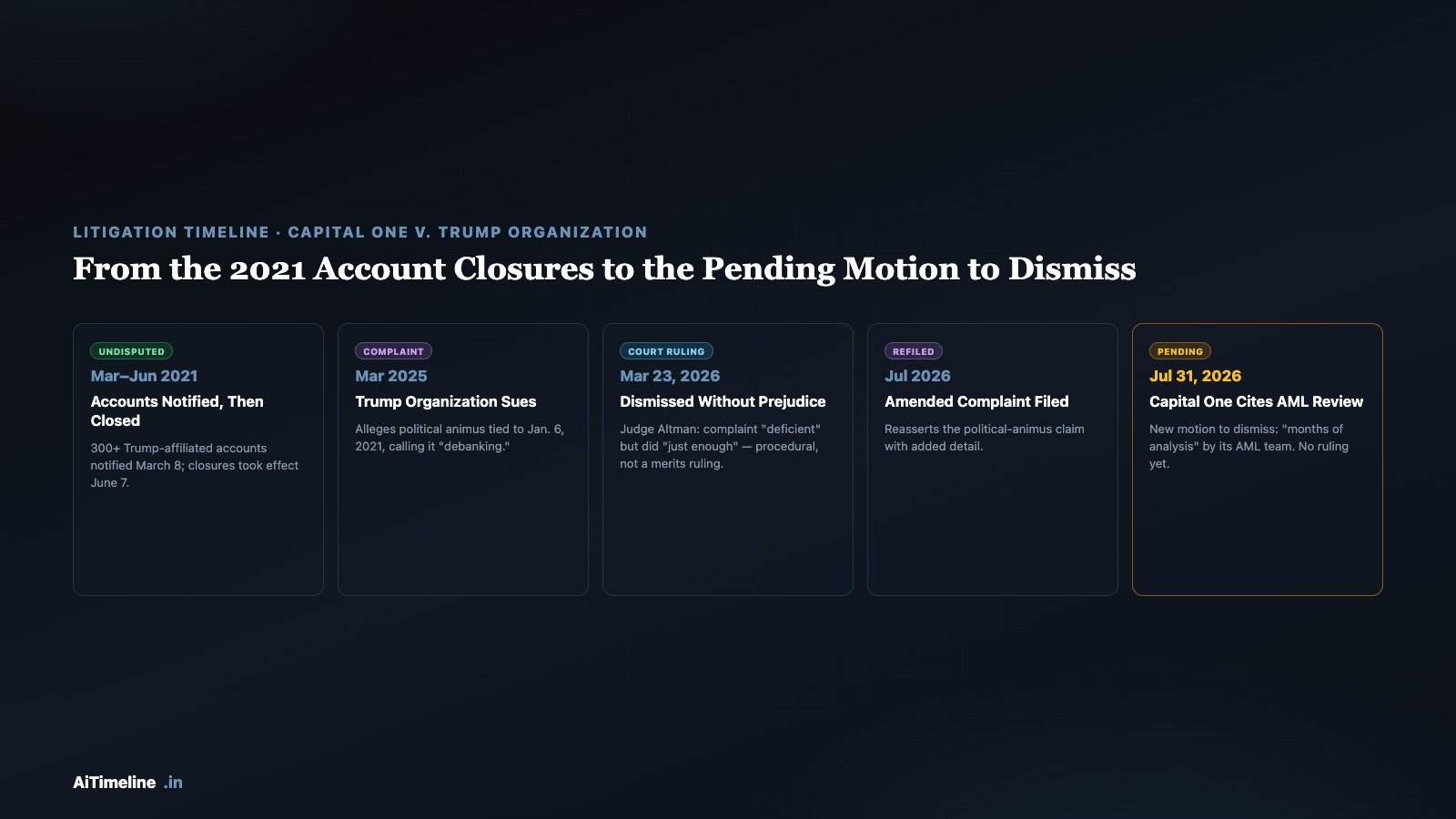
Case Timeline: From the 2021 Closures to the Pending Motion
Reverse-chronological. Each entry separates historical background, regulatory context, legal significance and current relevance.
Senator Hassan Presses Capital One for Documents
Historical background: Senator Maggie Hassan, a New Hampshire Democrat and the top Democrat on the Joint Economic Committee, sent a letter to Capital One CEO Richard Fairbank requesting documents describing the transactions, alerts and other factors that prompted the AML review, as well as any communications with law enforcement or regulators related to the matter.
Legal significance: This is a congressional oversight request, not a court filing or ruling, and runs on a separate track from the pending motion to dismiss before Judge Altman. Hassan said “the American people deserve to know.”
Current relevance: No Capital One response or deadline had been publicly reported as of this update; the request adds political and public scrutiny to a dispute that otherwise remains confined to the Miami federal court.
Capital One Files New Motion to Dismiss, Citing an AML Review
Historical background: Following the July 2026 amended complaint, Capital One filed a motion to dismiss stating the accounts were closed after “months of analysis and a careful review by Capital One’s [anti-money-laundering] team in accordance with bank policies and regulatory guidance.”
Legal significance: The filing also reiterated that Capital One’s account-holder terms permitted closing the accounts “at any time, for any or no reason and without notice.” Capital One’s filing does not accuse the Trump Organization of committing money laundering — it describes an internal risk review, not a finding of wrongdoing.
Current relevance: A Trump Organization spokesperson told CNN the explanation was “completely baseless” and that the bank “manufactured” a rationale. The motion is pending; no ruling has been issued as of this update.
Trump Organization Files an Amended Complaint
Historical background: After the case had been largely dormant following the March 2026 dismissal, lawyers for the Trump Organization filed an amended complaint reasserting that the 2021 closures were driven by political animus.
Legal significance: This refiling followed Judge Altman’s instruction to “beef up” the general allegations from the original complaint with more specific factual support, within the 90-day-discovery-plus-two-week window he set in March.
Current relevance: The amended complaint is the operative pleading Capital One’s July 31 motion to dismiss now seeks to have thrown out.
Judge Altman Dismisses the Original Complaint — Without Prejudice
Historical background: U.S. District Judge Roy Altman, a Trump appointee sitting in Miami, ruled the original 2025 complaint “deficient for numerous reasons” and lacking specificity.
Legal significance: Critically, Altman found the Trump Organization had done “just enough” to plausibly allege the accounts were potentially closed over political animus — a low pleading-stage bar, not a finding that animus actually occurred. He reportedly told the plaintiffs, “I’m going to ask you to beef up these general allegations.” He granted 90 days of discovery from Capital One plus roughly two additional weeks to file an amended complaint, with a refiling deadline reported as July 2, 2026.
Current relevance: This ruling is frequently summarized in press coverage as a partial win for the Trump Organization; more precisely, it was a dismissal that preserved the plaintiffs’ ability to try again, not a ruling on the underlying facts.
The Trump Organization Sues Capital One
Historical background: The Trump Organization filed suit in the U.S. District Court for the Southern District of Florida, alleging Capital One closed hundreds of its business accounts out of political animus toward conservatives in a process the complaint calls “de-banking,” tied to the aftermath of the January 6, 2021 Capitol riot.
Legal significance: The complaint reportedly also invoked a broader narrative describing pressure on banks in prior years to cut services to gun dealers, ammunition sellers, payday lenders and conservative-aligned businesses generally — the plaintiffs’ framing, not an independently verified pattern specific to this case.
Current relevance: This filing is the origin point of the litigation now working through the same Miami federal court more than a year later.
Capital One Notifies and Closes the Accounts
Historical background: Capital One notified Trump-affiliated entities on March 8, 2021 that accounts they controlled, benefited from, or actively used would be closed; the closures took effect June 7, 2021. More than 300 accounts were affected.
Regulatory context: This is the one set of facts in the case both sides agree occurred — the dispute is entirely about why it happened, which is why this entry is tagged “undisputed” while every entry describing a party’s explanation is tagged “disputed” or attributed directly.
Current relevance: The four-plus-year gap between the closures (2021) and the lawsuit (2025) is itself part of the public record, though neither party’s reason for the timing has been independently verified by this article.
Capital One Pays a Separate $390 Million FinCEN Penalty
Historical background: About two months before the Trump-account notifications, Capital One was fined roughly $390 million by FinCEN for failures in its Bank Secrecy Act/AML compliance program tied to its former check-cashing business unit.
Regulatory context: This is a documented, separate FinCEN enforcement action from Capital One’s broader AML compliance history — no source has tied it directly to the decision on the Trump-affiliated accounts specifically, and this article draws no causal link between the two.
Current relevance: Trade coverage of the July 2026 filing noted this fine as background context for Capital One’s stated AML posture in early 2021; readers can weigh its relevance for themselves.
The USA PATRIOT Act Expands AML and KYC Obligations
Historical background: Enacted after the September 11 attacks, the USA PATRIOT Act significantly broadened U.S. financial institutions’ AML and customer-identification obligations, including information-sharing provisions and enhanced due diligence requirements for higher-risk accounts.
Regulatory context: This is the legal backbone of the modern KYC regime every U.S. bank, including Capital One, operates under today.
Current relevance: The “AML program” Capital One’s 2026 filing references operates within the framework this Act established.
The Money Laundering Control Act Criminalizes Money Laundering
Historical background: The Money Laundering Control Act of 1986 made money laundering a distinct federal crime for the first time, giving prosecutors a direct charge rather than relying solely on underlying predicate offenses.
Regulatory context: This Act is the reason “money laundering” carries the specific legal weight it does — and why Capital One’s filing is notable for describing an AML review rather than an accusation of the crime itself.
Current relevance: Every SAR a bank files today is, ultimately, in service of detecting the conduct this 1986 law criminalized.
The Bank Secrecy Act Establishes the Modern AML Framework
Historical background: The Bank Secrecy Act, enacted in 1970, is the foundational U.S. anti-money-laundering statute, requiring financial institutions to keep records and file reports useful in criminal, tax and regulatory investigations, and establishing currency transaction reporting.
Regulatory context: Every AML program at every U.S. bank today, including whatever review Capital One conducted of the Trump-affiliated accounts, ultimately traces its legal basis back to this Act.
Current relevance: Fifty-plus years on, the BSA remains the statutory foundation regulators and courts alike refer back to in cases like this one.
Who’s Involved: Regulators, Court and Parties
FinCEN
The Financial Crimes Enforcement Network administers the Bank Secrecy Act, receives Suspicious Activity Reports and Currency Transaction Reports from every U.S. financial institution, and brings its own civil enforcement actions against banks found to have deficient AML programs — the authority under which it fined Capital One roughly $390 million in January 2021, a matter unrelated, per available sourcing, to this specific case.
Office of the Comptroller of the Currency (OCC)
Supervises nationally chartered banks, including Capital One, N.A., examining them for BSA/AML compliance among its broader safety-and-soundness mandate; the OCC can also bring its own enforcement actions independent of FinCEN’s.
Federal Deposit Insurance Corporation (FDIC)
Insures bank deposits up to statutory limits and holds supervisory and examination authority over certain financial institutions, operating alongside the OCC and Federal Reserve in the layered U.S. bank-regulatory system.
Federal Reserve
Holds supervisory authority over bank holding companies specifically, complementing the OCC’s and FDIC’s bank-level supervision within the broader U.S. bank-regulatory framework.
Capital One, N.A.
A nationally chartered U.S. bank and a subsidiary of Capital One Financial Corporation; states in its July 2026 court filing that the account closures followed an internal AML review conducted in accordance with bank policies and regulatory guidance, and that its account-holder terms independently permit closure “for any or no reason.”
Trump Organization (affiliated entities)
The real-estate and business entities whose Capital One accounts were closed in 2021; alleges in its complaint, filed March 2025 and amended July 2026, that the closures were driven by political animus following the January 6, 2021 Capitol riot, a claim it calls “debanking.”
U.S. District Court, S.D. Florida
The federal trial court in Miami hearing the case since March 2025; presided over by U.S. District Judge Roy Altman, who issued the March 2026 dismissal and will rule on Capital One’s pending July 2026 motion.
Trump Entities v. JPMorgan Chase
A separate, related lawsuit alleging similar “debanking,” reportedly seeking $5 billion in damages, proceeding independently of the Capital One case but frequently discussed alongside it given the overlapping legal theory.
Timeline Takeaway
Understanding this dispute requires knowledge of banking regulation, AML compliance, litigation procedure and financial risk management — not just the headlines a single filing generates. The AML framework Capital One invokes traces back to 1970; the “any or no reason” contract clause it also invokes is a decades-old, industry-standard provision; and the procedural posture of the case (a pending motion to dismiss, following one earlier dismissal without prejudice) has its own well-established rules that determine what happens next, independent of either party’s public statements.
Comparisons: Getting the Distinctions Right
Anti-Money Laundering (AML)
- The full compliance program: monitoring, reporting, internal controls, governance
- Governed primarily by the Bank Secrecy Act and its amendments
- Enforced by FinCEN and prudential regulators like the OCC
- Includes KYC as one component among several
Know Your Customer (KYC)
- The identity-verification and due-diligence layer specifically
- Confirms who a customer is and assesses their risk profile
- A required input into the broader AML program, not a separate law
- Applied at onboarding and re-applied periodically as risk changes
Account Suspension
- Temporary restriction on account activity
- Often used while a review is pending
- Access can be restored once the review concludes
- Generally reversible by the bank’s own decision
Account Closure
- Permanent termination of the banking relationship
- What occurred with the Trump-affiliated accounts in 2021
- Typically final, absent a new account application
- The action underlying this entire lawsuit
Allegations
- Claims made by a party in a complaint or filing
- Example: the Trump Organization’s political-animus claim
- Example: Capital One’s AML-review explanation
- Neither becomes fact simply by being filed
Court Findings
- Conclusions a judge or jury reaches after evaluating evidence
- Requires a ruling on the merits, not just a pleading-stage motion
- No court has yet made a merits finding in this case
- The March 2026 dismissal was procedural, not a merits finding
Civil Litigation
- A private lawsuit between two parties (here, Trump entities vs. Capital One)
- Resolved through motions, discovery, and potentially trial
- Can result in damages or other relief between the parties
- Does not itself impose regulatory penalties
Regulatory Investigation
- Conducted by an agency such as FinCEN, the OCC or the FDIC
- Can result in fines, consent orders or other enforcement action
- Example: Capital One’s January 2021 FinCEN penalty
- No regulator has announced an investigation into this specific case
Legal Insight
A lawsuit contains allegations by the parties; those allegations are not judicial findings unless a court rules on them. Judge Altman’s March 2026 dismissal is frequently summarized in headlines as a step forward for the Trump Organization — more precisely, it found the original complaint had barely cleared a low pleading-stage bar, not that political animus was proven.
Glossary: Key AML and Legal Terms in This Guide
Defined once here; used consistently throughout the article.
| Term | Definition |
|---|---|
| Bank Secrecy Act (BSA) | The 1970 federal law establishing the foundation of U.S. AML recordkeeping and reporting requirements for financial institutions. |
| Anti-Money Laundering (AML) | The full body of laws, regulation and internal bank programs designed to detect and prevent disguising illegally obtained funds as legitimate. |
| Know Your Customer (KYC) | The identity-verification and due-diligence component of an AML program. |
| Suspicious Activity Report (SAR) | A confidential report a bank must file with FinCEN upon detecting potential financial crime; banks generally cannot disclose to the customer that one was filed. |
| Currency Transaction Report (CTR) | A report banks must file with FinCEN for cash transactions above a statutory threshold, regardless of suspicion of wrongdoing. |
| Debanking | A non-legal term used variously for politically motivated account termination, financial-crime-risk “de-risking,” or any disputed account closure. |
| Enhanced Due Diligence | A deeper, more frequent layer of customer review applied to higher-risk categories of accounts. |
| Risk-Based Compliance | A regulatory approach directing banks to allocate compliance resources according to relative risk, rather than applying a uniform standard to every account. |
| Motion to Dismiss | A pretrial motion arguing that, even if a complaint’s factual allegations are true, they do not state a legally valid claim. |
| Dismissal Without Prejudice | A dismissal that permits the plaintiff to refile a corrected complaint, as distinct from a dismissal “with prejudice,” which ends the case. |
| Discovery | The pretrial process in which each party can seek evidence, documents and testimony from the other. |
| FinCEN | The Financial Crimes Enforcement Network, a U.S. Treasury bureau that administers the BSA and receives SARs and CTRs. |
| OCC | The Office of the Comptroller of the Currency, the primary federal regulator of nationally chartered banks such as Capital One, N.A. |
Data Tables: Laws, Regulators and the Case Record
Five reference tables condensing the legal framework and case history covered above.
| Law | Enacted | What It Established |
|---|---|---|
| Bank Secrecy Act | 1970 | Foundational AML recordkeeping and reporting requirements |
| Money Laundering Control Act | 1986 | Made money laundering a distinct federal crime |
| USA PATRIOT Act | 2001 | Expanded AML/KYC obligations, enhanced due diligence, information sharing |
| Regulator | Primary Role |
|---|---|
| FinCEN | Administers the BSA; receives SARs/CTRs; enforcement actions (e.g., Capital One’s 2021 penalty) |
| OCC | Supervises nationally chartered banks including Capital One, N.A. |
| FDIC | Deposit insurance; supervisory authority over certain institutions |
| Federal Reserve | Supervises bank holding companies |
| Date | Event | Legal Importance |
|---|---|---|
| Jan 2021 | Capital One pays ~$390M FinCEN penalty (unrelated compliance matter) | Background context, not tied by any source to the Trump accounts specifically |
| Mar 8, 2021 | Capital One notifies Trump-affiliated entities of closure | Undisputed fact |
| Jun 7, 2021 | 300+ accounts closed | Undisputed fact; triggering event for the later lawsuit |
| Mar 2025 | Trump Organization files suit | Alleges political animus/”debanking” |
| Mar 23, 2026 | Judge Altman dismisses original complaint without prejudice | Procedural ruling; not a merits finding |
| Jul 2026 | Amended complaint filed | Reasserts political-animus claim with added detail |
| Jul 31, 2026 | Capital One files new motion to dismiss, cites AML review | Capital One’s first detailed public AML explanation; disputed by plaintiffs |
| Sep 2, 2026 | Sen. Maggie Hassan sends document-request letter to Capital One CEO | Congressional oversight inquiry, separate from the pending court motion |
| Term | Plain-English Meaning |
|---|---|
| Money laundering | Disguising the origin of illegally obtained funds to make them appear legitimate |
| Structuring | Breaking transactions into smaller amounts to avoid reporting thresholds |
| Politically exposed person (PEP) | An individual holding a prominent public position, typically triggering enhanced due diligence |
| De-risking | A bank exiting entire categories of customers to reduce compliance burden or risk exposure |
| Regulatory Body | Confirmed Public Statement on This Case |
|---|---|
| FinCEN | None identified as of this update |
| OCC | None identified as of this update |
| FDIC | None identified as of this update |
Regulatory Insight
Banks often cannot publicly discuss certain compliance reviews because of confidentiality obligations — a Suspicious Activity Report, if one exists, is confidential by law. This is part of why litigation like this can proceed for years without either side’s account being independently verifiable by the public in real time.
Where the “Debanking” Debate Comes From
Neutral background on a term that predates this specific case by more than a decade.
The tension between anti-money-laundering compliance and customer access to banking is not new to 2021 or to this case. In the early 2010s, a Department of Justice and FDIC initiative informally known as “Operation Choke Point” drew scrutiny after some banks reportedly reduced services to legal but higher-risk industries — including payday lenders, firearms and ammunition dealers, and certain money-service businesses — citing AML and reputational-risk concerns. Critics argued regulators were using informal pressure to accomplish through the banking system what direct regulation of those industries could not; regulators and some banks countered that the industries in question genuinely presented elevated financial-crime risk under existing risk-based compliance standards. That episode is widely cited, across the political spectrum, as the origin point of “debanking” as a public policy term, years before it became associated with the political-affiliation claims at issue in this lawsuit.
Separately, and further back, U.S. banking law has a long history of fair-access requirements aimed at preventing discriminatory lending and account practices — including the Equal Credit Opportunity Act and the Community Reinvestment Act, both enacted in the 1970s to address documented patterns of banks declining to serve certain communities. Those statutes address discrimination on specific protected bases (race, and geographic redlining, among others) and do not, on their own, address the political-affiliation theory the Trump Organization’s complaint advances; this article notes them only as background on how U.S. law has historically approached bank-access disputes generally, not as directly applicable precedent for this case.
More recently, “debanking” has resurfaced in congressional hearings and state-level legislation, with some lawmakers proposing restrictions on banks’ ability to close accounts based on a customer’s lawful political or religious activity, and banking-industry groups generally opposing limits on their existing contractual discretion. This case is unfolding against that live legislative and regulatory backdrop, though no such legislation has been identified in sourcing reviewed for this article as directly governing the Capital One dispute itself.
Detailed Sections: How This Actually Works
How AML Monitoring Systems Work
Modern bank AML systems continuously screen transactions against rules and models — unusual transaction size, rapid movement of funds, activity inconsistent with a customer’s stated business, and matches against sanctions lists, among many other signals. Flagged activity is escalated to human analysts, who investigate, document findings and decide whether to close the alert, request more information from the customer, file a SAR, or recommend the relationship for closure. This is a general description of how the industry operates; this article has no independently sourced information about the specific system or alerts, if any, involved in Capital One’s review of the Trump-affiliated accounts.
Large banks typically layer this automated screening with periodic, manually driven relationship reviews — especially for complex commercial customers with many related accounts and entities, of the kind a large real-estate business would typically operate. A single automated alert on one transaction and a multi-month, portfolio-wide review of an entire family of related accounts are different in scale and process, even though both fall under the umbrella of “AML review.” Capital One’s filing describes “months of analysis,” language more consistent with the latter than a single triggered alert, though this article cannot independently verify which internal process actually produced the 2021 decision.
Enterprise and Business Banking Implications
For businesses of any size, this case is a reminder that commercial banking relationships — even long-standing, high-volume ones — typically rest on contracts that give the bank considerable unilateral discretion. Companies with complex, multi-entity account structures face particular exposure if a single relationship-level decision affects dozens or hundreds of related accounts simultaneously, as occurred here. Common industry practice in response includes maintaining banking relationships with more than one institution, keeping account documentation current to reduce the likelihood of a routine review flagging avoidable questions, and understanding the specific closure and dispute-resolution terms in a bank’s account agreement before a relationship becomes business-critical.
How Courts Generally Evaluate “Debanking” Claims
Because “debanking” is not itself a statutory cause of action, a plaintiff alleging it must typically frame the claim around an existing legal theory — a specific anti-discrimination statute, a breach-of-contract claim, or, in some public-figure cases, a constitutional theory if state action can be shown. Courts have generally required plaintiffs to plead specific facts connecting the closure to the alleged improper motive, rather than relying on timing or suspicion alone, which is consistent with Judge Altman’s March 2026 instruction that the Trump Organization needed to “beef up” its general allegations with more specific supporting detail.
The Account-Closure Decision Process
Beyond a specific compliance flag, banks also periodically reassess entire relationships against their current risk appetite, profitability targets and regulatory posture — especially after a bank has faced its own regulatory scrutiny, as Capital One had two months before the March 2021 notifications. A closure decision can therefore result from a specific investigation, a portfolio-wide review, or some combination; without access to Capital One’s internal file, this article cannot and does not determine which applied here.
Federal Banking Regulation, Briefly
U.S. banks answer to multiple regulators depending on their charter and structure: the OCC for nationally chartered banks like Capital One, N.A.; the FDIC for deposit insurance and certain supervisory functions; and the Federal Reserve for bank holding companies. FinCEN sits alongside these prudential regulators as the specialized AML/BSA administrator, receiving SARs and CTRs and issuing its own enforcement actions, such as the 2021 penalty against Capital One.
Legal Arguments From Both Sides
Capital One’s position, per its filings: the closures followed a legitimate, months-long AML review, and its account contract independently permitted closure “for any or no reason,” which courts have generally been reluctant to second-guess. The Trump Organization’s position, per its complaint: the AML explanation is a fabricated, after-the-fact justification, and the true motivation was political animus following January 6, 2021. Both are advocacy positions in active litigation, and this article presents them as such throughout.
What Happens Next, Procedurally
With Capital One’s July 31, 2026 motion to dismiss pending, Judge Altman will next rule on whether the amended complaint states a legally sufficient claim. If it survives, the case would typically proceed to discovery, where evidence bearing on the actual reason for the closures could become part of the public record for the first time. If dismissed again, the Trump Organization could potentially appeal or, depending on the ruling’s terms, attempt a further amendment.
Customer Rights and Business Implications
Bank customers generally have limited legal recourse to compel a bank to maintain an account, absent a specific contractual violation or a claim under an applicable anti-discrimination statute. For businesses, an account closure — especially one affecting hundreds of related accounts — can create significant operational disruption: payroll processing, vendor payments, escrow arrangements and day-to-day cash management can all be interrupted while a company arranges replacement banking relationships. That disruption is part of why litigation like this, regardless of its outcome, has drawn attention from other companies watching how courts treat broad “any reason” closure clauses, and from banking-industry groups with an interest in preserving that contractual discretion.
Privacy Obligations Banks Operate Under
Beyond SAR confidentiality specifically, banks operate under a broader set of privacy and data-protection obligations — including the Gramm-Leach-Bliley Act’s requirements around safeguarding and limiting disclosure of nonpublic customer information. These overlapping obligations mean that even a bank eager to publicly clear the air about a specific account decision may be legally constrained in exactly what it can disclose, and precisely how much detail it can offer, without separate customer authorization or a court order compelling disclosure through the discovery process.
How This Case Could Affect the Broader “Debanking” Debate
Advocacy groups, some lawmakers and industry commentators have debated for several years whether “debanking” represents a widespread, politically motivated practice or a mischaracterization of ordinary risk-based account management. Because this case involves a detailed, publicly filed account of one bank’s stated rationale, legal observers have noted it could become a reference point — regardless of its ultimate outcome — for how courts evaluate similar claims elsewhere, including the parallel JPMorgan Chase litigation. This article does not take a position on that broader debate; it reports what has and has not been established in this specific case.
History Insight
AML regulation has expanded significantly over five decades — from the Bank Secrecy Act’s 1970 recordkeeping rules, through the 1986 criminalization of money laundering itself, to the USA PATRIOT Act’s post-9/11 expansion of due-diligence obligations. Each expansion followed a specific perceived gap in the financial system, and the framework Capital One invokes today is the cumulative product of all three.
💡 Did You Know?
Financial institutions may close customer accounts for a wide variety of reasons — business risk, compliance requirements, unprofitability, or a simple contractual right — depending on applicable law and the specific account agreement. Most such closures never become public at all; a bank is under no general obligation to publicize a routine account-closure decision, which is one reason a case involving hundreds of related closures at once is unusual regardless of its underlying cause.
🔮 Future Watch
What to track next, from official sources only: Judge Altman’s ruling on Capital One’s pending July 31, 2026 motion to dismiss; whether Capital One responds to Senator Hassan’s September 2, 2026 document request; any further amended filings from either party; and any public statement from FinCEN, the OCC or another federal regulator addressing this case specifically (none has been identified as of this update). This article does not speculate about how the pending motion will be decided.
Explore More Timelines
People Also Ask
Frequently Asked Questions
85 questions, organized from AML and KYC basics through the case’s procedural history, the regulatory framework, and how to follow the litigation responsibly.
Related AiTimeline Coverage
AI Recession Warning: Timeline of Economic Impact
Global Geopolitical Conflicts: Shifting Alliances
Invest in US Stocks from India: A Timeline
5 Best Short-Term Investments for 2026 in India
Explore All AiTimeline Stories
⚠️ Editorial Note & Disclaimer
This article covers an active, unresolved federal lawsuit involving allegations that have not been proven in court. Capital One’s anti-money-laundering explanation and the Trump Organization’s political-animus allegation are both litigation positions, not established facts, and this article attributes each to the party making it throughout. Capital One’s court filing does not accuse the Trump Organization of money laundering or any other crime.
Sourcing includes named court-filing reporting from Bloomberg, CNBC, NPR, CNN and CBS News, legal-trade coverage from American Banker and Insurance Journal, and general regulatory background from FinCEN’s public guidance, each cited by name so readers can evaluate the claim at its source.
This article is not legal advice. It does not predict how the pending motion to dismiss will be decided. Readers following the litigation should consult the court’s public docket and official statements from the parties directly. AiTimeline is an independent editorial publication, not a party to this litigation or a substitute for legal counsel.
Methodology & update note: This article was compiled from the court-filing reporting and regulatory background sourced throughout. It is maintained as a living reference and will be revised as Judge Altman rules on the pending motion to dismiss, as further filings are made, or as regulators issue any relevant public statements. Last substantive update: September 2026.
Why Banking Compliance Matters Beyond a Single Lawsuit
The Capital One-Trump Organization dispute is, at its core, a disagreement over why several hundred bank accounts closed in 2021 — a question that remains legally unresolved as this article is published. But the case sits inside a larger, permanent structure: banks are required by federal law to run anti-money-laundering programs that identify and manage financial-crime risk, those programs routinely result in account reviews and closures that draw no public attention at all, and the confidentiality obligations built into that framework (particularly around Suspicious Activity Reports) mean the public often cannot verify a bank’s stated rationale even when a dispute becomes public, as this one has.
That structural reality cuts in more than one direction. It means a bank’s AML explanation, even a sincere one, may be difficult to independently confirm from outside the institution. It also means a customer’s suspicion of an improper motive, even a sincere one, may be equally difficult to disprove without discovery. Courts exist, in part, to resolve exactly this kind of evidentiary standoff — which is why the pending motion to dismiss, and whatever discovery may follow, matters more to a real answer here than any public statement issued by either side so far.
What can be said with confidence, based on the record assembled in this guide: more than 300 accounts connected to Trump-affiliated entities were closed by Capital One in 2021; the Trump Organization sued in 2025 alleging political animus; a federal judge dismissed the original complaint without prejudice in March 2026 on pleading-specificity grounds, not a finding on the merits; and Capital One’s July 31, 2026 filing offered its first detailed public account of an internal AML review, an explanation the Trump Organization disputes as fabricated. Each of those claims traces to a named, checkable source. None of them requires speculating about which side’s explanation is true. Readers who want to follow this case beyond what any single article can capture are best served by the court’s own public docket and the primary reporting cited throughout — updated here as new, officially confirmed developments occur, not replaced by a new article each time.
Evaluating either party’s account requires the same discipline a compliance analyst or a judge would apply: separate what is documented from what is asserted, note who is making each claim, and resist the pull toward a tidy narrative before the process designed to test these claims — discovery, further motions, and potentially trial — has actually run. That is a slower, less satisfying way to read a news story than picking a side from a headline. It is also the only way to describe an active federal lawsuit accurately, and it is the standard this guide will continue to apply as the case proceeds.
Sources & further reading
Every dated entry above was checked against these references. Last reviewed 19 September 2026.
- CNN: Capital One Says It Shut Down Hundreds of Trump Organization Accounts Over Money-Laundering Concerns
- CNBC: Capital One Says It Closed Trump Organization Accounts After Money-Laundering Probe
- NPR: Capital One Says It Closed Trump Organization Accounts Over Money-Laundering Concerns
- American Banker: Judge Tosses Trump's Capital One Debanking Suit, For Now
- Insurance Journal: Trump Suit Against Capital One Dismissed But Can Be Refiled
- Financial Crimes Enforcement Network (FinCEN)