Taliban Five Years in Power: What Changed in Afghanistan, and What Hasn’t
Five years after the Taliban took Kabul, control has outpaced rights. See the timeline, UN data on women, security and recognition as of Aug 2026.
Latest Story
Kabul’s streets carry less gunfire than they did through most of the war years that preceded August 2021. That quiet is real, and Taliban officials point to it constantly. It is not, by itself, an answer to the harder question five years poses: what does a movement that fought a 20-year insurgency actually build once it runs a government uncontested? As Afghanistan marks five years of Taliban rule on August 15, 2026 — five years to the day since Taliban fighters entered Kabul and President Ashraf Ghani flew out of the country — the honest answer is neither “collapse” nor “recovery.” It is a country where a girl in Kandahar has not sat a lesson beyond sixth grade in four years, where a Kabul shopkeeper can keep his shop open past dark without the checkpoints that once slowed him down, and where the same authorities are responsible for both facts. This article separates what Taliban authorities describe as achievements from what UN monitors, aid agencies and independent researchers have documented, using sources dated as close to the anniversary as the public record allows.
🧠 In 60 Seconds
Five years after taking Kabul on August 15, 2021, Taliban authorities control all of Afghanistan and have ended large-scale front-line warfare, but the picture is not simply one of stability. UNESCO counted 2.4 million girls excluded from secondary school as of August 2026; UN Women found only 7% of working-age Afghan women employed; the UN’s $1.71 billion 2026 aid appeal is 26% funded; and only Russia, since July 2025, has formally recognized the Taliban government. Control has outpaced legitimacy, security has outpaced rights, and diplomatic contact has outpaced recognition.
Taliban Five Years in Power: Key Questions
What Five Years Actually Add Up To
- Political control: Taliban authorities have held all 34 provinces for five years, though an armed opposition group’s capture and holding of outposts in Badakhshan since July 2026 marks the first sustained territorial challenge to that control — itself not the same thing as legitimacy or stability.
- Security is mixed, not solved: large-scale front-line war has ended, but ISIS-K attacks continue and a new Pakistan border conflict opened in February 2026.
- Recognition remains narrow: Russia is the only government to have formally recognized Taliban rule, as of July 2025.
- The girls’ secondary-school ban is now four years old and has widened — women were barred from medical, nursing and midwifery training in December 2024.
- Women’s formal employment has collapsed to roughly 7% versus 84% for men, per UN Women’s July 2026 survey.
- Humanitarian need remains enormous: the UN’s 2026 appeal for $1.71 billion is only 26% funded.
- Millions of Afghans have returned from Iran and Pakistan since late 2023, many under deportation pressure rather than by choice.
- Opium cultivation has collapsed since the April 2022 ban, though prices remain roughly five times pre-ban levels.
- Regional powers engage pragmatically: China, India and others deal with Kabul on security and trade grounds without conferring recognition.
Latest Update — August 2026
In the two weeks around the anniversary, Taliban control faced its most direct territorial and security challenge since 2021, concentrated in Badakhshan province. The Afghanistan Freedom Front says it has captured and held several Taliban outposts around the Zebak district border battalion since July 23, 2026, repelling repeated Taliban counterattacks; independent trackers including FDD’s Long War Journal and KabulNow describe it as the first time an anti-Taliban armed group has held ground against counterattacks in nearly five years, though the United Nations maintains opposition groups still control no fixed geographical area. Two Taliban officials were separately assassinated in the province within three weeks of each other: the Taliban’s information and culture director for Badakhshan on July 28, and the Taliban-appointed mayor of Faizabad, Habibur Rahman Mansur, in a bombing roughly 100 meters from the provincial governor’s office on August 13 — both claimed by the National Resistance Front (Washington Post, RFE/RL, Aug 13–14, 2026). None of this changes who governs Afghanistan nationally, but it is the most concrete evidence yet that “uncontested control” no longer fully describes the provincial picture, and Taliban leaders devoted a notable share of their August 19 Independence Day speeches to addressing armed opponents directly.
How the Taliban Returned to Power
A 20-year insurgency ended in roughly eleven days of provincial collapse
The Afghan government did not fall in a single battle. It fell because a series of political and military supports gave way at nearly the same time. The U.S.-Taliban Doha Agreement, signed February 29, 2020, committed Washington to a full troop withdrawal in exchange for Taliban counterterrorism assurances and a promise of intra-Afghan talks — talks that never produced a real settlement because the Afghan government itself was excluded from the original negotiation. On April 14, 2021, President Biden announced that the remaining U.S. and NATO forces would leave by September 11, 2021 (later moved up to August 31). That fixed date, more than any single battlefield event, told Taliban commanders, provincial power-brokers and ordinary Afghan soldiers alike which way the war was going to end.
What followed was not so much a military campaign as a negotiated capitulation, province by province, as local strongmen and army units concluded that fighting on served no purpose once the international backing behind Kabul’s government was leaving. Afghan National Army morale, already strained by unpaid wages, corruption and the sense of being abandoned, broke down faster than intelligence assessments had predicted.
Zaranj falls — the first provincial capital
Nimruz province’s capital became the first of Afghanistan’s 34 provincial capitals to fall, with almost no resistance from local security forces.
Sar-e Pul falls
Northern provincial capitals began collapsing in quick succession as the offensive gathered pace.
Herat falls
Afghanistan’s third-largest city fell after resistance led by veteran commander Ismail Khan, who was captured.
Kandahar falls
The Taliban’s spiritual and historical stronghold in the south fell, removing one of the last major government footholds.
Mazar-i-Sharif falls
The last major northern city under government control fell, effectively encircling Kabul.
Kabul falls; President Ghani flees
Taliban fighters entered Kabul largely unopposed. President Ashraf Ghani left the country, later saying he did so to avoid bloodshed. Chaotic scenes followed at Hamid Karzai International Airport as thousands of Afghans attempted to flee, including the August 26 suicide bombing at the airport’s Abbey Gate that killed an estimated 170 Afghans and 13 U.S. service members.
Final U.S. withdrawal
The last U.S. military flight departed Kabul airport just before the August 31 deadline, ending America’s longest war and closing the evacuation.
The Doha Agreement: The Deal That Set the Exit in Motion
Signed in Doha, Qatar, on February 29, 2020, between U.S. Special Representative Zalmay Khalilzad and Taliban co-founder Mullah Abdul Ghani Baradar, the agreement traded a firm U.S. withdrawal timeline for Taliban commitments not to allow al-Qaeda or other groups to use Afghan soil against the United States or its allies, and for the Taliban to enter negotiations with the Afghan government. The Afghan government under President Ghani was not a signatory and had little influence over the terms. Intra-Afghan talks that opened in Doha in September 2020 stalled repeatedly, and by the time the Taliban’s 2021 offensive began, no political settlement existed to fall back on. Analysts and former officials have since disputed how much the agreement itself caused the collapse versus how much it merely set a clock that revealed problems — corruption, patronage-based command structures, low troop morale — that already existed inside the Afghan security forces.
The Contradiction of Five Years of Taliban Rule
Several things are simultaneously true, and that tension is the real story
Less conventional warfare, greater restrictions on women, partial economic stabilization, a still-severe humanitarian crisis, deeper regional engagement, and only one country’s formal recognition — these are not contradictions to be resolved by picking a side. They are the actual shape of five years of Taliban governance, and any single-sentence verdict (“Afghanistan is safer now” or “Afghanistan has collapsed”) leaves most of that shape out.
| Category | August 2021 | August 2026 | What changed |
|---|---|---|---|
| Political control | Taliban seizes Kabul Aug 15; no governing structure yet in place | All 34 provinces held for a fifth year under Hibatullah Akhundzada’s centralized, Kandahar-based emirate, though Badakhshan has seen the first sustained territorial and assassination challenge from armed opposition groups since July 2026 | Control consolidated; no elections or power-sharing introduced; first cracks in uncontested control now documented |
| Security | Civil war just ending; Kabul airport bombing kills ~170 Afghans, Aug 26 | No front-line civil war; ISIS-K attacks continue (Jan 2026 Kabul bombing, 7 dead); new Pakistan border conflict since Feb 2026 | Conventional war ended; new cross-border conflict and residual insurgency replaced it |
| Girls’ secondary education | ~1 million girls enrolled in grades 7–12 | 2.4 million girls excluded (UNESCO, Aug 2026) | Banned since March 2022; Afghanistan is the only country with this policy |
| Women’s higher education | Women attending university | Banned since Dec 2022; medical/nursing/midwifery training also banned Dec 2024 | Near-total closure of formal higher education to women |
| Women’s employment | Women worked across government, education, health, media, NGOs | ~7% of women employed vs. 84% of men (UN Women, Jul 2026) | Sharp formal-sector contraction; informal/home-based work continues |
| Media freedom | ~12,000 journalists working nationwide | Afghanistan ranks 175th of 180 (RSF 2026 Index); two-thirds of 2021’s journalists have left the field | Steep decline in outlets, especially among women journalists |
| Economy | Already aid-dependent; reserves frozen days after takeover | ~4.0% GDP growth forecast for 2026, but GDP per capita falling (World Bank, May 2026) | Nominal stabilization; living standards still declining |
| Humanitarian need | Banking-system shock just beginning | 21.9 million people (~45% of population) need aid; 2026 appeal 26% funded | Chronic, large-scale need persists |
| International recognition | Zero governments recognize Taliban rule | One state (Russia, since Jul 2025) formally recognizes; others maintain contact only | First formal recognition achieved, but isolated |
| Refugees/returns | Millions already displaced by decades of war | 5.4 million returned from Iran/Pakistan since late 2023 (UNHCR), much of it under deportation pressure | A return/deportation wave adds strain rather than resolving displacement |
| Opium cultivation | ~233,000 hectares cultivated (2022 season, pre-ban) | 10,200 hectares in 2025, down 20% year-on-year (UNODC) | Sharp fall after the April 2022 ban; farmgate prices still ~5x pre-ban levels |
What Has Actually Improved
Taliban authorities point to several areas as evidence of successful governance. Examined against independent evidence, some of that holds up better than others.
Reduction in large-scale battlefield conflict. Claim: the 20-year civil war has ended. Evidence: independently confirmed — there has been no return to front-line warfare between Taliban forces and a rival Afghan government since 2021. Limitation: this framing excludes the new Pakistan border conflict since February 2026 and continuing ISIS-K attacks, both of which have killed and displaced large numbers of Afghans.
Opium suppression. Claim: the April 2022 cultivation ban eliminated Afghanistan’s drug economy. Evidence: UNODC confirms cultivation fell from roughly 233,000 hectares in 2022 to 10,200 hectares in 2025. Limitation: farmgate income for farmers collapsed by 48% in a single year (2024 to 2025) and dry opium prices remain about five times pre-ban levels — suppression, not elimination, and a real rural-income shock.
Revenue collection and trade. Claim: Taliban officials cite improved customs and domestic revenue collection and highlight infrastructure projects such as the Qosh Tepa irrigation canal. Evidence: AiTimeline could not locate an independently audited 2025 or 2026 Taliban government revenue figure. Taliban spokesman Zabihullah Mujahid’s October 2025 claim that canal excavation was nearing completion is not independently confirmed; regional reporting (NZZ, Times of Central Asia) has flagged a large water leak along the canal route raising structural-integrity concerns. Limitation: treat all of this as a Taliban-sourced claim pending independent verification, not as an established fact.
What Has Deteriorated
Women’s rights and girls’ education represent the most extensively documented rollback: secondary schooling, university, medical training, most formal employment and, since September 2025, entry to UN offices are all barred to women by decree. Media freedom has fallen sharply — Afghanistan ranks 175th of 180 countries in RSF’s 2026 World Press Freedom Index, with roughly two-thirds of the journalists working in 2021 having left the profession, and eight in ten women journalists have stopped working entirely. Political participation remains closed to anyone outside the Taliban’s own leadership; no elections have been held or scheduled. Humanitarian conditions remain severe, with a chronically underfunded UN appeal and food insecurity affecting more than a third of the population.
What Remains Unresolved
International recognition beyond Russia; economic integration with frozen central-bank reserves still unresolved five years on; a durable Pakistan relationship after the ceasefire that collapsed in February 2026; a sustainable path for the millions of returning refugees; closing the humanitarian funding gap; and any credible move toward inclusive governance that would satisfy the conditions most governments have set for deeper engagement.
What Five Years of Taliban Rule Mean for Women and Girls
The most carefully documented, and most consequential, part of this record
No single sentence captures what has happened to women’s and girls’ rights under Taliban authorities since 2021 — the restrictions are specific, layered, and were introduced gradually rather than all at once. What follows is what is actually documented, sector by sector, with sources and dates.
✅ Afghan Women Can
- Attend primary school, grades 1–6
- Work in some healthcare roles already qualified for (though new training is barred)
- Run home-based or informal businesses in most provinces
- Move within their own city on public transport, generally with a mahram (male guardian) expected, enforcement varies by province
❌ Afghan Women Cannot
- Attend secondary school (grade 7 and above) since March 2022
- Attend university since December 2022
- Enroll in medical, nursing or midwifery training since December 2024
- Work for most NGOs (since Dec 2022) or enter UN offices (since Sept 2025)
- Travel long distances without a mahram in most provinces, per Taliban guidance
The Schooling Divide
Boys’ education has continued largely uninterrupted at all levels, including university. Girls’ education stops at grade six. UNESCO’s report timed to the five-year anniversary, published in August 2026, counted 2.4 million Afghan girls excluded from secondary education — up roughly 200,000 from the prior year’s count — and projected the figure could approach 4 million by 2030 if the ban continues. UNESCO describes Afghanistan as the only country in the world formally barring girls and women from education beyond the primary level. Before the March 2022 ban, roughly 1 million girls were enrolled in secondary school. The December 2024 decree closing medical, nursing and midwifery training removed the last formal pathway into a healthcare profession for Afghan women, a decision UNICEF has warned could cost Afghanistan more than 25,000 female teachers and health workers by 2030 if left unchanged. Female teachers who once taught secondary-level girls have lost their positions or been redirected to primary schools, and literacy gains among adolescent girls made over the previous two decades have stalled.
This is not only an education story. Prolonged exclusion from secondary and higher education is linked, in the wider development literature UN agencies draw on, to earlier marriage, higher maternal health risk, and a shrinking future workforce — consequences that play out over a decade, not a news cycle. AiTimeline is not asserting specific economic projections for Afghanistan itself here; the point is structural, not a forecast.
Women’s Employment
The December 2022 decree barring women from working for national and international NGOs, followed by a ban on women in most civil-service roles and public spaces such as beauty salons, sharply narrowed formal employment. UN Women’s July 2026 survey found just 7% of working-age Afghan women employed, compared with 84% of men. The same survey, covering 74 Afghan women-led organizations, found roughly three-quarters had been hit by 2025 funding cuts, two-thirds had six months or less of operating funds left, and 92% had lost staff. Since September 2025, Taliban authorities have also barred Afghan women, including female UN staff, from entering UN office premises — a restriction the UN’s own human rights experts publicly protested. Enforcement is not uniform nationwide: some healthcare and education roles already filled by women continue in practice, particularly outside Kabul, even as the legal restrictions on new entrants remain in force.
What Happens When Women Cannot Move or Work Freely?
The clearest consequence shows up in healthcare. Midwives provide up to 90% of essential health services for women and girls across much of rural Afghanistan, according to UNFPA, but as of May 2026 only about 18% of Afghanistan’s roughly 34,000 trained midwives were formally employed. With new midwifery and nursing training barred since December 2024, that workforce cannot be replenished. Afghanistan’s most recent recorded maternal mortality rate — 638 deaths per 100,000 live births, a 2024 figure, the highest in Asia and among the highest globally — predates the training ban and should not be read as a current 2026 number. Some UN-linked commentary has modeled that maternal mortality could rise by at least 50% if current restrictions on women’s training and movement continue; that is an explicitly modeled projection, not an observed outcome, and AiTimeline is labeling it as such rather than presenting it as fact. On the positive side, WHO and the Islamic Development Bank reported training more than 977 health workers under a joint maternal and newborn care initiative in 2026 — a real but partial intervention against a system-wide shortage.
Afghanistan’s Human Rights Record After 2021
UNAMA, the UN’s monitoring mission in Afghanistan, publishes the most systematic independent record of rights conditions. Its most recent quarterly update, covering April to June 2026 and published July 28, 2026, documented widespread and specific violations, summarized below. Taliban authorities have historically rejected or disputed individual UNAMA findings while broadly denying that systemic abuse occurs; UNAMA’s methodology relies on victim and witness testimony cross-checked where possible, which it states in every report.
| Category | Documented (Apr–Jun 2026) | Detail |
|---|---|---|
| Arbitrary arrest / detention | 389 cases | Across provinces monitored by UNAMA |
| Torture / ill-treatment | 65 cases | Documented in detention settings |
| Corporal punishment (public floggings) | 137 cases | 112 men, 25 women; largely morality-code enforcement |
| Herat hijab enforcement action | 30+ women arrested | June 6–8, 2026, over dress-code non-compliance |
| Former officials / security personnel | 8 killings, 29 arrests, 5 torture cases | Targeting individuals tied to the former government |
| Cross-border airstrike casualties | 28 killed, 49 injured | Paktya, Paktika, Kunar provinces |
Source: UNAMA, “Update on the Human Rights Situation in Afghanistan (April to June 2026),” published July 28, 2026.
An earlier OHCHR assessment, published March 2026, stated that “Afghanistan’s human rights situation continues to deteriorate dramatically.” Reporting also documents continued use of the death penalty and restrictions on independent media and civil society, alongside the education and employment restrictions on women covered above.
Is Afghanistan Safer Under the Taliban?
This question needs to be split in two, because the honest answer to each half is different. Has the large-scale, front-line civil war that killed tens of thousands of Afghans annually through the 2010s ended? Yes — there is no dispute about that, and it is the single most credible claim Taliban officials make. Many Afghans, particularly in provinces that saw heavy fighting before 2021, describe daily life as calmer. Is Afghanistan now simply “safe”? No. ISIS-K continues to carry out attacks, including a January 19, 2026 suicide bombing at a Chinese restaurant in Kabul’s Shahr-e Naw district that killed seven people. A new and separate conflict opened along the Pakistan border in February 2026 (covered below), which by mid-2026 the UN said had killed more than 370 Afghans in the first quarter alone. The right framing, and the one this article uses throughout, is: large-scale conventional conflict has declined sharply, while other forms of insecurity persist or have emerged.
ISIS-K: A Diminished but Real Threat
Islamic State Khorasan Province (ISIS-K) is a rival jihadist group that opposes Taliban rule and has carried out repeated attacks against Taliban officials, religious minorities, foreign nationals and civilians since 2021. Independent assessments, including BBC Monitoring’s June 2026 review, describe the group as “severely crippled” relative to its 2021–2024 peak, following sustained Taliban counterterrorism operations. It retains the capability for high-profile, lower-frequency attacks, illustrated by the January 2026 Kabul bombing and by ISIS-K’s claimed killing of a Taliban provincial information official in Badakhshan in July 2026. AiTimeline is not detailing operational or tactical specifics here, consistent with standard practice for reporting on active extremist groups.
Taliban–Pakistan Relations
The relationship between Taliban authorities and Pakistan, once a close if complicated one, has deteriorated into open conflict. Islamabad accuses the Taliban of sheltering Tehrik-i-Taliban Pakistan (TTP) militants who carry out attacks inside Pakistan; Kabul denies this. A Pakistani airstrike in Kabul targeting a TTP leader in October 2025 triggered border skirmishes, a short-lived Doha ceasefire (October 18–19, 2025), and follow-up talks in Istanbul (October 25–30 and November 6–8, 2025) that ended without resolving how TTP activity would be verified or restrained. On February 26–27, 2026, Afghan forces launched a cross-border offensive and Pakistan retaliated with air and ground strikes on Kabul, Kandahar and border areas, collapsing the ceasefire. The UN’s human rights office reported more than 370 Afghans killed in the Pakistan conflict during the first quarter of 2026 alone, with over 115,000 people displaced and the majority of casualties attributed to airstrikes. AiTimeline could not independently confirm the precise state of the ceasefire specifically as of August 15, 2026 — the confirmed public record extends through the escalation of February to May 2026 and describes an unresolved, still-tense relationship rather than a settled one. Pakistan has also deported or expelled large numbers of Afghans since 2023 (see Refugees, below), adding an additional layer of strain, alongside repeated closures of the Torkham border crossing that has disrupted trade.
Why the Taliban Still Lacks Broad International Recognition
Recognition, diplomatic contact, embassy presence and trade are four different things
These four categories get conflated constantly, and the conflation is where most bad reporting on this subject comes from. Formal recognition means a government officially acknowledges the Taliban as Afghanistan’s legitimate government. Diplomatic contact means officials meet and talk, without that acknowledgment. Embassy or mission presence means a country maintains diplomatic staff in Kabul (or Taliban staff abroad) for practical business, again without recognition. Trade and humanitarian engagement can occur even in the total absence of the first three. As of August 2026, exactly one government — Russia — has taken the first step.
Russia
Russia’s Supreme Court lifted its domestic “terrorist organization” designation of the Taliban on April 17, 2025. On July 3, 2025, Russia became the first state to formally recognize the Taliban government, when its ambassador presented credentials to acting Foreign Minister Amir Khan Muttaqi. No other government has followed as of August 2026.
China
In January 2026, Xi Jinping accepted the credentials of the Taliban’s ambassador in Beijing — widely read as de facto engagement, though Chinese diplomats explicitly denied it constitutes formal recognition. Beijing has pursued mining and energy deals, including lithium and copper contracts reportedly worth several billion dollars, driven by resource and security interests, including concerns about Uyghur militants operating from Afghan soil.
India
India upgraded its Kabul “technical mission” to a full embassy in November 2025; Taliban authorities reciprocated by naming a chargé d’affaires in New Delhi in January 2026. Indian ministers have visited Kabul on trade and health matters. India has explicitly not extended formal recognition, describing its approach as structured but calibrated engagement.
Pakistan
Once the Taliban’s closest external patron, Pakistan is now in open cross-border conflict with Taliban forces following the collapse of a 2025 ceasefire (see above). Relations in 2026 are the most hostile of any neighboring state.
Iran
Iran deported roughly 2 million undocumented Afghans in 2025 alone, continuing into 2026, against the backdrop of a long-running dispute over Helmand River water flows — Iran says it receives a small fraction of treaty-obligated flow; Afghanistan cites drought. No formal recognition or embassy upgrade has occurred.
Central Asia
Uzbekistan, Turkmenistan and Tajikistan maintain trade and border-security relations with Taliban authorities without formal recognition. AiTimeline found no major 2025–2026 bilateral shift for these states beyond routine engagement and could not verify further specifics.
United States
Washington does not recognize Taliban rule; the Taliban remains U.S.-sanctioned. Roughly $9.5 billion in Afghan central bank reserves has remained frozen since 2021, split between direct U.S. holds and the Swiss-based Afghan Fund, with no resolution as of 2026. In September 2025, President Trump publicly demanded the return of Bagram Airbase; Taliban officials, including acting Defense Minister Fasihuddin Fitrat, refused.
European Union
The EU held its first direct talks with Taliban officials in Brussels on June 23, 2026, focused on migrant deportation and readmission, with the EU explicitly stating this does not amount to recognition. Individual member states, including Poland, have carried out deportations of Afghans; Amnesty International has criticized the broader EU readmission approach.
Five Years After the U.S. Withdrawal
The U.S. relationship with Afghanistan since August 2021 has moved through several distinct phases rather than one fixed policy: the chaotic evacuation itself; an initial freeze of roughly $7 billion in Afghan central bank assets, later split with $3.5 billion moved into the Afghan Fund structure for humanitarian use outside direct Taliban control; continued sanctions and Taliban’s listing under U.S. terrorism authorities; ongoing but limited humanitarian aid channeled through UN agencies and NGOs rather than the Taliban government directly; and, in 2025, the Bagram Airbase dispute, which produced public friction but no policy reversal. Counterterrorism concerns, particularly around ISIS-K and residual al-Qaeda presence, remain the dominant lens through which Washington frames the relationship, alongside continued pressure over women’s rights.
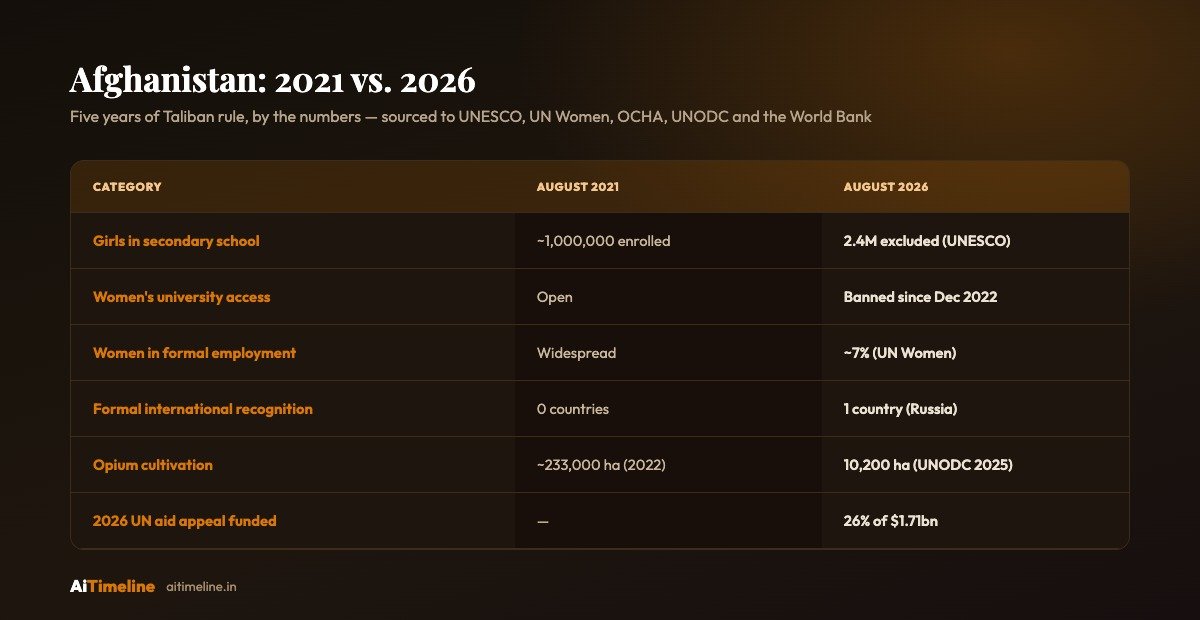
AiTimeline · five-year comparison built from UN, UNESCO, World Bank and UNHCR data cited throughout this article
The Economy: Collapse, Adaptation and Survival
Afghanistan’s economy did not simply “collapse” once in 2021 and stay collapsed; it shocked hard in 2021–22 as reserves froze and foreign aid that had funded roughly 40% of pre-2021 GDP vanished almost overnight, then partially adapted around sanctions, informal trade and Taliban-imposed fiscal discipline. The World Bank’s May 2026 assessment found GDP growth of roughly 4.8% in 2025, forecast to slow to about 4.0% in 2026, but GDP per capita actually falling 5.6% because population grew roughly 11% in 2025 — driven largely by the returnee influx from Iran and Pakistan outpacing economic capacity to absorb it. Inflation reached 7.6% by March 2026, driven by food prices. Roughly $9.5 billion in central bank reserves remains frozen. About 60% of Afghan trade now routes through Iran, a dependency the World Bank flagged as a vulnerability, and hawala — the informal, trust-based money-transfer network — has become the main channel bypassing formal banking sanctions.
| Indicator | Figure | Source / date |
|---|---|---|
| 2026 UN humanitarian appeal | $1.71 billion requested | OCHA, Dec 2025 |
| Appeal funded | 26% (~$269 million) | OCHA / KabulNow, Aug 2026 |
| People in humanitarian need | 21.9 million (~45% of population) | OCHA, 2026 |
| People facing acute food insecurity | 17.4 million (incl. 4.7M in IPC Phase 4) | IPC, Sept 2025–Sept 2026 |
| GDP growth | ~4.0% forecast (down from ~4.8% in 2025) | World Bank, May 2026 |
| GDP per capita | Down 5.6% | World Bank, May 2026 |
| Inflation | 7.6% (by March 2026) | World Bank, May 2026 |
| Central bank reserves frozen | ~$9.5 billion | Multiple 2026 sources |
| Afghans returned since late 2023 | 5.4 million | UNHCR, 2026 |
Why Humanitarian Need Remains So High
Three pressures compound each other: a fragile post-shock economy, recurring natural disasters, and a wave of returning refugees larger than the system can absorb. On disasters alone, Afghanistan has been repeatedly struck since mid-2025 — a magnitude 6.0 earthquake across eastern provinces on August 31, 2025 killed 2,217 people; further earthquakes struck near Mazar-i-Sharif in November 2025, Panjshir in January 2026, and the Hindu Kush region in April 2026 (12 killed). The World Food Programme says 12 provinces are recording their highest-ever levels of critical acute child malnutrition, with 4.9 million women and children needing malnutrition treatment in 2026 and WFP alone needing $468 million to reach 6 million of the most vulnerable. Aid officials and WFP explicitly name the scale of 2025 returnee arrivals from Iran and Pakistan as a direct driver of the strain.
The Return of Millions of Afghans
UNHCR counts 5.4 million Afghans as having returned from Iran and Pakistan since late 2023, with 232,500 more recorded in the first months of 2026 alone (146,206 from Pakistan, 86,253 from Iran, as of a March 2026 snapshot). These are not uniformly voluntary. Pakistan has framed its expulsions as action against “illegal foreigners,” a process rights groups describe as largely forced; Iran’s returns are a mix of formal deportation and what UN agencies describe as pressured departures under threat of arrest, sometimes labeled “voluntary” despite the coercive context. IOM has warned of a “dire funding shortfall” for reception capacity at border crossings, meaning many returnees arrive to inadequate housing, healthcare, food and schooling exactly where the humanitarian system is already stretched thinnest.
What Happened to Afghan Media?
RSF’s 2026 World Press Freedom Index ranks Afghanistan 175th of 180 countries. Taliban authorities have issued more than 20 directives and provincial orders restricting the press since August 2021, and a newly adopted (leaked, January 2026) criminal-procedure law is reported to tighten restrictions further. The Afghanistan Journalists Center’s most recent annual count recorded 207 media-rights violations — two journalists killed, one injured, 183 threats and 21 arrests — up roughly 20% year-on-year. More than two-thirds of the roughly 12,000 journalists working in 2021 have left the profession, and RSF/AJC reporting indicates eight in ten women journalists have stopped working entirely.
Minorities Under Taliban Rule
Afghanistan’s Hazara community, predominantly Shia Muslim in a majority-Sunni country, has faced repeated ISIS-K attacks since 2021, including a September 12, 2024 assault in Qorodal, Daykundi province that killed 15 people, all Hazara Shia. AiTimeline could not confirm a comparable large-scale, ethnically or religiously targeted mass-casualty attack specifically within the 2026 window at the time of writing; this should not be read as evidence conditions have improved, only that no new incident of that scale was independently confirmed in the sources reviewed. Rights groups and UNAMA have separately documented discrimination allegations and underrepresentation of minorities in Taliban governing structures, alongside continuing insecurity that affects Hazara communities disproportionately given ISIS-K’s targeting pattern.
How the Taliban Govern Afghanistan
Authority is centralized under Supreme Leader Hibatullah Akhundzada, who governs from Kandahar rather than Kabul and issues binding decrees on matters from women’s education to public dress codes. A Kabul-based cabinet, led by acting Prime Minister Mohammad Hassan Akhund, handles day-to-day administration; Sirajuddin Haqqani, leader of the Haqqani network and a U.S.-designated terrorist, has served as Interior Minister since the September 2021 interim government was announced. Provincial governors and district officials, largely drawn from the Taliban’s own movement, administer local affairs, with religious courts applying the Taliban’s interpretation of Islamic law. No elections have been held, no political parties beyond the Taliban itself are permitted to organize, and AiTimeline found no credible, independently sourced reporting detailing the extent of internal leadership disagreements specific enough to publish without speculation — occasional reports of friction between Kandahar-based religious leadership and more pragmatic Kabul-based officials exist in regional media but are not treated here as confirmed fact.
What the Taliban Say They Have Achieved
Claims examined against independent evidence
| Taliban Claim | Evidence | Limitations / Independent Assessment |
|---|---|---|
| Ended the civil war, restored security | Confirmed — no return to front-line conflict with a rival government since 2021 | Excludes ISIS-K attacks and the 2026 Pakistan border conflict |
| Eliminated the opium economy | Cultivation fell ~96% from 2022 to 2025 (UNODC) | Farmer income collapsed; prices remain ~5x pre-ban; not eliminated, sharply suppressed |
| Improved revenue collection | No independently audited figure located | Treat as an unverified Taliban-sourced claim |
| Delivered major infrastructure (Qosh Tepa canal) | Taliban spokesman claims near-completion (Oct 2025); independent estimates put excavation at 70–80% by late 2024, targeting 2028 | Reports of a structural water leak along the route raise unresolved integrity concerns |
| Reduced corruption | No independently verified national data located | AiTimeline could not confirm this claim; not included as fact |
Opium: The Ban’s Real Impact
Taliban authorities banned opium poppy cultivation in April 2022. UNODC’s most recent full survey, covering the 2025 season and published in November 2025, found cultivation of 10,200 hectares, down 20% from 12,800 hectares in 2024, and down roughly 96% from the approximately 233,000 hectares cultivated in 2022, the last season before the ban took hold. Production fell 32% year-on-year to 296 tons. But farmgate income for the farmers still growing it collapsed 48% in a single year, to $134 million, and the dry opium price of $570 per kilogram, while down 27% from 2024, remains roughly five times the pre-ban average — a sign of scarcity-driven pricing more than a healthy market exit. No UNODC data for the 2026 growing season has been published yet; the survey is released annually each November for the prior season, and any 2026 cultivation claim should be treated as unconfirmed until then.
🔍 Five Things That Surprised Our Research
- Afghanistan is currently the only country in the world that formally bars girls and women from education beyond the primary level, according to UNESCO.
- Russia, not any Muslim-majority state, was the first government to formally recognize Taliban rule.
- The opium ban cut cultivation by roughly 96% since 2022, but the price of opium is still about five times what it was before the ban — suppression, not elimination.
- Pakistan, once the Taliban’s closest external backer, is now the neighbor Afghanistan is in open, lethal conflict with.
- Population growth from returning refugees, not economic contraction alone, is a named reason GDP per capita fell in 2025 even as headline GDP grew.
Explore More Timelines
AiTimeline Analysis: Five Years of Taliban Rule
Editorial observations, not independently established facts — clearly labeled as AiTimeline’s own reading of the evidence above
- Territorial control has proven easier for the Taliban than gaining international legitimacy. Holding Kabul took eleven days in 2021; gaining a second country’s formal recognition has taken five years and counting.
- Reduced conventional warfare does not automatically mean political stability. The Pakistan border conflict that opened in 2026 shows security gains from 2021 can still be offset by new fronts.
- Women’s exclusion has become one of the biggest barriers to international normalization — it is cited explicitly by the EU, the U.S. and UN bodies as a recognition precondition, more consistently than any other single issue.
- Regional powers are engaging Kabul for practical reasons even without broad formal recognition — China’s mineral interests and India’s embassy upgrade both suggest pragmatism is outpacing principle in regional diplomacy.
- Afghanistan’s humanitarian crisis cannot be understood separately from aid funding and restrictions on women’s participation — a system that cannot employ enough female health workers cannot fully deliver aid to female patients, compounding the funding shortfall.
- The Taliban’s ability to maintain control does not by itself prove sustainable development — GDP per capita fell in 2025 even as headline growth was positive.
- Security and human rights should be measured separately, not traded off against each other in a single verdict on “how things are going.”
- Economic adaptation has occurred, but adaptation is not prosperity — hawala networks and informal trade have kept commerce moving without restoring formal banking access.
- Pakistan has shifted from strategic partner to the most difficult neighbor in the space of about eighteen months, a faster deterioration than any other bilateral relationship covered here.
- The next five years may depend as much on Afghanistan’s relationships with its neighbors — Pakistan, Iran, China, India — as on any Western policy shift.
- Claims of achievement from Taliban officials are verifiable in some areas (security, opium) and unverifiable in others (revenue, corruption) — readers should expect that split to persist, not resolve.
- Aggregate national statistics can obscure sharply different lived experiences by gender, province, and proximity to the Pakistan border — a single “Afghanistan in 2026” verdict flattens real variation.
⚠️ How We Fact-Checked This Timeline
Every dated claim in this article is sourced to a named UN body (UNAMA, UNESCO, UN Women, OCHA, UNHCR, UNODC, WHO, OHCHR), the World Bank, IOM, or a Tier-2 news organization (Reuters, AP, BBC, Al Jazeera, NPR, Washington Post) or Tier-3 monitor (RSF, Human Rights Watch, Crisis Group), with the publication date included wherever the figure could change. Claims we could not independently verify — including precise August 2026 Pakistan ceasefire status, any 2026 Hazara-specific mass-casualty attack beyond what’s cited, exact Taliban revenue-collection figures, and any 2026 UNODC opium data — are explicitly flagged as unverified in the relevant section rather than presented as fact. Taliban-sourced claims are labeled as such and distinguished from independently confirmed findings throughout.
Sources & further reading
Every dated entry above was checked against these references. Last reviewed 15 September 2026.
- UNAMA: Update on the Human Rights Situation in Afghanistan (April to June 2026)
- UNESCO: Five years on, UNESCO calls for full restoration of the right to education for Afghan girls and women
- UN Women: Aid cuts, employment bans, movement restrictions - the triple threat to Afghan women
- OCHA: Afghanistan Humanitarian Needs and Response Plan 2026
- UNODC: Afghanistan Opium Survey 2025
- UNHCR: Briefing note - 5.4 million Afghans return since late 2023
- World Bank: Afghanistan's Economy Shows Resilience but Living Standards Are Falling
- Reporters Without Borders: Afghanistan country profile, 2026 World Press Freedom Index