Sheikh Hasina and Bangladesh Politics: The Complete Timeline
Sheikh Hasina and Bangladesh politics explained: elections, the Awami League, the 2024 crisis and 2025-26 legal developments, sourced to official records.
Latest Story
In March 1973, Bangladesh held its first parliamentary elections as an independent nation. The country was barely two years removed from a war that had killed hundreds of thousands and displaced millions; its institutions — a constitution, an election commission, a parliament chamber — existed mostly on paper. The Awami League, the party that had led the independence movement, won an overwhelming majority under Sheikh Mujibur Rahman, the country’s founding leader. Fewer than four years later, that same Mujibur Rahman would be dead, killed by his own army in a coup that ended Bangladesh’s first experiment with parliamentary government almost as soon as it began. His daughter, a 27-year-old scientist’s wife then studying abroad, would spend the next six years in exile before returning to lead the same party into a fight for democracy that would define both her life and much of Bangladesh’s subsequent political history.
This guide is about that history — not as a biography of one person, but as an account of how Bangladesh’s parliamentary institutions, election commission, judiciary and political parties evolved across five decades, and how Sheikh Hasina’s career intersected with nearly every major turn in that evolution: democratic restoration in 1990, more than two decades as Prime Minister across five terms, a period of substantial economic growth, and, in August 2024, a departure from office following weeks of student-led protests that remains one of the most consequential events in the country’s recent history. What follows separates historical fact from official statement, election results from disputed allegations, and completed legal proceedings from ones still ongoing — because on a subject this contested, that separation is the entire point.
🏛 60-Second Answer
Sheikh Hasina served as Bangladesh’s Prime Minister across five terms (1996-2001 and 2009-2024), leading the Awami League and overseeing a period of substantial economic growth alongside persistent debates over democratic governance. Following weeks of student-led protests over a civil service quota system in July-August 2024, she resigned and left Bangladesh on August 5, 2024. An interim government led by Muhammad Yunus governed until February 2026, when Bangladesh held new elections; the Bangladesh Nationalist Party won and Tarique Rahman became Prime Minister. Hasina was convicted in absentia and sentenced to death by Bangladesh’s International Crimes Tribunal in November 2025 over the 2024 crackdown; as of this update, no appeal has been filed and India is still reviewing Bangladesh’s extradition request.
Who, What, Why, When, Where, How
What to Understand Before Reading Further
- This is institutional history, not just biography: Bangladesh’s parliamentary system, Election Commission and judiciary shaped and were shaped by five decades of political competition, not one leader alone.
- Hasina served five terms as Prime Minister — 1996-2001 and an uninterrupted stretch from 2009-2024 — making her one of the longest-serving elected heads of government in South Asian history.
- Her tenure coincided with substantial economic growth, documented by World Bank and IMF data, alongside sustained, independently documented criticism of election fairness and civil liberties.
- The 2018 and January 2024 elections were both seriously disputed by international observers and domestic monitors, whose specific findings this guide attributes by name.
- The July-August 2024 crisis began as student protests over civil service quotas and escalated into a mass uprising after a violent security crackdown.
- Hasina resigned and left Bangladesh on August 5, 2024; an interim government led by Nobel laureate Muhammad Yunus governed until February 2026.
- Bangladesh’s International Crimes Tribunal convicted and sentenced Hasina to death in absentia in November 2025 for crimes against humanity tied to the 2024 crackdown — a first-instance verdict, not a final, appeal-exhausted outcome.
- The Awami League’s registration was suspended in May 2025, barring it from the February 2026 election pending completion of ongoing tribunal proceedings.
- Bangladesh held new elections on February 12, 2026; the Bangladesh Nationalist Party won a majority and Tarique Rahman became Prime Minister.
- This is a living reference, updated as Bangladesh’s courts, Election Commission and international organizations publish verified developments.
Executive Summary & One-Minute Summary
The essentials, for readers who need the shape of the story before the detail
Executive Summary: Sheikh Hasina, daughter of Bangladesh’s founding leader Sheikh Mujibur Rahman, led the Awami League and served as Prime Minister across five terms between 1996 and 2024, making her one of the longest-serving elected heads of government in South Asian history. Her tenure coincided with substantial economic growth and infrastructure expansion documented by the World Bank and IMF, alongside sustained, independently documented concerns over election fairness — particularly in 2018 and January 2024 — and civil liberties. In July-August 2024, student-led protests over civil service job quotas escalated into a mass uprising after a violent crackdown the United Nations estimated may have killed as many as 1,400 people; Hasina resigned and left for India on August 5, 2024. An interim government under Nobel laureate Muhammad Yunus governed until February 2026 elections brought the Bangladesh Nationalist Party to power under Tarique Rahman. Bangladesh’s International Crimes Tribunal convicted and sentenced Hasina to death in absentia in November 2025; no appeal has been filed as of this update, and India has stated Bangladesh’s extradition request remains under examination.
One-Minute Summary: This is the story of how one political family’s history intertwined with Bangladesh’s institutions across five decades — a liberation war, an assassination, years of exile, a fight for democratic restoration, and more than two decades in office spanning economic transformation and mounting governance criticism. It ends, for now, with a still-unfolding sequence: a mass uprising, a resignation, an interim government, a tribunal conviction under appeal-eligible but as-yet-unappealed terms, a new election, and an extradition request still pending review. Nothing in that final sequence is settled history yet — it is documented, evolving, and this guide updates as new official developments occur.
Introduction: Bangladesh’s Institutions and a Defining Political Career
Who Sheikh Hasina is, and why understanding her requires understanding Bangladesh’s constitutional structure
Sheikh Hasina is a Bangladeshi politician, the daughter of independence leader Sheikh Mujibur Rahman, who led the Awami League and served as Prime Minister of Bangladesh across five terms — 1996 to 2001, and an unbroken stretch from January 2009 until her resignation in August 2024. Understanding her career in isolation, however, misses most of what actually happened: Bangladesh’s parliamentary democracy, its Election Commission, its judiciary and its political party system evolved through decades of confrontation and compromise involving many actors, not one leader’s decisions alone.
Bangladesh emerged from a nine-month liberation war in 1971 as one of the world’s poorest and most densely populated nations, with institutions largely built from scratch. Sheikh Mujibur Rahman, who had led the independence movement and became the country’s first head of government, presided over that initial institution-building period until his assassination in 1975 — an event that interrupted Bangladesh’s first attempt at parliamentary government and ushered in more than a decade of military and quasi-military rule before democracy was restored in 1990.
The Awami League, founded in 1949, is Bangladesh’s oldest continuously operating political party and the organization that led the independence movement; it has alternated in and out of power with its principal rival, the Bangladesh Nationalist Party (BNP), across every competitive election since 1991, a rivalry that has structured Bangladeshi politics for over three decades. Bangladesh’s system of government is a parliamentary democracy: voters elect members of the unicameral Jatiya Sangsad (National Parliament), and the party or coalition commanding a majority forms a government led by a Prime Minister who holds most executive authority, while a separately elected President serves a largely ceremonial head-of-state role. The Prime Minister’s powers in this system are substantial — control over the cabinet, the civil service and, in practice, significant influence over appointments across many state institutions — which is part of why control of that office has been so fiercely contested.
Sheikh Hasina remains one of South Asia’s most influential political figures for reasons that are genuinely disputed rather than simply matters of record: her supporters point to sustained economic growth, poverty reduction and infrastructure development documented by international financial institutions during her tenure; her critics point to independently documented concerns about election fairness, press freedom and the treatment of political opposition across the same period. Both sets of claims are addressed in this guide, attributed to their sources, because an honest account of her influence has to hold both at once rather than resolving them into a single verdict this guide is not positioned to render.
📜 History Insight
Modern Bangladesh has been shaped by multiple political movements, constitutional amendments and electoral transitions — the 1991 restoration of parliamentary democracy, the caretaker-government system introduced in 1996, its abolition in 2011, and the 2025-2026 reform process — rather than by any single leader’s tenure alone.
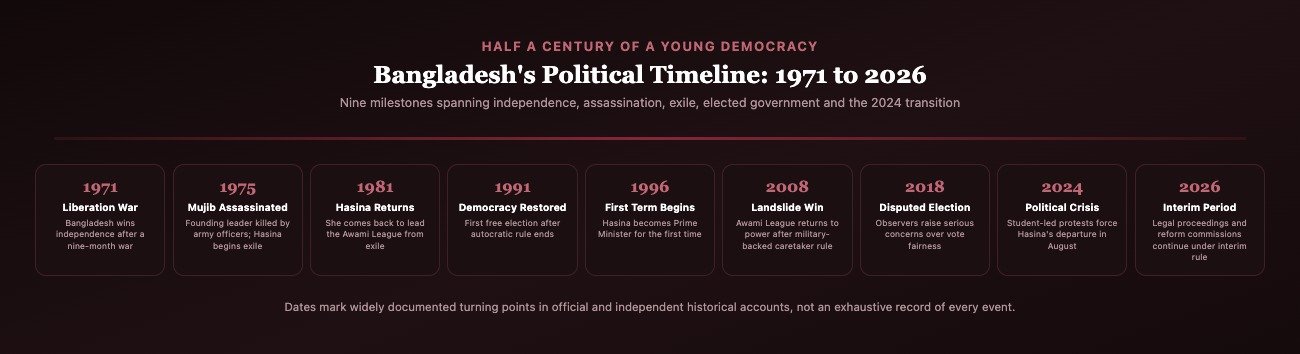
The Complete Political Timeline: 1947 to 2026
Sixteen milestones, each separating political background, economic context, domestic developments, international relations and current relevance
Birth in East Bengal
Political background: Sheikh Hasina was born September 28, 1947, in Tungipara, in what was then East Bengal, part of the newly partitioned Pakistan, to Sheikh Mujibur Rahman and Sheikh Fazilatunnesa.
Economic context: East Bengal (later East Pakistan) was economically marginalized relative to West Pakistan despite generating a majority of Pakistan’s export earnings through jute, a grievance that fed directly into the independence movement two decades later.
Domestic developments: Her father was already active in regional politics and would go on to found the Awami League two years later, in 1949.
International relations: Partition of British India in 1947 created Pakistan as a two-wing state separated by over 1,000 miles of Indian territory, an arrangement that proved politically unstable from the outset.
Current relevance: Her birth into a politically active family in a marginalized region set the context for a life that would become inseparable from the independence movement and its aftermath.
The Bangladesh Liberation War
Political background: Following a Pakistani military crackdown on Bengali nationalists beginning March 25, 1971, Sheikh Mujibur Rahman declared independence and was arrested; a nine-month war followed, with India intervening militarily in December 1971 in support of Bangladeshi forces.
Economic context: The war devastated an already poor region’s infrastructure and economy, displacing an estimated 10 million refugees into India and killing a disputed number of people, with estimates varying widely by source and remaining a subject of historical debate.
Domestic developments: Bangladesh achieved independence on December 16, 1971, with the surrender of Pakistani forces in Dhaka; Mujibur Rahman was released from Pakistani custody in January 1972 and became the new nation’s first head of government.
International relations: India’s military and diplomatic support was decisive to the war’s outcome; the war reshaped South Asian geopolitics and remains a defining reference point in India-Bangladesh relations to this day.
Current relevance: The Liberation War remains the founding event of Bangladeshi national identity and the source of the Awami League’s claim to a unique historical legitimacy in national politics.
Assassination of Sheikh Mujibur Rahman and Years of Exile
Political background: On August 15, 1975, a group of army officers assassinated Sheikh Mujibur Rahman along with most of his family in a coup, ending Bangladesh’s first parliamentary government less than four years after independence.
Economic context: The years following the coup saw continued economic hardship and political instability under successive military and quasi-military governments.
Domestic developments: Sheikh Hasina and her sister Sheikh Rehana survived because they were abroad in West Germany at the time; Hasina spent the following six years largely in exile, primarily in India, unable to safely return to Bangladesh.
International relations: India granted Hasina refuge during this period, beginning a personal history with the country that would recur decades later in 2024.
Current relevance: The assassination remains a foundational trauma in Awami League political identity and a frequently invoked reference point in Hasina’s own public statements about political violence.
Return to Bangladesh and Awami League Leadership
Political background: Sheikh Hasina was elected president of the Awami League in absentia in 1981 and returned to Bangladesh on May 17, 1981, to lead the party under the military government of Hussain Muhammad Ershad, who had taken power in a 1982 coup.
Economic context: Bangladesh in this period remained heavily dependent on foreign aid, with limited industrial development beyond the jute sector and an emerging ready-made garment industry.
Domestic developments: Hasina spent most of the 1980s in opposition politics, organizing against Ershad’s military-backed rule alongside BNP leader Khaleda Zia, despite the two parties’ rivalry, in a period of shared opposition to autocratic rule.
International relations: International donor pressure on Bangladesh’s military government grew through the decade as global attention to democratic governance increased.
Current relevance: This period established Hasina as the Awami League’s central figure for the next four-plus decades and set the template for opposition-alliance politics later revisited in 2024-2025.
Democratic Transition
Political background: Sustained mass protests led by both the Awami League and BNP forced President Ershad’s resignation in December 1990, ending nine years of military-backed rule and restoring competitive parliamentary democracy.
Economic context: The transition coincided with early structural economic reforms and Bangladesh’s growing integration into global garment-export supply chains.
Domestic developments: A caretaker government led by Chief Justice Shahabuddin Ahmed oversaw the transition to the 1991 general election, establishing a precedent later formalized into Bangladesh’s constitutional caretaker-government system.
International relations: International observers and donor governments welcomed the democratic transition as part of a broader wave of democratization across the developing world in this period.
Current relevance: The caretaker-government model established here would govern Bangladesh’s elections for the next two decades, and its 2011 abolition remains a central point of dispute in Bangladeshi politics.
First Election Victory and First Term as Prime Minister
Political background: Following a disputed February 1996 election that the Awami League and other parties boycotted, a caretaker government oversaw a fresh election in June 1996, which the Awami League won, making Sheikh Hasina Prime Minister for the first time.
Economic context: Bangladesh’s economy grew steadily through the late 1990s, with the ready-made garment sector expanding as a major source of export earnings and employment.
Domestic developments: This first term (1996-2001) included the signing of the 1997 Chittagong Hill Tracts Peace Accord, ending a long-running insurgency, and the 1996 Ganges Water Treaty with India.
International relations: The Ganges treaty marked a significant diplomatic achievement in India-Bangladesh relations, resolving a long-standing water-sharing dispute.
Current relevance: This term established Hasina’s domestic and international governing record independent of her father’s legacy for the first time.
Election Defeat
Political background: The October 2001 general election, held under a caretaker government, resulted in a decisive win for the BNP-led four-party alliance; the Awami League returned to opposition.
Economic context: Bangladesh’s garment-export-driven growth continued through this period regardless of which party held power, a pattern that would recur across subsequent administrations.
Domestic developments: The period after 2001 saw rising political violence and tension between the two main parties, including a 2004 grenade attack targeting Hasina at an Awami League rally in Dhaka that killed 24 people and injured hundreds, though she survived.
International relations: International donors continued engagement with Bangladesh through this period despite domestic political tension.
Current relevance: The peaceful transfer of power in 2001 demonstrated the caretaker system’s basic function, even as the years that followed showed its limits amid rising political violence.
Landslide Return to Power
Political background: Following a state of emergency and a military-backed caretaker government from 2007-2008 that included a period of Hasina’s own detention on corruption charges later dropped, the December 2008 election delivered a landslide majority to the Awami League-led alliance.
Economic context: Bangladesh’s economy had continued growing through the emergency period, and the incoming government inherited a relatively stable macroeconomic position.
Domestic developments: This victory began what would become an uninterrupted stretch in power lasting until August 2024, encompassing four subsequent elections.
International relations: International observers generally regarded the 2008 election as credible, an assessment that would not be consistently repeated for Bangladesh’s subsequent elections under Hasina.
Current relevance: 2008 marks the start of the 16-year governing period whose economic record and governance practices remain the central subject of contemporary debate over Hasina’s legacy.
Digital Bangladesh and Infrastructure Expansion
Political background: The Awami League government launched “Digital Bangladesh,” a technology and e-governance initiative, alongside a major expansion of infrastructure spending financed through a mix of domestic resources, foreign loans and, for the Padma Bridge, entirely domestic financing after the World Bank withdrew its funding commitment amid a corruption allegation.
Economic context: World Bank and IMF data document sustained GDP growth averaging roughly 6% annually through much of this period, alongside substantial poverty reduction, though critics note growth statistics and their interpretation have themselves been subject to academic debate.
Domestic developments: Major projects begun or advanced in this period include the Padma Multipurpose Bridge (construction 2014-2022) and the Dhaka Metro Rail (construction from 2016).
International relations: The World Bank’s 2012 withdrawal from Padma Bridge financing, and Bangladesh’s subsequent self-financed completion of the project, became a significant point of national pride cited by the government as evidence of economic self-sufficiency.
Current relevance: These infrastructure and digital-governance investments are frequently cited by supporters as core achievements of the Hasina era, and remain in active use regardless of the political transition that followed.
Rohingya Refugee Response
Political background: Following a Myanmar military crackdown on Rohingya Muslims in Rakhine State beginning August 2017, Bangladesh accepted an estimated 700,000-plus refugees who fled across the border, in addition to earlier refugee populations already present.
Economic context: The refugee influx placed substantial strain on local resources in Cox’s Bazar district, with international humanitarian agencies providing the bulk of direct assistance funding.
Domestic developments: The Hasina government established large refugee camps and pursued a controversial relocation program moving some refugees to Bhasan Char island, which UN agencies and rights groups raised concerns about regarding consultation and conditions.
International relations: The UN and international community broadly praised Bangladesh’s decision to accept refugees on humanitarian grounds, while repatriation to Myanmar has remained stalled for years amid continued instability there.
Current relevance: The Rohingya refugee situation remains unresolved and continues to be managed by Bangladesh’s government under the current administration, a continuity point across the political transition.
A Seriously Disputed Election
Political background: The December 30, 2018 general election returned the Awami League to power with a large majority, extending Hasina’s tenure to a fourth overall term.
Economic context: Bangladesh’s economic growth continued at a strong pace through this period per World Bank data, even as the election’s fairness became a subject of significant dispute.
Domestic developments: Transparency International Bangladesh characterized the vote as “partially participatory, non-competitive, questionable, and faulty,” citing obstructed polling agents and voter intimidation; Human Rights Watch documented systemic irregularities including uneven enforcement of voting procedures.
International relations: The European Union declined to send a full election observer team, citing concerns raised by its ambassador to Bangladesh; opposition parties accused the ruling party of rigging the vote, an allegation the government rejected.
Current relevance: The specific, named criticisms of this election — from Transparency International Bangladesh, Human Rights Watch and the EU’s observer decision — are frequently cited in later assessments of Bangladesh’s democratic backsliding during this period.
The COVID-19 Period
Political background: Bangladesh’s government implemented lockdowns, a national vaccination campaign and economic stimulus measures in response to the COVID-19 pandemic beginning in early 2020.
Economic context: The pandemic caused a significant but temporary slowdown in Bangladesh’s GDP growth and disrupted the crucial ready-made garment export sector, which recovered relatively quickly compared to some regional peers per World Bank assessments.
Domestic developments: The government’s stimulus packages targeted export industries and vulnerable populations, while public health measures drew both praise for scale and criticism over implementation gaps in rural areas.
International relations: Bangladesh received vaccine donations and support through COVAX and bilateral arrangements with India, China and others, reflecting its broader multi-directional foreign policy approach.
Current relevance: Bangladesh’s relatively resilient economic recovery from the pandemic is cited by economists as evidence of underlying structural strength in its export-oriented growth model.
Jan
A Fifth Term, Won Amid a Boycott
Political background: The January 7, 2024 general election delivered the Awami League a fourth consecutive term (Hasina’s fifth overall), winning 224 of 300 contested seats, after the BNP and most major opposition parties boycotted the vote and called a general strike.
Economic context: Bangladesh entered 2024 facing rising inflation, foreign-currency reserve pressure and a 2023 IMF loan program, an economic backdrop that would compound political tensions in the months ahead.
Domestic developments: Official turnout was recorded at 41.8%, the second-lowest in Bangladesh’s democratic history; the vote was accompanied by pre-election arson attacks and was described by independent monitors as marred by irregularities.
International relations: The election drew limited international observer presence and skeptical commentary from Western governments regarding its competitiveness, though it was not universally condemned by all international actors.
Current relevance: This election’s low turnout and opposition boycott are frequently cited as context for the depth of public frustration that would erupt seven months later.
Jul-Aug
Student-Led Protests and Hasina’s Departure
Political background: Student-led protests began in mid-July 2024 over a civil service job-quota system, escalating rapidly into a broader anti-government uprising after a violent security crackdown on demonstrators.
Economic context: Existing economic strain — inflation, youth unemployment and limited formal-sector job creation despite years of GDP growth — is widely cited by analysts as an underlying driver of the protests’ intensity beyond the quota issue itself.
Domestic developments: The United Nations Human Rights Office estimated that as many as 1,400 people may have been killed during the unrest between mid-July and August 5, 2024 — a UN-attributed estimate, not a Bangladeshi government figure. Sheikh Hasina resigned as Prime Minister and departed Bangladesh for India on August 5, 2024.
International relations: India confirmed Hasina’s arrival and continued residence in the country in official statements; the crisis drew international attention and statements of concern from multiple governments and human rights bodies regarding the crackdown’s severity.
Current relevance: This period is now the subject of formal legal proceedings before Bangladesh’s International Crimes Tribunal, detailed later in this timeline.
Interim Administration Under Muhammad Yunus
Political background: Nobel Peace Prize laureate Muhammad Yunus was sworn in as Chief Adviser of an interim government on August 8, 2024, at the request of the protest movement’s leaders, with an initial 22-member advisory council later expanded to 24.
Economic context: The interim government managed continued economic strain, including inflation and reserve pressures inherited from the prior administration, while maintaining Bangladesh’s IMF program commitments.
Domestic developments: The interim administration pursued a six-area reform mandate covering the election system, police, judiciary, anti-corruption institutions, public administration and the constitution, producing the “July Charter” reform document in 2025 with cross-party endorsement covering more than 80 proposed changes.
International relations: The interim government maintained Bangladesh’s existing diplomatic relationships, including continued engagement with India despite the tension created by Hasina’s presence there, and with China and other partners.
Current relevance: Yunus stepped down on February 16, 2026, as the newly elected government took office, concluding an 18-month interim period that ended through a scheduled electoral handover rather than a further crisis.
Legal Proceedings, the Awami League Ban and a New Election
Political background: On May 12-13, 2025, the interim government banned Awami League political activity under anti-terrorism legislation and the Election Commission suspended the party’s registration, citing ongoing International Crimes Tribunal proceedings; the ban’s stated duration is tied to the completion of those proceedings.
Economic context: Bangladesh’s economy continued operating under IMF program terms through this period, with the political transition’s economic effects a subject of ongoing analysis by international financial institutions.
Domestic developments: On November 17, 2025, Bangladesh’s International Crimes Tribunal convicted Sheikh Hasina in absentia of crimes against humanity related to the 2024 crackdown and sentenced her to death; a separate corruption case resulted in a 21-year sentence on November 27, 2025. Bangladesh held a general election and constitutional referendum on February 12, 2026; the Bangladesh Nationalist Party won 209 of 299 contested seats, and Tarique Rahman was sworn in as Prime Minister on February 17, 2026.
International relations: Bangladesh formally requested Hasina’s extradition from India, first in December 2024 and reiterated after the November 2025 verdict; India has stated, most recently on July 17, 2026, that the request remains under examination with no final decision made. The European Union’s election observation mission characterized the February 2026 vote as “genuinely competitive” and “credible and competently managed.”
Current relevance: As of this update, no appeal has been filed against the November 2025 verdict, the extradition request remains pending, and Hasina has publicly disputed the tribunal’s legitimacy, calling it “a rigged tribunal established and presided over by an unelected government with no democratic mandate” — her characterization, not an independently adjudicated finding.
Ten Terms This Guide Runs On
Plain-English definitions of the institutions and concepts that recur through every section
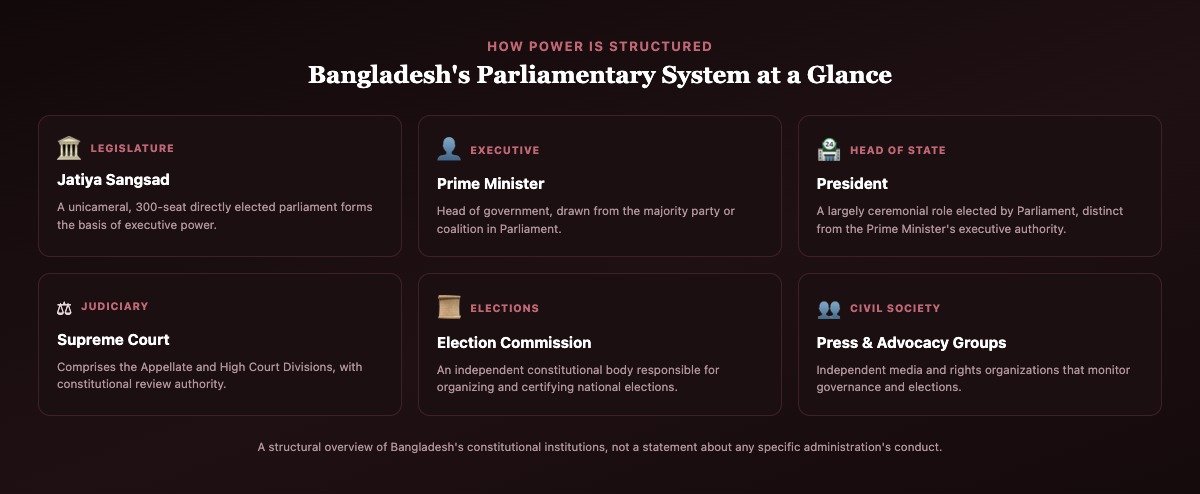
How Bangladesh’s Parliamentary System Works
The institutional structure that every election, government and reform proposal in this guide operates within
Bangladesh’s Jatiya Sangsad is a unicameral, 300-seat directly elected parliament, with an additional 50 seats reserved for women elected by the sitting members rather than by direct popular vote. The party or coalition that wins a majority of the 300 directly elected seats forms the government; its leader becomes Prime Minister and appoints a cabinet from among sitting MPs. The President, elected by Parliament rather than by popular vote, serves a largely ceremonial role — head of state rather than head of government — with the notable historical exception of periods when caretaker governments briefly expanded presidential authority to oversee elections. The Supreme Court, divided into an Appellate Division and a High Court Division, holds constitutional review authority and has, at various points across Bangladesh’s history, intervened in major political disputes, including rulings on the caretaker-government system itself.
History of the Awami League
Bangladesh’s oldest continuously operating political party
Founded in 1949 as the Awami Muslim League and later renamed simply the Awami League, the party emerged from opposition to Pakistani rule over what was then East Pakistan, and became the vehicle for the independence movement Sheikh Mujibur Rahman led in 1971. After his 1975 assassination and years in which the party operated under authoritarian rule, it re-emerged as one of Bangladesh’s two dominant parties following the 1990 democratic transition, alternating in and out of government with the BNP across every competitive election from 1991 through 2018, before winning a disputed fourth consecutive term in January 2024. Its registration was suspended by the Election Commission in May 2025, pending completion of International Crimes Tribunal proceedings against its former leadership — a status this guide treats as a current administrative fact, not a permanent judgment on the party’s future.
Caretaker Government, Explained
The system that governed Bangladesh’s elections for fifteen years, and the dispute over its abolition
Bangladesh’s caretaker-government system, formalized by constitutional amendment in 1996 after the precedent set during the 1990-91 transition, required a non-partisan, temporary administration to take charge of the government for roughly three months before each general election, with the explicit purpose of preventing an incumbent government from using state machinery to influence the vote. The system oversaw the 1996, 2001 and 2008 elections. In 2011, Bangladesh’s Supreme Court declared the caretaker system unconstitutional in a ruling the Awami League government then used as the basis for a constitutional amendment abolishing it outright — a decision the BNP and other opposition parties argued removed a crucial check on incumbent power, since all elections after 2011 (2014, 2018 and January 2024) were held under the sitting government rather than a neutral caretaker administration. The 2025 July Charter reform process revisited this question directly, and its outcome is one of the constitutional changes the current administration is implementing.
📜 Democracy Insight
Political stability, electoral competition and institutional independence remain central, contested themes in Bangladesh’s democratic evolution — the caretaker system’s 2011 abolition, and the disputed elections that followed it, are frequently cited by researchers as a turning point in that evolution.
Political Ideology and Leadership Style
How Hasina and the Awami League positioned themselves, and how she governed
The Awami League under Hasina positioned itself as a secular, center-left nationalist party, emphasizing continuity with the 1971 independence movement’s founding principles, economic development through export-led growth, and a foreign policy independent of any single major power. Academic and journalistic accounts of her leadership style, across multiple decades of coverage, describe a highly centralized decision-making approach concentrated within the Prime Minister’s office and a small circle of trusted officials — a pattern her supporters characterize as decisive and effective governance, and her critics characterize as a gradual erosion of institutional checks. Both characterizations appear regularly in independent academic and journalistic analysis of her tenure, and this guide presents them as competing interpretations rather than resolving between them.
Major Election Campaigns
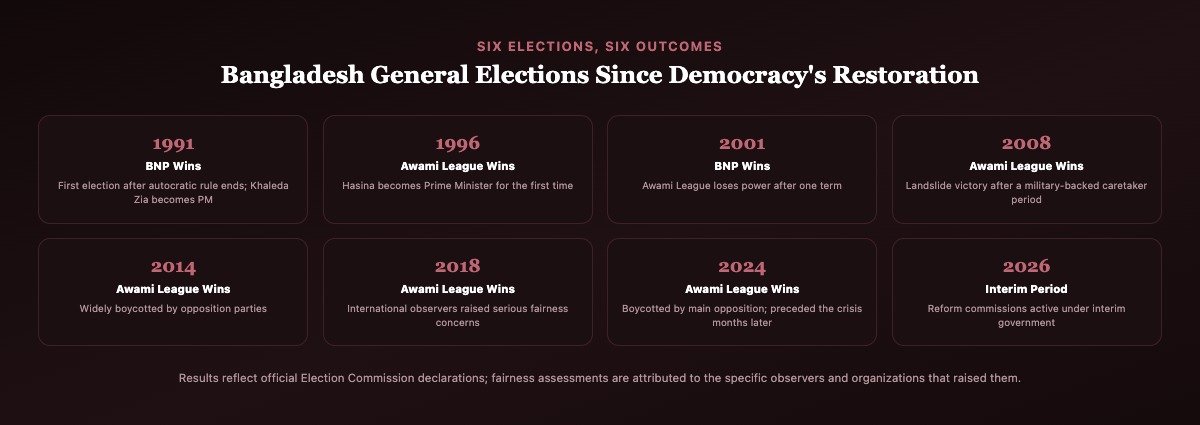
How six national elections were fought and won
Hasina’s electoral campaigns evolved considerably across her career: the 1996 and 2008 campaigns emphasized anti-corruption messaging against incumbent BNP governments and promises of development, both resulting in decisive Awami League victories under conditions international observers regarded as broadly credible. Her later campaigns — 2014, 2018 and January 2024 — occurred under progressively more contested circumstances, with declining opposition participation and, in 2018 and 2024, documented irregularities cited by independent monitors. This trajectory, from broadly credible early wins to progressively disputed later ones, is itself one of the most frequently analyzed patterns in academic writing about Bangladesh’s democratic trajectory during this period.
Bangladesh’s Economic Transformation
What World Bank and IMF data actually document
Bangladesh’s economic record across Hasina’s tenure is among the most substantively documented aspects of her legacy, drawing on independent World Bank and IMF data rather than government self-reporting alone. GDP growth averaged roughly 6% annually through much of the 2009-2019 period, among the fastest sustained rates in South Asia; the World Bank reclassified Bangladesh as a lower-middle-income country in 2015, and the United Nations approved the country’s eligibility for graduation from Least Developed Country status in 2021, with the formal graduation process following a transition period. Poverty rates fell substantially over the same decades, driven significantly by the ready-made garment export sector, which grew from a marginal industry in the 1980s into Bangladesh’s dominant export earner and a major source of formal employment, particularly for women. These figures are independently documented, even as economists have separately raised questions about data transparency in some official statistical releases during this period — a distinct, narrower critique from the broader growth trend itself.
📈 Economic Insight
Bangladesh experienced significant economic growth over several decades, documented independently by the World Bank and IMF, alongside ongoing, separately documented debates about governance, institutional reform and statistical transparency — both can be true simultaneously without contradiction.
Infrastructure
Major projects that reshaped Bangladesh’s physical landscape
The Padma Multipurpose Bridge, connecting southwestern Bangladesh to the capital region across the Padma River, opened in June 2022 after entirely domestic financing following the World Bank’s 2012 withdrawal amid a corruption allegation the Bangladeshi government disputed; some economists estimate the bridge could add roughly 1.3 percentage points to national GDP by improving connectivity for 21 districts. The Dhaka Metro Rail, whose first line opened in December 2022, addressed chronic congestion in one of the world’s most densely populated capital cities. Both projects are widely cited, including by sources critical of other aspects of the Hasina government’s record, as genuine, functioning infrastructure achievements that outlived the administration that built them.
Education, Healthcare and Women’s Empowerment
Social policy outcomes across the Hasina era
Bangladesh made measurable gains in primary school enrollment and gender parity in education across this period, with girls’ enrollment rates matching or exceeding boys’ at the primary level according to UNESCO and World Bank data. Healthcare indicators, including maternal mortality and child mortality rates, improved substantially over the same decades, though rural-urban disparities in healthcare access remained a persistent, independently documented concern. Women’s labor force participation, particularly in the garment sector, rose significantly, and Bangladesh’s ready-made garment industry became one of the largest employers of women in South Asia — a data point frequently cited alongside the sector’s separately documented labor-condition and workplace-safety concerns, most notably following the 2013 Rana Plaza factory collapse, which drew significant international attention to garment-sector labor practices and prompted subsequent safety-reform initiatives.
Foreign Policy: India, China and Regional Diplomacy
How Bangladesh balanced its two largest neighbors and the wider region
Bangladesh’s relationship with India under Hasina was characterized by close strategic and economic cooperation, including the 1996 Ganges Water Treaty, expanded trade and connectivity agreements, and security cooperation, alongside persistent unresolved issues including the Teesta River water-sharing dispute. India’s decision to grant Hasina refuge in August 2024, and its subsequent handling of Bangladesh’s extradition request, has made the bilateral relationship a subject of renewed diplomatic sensitivity since the political transition. Bangladesh’s relationship with China grew substantially over the same period through infrastructure financing, trade and defense-equipment purchases, part of a broader pattern of Bangladesh pursuing economic ties with China while maintaining separate strategic ties with India and the West — a multi-directional foreign policy approach rather than exclusive alignment with any single power. Bangladesh has also participated in regional diplomacy through the South Asian Association for Regional Cooperation (SAARC), though SAARC’s own effectiveness as a regional body has been limited by broader India-Pakistan tensions largely outside Bangladesh’s control.
Human Rights Debates and Press Freedom
Independently documented concerns, attributed to their sources
Human rights organizations, including Human Rights Watch and Amnesty International, documented a range of concerns across Hasina’s tenure, including allegations of enforced disappearances and extrajudicial killings attributed to security forces, restrictions on press freedom under laws including the Digital Security Act, and the treatment of political opposition figures. The Bangladeshi government under Hasina consistently disputed characterizations of systemic human rights violations, framing security operations as necessary responses to extremism and instability. Reporters Without Borders’ press freedom rankings placed Bangladesh in a low position throughout much of this period, citing self-censorship pressures and legal risks facing journalists. These are documented findings from named organizations using their own methodologies, presented here as such rather than as this guide’s independent conclusions.
Governance Reforms, Criticisms and Achievements
Holding both sides of the record at once
An honest accounting of Hasina’s governance record requires holding documented achievements and documented criticisms simultaneously rather than resolving them into a single verdict. On the achievement side: sustained GDP growth, poverty reduction, major infrastructure completion, expanded girls’ education access and a globally significant garment-export sector, all independently documented by international financial institutions. On the criticism side: the 2011 abolition of the caretaker-government system, election-fairness concerns documented by named international and domestic monitors in 2014, 2018 and 2024, human-rights concerns documented by named rights organizations, and, ultimately, a first-instance criminal conviction for crimes against humanity connected to the 2024 crackdown. Both records are real, sourced and simultaneously true; this guide’s role is to present them clearly attributed, not to weigh them into a final judgment it is not positioned to make.
🏛 Governance Insight
Long-serving governments often influence infrastructure, institutions and public administration in lasting ways — Bangladesh’s Padma Bridge and Digital Bangladesh initiatives function independently of the political transition that followed them, just as the governance concerns documented during the same period remain part of the historical record regardless of that transition.
Legacy Debates
Why Hasina’s legacy remains an actively contested question, not a settled one
Sheikh Hasina’s legacy is, as of this update, an actively contested subject rather than a matter of historical consensus — a status that is itself notable, since most former heads of government eventually settle into a broadly agreed-upon historical assessment even amid partisan disagreement. Her case remains unusually unsettled because the legal proceedings against her are ongoing, the party she led remains under a registration suspension tied to those same proceedings, and the government that replaced hers has an obvious institutional interest in one particular framing of her tenure, just as she and her remaining supporters have an obvious interest in another. Academic political scientists studying Bangladesh have generally cautioned against premature verdicts for exactly this reason, noting that assessments made this close to an unresolved legal and political transition are more likely to reflect the transition’s politics than settled historical judgment.
Comparisons: The Frameworks Behind the Headlines
Four head-to-head comparisons that explain recurring terms in Bangladesh political coverage
Parliamentary vs Presidential Systems
Caretaker Government vs Elected Government
| Year | Winner | Notes |
|---|---|---|
| 1991 | BNP | First election after autocratic rule; Khaleda Zia becomes PM |
| 1996 | Awami League | Hasina’s first term begins, after a boycotted Feb 1996 vote and fresh June election |
| 2001 | BNP | Awami League returns to opposition |
| 2008 | Awami League | Landslide after military-backed caretaker period; begins 16-year tenure |
| 2014 | Awami League | Widely boycotted by opposition parties |
| 2018 | Awami League | Fairness disputed by Transparency International Bangladesh, HRW; EU skipped full observation |
| Jan 2024 | Awami League | 224/300 seats; BNP boycotted; 41.8% turnout, second-lowest on record |
| Feb 2026 | BNP | 209/299 seats; EU called it credible and competently managed |
| Prime Minister | Party | Term(s) |
|---|---|---|
| Sheikh Mujibur Rahman | Awami League | 1972-1975 (as PM, then President) |
| Khaleda Zia | BNP | 1991-1996, 2001-2006 |
| Sheikh Hasina | Awami League | 1996-2001, 2009-2024 |
| Muhammad Yunus (Chief Adviser) | Non-partisan | Aug 2024-Feb 2026 (interim) |
| Tarique Rahman | BNP | Feb 2026-present |
| Period | Indicator | Source |
|---|---|---|
| 1990s | Steady growth; garment sector expansion begins in earnest | World Bank historical data |
| 2000s | Continued export growth regardless of governing party | World Bank historical data |
| 2010s | ~6% average annual GDP growth; lower-middle-income reclassification (2015) | World Bank |
| 2020s (pre-2024) | Pandemic slowdown, recovery, then inflation and reserve pressure by 2023-24 | IMF, World Bank |
| 2024-2026 | Continued IMF program; transition-period effects under ongoing assessment | IMF |
| Change | Year | Effect |
|---|---|---|
| Constitution adopted | 1972 | Founding legal document of independent Bangladesh |
| Caretaker government formalized | 1996 | 13th Amendment; neutral administration for elections |
| Caretaker system abolished | 2011 | 15th Amendment, following Supreme Court ruling |
| Digital Security Act | 2018 | Cited by press freedom organizations as restricting journalism |
| July Charter reform document | 2025 | 80+ proposed reforms, including constitutional changes, cross-party endorsed |
| Project | Completed | Significance |
|---|---|---|
| Padma Multipurpose Bridge | June 2022 | Self-financed after World Bank withdrawal; connects 21 districts |
| Dhaka Metro Rail (Line 6) | December 2022 | First mass-transit line in the capital |
| Digital Bangladesh initiative | Ongoing from 2009 | E-governance and technology-access expansion |
| Milestone | Year | Partner |
|---|---|---|
| Ganges Water Treaty | 1996 | India |
| Rohingya refugee acceptance | 2017 | Response to Myanmar crisis, praised by UN |
| Padma Bridge self-financing | 2012-2022 | Following World Bank funding withdrawal |
| Extradition request for Hasina | Dec 2024, reiterated Nov 2025 | India (under examination as of Jul 2026) |
| Year | Event | National Importance |
|---|---|---|
| 1971 | Liberation War and independence | Founding event of the Bangladeshi state |
| 1975 | Assassination of Mujibur Rahman | Ends first parliamentary government |
| 1990 | Democratic transition | Restores competitive parliamentary democracy |
| 1996 | Hasina’s first term begins | Establishes independent governing record |
| 2008 | Landslide win begins 16-year tenure | Longest continuous governing period in Bangladesh’s history |
| 2024 | Political crisis and departure | Ends the 16-year tenure via mass uprising |
| 2026 | New election, BNP takes power | First credible transfer of power since the crisis |
Key Institutions to Know
The bodies whose data and rulings this guide draws on
Awami League
Bangladesh’s oldest continuously operating party, founded 1949; registration suspended by the Election Commission in May 2025.
Bangladesh Parliament (Jatiya Sangsad)
The 300-seat unicameral national legislature whose majority party forms the government.
Election Commission of Bangladesh
The independent constitutional body responsible for organizing and certifying national elections, including the disputed 2018 and January 2024 votes and the February 2026 election.
Supreme Court of Bangladesh
The country’s highest court, whose Appellate and High Court Divisions ruled the caretaker-government system unconstitutional in 2011.
United Nations
UN human rights bodies produced the widely cited estimate of up to 1,400 deaths during the July-August 2024 crackdown.
World Bank
Source of independent GDP, poverty and income-classification data cited throughout this guide’s economic sections.
International Monetary Fund
Provider of Bangladesh’s 2023 loan program and ongoing economic assessments through the political transition.
South Asian Association for Regional Cooperation (SAARC)
The regional body through which Bangladesh has pursued South Asian diplomacy, alongside its bilateral relationships with India and China.
Interesting Facts
- Sheikh Hasina and BNP leader Khaleda Zia, rivals for over three decades, once campaigned in parallel against the same military-backed government in the 1980s before becoming each other’s principal political opponents.
- The Padma Bridge, self-financed after the World Bank withdrew funding, became one of the few major South Asian infrastructure projects completed entirely without foreign development-bank financing.
- Bangladesh held a national election and a constitutional referendum on the same day in February 2026 — a “twin poll” format not previously used in the country’s history.
- Tarique Rahman returned to Bangladesh in December 2025 after 17 years of self-imposed exile in London, becoming Prime Minister just over two months later.
- The International Crimes Tribunal that convicted Hasina in November 2025 was the same institution originally established under her own government in 2010 to try 1971 war-crimes cases.
👀 Future Watch
What to track next, from official sources only: any formal appeal filed against the November 2025 tribunal verdict; further statements from India’s Ministry of External Affairs on the extradition request; Election Commission of Bangladesh updates on the Awami League’s registration status; and implementation updates on the July Charter’s constitutional reforms from Bangladesh’s Parliament. This guide does not speculate about future election outcomes or predict the extradition request’s resolution.
Explore More Timelines
People Also Ask
Frequently Asked Questions
100 expert questions, organized by topic
Why Bangladesh’s Political History Is Larger Than Any One Leader
Return, for a moment, to March 1973 — the first parliamentary elections of an independent Bangladesh, held by institutions barely two years old, in a country still counting the human cost of the war that created it. What happened in the more than five decades since — a coup, years of authoritarian rule, a democratic restoration achieved by rival parties acting together, more than two decades under one Prime Minister, substantial economic transformation, mounting governance criticism, a mass uprising, an interim government, a tribunal verdict still under appeal, and a new government elected under reformed rules — is not reducible to any single person’s story, however central Sheikh Hasina was to large parts of it.
Sheikh Hasina’s political career is inseparable from Bangladesh’s post-independence history, its democratic evolution, its economic transformation and its constitutional development, precisely because she was present, in one role or another, for nearly every major turn that history took. But understanding her legacy honestly requires examining both documented achievements and documented criticisms through verified evidence — official records, Election Commission data, World Bank and IMF statistics, human rights reporting from named organizations, academic research and reputable journalism — rather than resolving a still-actively-contested question into a premature verdict this guide is not positioned to render and, as the ongoing legal proceedings against her demonstrate, neither is anyone else quite yet.
For verified updates beyond this guide’s last revision, the most reliable path runs through Bangladesh’s Election Commission, its courts, its Parliament, and international bodies including the United Nations, World Bank and IMF — read for what they actually confirm at each stage, not for how a headline compresses a still-unfolding legal and political process into a single, settled sentence.
Sources & further reading
Every dated entry above was checked against these references. Last reviewed 15 September 2026.
- CNN: Bangladesh's Ousted Leader Sheikh Hasina Sentenced to Death After Crimes Against Humanity Conviction
- Human Rights Watch: Bangladesh - Hasina Found Guilty of Crimes Against Humanity
- Al Jazeera: BNP Wins Bangladesh Election, Tarique Rahman Set to Be Prime Minister
- Al Jazeera: India 'Examining' Bangladesh Extradition Request for Convicted Ex-PM Hasina
- Bangladesh Election Commission: Bangladesh Awami League (Suspended)