Australian Open Hard-Court Era: Evolution & Winners Timeline
The Australian Open switched from grass to hard courts in 1988. See every champion, all three surfaces, and how Alcaraz and Rybakina won in 2026.
Latest Story
In 1988 the Australian Open hard-court era began: the tournament left Kooyong Lawn Tennis Club’s grass for a purpose-built stadium at what is now Melbourne Park, and swapped a low, fast grass bounce for a synthetic hard court. Almost four decades and three separate court systems later — Rebound Ace, Plexicushion and today’s GreenSet — that single 1988 decision still shapes who wins in Melbourne, from Mats Wilander and Steffi Graf’s first hard-court titles to Carlos Alcaraz completing his career Grand Slam against Novak Djokovic in 2026.
🧠 AI Overview Summary
The Australian Open’s hard-court era began in 1988, when the tournament moved from Kooyong’s grass courts to the newly built Melbourne Park and adopted Rebound Ace hard courts. The surface changed twice more — to Plexicushion in 2008, then GreenSet in 2020 — while attendance roughly doubled overnight and the event grew into a modern global spectacle. Novak Djokovic (10 men’s titles) and Serena Williams (7 women’s titles) are the era’s most successful champions; Carlos Alcaraz and Elena Rybakina won in 2026.
Australian Open Hard-Court Era: Key Questions
What Changed in 1988, and What It Set Off
- 1988 is the hinge year: the Australian Open left Kooyong’s grass for Melbourne Park’s hard courts in the same move.
- Attendance nearly doubled instantly: from roughly 140,000 in the final Kooyong year (1987) to more than 250,000 in 1988.
- Three surface systems, not one: Rebound Ace (1988–2007), Plexicushion (2008–2019) and GreenSet (2020–present) have each played differently.
- The courts turned blue in 2008: the Rebound Ace-to-Plexicushion switch was also a visual rebrand from green to the now-iconic blue.
- Novak Djokovic owns the men’s record with 10 titles across three different surface systems (2008–2023).
- Serena Williams owns the women’s hard-court record with 7 titles across a 14-year span (2003–2017).
- Different champions, different games: Sampras’s serve-and-attack, Agassi’s return, Hingis’s placement, Nadal’s topspin and Alcaraz’s all-court speed all won in Melbourne on hard courts.
- Heat is part of the contest: extreme-heat policies and retractable roofs on Rod Laver, Margaret Court and John Cain Arenas exist because Melbourne’s summer, not just the opponent, has to be managed.
- 2026 closed a loop: Carlos Alcaraz beat Djokovic in a men’s final for the first time at the Australian Open, completing his career Grand Slam; Elena Rybakina avenged her 2023 final loss to Aryna Sabalenka.
Three Hard-Court Eras at Melbourne Park
The Australian Open has used three distinct hard-court systems since 1988 — the surface itself has kept changing even though “hard court” never did.
Rebound Ace
The original cushioned acrylic hard court, green in colour. Its pace and bounce could vary noticeably with heat, which organisers cited as a reason to move on after two decades. Opened with Mats Wilander & Steffi Graf, closed with Roger Federer & Serena Williams.
Plexicushion
Replaced Rebound Ace in 2008 for a truer, more consistent bounce and simultaneously turned the courts blue — now the tournament’s signature look. Opened with Novak Djokovic’s first Grand Slam title & Maria Sharapova, closed with Djokovic’s seventh title & Naomi Osaka.
GreenSet
The current cushioned acrylic system, still blue despite the name. Introduced amid bushfire-smoke disruption in 2020. Opened with Djokovic & Sofia Kenin; the 2026 champions, Carlos Alcaraz & Elena Rybakina, are its latest.
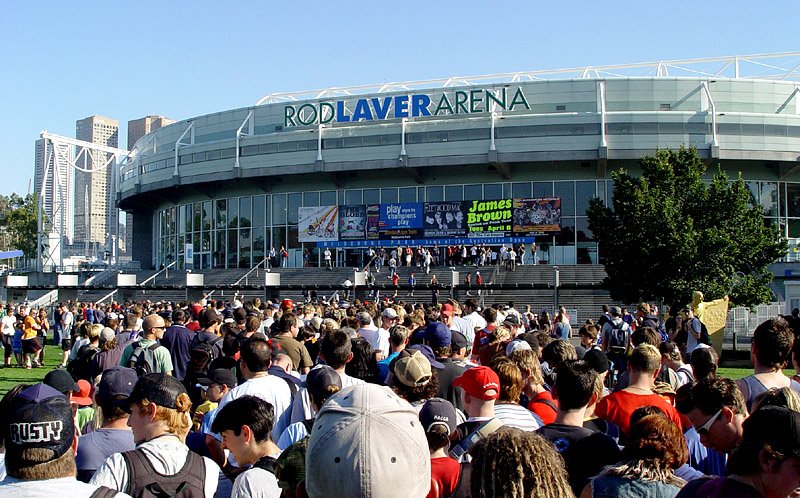
Rod Laver Arena at Melbourne Park — built for the 1988 move to hard courts. Photo: SimonEast, CC BY-SA 3.0, via Wikimedia Commons.
Grass to Hard Court: Why the Australian Open Changed
Kooyong was beloved but outgrown; a fourth major competing with Wimbledon, Roland Garros and the US Open needed a venue built for scale.
1987 Kooyong (Grass) vs 1988 Melbourne Park (Hard Court)
Kooyong Lawn Tennis Club hosted the Australian Open from 1972 to 1987 on grass — a surface that rewarded serve-and-volley tennis and had produced champions from Rod Laver to Chris Evert. But Australia’s distance from Europe and North America made the tournament harder to reach than the other three majors, and some leading players skipped it in years when the calendar didn’t favour the trip. By the final Kooyong edition, roughly 140,000 fans attended a venue the tournament had clearly outgrown.
Stefan Edberg and Hana Mandlikova won that last grass-court edition in 1987 and became, by default, the final Australian Open grass-court singles champions. The following year the tournament reopened at a newly built complex then called Flinders Park (renamed Melbourne Park in 1996), costing roughly A$94 million and including a nearly 15,000-seat main stadium with a retractable roof — unusual for tennis at the time. Attendance in 1988 came in at more than 250,000, close to double the year before.
Australian Open Hard-Court Era Timeline
Newest first — the milestones that defined each surface era, from 1988’s move to Melbourne Park to Carlos Alcaraz’s 2026 career Grand Slam.
Alcaraz Completes the Career Grand Slam, Rybakina Gets Her Revenge
Men’s final: Carlos Alcaraz came back from a set down to beat 10-time champion Novak Djokovic 2–6, 6–2, 6–3, 7–5, becoming at 22 the youngest man to complete the career Grand Slam and handing Djokovic his first Australian Open final defeat (his record moved from 10–0 to 10–1 in finals).
Women’s final: Elena Rybakina beat Aryna Sabalenka 6–4, 4–6, 6–4 in a rematch of their 2023 final, becoming the first Kazakh player to win an Australian Open singles title and taking her second major after Wimbledon 2022.
Djokovic’s Tenth Title Sets the Men’s Record
Result: Novak Djokovic defeated Stefanos Tsitsipas in straight sets, dropping only one set across the entire tournament, to win his tenth Australian Open singles title — the most of any man in tournament history.
Significance: The win confirmed Djokovic’s Melbourne dominance across three different court systems (Plexicushion and GreenSet) spanning 15 years, 2008 to 2023.
GreenSet Arrives Amid Bushfire Smoke
Surface change: Melbourne Park switched to GreenSet acrylic hard courts, aiming for a medium-fast, more consistent court speed. The colour stayed blue.
Result: Novak Djokovic won his eighth Australian Open, defeating Dominic Thiem; Sofia Kenin won the women’s title, both becoming the first champions of the GreenSet era.
The Longest Australian Open Final: 5 Hours 53 Minutes
Result: Novak Djokovic beat Rafael Nadal 5–7, 6–4, 6–2, 6–7(5), 7–5 in the longest Australian Open men’s singles final on record, and one of the longest Grand Slam finals ever played.
Significance: The match became a defining symbol of the hard-court era’s physical demands — both players needed chairs during the trophy ceremony.
Plexicushion Replaces Rebound Ace, Courts Turn Blue
Surface change: After 20 years on Rebound Ace, organisers switched to Plexicushion, citing concerns over pace and bounce consistency in extreme heat. The courts changed colour from green to blue in the same move.
Result: Novak Djokovic won his first Grand Slam title, beating Jo-Wilfried Tsonga in the final; Maria Sharapova won the women’s title without dropping a set.
Martina Hingis Wins Three Straight Titles
Result: Martina Hingis won the Australian Open in 1997, 1998 and 1999 — three consecutive titles from age 16 — built on anticipation, angles and placement rather than raw power.
Significance: Hingis’s run showed hard courts could reward court intelligence as much as strength, a different template from the era’s power baseliners.
Agassi Beats Sampras in a Style Clash
Result: Andre Agassi beat Pete Sampras in the 1995 Australian Open final, the first of Agassi’s four Melbourne titles (1995, 2000, 2001, 2003).
Significance: The final crystallised a contrast that defined 1990s hard-court tennis: Sampras’s serve-and-attack game against Agassi’s elite return and baseline timing. Both approaches proved capable of winning in Melbourne.
Monica Seles Wins Three in a Row
Result: Monica Seles won the Australian Open in 1991, 1992 and 1993 at age 17 to start, then returned to win a fourth title in 1996 after the 1993 stabbing attack in Hamburg that interrupted her career.
Significance: Seles’s aggressive two-handed groundstrokes from both wings set a new tactical standard for baseline power on hard courts.
The Move to Melbourne Park and the First Hard-Court Champions
Result: Mats Wilander beat defending champion Pat Cash to become the first men’s hard-court champion; Steffi Graf won the women’s title as part of her Golden Slam season (all four majors plus Olympic gold).
Significance: The relocation from Kooyong’s grass, combined with the new hard-court surface, nearly doubled attendance in a single year and set the template for the modern Australian Open.
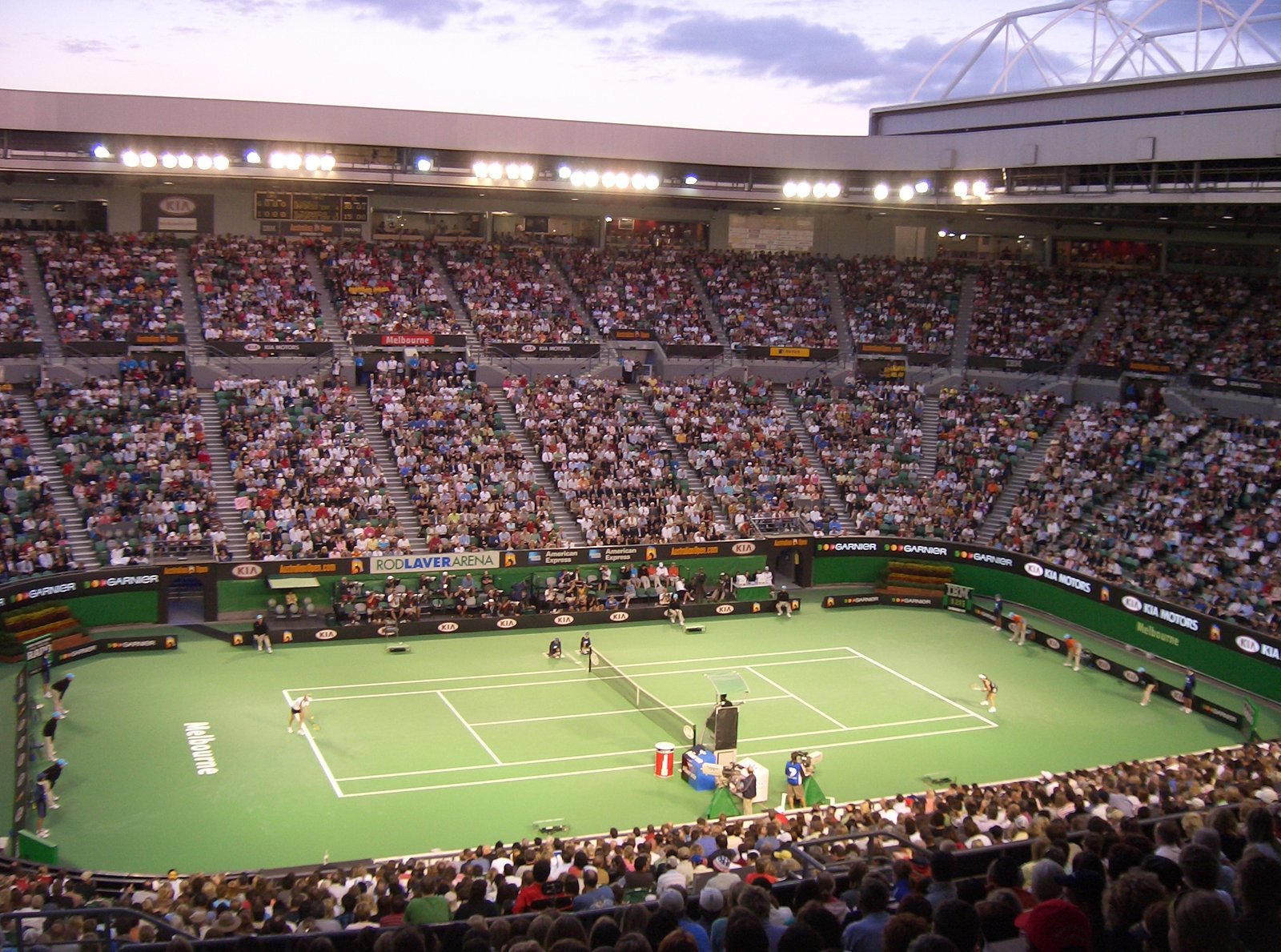
Inside Rod Laver Arena, on the blue cushioned acrylic hard court used since 2008. Photo: pfctdayelise, CC BY-SA 2.5, via Wikimedia Commons.
Hard-Court Era Title Leaders
Djokovic and Serena Williams are the defining champions of the men’s and women’s hard-court eras respectively.
Men
Serbia
Switzerland
United States
Women
United States
Germany
United States
Discover: How Hard-Court Tennis Evolved Alongside the Surface
- Late 1980s–90s: serve-and-volley still common; Sampras and Agassi represent opposite ends of the same era.
- 2000s: better rackets and strings push baseline power and defence; Federer combines attack with defence.
- 2010s: physical standards explode — long rallies, huge returns, sliding on hard courts, elite court coverage (Djokovic, Nadal, Murray, Wawrinka).
- 2020s: modern champions blend everything — Sinner’s early ball-striking, Alcaraz’s speed and variety, Sabalenka’s power, Rybakina’s serve and clean aggression.
- Melbourne’s heat protocols and retractable roofs (Rod Laver, Margaret Court, John Cain Arenas) have grown alongside the tennis, because conditions are part of the contest.
Every Australian Open Hard-Court Champion, 1988–2026
The full year-by-year men’s and women’s singles honour roll since the move to hard courts.
| Year | Men’s Champion | Surface |
|---|---|---|
| 1988 | Mats Wilander (SWE) | Rebound Ace |
| 1989 | Ivan Lendl (TCH) | Rebound Ace |
| 1990 | Ivan Lendl (TCH) | Rebound Ace |
| 1991 | Boris Becker (GER) | Rebound Ace |
| 1992 | Jim Courier (USA) | Rebound Ace |
| 1993 | Jim Courier (USA) | Rebound Ace |
| 1994 | Pete Sampras (USA) | Rebound Ace |
| 1995 | Andre Agassi (USA) | Rebound Ace |
| 1996 | Boris Becker (GER) | Rebound Ace |
| 1997 | Pete Sampras (USA) | Rebound Ace |
| 1998 | Petr Korda (TCH) | Rebound Ace |
| 1999 | Yevgeny Kafelnikov (RUS) | Rebound Ace |
| 2000 | Andre Agassi (USA) | Rebound Ace |
| 2001 | Andre Agassi (USA) | Rebound Ace |
| 2002 | Thomas Johansson (SWE) | Rebound Ace |
| 2003 | Andre Agassi (USA) | Rebound Ace |
| 2004 | Roger Federer (SUI) | Rebound Ace |
| 2005 | Marat Safin (RUS) | Rebound Ace |
| 2006 | Roger Federer (SUI) | Rebound Ace |
| 2007 | Roger Federer (SUI) | Rebound Ace |
| 2008 | Novak Djokovic (SRB) | Plexicushion |
| 2009 | Rafael Nadal (ESP) | Plexicushion |
| 2010 | Roger Federer (SUI) | Plexicushion |
| 2011 | Novak Djokovic (SRB) | Plexicushion |
| 2012 | Novak Djokovic (SRB) | Plexicushion |
| 2013 | Novak Djokovic (SRB) | Plexicushion |
| 2014 | Stan Wawrinka (SUI) | Plexicushion |
| 2015 | Novak Djokovic (SRB) | Plexicushion |
| 2016 | Novak Djokovic (SRB) | Plexicushion |
| 2017 | Roger Federer (SUI) | Plexicushion |
| 2018 | Roger Federer (SUI) | Plexicushion |
| 2019 | Novak Djokovic (SRB) | Plexicushion |
| 2020 | Novak Djokovic (SRB) | GreenSet |
| 2021 | Novak Djokovic (SRB) | GreenSet |
| 2022 | Rafael Nadal (ESP) | GreenSet |
| 2023 | Novak Djokovic (SRB) | GreenSet |
| 2024 | Jannik Sinner (ITA) | GreenSet |
| 2025 | Jannik Sinner (ITA) | GreenSet |
| 2026 | Carlos Alcaraz (ESP) | GreenSet |
| Year | Women’s Champion | Surface |
|---|---|---|
| 1988 | Steffi Graf (GER) | Rebound Ace |
| 1989 | Steffi Graf (GER) | Rebound Ace |
| 1990 | Steffi Graf (GER) | Rebound Ace |
| 1991 | Monica Seles | Rebound Ace |
| 1992 | Monica Seles | Rebound Ace |
| 1993 | Monica Seles | Rebound Ace |
| 1994 | Steffi Graf (GER) | Rebound Ace |
| 1995 | Mary Pierce (FRA) | Rebound Ace |
| 1996 | Monica Seles (USA) | Rebound Ace |
| 1997 | Martina Hingis (SUI) | Rebound Ace |
| 1998 | Martina Hingis (SUI) | Rebound Ace |
| 1999 | Martina Hingis (SUI) | Rebound Ace |
| 2000 | Lindsay Davenport (USA) | Rebound Ace |
| 2001 | Jennifer Capriati (USA) | Rebound Ace |
| 2002 | Jennifer Capriati (USA) | Rebound Ace |
| 2003 | Serena Williams (USA) | Rebound Ace |
| 2004 | Justine Henin (BEL) | Rebound Ace |
| 2005 | Serena Williams (USA) | Rebound Ace |
| 2006 | Amelie Mauresmo (FRA) | Rebound Ace |
| 2007 | Serena Williams (USA) | Rebound Ace |
| 2008 | Maria Sharapova (RUS) | Plexicushion |
| 2009 | Serena Williams (USA) | Plexicushion |
| 2010 | Serena Williams (USA) | Plexicushion |
| 2011 | Kim Clijsters (BEL) | Plexicushion |
| 2012 | Victoria Azarenka (BLR) | Plexicushion |
| 2013 | Victoria Azarenka (BLR) | Plexicushion |
| 2014 | Li Na (CHN) | Plexicushion |
| 2015 | Serena Williams (USA) | Plexicushion |
| 2016 | Angelique Kerber (GER) | Plexicushion |
| 2017 | Serena Williams (USA) | Plexicushion |
| 2018 | Caroline Wozniacki (DEN) | Plexicushion |
| 2019 | Naomi Osaka (JPN) | Plexicushion |
| 2020 | Sofia Kenin (USA) | GreenSet |
| 2021 | Naomi Osaka (JPN) | GreenSet |
| 2022 | Ashleigh Barty (AUS) | GreenSet |
| 2023 | Aryna Sabalenka (BLR) | GreenSet |
| 2024 | Aryna Sabalenka (BLR) | GreenSet |
| 2025 | Madison Keys (USA) | GreenSet |
| 2026 | Elena Rybakina (KAZ) | GreenSet |
⚠️ Editorial Note
Champion lists, scorelines and title counts are compiled from the Australian Open’s own official history pages and honour rolls, cross-checked against ATP and WTA tournament records. Figures such as 1987/1988 attendance are widely reported estimates from the tournament’s own historical account rather than audited turnstile counts; treat them as approximate, not exact.
Explore More Timelines
People Also Ask
Frequently Asked Questions
Related AiTimeline Stories
⚠️ Editorial Note
This timeline compiles publicly available tournament records from the Australian Open’s official history and ATP/WTA honour rolls. It is editorial and AI-assisted content, not tournament, ATP or WTA official communication; scores and dates are provided for reference and may contain inaccuracies despite verification efforts.
Sources & further reading
Every dated entry above was checked against these references. Last reviewed 23 September 2026.