COP Climate Summit Timeline: Pledges vs Emissions
COP1 to COP31, 1995-2026: every climate summit pledge vs the actual emissions gap, with UNEP 2025 warming scenarios, NDC targets and record CO2 levels.
Latest Story
In 1995 the first COP climate summit met in Berlin to work out how the world would cut greenhouse-gas emissions. Three decades, 30 summits and a Kyoto Protocol, Paris Agreement and Glasgow, Dubai and Baku deal later, one number has moved in only one direction: atmospheric CO₂ hit a record 423.9 parts per million in 2024, rising 3.5 ppm in a single year — the largest annual jump since measurements began in 1957. This is the dated record of what governments promised at each COP, and what actually happened to the emissions those promises were meant to cut.
🧠 AI Overview Summary
COP is the annual Conference of the Parties to the UN climate treaty, running since 1995. It produced the binding Kyoto Protocol (1997), the near-universal Paris Agreement (2015, targeting well below 2°C and pursuing 1.5°C), the Glasgow coal-phase-down language (2021), the Sharm el-Sheikh loss-and-damage fund (2022), the Dubai call to transition away from fossil fuels (2023) and the Baku $300-billion finance goal (2024). Despite this, UNEP’s 2025 assessment puts current policies on a path to roughly 2.8°C of warming and full NDC implementation at roughly 2.3–2.5°C — both above the 1.5°C Paris goal, which needs global emissions about 55% below 2019 levels by 2035.
COP Climate Summit: Key Questions
Three Decades of COP, in Nine Lines
- COP is not a world government: it cannot order a country to close a coal plant or an oil field — its power runs through treaties, national pledges, finance, transparency and diplomacy.
- Kyoto (1997) bound only developed economies to numerical targets, and its biggest emitter, the United States, never ratified it — a structural gap that shaped every COP after it.
- Paris (2015) traded top-down force for near-universal reach: almost every country joined, but each sets its own target through a Nationally Determined Contribution (NDC).
- Glasgow (2021) was the first COP cover decision to name coal explicitly — and the final wording was softened from “phase out” to “phase down” in the closing hours.
- Sharm el-Sheikh (2022) delivered the Loss and Damage Fund, the first time COP built dedicated finance architecture for climate harms that can’t be prevented or adapted to.
- Dubai (2023) produced the first Global Stocktake and the first COP text calling for “transitioning away from fossil fuels in energy systems.”
- Baku (2024) set a $300-billion-a-year finance goal by 2035, with a broader $1.3-trillion-a-year ambition — developing countries called both insufficient.
- Belém (2025) shifted the language to delivery: a new Just Transition framework, Adaptation Indicators, and a call to triple adaptation finance by 2035.
- The gap has narrowed but not closed: new NDCs point to about 12% below 2019 emissions by 2035, versus roughly 55% needed for 1.5°C.
Three Climate Futures, One Set of Pledges
UNEP’s Emissions Gap Report 2025 models three warming paths depending on how much of the COP process actually gets implemented.
Source: UNEP 2025
Source: UNEP 2025
Source: UNEP / UNFCCC 2025
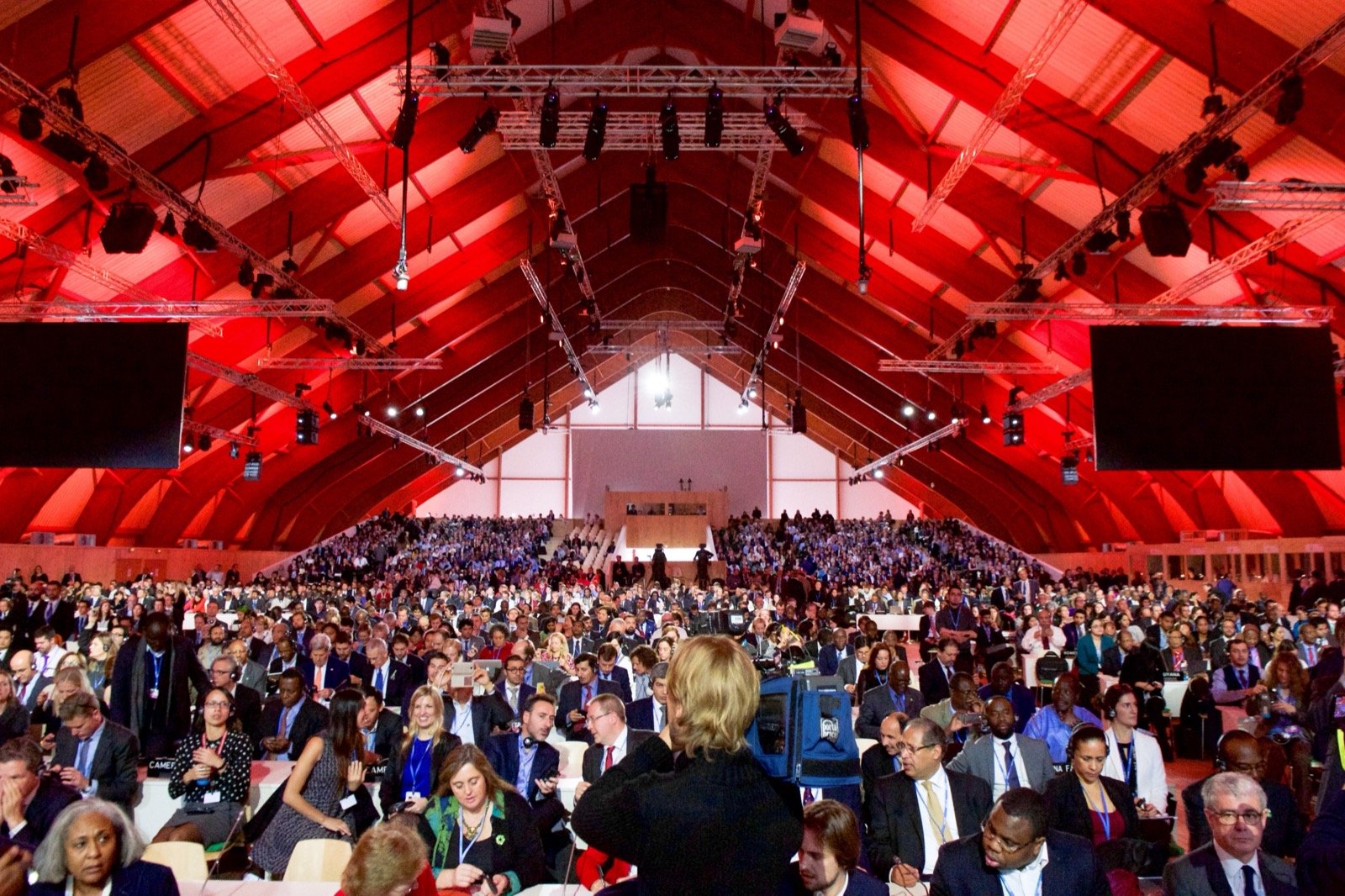
Delegates in the plenary hall at Le Bourget, Paris, before the speeches that opened COP21 in December 2015. Photo: U.S. Department of State, Public Domain, via Wikimedia Commons.
Four Eras of COP: From “Who Cuts?” to “Did You Actually Do It?”
The 31-year history of COP breaks into four distinct diplomatic phases, each answering a different question.
Who Should Cut?
Kyoto’s answer: binding, quantified targets for developed economies only. Global emissions kept rising as the world’s emissions geography shifted toward fast-industrialising economies outside that binding structure.
How Do We Get Everyone In?
Copenhagen’s 2009 stalemate forced a reset. Durban (2011) opened talks on a framework “applicable to all,” and Lima (2014) introduced the idea each country would submit its own plan.
What Will Everyone Promise?
Paris (2015) created Nationally Determined Contributions on a five-year ratchet. Glasgow (2021) named coal for the first time; Sharm el-Sheikh (2022) built the Loss and Damage Fund.
Did You Actually Do It?
Dubai’s first Global Stocktake (2023) graded progress “too slow.” Baku (2024) put a number on finance. Belém (2025) shifted the language explicitly to implementation and delivery.
COP is short for Conference of the Parties — the annual meeting of governments that have signed the UN Framework Convention on Climate Change, adopted at the 1992 Rio Earth Summit. It is the world’s main multilateral forum on climate change, but it is not a global government: no COP decision can, by itself, close a coal plant, cancel an oil lease or shut a factory. Its power runs through international law, national pledges, climate finance, transparency rules, carbon markets and diplomatic pressure — which is also why COP outcomes move more slowly than the emissions problem they exist to solve.
COP outcomes are not all the same kind of promise. The UNFCCC and the Kyoto Protocol contain binding legal obligations. The Paris Agreement binds countries procedurally — they must prepare, communicate and periodically strengthen an NDC — but the actual emissions number inside that NDC is nationally determined, not internationally imposed. Cover-decision language (like Glasgow’s “phase down” of coal) is a negotiated political text, not a treaty obligation. Understanding which kind of promise is on the table at each COP is the difference between reading the outcome accurately and being disappointed by it.
The Pledge Gap: What Was Promised vs What’s Needed
Two separate, authoritative 2025 assessments — the UNFCCC’s synthesis of new NDCs and UNEP’s Emissions Gap Report — show where current pledges land against the emissions cuts the science says are required.
2035 Global Emissions Index (2019 = 100)
Discover: Why Pledges Haven’t Become Emissions Cuts Fast Enough
- Global energy demand keeps growing even as renewable capacity expands, so clean power must outrun demand growth, not just add to the mix.
- Fossil infrastructure built today — a coal plant, a gas pipeline, a refinery — can operate for 30–40 years, locking in emissions decades past any single COP’s target year.
- A net-zero pledge is not a policy: without a near-term legislated plan, it is a target with no road to it.
- Climate finance for developing economies remains short of need, which slows the grids, transport and industrial transition those pledges assume will happen.
- Forests and oceans absorb roughly half of human CO₂ emissions, but that absorption capacity is not infinite and is itself under pressure from heat and drought.
COP Climate Summit Timeline
Newest first — the summits that changed what governments promised, from Berlin’s first meeting to Belém’s implementation push.
COP31 Approaches in Antalya
Focus: With the Paris Agreement now a decade old, COP31’s diplomatic focus is shifting from target-setting toward delivery — tracking whether the finance, adaptation and just-transition commitments made at Baku and Belém are actually being implemented.
COP30 Belém: Adaptation, Just Transition and a Numbers Test
Outcome: Parties adopted a new Just Transition framework and the Belém Adaptation Indicators, and the closing Mutirão decision called for tripling adaptation finance by 2035.
Reality check: Days after the summit, an updated UNFCCC synthesis covering new NDCs from 113 Parties projected 2035 emissions only about 12% below 2019 — far short of the roughly 55% cut UNEP says a 1.5°C path requires.
COP29 Baku: The Finance COP
Outcome: Developed countries agreed to take the lead in mobilising at least $300 billion a year for developing countries by 2035, inside a broader goal to scale total climate finance to at least $1.3 trillion a year by 2035.
Reaction: Developing countries and civil-society groups called both figures insufficient against the scale of grids, adaptation and loss-and-damage needs.
COP28 Dubai: The First Global Stocktake
Outcome: Parties completed the Paris Agreement’s first Global Stocktake — a report-card on the treaty’s first eight years — and its verdict was that progress was too slow. The closing text called for “transitioning away from fossil fuels in energy systems,” tripling global renewable capacity and doubling the rate of energy-efficiency improvement, all by 2030.
Significance: It was the first COP cover decision to place fossil fuels explicitly at the centre of the transition conversation, hosted in a major oil-producing state.
COP27 Sharm el-Sheikh: The Loss and Damage Fund
Outcome: After decades of pressure from vulnerable and developing nations, governments agreed to establish new funding arrangements, including a dedicated Loss and Damage Fund, for climate harms that mitigation and adaptation cannot prevent.
Significance: It moved the “we contributed less, but pay more” argument from rhetoric into financial architecture — even as global fossil-fuel use kept expanding.
COP26 Glasgow: Coal Named, Then Softened
Outcome: The Glasgow Climate Pact became the first COP cover decision to explicitly address coal, calling for accelerating the “phase-down of unabated coal power” and the “phase-out of inefficient fossil-fuel subsidies.”
The word that mattered: Negotiators wanted “phase out”; the final text says “phase down” — a last-minute change that showed how far two words can move a global consensus.
COP21 Paris: The Near-Universal Agreement
Outcome: The Paris Agreement set a central goal of holding warming well below 2°C while pursuing efforts to limit it to 1.5°C, built on Nationally Determined Contributions that each country updates on a five-year ratchet.
The trade-off: Paris sacrificed Kyoto’s top-down, internationally imposed targets to gain near-universal participation — every country sets its own number, and Paris binds them procedurally to keep raising it.
COP15 Copenhagen: High Hype, Weak Deal
Outcome: Negotiations aiming for a comprehensive post-Kyoto treaty collapsed into procedural gridlock; the resulting Copenhagen Accord was only “noted,” not formally adopted, though it introduced the below-2°C goal and a $100-billion climate-finance pledge for 2020.
Significance: Copenhagen’s failure to deliver a binding global treaty pushed climate diplomacy toward the voluntary, bottom-up pledge system Paris would formalise six years later.
COP3 Kyoto: The First Binding Targets
Outcome: The Kyoto Protocol set the first internationally binding emissions targets, applying to industrialised economies and economies in transition, averaging roughly 5% below 1990 levels.
The gap in the deal: Major developing economies had no equivalent quantified obligation, and the United States signed but never ratified — leaving Kyoto’s binding coverage increasingly narrow as the world’s emissions geography shifted.
COP1 Berlin: Where It Started
Outcome: Delegates concluded that existing UNFCCC commitments were inadequate and launched negotiations toward stronger, binding obligations for developed economies — the Berlin Mandate, which led directly to Kyoto two years later.
Context: COP1 came three years after the 1992 Rio Earth Summit adopted the UNFCCC itself, the treaty every COP since has operated under.
Pledge vs Emissions Scoreboard
What each landmark COP promised, set against what actually happened to global emissions afterward.
| COP | Promise | Reality |
|---|---|---|
| COP3, Kyoto (1997) | Binding targets for developed economies | Global emissions kept growing as emitting economies shifted outside the binding structure |
| COP15, Copenhagen (2009) | Political accord + climate-finance pledge | No binding global treaty emerged; ambition stayed voluntary |
| COP21, Paris (2015) | Well below 2°C, pursue 1.5°C, universal NDCs | Policies improved, but emissions stayed far above a 1.5°C-aligned path |
| COP26, Glasgow (2021) | Coal phase-down, stronger 2030 action | Fossil fuels remained deeply embedded in the global energy system |
| COP27, Sharm el-Sheikh (2022) | Loss and Damage Fund | Addressed consequences of emissions more than the emissions trajectory itself |
| COP28, Dubai (2023) | Transition away from fossil fuels; triple renewables | First Global Stocktake found overall progress “too slow” |
| COP29, Baku (2024) | $300B/yr finance goal by 2035 | Developing nations called the figure short of actual need |
| COP30, Belém (2025) | Just Transition, adaptation, implementation focus | New NDCs still leave 2035 emissions roughly 12% below 2019, versus ≈55% needed for 1.5°C |
Every COP Climate Summit, 1995–2026
The full host-city record, from Berlin’s first meeting to Antalya’s scheduled 2026 summit.
| COP | Year | Host City |
|---|---|---|
| COP1 | 1995 | Berlin, Germany |
| COP2 | 1996 | Geneva, Switzerland |
| COP3 | 1997 | Kyoto, Japan |
| COP4 | 1998 | Buenos Aires, Argentina |
| COP5 | 1999 | Bonn, Germany |
| COP6 | 2000–01 | The Hague, Netherlands / Bonn, Germany |
| COP7 | 2001 | Marrakech, Morocco |
| COP8 | 2002 | New Delhi, India |
| COP9 | 2003 | Milan, Italy |
| COP10 | 2004 | Buenos Aires, Argentina |
| COP11 | 2005 | Montreal, Canada |
| COP12 | 2006 | Nairobi, Kenya |
| COP13 | 2007 | Bali, Indonesia |
| COP14 | 2008 | Poznań, Poland |
| COP15 | 2009 | Copenhagen, Denmark |
| COP16 | 2010 | Cancún, Mexico |
| COP17 | 2011 | Durban, South Africa |
| COP18 | 2012 | Doha, Qatar |
| COP19 | 2013 | Warsaw, Poland |
| COP20 | 2014 | Lima, Peru |
| COP21 | 2015 | Paris, France |
| COP22 | 2016 | Marrakech, Morocco |
| COP23 | 2017 | Bonn, Germany (presided by Fiji) |
| COP24 | 2018 | Katowice, Poland |
| COP25 | 2019 | Madrid, Spain |
| COP26 | 2021 | Glasgow, UK (postponed from 2020) |
| COP27 | 2022 | Sharm el-Sheikh, Egypt |
| COP28 | 2023 | Dubai, UAE |
| COP29 | 2024 | Baku, Azerbaijan |
| COP30 | 2025 | Belém, Brazil |
| COP31 | 2026 | Antalya, Türkiye (scheduled) |
⚠️ Editorial Note
Temperature projections (2.8°C current policies, 2.3–2.5°C full NDCs) and the 55%/35% 2035 emissions-cut figures are drawn from UNEP’s Emissions Gap Report 2025. The 12%-below-2019 figure for 2035 is from the UNFCCC’s own November 2025 synthesis of new NDCs covering 113 Parties — a separate assessment using its own methodology, not the same calculation as UNEP’s, so treat the two as complementary rather than identical. Atmospheric CO₂ figures (423.9 ppm in 2024, +3.5 ppm year-on-year) are from WMO greenhouse-gas monitoring.
Explore More Timelines
People Also Ask
Frequently Asked Questions
Related AiTimeline Stories
⚠️ Editorial Note
This timeline compiles publicly available records from UNFCCC COP outcome documents, UNEP’s Emissions Gap Report 2025, the UNFCCC’s November 2025 NDC synthesis, and WMO greenhouse-gas monitoring data. It is editorial and AI-assisted content, not an official UN, UNFCCC or UNEP communication; figures and dates are provided for reference and may contain inaccuracies despite verification efforts.
Sources & further reading
Every dated entry above was checked against these references. Last reviewed 23 September 2026.
- UNFCCC — Conferences of the Parties (COP)
- UNFCCC — The Kyoto Protocol
- UNFCCC — The Paris Agreement
- UNFCCC — The Glasgow Climate Pact
- UNFCCC — COP28 Agreement on Transitioning Away From Fossil Fuels
- UNFCCC — New NDC Synthesis Still Insufficient to Avert Serious Climate Impacts (Nov 2025)
- WMO — Greenhouse Gas Concentrations Reach Yet Another High