Shiv Sena Split: Timeline of Maharashtra’s Political Crisis
Shiv Sena split timeline: Uddhav Thackeray's 2019 MVA alliance, Eknath Shinde's 2022 rebellion, Supreme Court rulings and the 2026 symbol dispute.
Latest Story
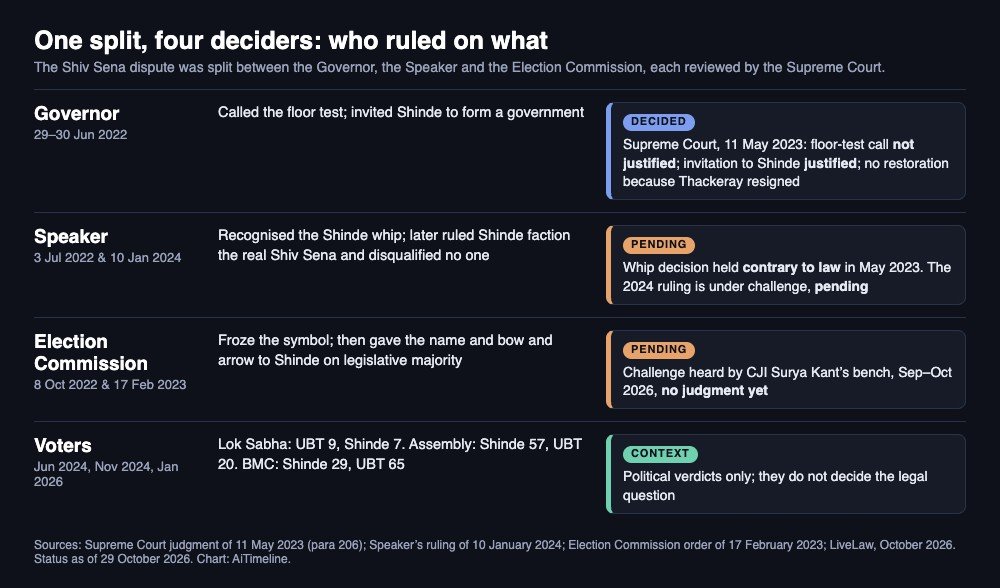
The Shiv Sena split of June 2022 brought down Uddhav Thackeray’s Maha Vikas Aghadi government and made Eknath Shinde Chief Minister with the BJP’s support. It then became a contest across four forums: the Governor, the Assembly Speaker, the Election Commission and the Supreme Court. The Commission gave Shinde’s faction the Shiv Sena name and the bow-and-arrow symbol in February 2023. The Supreme Court ruled in May 2023 that the Governor had been wrong to call a floor test, but could not restore Thackeray because he had resigned. In 2026 the Court is hearing the challenge to the symbol order, and as of 29 October 2026 it had not ruled.
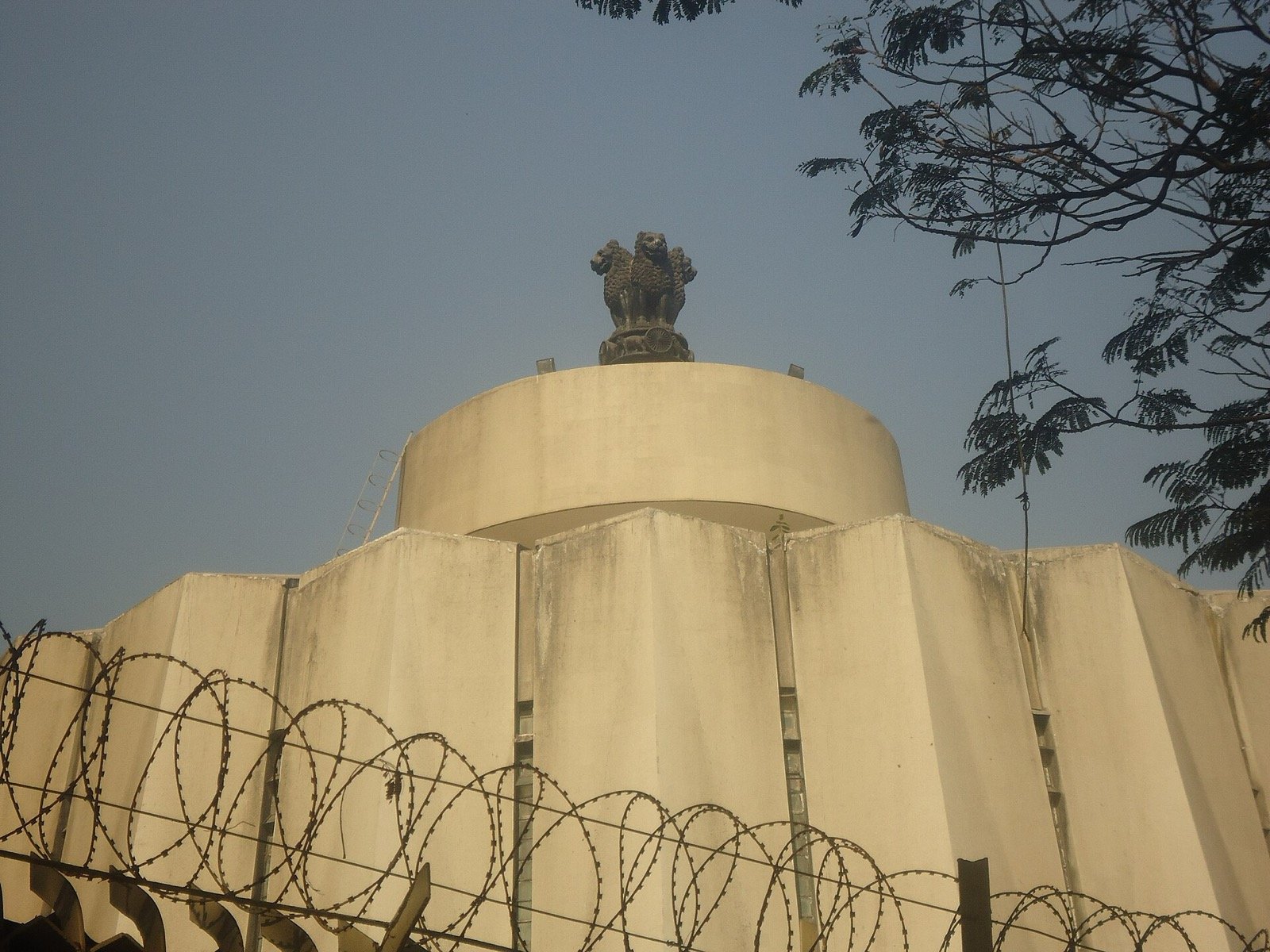
Status: the Supreme Court is still hearing the challenge to the Election Commission’s 2023 order and the Speaker’s 2024 ruling. No judgment has been reported.
- Bench: Chief Justice Surya Kant, Justices Joymalya Bagchi and V. Mohana.
- Latest hearing: 28 October, when the Shinde side argued the disqualification appeal is now infructuous (LiveLaw); listed again 29 October (ThePrint).
- Until it rules: the Shinde faction keeps the Shiv Sena name and the bow and arrow.
- Next update: when the Court reserves or delivers judgment.
💡 Short Answer
The Shiv Sena split when Eknath Shinde led 37 of its 55 MLAs against Uddhav Thackeray in June 2022. Thackeray resigned on 29 June and Shinde became Chief Minister on 30 June with BJP support. The Election Commission gave Shinde the Shiv Sena name and bow and arrow on 17 February 2023. The Supreme Court said on 11 May 2023 that the Governor erred but Thackeray could not be restored. The Speaker disqualified no one on 10 January 2024. The symbol challenge was still being heard in October 2026.
Shiv Sena Split: Key Questions
The Shiv Sena Split in Nine Points
- Origin: the 2019 alliance with the Congress and the NCP that made Uddhav Thackeray Chief Minister.
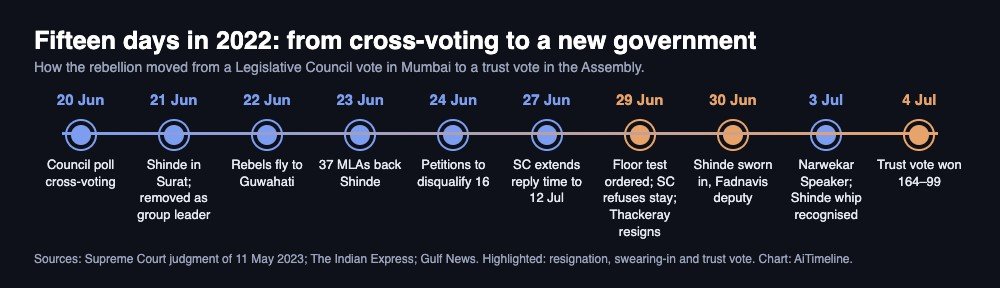
- Rebellion: 20–23 June 2022, Mumbai to Surat to Guwahati; 37 MLAs signed for Shinde.
- Fall: Thackeray resigned on 29 June 2022; Shinde was sworn in on 30 June.
- Symbol frozen: 8 October 2022; the flaming torch came on 10 October 2022.
- Symbol awarded: to Shinde on 17 February 2023, on legislative majority.
- Constitution Bench: Governor wrong, whip decision wrong, but no restoration.
- Speaker: Shinde faction is the real Shiv Sena; no MLA disqualified (10 January 2024).
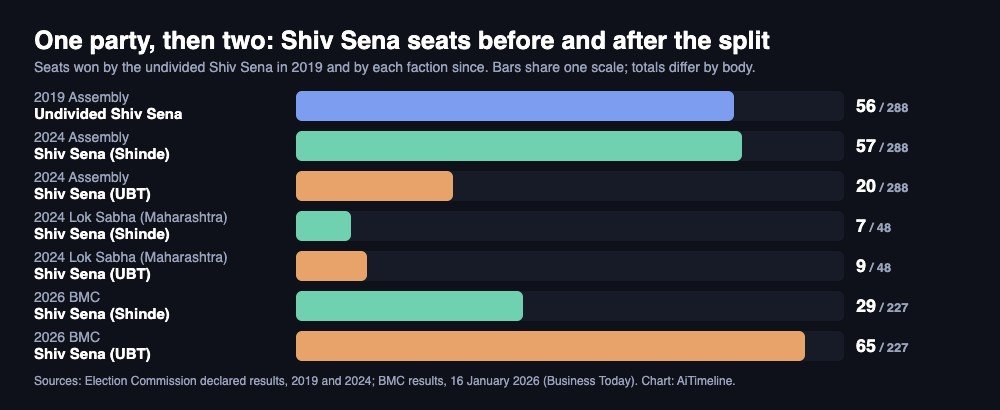
- Voters: Shinde 57 and UBT 20 seats in 2024; UBT 65 and Shinde 29 in the 2026 BMC.
- Still open: the Supreme Court’s ruling on the symbol and the Speaker’s decision.
Shiv Sena Split Timeline, Latest First
From the 2026 Supreme Court hearings back to the party’s founding in 1966. Each entry is tagged and ends with why it matters.
Final hearing continues; no judgment yet Pending
The Supreme Court is hearing the Thackeray faction’s challenge to the Election Commission’s February 2023 order together with the challenge to the Speaker’s January 2024 ruling. LiveLaw reports the lead matter as Sunil Prabhu v. Eknath Shinde (LiveLaw). After Kapil Sibal and Devdutt Kamat argued for the Thackeray side, Neeraj Kishan Kaul finished for the Shinde faction, and Maninder Singh was due to follow on 14 October (Lokshahi).
On 28 October Dhruv Mehta, for the Shinde faction, argued that the disqualification appeal had become infructuous because the 14th Assembly’s term had ended, so the MLAs concerned are no longer members of that House. Maninder Singh defended the Election Commission’s legislative-majority test, arguing that an organisational test could not work for a party that had not held internal elections (LiveLaw).
The hearing was to continue on 29 October (ThePrint). As of 29 October 2026, no judgment or order deciding the case had been reported. The Court has not said when it will rule.
2026
Bench asks why the symbol was not withheld from both sides Court
Justice Joymalya Bagchi asked why the Election Commission relied on the legislative-majority test without addressing a fourth option: refusing the reserved symbol to either faction. “If none of these tests appear to be strong, then what else? Why give a prize to one? Cancel it,” he said, while adding that withholding a symbol would be a “rarest of rare” step (LiveLaw).
A day earlier the bench had asked whether the “sentiment of the symbol” should operate in favour of people who committed the “constitutional sin” of defection (The Pioneer). For the Shinde faction, Neeraj Kishan Kaul argued that Paragraph 15 of the Symbols Order fixes no single test, and that the Commission used legislative strength because the party’s constitution and organisational majority could not be relied on.
Justice Bagchi stressed that the Court would not substitute its own view on the merits. The question was whether the Commission had left a relevant option unaddressed.
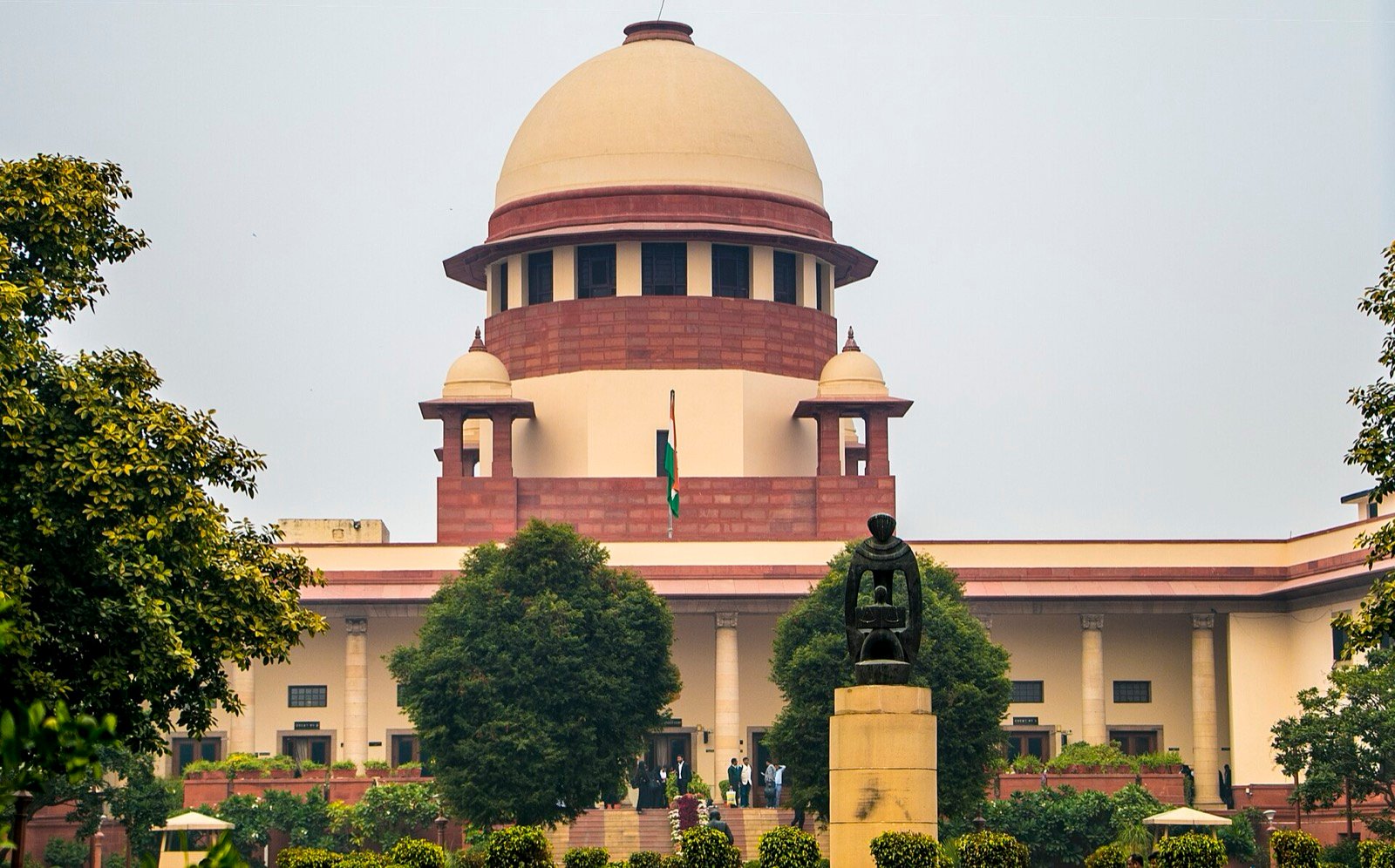
Final hearing begins in earnest; Shinde side defends the test Court
Arguing for the Shinde faction in early September, Neeraj Kishan Kaul said Uddhav Thackeray had “significantly altered” the party structure in 2018, concentrating power in the party chief. He said the changes had not been placed on the Election Commission’s record. The hearing then continued on 15 September (The Pioneer).
The Shinde side’s case is that the Commission could not use the party’s organisational wing as a reliable measure, and so turned to elected legislators. The Thackeray side says that test was rejected by the Constitution Bench in 2023 as a weak guide in a split.
2026
BMC results end decades of Sena control in Mumbai Election
The BJP won 89 wards and Shinde’s Shiv Sena 29, giving the alliance 118, four above the majority mark of 114. The Shiv Sena (UBT) won 65 and its ally, Raj Thackeray’s Maharashtra Navnirman Sena, six (Business Today). The undivided Shiv Sena had won 84 wards in 2017.
2024
Assembly election: Shinde 57, Thackeray 20 Election
The BJP-led Mahayuti alliance won a large majority. The BJP took 132 seats, Shinde’s Shiv Sena 57 of the 81 it contested, and Ajit Pawar’s NCP 41 (Deccan Herald). The Shiv Sena (UBT) won 20. Devendra Fadnavis returned as Chief Minister on 5 December 2024, with Eknath Shinde and Ajit Pawar as Deputy Chief Ministers.
The result gave the Shinde faction a popular verdict to point to, but it did not decide the legal question. The Supreme Court still has to rule on whether the 2023 symbol order was lawful.
2024
Lok Sabha election: the two Senas split the vote Election
In the first national election after the split, the Shiv Sena (UBT) won nine Lok Sabha seats in Maharashtra and Shinde’s Shiv Sena won seven. The Thackeray faction contested as part of the Maha Vikas Aghadi with the Congress and Sharad Pawar’s NCP; the Shinde faction contested with the BJP.
2024
Speaker rules the Shinde faction is the real Shiv Sena Assembly
Acting on the Supreme Court’s 2023 direction, Speaker Rahul Narwekar held that the Shinde-led group was the real Shiv Sena when the rival factions emerged on 21 June 2022 (Scroll; The Indian Express). He relied on the party’s 1999 constitution, which was on the Election Commission’s record, rather than the 2018 version the Thackeray side cited, and found that Shinde had 37 of the 55 Shiv Sena MLAs.
He held that Bharat Gogawale had been validly appointed whip and that Sunil Prabhu had ceased to be whip. He rejected every disqualification petition, from both sides: “No MLA is being disqualified.” The Thackeray faction challenged the ruling in the Supreme Court; the Shinde faction separately went to the Bombay High Court over the dismissal of its petitions against 14 Thackeray-camp MLAs.
2023
Constitution Bench verdict: Governor wrong, but no return for Thackeray Court
A five-judge bench of Chief Justice D.Y. Chandrachud and Justices M.R. Shah, Krishna Murari, Hima Kohli and P.S. Narasimha ruled unanimously (judgment). It held that Governor Bhagat Singh Koshyari “was not justified” in calling for a floor test, because he had no objective material showing Thackeray had lost the House’s confidence. But “the status quo ante cannot be restored because Mr. Thackeray did not face the floor test and tendered his resignation.”
The Court held that the political party, not the legislature party, appoints the whip, and that the Speaker’s 3 July 2022 recognition of the Shinde camp’s whip was “contrary to law”. It left disqualification to the Speaker “within a reasonable period”. It said the Election Commission could apply the test “best suited” to the facts, and that the Speaker and Commission could proceed at the same time. It found the Governor was justified in inviting Shinde to form a government, and referred the 2016 Nabam Rebia ruling on Speakers facing removal notices to a seven-judge bench.
2023
Election Commission gives the name and bow and arrow to Shinde Election Commission
The Commission recognised the Shinde-led faction as the Shiv Sena and allotted it the reserved bow-and-arrow symbol (The Indian Express). It relied mainly on the test of legislative majority, measured by the votes polled by the MLAs and MPs who backed each side. It found the party’s organisation could not be a reliable test, partly because the 2018 amendments to the party constitution had not been shared with it.
The Thackeray faction challenged the order in the Supreme Court. It continued as the Shiv Sena (Uddhav Balasaheb Thackeray) with the flaming torch, both of which it had first received as an interim allotment in October 2022.
2022
Symbol frozen; both factions get interim names Election Commission
With a by-election due in Andheri East on 3 November, the Commission froze the bow-and-arrow symbol and the Shiv Sena name on 8 October 2022 and barred both factions from using them. On 10 October it allotted the Thackeray faction the name Shiv Sena (Uddhav Balasaheb Thackeray) and the flaming torch, after rejecting its claim to the trident on religious grounds (Business Today). The Shinde faction received the name Balasahebanchi Shiv Sena.
2022
New Speaker, a contested whip and a 164–99 trust vote Assembly
On 3 July the BJP’s Rahul Narwekar was elected Speaker. The same day his office reinstated Shinde as Shiv Sena legislature party leader and recognised Bharat Gogawale as chief whip, a decision the Supreme Court later called contrary to law. On 4 July the Shinde government won the trust vote 164–99 on a head count (Gulf News).
2022
Eknath Shinde sworn in as Chief Minister Assembly
Eknath Shinde took oath as Chief Minister, with Devendra Fadnavis as Deputy Chief Minister. Fadnavis had written to the Governor that day saying the BJP’s MLAs backed a Shinde-led government. The Governor asked Shinde to prove his majority within seven days. The Supreme Court later held this invitation was justified.
2022
Court refuses to stop the floor test; Thackeray resigns Assembly
Governor Koshyari directed Thackeray to prove his majority on 30 June. The Supreme Court declined to stay the floor test that evening. Thackeray announced his resignation on a live address the same night, before facing the vote (Wikipedia summary).
That choice later decided the outcome of the Constitution Bench case. Because he resigned without facing the House, the Court said in May 2023 that it could not reinstate him, even though it found the Governor had no proper basis to call the test.
2022
Vacation bench gives rebels more time on disqualification Court
The Shinde camp challenged the Deputy Speaker’s disqualification notices, which had given 16 MLAs about two days to respond. A vacation bench of Justices Surya Kant and J.B. Pardiwala extended their time to reply to 12 July and asked the Deputy Speaker to explain his position on a pending notice seeking his own removal (The Indian Express).
2022
The rebellion: Surat, then Guwahati Background
Cross-voting in the Legislative Council election on 20 June exposed the split. On 21 June Shinde and a group of MLAs were in Surat, Gujarat; the party replaced him as legislature party leader the same day. On 22 June the group moved to Guwahati in Assam. On 23 June 37 Shiv Sena MLAs, the two-thirds needed under the anti-defection law, signed a letter backing Shinde as their leader. On 24 June the Thackeray side petitioned the Deputy Speaker to disqualify 16 rebels (Wikipedia summary).
The rebels said the Shiv Sena had abandoned its ideology by allying with the Congress and the NCP. Thackeray’s supporters said the rebels had defected under pressure. Each side has continued to dispute the other’s account.
2019
Uddhav Thackeray becomes Chief Minister at the head of the MVA Background
The BJP and Shiv Sena fought the 2019 election as allies. The BJP won 105 seats, the Shiv Sena 56, the NCP 54 and the Congress 44 in the 288-member Assembly. The allies then fell out over power-sharing. After a pre-dawn swearing-in of Devendra Fadnavis with Ajit Pawar on 23 November collapsed within days, Thackeray was sworn in on 28 November as head of the Maha Vikas Aghadi with the Congress and the undivided NCP.
The source brief attributes 105 and 54 to the Supreme Court; the Court’s own account gives the BJP 106 and the NCP 53 (judgment, para 2). The figures above are the declared results.
2012
Bal Thackeray dies Background
The party’s founder died aged 86. Uddhav Thackeray, who had been the party’s working president since 2003, took over its leadership. Eknath Shinde, a Thane leader, rose through the party to become a senior minister, and was Urban Development Minister in the MVA government in 2022.
1966
Bal Thackeray founds the Shiv Sena Background
Cartoonist Bal Thackeray founded the Shiv Sena in Bombay, six years after the city went to the new state of Maharashtra (see how the States Reorganisation Act redrew India’s map). It began as a movement for Marathi-speaking “sons of the soil”, later adopted Hindutva and allied with the BJP from the late 1980s.
Why Did the Shiv Sena Split?
Three disputes ran together: alliance, control and identity.
1. A disputed alliance
The Shiv Sena had fought the 2019 election with the BJP. Forming the government with the Congress and the NCP was the central grievance the rebels cited. Thackeray’s side defended it as the only route to power after the BJP refused to share the chief minister’s post. Each side’s account of who broke the 2019 alliance is still contested.
2. A fight over who controls the party
The two factions made rival claims about the legislature party leader, the whip and the party’s own constitution. The anti-defection law made these questions decisive: whoever controlled the whip could seek to disqualify MLAs who defied it. Since the 2003 amendment removed the “split” defence, a breakaway group cannot simply form a new party; see how the same law played out in the 2016 Uttarakhand crisis, when nine rebel MLAs were disqualified.
3. The name and the symbol
The Shiv Sena name and the bow and arrow carry decades of recognition among voters. Under Paragraph 15 of the Symbols Order, only the Election Commission can decide which rival group is the party. Its 2023 order gave both to Shinde. The Thackeray faction now fights elections under a new name and the flaming torch.
What Did the Supreme Court Decide in 2023?
The Constitution Bench answered how the crisis was handled, not which faction is the party.
The Supreme Court’s 11 May 2023 judgment (full text; The Indian Express explainer) answered constitutional questions about how the crisis was handled. It did not decide which faction is the real Shiv Sena.
- On the Governor: the call for a floor test lacked objective material. The invitation to Shinde to form a government was justified.
- On the remedy: the Thackeray government could not be restored, because he resigned before the floor test.
- On the whip: the political party appoints the whip; the Speaker’s 3 July 2022 decision recognising the Shinde camp’s whip was contrary to law.
- On disqualification: the Court declined to decide it itself and told the Speaker to do so within a reasonable period.
- On the symbol: the Election Commission may use the test best suited to the facts, and can act in parallel with the Speaker.
- On the larger question: whether a Speaker facing a removal notice can rule on disqualification went to a seven-judge bench.
The questions the bench put in October 2026 should not be treated as a ruling. The 2026 case will decide whether the Commission applied its test lawfully; it may also bear on the Speaker’s January 2024 decision. For other moments when the Supreme Court itself became the story, see the 2018 judges’ press conference.
Where Each Legal Question Stands
Decided, challenged or pending, as of 29 October 2026.
| Question | Who decided | Date | Result | Status, Oct 2026 |
|---|---|---|---|---|
| Was the floor-test call valid? | Supreme Court (5 judges) | 11 May 2023 | Governor “not justified”; Thackeray not restored | Final |
| Who is the party’s whip? | Supreme Court (5 judges) | 11 May 2023 | Party, not legislators, appoints the whip; 3 Jul 2022 recognition “contrary to law” | Final |
| Should rebel MLAs be disqualified? | Speaker Rahul Narwekar | 10 Jan 2024 | No MLA disqualified, on either side | Challenged in Supreme Court |
| Which faction is the Shiv Sena? | Election Commission | 17 Feb 2023 | Shinde faction; gets name and bow and arrow | Final hearing, no judgment |
| Can a Speaker facing removal rule on disqualification? | Seven-judge bench (reference) | Referred 11 May 2023 | Correctness of Nabam Rebia (2016) referred | No ruling reported |
The Two Senas Compared
| Shiv Sena (Shinde) | Shiv Sena (UBT) | |
|---|---|---|
| Leader | Eknath Shinde | Uddhav Thackeray |
| Name | Shiv Sena (recognised 17 Feb 2023) | Shiv Sena (Uddhav Balasaheb Thackeray) |
| Symbol | Bow and arrow | Flaming torch (mashaal) |
| Allies | BJP, NCP (Ajit Pawar): Mahayuti | Congress, NCP (SP): Maha Vikas Aghadi |
| 2024 Assembly seats | 57 | 20 |
| 2024 Lok Sabha seats (Maharashtra) | 7 | 9 |
| 2026 BMC wards | 29 | 65 |
| Legal position | Holds name, symbol and Speaker’s ruling | Challenging both in the Supreme Court |
Explore More Timelines
People Also Ask
Shiv Sena Split: Frequently Asked Questions
From an Alliance Dispute to a Constitutional Test
The Shiv Sena split began as a quarrel over alliances and became a test of how India’s institutions treat parties and their legislators. Shinde’s faction holds the name and symbol through the Election Commission’s 2023 order and the Speaker’s 2024 ruling. Thackeray’s faction continues under a separate identity. The 2023 Constitution Bench verdict fixed some rules, on the Governor and the whip, but left the core decisions to others.
The 2026 ruling will matter beyond Maharashtra. It will tell the Election Commission how far it can rely on legislators’ numbers when a party splits, a question that also arose in the NCP split of 2023.
Related AiTimeline Stories
⚠️ Editorial Note
Last updated 29 October 2026. This article separates judicial findings from the arguments of the rival factions; oral remarks from the bench are reported as questions, not rulings. The case status was rechecked on 29 October 2026: the matter was heard on 28 October and listed on 29 October, and no judgment had been reported. Primary sources are the Supreme Court judgment of 11 May 2023 and the orders of the Speaker and the Election Commission. We corrected the source brief in four places. The Supreme Court’s account gives the BJP 106 and the NCP 53 seats in 2019, not 105 and 54; those are the declared results. The flaming torch and the name Shiv Sena (UBT) were allotted on 10 October 2022, before the February 2023 order. The rebels reached Guwahati on 22 June, not 22–23 June. And the 15 September 2026 New Indian Express link in the brief no longer resolves, so we cite other reports of that hearing. We also added the October 2022 freeze, the July 2022 Speaker election and trust vote, the 2024 elections, the 2026 BMC results and the October 2026 hearings. AiTimeline has no dedicated pages yet on the anti-defection law or the 2024 Maharashtra election; related coverage is linked below.
Sources & further reading
Every dated entry above was checked against these references. Last reviewed 29 October 2026.
- Supreme Court of India: Subhash Desai v. Principal Secretary, Governor of Maharashtra, judgment of 11 May 2023 (PDF)
- The Indian Express: Supreme Court verdict on the Maharashtra crisis explained (May 2023)
- The Indian Express: Election Commission recognises Shinde faction as the real Shiv Sena (17 February 2023)
- The Indian Express: The Speaker's January 2024 ruling explained
- Scroll: Shinde group is the real Shiv Sena, rules Maharashtra Speaker (10 January 2024)
- Business Today: Shiv Sena factions get new names, flaming torch for Uddhav faction (10 October 2022)
- LiveLaw: Supreme Court questions ECI applying the legislative majority test (7 October 2026)
- LiveLaw: Shinde faction tells Supreme Court the disqualification plea is infructuous (28 October 2026)
- Business Today: BMC election results 2026 (16 January 2026)