The Cauvery Water Dispute: A Complete Legal and Hydrological Timeline
Every June, two farmers watch the same sky. One stands at the edge of a paddy field near Mandya in Karnataka, close to where the Cauvery leaves the Krishnarajasagara reservoir. The other stands in the delta near Thanjavur in Tamil Nadu, more than four hundred kilometres downstream, where the same river — by then renamed the Kollidam in one of its channels — finally reaches the sea. Neither has met the other. Both are waiting for the same thing: enough rain over the Western Ghats to fill the reservoirs upstream, and enough water released, at the right time, to transplant a crop that will feed a family for a year.
In a good monsoon year, both of them get what they need, and the Cauvery does what rivers have done in this basin for over a thousand years — it moves water from a wet upland to a dry plain, and in doing so it makes settled agriculture possible for millions of people who would otherwise depend entirely on rainfall falling directly on their own fields. In a poor monsoon year, the same river cannot satisfy both of them at once, and the question of who gets how much, and when, stops being a matter of hydrology alone. It becomes a matter of history, law, and negotiation between two state governments answerable to two different electorates who both, reasonably, believe their farmers deserve water first. That tension — not villainy on either side, but a shared river and an unshared sky — is what this guide sets out to explain.
The complete Cauvery Water Dispute timeline: 1892 and 1924 pacts, the CWDT Tribunal, the 2018 Supreme Court verdict, the CWMA, and 2026 monsoon updates.
Latest Story
The Cauvery Water Dispute is India’s longest-running inter-state river water conflict, involving Karnataka, Tamil Nadu, Kerala and the Union Territory of Puducherry. It traces back to water-sharing agreements signed in 1892 and 1924 under British administration, was formally adjudicated by the Cauvery Water Disputes Tribunal between 1990 and 2007, reshaped by a Supreme Court of India judgment in 2018, and is today administered on a continuing basis by the Cauvery Water Management Authority (CWMA) and the Cauvery Water Regulation Committee (CWRC). This guide separates that history into what is documented fact, what is legal ruling, what is government notification, what is scientific evidence about rainfall and river flow, and what is independent explanation — because in a dispute this old, those four categories are routinely blurred, and keeping them apart is the only way to understand it accurately.
🧠 AI Overview Summary
The Cauvery Water Dispute is a long-running disagreement among Karnataka, Tamil Nadu, Kerala and Puducherry over sharing the Cauvery river’s water, rooted in 1892 and 1924 colonial-era agreements. A tribunal adjudicated the dispute from 1990 to 2007, and the Supreme Court modified its award in a 2018 judgment that set annual shares of 404.25 TMC for Tamil Nadu and 284.75 TMC for Karnataka out of 740 TMC. Since 2018, the Cauvery Water Management Authority has overseen implementation, adjusting releases each year according to monsoon rainfall and reservoir storage.
Who, What, Why, When, Where and How
What to Understand Before Reading the Timeline
- This is a shared-resource dispute, not a contest with a “right” side. Both states have genuine, legally recognised claims on a river that cannot always satisfy every claim in full.
- The current legal framework rests on two documents: the Cauvery Water Disputes Tribunal’s 2007 final award and the Supreme Court’s 2018 modification of it. Together they set the baseline annual shares still in force.
- 740 TMC is the assessed water availability in a normal year at 50% dependability. Actual availability varies significantly with the monsoon, which is why “normal year” and “distress year” require separate rules.
- The CWMA and CWRC, both created in June 2018, are the standing bodies that now manage implementation month to month, replacing the earlier, less formal Cauvery River Authority.
- Rainfall variability drives almost every flashpoint. Nearly every major crisis in this dispute’s history — 1991, 2002, 2016, 2023, 2026 — coincided with a deficient southwest monsoon, not a change in the legal shares themselves.
- The dispute predates independent India. The 1892 and 1924 agreements were signed between the princely state of Mysore and the Madras Presidency under British mediation, and their unresolved terms shaped every negotiation that followed.
- Groundwater is legally material, not a separate issue. The Supreme Court’s 2018 judgment explicitly adjusted surface-water shares after considering groundwater availability in Tamil Nadu.
- Water reaching Tamil Nadu is measured at the Biligundlu gauging station, and both compliance disputes and public debate tend to centre on data recorded there.
- Ongoing proposals such as the Mekedatu project remain contested and unresolved as of 2026, illustrating that the 2018 judgment settled shares, not every downstream infrastructure question.
- The most reliable primary sources are the Supreme Court’s own judgments, CWMA orders, and Ministry of Jal Shakti and PIB notifications — not news commentary or political statements, which this guide treats as a separate, clearly labelled category.
Executive Summary
The whole dispute in about 150 words
The Cauvery Water Dispute concerns how the waters of the Cauvery river are shared among Karnataka, Tamil Nadu, Kerala and Puducherry. Its roots lie in an 1892 agreement and a 1924 agreement between the princely state of Mysore and the Madras Presidency, the second of which lapsed in 1974 without a replacement. Renewed conflict led the Union Government to constitute the Cauvery Water Disputes Tribunal in 1990, which issued an interim order in 1991 and a final award in 2007, allocating 740 TMC of assessed normal-year water among the four states. The Supreme Court of India modified that award in a landmark 2018 judgment, adjusting Tamil Nadu’s share to 404.25 TMC and Karnataka’s to 284.75 TMC, and directed the creation of the Cauvery Water Management Authority to implement it. The CWMA and its regulation committee, the CWRC, have managed releases since June 2018, adjusting for monsoon rainfall each year, including during the deficient 2026 southwest monsoon.
⏱️ 60-Second Summary
- Colonial-era water-sharing pacts (1892, 1924) governed the basin until the 1924 agreement expired in 1974.
- Renewed disputes led to a Tribunal in 1990, an interim order in 1991, and a final award in 2007.
- The Union Government gazetted that award only in 2013, after years of review petitions.
- The Supreme Court revised the shares in February 2018 and ordered a permanent implementation body.
- The CWMA and CWRC have run day-to-day water management since June 2018.
- Every distress year since — most recently 2026 — has tested that framework against a poor monsoon, not against the law itself.
Understanding the Cauvery: River, Basin and Why Shared Rivers Create Disputes
The geography and the everyday stakes behind the legal history
The Cauvery rises at Talakaveri, a spring in the Brahmagiri hill range of the Western Ghats in Karnataka’s Kodagu (Coorg) district, at an elevation of roughly 1,340 metres. From there it runs a course of approximately 800 kilometres southeast across the Deccan plateau, through Karnataka and Tamil Nadu, before splitting into a delta near Thanjavur and Nagapattinam and emptying into the Bay of Bengal, with one of its distributaries reaching the sea close to Puducherry’s Karaikal enclave. Along the way it is joined by major tributaries including the Hemavathi, the Kabini (which itself rises in Kerala’s Wayanad district before joining the Cauvery in Karnataka), the Bhavani, the Noyyal and the Amaravati.
The river’s catchment — the total land area whose rainfall eventually drains into it — covers 81,155 square kilometres, about 2.7% of India’s total geographical area, according to figures maintained by India-WRIS, the government’s water resources information system. Of that catchment, roughly 34,273 sq km (about 42%) lies in Karnataka, 43,856 sq km (about 54%) in Tamil Nadu, 2,866 sq km (about 3.5%) in Kerala, and a small 160 sq km in Puducherry’s Karaikal region. That distribution is central to the dispute: Karnataka controls most of the river’s upper catchment and its major reservoirs, while Tamil Nadu’s much larger lower share of the basin has depended on guaranteed downstream flows for its irrigation since long before independence.
What the River Actually Supports
Reduced to a single sentence, the Cauvery is the reason large parts of southern Karnataka and central Tamil Nadu can grow water-intensive crops like paddy rice at all. Its water underwrites four distinct, overlapping needs. Agriculture is the largest by volume: irrigation commands in the Mandya and Mysuru region of Karnataka and the Cauvery delta of Tamil Nadu — among the oldest continuously irrigated tracts in India — depend on scheduled releases timed to the paddy-transplanting calendar. Drinking water is the fastest-growing claim: Bengaluru alone, a metropolitan region of more than ten million people, draws a significant share of its municipal supply from the Cauvery system, a fact the Supreme Court weighed directly in 2018. Hydropower stations at Mettur and along Karnataka’s reservoir chain generate electricity as water is released for irrigation, making power generation a secondary rather than primary use in most operating rules. Ecology depends on the same flow: the river sustains riverine forests, the Cauvery Wildlife Sanctuary in Karnataka, fisheries, and the estuarine and deltaic ecosystems where it meets the sea — which is also why both the Tribunal award and the 2018 judgment set aside a specific volume for environmental protection and for maintaining flow to the sea, rather than allocating every drop for consumptive use.
Why Rivers Shared Across States Produce Disputes
Under India’s federal structure, water is primarily a state subject, but a river that crosses state boundaries cannot be managed by any single state acting alone — what an upstream state does to a river’s flow directly affects what is available downstream. The Constitution anticipated this tension directly. Disputes of this kind are not unique to the Cauvery: the Krishna, Godavari, Narmada and Ravi-Beas basins have produced comparable tribunals. What makes such disputes structurally difficult, rather than simply political, is that three separate forms of uncertainty compound each other: hydrological uncertainty (rainfall varies year to year and cannot be predicted precisely months in advance), demand growth (both agricultural expansion and urban population growth increase claims on a fixed long-term water supply), and jurisdictional division (each state answers to its own legislature and electorate, with every release decision visible and politically consequential on both sides of the border at once). The Cauvery dispute is, in this sense, an unusually well-documented case study in a general problem of federal water governance, not an anomaly.
🔬 History Insight
The dispute reflects more than a century of agreements, legal interpretation and changing irrigation patterns. It did not begin with a single grievance; it accumulated across colonial treaty-making, post-independence state reorganisation, expanding irrigation on both sides of the border, and the growth of Bengaluru into a metropolis with its own claim on the same river. Reading any single decade in isolation misses how much of the present framework is a response to decisions made generations earlier.
The Complete Timeline: From Ancient Irrigation to the 2026 Monsoon
Each entry is grouped by record type — historical agreement, tribunal proceeding, Supreme Court ruling, government notification, or current reporting
Pre-Colonial Irrigation Shapes the Basin’s Water Culture
Context. Long before any written water-sharing agreement, communities across the Cauvery basin had already built extensive irrigation infrastructure. The Grand Anicut (Kallanai), a diversion dam across the Cauvery in the Tamil Nadu delta attributed to the Chola dynasty around the 2nd century CE, is among the oldest water-regulation structures still in active use anywhere in the world, and it anchored a delta irrigation system that made the region one of the subcontinent’s most productive rice-growing tracts for close to two thousand years.
Why it matters to the modern dispute. This deep irrigation history is not a decorative footnote. It is the reason the downstream Tamil Nadu delta entered the colonial period with an established, high-value irrigated economy already dependent on predictable Cauvery flows — a starting condition that shaped every agreement negotiated afterward, including the emphasis British administrators later placed on protecting “existing” downstream irrigation rights.
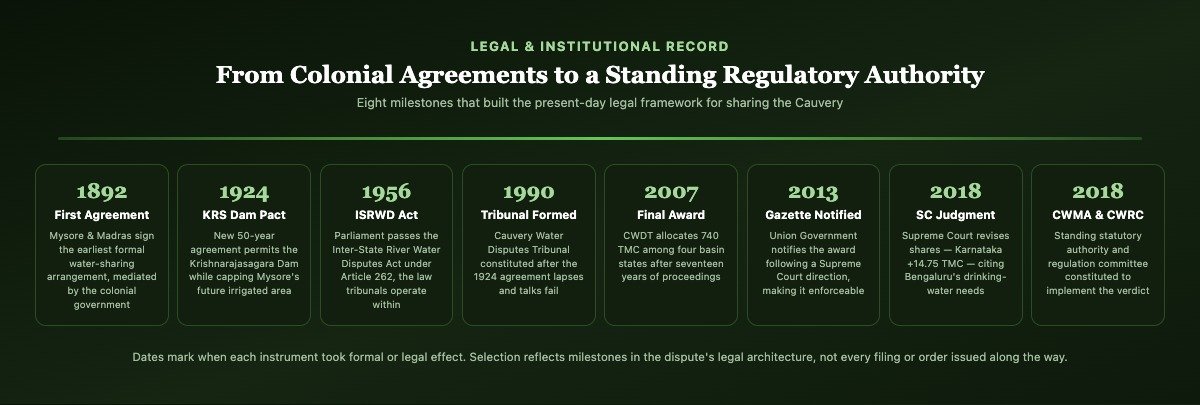
Mysore and Madras Sign the First Formal Water-Sharing Agreement
Historical and political context. In 1892, the princely state of Mysore and the neighbouring Madras Presidency, then both under British paramountcy, signed an agreement regulating new irrigation works on the Cauvery and its tributaries. Because Madras was a British-administered province and Mysore a princely state under indirect rule, the agreement was negotiated with the Government of India acting as an involved intermediary rather than a neutral outside party.
What it established. The agreement required Mysore to obtain Madras’s concurrence before constructing significant new irrigation works that could affect downstream flow, while recognising Madras’s existing irrigation as a protected baseline. It set no fixed volumetric shares of the kind later tribunals would use; it worked instead through a consent mechanism for new construction.
Current relevance. The 1892 agreement is frequently cited in later legal arguments as the earliest documented recognition that Cauvery water-sharing required inter-territorial consent — a principle that, in modified form, still runs through the dispute today.
A New Agreement Clears the Way for the Krishnarajasagara Dam
Historical and political context. By the early 1920s, Mysore wanted to build a major new dam at Kannambadi to store Cauvery water for irrigation and, notably, for one of India’s earliest large hydroelectric schemes. Madras, protective of its delta irrigation, negotiated hard over the terms. The resulting 1924 agreement permitted construction of the Krishnarajasagara (KRS) Dam while capping how much additional area Mysore could irrigate from it and guaranteeing a specified flow to Madras.
Legal development. Critically, the 1924 agreement carried an explicit 50-year validity term — a detail that would not matter for decades but would become the single most consequential clause in the entire dispute once that half-century expired.
Current relevance. The KRS Dam, completed in 1932, remains one of Karnataka’s principal Cauvery reservoirs today. The 1924 agreement’s asymmetric caps on Mysore’s future irrigation expansion became Karnataka’s central historical grievance in every subsequent negotiation and tribunal hearing.
Independence Changes the Parties, Not the Agreement
Context. Indian independence in 1947 and the subsequent integration of princely states into the Union did not automatically void agreements like that of 1924; under the doctrine of state succession generally applied at the time, the new government of Mysore state inherited the obligations and entitlements the princely state had negotiated.
Why it mattered later. This continuity is why the 1924 agreement remained legally live and its 50-year clock kept running through independence, rather than lapsing automatically when British paramountcy ended. Both successor governments continued to treat it as binding until its term clause took effect in 1974.
State Reorganisation Redraws the Basin’s Political Map
Political context. The States Reorganisation Act, 1956 restructured Indian states along linguistic lines, enlarging Mysore state with additional Kannada-speaking regions (it was renamed Karnataka in 1973) and reshaping the administrative boundaries of the former Madras Presidency into present-day Tamil Nadu, with Kerala emerging as a separate state covering the Malabar coast, including part of the Cauvery’s Wayanad catchment.
Legal development. The same year, Parliament enacted the Inter-State River Water Disputes Act, 1956, under the authority granted by Article 262 of the Constitution. This is the law under which the Cauvery Water Disputes Tribunal would later be constituted, and it remains the statutory foundation for how India adjudicates every inter-state river dispute, not only the Cauvery.
Current relevance. 1956 is therefore a double milestone: it created four basin territories in roughly their present form, and it created the legal instrument that would eventually be used to arbitrate between them.
The 1924 Agreement’s Fifty-Year Term Expires
Legal and political context. The 1924 agreement’s 50-year validity clause lapsed in 1974. With no successor agreement negotiated in advance, Karnataka took the position that the agreement, and the restrictions it placed on Karnataka’s irrigation expansion, no longer applied. Tamil Nadu maintained that the guaranteed flows the agreement protected reflected long-standing rights that predated the agreement itself and should continue regardless.
Hydrological context. Freed from the agreement’s expansion caps, Karnataka accelerated construction of new dams and irrigation projects on the upper Cauvery through the 1970s and 1980s, increasing the volume of water retained upstream in a normal year — a trend Tamil Nadu argued was steadily reducing the flow reaching its delta.
Current relevance. 1974 is the year the modern phase of the dispute effectively began. Every subsequent tribunal proceeding and court case traces its cause of action back to the vacuum this lapse created.
Tamil Nadu Formally Seeks a Tribunal
Context. More than a decade of inter-state negotiations after 1974 failed to produce a new agreement. Water-users’ associations in the Tamil Nadu delta petitioned the courts and government to act, and Tamil Nadu formally pressed the Union Government to constitute a tribunal under the Inter-State River Water Disputes Act, 1956, arguing that bilateral negotiation had been exhausted.
Why negotiation had stalled. Both states faced the same underlying problem from opposite sides: any share Karnataka offered to guarantee downstream, it could not later withdraw from its own irrigation and drinking-water planning, while any volume Tamil Nadu accepted as sufficient, it could not later claim was inadequate. Without an independent adjudicator, neither state could make a binding offer the other would trust.
The Cauvery Water Disputes Tribunal Is Constituted
Legal development. On 2 June 1990, the Union Government constituted the Cauvery Water Disputes Tribunal (CWDT) under the Inter-State River Water Disputes Act, 1956, following directions from the Supreme Court after Tamil Nadu’s formal reference. The Tribunal comprised a sitting or retired Supreme Court or High Court judge as chairman and two additional judicial members, and was mandated to investigate and adjudicate the water-sharing claims of Karnataka, Tamil Nadu, Kerala and Puducherry.
Political context. Constitution of the Tribunal shifted the dispute’s centre of gravity from state legislatures and inter-state council negotiations to a formal judicial process — a shift both states had, by this point, effectively requested, even though neither would find every subsequent ruling to its liking.
An Interim Order Triggers Unrest in Bengaluru
Legal development. While its full adjudication continued, the CWDT issued an interim order on 25 June 1991 directing Karnataka to ensure that 205 TMC of water reached Tamil Nadu annually, pending the final award. The Supreme Court subsequently upheld the interim order after Karnataka challenged it.
Political and social context. The order triggered significant public protest and unrest in parts of Karnataka, including Bengaluru and Mysuru, reflecting how directly water-release orders were felt by farming communities upstream who feared reduced supply for their own irrigation. It was the first clear demonstration that Cauvery rulings would carry immediate, visible political consequences on the ground, not just legal ones on paper.
Current relevance. The 1991 interim order established a pattern — interim relief followed by public reaction — that would recur in 2002, 2016 and subsequent distress years.
The Cauvery River Authority Is Formed to Oversee Implementation
Legal and political development. To manage compliance with the 1991 interim order between tribunal hearings, the Union Government constituted the Cauvery River Authority (CRA) in 1998, chaired by the Prime Minister and including the chief ministers of Karnataka, Tamil Nadu, Kerala and the Chief Administrator of Puducherry as members.
How it functioned, and its limits. The CRA was intended as a political-executive mechanism for cooperative water management, meeting periodically to review storage and release positions. In practice, its recommendations often required state governments’ active cooperation to implement, and it lacked the standing regulatory machinery — daily monitoring, a dedicated secretariat — that the CWMA would later be given. Disagreements at CRA meetings were common, particularly in drought years.
A Severe Drought Produces the Dispute’s First Major Modern Crisis
Hydrological context. The 2002 southwest monsoon was significantly deficient across the Cauvery basin, sharply reducing inflows into Karnataka’s reservoirs at the same time as Tamil Nadu’s delta crops needed water. It was, at the time, one of the most severe distress years the dispute’s post-tribunal framework had faced.
Political context. Karnataka argued its own reservoirs held insufficient water to meet both its own irrigation and drinking-water needs and the 205 TMC interim obligation simultaneously. Tamil Nadu maintained the interim order was binding regardless of Karnataka’s own shortfall. The CRA was unable to broker an agreed release, and the matter went to the Supreme Court, which directed specific release volumes.
Current relevance. The 2002 crisis is widely cited as the clearest early demonstration that a single interim figure, fixed without a formal mechanism for sharing shortfall in a bad year, was not sustainable — a lesson that shaped the distress-sharing provisions eventually built into the 2007 final award.
The Tribunal Delivers Its Final Award After Seventeen Years
Legal development. On 5 February 2007, the CWDT delivered its final award, assessing total normal-year availability in the basin at 740 TMC at 50% dependability, and allocating 419 TMC to Tamil Nadu, 270 TMC to Karnataka, 30 TMC to Kerala and 7 TMC to Puducherry, with a further 10 TMC reserved for environmental protection and 4 TMC allowed for inevitable escapages to the sea.
Political context. All four states filed review petitions against aspects of the award almost immediately — Karnataka seeking a larger share and less stringent monthly release schedules, Tamil Nadu and the other states seeking to protect or increase their allocations — meaning the award, though “final” in name, did not immediately end the legal contest.
Current relevance. The 2007 figures remained the operative baseline, with modification, until the Supreme Court’s 2018 judgment. The monthly release schedule the Tribunal set out is still, in its broad structure, the template CWMA orders follow today.
The Final Award Is Formally Notified — Six Years Later
Legal and political context. Although the Tribunal issued its final award in 2007, the Union Government did not publish it in the official Gazette — the step that makes such an award legally binding and enforceable — until 19 February 2013, following a direct Supreme Court order compelling notification after years of pending review petitions had stalled the process.
Why the delay mattered. Until notification, the award existed as a Tribunal ruling without the full force of an enforceable government order, leaving both the 1991 interim figures and the unimplemented 2007 award in an ambiguous middle state for six years.
Current relevance. The 2013 gazette notification is the formal legal starting point from which the 2007 award’s enforceability, and the countdown to the Supreme Court’s own 2018 review of it, is measured.
A Drought-Year Release Order Leads to Serious Unrest
Hydrological context. The 2016 southwest monsoon was deficient across the basin, leaving Karnataka’s reservoirs well below normal storage at a point in the year when Tamil Nadu’s delta crops still needed water.
Legal development. In September 2016, the Supreme Court, hearing Tamil Nadu’s plea, initially directed Karnataka to release 15,000 cusecs of water daily; it subsequently modified this to 12,000 cusecs daily until 20 September after Karnataka argued the original figure was unsustainable given its own storage position.
Public response. The order was followed by serious unrest in Bengaluru, including vehicle burning and vandalism, resulting in one death and injuries, prompting a large police deployment and emergency restrictions on public gatherings; there were also reports of retaliatory incidents affecting Kannadiga residents and businesses in parts of Tamil Nadu. This remains the most serious instance of public disorder directly linked to a Cauvery ruling.
The Supreme Court Modifies the Tribunal’s Award
Legal development. Ruling on cross-appeals against the 2007 award, the Supreme Court delivered its judgment on 16 February 2018, revising the allocations to 404.25 TMC for Tamil Nadu (down from 419) and 284.75 TMC for Karnataka (up from 270), while leaving Kerala’s 30 TMC and Puducherry’s 7 TMC unchanged, within the same 740 TMC normal-year total.
Scientific and legal reasoning, as stated in the judgment. The Court’s stated reasoning combined two factors: it recognised approximately 10 TMC of additional groundwater availability in Tamil Nadu that the Tribunal had not fully accounted for, treating surface and groundwater as connected parts of the same water balance, and it allowed Karnataka an additional 4.75 TMC for drinking and domestic use, explicitly citing Bengaluru’s growth and drinking-water needs as a legitimate, non-irrigation claim on the river.
Current relevance. The Court also directed the Union Government to frame a scheme for implementing the revised award within a set period, which led directly to the creation of the CWMA a few months later. The judgment was stated to apply for a period of 15 years from its date, i.e., broadly through 2033, subject to review.
The CWMA and CWRC Are Constituted
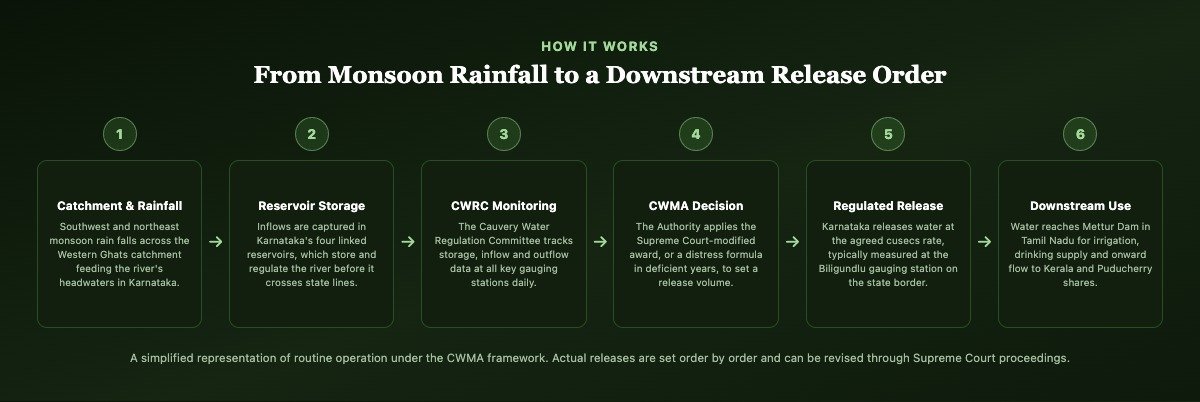
Legal and administrative development. On 1 June 2018, the Union Government notified the Cauvery Water Management Scheme, constituting the Cauvery Water Management Authority (CWMA) and the Cauvery Water Regulation Committee (CWRC) under Section 6A of the Inter-State River Water Disputes Act, 1956, to give effect to the Supreme Court’s modified award. Both bodies are headquartered in New Delhi and function under the Union Ministry of Jal Shakti.
How the two bodies divide responsibility. The CWMA is a statutory, quasi-judicial authority with representation from all four basin states plus central government nominees, responsible for overseeing compliance with the award, approving annual and monthly release schedules, and adjudicating implementation disputes between states in the first instance. The CWRC, a technical sub-body reporting to the CWMA, monitors day-to-day reservoir storage, inflow and outflow data and makes operational recommendations that the CWMA then reviews and approves.
Current relevance. This two-tier structure replaced the more informal, politically-chaired Cauvery River Authority, and is the institutional framework still governing every water-release decision described later in this timeline.
Seven Years of Implementation, Tested by Uneven Monsoons
Institutional development. Between 2019 and 2025, the CWMA held regular meetings — typically several times a year, more frequently during the monsoon and post-monsoon release-planning periods — reviewing storage positions and approving or revising release schedules under its standing procedure. The CWRC’s monitoring reports from this period form the ongoing technical record the CWMA’s decisions rely on.
Hydrological context. The basin experienced a mix of adequate and deficient monsoon years across this period. Years with a weaker southwest monsoon, most visibly 2023, produced familiar friction: Karnataka citing insufficient storage for its own drinking-water and irrigation needs, Tamil Nadu citing its statutory entitlement, and the CWMA working, sometimes contentiously, to apply an equitable distress apportionment rather than a fixed formula in the absence of one both states have agreed to in advance.
Current relevance. This period established the CWMA as the routine forum for these disputes, with the Supreme Court remaining available, and occasionally used, as a last-resort venue for either state when it disputed a CWMA or CWRC decision.
The Mekedatu Project Remains Contested as the Centre States Consent Is Not Mandatory
Government notification, as reported. In late July 2026, the Union Minister of State for Jal Shakti told the Rajya Sabha that the Supreme Court’s 2018 Cauvery judgment does not require Karnataka to obtain Tamil Nadu’s consent to proceed with the proposed Mekedatu multi-purpose project, a reservoir proposed across the Cauvery with a gross storage of roughly 67 TMC and an associated 400 MW hydropower component, estimated at approximately Rs 5,912 crore.
Independent context. Tamil Nadu has consistently opposed Mekedatu, arguing it could allow Karnataka to regulate flows in ways that affect downstream availability beyond what the 2018 award anticipated; Karnataka has maintained the project is intended for drinking-water augmentation and flow regulation within its allocated share, not to increase its entitlement. The project’s detailed project report has been before the Central Water Commission, and the matter remains before the Supreme Court, which has at various points granted Tamil Nadu time to respond to Karnataka’s submissions; the CWMA has also, at points, deferred substantive discussion of the project at Tamil Nadu’s request.
Current relevance. Mekedatu illustrates a distinction worth holding onto: the 2018 judgment settled annual water shares, but it did not pre-approve every future piece of infrastructure either state might propose within its own share — those remain separate approval and, where contested, judicial processes.
A Deficient Monsoon Tests the Framework in Real Time
Hydrological context, as reported. The 2026 southwest monsoon has been deficient over parts of the Cauvery basin, reducing storage across Karnataka’s reservoir system relative to the seasonal norm. In response, the CWRC recommended, and the CWMA endorsed, a release of 3,500 cusecs from Karnataka to Tamil Nadu for a 15-day period (29 July to 12 August 2026), amounting to approximately 4.5 TMC — a distress-year figure well below the Tribunal’s normal-year monthly schedule.
Rapid change, as reported. Conditions shifted within days: heavy rainfall over Kerala’s Wayanad district on 1 August 2026 sharply increased inflows into the Kabini reservoir, prompting Karnataka to release approximately 25,000 cusecs into the Cauvery system that day — a reminder of how quickly reservoir positions in this basin can move with a single significant rainfall event.
Political and institutional response. Karnataka’s Chief Minister called an all-party meeting for 2 August 2026 to discuss the state’s approach to further Cauvery releases to Tamil Nadu, consistent with the pattern, visible throughout this timeline, of release decisions in deficient years drawing direct, cross-party political attention within the releasing state.
⚖️ Law Insight
The Tribunal’s award and the Supreme Court’s judgment together define the present legal framework. Neither stands alone: the 2007 award set the original allocation and monthly schedule, and the 2018 judgment amended specific figures within that same structure rather than replacing it outright. Reading either document without the other gives an incomplete, and in places materially incorrect, picture of the current legal entitlements.
A Hydrological and Legal Glossary
The terms this dispute cannot be explained without
- River Basin
- The total land area that drains into a river and its tributaries; for the Cauvery, this covers 81,155 sq km across four states and territories.
- Catchment
- Used interchangeably with basin in most Indian water documents; the area whose rainfall contributes runoff to a given river or reservoir.
- Reservoir
- An artificial lake formed behind a dam, used to store monsoon inflow so it can be released steadily through drier months rather than lost as immediate runoff.
- TMC (Thousand Million Cubic Feet)
- The standard volumetric unit for Indian inter-state river allocations, equal to one billion cubic feet, or roughly 28.3 million cubic metres.
- Cusec
- Cubic feet per second — the unit used for real-time release rates, as distinct from TMC, which measures cumulative volume over a period.
- Distress-Sharing
- The principle that when actual water availability falls below the normal-year assessment, the shortfall is apportioned between states rather than one state’s share being protected in full at another’s expense.
- Southwest Monsoon
- The June-to-September rainy season that supplies the large majority of the Cauvery basin’s annual inflow, driven by moisture-laden winds off the Arabian Sea striking the Western Ghats.
- Northeast Monsoon
- The October-to-December rainy season, comparatively more significant for Tamil Nadu’s portion of the basin, which can offset an earlier southwest-monsoon shortfall.
- Inter-State River Water Disputes Act, 1956
- The central law, enacted under Article 262, that authorises the Union Government to constitute tribunals to adjudicate water disputes between states.
- Article 262
- The constitutional provision empowering Parliament to legislate for adjudication of inter-state river water disputes and, if it so provides, to bar the Supreme Court’s original jurisdiction over such disputes.
- CWMA
- Cauvery Water Management Authority — the statutory body implementing the Supreme Court-modified award since June 2018.
- CWRC
- Cauvery Water Regulation Committee — the technical committee under the CWMA that monitors storage and flow data and recommends release schedules.
- Water Allocation
- The specific annual volume, in TMC, that a tribunal or court assigns to each riparian state out of the total assessed availability.
- Riparian State
- A state or territory through which a river flows or that shares its drainage basin, and which therefore holds a recognised legal interest in its waters.
The Legal Framework: How India Adjudicates a River Dispute
From constitutional provision to daily reservoir orders
India’s Constitution places water primarily within the legislative competence of individual states, but it makes one deliberate exception for exactly this situation. Article 262 empowers Parliament to provide, by law, for the adjudication of disputes over the use, distribution or control of inter-state river waters, and further allows Parliament to exclude such disputes from the Supreme Court’s ordinary original jurisdiction where a tribunal has been constituted — a structural choice to route these conflicts through specialised adjudication rather than general litigation.
Parliament exercised that power through the Inter-State River Water Disputes Act, 1956, which sets out how a tribunal is constituted (on a state government’s request, once the Union Government is satisfied the dispute cannot be settled by negotiation), who may serve on it (sitting or retired judges of the Supreme Court or a High Court), and how its award, once gazetted, becomes binding and enforceable as if it were an order of the Supreme Court. The Cauvery Water Disputes Tribunal was constituted under this Act, as have tribunals for the Krishna, Godavari, Narmada, Ravi-Beas and other inter-state basins.
The Tribunal Process
A tribunal under the 1956 Act functions much like a specialised court: it hears evidence and arguments from every party state, commissions or reviews hydrological and agricultural data, and issues a reasoned award. States may seek clarification or, in practice, effectively re-litigate specific findings through review petitions, which is precisely what stretched the Cauvery Tribunal’s proceedings from its 1990 constitution to its 2007 final award, and further delayed the award’s Gazette notification until 2013.
The Supreme Court’s Role
Although the 1956 Act limits the Supreme Court’s original jurisdiction once a tribunal is seized of a dispute, the Court retains appellate and supervisory authority, which is the basis on which it heard cross-appeals against the CWDT’s 2007 award and delivered its own modifying judgment in 2018. The Court has also, at multiple points across this timeline — 1991, 2002, 2016 and in ongoing Mekedatu proceedings — exercised its jurisdiction to hear urgent applications for interim relief between full reviews, functioning as the dispute’s ultimate arbiter when the CWMA process itself is disputed by a state.
How the 2018 Judgment Is Implemented
The Supreme Court did not leave implementation to informal cooperation. It directed the Union Government to frame a scheme, which produced the Cauvery Water Management Scheme, 2018, notified on 1 June 2018 under Section 6A of the Act. That scheme created the CWMA as the body responsible for ensuring the modified award’s implementation, giving it powers to approve release schedules, resolve implementation disputes between states, and refer unresolved matters upward. The CWRC operates beneath the CWMA specifically to keep that decision-making grounded in current data rather than the previous year’s assumptions.
📊 Policy Insight
Long-term cooperation depends on data sharing, reservoir coordination, efficient irrigation and adaptive water management. The CWMA/CWRC structure exists precisely because a fixed annual number, decided once, cannot on its own manage a river whose actual flow varies by season and by year. Its effectiveness in any given year still depends on both states accepting its data and its process, which is a governance challenge as much as a hydrological one.
The Science: Why the Same River Behaves Differently Every Year
Rainfall, reservoirs and the physical limits of any allocation formula
A water-sharing figure fixed in a legal document describes a normal year. The Cauvery, like every monsoon-fed river, rarely produces exactly a normal year. Understanding why requires separating several distinct scientific factors that are often collapsed into a single vague idea of “drought.”
Rainfall Variability and River Flow
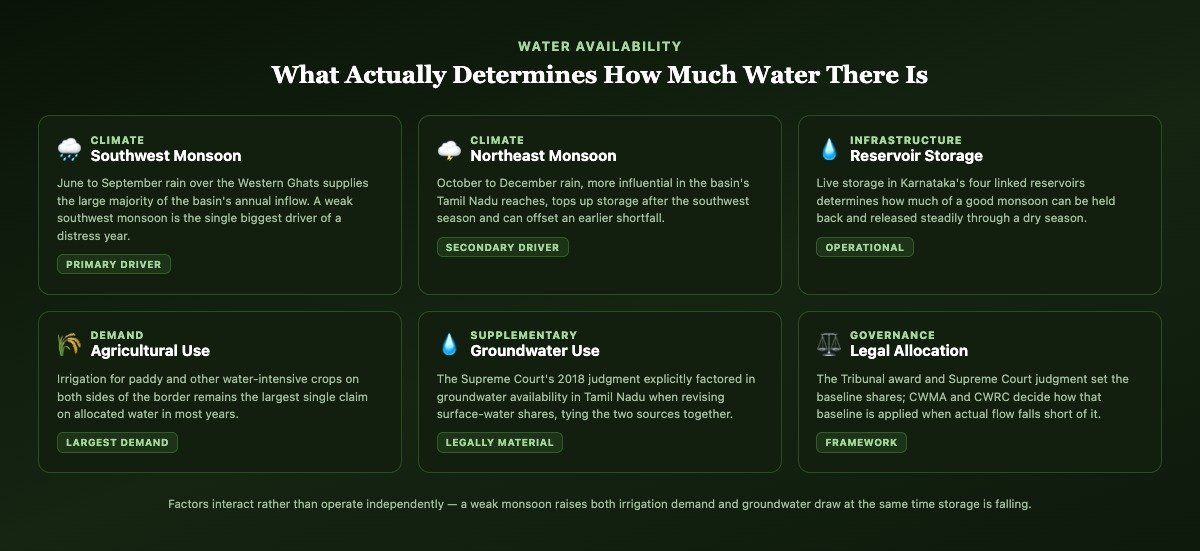
The Cauvery basin receives the large majority of its annual inflow from the southwest monsoon, when moisture-bearing winds off the Arabian Sea strike the Western Ghats and produce heavy orographic rainfall across the river’s upper catchment in Kodagu and neighbouring districts. A smaller but still meaningful contribution comes from the northeast monsoon later in the year, more influential in the basin’s Tamil Nadu reaches. Because both rely on winds and sea-surface conditions that vary naturally year to year, no two monsoon seasons deliver identical rainfall, and the resulting river flow varies accordingly — sometimes substantially, even between consecutive years.
Reservoir Operation as a Buffer, Not a Solution
Reservoirs exist to convert an uneven, seasonal rainfall pattern into a more even, year-round water supply, by storing surplus inflow when it arrives and releasing it gradually. But a reservoir can only buffer variability within the limits of its storage capacity: if a deficient monsoon fails to fill it in the first place, there is no stored surplus left to draw on later in the dry season, regardless of what an allocation schedule specifies on paper. This is the physical reality behind every “distress year” dispute in this timeline — the states are not disagreeing about arithmetic so much as about how to divide a shortfall that the reservoirs themselves cannot make up.
Climate Variability and El Niño
Year-to-year monsoon strength is influenced by large-scale climate patterns, most notably the El Niño-Southern Oscillation. El Niño years — when the central and eastern Pacific Ocean warms above average — have historically been associated with a weaker Indian southwest monsoon in aggregate, though the relationship is statistical and not a guarantee for any single basin in any single year; India Meteorological Department seasonal forecasts incorporate this and other climate signals, alongside considerable acknowledged uncertainty, months ahead of the monsoon’s actual onset.
Agricultural Demand and Groundwater Dependence
Demand does not stay fixed while supply varies. Paddy cultivation, the dominant crop across much of the irrigated Cauvery command area, is comparatively water-intensive, and cropping calendars on both sides of the border are built around expected release schedules. When surface releases fall short, farmers frequently increase groundwater extraction to compensate — which is precisely the dynamic the Supreme Court addressed directly in 2018 by factoring Tamil Nadu’s groundwater availability into its revised surface-water allocation, treating the two sources as connected rather than independent.
Water-Use Efficiency
Independent of any legal share, how efficiently water is actually used once released affects how far it goes. Losses in unlined canals, over-irrigation relative to actual crop water requirement, and the choice of crop itself (paddy against less water-intensive alternatives) all affect the practical adequacy of a given TMC allocation. Efficiency improvements do not change the legal shares, but they materially affect how much distress a given shortfall actually causes on the ground — a point increasingly raised in policy discussion around the dispute’s long-term management.
🔬 Science Insight
River flows vary significantly depending on seasonal rainfall, making water management especially challenging during deficit monsoon years. No amount of legal precision in an allocation document changes the physical volume of water a below-average monsoon actually delivers — which is why the CWMA’s distress-year decisions are, in practice, exercises in apportioning a shortfall rather than in enforcing a fixed number regardless of conditions.
Five Things Worth Understanding in More Depth
Evergreen explainers that answer the questions behind the headlines
What Is a TMC of Water?
A Thousand Million Cubic Feet (TMC) is the standard unit Indian inter-state river tribunals use to describe annual water allocations — equal to one billion cubic feet, or approximately 28.3 million cubic metres, or roughly 28,317 million litres. To put the Cauvery’s 740 TMC normal-year assessment in perspective, that volume is large enough to cover an area the size of a small state to a depth of several centimetres. TMC measures cumulative volume over a period, typically a year or a month; it is distinct from a cusec (cubic feet per second), which measures an instantaneous release rate and is the unit used in day-to-day CWMA and CWRC release orders.
How the Cauvery Basin Works
Rain falling on the Western Ghats in Karnataka’s Kodagu district collects into small streams that converge into the Cauvery near Talakaveri. As the river flows southeast, it is joined by tributaries — the Hemavathi, Kabini, Bhavani, Noyyal and Amaravati among them — each draining its own sub-catchment across Karnataka, Kerala and Tamil Nadu. Karnataka’s four major reservoirs (KRS, Kabini, Hemavathi and Harangi) capture and regulate flow before the river crosses into Tamil Nadu, where it is measured at the Biligundlu gauging station, then stored again at Mettur before being distributed across the delta irrigation system that has operated, in some form, for close to two thousand years.
Why Distress Sharing Matters
The Tribunal award and Supreme Court judgment describe shares for a normal year assessed at 740 TMC. Real years are frequently not normal. Distress-sharing is the unresolved practical question of how a shortfall below that baseline should be divided — proportionally to each state’s normal share, or by some other equitable method accounting for each state’s minimum drinking-water and essential-irrigation needs. Despite repeated attempts, no single fixed distress formula has been permanently agreed by all parties; in practice, the CWMA applies what has been described in official and legal commentary as an equitable apportionment, decided having regard to ground realities each time a deficient year occurs, rather than a mechanical pro-rata calculation.
CWMA vs CWRC: What Is the Difference?
The two bodies are frequently confused because they were created on the same day and work together closely. The CWMA is the senior statutory authority: it approves annual and monthly release schedules, resolves disputes between states over implementation, and is the body whose decisions can ultimately be challenged in the Supreme Court. The CWRC is its technical monitoring arm: it collects and reports reservoir storage, inflow, outflow and rainfall data, and recommends specific release volumes for the CWMA to consider and approve. In short, the CWRC supplies the data and the technical recommendation; the CWMA makes the binding decision.
How Reservoir Operations Affect Downstream States
Because Karnataka’s major reservoirs sit upstream of the state border, how they are operated — when water is stored, when it is released, and at what rate — directly determines what reaches Tamil Nadu, regardless of how much rain fell in a given month. This is why the CWRC’s gauge-station data, particularly at Biligundlu, is central to nearly every implementation dispute: it is the point at which “how much water was released” becomes a verifiable, shared fact rather than a claim by either side.
Comparison Tables: The Dispute Side by Side
Nine reference tables covering agreements, institutions, hydrology and allocation
1892 Agreement vs 1924 Agreement
| Aspect | 1892 Agreement | 1924 Agreement |
|---|---|---|
| Parties | Mysore & Madras Presidency | Mysore & Madras Presidency |
| Core mechanism | Consent required for new irrigation works affecting downstream flow | Fixed guaranteed flow to Madras; capped Mysore’s future irrigated area |
| Trigger | General regulation of new construction | Enabled construction of the Krishnarajasagara Dam |
| Validity term | No fixed expiry specified | 50 years |
| Outcome | Superseded in practice by the 1924 agreement | Lapsed in 1974, directly triggering the modern dispute |
Tribunal Award (2007) vs Supreme Court Judgment (2018)
| Aspect | CWDT Final Award, 2007 | Supreme Court Judgment, 2018 |
|---|---|---|
| Tamil Nadu share | 419 TMC | 404.25 TMC |
| Karnataka share | 270 TMC | 284.75 TMC |
| Kerala share | 30 TMC | 30 TMC (unchanged) |
| Puducherry share | 7 TMC | 7 TMC (unchanged) |
| Basis for change | 17 years of tribunal hearings and evidence | ~10 TMC Tamil Nadu groundwater recognised; 4.75 TMC added for Karnataka’s drinking-water/Bengaluru needs |
| Implementation body directed | None specified beyond the Cauvery River Authority then in place | Directed creation of a new statutory scheme — the CWMA/CWRC |
| Status today | Superseded on the two revised figures; other terms remain operative | Currently governing judgment, stated to apply for 15 years from 2018 |
Legal Institutions Involved: Roles at a Glance
| Institution | Type | Role | Status |
|---|---|---|---|
| Cauvery Water Disputes Tribunal (CWDT) | Ad hoc judicial tribunal | Adjudicated the original dispute, 1990–2007 | Dissolved after final award; its award remains legally operative |
| Supreme Court of India | Constitutional court | Appellate review of the award; hears urgent inter-state applications | Ongoing supervisory jurisdiction |
| Cauvery Water Management Authority (CWMA) | Statutory, quasi-judicial authority | Approves release schedules; resolves implementation disputes | Active since June 2018 |
| Cauvery Water Regulation Committee (CWRC) | Technical committee under CWMA | Monitors storage/flow data; recommends releases | Active since June 2018 |
| Ministry of Jal Shakti | Union government ministry | Administers the CWMA/CWRC; issues notifications | Ongoing |
Southwest Monsoon vs Northeast Monsoon
| Aspect | Southwest Monsoon | Northeast Monsoon |
|---|---|---|
| Typical period | June to September | October to December |
| Moisture source | Arabian Sea winds striking the Western Ghats | Bay of Bengal winds affecting southeastern India |
| Share of basin inflow | Large majority of annual Cauvery inflow | Smaller but meaningful supplementary contribution |
| Most affected part of basin | Karnataka’s upper catchment and reservoirs | Tamil Nadu’s lower basin and delta |
| Dispute relevance | A weak season is the leading cause of distress years | Can partially offset an earlier southwest shortfall |
Normal Year vs Distress Year
| Aspect | Normal Year | Distress Year |
|---|---|---|
| Reference availability | 740 TMC at 50% dependability | Actual inflow below assessed normal availability |
| Governing rule | Fixed monthly release schedule from the award | Equitable apportionment of the shortfall, case by case |
| Typical trigger | Adequate southwest and northeast monsoon | Deficient southwest monsoon, e.g. 1991, 2002, 2016, 2023, 2026 |
| Decision-making body | CWMA applies the standard schedule | CWMA/CWRC recommend a revised figure; Supreme Court may intervene |
| Public visibility | Routine, low public attention | High public attention; history of protest in acute cases (1991, 2016) |
Annual Water Allocation Summary (Normal Year, 740 TMC)
| Recipient | Share (TMC) | Approximate % | Primary Use |
|---|---|---|---|
| Tamil Nadu | 404.25 | 54.6% | Delta irrigation, drinking water |
| Karnataka | 284.75 | 38.5% | Upstream irrigation, Bengaluru drinking water |
| Kerala | 30 | 4.1% | Wayanad catchment irrigation & use |
| Puducherry (Karaikal) | 7 | 0.9% | Delta-area irrigation |
| Environmental protection | 10 | 1.4% | Riverine and estuarine ecology |
| Escapages to the sea | ~4 (variable) | 0.5% | Unavoidable outflow, delta salinity control |
Major Reservoirs and Dams
| Reservoir | State | River | Approx. Full Capacity | Primary Purpose |
|---|---|---|---|---|
| Krishnarajasagara (KRS) | Karnataka | Cauvery (main stem) | ~49.5 TMC | Irrigation, drinking water, hydropower |
| Kabini | Karnataka | Kabini (tributary) | ~19.5 TMC | Irrigation, flow regulation |
| Hemavathi | Karnataka | Hemavathi (tributary) | ~37.1 TMC | Irrigation, drinking water |
| Harangi | Karnataka | Harangi (tributary) | ~8.5 TMC | Irrigation |
| Mettur (Stanley Reservoir) | Tamil Nadu | Cauvery (main stem) | ~93.5 TMC | Delta irrigation, hydropower (250 MW) |
Rainfall Pattern vs River Flow Impact (Illustrative)
| Monsoon Condition | Typical Basin Rainfall | Effect on River Flow | Effect on Allocation Process |
|---|---|---|---|
| Above normal | >110% of long-period average | Reservoirs fill early; surplus flow to the sea | Standard schedule followed; low dispute risk |
| Normal | 96–104% of long-period average | Reservoirs fill close to design capacity | Standard monthly schedule applies without modification |
| Below normal | 90–95% of long-period average | Partial storage shortfall by season end | CWRC monitoring intensifies; minor schedule adjustments possible |
| Deficient | <90% of long-period average | Significant storage shortfall | Distress apportionment invoked; heightened political and legal attention |
Timeline Summary
| Year | Event | Importance |
|---|---|---|
| 1892 | First Mysore–Madras water agreement | Earliest documented framework for sharing the river |
| 1924 | Second agreement enables KRS Dam | Sets the 50-year clause that later triggers renewed dispute |
| 1956 | States Reorganisation Act & ISRWD Act | Creates modern basin states and the tribunal law itself |
| 1974 | 1924 agreement lapses | Legal trigger for the modern phase of the dispute |
| 1990 | CWDT constituted | Dispute formally enters judicial adjudication |
| 1991 | Interim order; Bengaluru unrest | First binding release figure; first major public reaction |
| 1998 | Cauvery River Authority formed | First standing implementation mechanism |
| 2002 | Severe drought crisis | Exposes the need for a distress-year rule |
| 2007 | CWDT final award | Sets the 740 TMC baseline allocation |
| 2013 | Award gazetted | Award becomes legally enforceable |
| 2016 | Court-ordered release; serious unrest | Most severe public disorder linked to a ruling |
| 2018 (Feb) | Supreme Court modifies award | Sets the currently governing TMC shares |
| 2018 (Jun) | CWMA & CWRC constituted | Creates the standing implementation framework used today |
| 2019–25 | Ongoing implementation | Framework tested across both adequate and deficient years |
| 2026 | Deficient monsoon; Mekedatu debate continues | Shows the framework operating in real time |
Who’s Who: The Institutions Behind This Dispute
The organisations named throughout this guide, in one place
Cauvery Water Management Authority (CWMA)
The standing body implementing the Supreme Court’s 2018 judgment since 1 June 2018, headquartered in New Delhi under the Ministry of Jal Shakti.
Cauvery Water Regulation Committee (CWRC)
Monitors reservoir storage, inflow and outflow data and recommends release schedules to the CWMA.
Supreme Court of India
Delivered the 2018 modifying judgment; retains ongoing appellate and supervisory jurisdiction over the dispute.
Ministry of Jal Shakti
The central government ministry responsible for water resources, under which the CWMA and CWRC function.
Press Information Bureau (PIB)
The official channel for government notifications and statements relating to Cauvery Water Management Scheme developments.
India Meteorological Department (IMD)
Issues seasonal monsoon forecasts and rainfall data that directly inform CWRC and CWMA distress-year assessments.
Karnataka
Upstream state controlling the majority of the river’s reservoirs and upper catchment; allocated 284.75 TMC.
Tamil Nadu
Downstream state with the largest allocation, 404.25 TMC, and the oldest continuously irrigated delta command area.
Kerala
Smaller riparian state whose Wayanad district contains part of the Cauvery’s tributary catchment; allocated 30 TMC.
Puducherry
Its Karaikal region lies in the delta near where the river meets the sea; allocated 7 TMC.
Myth vs Fact
Common misconceptions, checked against the official record
✓ Verified Facts
- The current legally binding shares come from the 2018 Supreme Court judgment, which modified — not replaced — the 2007 Tribunal award.
- The CWMA and CWRC, not the older Cauvery River Authority, have managed implementation since June 2018.
- The Supreme Court’s 2018 revision explicitly considered groundwater availability in Tamil Nadu alongside surface-water shares.
- Distress-year decisions are made case by case; no single fixed pro-rata formula has been permanently adopted.
- The 2018 judgment is stated to apply for 15 years from its date, with review possible thereafter.
✗ Common Myths
- Myth: “The dispute was settled once and for all in 2018.” Fact: The judgment fixed the legal shares; annual implementation, especially in deficient years, remains an active, recurring process.
- Myth: “One state simply refuses to release water it owes.” Fact: Most disputes concern how much water actually exists to release in a given month, not a refusal to comply with a clear obligation.
- Myth: “The Cauvery River Authority still manages releases.” Fact: It was superseded by the CWMA and CWRC in 2018.
- Myth: “A single fixed formula exists for sharing shortfalls in bad years.” Fact: No such standing formula has been permanently agreed; each distress year is assessed individually.
- Myth: “The dispute is a purely modern political conflict.” Fact: Its legal roots trace to 1892, predating independence by over half a century.
💡 Interesting Facts
- The Grand Anicut (Kallanai) across the Cauvery delta, built roughly 1,800 years ago, is still functioning today, making it one of the oldest water-diversion structures in continuous use anywhere in the world.
- The Cauvery is known by different names along different stretches and distributaries, including the Kollidam in part of its delta channel in Tamil Nadu.
- The Kabini, one of the Cauvery’s main tributaries, itself originates in Kerala’s Wayanad district before flowing into Karnataka and joining the main river.
- The Tribunal’s proceedings, from constitution to final award, ran for seventeen years — longer than many of the irrigation projects it ultimately ruled on took to build.
- The 2018 Supreme Court judgment’s 14.75 TMC shift between states is a small fraction — under 2% — of the total 740 TMC normal-year assessment, despite the scale of public attention it received.
👀 Future Watch
What to monitor going forward, from official sources only: further CWMA meeting outcomes on 2026 monsoon-season releases; any Supreme Court order in the ongoing Mekedatu proceedings; Ministry of Jal Shakti notifications on scheme implementation; updated CWRC reservoir data as the 2026 southwest and northeast monsoons progress; and any scientific water-management initiatives, such as efficiency or data-sharing improvements, that the CWMA formally adopts. This section deliberately excludes political speculation or predictions about election outcomes; it tracks only documented institutional developments.
Explore More Timelines
People Also Ask
Frequently Asked Questions
90 questions on the history, law, hydrology and current status of the Cauvery dispute
Why the Cauvery River Requires Cooperation More Than Conflict
Return to the two farmers from the opening — one near Mandya, one near Thanjavur, both watching the same monsoon sky from four hundred kilometres apart. Nothing in this guide changes what either of them is waiting for. The river will do, this year as every year, whatever the southwest and northeast monsoons allow it to do, and the water that reaches each of their fields will still depend on rainfall neither government controls, reservoirs both governments must manage, and a legal framework built, argument by argument, agreement by agreement, ruling by ruling, over more than 130 years.
What that history actually shows, read in full rather than in headlines, is not a story of one state’s obstinacy against another’s reasonable claim. It is the record of two — eventually four — governments repeatedly discovering that a shared, variable river cannot be managed by unilateral decision, and building, slowly and imperfectly, the institutions to manage it jointly instead: an 1892 consent mechanism, a 1924 volumetric agreement, a tribunal empowered by Article 262, a Supreme Court willing to revisit its own tribunal’s arithmetic when new evidence on groundwater and drinking water warranted it, and finally a standing regulatory authority designed to keep working through good years and bad without needing a fresh crisis to prompt each decision.
That framework is not, and was never going to be, a machine that removes disagreement. The 2018 judgment settled specific numbers; it did not settle how much rain will fall in any given July, and it did not resolve every future question about new infrastructure, as the still-unresolved Mekedatu debate makes clear. What it did was replace ad hoc confrontation with a standing, data-driven, judicially supervised process — one that, as this guide’s final timeline entries show, was actively adjusting a distress-year release order and responding to a sudden reservoir inflow surge in the very days this page was last checked. Sustainable water-sharing across the Cauvery basin depends on exactly what has slowly been built here: transparent reservoir and rainfall data, coordinated operation of Karnataka’s and Tamil Nadu’s reservoirs rather than unilateral decisions, continued gains in irrigation efficiency, honest acknowledgement of rainfall variability that no legal document can override, and sustained legal compliance by every basin state, even in the years when compliance is genuinely difficult. For the most accurate and current understanding of any specific development, consult the Supreme Court’s own judgments, official CWMA and CWRC orders, and Ministry of Jal Shakti and Press Information Bureau notifications directly — not summaries, including this one, standing alone.
Related Reading on AiTimeline
Sources & further reading
Every dated entry above was checked against these references. Last reviewed 15 September 2026.